
I do not see search demand disappearing. I see it moving. In this analysis, 29% of high-volume search demand is declining, while nearly the same amount is growing somewhere else. Overall demand is essentially flat because people are redistributing how and where they search instead of abandoning search altogether.
That changes how I think about SEO strategy. I would not start by panicking over shrinking keywords. I would start by identifying which queries are losing volume, which ones are gaining momentum, and where a brand can build enough authority to appear in both traditional search results and AI-generated answers.
This study looks at where search demand is shifting, which industries are seeing the sharpest changes, and what those patterns mean for SEO teams trying to adapt to AI-driven discovery.
How I studied AI’s impact on search
In 2024, Gartner predicted that traditional search engine volume would fall 25% by 2026 as consumers shifted to AI chatbots and virtual agents. Fractl and Search Engine Land set out to test that prediction. (Disclosure: I’m the co-founder of Fractl.)
I worked from Semrush data covering 1,010,848 high-volume keywords, each with at least 10,000 monthly searches, across 379 brands in eight verticals. I also looked at survey responses from 1,004 U.S. consumers to better understand how AI is changing the way people search.
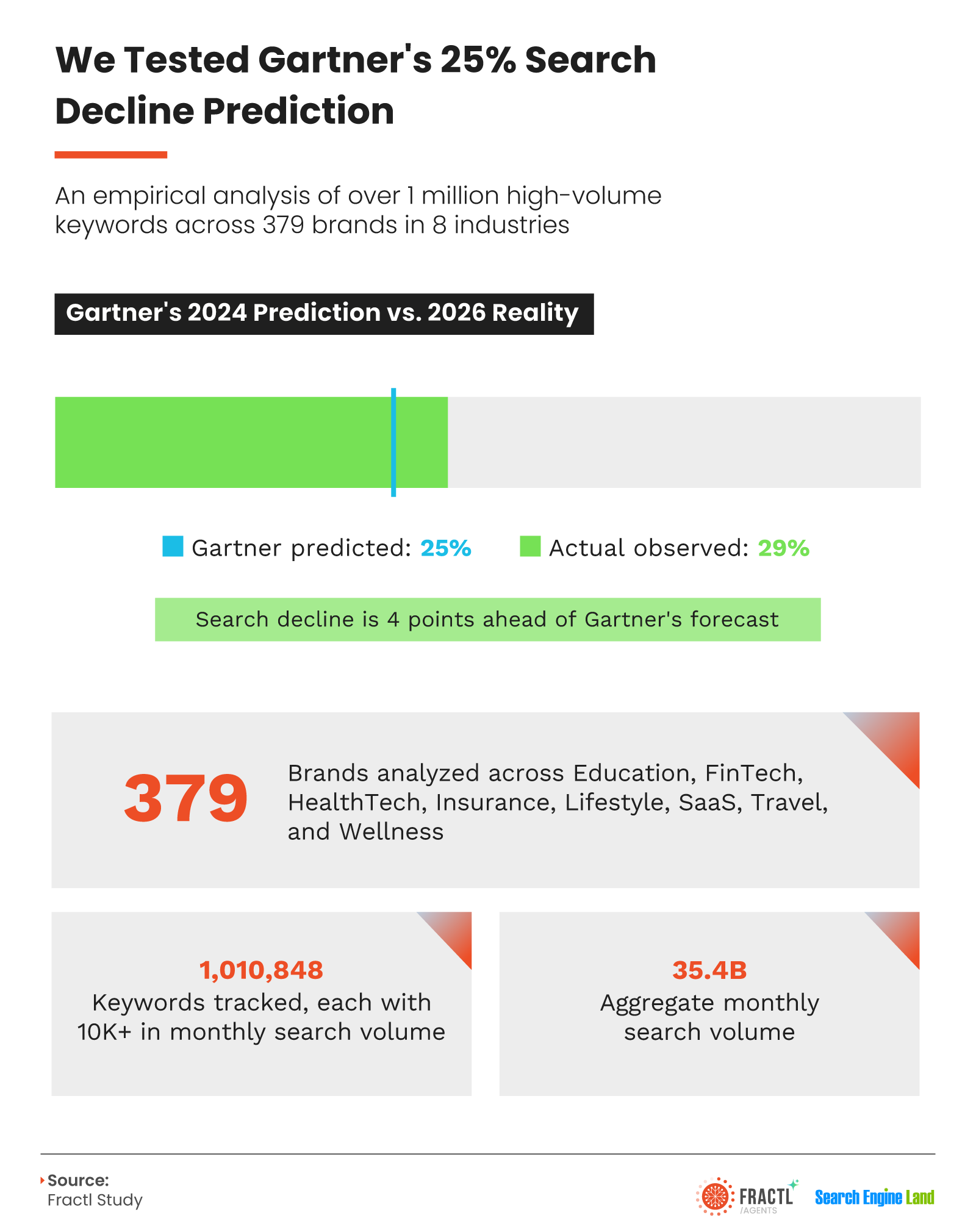
The analysis measured which keywords gained or lost search volume over the past year, how those shifts differed by industry, and how consumer behavior is evolving as AI tools become part of everyday discovery.
The 29% search decline is real, but it depends on the vertical
Across more than 1 million high-volume keywords, I found that 29% of search volume is in measurable decline. That is 4 percentage points above Gartner’s forecast. In a dataset representing 35.4 billion monthly searches, that difference represents a meaningful amount of search activity.
The impact is not evenly distributed. FinTech showed the largest decline at -37.7%, while Lifestyle saw the smallest decline at -15.2%. Only three of the eight verticals, Insurance, SaaS, and Lifestyle, came in below Gartner’s 25% threshold. FinTech, HealthTech, and Wellness were well above it.
The pattern makes sense when I look at how information-heavy each category is. When a chatbot can answer the question completely, such as summarizing drug interactions, explaining deductibles, or giving a quick overview of a fund, search volume is more likely to fall. When people need to compare prices, complete a transaction, or navigate to a specific site, search demand tends to hold up better.
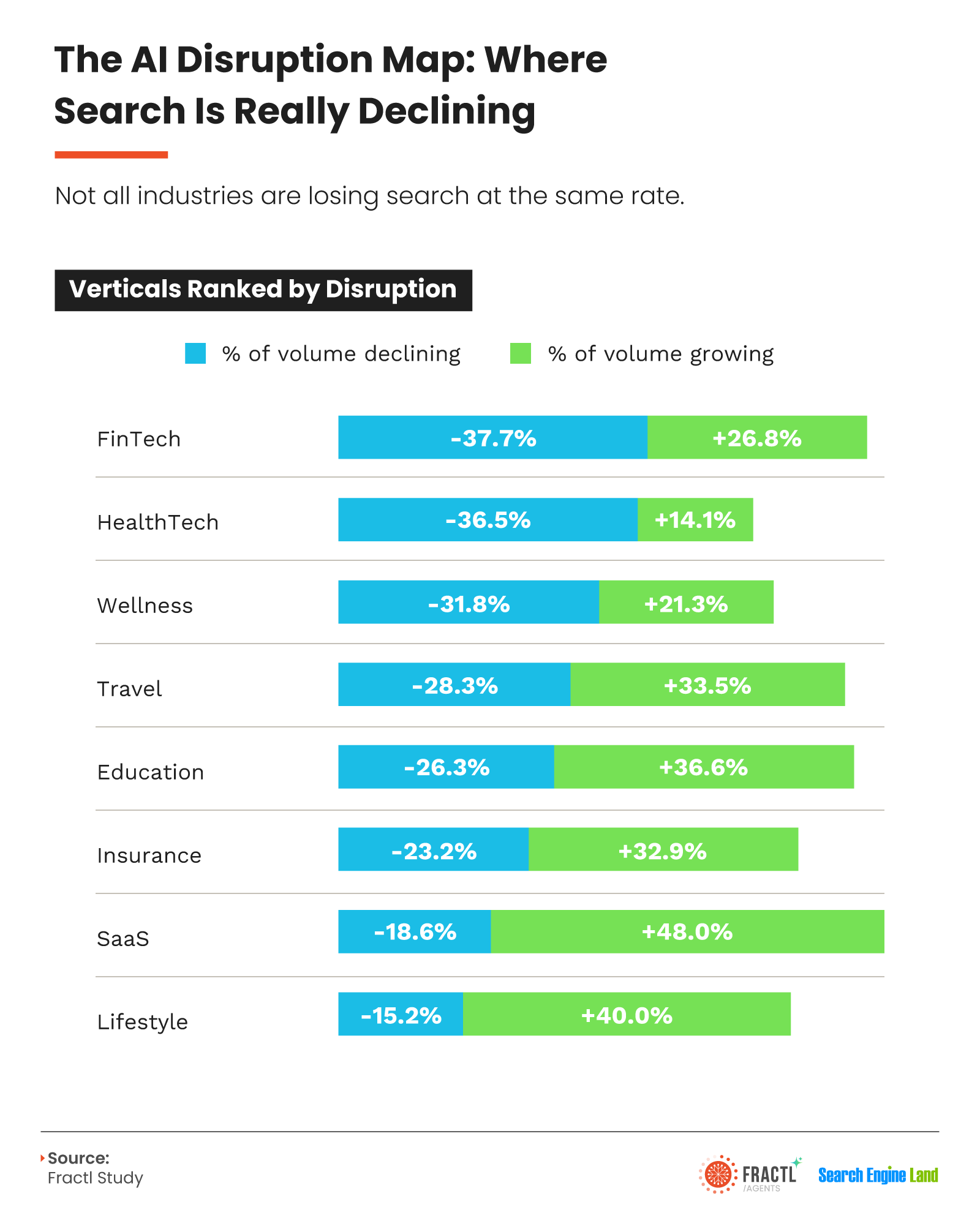
That is why transactional verticals such as SaaS, Lifestyle, Insurance, and Travel are growing or staying close to flat. Information-heavy verticals such as HealthTech, FinTech, and Wellness are seeing the largest declines.
Before reacting to broad claims about AI-driven search decline, I would benchmark these findings against the specific vertical in question. HealthTech and FinTech teams should expect more exposure than the overall 29% decline suggests. SaaS and Lifestyle teams have more reason to challenge the idea that search demand is simply collapsing.
Search demand is being redistributed
The headline number gets attention, but the offset is just as important. Demand did not vanish. It moved to a different set of words, and those are the terms I would want to understand first.
Among the high-volume keywords tracked, 40.7% are in measurable decline, meaning they lost more than 15% of their volume over the past year. Within that group, the average decline is -41%, and 112,378 keywords lost more than 40% of their volume. For brands that depend on those terms, the impact is significant.
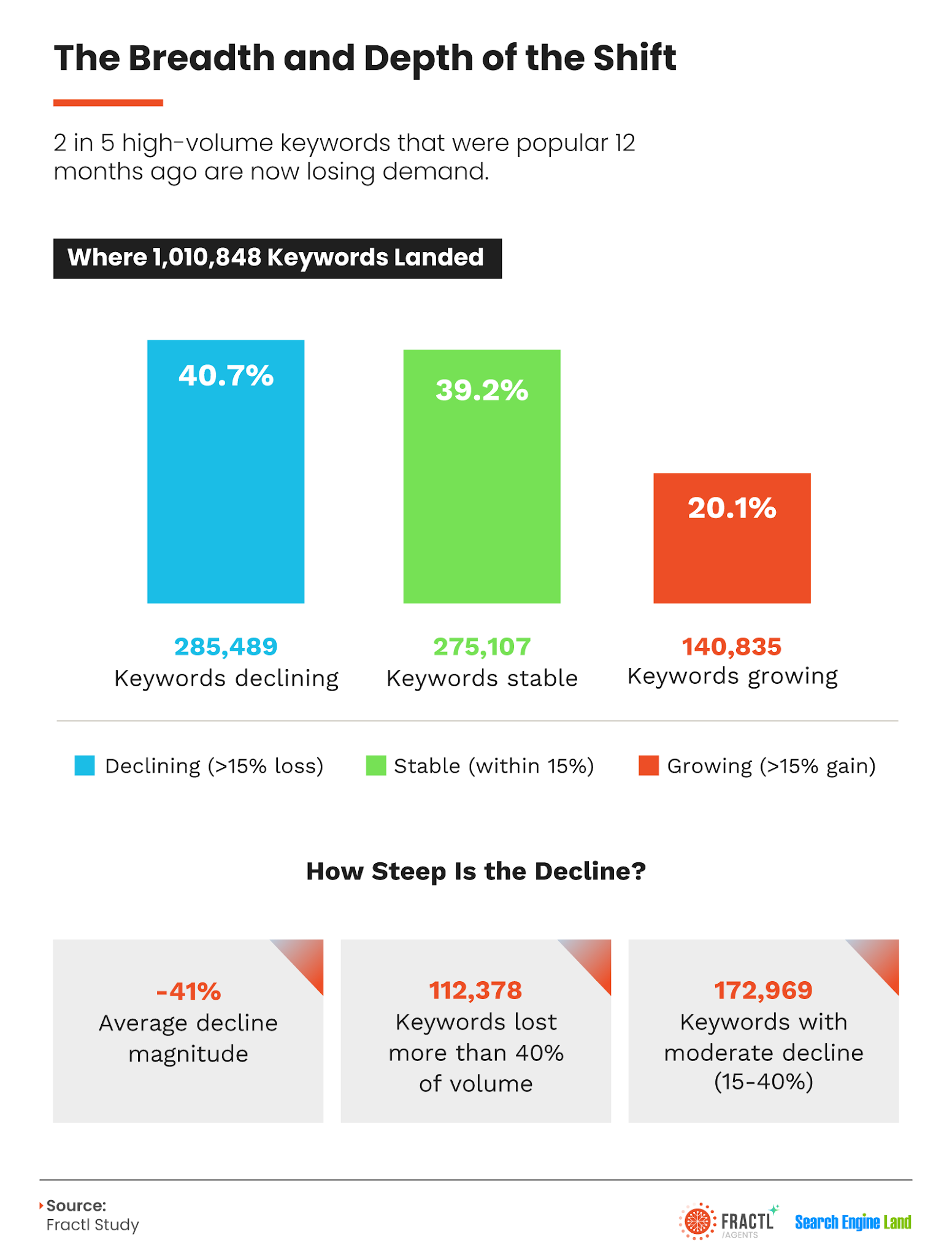
At the same time, 20.1% of keywords are growing by more than 15%. When I add up the volume on both sides, the decline and growth almost cancel each other out.
The 285,489 declining keywords represent roughly 10.29 billion monthly searches. The 140,835 growing keywords represent roughly 10.31 billion monthly searches. Across the entire dataset, the net change is +16.8 million searches per month.
Fewer keywords are growing than declining, but the growing keywords carry more volume each. That is why the totals balance out. In practical terms, I see demand relocating more than shrinking.
The vertical-level growth-to-decline ratios show where that new demand is landing. Lifestyle leads at 2.6x, with 40% of keywords growing versus 15% declining. SaaS follows closely at 2.5x, with 48% growing versus 19% declining. HealthTech sits at the other end with an inverted ratio of 0.4x, making it the most disrupted vertical in the set.

The first audit I would run is simple: pull the tracked keyword set, filter it by year-over-year volume change, and see which side of the ledger the portfolio sits on.
Non-branded queries are the most vulnerable
I see non-branded queries as the easiest ones for AI chatbots to replace. When a search term does not include a brand name, the user is not necessarily trying to reach a specific site or source. The full exchange can happen inside the chat window.
Across the dataset, 90% of all tracked search volume is non-branded. HealthTech, at 99.6%, and Wellness, at 98.5%, are the most exposed. Insurance, at 73.8%, and SaaS, at 82.0%, are less exposed, and both are growing overall. SaaS volume is up 48% year over year, while Lifestyle is up 40%.
If I wanted to identify the content most at risk, I would start with keyword patterns. They offer one of the clearest signals in the study.

The reason SaaS and Lifestyle can be heavily touched by AI and still grow comes down to what happens after the AI answer. If AI recommends a project management platform or a couch, many people still search for the specific brand, retailer, review, or product page before buying. The AI answer creates a downstream search.
HealthTech and FinTech often behave differently. A drug-interaction question or a “what is a deductible” query can be answered completely inside the chat window. There may be no next step that sends the user back to Google.
If a category produces complete AI answers with no natural next click, I would treat AI visibility as a core strategy, not an SEO side project. In those cases, showing up in the answer may be the entire opportunity.
70% of consumers use AI more, but only 17% use search less
The keyword data shows what is happening in the index. The survey data shows what is happening in the minds of the people doing the searching.
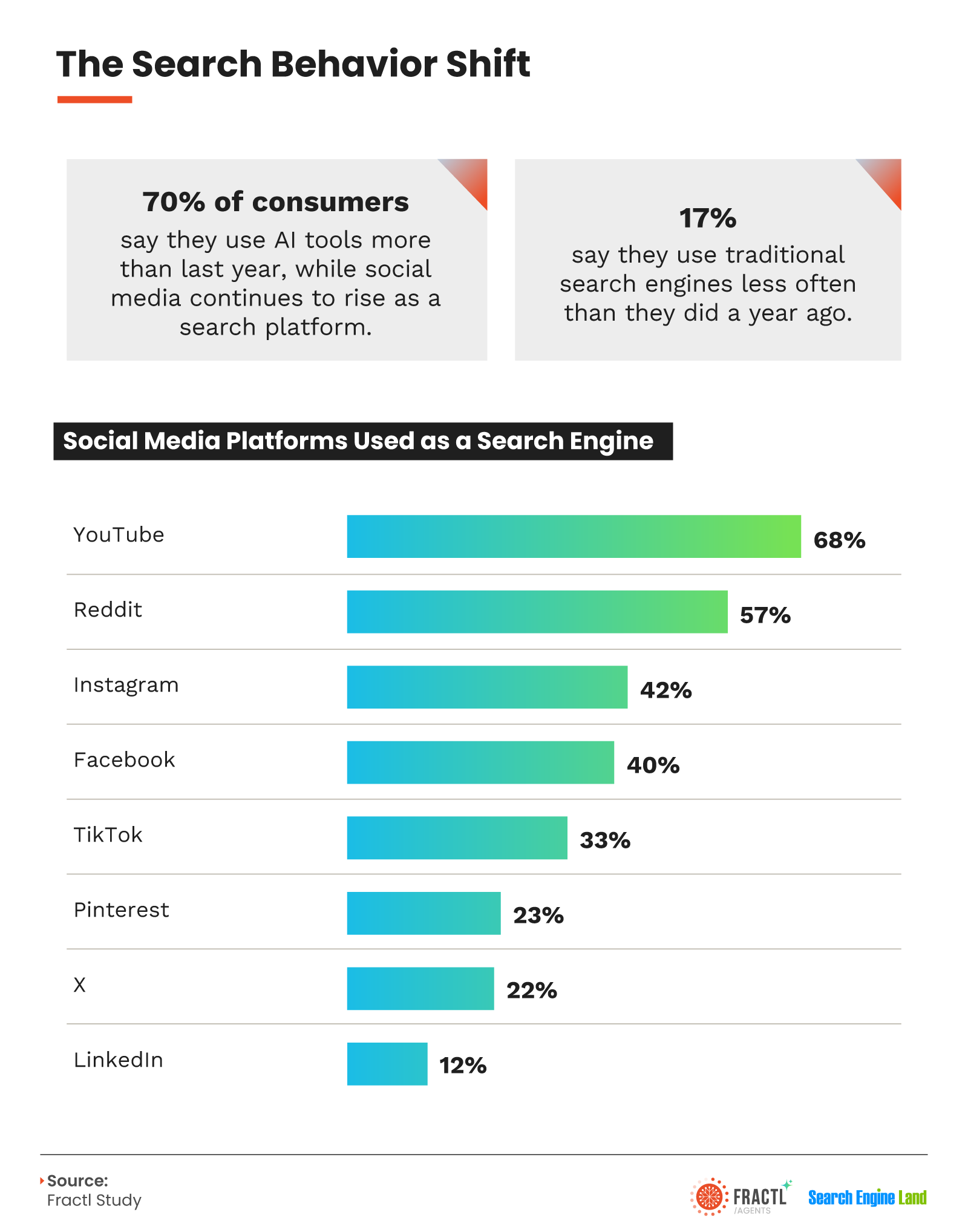
Search behavior is spreading across more platforms. Many people are adding AI to their routines without giving up Google.
Social platforms are also acting like search engines in a way they did not a few years ago. YouTube leads at 68%, followed by Reddit at 57%, Instagram at 42%, Facebook at 40%, and TikTok at 33%.
If I had not already prioritized YouTube and Reddit, I would move them up the list. Both rank ahead of TikTok, Instagram, and Facebook as search destinations, and both can also surface in Google results, which gives visibility there a compounding effect.
What has actually moved from Google to AI
More than a third of respondents, 35%, say they have not replaced traditional search with AI for anything yet. Among those who have, how-to guides and tutorials have taken the biggest hit.
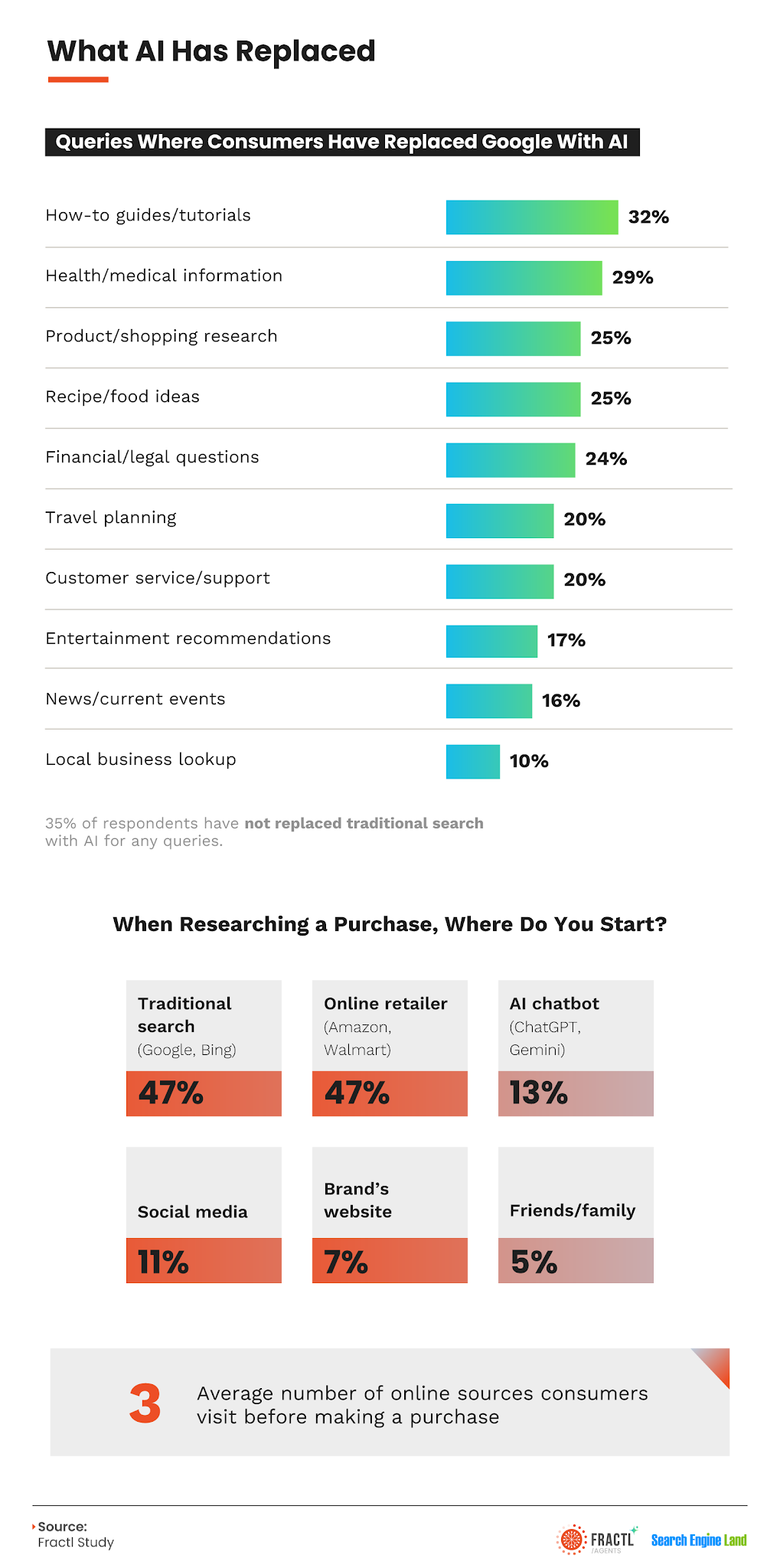
For purchase research, 47% of consumers start with a traditional search engine, tied with online retailers at 47%. Only 13% start with an AI chatbot, and shoppers check an average of three online sources before making a purchase.
The number I would bring to a strategy meeting is this: nearly one in five consumers, 18%, have bought something based on an AI recommendation without checking it against a separate search.
That creates a different kind of buyer journey. In that path, the brand may never receive a search-driven touchpoint. To be considered, the brand has to be one of the names the chatbot returns.
Gen Z and millennials are 2.5x more likely than baby boomers to buy based on an unverified AI recommendation, at 20% versus 7%. Across all consumers, 59% say they are likely to visit a brand’s website after an AI chatbot mentions or recommends it.
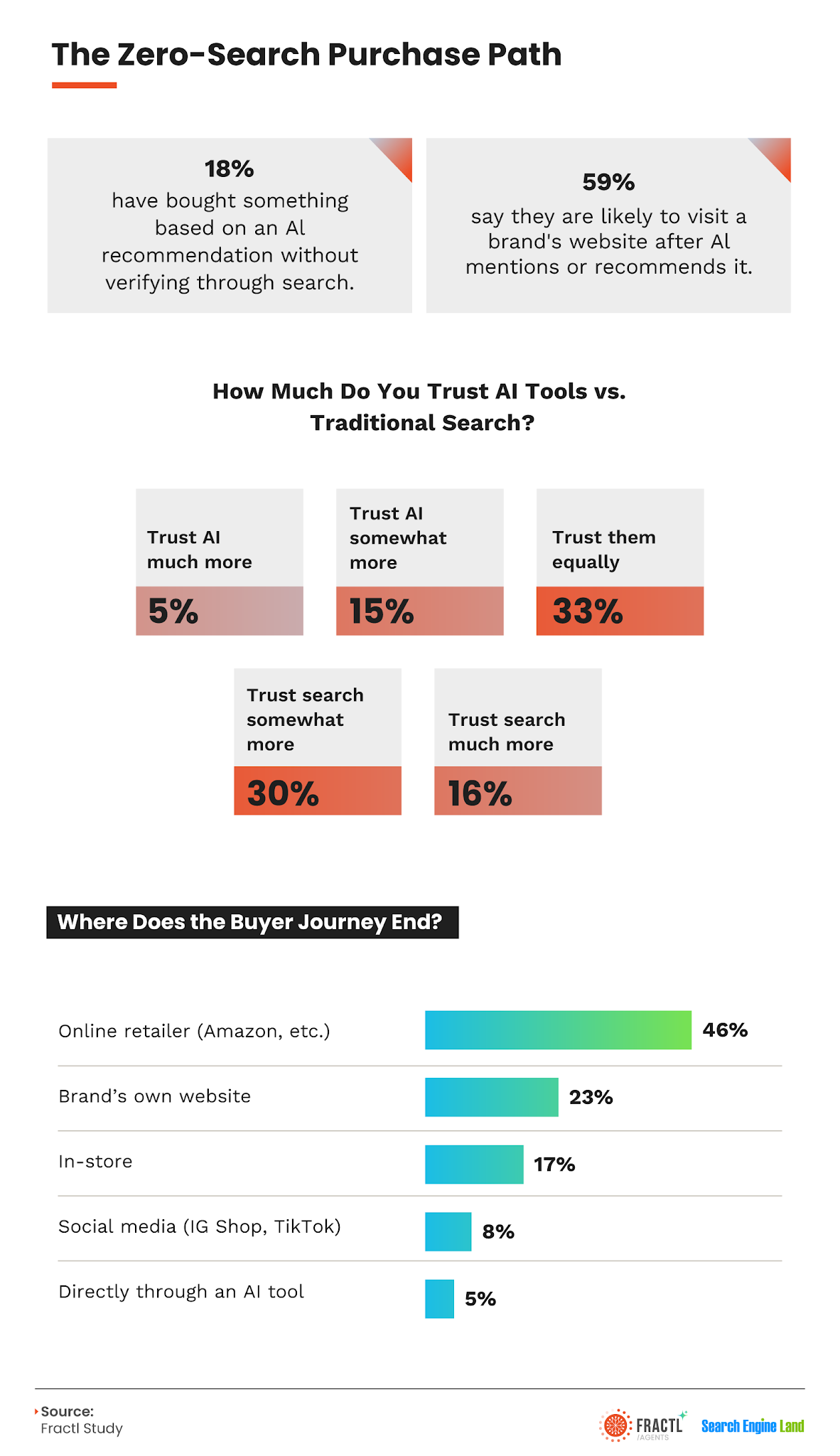
That is the emerging conversion funnel I am watching closely. Brand mentions in AI answers are starting to function like rankings. Visits to a brand’s website after an AI mention are starting to look like the new click-throughs.
Trust is still mixed. In the survey, 33% of consumers trust AI and traditional search equally, 46% trust search more, and 20% trust AI more.
More than half of consumers, 56%, are at least somewhat skeptical of AI product recommendations. I read that as a sign that people are willing to let AI filter and shortlist options, but many still want to verify before they buy.
The 5-year outlook: Google is not going away, but the shift matters
When asked whether Google will still be their primary search tool in five years, 52% of consumers say yes, including 17% who say definitely and 35% who say probably. Another 27% are unsure, while 20% say probably or definitely not.

The top reasons people prefer AI over traditional search are better summaries across sources, at 21%; faster and more direct answers, at 20%; and the ability to ask conversational follow-up questions, at 19%. More personalized results and avoiding website click-throughs were much lower, at 6% and 4%.
When asked what would bring them back to traditional search, the top answer was AI giving unreliable answers, at 35%. That means much of this shift depends on whether AI maintains trust as adoption scales. More accurate search results followed at 29%, then a preference for multiple source links at 22%, and privacy concerns at 20%.
The 20% who expect to leave Google are not the majority, but I would not dismiss them. A strategy does not need to be rebuilt entirely around them today, but brands do need to appear where those users are already moving.
What this means for content and SEO strategy
I see Gartner’s 25% prediction as a useful directional warning. The real shift may be steeper, but calling it only a decline misses the more important story. Total search volume is basically flat. What has changed is which searches carry the demand.
AI visibility is not just a threat to manage. I see it as a distribution channel. With 59% of consumers saying they are likely to visit a brand’s website after an AI mention, GEO has become a meaningful part of brand discovery.
Earned media, credible third-party coverage, and strong entity signals all help brands appear in chatbot answers. That is why digital PR and GEO are becoming more closely connected.
Search is moving, not disappearing.
The brands that lose will be the ones still optimizing mainly for queries that AI now answers better. The brands that win will be the ones building enough authority to become the answer, whether that answer appears in Google or inside a chatbot.
Methodology
This study combined two data sources to test Gartner’s 2024 prediction that traditional search engine volume would fall 25% by 2026.
Fractl and Search Engine Land analyzed Semrush search volume data for 1,010,848 high-volume keywords with 10,000 or more monthly searches each, covering 379 brands across eight verticals: FinTech, HealthTech, Wellness, Travel, Education, Insurance, SaaS, and Lifestyle. The dataset represented 35.4 billion in aggregate monthly search volume. Keyword-level year-over-year volume change was measured as of April 2026 and classified as declining, meaning more than 15% loss; stable, meaning within 15%; or growing, meaning more than 15% gain. Query pattern groupings, including “What is X,” “Best X for Y,” “X vs. Y,” and “How to X,” were applied at the keyword level.
Fractl and Search Engine Land also surveyed 1,004 U.S. consumers about their search habits, AI tool adoption, and purchase research behavior. The sample was 52% women, 46% men, and 1% nonbinary, with 49% millennials, 26% Gen X, 16% Gen Z, and 9% boomers. The median respondent age was 41, with a range of 18 to 82.
Inspired by this post on Search Engine Land.

Leave a Reply