
When I want a page to feel genuinely original, I start with original numbers. They are still one of the most reliable ways to make content stand apart, especially when those numbers come from the business itself instead of a one-off study created just to fill a content calendar.
The old approach was to pay a PR or research firm for a loosely related survey, like a car insurance FinTech commissioning road-trip research to earn a mention in Yahoo. I see that play as increasingly outdated. Almost every product now creates data worth publishing, and extracting that data is easier than it has ever been.
I do not need a full research department to compete here. The bar for standing out is lower than many teams assume.
First-party data: The strongest correlation of originality
On-Page.ai’s recent information gain study scored 150 top-3 Google pages across 50 keywords and 10 verticals. The study looked at how much each page added beyond the rest of its ranking cohort, grading contribution from 0 to 100 by meaning rather than wording.
The median page scored 52. More importantly, original data correlated with that score more strongly than any other page-level trait, including content length.
Pages with at most 1 unique figure averaged an information gain score of 40.2. Pages with 15 or more unique figures averaged 62.1, and the score increased steadily at every step in between.
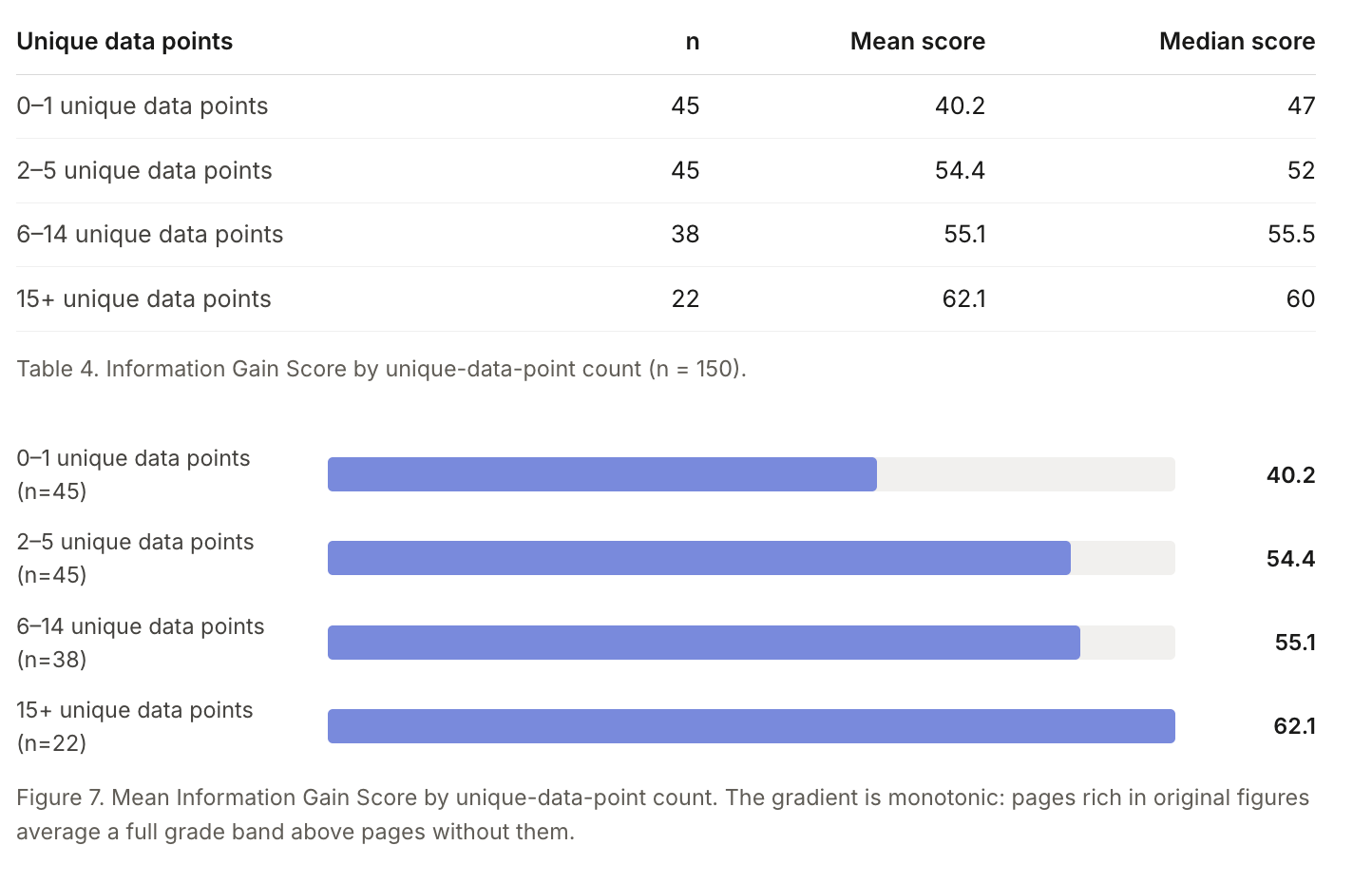
The good news is that the bar is not especially high. The study found that top organic results usually include only 4 unique data points on average. If I publish a page with more than 4 real original claims, figures, or answers, I create another lever for earning visibility in increasingly competitive organic search.
The analysis also found that almost every search leaves adjacent questions unanswered. On-Page used synthetic reader questions, meaning plausible related questions generated for the study, and found room for new pages to answer those questions more completely. That immediately reminds me of query fan-out.
I saw a similar pattern in an analysis of ChatGPT citations.
“A single evergreen page covering 10+ query intents is worth more in AI citation reach than 10 single-intent pages. The ROI of comprehensive content is front-loaded: one well-built page compounds citation reach over time. The long tail exists, but the top 5% of pages capture a disproportionate share of ongoing citation activity.” – The science of how AI picks its sources
That is why I believe high-intent prompts should be monitored across the full buyer journey. I would map them across the five stages from Reasoning Lift: Problem, Exploration, Comparison, Validation, and Selection. I would also use more accurate AI prompt tracking to understand where those questions emerge, then answer them with the kind of knowledge only the brand can provide.
My main takeaway is simple: most pages are only middling on originality, genuinely original pages are still a minority, and scoring high enough to stand out is achievable without an extraordinary lift.
The limitation is just as important. This study focuses on classic search visibility and rankings, which makes sense because the SEO concept of information gain comes from Google patent language. It does not analyze AI citations or mentions, and it does not appear to include AI Mode or AI Overviews.
Caveat: Being the primary source may not win the citation
This is the part of proprietary data advice I think gets skipped too often. Everyone says to publish original research. Far fewer people test whether AI rewards the brand that created the number or the page that presents it in the clearest, most extractable way.
More data analysis is still coming, but based on analyses completed at Growth Memo over the last year, I already see two patterns worth paying attention to.
- The entity types that predict ChatGPT citations the most are DATE and NUMBER (from The science of what AI actually rewards). Highly cited pages tend to be dense with specific entities, such as a particular methodology, a precise statistic, or a named comparison. Even when another source picks up my proprietary findings and gets cited instead, those external third-party authority signals can still build over time.
- Entity-richness and balanced sentiment matter (from The science of how AI pays attention). Generic advice is vague and risky. Specific entities are grounded and verifiable. Proprietary data can produce, verify, validate, and create entity-rich content at the same time. I can explain why a feature saves a certain percentage of dollars, how many hours clients save, or how performance compares with previous vendors. When I add balanced sentiment to the analysis and explanation, I get a stronger tactic from the same asset.
If the hypothesis holds that first-party data is crucial in the era of AI search, then publishing proprietary data is necessary, but it is not enough. LLM extraction structure, along with the sites AI search engines already trust for a topic, helps decide who actually earns the citation, even when the brand owns the data.
That is the frustrating part: an aggregator can repackage my benchmark into a cleaner, answer-ready page and collect the citation my research earned.
- Who wins: Brands that already have proprietary product, usage, or pricing data and also structure that data for extraction while continuing to build organic brand authority. This connects directly to How to build an AI SEO strategy that outlasts tactics.
- Who loses: Brands publishing opinion content that any tool can replicate, brands ignoring off-site authority, and primary sources that bury their own numbers inside narrative instead of surfacing them clearly.
I do not yet know whether some verticals reward data content more than others. The science series found that citation signals vary sharply by vertical, so I would be surprised by a uniform payoff. Still, I would not claim a pattern without data.

How to structure data for extraction
Owning the data gets me into the visibility race. How I structure that data may decide whether I win the citation.
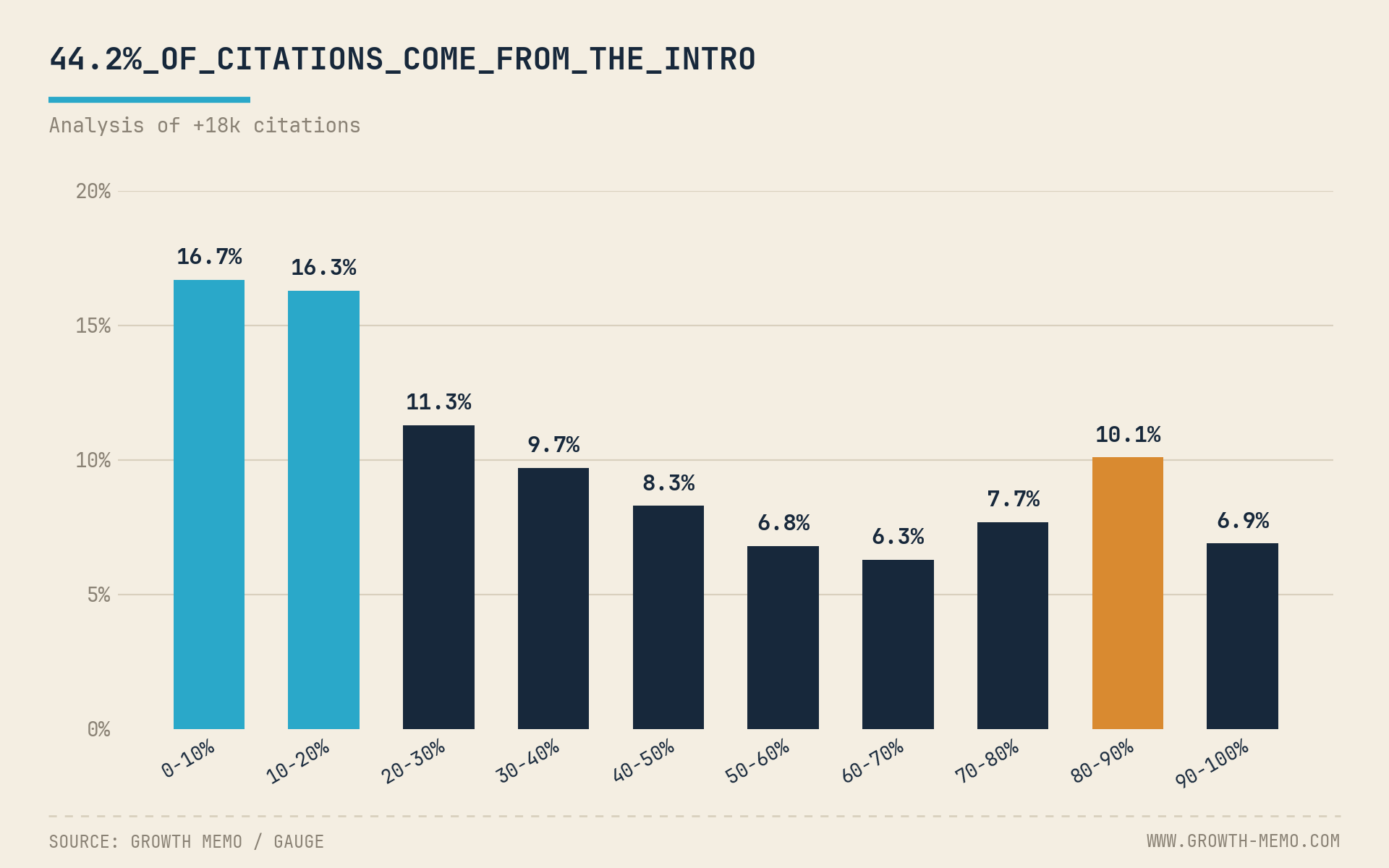
In an analysis of 18,012 verified ChatGPT citations, we found a ski-ramp distribution: 44.2% of all citations came from the first 30% of a page. The middle 30-70% earned 31.1%, and content buried deep in a long post was roughly 2.5x less likely to be cited.
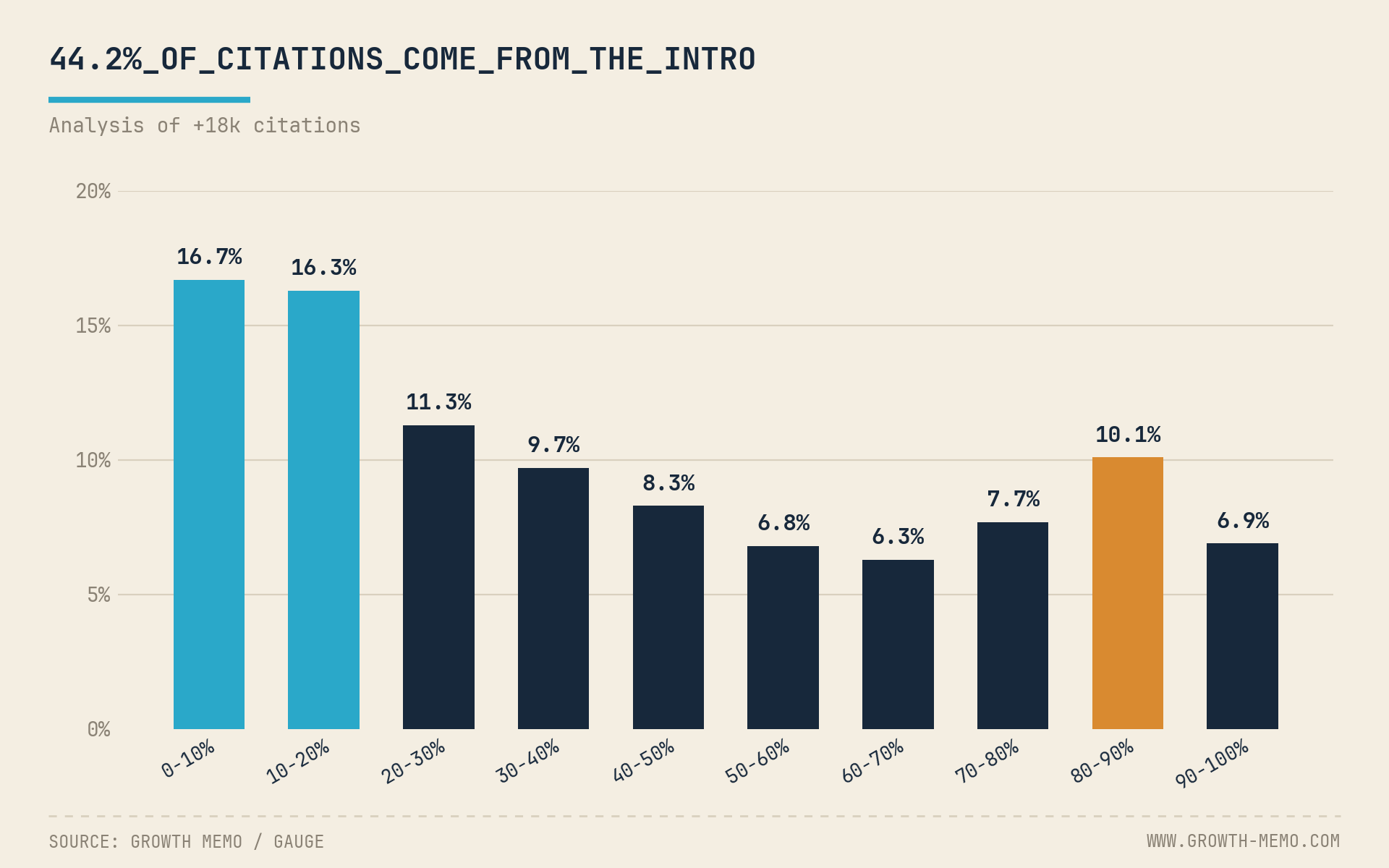
The follow-up analysis across 7 verticals made the target even clearer. The 10-20% band of a page is where AI reads hardest in every vertical, while the first 10% is usually navigation and intro filler that AI skips. The bottom 10% of any page earns only 2.4-4.4% of citations regardless of vertical.

When I apply that to a data study, the structure becomes straightforward.
- I lead with the headline statistic. My strongest number belongs in the first 30% of the page, ideally right after the title block where the 10-20% band begins. I want the number, the comparison, and the implication visible quickly.
- I define the metric immediately. I include one sentence explaining what the number measures and which population it covers. An undefined statistic is harder to extract with confidence.
- I box the methodology. I make the sample size, time window, and collection method easy to find in a short labeled block. Attribution confidence is part of what makes a number citable.
- I front-load every secondary finding. I rank findings by strength, with the strongest first. A 20-paragraph narrative buildup may help human suspense, but it can cost machine citations.
- I skip the suspense close. AI reads more like a busy editor than a patient student. The payoff-at-the-end structure that worked for ultimate guides often works against extraction.
This post first appeared on the author’s website and is republished here with permission.
Inspired by this post on Search Engine Land.

Leave a Reply