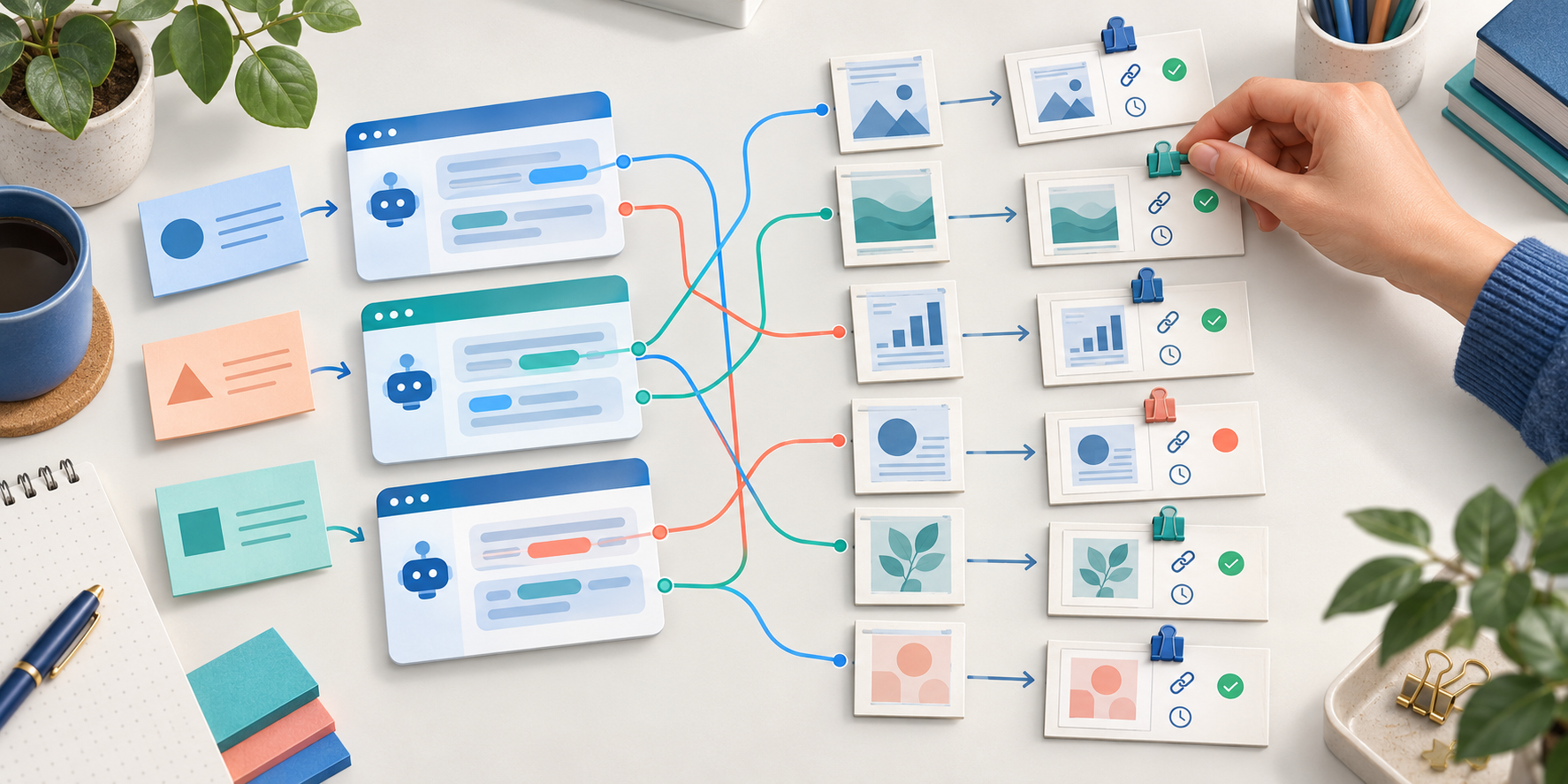
Tag: Citations

  • Effortlessly Boost Your Brand with Automated Citations

    Effortlessly Boost Your Brand with Automated Citations

    Have you ever wondered how to effortlessly get your brand mentioned in the most important third-party citations? Well, now you can, thanks to Profound and Noble’s latest automation feature. This groundbreaking technology allows me to seamlessly integrate my brand into key online listings, saving time and enhancing visibility.

    The convenience doesn’t end there. By automating the citation placement process, I can focus more on strategic activities rather than getting bogged down in the details. It’s all about maximizing impact with minimal effort.


    Inspired by this post on Try Profound Blog.


    crushpress.ai community screenshot
  • Unlocking Insights: Microsoft Clarity’s New Citations Dashboard

    Unlocking Insights: Microsoft Clarity’s New Citations Dashboard

    I’m thrilled to share that Microsoft has unveiled the Citations dashboard within Microsoft Clarity, their powerful analytics tool. This exciting update means you can now see how your content is being referenced in AI-generated responses across various AI platforms.

    The introduction of this feature moves Citations in Microsoft Clarity into general availability, complete with all the refinements users have come to expect. With this, you’ll have clearer visibility into how your pages are performing in AI-driven experiences.

    Citations Dashboard. With the Citations dashboard, I can monitor how my content is referenced in AI-generated answers by summarizing and aggregating citation activities. This is crucial because it covers essential areas such as:

    Page Citations: This displays the frequency of page references from my domain in AI-generated answers during a specified period, even if multiple citations occur within the same answer.

    Share of Authority: Here’s where I get a competitive view of how many citations my domain receives compared to others during the same set of queries.

    AI Referral Traffic: This metric shows the percentage of my site’s sessions that originated from AI assistants in the chosen timeframe, calculated by dividing AI-referred sessions by total sessions.

    Queries: Understanding the queries AI systems use to evaluate and retrieve my content gives me insight into AI’s interpretation of user intent.

    My Cited Pages: I can view which URLs from my domain AI systems often cite, complete with citation counts and corresponding grounding queries.

    ```json
{
  "alt": "Dashboard showing AI visibility metrics for Tailwind Traders with citation statistics.",
  "caption": "Explore the AI visibility insights for Tailwind Traders, highlighting citation metrics and top queries over the past week.",
  "description": "The image features a Microsoft Clarity dashboard displaying AI visibility metrics for the domain www.tailwind-traders.com. There are panels showing page citations, share of authority, and AI referral traffic. A donut chart represents the share of authority, while a queries list reveals top searches like 'best running shoes' and their respective citation counts. The 'My cited pages' section lists URLs with the highest citations. Data indicates total page citations of 375.73K, with Tailwind Traders holding a 23.38% share of authority."
}
```

    Trendlines: These help me track changes in citation activity over time as content and AI query patterns evolve.

    Microsoft also improved Clarity by enhancing the reporting model, query views, filtering, and pagination, making it more robust and efficient for analyzing larger datasets over extended periods.

    To check out Citations, navigate to Dashboards, then select AI Visibility, and finally Citations. For additional details, you can visit this help document.

    What it looks like. Here’s a glimpse of the Citations dashboard in Microsoft Clarity:

    Why we care. As AI search continues to gain traction, understanding how users discover our content and websites through AI is invaluable. Clarity’s new Citations report equips us with the necessary tools to navigate this landscape effectively.

    Similarly, Google Analytics has also introduced AI assistant traffic reporting to enhance our understanding of AI-driven traffic.

    Expect these reporting tools to evolve and improve over time, providing even more robust insights.


    Inspired by this post on Search Engine Land.


    crushpress.ai community screenshot
  • Transform Your Link Building with Citation Optimization

    Transform Your Link Building with Citation Optimization

    AI search is reshaping how SEO visibility is understood. It can often overlook high-ranking brands in buyer answers, urging us to refocus our strategies. Our mission as link builders is to optimize the sources AI systems use to retrieve and cite information.

    Link building has evolved significantly over the years. Traditionally, visibility was measured by keywords, rankings, links, and click-through traffic. Although these metrics are still crucial, their influence, especially at the top of the funnel, has diminished.

    There’s a seismic shift in how prospective customers resolve their issues. Today, buyers no longer compress their queries into keywords. Instead, they interact with AI systems using natural language, providing context to make informed decisions tailored to their needs.

    If we ignore this change, we’re in for visibility nightmares that outdated metrics can’t explain. As link builders, our role has always been about more than just accumulating links. We must earn visibility on pages that convert.

    Modern link building requires us to focus more closely on decision-making, understanding what buyers need, ensuring the information’s existence, and discerning which sources AI can trust and utilize.

    That’s why our focus should shift towards citation optimization.

    AI search changes the landscape of SEO visibility. Top-of-the-funnel strategies are still relevant, but they don’t yield the same impact as before. Ranking for key topics remains beneficial, as does maintaining visibility in searches and sources AI systems refer to for decision-stage prompts.

    Core SEO principles such as creating useful content, fostering trusted references, establishing authority, maintaining source consistency, ensuring clarity, and building strong links still matter. However, the traditional process has weakened.

    ```json
{
  "alt": "Illustration showing parts of the buyer journey with icons representing top-of-funnel visibility, buyer fit, proof, comparisons, use cases, implementation, and risk.",
  "caption": "Explore the multi-faceted buyer journey: from top-of-funnel visibility to risk management, each step features unique challenges and opportunities.",
  "description": "This infographic represents the buyer journey, highlighting that keywords only unlock part of the process. It visually separates stages such as top-of-funnel visibility, buyer fit, proof, comparisons, use cases, implementation, and risk, each illustrated with a unique icon. The color-coded sections provide a clear visual hierarchy, emphasizing the complexity and multifaceted nature of connecting with buyers. Ideal for content marketers and strategists aiming to optimize buyer engagement."
}
```

    We’ve built an entire SEO model around keywords, but they were always simplified representations of real problems. People had to translate their questions, constraints, fears, or decisions into keywords to use search.

    AI changes this behavior. People ask questions naturally, add context, and describe their problems, what they know, and their obstacles. Although simple, this represents a significant mental shift for SEO teams—from focusing on keyword rankings to assisting people in solving problems.

    Citation optimization involves guiding AI systems to useful source material for decisions rather than simply adding another link.

    AI makes visible the questions buyers once asked sales directly. We’ve observed enterprises with vast search visibility still missing in critical AI-driven buyer queries.

    Massive keyword searches and site traffic don’t guarantee presence in these AI-centric answers, as more focused questions tie closely to buyer pain points and services. Competitors often appear instead.

    Google’s AI Mode may not recognize some brands due to a lack of context necessary to confidently recommend them for specific buyer questions.

    These aren’t traditional keyword questions. They’re deeper buyer-side queries typically surfacing during sales interactions, aiming for clarification on fit, use cases, proof points, and implementation, traditionally held in sales reps’ knowledge.

    ```json
{
  "alt": "Chart showing AI surfaces for buyer questions used in sales, detailing sources and their importance for link builders.",
  "caption": "Discover how AI dynamically addresses common buyer queries, utilizing sales conversations and consultations to refine strategies for link builders.",
  "description": "This image features a detailed chart titled 'AI Surfaces The Questions Your Buyers Used To Ask Sales.' It displays five main sources: sales conversations, consultative solutioners, customer service logs, product detail, and customer reviews. Each source is paired with explanations of why they are significant for link builders, such as providing context and highlighting gaps. The chart emphasizes the integration of AI in addressing buyer needs and enhancing strategic decisions."
}
```

    Nowadays, buyers conduct this research independently when narrowing down options, confirmed by our recent behavioral study.

    As link builders, it’s our responsibility to extract this valuable information from within our organizations, posting it where AI tools are likely to source answers, not just focusing on backlinks.

    This necessitates access to essential sales and implementation diagnostics insights.

    When these questions arise, simply covering keywords isn’t enough. It showcases demand but doesn’t highlight necessary buyer trust elements nor uncover unasked questions (known as FLUQs) essential for decision-level information AI systems require.

    AI systems need materials to answer buyer questions. Tracking BOFU prompts lets us examine these surfaces.

    Direct prompt data remains inaccessible, but synthetic prompts can reflect real buyer intent, guiding insight without treating single rundowns as conclusive.

    We must begin by considering what sources AI systems access when responding to buyer problems.

    ```json
{
  "alt": "Infographic showing sources where AI tools pull answers: LinkedIn, in-market content, YouTube, government studies, and more.",
  "caption": "Discover the diverse sources where AI tools gather insights: from LinkedIn to YouTube, government studies to microsites, maximizing the richness of AI-generated answers.",
  "description": "This infographic illustrates the various sources from which AI tools derive answers: LinkedIn, in-market vendor content, YouTube, published data and reports, third-party comparison pages, government studies, and microsites. Represented with icons and arrows, it showcases the interconnected nature of AI data sourcing. Ideal keywords include AI tools, data sources, and AI-generated answers."
}
```

    This changes link-building strategy. We assess cited pages in AI responses asking if they provide detailed, accurate answers:

    • Do they explain the offer?
    • Do they compare options?
    • Do they outline use cases?
    • Do they provide proof?

    The source mix varies by prompt, industry, and intent. At the funnel’s bottom, AI tools often cite LinkedIn, YouTube, third-party comparison pages, microsites, and competitive or vendor content.

    AI systems work with what they can swiftly access, requiring page content prepared for easy consumption, like tables or comparisons.

    Our job is to earn not just links, but to enhance material AI systems reference, aiding their brand decisions.

    Don’t over-analyze a single prompt. Track multiple prompts for recurring gaps. If a brand is visibly missing from valuable prompt categories, that gap signals an area to investigate.

    Citation optimization involves identifying influential pages and websites and ensuring they properly mention your offering to boost brand visibility and accuracy within AI context.

    ```json
{
  "alt": "Infographic on citation optimization and link building with five components: Prompts, Answers, References, Signals, Expansion.",
  "caption": "Exploring the future of link building, this infographic breaks down citation optimization into Prompts, Answers, References, Signals, and Expansion.",
  "description": "This infographic titled 'Citation Optimization: The Future State of Link Building' outlines a five-part framework: Prompts, Answers, References, Signals, and Expansion. Each section highlights essential questions for effective brand citation, like identifying buyer questions, useful brand associations, supporting sources, credible signals, and the need for stronger source coverage. The structured approach aims to enhance link-building strategies, emphasizing credibility and trust in search engine optimization (SEO). Keywords: citation optimization, link building, SEO, brand strategy."
}
```

    Remember PARSE: Source-led research starting points for SEOs and link builders. Track relevant unbranded prompts, identify repeatedly cited pages and domains, and review them closely.

    Questions to consider:

    • What sources shape the answer?
    • Which pages compare options?
    • Which provide a table, list, or framework AI systems can utilize?
    • Which omit your brand while mentioning competitors?
    • Where are you mentioned without enough context?

    This approach produces a richer target list beyond mere backlinks. It’s about refining material AI might use to identify brand presence in an answer.

    Incorporate your brand into cited pages, enriching existing mentions, or improving thin comparisons with clearer ones, adding tables, graphics, or explanations to create more valuable content chunks.

    Links remain important but aren’t standalone solutions. You need more than anchor text; contextual material surrounding it is critical for AI understanding, forming effective citations.

    Whether you’re managing link-building internally or with partners, seek more than just a backlink. Ask for comprehensive anchor context, including insights into the offer, use cases, beneficiaries, and reasons for its place in the AI-driven answer.

    This marks the first step from traditional link building to the realm of citation optimization, enhancing both search and AI visibility.


    Inspired by this post on Search Engine Land.


    crushpress.ai community screenshot
  • Maximize AI Visibility: Influence, Signals, and Citations

    Maximize AI Visibility: Influence, Signals, and Citations

    I’ve seen how crucial it is to understand that AI visibility starts long before users hit that search bar and ends with citations.

    These insights are vital in shaping what gets seen, summarized, and cited by AI systems.

    Currently, the focus has shifted towards improving the AI ROI story, and I’m right in the thick of it, learning what strategies truly work.

    This year, attending SMX Advanced will be more enlightening than ever, bringing unique perspectives and strategies.

    Let’s dive into why influence matters everywhere, and how it impacts AI citations.

    Rand Fishkin’s study, ‘Influence Happens Everywhere,’ reveals that, although Google commands the majority of search traffic, it’s the influence happening outside of search that truly dictates what people look for online.

    For many, wandering through social media or news sites builds their understanding and interest long before the actual search occurs.

    Despite the exciting growth of AI tools, achieving a stable presence online requires understanding how fragmented channels contribute to this influence.

    When crafting content, it’s essential to dominate the influence phase so thoroughly that an AI assistant doesn’t just suggest your brand—it demands it.

    That’s the strategic thrust behind the discussions at SMX Advanced in Boston and why I align my content calendar accordingly.

    My colleagues at Search Engine Land are among those shaping these discussions. Insights from thought leaders like Dave Davies and Carolyn Shelby are invaluable.

    They emphasize the importance of structured visibility signals and entity recognition, helping AI systems select the right brands to highlight.

    In my own analysis, the various AI models like ChatGPT, Perplexity, and others have unique methodologies for selecting sources, reinforcing the idea that an engaged, multi-platform strategy is critical.

    So, what does full-stack content truly mean today? It’s more than crafting blog posts; it’s about commanding entire topics with authority and depth, enhanced by AI tools like Jasper’s Enterprise Suite.

    ```json
{
  "alt": "The CapmatchOne logo with a gradient circle and bold text.",
  "caption": "Discover innovation with the CapmatchOne logo, featuring sleek typography and a modern gradient circle.",
  "description": "The CapmatchOne logo features bold, modern typography coupled with a gradient circle, symbolizing connection and innovation. The sleek design conveys a sense of progress and creativity. This image can be used for branding or promotional purposes, appealing to audiences interested in innovative solutions and forward-thinking designs."
}
```

    The ability to integrate real-time data, identify competitive content gaps, and create diverse multimedia content packages mean we’re shifting from simply generating content to dominating entire narratives.

    But AI tools can only serve the overarching strategy if our content offers the original insights that help us stand out in AI retrieval systems.

    This year, Purna Virji’s insights at SMX Advanced will challenge us to think critically about the real ROI in AI investment.

    I’m particularly interested in seeing how Google Vids is democratizing video content by eliminating the high entry barriers of previous video production methods.

    Now, video content can be produced and localized for a multitude of markets rapidly, a paradigm shift in how we engage audiences across the globe.

    The standards AI is setting for content — whether text, video, or multimedia — require a strategic framework that aligns with evolving platforms like GEO and AEO.

    For those in the trenches like me, adjusting focus towards an integration of structured data and earned media becomes imperative.

    The real challenge isn’t in the buzzwords but effectively navigating the volatile landscape of AI-driven citations.

    I recognize the adjustments needed in approach, especially when considering the stark differences in referral and conversion rates from traditional search versus AI platforms.

    So, practical actions for the rest of 2026? Audit your AI presence thoroughly, stop gating original research, secure your place in vibrant communities, and refine your focus towards citatability rather than simple visibility.

    Ultimately, the brands ready to adapt will continue to thrive in this AI-enhanced environment.

    Indeed, the bots are crawling, and it’s time I ensured my brand is worth citing.


    Inspired by this post on Search Engine Land.


    crushpress.ai community screenshot
  • Top AI Search Citations: Uncover the Dominant Domains

    Top AI Search Citations: Uncover the Dominant Domains

    Have you ever wondered which domains lead the way in the world of AI citations, specifically with giants like ChatGPT and Gemini? I’ve delved into a staggering 58.6 million AI citations to uncover the patterns and top-performing sites dominating this space. Join me as I share insights into these trends and explore strategies to boost your own citation share.

    The AI industry is bustling with innovation and adaptation. Identifying which domains stand out can give us valuable insights into the digital landscape’s future. Let me walk you through the journey of how these insights can be leveraged for growth and visibility in this ever-evolving domain.


    Inspired by this post on HiGoodie Blog.


    crushpress.ai community screenshot
  • How Query Language Transforms AI Citations Globally

    How Query Language Transforms AI Citations Globally

    As I dive deeper into the world of AI, I’ve come across something truly fascinating about how query language is changing the landscape of AI citations. In our analysis, Profound looked at an astounding 3.25 billion citations spread across seven AI models and fourteen countries. What the data revealed was mind-blowing: the language used in queries is the main catalyst reshaping citation rates across different AI platforms.

    Interestingly, I noted that AI tools like Google AI Overviews and ChatGPT handle non-English prompts in uniquely distinct manners. This variation has far-reaching consequences for brand visibility on a global scale, especially within the realms of AI search. The differences in response patterns not only highlight the power of language but also impact how brands are perceived worldwide.


    Inspired by this post on Try Profound Blog.


    crushpress.ai community screenshot
  • Discover How AI Models Stay True to Reality

    Discover How AI Models Stay True to Reality

    Have you ever wondered how AI manages to stay grounded in reality? As I delve into the fascinating world of LLM grounding, I uncover how AI models maintain their accuracy, and why this is crucial for your brand’s visibility and success across platforms like ChatGPT and Gemini.

    Understanding how AI functions in this way is not just about technical curiosity; it’s about knowing how to leverage these tools to enhance your brand’s presence and credibility online. Join me as I explore the role of LLM grounding in shaping AI’s effectiveness and reliability.


    Inspired by this post on HiGoodie Blog.


    crushpress.ai community screenshot
  • How to Earn More ChatGPT Citations: Insights from a New Study

    How to Earn More ChatGPT Citations: Insights from a New Study

    ChatGPT citations prioritize ranking and precision, not length. I recently came across an intriguing study conducted by AirOps that examined how ChatGPT assigns citations. It revealed that pages with precise, narrow answers are favored over lengthy, broad content.

    After reviewing 16,851 queries, AirOps found that pages with well-matched headings and focused content rank higher in citations. Impressively, the top retrieval result was cited 58% of the time, indicating a strong preference for relevance over mere volume.

    Why this matters to us. These findings are crucial if we’re aiming to earn more ChatGPT citations. To succeed, we need to prioritize winning retrieval spots, mirroring queries in our headings, and providing highly precise answers.

    Key insights. The study emphasized retrieval ranking as a pivotal factor. Top-ranking pages were cited 58.4% of the time, compared to only 14.2% for pages positioned tenth. This highlights the significant impact of retrieval rank on citation frequency.

    Another crucial point I noted was the importance of heading relevance. Pages where the heading strongly matched the query were cited 41% of the time, significantly outperforming less matched options.

    It also showed that narrowly focused pages outperform comprehensive guides, challenging the typical “ultimate guide” approach many of us might consider effective.

    Factors driving citations. From what I gathered in the study, being well-ranked, using query-matching headings, and maintaining content focus are key to earning citations from ChatGPT.

    Additional structural insights: While structure like JSON-LD markup offered a slight boost in citations, it wasn’t as critical as I initially thought. Pages with this markup had a citation rate of 38.5% versus 32.0% for those without. Interestingly, articles with 4 to 10 subheadings performed notably well.

    Furthermore, content length had diminishing returns. Pages with 500 to 2,000 words performed best in citations, whereas those exceeding 5,000 words were cited less than even the briefest ones.

    Freshness matters, but only to an extent. Content published within 30 to 89 days had the best performance in terms of citations, while newer content underperformed slightly, suggesting the need for time to build retrieval signals.

    Older content, particularly those older than 2 years, struggled in citations, implying the potential benefits of refreshing existing content if it currently ranks well for target queries.

    Understanding the data. AirOps examined 50,553 responses derived from 16,851 unique queries, each run three times. The exhaustive dataset encompassed 353,799 pages across various sectors and query types.

    The detailed analysis is documented in the report titled The Fan-Out Effect: What Happens Between a Query and a Citation.


    Inspired by this post on Search Engine Land.


    crushpress.ai community screenshot
  • Unveiling the Power of AI: Boosting Citation Impact

    Unveiling the Power of AI: Boosting Citation Impact

    I am thrilled to share the news of an exciting new partnership that is set to revolutionize the way we connect AI visibility data to tangible citation outcomes and impacts.

    This collaboration promises to enhance the visibility of AI-generated insights and effectively translate them into actionable citations, thereby amplifying their real-world influence.

    In a world where AI continues to drive change and innovation, ensuring that these contributions are recognized and used is crucial, and this partnership is a significant step in that direction.


    Inspired by this post on Conductor Blog.


    crushpress.ai community screenshot
  • Revolutionizing PR: How AI is Transforming the Landscape

    Revolutionizing PR: How AI is Transforming the Landscape

    As someone deeply invested in the world of public relations, I’ve witnessed remarkable changes in how AI is reshaping our industry. It’s not just about innovation; it’s about staying ahead in a rapidly evolving landscape. Let me guide you through how AI PR is transforming the way we do business.

    One crucial aspect of this transformation is the importance of citations in AI-generated answers. It’s vital that the information we use is both credible and traceable, ensuring that our strategies remain effective and trustworthy.

    Additionally, understanding LLM (Large Language Model) visibility is key to making the most of AI capabilities. The visibility of these models determines how well they integrate into our PR strategies, impacting overall success.

    For PR teams like mine, adapting our strategies in response to these changes is more important than ever. Staying agile and informed allows us to navigate this new era with confidence and creativity.


    Inspired by this post on HiGoodie Blog.


    crushpress.ai community screenshot