Google is placing news updates and Top Stories inside some AI Overviews, giving timely reporting a more prominent position within its AI-generated search experience. The change affects how mobile users may encounter coverage of developing topics and how publishers can earn visibility from those searches.
Search Engine Land reports that a Google spokesperson confirmed the feature is fully rolled out in the United States on mobile. However, it appears only for some queries, so neither users nor publishers should expect it on every AI Overview.
What Google has added to AI Overviews
For eligible searches about developing subjects, an AI Overview can now include a prominent carousel featuring timely articles. This introduces a recognizable news-discovery element directly into a search feature that otherwise summarizes information and presents supporting links.
The carousel can also highlight Preferred Sources, according to the announcement described by Search Engine Land. That connection matters because it gives users another way to encounter publishers they have chosen while exploring a topic through Google’s AI search interface.
Key takeaways
Top Stories and news updates can appear within AI Overviews for some developing-topic searches.
Google confirmed that the rollout is fully live for mobile users in the United States.
The news carousel can feature Preferred Sources alongside other timely coverage.
The format may create additional opportunities for publishers to receive visits from Google’s AI search features.
Why the placement matters to news publishers
The practical significance is placement. A publisher link shown prominently inside an AI Overview may be easier to notice than one competing only in the conventional results below it. For news organizations, that creates a potential route from an AI-generated answer to the original reporting.
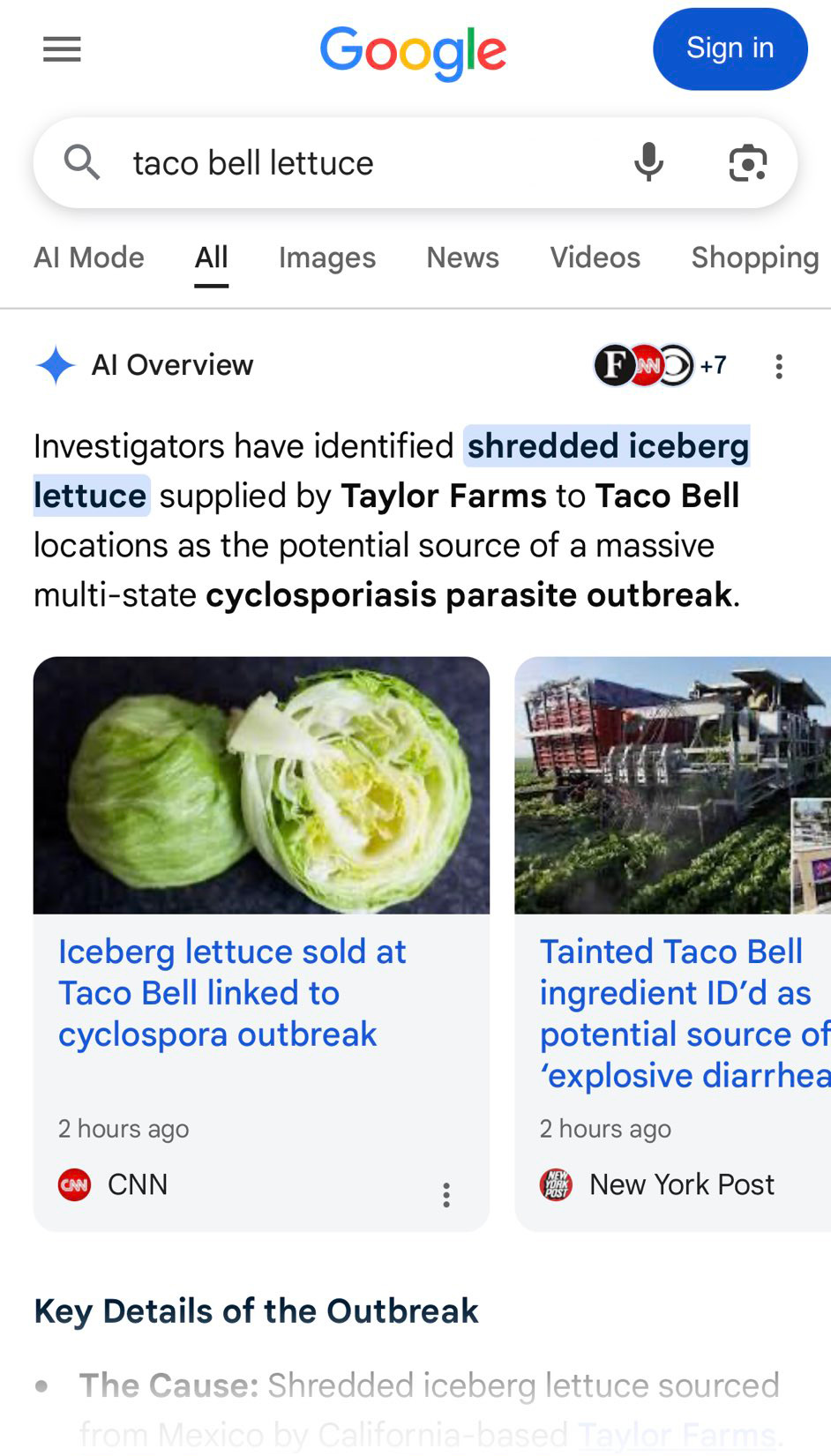
A Google mobile search for "taco bell lettuce" displays an AI Overview naming shredded iceberg lettuce and news cards from CNN and the New York Post.
That opportunity should not be mistaken for a guaranteed traffic increase. The source does not provide click-through data for this feature, and its availability is limited by query, device and geography. Actual results will depend on when Google displays the carousel, which sources it selects and whether users choose to open an article after reading the overview.
Even with those caveats, the design addresses an important tension in AI search: summaries can satisfy part of a user’s information need before a website visit occurs, while prominent article links can give readers a clear path to fuller coverage. The new treatment could therefore be more consequential for publishers than a subtle citation or less visible source link.
How editorial and SEO teams should respond
The report does not identify a new optimization method or a special eligibility process. Publishers should therefore avoid treating the rollout as evidence of a new ranking formula. A more grounded response is to monitor whether timely stories begin appearing in these carousels and whether those appearances produce measurable referral traffic.
Editorial, audience and SEO teams can evaluate the change through a few practical questions:
Organic visibility, paid media and artificial intelligence merge into one connected search ecosystem, where vivid data streams link a creative website with a powerful analytics dashboard.
Do relevant mobile searches trigger an AI Overview with a news carousel?
Which publishers and article formats receive prominent placement?
Are Preferred Sources visibly represented when the feature appears?
Do analytics show changes in Google referrals to timely coverage?
Observations should be separated from assumptions. Seeing a story in one result does not establish a repeatable tactic, while the absence of a carousel on a particular search does not mean the rollout is unavailable. Testing across suitable developing-topic queries can help teams understand the feature without overstating what limited examples prove.
The broader direction for AI-powered search
Search Engine Land connects this rollout to Google’s earlier announcement about adding fresh perspectives, updates and more prominent links to AI Overviews. Top Stories puts that direction into a concrete interface: timely source material is surfaced within the AI response rather than left entirely to the standard results.
The next question is whether this visibility consistently translates into meaningful visits for publishers. Broader availability, clearer performance evidence and continued observation will be needed before the feature’s impact on news traffic can be judged.
A pending European Union decision could change how Google presents its own shopping, travel, and other specialized services alongside competing results. The central issue is whether Google has given its products an unlawful advantage within search.
The outcome remains expected rather than final. Based on reporting summarized by Search Engine Land, however, the case may affect commercial search visibility, access to search data, and the features available to third-party AI providers.
The expected decision centers on Google’s dual role
Google operates the general search platform while also offering specialized services that can appear within its results. That dual role matters because placement on a search results page can influence which services users encounter when they are comparing products, planning travel, or making other purchase-oriented decisions.
Search Engine Land reports that the European Commission is expected to find that Google illegally favored its own vertical services over rivals. The anticipated decision would be made under the Digital Markets Act. Because no final ruling is described in the source material, the specific obligations and their practical effects should not yet be treated as settled.
Key takeaways
EU regulators are expected to rule on how Google displays its own specialized services compared with competing services.
Changes could affect visibility for comparison websites, travel platforms, shopping services, and other businesses seeking organic traffic from commercial queries.
The Commission is also expected to address third-party access to ranking, query, click, and view data.
A related question is whether third-party AI providers should receive access to features available to Gemini.
Commercial search visibility could be redistributed
If the Commission requires Google to alter the presentation of its services, rival platforms may gain additional opportunities to appear in prominent search positions. That possibility is especially relevant in categories where users arrive with strong commercial intent and where visibility can direct valuable organic traffic.
The effect would not necessarily be uniform. A display change could influence comparison services differently from travel or shopping platforms, depending on which search features are covered and how Google implements any order. The reported case therefore signals a potential change in opportunity, not a guaranteed traffic increase for every competitor.
For search marketers, the useful distinction is between rankings and presentation. A business may retain the same conventional organic position while receiving more or less attention because surrounding modules, specialized results, or Google-owned features have changed. Any assessment of the ruling’s impact should therefore examine actual result-page layouts as well as ranking reports.
Organic visibility, paid media and artificial intelligence merge into one connected search ecosystem, where vivid data streams link a creative website with a powerful analytics dashboard.
Financial penalties could accelerate compliance
According to the report, the Commission is expected to impose fines totaling hundreds of millions of euros across two Digital Markets Act decisions. Google could also face daily penalties if it does not comply with parts of the orders within 60 days.
Those reported enforcement measures matter because the consequences may extend beyond a one-time financial penalty. A compliance deadline could require operational changes on a defined schedule, while the possibility of continuing penalties would add pressure to complete them. The source does not specify the final fine, the exact daily penalty, or the complete design of any required search changes.
Data access raises a separate privacy dispute
The Commission is also expected to decide whether Google must provide third-party search engines with access to search data. The reported categories include ranking, query, click, and view information. Such data can be valuable because it may help a search provider understand user demand, evaluate result quality, and improve how information is retrieved and ordered.
Google disputes that proposed access, arguing that data sharing would endanger user privacy and go beyond the Commission’s authority. This creates a distinct policy tension: regulators may view access as a way to reduce structural advantages, while Google presents privacy and legal scope as limits on what should be shared. The source provides Google’s position but does not report a final resolution of that disagreement.
AI access could broaden the decision’s reach
The Commission is reportedly considering whether third-party AI providers should receive access to the same features available to Gemini. That question connects the search dispute to competition in AI services, although the source does not identify the features at issue or explain how access would be implemented.
The most important next step is the final text of the Commission’s decisions. It should determine whether the expected findings become formal obligations, which services and data are covered, and what Google must change. Until those details are available, businesses should treat shifts in search visibility and data access as credible possibilities rather than completed outcomes.
When I work on a site built with a framework like Next.js, Nuxt, SvelteKit, or a similar JavaScript framework, I pay close attention to hydration. It is the step that turns server-rendered HTML into an interactive page, but it is often explained in a way that does not connect clearly to SEO.
I think hydration is easier to understand when I separate content from behavior. The content may already be visible, but the page may not be fully usable until the browser finishes connecting that content to the JavaScript behind it.
What I mean by hydration
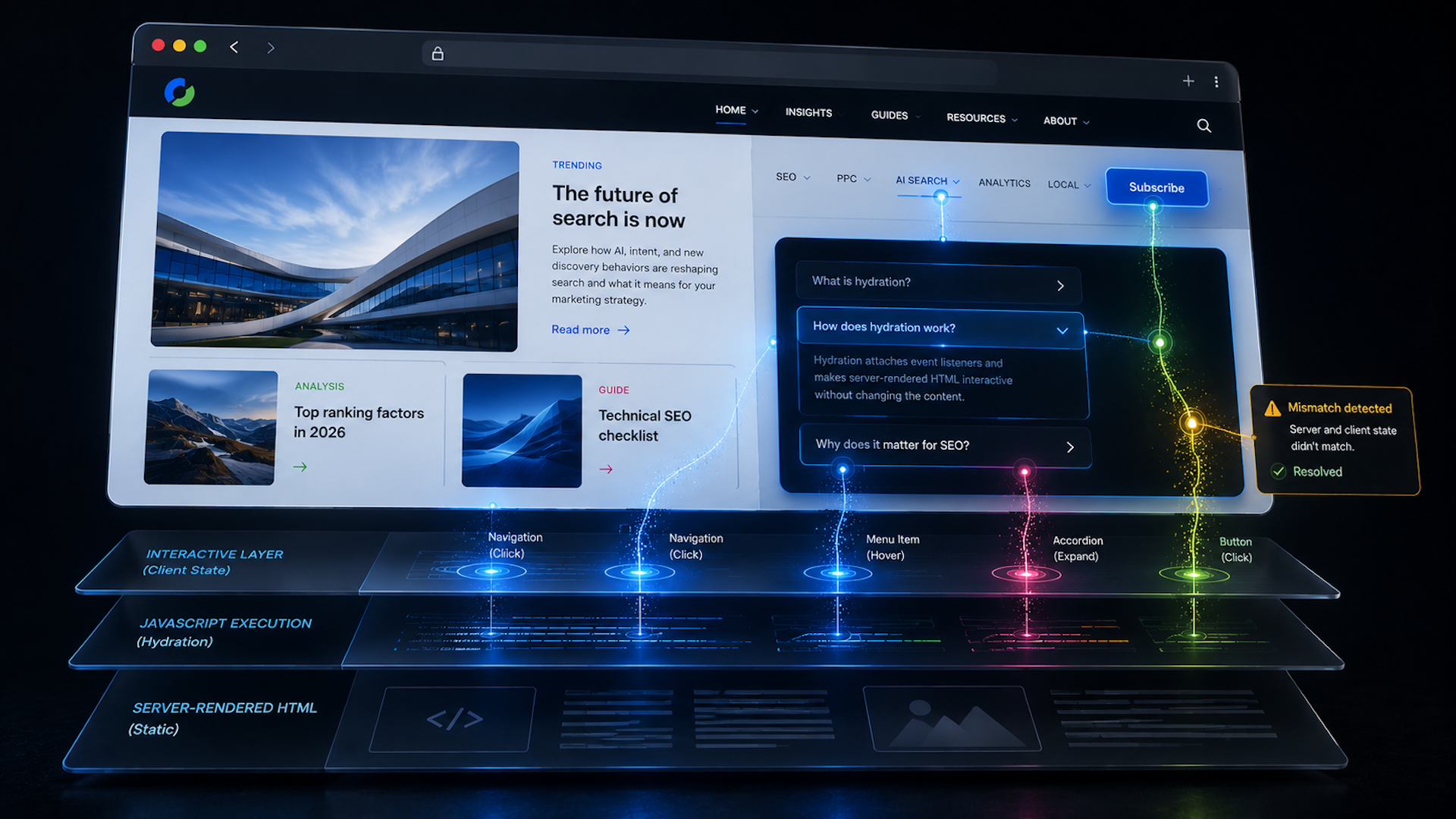
Hydration is the process where JavaScript in the browser takes over the static HTML that was built on the server. The server sends a complete page first, and then the framework attaches the logic that makes buttons, menus, forms, filters, and other interactive pieces actually work.
Here is how I usually explain the sequence. First, the server builds the page and sends fully formed HTML to the browser. I can see the content quickly, but the page is not interactive yet. Then the framework loads, walks through the existing HTML, attaches event listeners, and reconnects the visible markup to the application logic. Once that is done, the page behaves like a normal interactive app.
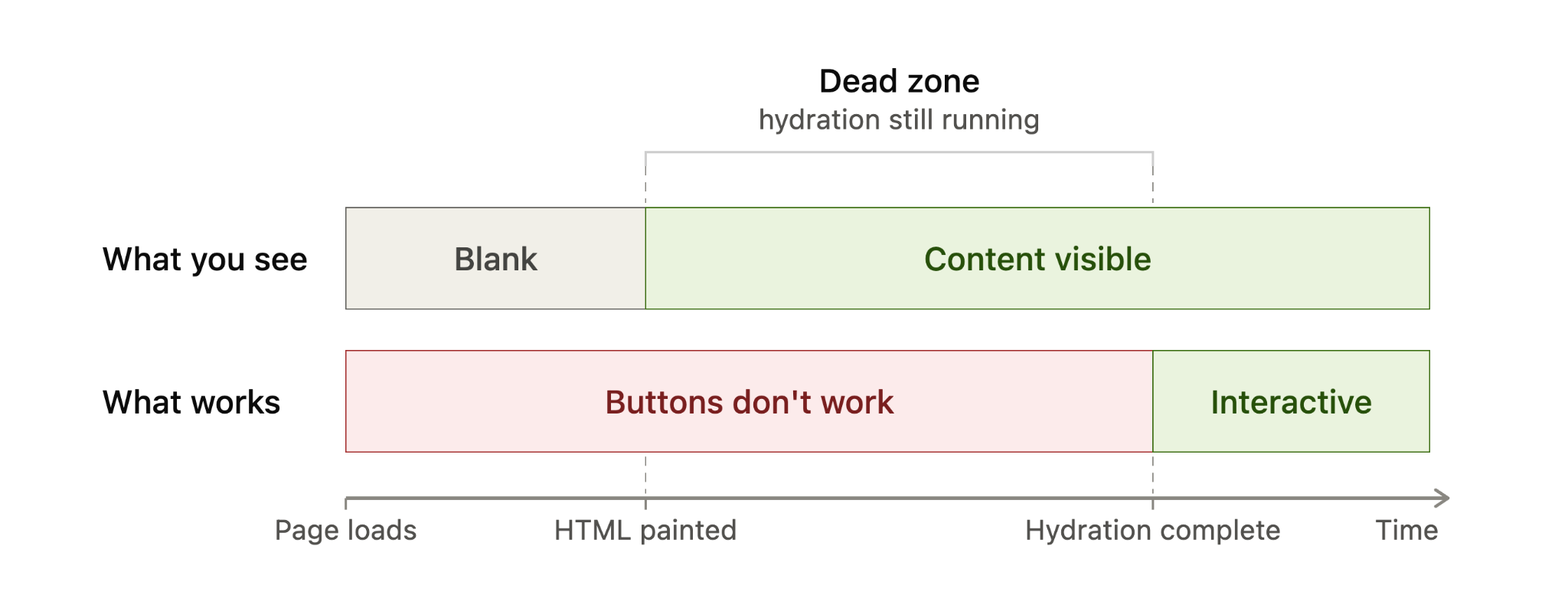
This is why server-rendered HTML can feel fast at first. It can paint quickly and often helps with first impressions and Largest Contentful Paint (LCP). The tradeoff is that, with traditional hydration, the page may appear ready before it is actually usable.
Hydration adds interactivity, not content
The most important distinction I keep in mind is this: hydration does not add the main content to the page. The text, images, and layout should already be present in the server-rendered HTML. Hydration only adds behavior by wiring that HTML to the JavaScript that responds to clicks, typing, taps, and other user actions.
A hydration timeline shows the gap between content appearing and a page becoming usable: HTML is visible first, but buttons only work after hydration completes.
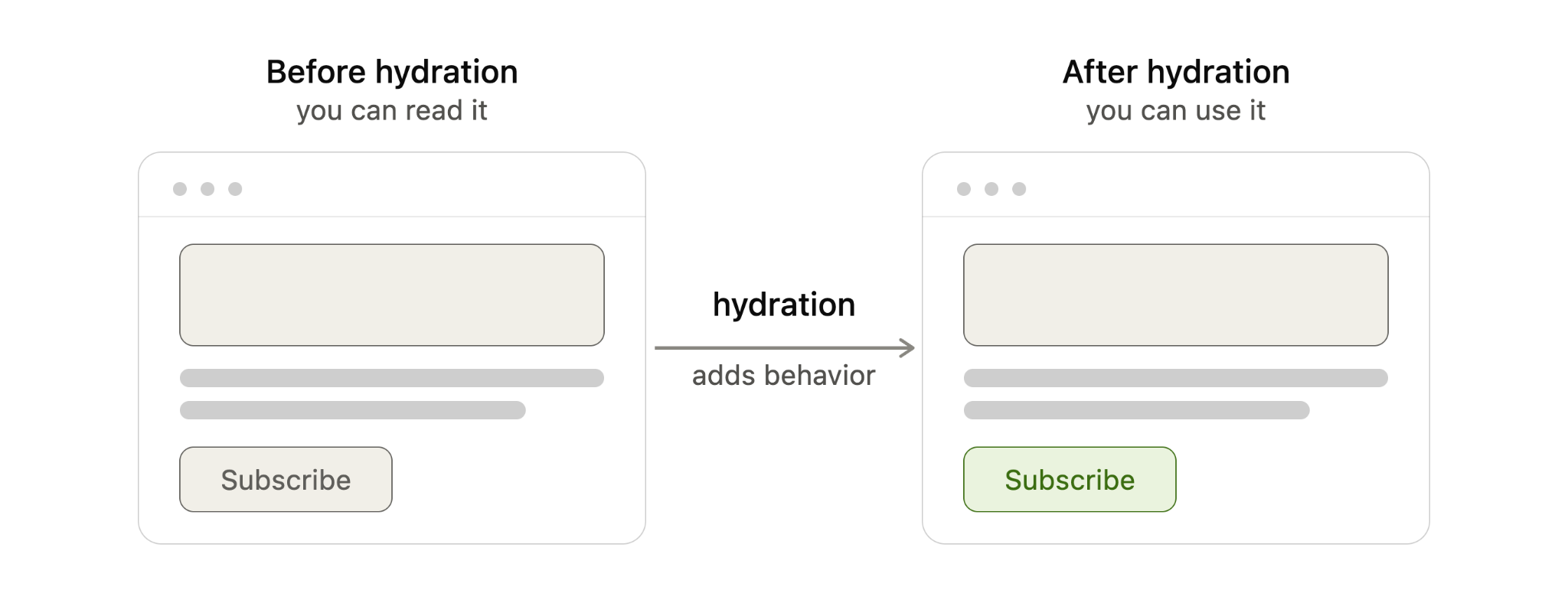
Put simply, before hydration I can read the page. After hydration, I can use it.
I also avoid confusing hydration with the rendering pattern itself. Server-side rendering (SSR), static site generation (SSG), and client-side rendering (CSR) describe where and when the page is built. Hydration describes what happens after server-rendered or statically generated HTML reaches the browser and needs to become interactive.
From an SEO perspective, that distinction matters. When a page uses SSR or SSG correctly, the core content is already in the initial HTML. Google can discover and index that content from the HTML before depending on a JavaScript render step, which is generally more reliable than sending a mostly empty client-rendered shell.
When I see hydration become an SEO problem
Most of the time, I do not treat hydration itself as an SEO problem. It becomes a problem when hydration breaks, usually because the HTML created on the server does not match what the framework expects to create in the browser.
That kind of mismatch can happen when content depends on browser-only APIs such as localStorage, when a value changes between server and client rendering such as new Date(), when a third-party script or browser extension changes the DOM before hydration finishes, or when invalid HTML causes the browser to rewrite the structure before the framework can attach to it.
Before hydration, a server-rendered page can be read but not used; after hydration, JavaScript adds behavior so elements like the Subscribe button respond.
When the two versions do not line up, the framework may throw away the mismatched section and re-render it in the browser. The exact behavior depends on the framework, but the SEO and performance risks are similar.
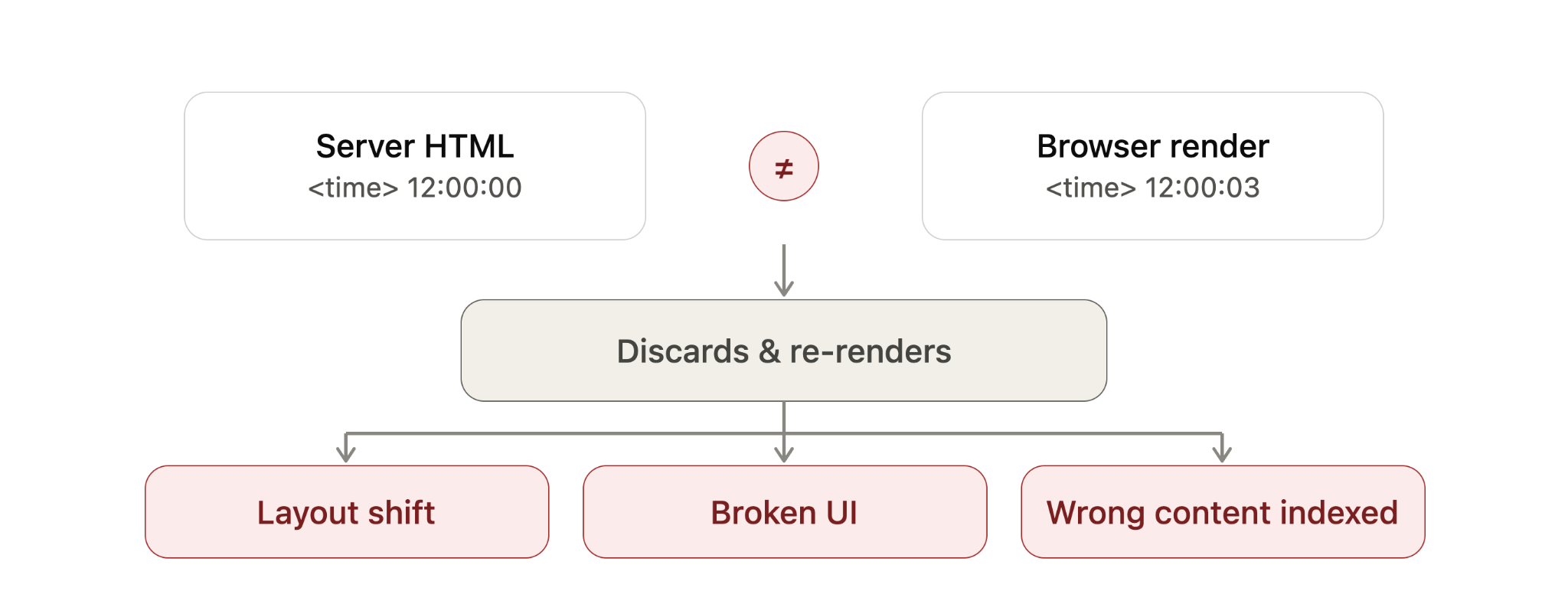
For example, if a <time> value is generated with new Date(), the server may output one value while the browser generates another. That mismatch can force a re-render, even though the page appeared to load correctly at first.
I worry about this because it can hurt the page in several ways. A re-render can make the page feel sluggish, which can affect Interaction to Next Paint (INP). It can shift the layout, which can affect Cumulative Layout Shift (CLS). It can also break user actions if event listeners fail to attach properly, leaving buttons, menus, or forms unresponsive.
In severe cases, Google may read the raw server HTML before JavaScript finishes rendering and then index content that visitors never actually see after the page re-renders. That is the scenario I want to avoid most: search engines and users experiencing different versions of the same page.
The fix is usually not an SEO trick. It is a development fix. I want the underlying mismatch removed by using valid HTML, avoiding browser-only logic during server rendering, stabilizing values that change between server and client, and controlling third-party scripts that alter the DOM too early.
When server HTML and browser-rendered content disagree, hydration may discard and rebuild the page, creating layout shifts, broken UI and potential SEO indexing problems.
How I spot hydration problems on a live site
Hydration errors are usually easier to catch in development than on a live site, but I still look for a few practical signals. I start with the browser’s Developer Tools console and check for hydration warnings, JavaScript errors, or framework-specific mismatch messages.
Then I watch the page load carefully. If content flickers, shifts, disappears, reappears, or stays unresponsive for longer than expected, I treat that as a sign worth investigating.
I also use Google Search Console’s URL Inspection tool on important templates to see how Google renders the page. For larger sites, I prefer crawling with JavaScript rendering enabled in tools like Screaming Frog or Sitebulb so I can compare rendered output against raw HTML at scale.
How I think about different hydration approaches
Modern frameworks handle hydration in different ways, and I think of those differences as a balance between performance, interactivity, and how much JavaScript must run in the browser.
Full hydration means the entire page hydrates in one pass. It is straightforward, but it usually ships the most JavaScript and asks the browser to do the most main-thread work. Next.js Pages Router is a common example of this model.
A glowing Google search bar cuts through streams of digital data, capturing the fast-moving world of search, shopping visibility, and SEO innovation.
Partial hydration hydrates only the interactive pieces, often called islands. Static sections remain plain HTML and do not need client-side JavaScript. Astro’s islands architecture is a well-known example of this approach.
Progressive hydration hydrates the page in pieces over time. A framework may hydrate sections as they scroll into view or as browser resources become available. Angular’s incremental hydration follows this general pattern.
React Server Components take a different path by letting some components render entirely on the server and ship no client-side JavaScript for those server-only parts. In those cases, there is nothing for the browser to hydrate for that portion of the page. Next.js App Router uses this model.
Resumability goes further by trying to skip hydration entirely. Instead of re-running components on load, the page resumes from the state the server already produced. Qwik is the main example here, although I still view it as newer and less battle-tested than some of the older patterns.
When I compare these techniques, I look at what hydrates, how much JavaScript ships, and how much work the browser must do. Full hydration touches the entire page and usually ships the most JavaScript. Partial hydration touches only interactive components and ships less. Progressive hydration spreads the work over time. React Server Components reduce hydration for server-only parts. Resumability aims to avoid hydration altogether.
What this means for my SEO work
I do not assume hydration is bad for SEO. In most cases, it is simply part of how modern server-rendered and statically generated sites become interactive.
What I do watch closely is whether the server HTML and the browser-rendered version agree. If they do, hydration is usually a performance and user experience consideration. If they do not, hydration can become a visibility problem, especially when Google indexes a version of the page that users never see.
Newer frameworks reduce some of this risk by shipping less JavaScript and doing less work in the browser, but they do not remove the need for careful implementation. For me, the practical takeaway is simple: make sure the important content is present in the initial HTML, keep server and client output consistent, and test how search engines actually render the page.
I see TikTok becoming harder to ignore in SEO because discovery no longer happens in one clean path. Someone might find a restaurant on TikTok, verify it through Google Reviews, check Reddit for honest opinions, scan the menu on the business website, and then book a table. Someone else might take those same steps in a completely different order.
Nearly half of U.S. consumers used TikTok as a search engine in 2026, up from 41% in 2024, according to Adobe survey data. What stands out to me is why people search there: short-form video, storytelling, interactivity, tutorials, product reviews, personal stories, and influencer recommendations all make the platform feel more immediate than a traditional results page.
I also think TikTok recent updates show how seriously the platform wants to be part of the search journey. Many purchase decisions are visual, social, emotional, and trust-driven, which is exactly where TikTok has strength. With Local Feed, AI summaries, creator reviews, and shopping features, TikTok is trying to meet people at the moment they are exploring, comparing, and deciding.
So instead of asking whether TikTok is a traditional search engine, I ask a more useful question: how do I make sure people can find, understand, trust, and choose a brand wherever their search journey begins? More often than many marketers want to admit, that starting point may be TikTok.
TikTok SEO Is More Than Hashtags Now
I think of TikTok SEO much like traditional SEO: it is the work of making a business, place, product, service, or experience easier to discover. As TikTok has evolved, the discovery surfaces have expanded far beyond captions and hashtags.
In the past, I mostly associated TikTok optimization with captions, hashtags, trending sounds, posting times, and the hope that a video would land on the For You feed. Those pieces still matter, but they are no longer the full picture.
Today, I have to think about TikTok Search, recommendations, Local Feed, Places, reviews, comments, creator content, visual cues, product signals, and AI-assisted discovery. A stronger TikTok SEO strategy now includes search query relevance, spoken topic clarity, on-screen text, captions, hashtags, location context, creator reviews, comments, product visuals, and the searches people make after seeing a video.
TikTok documentation says search results can be shaped by how well content matches a query, along with hashtags, sounds, user interactions, language, and location. The For You feed also weighs user interactions, content information, user information, and watch behavior, which means usefulness and engagement both matter.
Local Feed Creates a New Discovery Surface
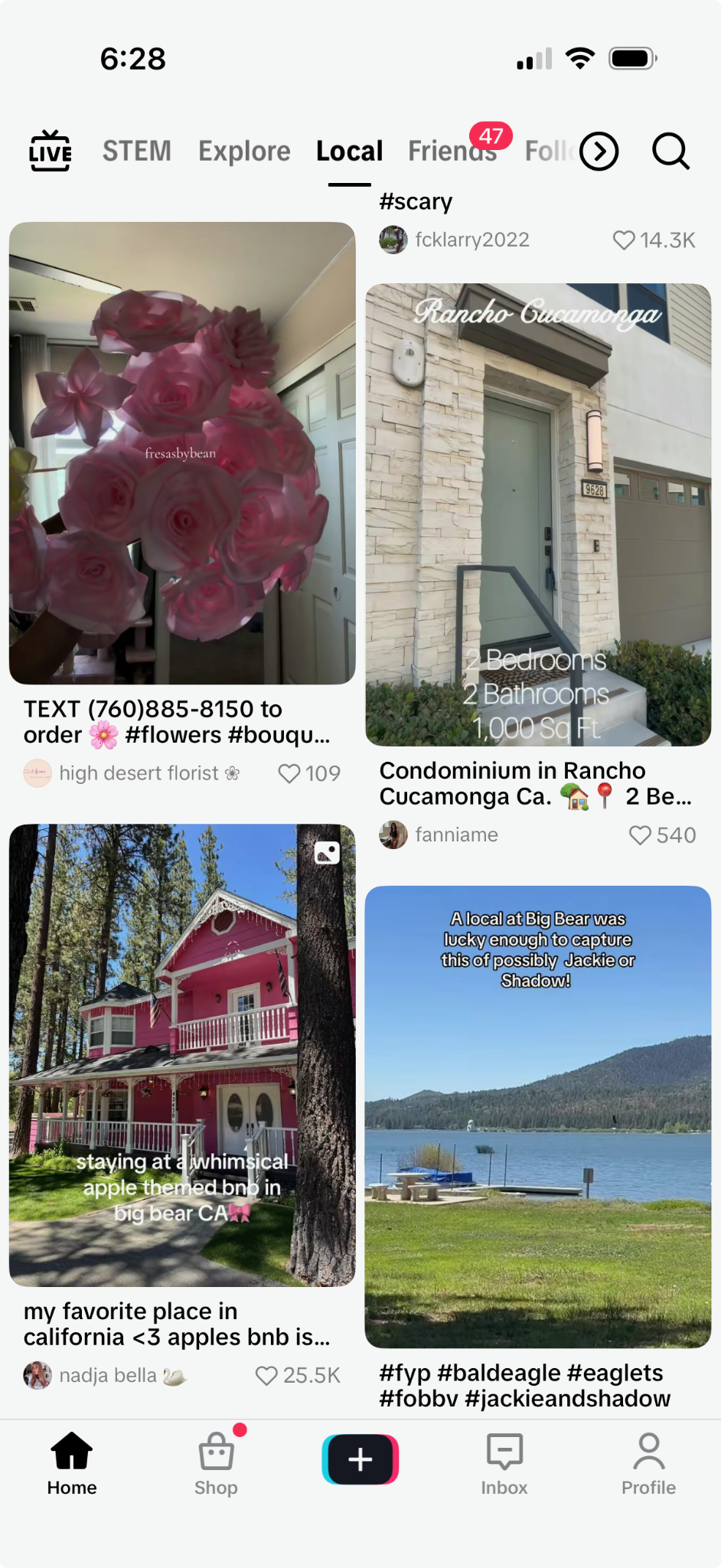
TikTok launched Local Feed in the U.S. on Feb. 11 as a home-screen tab for nearby content related to travel, events, restaurants, shopping, small businesses, and local creators. TikTok says posts can appear based on location, topic, and when the content was published.
I see Local Feed as another organic discovery touchpoint, especially for local businesses. A restaurant can appear while someone is deciding where to eat nearby. A wellness club can show up when someone is looking for weekend plans. A venue can answer practical before-you-go questions before a guest ever reaches the box office.
There are limits I would keep in mind. TikTok precise location setting is optional, off by default, available only for users 18 and older, and still rolling out across the U.S. TikTok also says private accounts, accounts for users under 18, and posts limited to Friends or Only You will not appear in Local Feed.
Local Explorer Shows TikTok Is Investing in Places
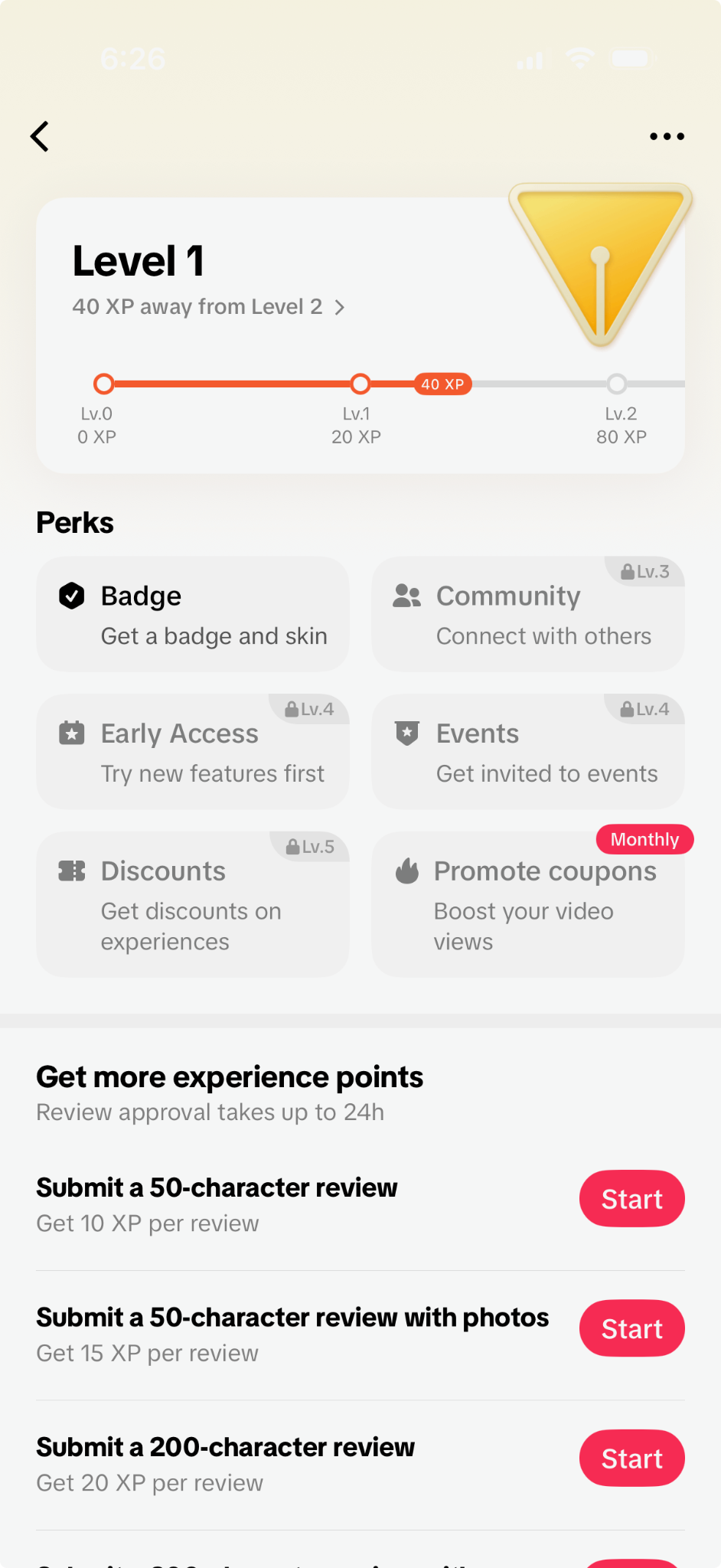
TikTok Local Explorer Program is one of the clearest signs I have seen that the platform wants to build stronger place-based discovery. The program encourages people to submit location-based reviews and rewards participation with experience points, levels, badges, community access, and other perks.
I would not assume every market has the same access or level of activity, because availability has been limited and uneven by region. Still, the direction matters: TikTok is building more ways for users to evaluate places inside the app.
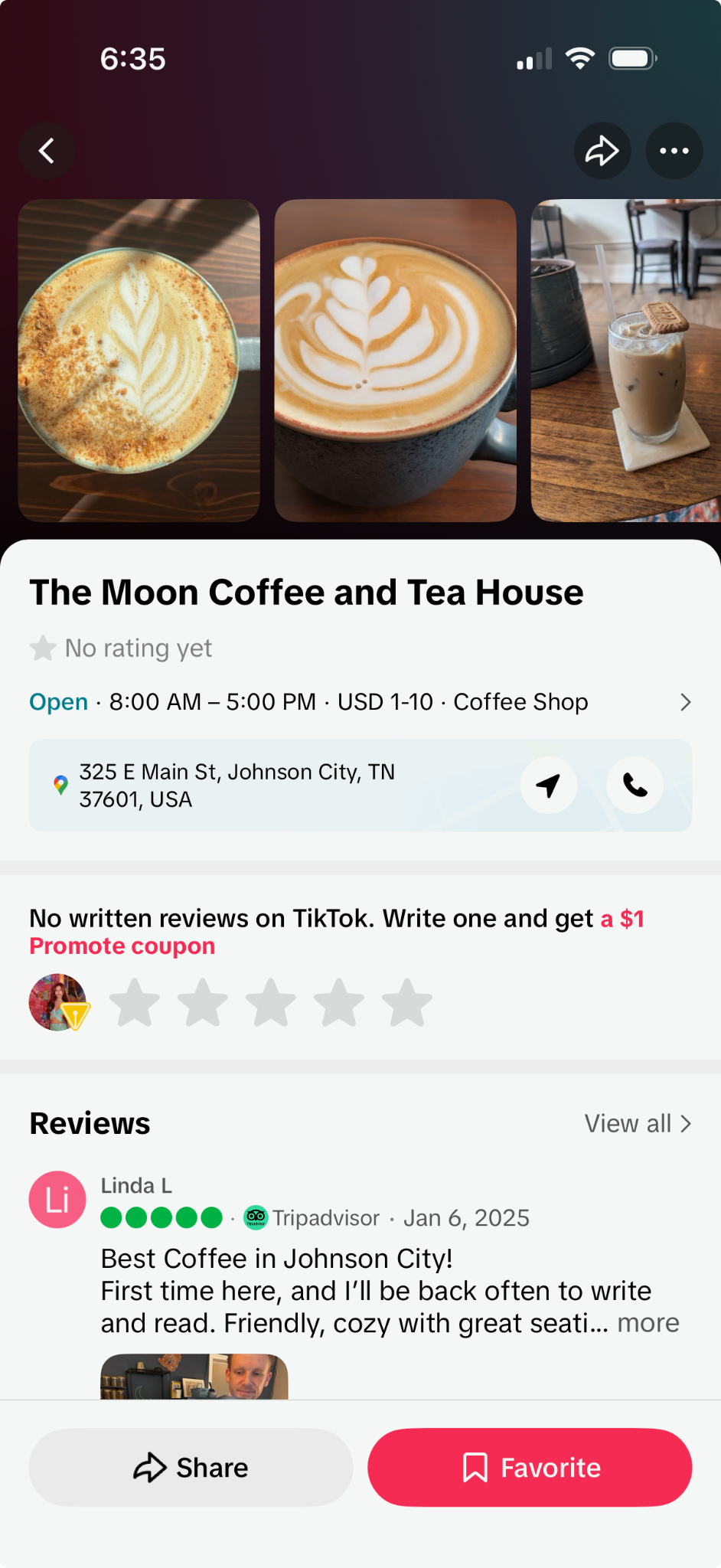
I have also seen TikTok incentivize reviews for places that do not already have TikTok reviews. In one example, a coffee shop had no TikTok reviews, and I was offered a $1 Promote coupon to leave one.
When a place does not have native TikTok reviews, I have seen TikTok pull reviews from TripAdvisor and, in some cases, Google. That makes the Places tab a useful comparison surface where people can evaluate reviews, videos, and comments before deciding whether to visit a local business.
Visual Search Links Matter More Than Exact Keywords
TikTok increasingly adds automated search links and related query prompts beneath videos. I pay attention to these because they show how TikTok can connect a video to a broader topic, place, or product discovery path.
For example, a video about a place like Glen Ivy may show a search bar at the bottom that lets users explore more related content. Those search bars can appear even when a creator has not overloaded the description with exact-match keywords, which tells me TikTok is reading more than just captions.
TikTok Shop Turns Discovery Into Buying
With TikTok Shop, someone can see a product in a video, search for it, compare it through comments and creator content, and buy it without leaving the app. That makes TikTok more than a discovery channel for ecommerce brands; it can become part of the full purchase path.
I would optimize TikTok Shop content around the information TikTok needs to understand a product. Search relies heavily on how well a shopper query matches product information such as titles, categories, attributes, and content context.
TikTok Shop has also released Shoppable Photos in beta for select sellers. Eligible sellers can create image-based posts, include multiple photos, and tag products directly in the post. These posts may appear in the For You feed, Search, and the Shop tab, giving sellers a simpler way to showcase inventory without producing a full video.
AI Is Becoming Part of TikTok Discovery
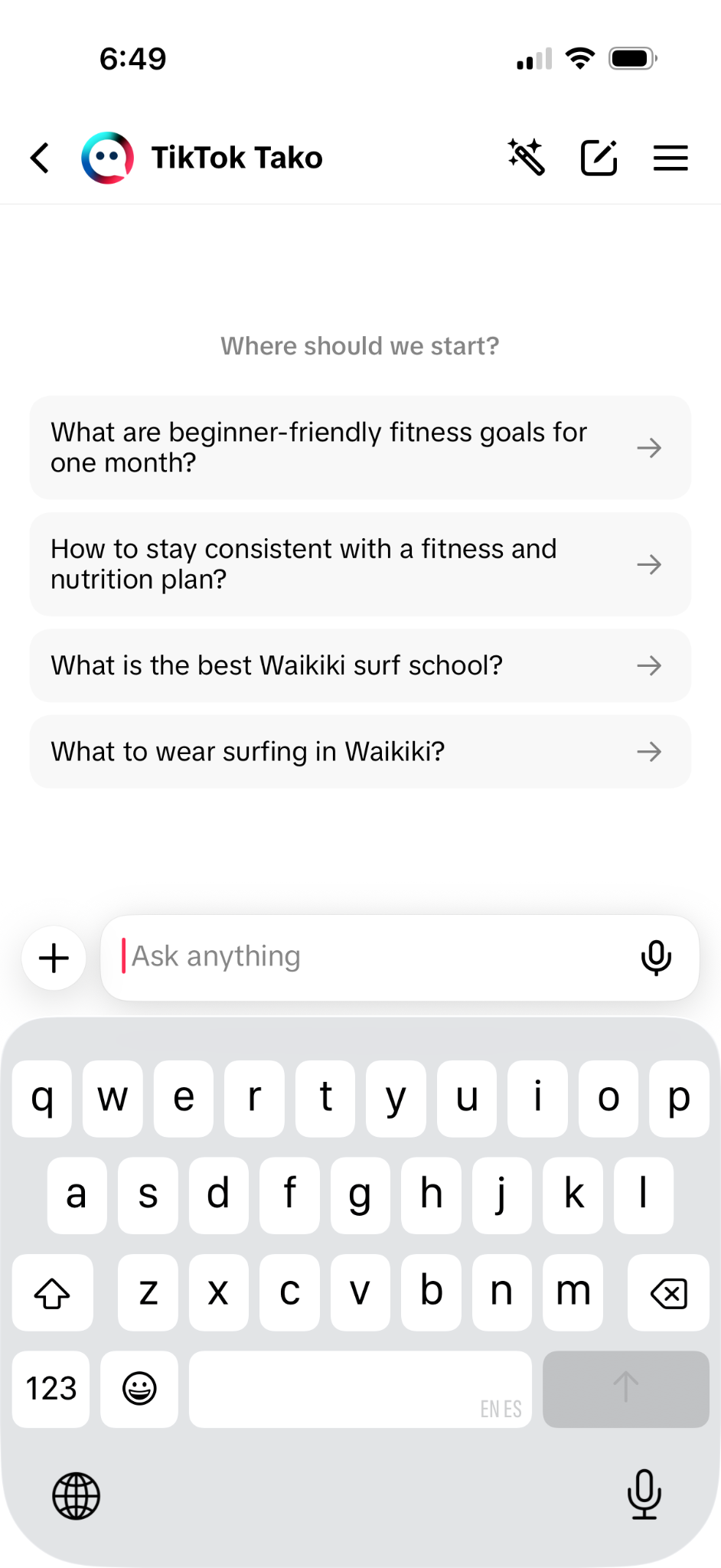
I am also watching TikTok AI-assisted discovery features closely, even though availability varies by market, account, and test. Features such as Tako, AI Overviews, Quick Highlights, AI summaries, and Content Studio all point in the same direction: TikTok wants to help users search, summarize, and create faster.
Tako is TikTok chatbot, and it lets users search in a way that feels similar to using the app search bar. It can surface relevant TikTok videos and external sources, including articles.
TikTok also now offers AI Overviews for some searches. When users search a topic, they may see an AI-generated summary of the results. If they click a visual search bar, they may also see Quick Highlights that summarize that search experience.
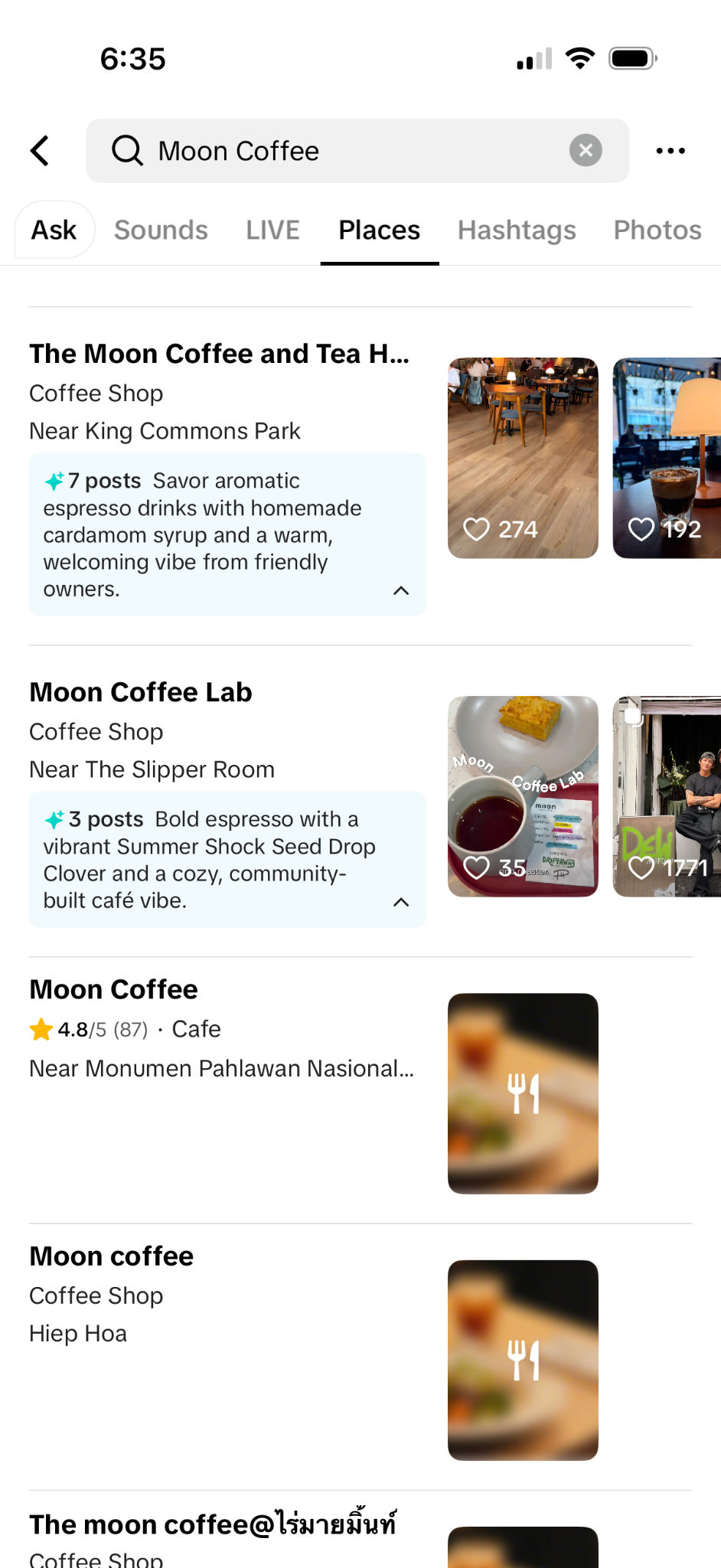
The Places tab includes AI summaries too, and users can see how many posts were used to generate a place summary. For local businesses, that makes the quality and clarity of creator posts, customer videos, and reviews even more important.
On the creator and seller side, TikTok AI tools can help generate captions, hashtags, and even videos. I would treat these tools as helpful support, not a substitute for real strategy, because features like Content Studio are still not available to everyone and remain in testing.
How I Would Improve Visibility on TikTok
On TikTok, visibility comes from what people search for, what TikTok can understand, and what the camera actually shows. That means I would focus less on cleverness and more on showing people what they need to see before they choose a business, product, or place.
For restaurants, I would show menu items, exterior signage, the dining room, takeout packaging, seasonal dishes, and neighborhood cues. Those visuals help both users and TikTok understand what the place offers and where it fits.
For retail, I would show product displays, packaging, try-ons, shelf layout, gift ideas, and the storefront. The more clearly a video communicates what is available, who it is for, and where someone can get it, the stronger the discovery signal becomes.
I would also build simple habits into every TikTok content workflow: use location context naturally, show products clearly, show the storefront or interior when relevant, mention the city or neighborhood when it helps, create timely content around local moments, tag the physical location when appropriate, and work with creators who already understand discovery-driven content.
Keyword Research
I would start TikTok keyword research inside the app because that is where the search behavior is happening. Seed topics might include best brunch, World Cup outfits, things to do in [location], wedding inspiration, or gluten-free bakery.
From there, I would search each phrase on TikTok, document autocomplete suggestions, review suggested filters, look for Others searched for prompts, study top videos, and pay close attention to comment themes. I would also test city and neighborhood modifiers, then compare TikTok findings with Google Search Console, Google autocomplete, Reddit, YouTube, and site search data.
TikTok Creator Search Insights can add another useful layer by showing personalized information about search topics, content gaps, and how content tied to searched topics is performing.
Keyword Placement
I would place the core topic where TikTok and viewers can recognize it quickly: in the first few seconds of the video, the first text overlay, the opening of the caption, relevant hashtags, location tags, pinned comments, reply videos, the profile bio, playlist names, and creator briefs.
Comments and Reviews
I would treat comments and reviews as visibility assets, not afterthoughts. That means pinning genuinely helpful comments, replying to repeated questions with videos, correcting misinformation when trust is at stake, watching for recurring objections, and turning repeated questions into FAQs, landing page content, Google Business Profile posts, and future videos.
A creator saying that a bakery is the best gluten-free option in Portland because it takes cross-contamination seriously may be more useful than a generic five-star review. That kind of specific language can shape website copy, FAQ strategy, and customer messaging.
Referral Traffic and Branded Search
I would track TikTok referral traffic and monitor branded searches over time. When a TikTok post performs well, I would annotate it and compare branded search trends against a baseline.
I would look for directional movement in branded clicks, branded impressions, TikTok referral traffic, Google Business Profile actions, and engagement on related pages. At the same time, I would avoid giving TikTok credit for every increase without considering PR, paid campaigns, email, promotions, seasonality, and other marketing activity.
Attribution may never be perfect, but imperfect measurement does not make TikTok influence meaningless. I would rather measure directional impact than ignore a channel that is clearly shaping discovery behavior.
I Would Explore TikTok Instead of Ignoring It
Someone may find a business on TikTok before they ever search for its name on Google or ChatGPT. Someone else may turn to TikTok midway through the journey to decide whether the business is worth the trip, the purchase, or the recommendation.
Either way, I believe TikTok has earned a meaningful role in modern SEO strategy. Between Local Feed, Places, Tako, AI summaries, creator reviews, and TikTok Shop, the platform keeps adding new ways for businesses to be discovered, and many of those opportunities are still underused.
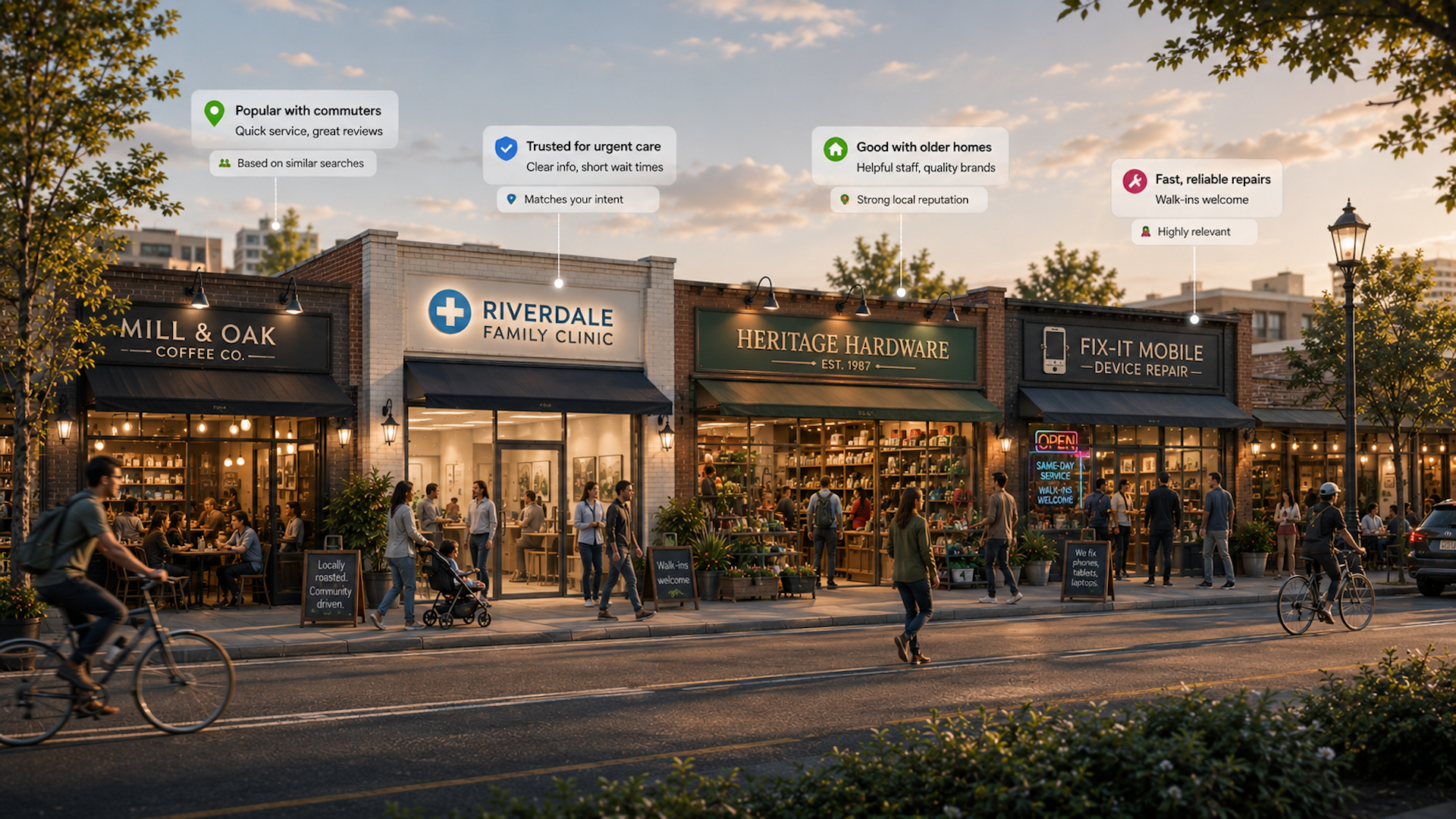
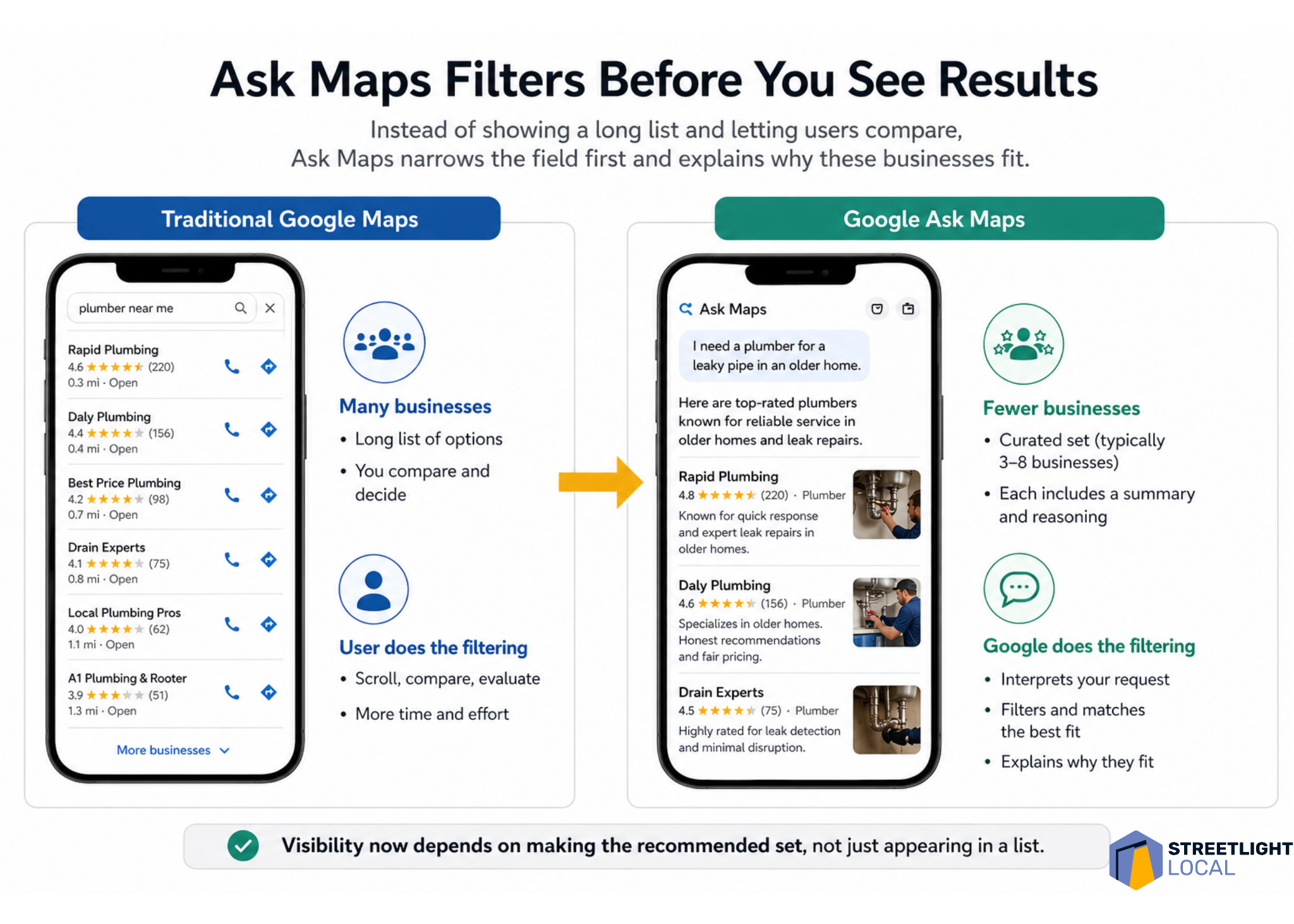
I see Google Ask Maps changing local visibility in a meaningful way. Instead of showing people a long list of nearby businesses and leaving them to sort through everything, Ask Maps narrows the options, interprets the searcher’s intent, and explains why certain businesses look like a strong fit.
That changes how I think about local SEO. Visibility is no longer only about ranking somewhere near the top of a long results list. It is increasingly about whether Google understands a business well enough to recommend it with confidence.
I would not treat Ask Maps as a separate optimization channel or a brand-new tactic to chase. I would focus on making the business easier for Google to understand, easier to match to real customer situations, and easier to trust. The foundations of local SEO still matter, but the way those signals work together matters even more.
Visibility in Ask Maps starts with filtering
One of the first things I notice about Ask Maps is how small the result set can be. In testing, it often showed around three to eight businesses, depending on the query. That feels very different from traditional Google Maps, where people can scroll through dozens of options and compare them on their own.
With Ask Maps, much of that comparison happens earlier. Google filters the market first, interprets what the person is really asking for, and then presents a smaller group of businesses with an explanation of why each one fits.
That means I have to think beyond the question of whether a business ranks. I also have to ask whether Google has enough confidence to include that business in a short recommendation set and explain why it belongs there.
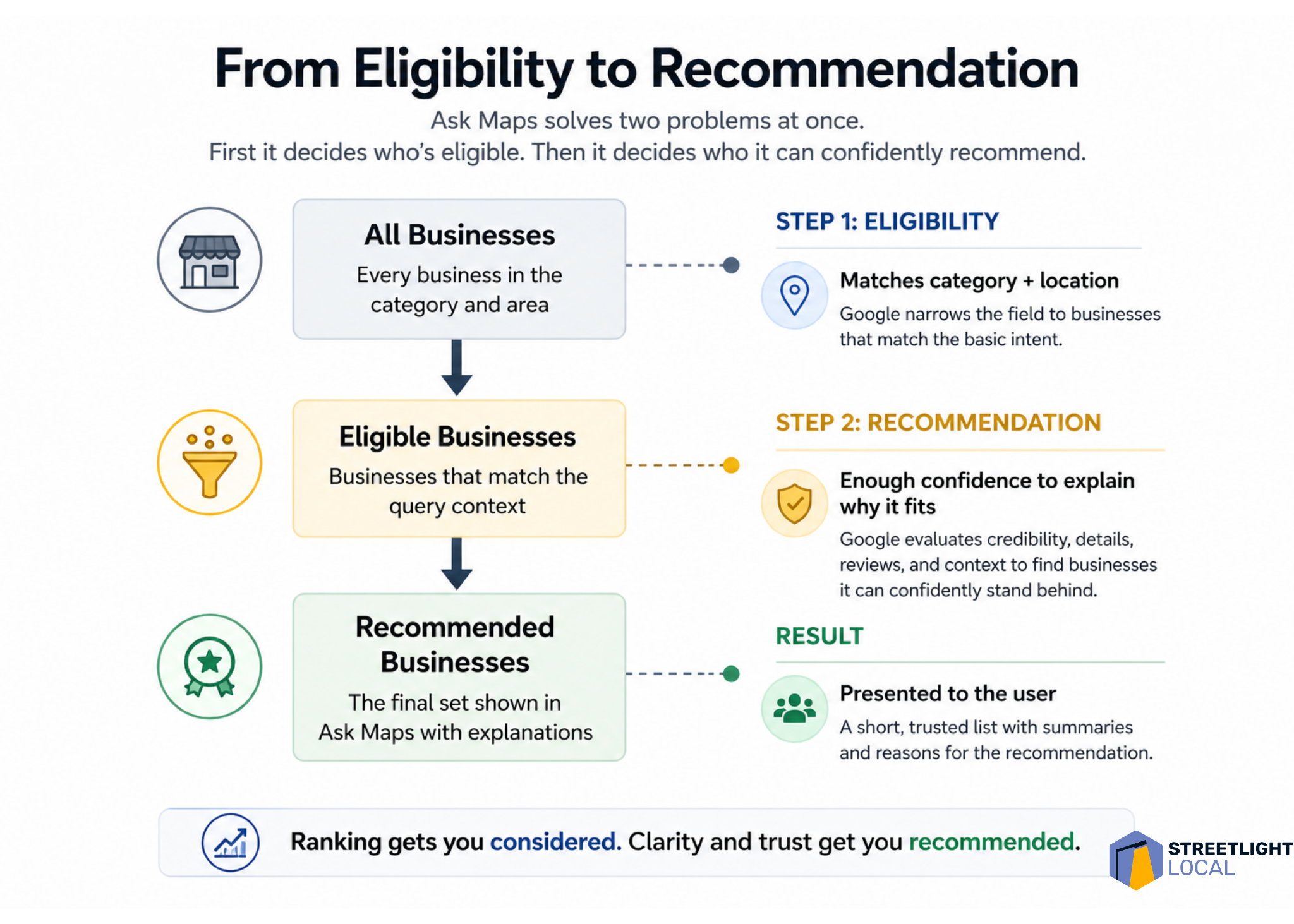
I think of this as a two-step problem. First, Google decides which businesses are eligible for the query. Then, it decides which eligible businesses it can confidently recommend.
Ask Maps needs enough detail to explain the business
Ask Maps does more than list businesses. It interprets and describes them. Even for simple searches, I often see businesses framed around qualities such as responsiveness, experience, specialization, professionalism, or the kinds of situations they seem best suited for.
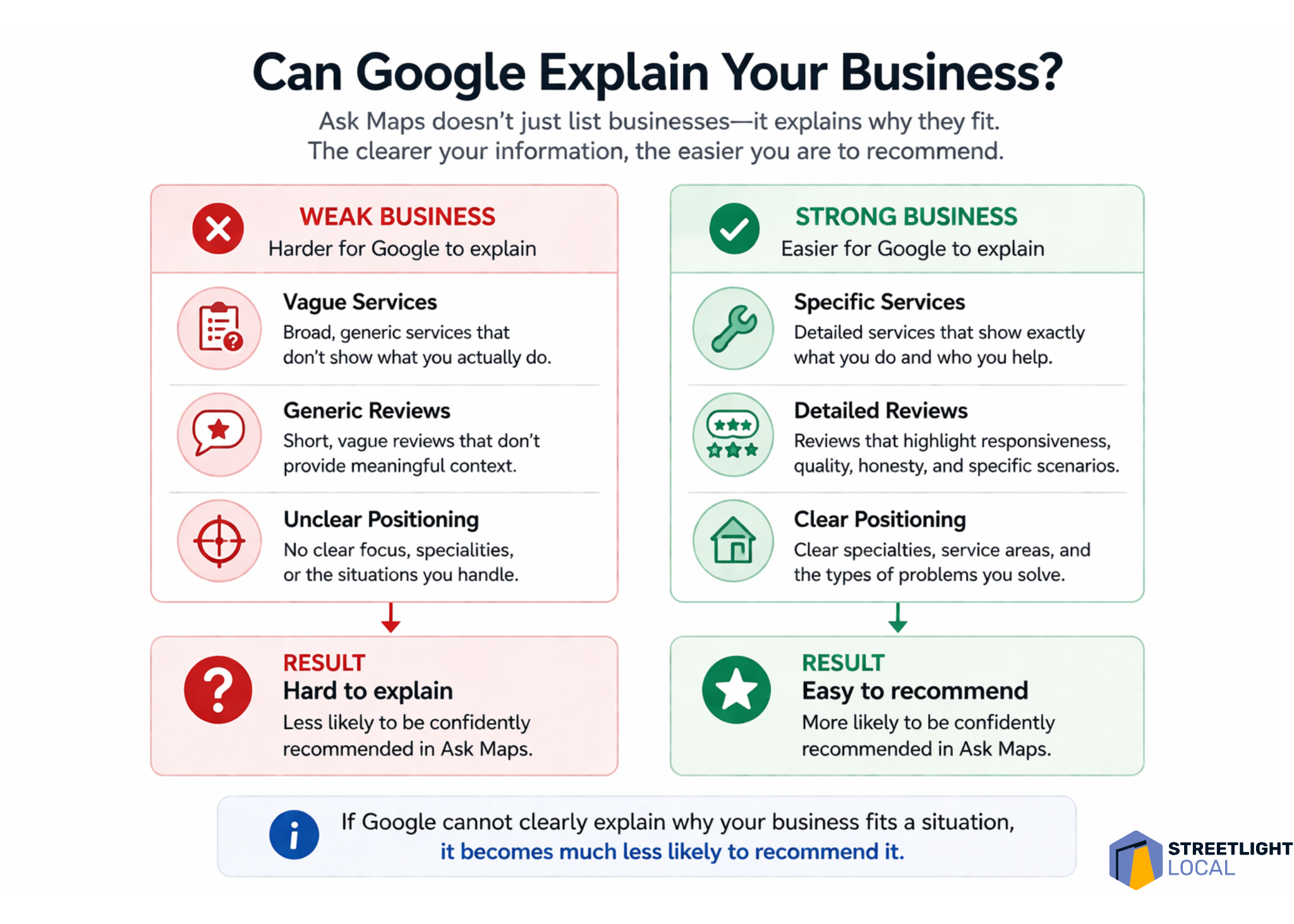
That creates a different optimization challenge. It is not enough for Google to know that a business exists or that it offers a basic service. Google needs enough information to answer a more practical question: when should this business be recommended?
To support that, I want Google to understand the types of jobs the business handles, the situations it commonly deals with, the concerns customers usually have, and how the business approaches those situations.
If that information is vague, scattered, or inconsistent, Ask Maps has less to work with. When Google cannot clearly explain why a business fits a specific situation, I would expect that business to be less likely to appear as a recommendation.
Google Business Profile becomes the identity layer
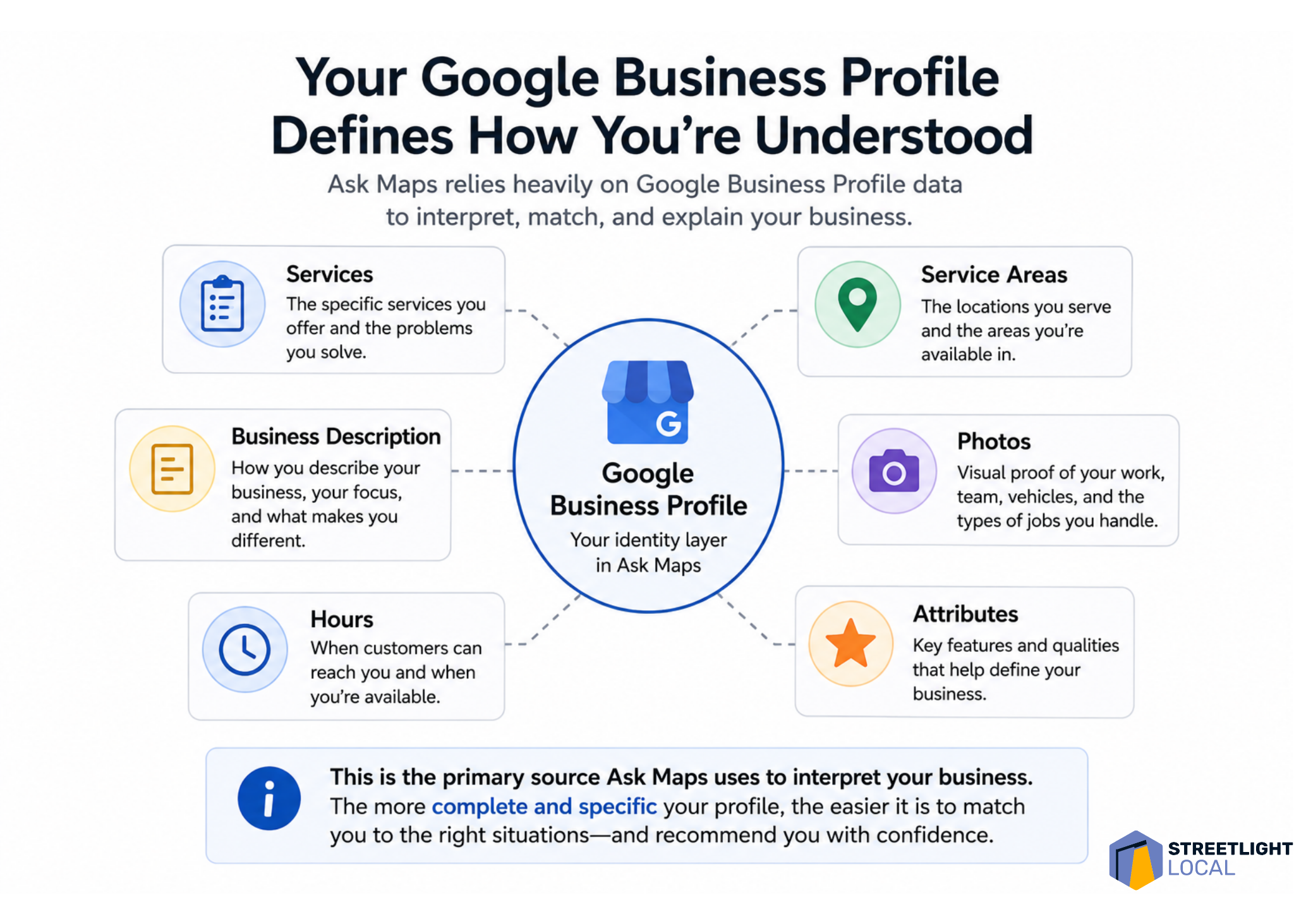
For me, the Google Business Profile sits at the foundation of this whole process. In earlier-stage queries, Ask Maps appears to rely heavily on profile data, including business descriptions, services, reviews, ratings, hours, and operational details.
Many businesses still treat their profile like a basic listing to fill out and keep current. That is necessary, but I do not think it is enough for an environment where Google is trying to describe and recommend businesses. The profile needs to communicate a clear, specific identity.
A generic profile might say that a business offers plumbing, HVAC, electrical work, or another broad service. A stronger profile clarifies the kinds of problems it handles, the situations it is built for, and the details that make it useful to specific customers.
For example, I would use the profile to reinforce details such as emergency availability, response times, specific repair or installation types, experience with older homes, complex systems, or common customer problems the business solves.
That level of specificity gives Google more direct evidence. Instead of forcing the system to infer what the business is known for, I want the profile to make that identity clear.
Reviews shape positioning, not just credibility
Reviews have always mattered in local search, but I see them playing a more structured role in Ask Maps. Review language can show up in the way Google describes a business, especially around themes like responsiveness, honesty, communication, professionalism, and quality of work.
That tells me reviews are doing more than supporting credibility. They are helping define how the business is positioned.
I would still pay attention to rating, volume, and recency. But I would also look closely at what customers actually say. The language inside reviews can give Google useful context about what the business does, how it works, and what customers value about the experience.
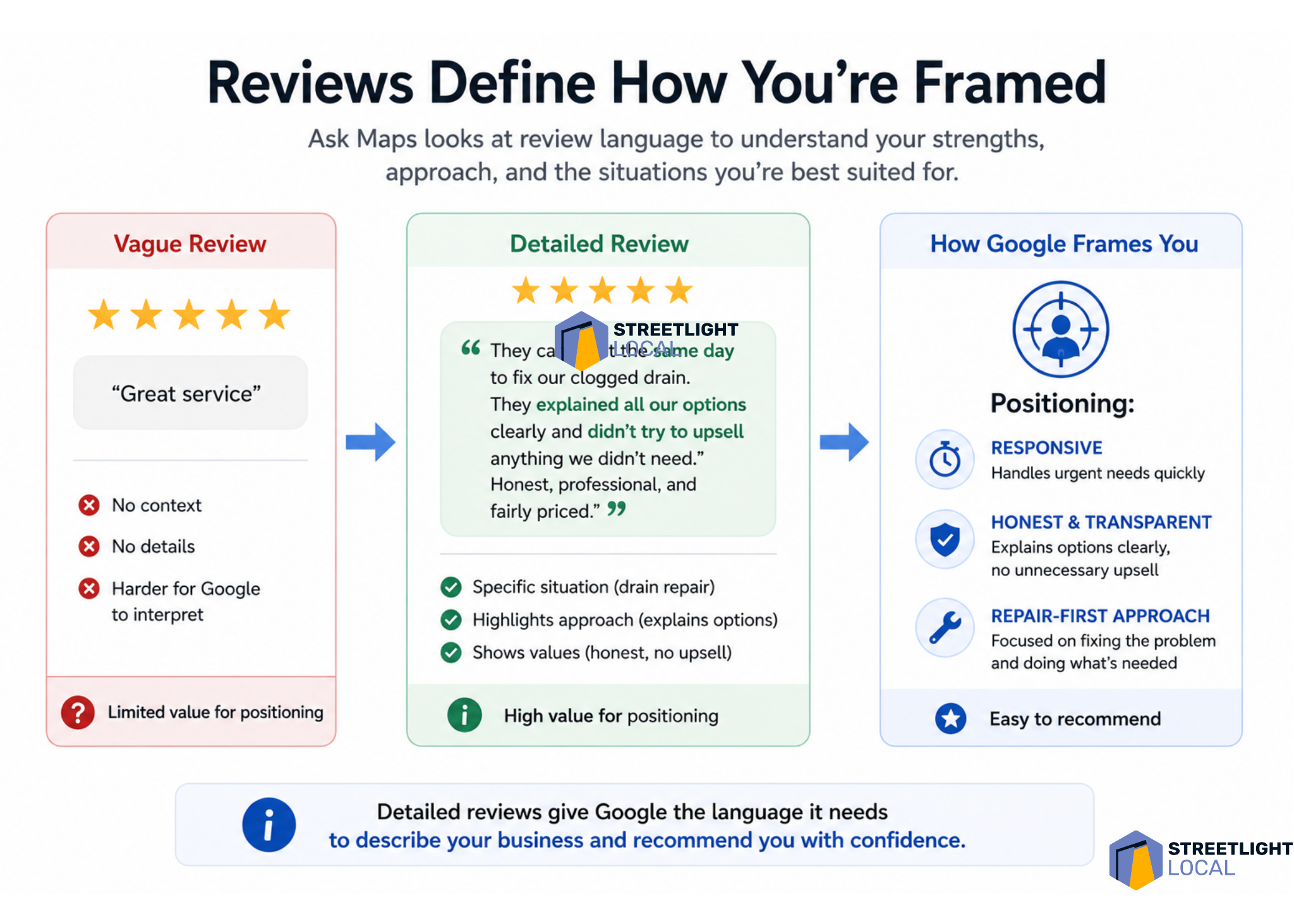
A vague review such as “great service” signals satisfaction, but it does not explain much. A detailed review that mentions a same-day response, a drain backup, clear communication about options, and a repair-focused solution gives Google several stronger signals about the business.
Over time, those patterns accumulate. In that sense, I view reviews as one of the main ways Google learns what a local business is known for.
Website content matters more when decisions get harder
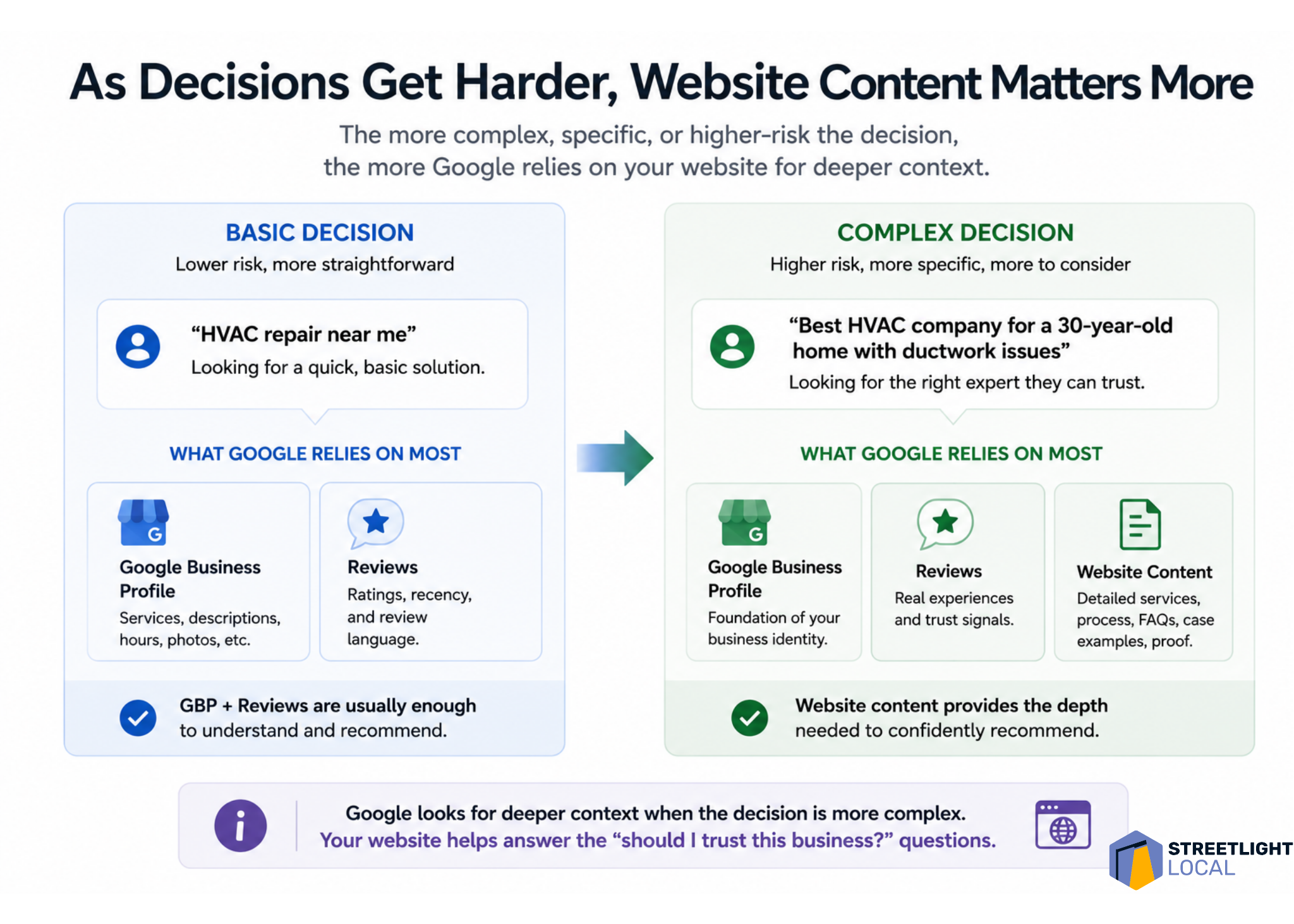
I also see website content becoming more important as queries become more complex. For basic service searches, the Google Business Profile and reviews may carry a lot of the weight. But when the search involves higher cost, uncertainty, or trust, Google appears to look for deeper supporting evidence.
That is where the website can help. Many service pages explain what a business offers and why it is qualified. That still matters, but it does not always match how people search when they are trying to make a difficult decision.
In more situational searches, people are not just looking for a service. They are trying to understand a problem, compare options, reduce risk, and decide what to do next.
That is why I would build content around the customer’s situation, not just around the service name. Stronger pages explain what leads to the problem, how to recognize it, what options are available, how to think through the decision, and what outcomes to expect.
For example, a furnace repair page can go beyond a basic list of services. It can cover common symptoms, when repair makes sense, when replacement might be worth considering, and how a homeowner can evaluate the decision. That kind of content lines up more closely with the prompts Ask Maps is trying to interpret.
I also see a strong fit for jobs-to-be-done pages. Instead of organizing every page around a service category, I would create pages around the situation the customer is trying to solve and the decision they are working through.
Trust signals matter more as risk increases
As searches move from simple service needs into decision-making, trust becomes more important. When people mention cost, honesty, uncertainty, or fear of making the wrong choice, Ask Maps tends to highlight qualities such as transparency, fairness, careful workmanship, and clear communication.
That makes sense to me because it reflects how people actually think in those moments. When someone faces an expensive repair or an unexpected issue, they are not only asking who can do the work. They are asking who they can trust to handle it correctly.
I would support that trust with evidence across the business’s online presence. Reviews can show that customers felt respected and informed. Website content can explain the process. Examples of completed work can show experience. Clear “what to expect” sections can reduce uncertainty.
The higher the perceived risk, the more supporting evidence matters. I want Google to see a consistent pattern that the business explains options clearly, avoids unnecessary pressure, handles similar situations, and leaves customers confident in the outcome.
Detailed customer reviews do more than boost ratings. They give Google Ask Maps the context it needs to understand, position and confidently recommend a local business.
External signals should reinforce the same story
For more complex or trust-heavy queries, Ask Maps may look beyond the Google Business Profile, reviews, and website. Third-party platforms, directories, and other public sources can help reinforce how Google understands a business.
I do not take that to mean every external mention is equally important. I take it to mean consistency matters. If a business is described one way on its website, another way in reviews, and differently across directories or social platforms, the overall picture becomes harder to interpret.
When those signals align, they strengthen each other. Business descriptions, services, customer experiences, types of work handled, and overall positioning should tell the same story wherever they appear.
From a practical standpoint, I would not try to appear on every possible platform. I would make sure the important sources are accurate, credible, and consistent.
I would optimize for evidence, not just keywords
As local search decisions become more specific and higher risk, Google needs deeper signals from business profiles, reviews, and website content to recommend the right provider.
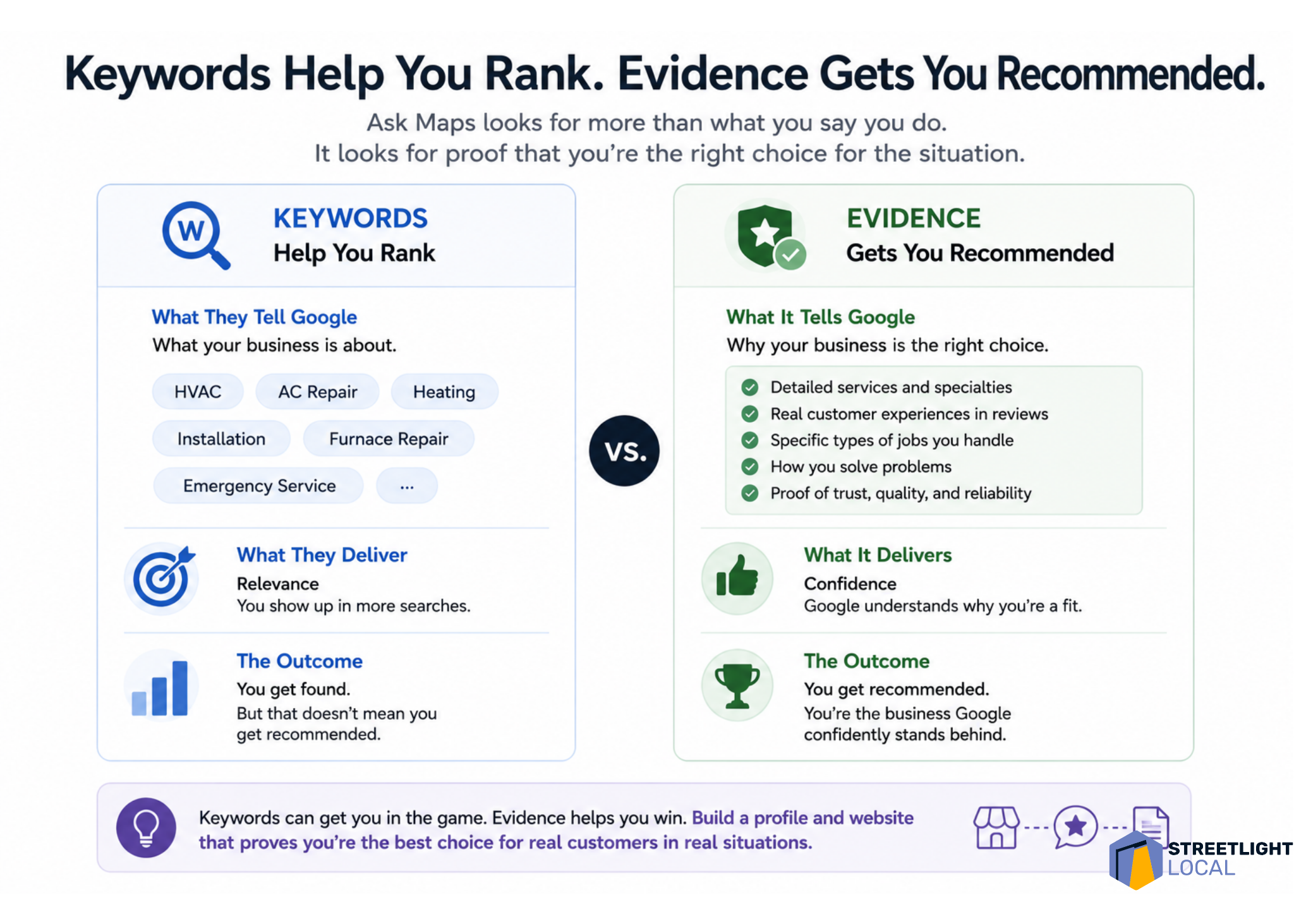
Taken together, these patterns push me to think differently about optimization. Traditional local SEO often starts with keywords and rankings. Those still matter, but they do not fully explain what Ask Maps is doing.
I find it more useful to think in terms of evidence. For a business to be recommended, Google needs enough information to understand what it does, what types of jobs it handles, what situations it fits, how customers experience it, and whether it can be trusted in higher-stakes decisions.
Each source contributes something different. The Google Business Profile establishes the baseline identity. Reviews add real-world context. Website content provides depth and explanation. External sources help confirm the same picture.
Individually, none of those elements tells the whole story. Together, they create a clearer and more consistent understanding of the business. That is where the shift from ranking to recommendation becomes most obvious: keywords can support relevance, but evidence supports recommendation.
My practical framework for Ask Maps visibility
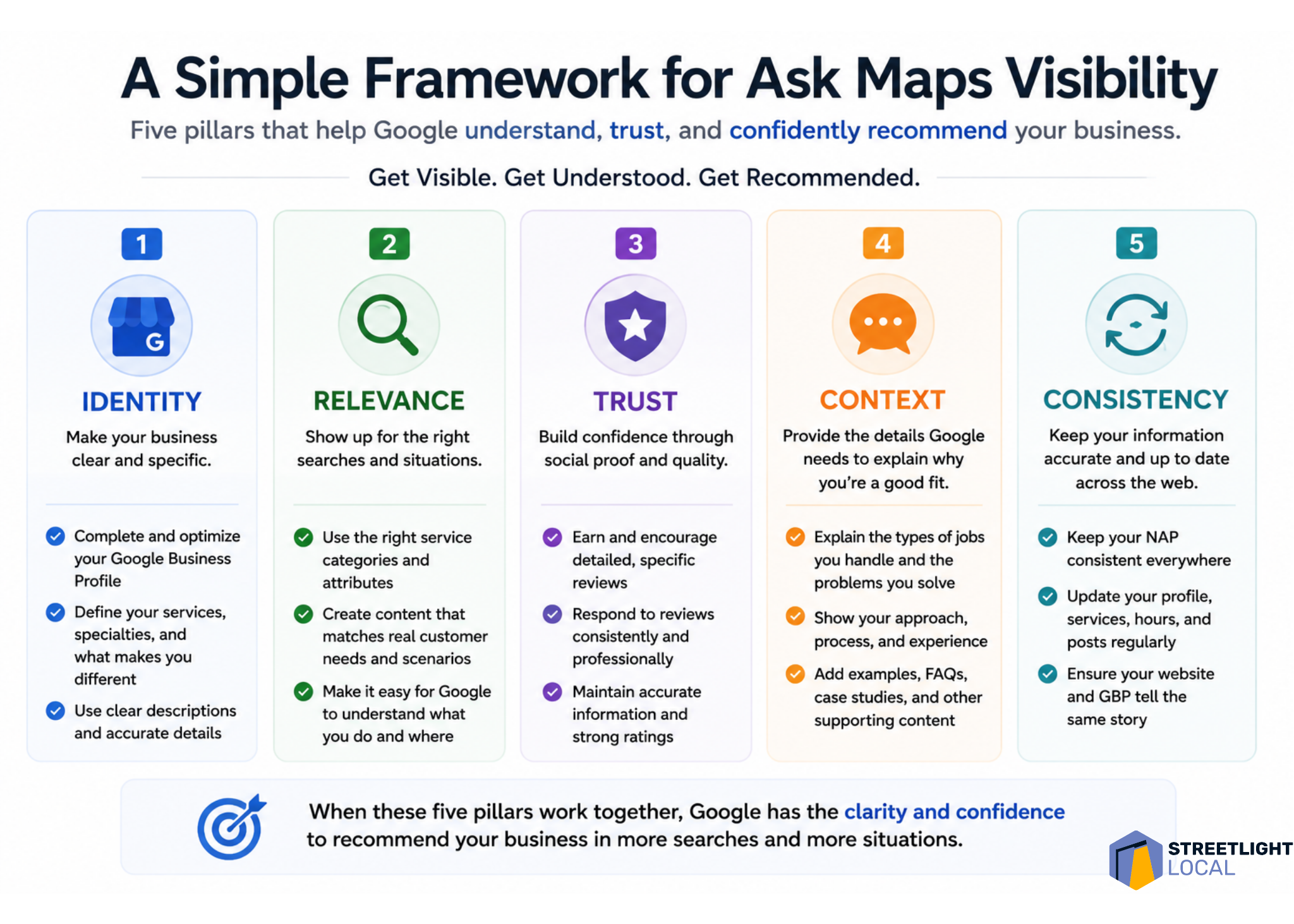
When I evaluate a business for Ask Maps visibility, I would look at five areas: identity, relevance, trust, context, and consistency.
Google Ask Maps rewards more than keyword relevance. This visual shows why reviews, service details, trust signals, and real proof help local businesses get recommended.
Identity asks whether Google can clearly understand what the business does and where it operates. Relevance asks whether the business can be matched to specific services and situations. Trust asks whether there is enough proof that customers feel confident choosing it.
Context asks whether the content reflects the decisions customers are actually trying to make. Consistency asks whether different sources reinforce the same understanding of the business.
I do not see this as a checklist to complete once. I see it as a practical way to evaluate how clearly and consistently a business is represented across the sources Ask Maps appears to use.
What I would avoid
With any new search feature, it is easy to overcorrect. I would avoid treating Ask Maps as an isolated channel that needs thin content, unnatural profile language, generic service-page duplication, or review language that feels forced.
Those tactics may create more content, but they do not necessarily create more useful evidence. The better approach is to align more closely with how customers actually search, evaluate options, and make decisions.
A practical local SEO framework shows how businesses can earn visibility in Google Ask Maps by clarifying identity, proving relevance, building trust, adding context, and staying consistent online.
When the business presence reflects real customer needs clearly and consistently, it naturally creates the kinds of signals Ask Maps seems to rely on.
What I still do not know about Ask Maps
I would treat all of this as directional, not definitive. Ask Maps is still being tested and refined, and the system is not fully documented.
The result structure can vary by query and test environment. The feature’s usability is also still changing. In many cases, users may still need to click into a Google Business Profile to call, book, or engage, rather than acting directly from the Ask Maps response.
Measurement is another open issue. Right now, I do not see a clean way to isolate Ask Maps visibility or performance inside standard reporting tools. That makes it difficult to attribute calls, traffic, or conversions directly to this experience.
I also would not assume the same signal weighting applies to every query. Google Business Profile data, reviews, website content, and external sources may all matter, but their relative importance likely changes based on the search intent and the complexity of the decision.
The real shift is from ranking to recommendation
I see Ask Maps as a version of local search where retrieval, evaluation, and decision support are moving closer together. Instead of making users search, compare, research, and decide across several steps, Google is trying to guide more of that process inside one experience.
That changes the meaning of visibility. In Ask Maps, it is not enough for a business to simply appear. The business needs to be understood well enough for Google to explain why it fits the situation and trusted enough to be recommended.
For businesses and SEOs, I would not respond by chasing a narrow trick. I would build a clearer, more complete, and more consistent representation of the business across the sources that shape Google’s understanding.
The businesses most likely to benefit are the ones that are easiest to interpret, easiest to trust, and easiest to match to real-world customer needs.
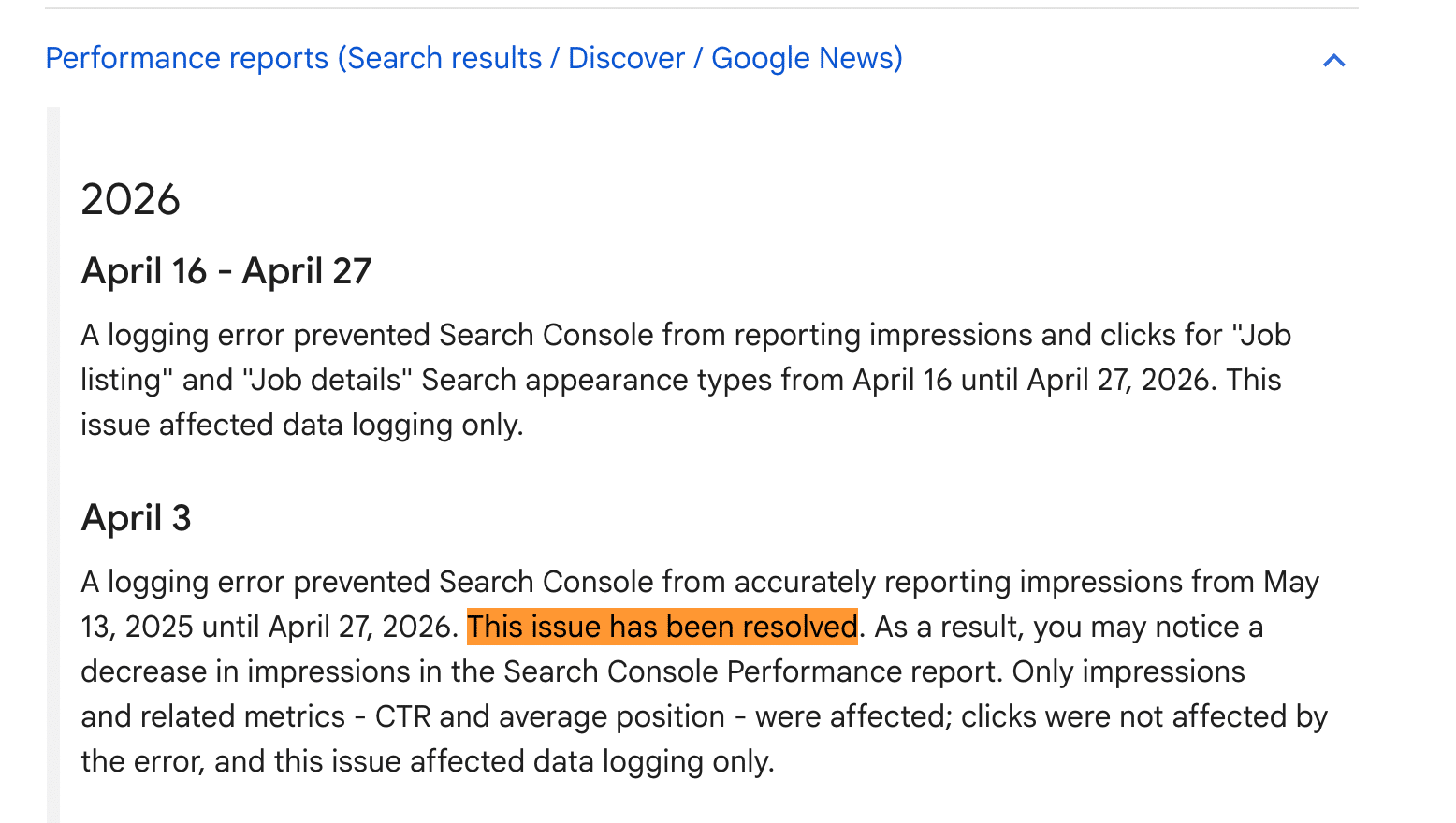
It feels like a moment of relief as Google recently announced a resolution to a longstanding data logging issue within Google Search Console. This glitch affected data between May 13, 2025, and April 27, 2026, spanning approximately 50 weeks. However, it’s important to note that while the root cause has been addressed, historical data from this period remains unfixed.
Google shared this update in a rather understated post, bringing light to a problem that many of us have been grappling with for quite some time. According to their post, “A logging error prevented Search Console from accurately reporting impressions from May 13, 2025, until April 27, 2026. This issue has been resolved.” It was a relief to hear, but also a bit frustrating knowing that impressions, CTR, and average position data were affected for such a significant period. Thankfully, clicks weren’t influenced by this error, which was some consolation.
As I sift through my Search Console data, I must remind myself of this anomaly, particularly when analyzing metrics from that problematic timeframe. The good news is that any data collected from this point forward should be accurate.
Further confirmation came from John Mueller on Bluesky, who reiterated that past data would not be retroactively corrected, but the issue has indeed been resolved going forward.
This development is crucial for all of us who rely heavily on precise data for SEO strategies. If your impressions appear lower and, consequently, your CTR and average position figures seem skewed during this period, this is likely why.
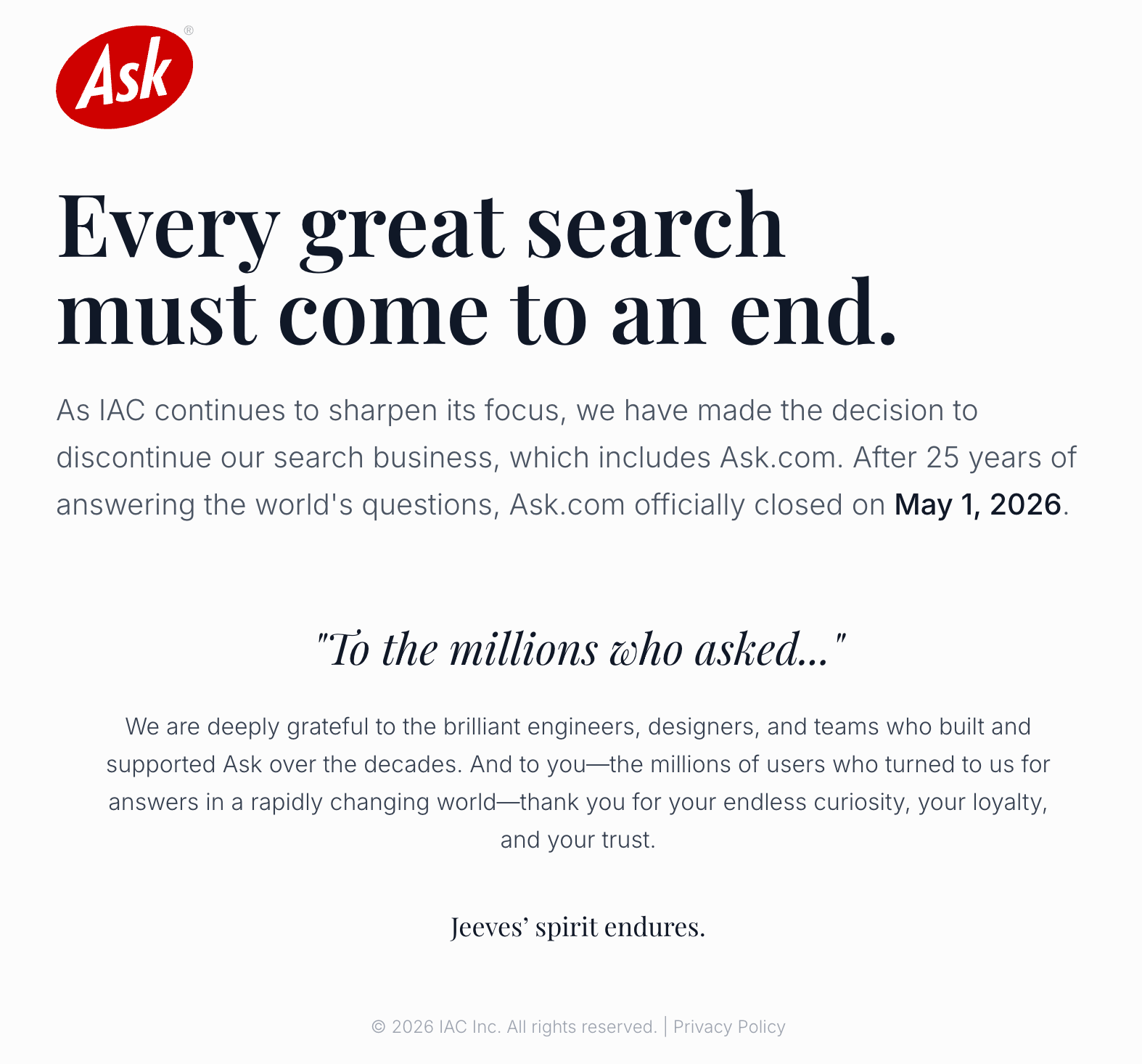
As someone who has been on the internet exploration journey for years, today’s news hits home. Ask.com, which many of us fondly remember as Ask Jeeves, officially closed down on May 1, 2026, after a remarkable 29 years of service. It launched on June 3, 1996, even before Google made its debut.
Upon visiting the now-closed Ask.com, we are greeted with a heartfelt farewell message that feels like a trip down memory lane:
Every great search must come to an end. As IAC continues to sharpen its focus, we have made the decision to discontinue our search business, which includes Ask.com. After 25 years of answering the world’s questions, Ask.com officially closed on May 1, 2026.
I can’t help but feel gratitude as they graciously acknowledge, “To the millions who asked…”. They expressed appreciation for the brilliant engineers and loyal users who have been a crucial part of their journey. And yes, Jeeves’ spirit indeed lives on.
For those of us who relied on this answer engine in its early days, Ask.com and the iconic Jeeves butler will always hold a special place. In a world now dominated by AI and competitive answer engines, it’s understandable why IAC, the parent company, decided to step back in such a challenging market.
Ask.com has left a significant impact on the search marketing industry, and saying goodbye is indeed bittersweet. Until we meet again in some digital form, dear Jeeves.