Category: Opinion

  • Google UCP and SEO: How I’m Preparing for AI Commerce

    Google UCP and SEO: How I’m Preparing for AI Commerce

    Google's Universal Commerce Protocol changes the path from search to sale

    For as long as I’ve worked in search marketing, I’ve viewed the path to purchase as a simple sequence: search query → click → buy.

    I’ve approached SEO through much the same model, using organic traffic, impressions, and click-through rate (CTR) as the primary measures of success.

    Google’s Universal Commerce Protocol (UCP) tells me that this familiar path is changing. Google is evolving from a discovery engine into a transaction layer where searching and buying can happen inside the same experience.

    With the rise of “agentic commerce,” I’m seeing Google gain the ability to discover, evaluate, compare, and purchase products on a user’s behalf within AI-powered experiences such as AI Mode, Gemini, YouTube, and Gmail.

    I believe the SEO implications are substantial. Instead of optimizing only for clicks, I now need to think about optimizing for AI-assisted transactions. If a brand cannot communicate through UCP and the product data that supports it, it risks becoming invisible to the next generation of shoppers.

    Here’s how I understand UCP, why I think it will reshape digital marketing, and what I recommend doing now to prepare an SEO strategy for agentic commerce.

    UCP: The infrastructure behind AI transactions

    I think of UCP as an open-source, vendor-agnostic standard that supports the entire commerce lifecycle inside an AI interface. That lifecycle can extend from product discovery and cart creation through checkout, fulfillment, and post-purchase tracking.

    Google co-developed UCP with Shopify, Walmart, Target, Wayfair, Etsy, and other commerce leaders. From my perspective, it acts as a universal translator between AI shopping agents and the systems merchants use to operate their online stores.

    Google UCP - Pay with GPay

    The clearest analogy I can make is that UCP may become the ecommerce equivalent of HTTPS. HTTPS standardizes secure communication between browsers and servers; UCP standardizes how AI agents interact with online stores. Instead of building a custom one-to-one integration for every merchant, an AI agent can use a shared framework to browse inventory securely and complete purchases across many stores.

    How I see AI transactions flowing through UCP

    Imagine I ask AI Mode to “find and order a replacement water filter for a 2021 Samsung French-door fridge with the fastest shipping.” UCP can coordinate that transaction through a structured workflow.

    Capability publication

    First, I expect the merchant to publish the capabilities its store supports, including product search, live pricing, fulfillment options, and accepted payment methods. This gives the AI agent a clear picture of what it can request and complete.

    Three mobile screens show a Monos suitcase listing, Google Pay order review, and completed checkout through Google’s Universal Commerce Protocol.
    From product discovery to payment and confirmation, this mobile shopping sequence shows a Monos suitcase purchase completed with Google Pay through Google’s Universal Commerce Protocol.

    Handshake

    Next, the AI agent reads the merchant’s profile, compares those capabilities with its own, and establishes a secure path forward. I see this step as the point where the systems can align on details such as loyalty programs and supported digital wallets.

    Action execution

    Once the systems are aligned, the AI searches for the product, verifies real-time inventory, builds the cart, and uses the Agent Payments Protocol (AP2) to complete a secure, tokenized transaction.

    Human escalation

    If the transaction needs my input—perhaps to select a delivery window or confirm a shipping address—UCP can pause the process and prompt me. After I respond, control returns to the AI so it can finish the workflow.

    Dig deeper: How Google’s Universal Commerce Protocol could reshape search conversions


    Why I believe UCP matters for search and SEO

    I don’t see UCP as merely a technical update. I see it changing the way AI discovers, evaluates, and purchases products—and that makes it directly relevant to SEO.

    1. I’m shifting from click-throughs to buy-throughs

    In an agentic search environment, I can no longer treat website traffic as the only measure of business value. Features such as Universal Cart can let shoppers add products from multiple retailers to one Google cart and check out with Google Wallet, dramatically shortening the buying journey.

    A shopper may never visit my homepage, category page, or product detail page. That changes my SEO objective: I need to earn product selection within the AI recommendation layer so a search query can become a sale even when it generates no intermediate website visit.

    2. I’m planning for hyper-personalized queries

    I’m also rethinking keyword research. Shoppers are moving beyond broad searches such as “men’s running shoes” and using detailed, situational prompts like “Best running shoes for flat feet under $150 that can arrive by Friday.”

    To match a request that specific, I know a search engine needs more than polished on-page copy. It needs rich, structured, and queryable product attributes. UCP helps bridge that gap by giving AI agents a way to match merchant inventory with a shopper’s precise requirements.

    3. I expect less checkout friction

    I continue to see cart abandonment as a major ecommerce challenge, especially when shoppers encounter long forms, broken checkout flows, or unexpected shipping costs. Because UCP can work with secure digital wallets and automatically pass verified user data, I expect it to eliminate many of those friction points.

    Glowing blue streams of people converge on a search bar and digital portal, symbolizing SEO traffic, AI visibility, and customer acquisition.
    As AI reshapes search, every glowing path to discovery carries commercial value—turning SEO investment into a conversation about pipeline, risk, and customer acquisition costs.

    For high-intent, urgent, or repeat purchases, I believe merchants that support UCP may capture more conversions than competitors that send every shopper to a separate checkout experience.

    4. I can retain brand control and customer ownership

    One detail I consider especially important is that the merchant remains the Merchant of Record when a transaction takes place through UCP. I can still control pricing, fulfillment, and return policies while retaining the customer relationship and first-party data. UCP provides the transactional infrastructure without replacing the merchant’s role.

    Dig deeper: Winning the AI decision layer: From AI discovery to agentic commerce

    How I recommend preparing a brand for UCP

    If I limit an SEO strategy to blog articles and meta descriptions, I overlook the technical infrastructure that powers AI commerce. To make products eligible for UCP-powered experiences, I recommend focusing on the following priorities.

    I would optimize the Merchant Center feed

    I no longer view Google Merchant Center (GMC) as a tool used only for Shopping ads. I see it becoming a primary source of product information for AI discovery, which makes feed quality central to both visibility and transaction eligibility.

    • Enable the native_commerce attribute: To opt into UCP-powered checkouts, I would add the native_commerce attribute to the product feed. Google recommends using supplemental feeds to apply it at the product level without changing the primary feed.
    • Map product identifiers: I would make sure every product ID in the GMC feed maps one-to-one with the corresponding ID in the internal checkout API. If the identifiers differ, I would use the merchant_item_id attribute to align them.
    • Complete policy data: I would keep returns, shipping, and customer-support information complete and current. Clear policy data gives an AI agent the details it needs to evaluate a merchant confidently.

    I would align structured data with the product feed

    Because AI search depends on consistent information, I would keep the Product, Offer, and Review schema on the website synchronized with the Merchant Center feed. If the price, availability, identifiers, or other details conflict, validation problems could make a product ineligible for AI-powered checkout.

    I would prepare for conversational attributes

    As Google introduces semantic attributes designed for conversational AI search, I would prepare inventory and product-information systems to supply richer answers. In particular, I would prioritize:

    • Real-time inventory availability.
    • Direct answers to product FAQs, such as “Is this jacket machine washable?”
    • Detailed compatibility information, including accessory pairings, sizing guides, and model-specific replacements.

    I would treat these details as more than feed enhancements. They are the signals that help an AI agent decide whether a product satisfies a nuanced request involving price, fit, compatibility, delivery speed, or another real-world constraint.

    Beyond clicks: The next SEO opportunity I see

    To me, the Universal Commerce Protocol reflects a broader transformation in search. It expands the role of SEO beyond generating traffic and brings product data, inventory systems, checkout infrastructure, and conversion readiness into the search conversation.

    By prioritizing structured product data, reliable commerce information, and readiness for agentic transactions, I can position a brand to capture demand at the exact moment a shopper expresses intent.

    I don’t believe the future of search will be only about getting found. Increasingly, it will be about making sure the products I represent can be evaluated, selected, and bought.


    Inspired by this post on Search Engine Land.


    crushpress.ai community screenshot
  • How I Build a Powerful SEO Budget Case My CFO Can’t Ignore

    How I Build a Powerful SEO Budget Case My CFO Can’t Ignore

    You're losing the SEO budget conversation before you walk into the room

    If I walk into a budget meeting armed only with rankings, traffic, and keyword reports, I know I am making the wrong case. CFOs do not approve SEO budgets because channel metrics look encouraging. They approve investments that reduce business risk, improve commercial outcomes, and justify the way capital is allocated.

    As AI reshapes search economics and customer acquisition costs continue to climb, I believe translating SEO into business risk is becoming as important as the search strategy itself. This is how I prepare for that conversation before I enter the room.

    Why I see SEO budget conversations break down

    A global enterprise software company recently shared a revealing example with us, and I keep returning to it because it captures the problem so clearly.

    One of the company’s core product lines generated 291 inbound demo requests during a single month in 2008. In the corresponding month of 2026, it generated only 274. Nearly two decades later, and despite a digital marketing budget roughly eight times larger, the business was producing fewer qualified opportunities.

    I do not see that as a simple search strategy problem. I see it as a structural problem—and the CFO had already noticed it.

    The head of search entered the budget review with a 24-slide deck. Slide 3 documented ranking improvements. Slide 7 highlighted year-over-year organic traffic growth. Slide 12 outlined keyword opportunities.

    Every number was accurate, but none of them answered the question that mattered to the CFO: Why was the company spending more each year to generate roughly the same number of qualified opportunities?

    The CFO let the presentation continue. Then, at slide 19, she put down her pen and said, “This is all interesting. But I can’t see the connection to pipeline.”

    The head of search began to explain. The CFO looked toward the CMO, and the meeting was effectively over.

    The lesson I take from this is that many search leaders lose the CFO budget conversation before they enter the room. Their strategies may be sound, and their numbers may hold up, but they arrive speaking in sessions, rankings, and organic traffic share. That is not the language of financial decision-making.

    When I prepare for this kind of meeting, I assume the CFO wants to discuss the P&L, risk, payback periods, and opportunity cost.

    If I open with “organic traffic grew 23% year over year,” I risk telling the CFO, unintentionally, that I cannot connect my work to revenue. If the CFO has already seen cost per opportunity moving in the wrong direction, that disconnect does more than create skepticism. It creates a reason to cut the budget.

    The structural shift I diagnose first

    I start with the diagnosis before I discuss tactics. Without a clear diagnosis, everything else becomes a more polished way to lose the same argument.

    In 2008, paid search behaved like an undersupplied monopoly channel: high intent, limited competition, and relatively linear returns. A dollar invested could produce a reasonably predictable return. There was no AI layer absorbing clicks before they happened, no army of comparison aggregators siphoning away high-intent traffic, and no group of competitors with 18 years to build organic authority in the category.

    That environment is gone.

    Today, I operate in a search landscape where organic authority is fiercely contested. AI Overviews can intercept high-intent queries before users reach paid ads, while attribution models designed for the old environment are still being used to defend budgets in the new one.

    The message I bring to a CFO is not simply, “I need more budget,” or, “Our rankings are improving.” I explain that the structural conditions that once made search efficient have changed, show how those changes affect commercial performance, and present my plan for adapting.

    Why I do not lead with channel metrics

    I understand the temptation to showcase channel performance. After spending months building organic authority, improving rankings, and growing traffic, I naturally want that work to be visible. The problem is that presenting it without a commercial connection can undermine the very case I am trying to make.

    CFOs have been burned by marketing attribution models before. They have seen enough ranking charts and organic traffic reports to know that neither metric connects directly to the P&L without additional evidence.

    When I lead with channel metrics, I invite two immediate questions: “According to which model?” and “What does this mean for revenue?” Every slide that raises those questions before I have framed the argument spends some of my credibility.

    How I handle the counterfactual problem

    The deeper issue is the question I expect every CFO to bring into the room: “Would this revenue have happened anyway?”

    I consider that the hardest question in marketing attribution, yet many budget presentations never answer it. They treat the connection between organic performance and commercial outcomes as self-evident. It is not. A CFO who has watched the marketing budget expand for a decade while blended customer acquisition cost drifts upward is right to challenge that assumption.

    If I am asked, “How do we know those customers would not have found us anyway?” and I do not have a prepared answer, I have lost the thread. That is why I do not build my budget case on an attribution model I cannot defend under pressure. I build it around something much harder to dismiss: measurable business risk.

    Dig deeper: Stop paying for traffic: The enterprise CMO’s guide to ROI-driven SEO

    How I frame SEO as business risk

    I think of CFOs primarily as risk managers, not channel optimizers. Their job is to protect the business from downside scenarios, allocate capital efficiently, and prevent unpleasant surprises in the P&L.

    If I enter the room talking only about upside—what a larger budget might achieve—I am appealing to the wrong instinct.

    Instead, I lead with downside and focus on three risks that a CFO can price, model, and act on.

    1. Competitive displacement risk

    I never treat organic search positions as permanent assets. They are contested positions in a live market. If I reduce investment, competitors do not pause and reduce theirs to match. They usually accelerate.

    I also avoid saying only, “We will lose rankings.” Rankings are still a channel metric. I frame the risk in commercial terms:

    • “A 30% budget reduction will not create a simple 30% reduction in output. I expect it to trigger a compounding decline over the next three to 18 months as competitor content accumulates, our positions erode, and the cost of recovering those positions exceeds the cost of maintaining them.”

    I am presenting a deferred-liability argument, not merely a channel-performance argument. It gives the CFO a risk that can be modeled. For example, I can calculate how much a 20% decline in organic share of voice would add to CAC over 12 months if paid search had to compensate for the lost visibility.

    When I show that calculation, I can move the conversation from “Can we afford this investment?” to “Can we afford the cost of withdrawing it?”

    2. AI visibility risk

    I see AI visibility as the newest and least understood risk in many boardrooms. That gives me an opportunity if I can explain it clearly and connect it to financial outcomes.

    As AI Overviews and LLM citations become a primary discovery layer for high-intent queries, I no longer think of organic authority solely in terms of rankings. I also ask whether our brand appears in the AI-generated answer.

    A paid campaign can often be restarted next quarter by adding budget. AI citation share is different. It depends on content depth, structured data, brand signals, and domain authority built over months or years. I cannot rebuild that visibility with a quick media buy; I need a content and authority program measured in quarters rather than weeks.

    The commercial connection is crucial. If I lose AI visibility, I do not just lose traffic. The business may have to buy back those same high-intent users through paid search, often at CPCs inflated by competitors that continued investing and preserved their citation share.

    I do not treat this as a distant concern. For many organizations, declining AI visibility can be the trigger for a broader CAC blowout, so I price the risk explicitly.

    The framing I use with the CFO:

    • “We currently hold strong AI citation share across our 10 most important commercial queries. I do not expect that position to maintain itself. Here is what it cost us to build, what I estimate it would cost to recover if we lost it, and the quarterly investment I recommend to defend it.”

    Dig deeper: The bureaucracy tax: How disruptors are winning AI search visibility

    3. CAC blowout risk

    I find that this risk lands hardest because it is already materializing in many enterprise organizations.

    Glowing blue streams of people converge on a search bar and digital portal, symbolizing SEO traffic, AI visibility, and customer acquisition.
    As AI reshapes search, every glowing path to discovery carries commercial value—turning SEO investment into a conversation about pipeline, risk, and customer acquisition costs.

    When I return to the enterprise software example, the year-over-year picture is even more revealing than the 18-year comparison:

    • April 2025: Roughly $420,000 in Google spend, 681 inbound demo requests, and approximately $617 per opportunity.
    • April 2026: Roughly $310,000 in Google spend, 418 inbound demo requests, and approximately $741 per opportunity.

    Spend fell by 26%, qualified opportunities fell by 39%, and cost per opportunity increased by 20% in one year. The deterioration happened not simply despite the budget reduction, but partly because of it.

    I expect a CFO to test a simpler explanation: Perhaps performance was already declining and the budget was cut in response. That is a reasonable hypothesis, but it does not fully fit the data. Cost per opportunity had started rising before the reduction. The cut did not create the original efficiency problem; it exposed a structural problem that already existed.

    The search environment had changed, but the budget strategy had not. AI Overviews were absorbing high-intent category and solution queries before many of those searches became clicks.

    At the same time, the organic authority that took years to build was generating fewer visits as zero-click search expanded. When paid spend fell, the organic foundation was not strong enough to carry the load. Together, the two effects caused more damage than either would have caused independently.

    This is how I explain the CAC blowout mechanism: When organic visibility weakens and paid media has to compensate, blended CAC rises. If paid investment is then reduced before the organic gap is repaired, CAC can rise even further.

    The CFO sees a negative trend and may conclude that search no longer works. I see a different problem: The structural relationship between paid and organic was never actively managed.

    I do not consider this unique to enterprise software. It is a predictable outcome when paid and organic search are managed as separate budget lines with separate accountability, as they still are in many enterprise organizations.

    The framing I use with the CFO: I show the relationship between organic share of voice and blended CAC across the previous 18 to 24 months. If organic visibility declined while paid CPCs rose, I have direct evidence of the risk.

    If I have completed a cannibalization audit and redirected spend away from terms where paid ads competed with strong organic coverage, I also present that work. Moving the budget toward genuine demand gaps gives me a concrete example of the structural fix in action.

    Why I brief the CMO before the meeting

    One of the most valuable preparation steps I can take is briefing the CMO before I enter the budget meeting. I do this not simply to seek approval, but to stress-test my argument.

    The CMO has usually participated in more CFO conversations than I have. They know which objections carry the most weight, which risks currently concern the CFO, and which parts of my case are likely to receive the greatest scrutiny. I cannot gain that perspective if I build the deck in isolation.

    A CMO who has already challenged and strengthened my argument becomes an ally in the room. A CMO who hears the case for the first time alongside the CFO can become a liability. If the CMO hesitates over a number or qualifies a claim I presented with confidence, the CFO will notice.

    That is why I brief the CMO and enter the meeting aligned. In my experience, much of the budget conversation is won or lost before anyone sits down.

    How I prepare for three inevitable questions

    Before I prepare the answers, I plan my opening move.

    I do not spend the first 60 seconds summarizing last quarter’s performance, and I do not jump into risk without establishing common ground. Instead, I begin with the structural diagnosis.

    I might say:

    • “Before I walk through the data, I want to explain why we are having this conversation. The search environment has changed materially over the past three years. I want to show how that change is affecting our cost per opportunity and what I recommend we do about it.”

    From there, I present the evidence, explain the risks, and prepare for the questions. These questions are not hypothetical. Search leaders hear them repeatedly, so I want my answers ready before I enter the room.

    “What happens if we cut this by 30%?”

    I do not respond by declaring the cut unacceptable or catastrophic. A CFO asking this question may be testing how well I understand the program’s efficiency curve rather than announcing an actual reduction. If I become defensive, I signal that I have not modeled the scenario.

    I prepare a specific answer in advance:

    • “A 30% reduction applied evenly across the program would cost us approximately [X] in organic traffic within six months. At our current organic conversion rate, that represents [Y] in pipeline impact. If we need to remove 30%, I would make these specific cuts to minimize commercial damage. This is the threshold below which I believe the program becomes structurally unsustainable and the cost of recovery exceeds the savings.”

    With that answer, I demonstrate P&L literacy, anticipate the follow-up questions, and shift the meeting from budget defense to business problem-solving. I am not protecting a line item; I am helping the CFO make a better capital allocation decision.

    “How do we know these conversions would not have happened anyway?”

    I do not try to defend an attribution model as if it were indisputable. I am unlikely to win that argument, and fighting it can damage the credibility of everything else I have presented.

    Instead, I acknowledge the attribution problem and pivot to incrementality:

    • “I agree that last-click attribution overstates organic search’s contribution, so I do not use it as my primary evidence. Instead, I track periods when organic visibility declined across our most important commercial queries and paid CAC increased as paid search compensated. I consider that our most defensible proxy for organic search’s incremental contribution, and I have deliberately kept the estimate conservative.”

    I find that intellectual honesty about attribution limitations builds credibility with a financially trained audience. CFOs have seen too many models that appear designed to prove whatever the presenter wants to prove.

    By acknowledging the limitation first and offering a conservative proxy, I can earn more trust than I would by making an aggressive ROI claim.

    “What is the payback period?”

    I avoid answering with a broad argument about long-term brand equity or compounding authority. CFOs working within quarterly reporting cycles are unlikely to approve capital based only on a three-year organic growth narrative. If I lead with that answer, I suggest that I do not understand how the allocation decision is being made.

    I separate the investment into two components with different payback profiles.

    Maintenance spend covers the work required to preserve existing positions, keep content current, and maintain technical health. I frame its payback as immediate because it protects value the business has already created. The relevant comparison is the future cost of recovering the positions if they are lost.

    Growth spend covers new content, category expansion, and authority building. For content aimed at existing demand with known search volume, I model the payback across six to 12 months. I make the assumptions visible, including query volume, conversion rate, and revenue per conversion.

    I show my work. If the CFO stress-tests my assumptions and challenges specific numbers, I consider that constructive engagement with the model. It is a better outcome than polite agreement followed by a budget cut because my methodology failed to inspire confidence.

    The data I leave behind—and the data I bring

    Before I build the deck, I decide what to remove. Most search budget presentations do not fail because they lack useful data. They fail because the valuable evidence is buried beneath metrics that erode credibility before the important numbers appear.

    What I leave behind

    • Keyword rankings in isolation: Unless I can connect a specific ranking movement to pipeline impact, I treat it as another channel metric that invites the counterfactual question.
    • Organic sessions without market context: If my traffic grew by 15% while the market grew by 40%, I lost ground. Without an external benchmark, year-over-year traffic growth gives the CFO little basis for evaluation.
    • Metrics that require a glossary: If I have to explain what a metric means before I can explain why it matters, I leave it out of the meeting. Every definition delays the commercial argument.
    • Long-term brand equity arguments: I do not reject these arguments, but I recognize that they are difficult to act on within a quarterly budget cycle. Leading with them creates a mismatch between my timeline and the CFO’s.

    What I bring

    Before I finish the deck, I decide what deserves the most important slide. I do not choose a generic traffic graph or ranking summary. I begin with a commercially meaningful statement such as:

    • “I estimate that organic search offset $[X] in paid-search dependency this quarter.”

    I lead with the money the program saved the business, expressed in language the CFO already uses. The supporting evidence follows:

    • Blended CAC across the previous 18 to 24 months, segmented by channel. I use this chart to expose the relationship between paid and organic performance and connect search investment to the P&L.
    • Organic share of voice compared with the three leading competitors over time. I use this to make competitive displacement measurable. If a competitor gained ground while our investment remained flat, I show it.
    • Pipeline contribution by channel under a conservative, clearly labeled attribution model. I state whether the model is last-touch, position-based, or something else. I find that transparent disclosure builds more credibility than an optimistic number that invites a methodological dispute.
    • A pre-modeled 30% reduction scenario with specific commercial consequences. I consider this the most powerful analysis I can bring because it answers the likely budget question before it is asked.
    • AI Overview citation share across the 10 most important commercial queries. I use our own data to ground the AI visibility argument. It demonstrates that I understand the changing discovery landscape without relying on vague industry generalizations.

    How I turn the meeting into a capital allocation conversation

    I do not consider the enterprise software company in this example an outlier. I see the same pattern across enterprise search: budgets rise, efficiency declines, and CFO skepticism grows as AI Overviews absorb intent, paid and organic remain disconnected, and reporting continues to reward channel metrics instead of commercial outcomes.

    I have learned that winning this conversation does not depend only on having the best search strategy. It depends on translating SEO into business risk in language a CFO can evaluate and act on.

    Before I enter the room, I brief the CMO, model the commercial effect of a budget cut, prepare a conservative answer to the attribution question, and separate maintenance investment from growth investment. That preparation is within my control, even though the structural shift in search—and the CFO’s skepticism—are not.

    Ultimately, I choose which conversation I am ready to have. I can defend a collection of channel metrics, or I can help the CFO make a capital allocation decision. Only one of those approaches gives my SEO budget a compelling business case.


    Inspired by this post on Search Engine Land.


    crushpress.ai community screenshot
  • Why Frontloading Ad Spend Backfires—and How I Scale

    Why Frontloading Ad Spend Backfires—and How I Scale

    Why frontloading your ad spend usually backfires

    I don’t recommend launching most paid media campaigns with the biggest budget available.

    When I see advertisers spend aggressively before validating performance, the outcome is often predictable: acquisition costs rise, optimization slows, and stakeholder confidence weakens when the promised results fail to appear.

    I prefer a phased rollout because it gives a campaign time to generate meaningful data, improve bidding efficiency, and reveal which audiences, keywords, and creative ideas deserve more investment.

    Here, I’ll explain why frontloading ad spend usually backfires, when a more aggressive launch may be justified, and how I scale budgets without sacrificing long-term performance.

    Fire bullets before cannonballs

    For those of us who make a living driving growth through paid media, there’s one problem almost as frustrating as a tiny advertising budget: an advertiser determined to spend too much, too soon.

    I believe every paid media launch should follow a deliberate plan. As Jim Collins wrote in Great by Choice, successful companies fire “bullets” first, learn from the results, and then fire “calibrated cannonballs” with greater confidence.

    In my experience, most campaigns aren’t ready for a cannonball on day one. The algorithms are still learning, Quality Scores haven’t matured, and I don’t yet know which audiences, keywords, or creative assets will perform best. That is usually when acquisition costs and inefficiencies are highest.

    I recognize that exceptions exist. Years of relevant historical data or unusually strong evidence may occasionally justify a more aggressive launch, but I consider those situations rare.

    More often, I see frontloaded spending create expensive lessons instead of faster growth. The following scenarios illustrate why companies choose this approach and why I usually recommend a measured rollout instead.

    Your budget isn’t a KPI

    I never confuse the amount spent on advertising with actual performance, regardless of how an ad platform labels its reporting columns.

    The Modify Columns workflow in Google Ads. Its Performance bucket is… not actual performance.
    The Modify Columns workflow in Google Ads. Its Performance bucket is… not actual performance.

    From what I’ve observed, street-smart owner-operators tend to begin with careful ad budgets. Deep-pocketed decision-makers are more likely to focus on how much they are capable of spending.

    By deep-pocketed decision-makers, I mean anyone from a high-ranking Fortune-something executive or venture capitalist to a serial entrepreneur who has suddenly received an unusually generous investment from a single backer.

    When Nassim Taleb praises people with “skin in the game,” I take the point to be that risk looks different when I must personally bear its consequences. Risk asymmetry allows a splashy failure to hurt the company far more than it hurts the person who encouraged the gamble.

    Google Trends chart comparing U.S. searches for “bruno mars concert” and “concert near me” over the past year, with a sharp Bruno Mars spike in early 2026.
    Bruno Mars briefly steals the spotlight: Google Trends shows his concert query surging to peak popularity in early 2026, while “concert near me” maintains steadier interest across the year.

    Directly or indirectly, I’ve analyzed close to 1,000 ad accounts over the years. The pattern has been clear: advertisers that overspend early in pursuit of hypergrowth often flame out and lose stakeholder support.

    Dig deeper: PPC budgeting in 2026: When to adjust, scale, and optimize with data

    Four frontloading arguments—and why I question them

    1. “It’s a land grab. We need to spend aggressively to gain market share quickly.”

    I rarely consider this a prudent strategy, but I understand the motivation behind it.

    The goal is to capture market share and secure a first-mover advantage before new entrants catch up. I can think of plenty of fast-moving customer acquisition environments, particularly among technology startups, where that prospect feels irresistible.

    I once joined a project to help a startup with a greatly diminished, modest, incremental Google Ads campaign. What shocked me was how little the company had learned—and how little money remained after it had raised more than $250 million. Nearly all of that funding had been burned, including large sums spent on advertising, and there wasn’t going to be more where it came from.

    My team helped the company measure KPIs such as “new accounts that actually led to revenue” and “lifetime revenue from those accounts.” Despite three years of relentless nine-figure spending, no one had made those outcomes a serious measurement priority.

    I’ve also seen bootstrapped startups become carried away after celebrating their first $1 million to $2 million in “real” venture funding. They may have less money to burn, but the faulty logic is the same—and the risk can be even greater.

    Over the years, I’ve helped niche SaaS startups such as Clio in legal practice management and SuccessFactors in HR management achieve prominence without pretending they were already operating at their future scale.

    I don’t see small beginnings or cautious ad budgets as barriers to unicorn status. I can match customer acquisition spending to a company’s current growth stage without sentencing it to permanent smallness.

    For initial paid growth, I recommend defining the addressable market relatively tightly. I save the “huge addressable market” story for longer-horizon conversations with investors instead of using it to justify immediate overspending.

    To keep early-stage growth in perspective, I remind myself how a behemoth like Uber began. Its seed round was $1.25 million, and the company was valued at a modest $4 million.

    I’m happy to think big, but I don’t try to act bigger than the company really is when the money and product-market fit aren’t there yet. If the business establishes a meaningful lead, network effects and access to more capital can accelerate growth later.

    Futuristic rocket launches from an industrial ad campaign control center with gauges for budget, bids, conversions, optimization, and quality score.
    A paid media campaign blasts toward growth, but the glowing budget controls offer a warning: validate performance, optimize carefully, and earn the right to scale.

    I often wonder why founders race through essential growth stages by setting their newly raised—but finite—cash on fire. Sometimes investors encourage it. In other cases, the growth team treats fresh funding like permission to spend without restraint.

    I know what happens when the hangover arrives. Investors see high churn, stratospheric customer acquisition costs, or few tangible signs of customer acquisition at all. They react as though they have been mortally wounded, even when they helped create the strategy.

    I always return to unit economics because they still matter. Other founders may appear to have repealed the laws of economics, but I remember the familiar parental warning: “If Billy jumped off a cliff, would you do it too?”

    2. “We’ll learn faster.”

    I agree that predictive bidding algorithms perform poorly when conversion and value signals are sparse. More data can help them recognize the patterns associated with higher-value sessions.

    My team also needs to move through feedback loops to understand what works, what fails, and how the campaign should evolve.

    One genuine benefit of higher volume is that I can discover necessary negative keywords more quickly. With low query volume, many bad searches may remain hidden in “Other Search Terms” for a long time.

    Even so, I find that spending becomes counterproductive beyond a certain point. More money does not automatically turn incomplete data into reliable insight.

    • I consider the length and variability of the sales cycle. If two or three months normally pass between the first ad view and a sale, forcing too much budget into month one leaves me running ads almost blind, with little opportunity to learn and iterate before the money is gone.
    • I watch for self-inflicted CPC inflation. If I charge into an auction that has reached a workable equilibrium and bid too aggressively, I may raise my own costs and prompt competitors to bid higher as well.
    • I expect early metrics to be relatively weak because the campaign hasn’t established mature Quality Scores. In one account, CPCs eventually fell by 80% as Quality Scores developed and our optimizations took effect. I was relieved that the initial pilot had used a modest budget.

    I see little logic in pouring a flood of money into what may be the worst ROI environment the campaign will ever face. Even four to six weeks later, ROI is often substantially better as Quality Scores mature and statistical confidence improves.

    Dig deeper: Stop looking for the perfect PPC budget split

    3. “We’re pre-revenue, and our investor wants a quick market-size estimate.”

    Whenever I hear this argument paired with a hefty new check, I have to ask: What could possibly go wrong?

    To me, this takes the land-grab strategy even further into the intellectual ether. Customers—or almost any other concrete business outcome—may not be the immediate goal.

    From where I sit, the investor’s instruction often amounts to this: “We don’t care if we spend a huge amount of cash in the first month. Just get us a pile of data.”

    Glowing blue streams of people converge on a search bar and digital portal, symbolizing SEO traffic, AI visibility, and customer acquisition.
    As AI reshapes search, every glowing path to discovery carries commercial value—turning SEO investment into a conversation about pipeline, risk, and customer acquisition costs.

    When a powerful backer’s name comes up, it’s tempting for everyone to shrug and think, “Billionaire knows best.” I’ve watched teams dutifully throw money at a performance channel without asking it to perform, only to learn 35 days later that the investor won’t contribute another penny. The founder is then left without a credible Plan B.

    I can imagine the next investor arriving with a few basic questions.

    • “Q: What is the company, exactly? I mean, what product or service do you provide?”
    • “A: We’re still figuring that out, but we know there must be a gold mine in there somewhere, given how many music fans are searching for [music examples redacted to protect the innocent].”

    I don’t consider that a true launch because the project was never clearly defined in the first place.

    To be fair, I do believe fail-fast market research can be valuable. My team once spent about $10,000 over a short period for a client exploring a telecommunications business model. The test gave him a definitive answer about demand patterns, and he decided not to enter that vertical.

    I regard Google Ads as an invaluable market research tool when I use it with discipline. I define a meaningful business outcome and require potential customers to clear a credible threshold of intent. If I don’t need that level of evidence, I can explore the question with Google Trends, Google Analytics on a purpose-built content site, Semrush, or a dedicated market research company.

    Free Google Trends market research shows “bruno mars concert” giving “concert near me” a solid run for its money.
    Free Google Trends market research shows “bruno mars concert” giving “concert near me” a solid run for its money.

    In an unusual research scenario like this, my goal is to control waste. I may not be able to eliminate it entirely, but I can keep it proportional to the value of the answer I’m seeking.

    4. “A vendor won’t work with us unless we spend more immediately.”

    I know that some ad platforms, third-party software tools, and managed services impose steep minimums. I also understand why advertisers feel pressured by FOMO to overspend for entry into an exclusive club.

    I think the early OpenAI ad pilot offered a timely example. Steep minimums and uncomfortably high CPMs appeared to exclude the typical advertiser.

    I won’t twist myself into a pretzel to rationalize wildly overpaying for every ad interaction. Eventually, the market may become more accessible. I only have to compare how easy it is to begin with StackAdapt in programmatic advertising against the higher barriers associated with Google DV360 and The Trade Desk.

    When I advise a smaller company, I encourage it to grow first and enter a more demanding platform only when its size and budget justify the move. I see this as a version of The Millionaire Next Door logic: buying a house I can’t afford or driving a luxury car doesn’t make me wealthy. It might prevent me from ever getting there.

    Dig deeper: How to diagnose and fix the biggest blocker to PPC growth

    Earn the right to scale

    My core conclusion is that frontloaded ad spending often destroys the support a campaign needs to succeed. I don’t want to taint an entire channel—or the company’s broader growth function—by accelerating so hard that the campaign skids into a ditch. I can travel much farther after building solid traction.

    For an owner-operated business with real skin in the game, this is about more than stakeholder confidence. Severe waste isn’t merely bad optics; it can threaten the company’s future.

    So, when an overconfident investor or ad platform sales representative urges me to go from “zero to sixty in 3.5,” I’m inclined to tap the brakes. I would rather earn the right to scale than discover too late whether the airbags work.


    Inspired by this post on Search Engine Land.


    crushpress.ai community screenshot
  • How Gemini Intelligence Will Reshape Search and Commerce

    How Gemini Intelligence Will Reshape Search and Commerce

    Google brings AI to Android — here's what it means for search

    I see Google’s unveiling of Gemini Intelligence at the May 12 Android Show as a significant step toward an agent-powered future. Announced alongside a new laptop called the Googlebook, Gemini Intelligence is designed as an underlying layer that works across the Android operating system on laptops, phones, watches, and glasses.

    The Googlebook makes that vision tangible to me. Built from the ground up around an AI agent, it can understand what is on the screen and act on it. I could point to a date in an email and have the agent schedule a meeting, or select furniture in an app and see how those pieces might look in my living room.

    I believe this ability to complete tasks without requiring someone to open a webpage will fundamentally change how people search, discover information, and conduct commerce. Here is how I expect that shift to affect the search industry.

    What the shift to an agentic operating system means

    Until now, I have viewed search as a familiar sequence: someone has a question or intent, enters it into a search engine, receives a list of links, and chooses one. Earning a prominent position on that list was the prize, and much of the SEO industry was built around winning that click.

    Gemini Intelligence starts from a very different assumption. Search intent still exists, but an AI agent can handle the steps between the request and the outcome. It can read pages, complete forms, and increasingly finish the entire task. Instead of visiting a website myself, I may have an agent visit and use it on my behalf.

    When I look for an early example, Chrome Auto Browse stands out. Launched in January and built on Gemini 3, it can manage multistep tasks such as researching flights, filling out forms, scheduling appointments, and managing subscriptions. It then pauses for approval before making a purchase.

    That efficiency gives me a clear reason to believe ecommerce will continue moving toward agentic AI.

    A 2025 preprint supports this view. Researchers evaluated the declared-tools approach across online shopping, authentication, and content management. They found that giving an agent pre-structured interaction data reduced processing requirements by 67.6% and lowered costs by 34% to 63% compared with parsing a complete HTML document. Task success declined only slightly, from 98.8% with the traditional method to 97.9%.

    The architecture behind Gemini Intelligence

    To me, the architecture is as important as the interface. AI agents naturally favor websites they can interact with cleanly and efficiently, and Gemini Intelligence can only deliver on its promise if those agents can perform tasks reliably.

    I see two protocols as central to making that possible. WebMCP turns a website’s actions into callable tools, while the Universal Commerce Protocol (UCP) allows an agent to complete a sale. Together, they enable an agent to finish a task without requiring a person to load and navigate the underlying webpage.

    Glowing blue streams of people converge on a search bar and digital portal, symbolizing SEO traffic, AI visibility, and customer acquisition.
    As AI reshapes search, every glowing path to discovery carries commercial value—turning SEO investment into a conversation about pipeline, risk, and customer acquisition costs.

    WebMCP

    I think of WebMCP as a labeled menu for AI agents. The API allows a website to declare functions as structured tools an agent can call, including searching inventory, beginning checkout, or submitting a support request.

    Google co-developed WebMCP with Microsoft. An origin trial is live in Chrome 149, Firefox has committed to the third quarter of 2026, and Safari is expected to follow in the fourth quarter.

    Universal Commerce Protocol (UCP)

    I see UCP as the transactional counterpart to WebMCP. It gives AI agents a shared language for discovering products, building a cart, completing checkout, and managing orders without requiring someone to visit the merchant’s website.

    Google also offers a consumer-facing layer called Universal Cart. It can collect items as I move across Search, Gemini, YouTube, and Gmail, creating a more connected shopping experience across Google’s products.

    The range of companies behind UCP shows me how seriously the industry is taking this shift. Google, Shopify, Walmart, Target, Etsy, Wayfair, PayPal, and Stripe co-developed the protocol, which launched in January.


    How I would prepare for agentic AI

    My main takeaway is that websites are rapidly evolving from destinations into backends—from places people actively visit into systems agents quietly use. As the operating system becomes a search and action layer, I no longer think ranking is the only question that matters. I also need to ask whether an agent can actually use the site.

    To prepare, I would begin by auditing the site’s most valuable actions, whether that means submitting a lead form, completing a booking flow, or reaching checkout. I would determine whether an agent could complete each action reliably and check the site’s Lighthouse Agentic Browsing score much as I would review Core Web Vitals. The goal is to understand whether an agent can use the site, not merely read it.

    If I ran an ecommerce business, I would confirm whether the checkout process is accessible through UCP or ACP. I would also continue investing in retrieval and visibility because an agent still needs to find and trust the business before it can act on anyone’s behalf.

    Dig deeper: Are we ready for the agentic web?


    Inspired by this post on Search Engine Land.


    crushpress.ai community screenshot
  • Credibility-First Link Building: How We Earn Lasting Authority

    Credibility-First Link Building: How We Earn Lasting Authority

    Link building for lasting brand authority

    At Resolve, we define link building for legitimacy as earning authoritative backlinks, brand mentions, and media coverage that demonstrate trust, expertise, and credibility to search engines and AI systems. Instead of chasing link volume, we use digital PR, original research, thought leadership, and journalist relationships to earn genuine editorial citations. These are the authority signals behind Google’s E-E-A-T framework, and they can help us appear in AI Overviews, earn citations from large language models, and build visibility that survives ranking swings.

    We believe a little competition is healthy. It challenges us, sharpens our thinking, and pushes us to pursue bigger and better results.

    However, today’s search environment is changing faster than ever. Large language models, AI-generated answers, and frequent algorithm updates are reshaping how people find information, making it increasingly difficult for us to rely on yesterday’s playbook.

    The metrics we once used to keep brands afloat — traffic, domain authority increases, and keyword rankings — no longer define SEO success on their own. We can reach the top of a search results page and still see very few conversions.

    If we continue chasing those numbers in isolation, we risk being left behind. We have to adapt.

    We now widen our view to the outcomes that matter most: trust and brand authority. Unlike a temporary ranking or traffic spike, trust and authority are not earned quickly or easily.

    We need time to spread the word about our brand, and we need even more time to prove that people can rely on us. Once we establish that trust, however, it becomes much harder to dislodge.

    An algorithm update can cut our traffic overnight. It cannot erase genuine trust overnight.

    Our challenge is learning how to build trust and strengthen our brand while every competitor is trying to do the same. We also need meaningful ways to measure concepts that can initially seem difficult to quantify.

    We have found that the answers involve some nuance, but they are simpler than they appear. The process begins with a shift in perspective.

    For years, we treated link building like a popularity contest. The site that collected the most votes, in the form of backlinks, was often rewarded with a prominent position in the search results.
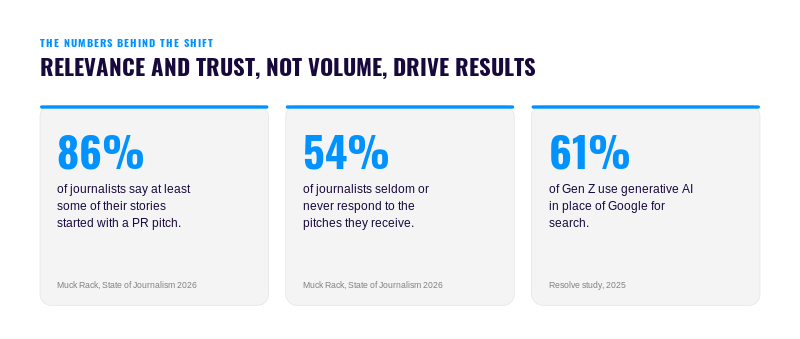
    Infographic showing 86% of journalists use PR-pitched stories, 54% rarely answer pitches, and 61% of Gen Z use generative AI instead of Google.
    Relevance and trust beat volume: 86% of journalists use at least some PR-pitched stories, yet 54% seldom respond, while 61% of Gen Z turn to generative AI instead of Google.

    Over time, Google and other search engines updated their algorithms to improve the search experience. With each change, Google cracked down on more sites that tried to manipulate the system with backlink volume instead of earning links with real editorial and audience value. Countless sites lost traffic, and many still feel the effects.

    Today, we see Google place more emphasis on relevance, industry trust, and authority. That helps explain why a familiar brand can attract more searchers than a smaller competitor even when both publish similar content and target similar keywords.

    Large language models and Google’s AI Overviews have widened this divide. These systems can use retrieval-augmented generation, or RAG, to retrieve relevant sources, often favoring authoritative publications and proprietary information. If we merely repeat a statistic already cited by a top-tier publication, an AI system may choose the better-known source to reduce the risk of spreading inaccurate information.

    We also see younger searchers moving toward AI tools. In a 2025 Resolve study, 61% of Gen Z respondents said they used generative AI instead of Google.

    None of this means every form of link building looks like spam to Google or an LLM. It means we need backlinks to work alongside a broader set of authority signals.

    When publications and journalists cite our brand, they signal authority. When we publish original content and proprietary data, we signal authority. When we create useful graphics and informative videos, we signal authority again.

    Once Google and AI systems recognize these signals, the backlinks supporting them become meaningful votes of confidence. Our site may then be more likely to rank prominently, appear in AI Overviews, and receive citations in LLM-generated answers.

    How we use E-E-A-T in a competitive search environment

    In 2018, Google updated its quality-rater guidance to place greater focus on expertise, authoritativeness, and trustworthiness, commonly shortened to E-A-T. In 2022, Google added another E for experience. Together, these qualities provide a framework for understanding how Google considers credibility and legitimacy.

    • Experience: We demonstrate that an author has personally engaged with the subject. Examples include a forum where people describe testing a product or a gardener documenting firsthand pest-prevention trials.
    • Expertise: We show that the author has relevant knowledge, qualifications, or credentials supporting the information and advice.
    • Authoritativeness: We earn recognition from credible sources and industry voices that cite or link to our work, helping establish us as a respected participant in the field.
    • Trustworthiness: We remain transparent, accurate, and honest. We avoid deceiving readers or using manipulative link-building practices.

    We apply E-E-A-T both on and off the page. Author biographies can demonstrate expertise, while accurate sourcing can demonstrate trustworthiness. Off the page, we strengthen E-E-A-T signals through the quality of the sites that link to us and the journalists who rely on us as a source. Both dimensions influence how search engines assess whether our information is useful, accurate, and credible.

    If we consistently earn backlinks from dozens of irrelevant websites, that pattern can look like a low-quality or manufactured signal. If several respected journalists mention our brand because we published a valuable study, those mentions are much more likely to function as genuine votes of confidence.
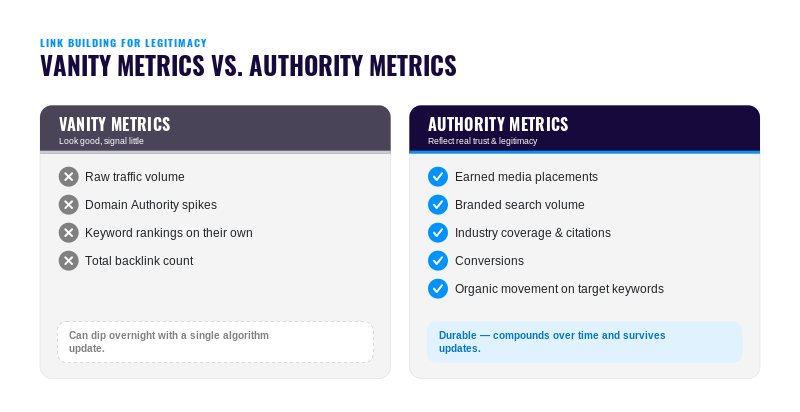
    Infographic comparing vanity SEO metrics like traffic and backlinks with durable authority metrics such as media placements, conversions and branded search.
    Move beyond fragile SEO numbers. This side-by-side graphic shows how earned media, branded searches, industry citations and conversions build authority that can survive algorithm updates.

    For us, link quantity is no longer a reliable proxy for legitimacy. We look for backlinks that demonstrate real relevance and value.

    We cannot earn those links half-heartedly. We need a coordinated strategy that strengthens credibility both on and off our site.

    The off-page SEO tactics we use to demonstrate value

    When we ask how to earn links that search engines and LLMs will treat as signs of trust, we do not look for a single outreach tactic. Strong links usually emerge from several activities that we sustain over time.

    We create genuinely linkable assets

    To prove that people genuinely want to reference our site, we first create content worth referencing. If we are accustomed to quick and easy links, this may require a larger investment in content than we have made before. A routine how-to article or listicle is rarely enough by itself.

    We define linkable content as something journalists, publishers, and readers find distinctive and useful — something they have not already encountered dozens of times. We often draw from the following content formats.

    • Original data and proprietary research: We publish information people cannot find elsewhere. In a crowded search environment, that means conducting original research rather than recycling familiar statistics. When a journalist needs a statistic and our site is the primary source, we can earn a natural backlink.
    • Thought leadership and expert commentary: We share an original perspective from a credible expert within our organization, giving publishers a useful idea or quotation they may cite in future coverage.
    • Authoritative long-form guides: We answer the main question thoroughly and anticipate the follow-up questions a reader is likely to ask. This depth can help us earn links as audiences move further into their research.
    • Engaging visuals and infographics: We invest in visual assets that make complex information easier to understand and share. Ahrefs found that YouTube mentions strongly correlated with inclusion in AI Overviews. Videos can be especially valuable, but informative infographics also give publishers a useful visual for their own audiences.

    These formats demand more time, effort, and money, but we have found that they are often more sustainable than disposable content. They help us earn credible editorial citations and build industry authority that is more resilient to algorithm updates.

    We connect link building with digital PR

    We place digital PR at the center of authority building because it connects brand development with link acquisition. It helps us earn coverage, attract links, and introduce our organization to new audiences through credible journalists. Those are precisely the kinds of signals search engines can consider when assessing legitimacy.

    Unlike traditional PR, our digital PR work focuses on online coverage and backlinks from news organizations and media outlets. We create useful assets or proprietary data, identify the journalists most likely to care, and pitch stories that fit their established beats.

    Many of these publications carry significant influence and reach large audiences that can introduce our brand to more people. When a highly authoritative outlet covers our story, other journalists may discover and cite it organically. Syndication can amplify the effect further when a media group republishes an article across its network, potentially producing many relevant links from one story.

    Our strongest digital PR campaigns typically use one or more of the following approaches.
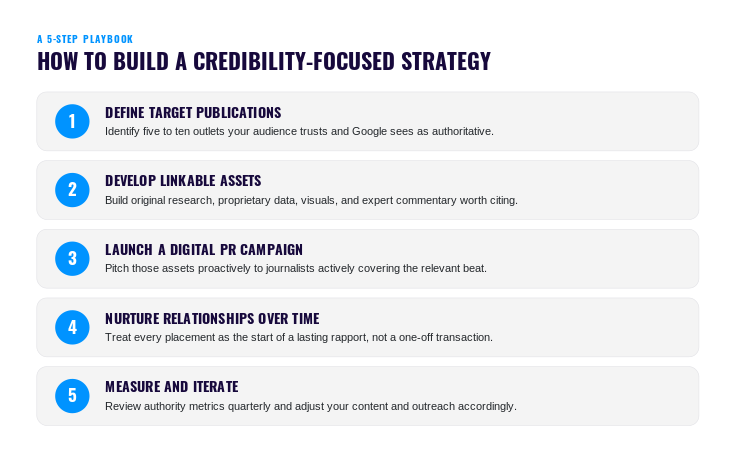
    Infographic outlining five steps for a credibility-focused SEO strategy, from targeting trusted publications and creating linkable assets to measuring results.
    Build lasting brand authority in five steps: target trusted publications, create citation-worthy assets, launch digital PR, nurture journalist relationships, then measure and refine your approach.
    • Data-led PR campaigns: We begin with what journalists and their readers care about, not simply what we find interesting. We review local news, Google News, and current coverage to understand which subjects are gaining attention. By considering journalist intent from the start, we improve our chances of receiving responses and earning placements.
    • Newsjacking or reactive PR: When we can move quickly, we contribute expert opinions, data, or commentary to breaking stories that relate to our brand. This gives journalists material they can use while the topic is still timely.
    • Proactive PR: We anticipate trends before they break and prepare insights around recurring news cycles, holidays, and other relevant media moments.
    • Contributed content and guest features: We place useful content written by our experts in relevant publications, allowing us to speak directly to established audiences and earn recognition.

    When we combine these tactics effectively, we can elevate our brand to a level that competitors cannot reproduce with a batch of low-value links.

    We build relationships with journalists and publishers

    We know that even fascinating proprietary data, packaged in an expertly designed analysis, can fail if our journalist outreach is poorly targeted.

    Resolve data about journalist outreach and PR pitches

    Journalists receive an enormous number of PR pitches, and those messages can either support or obstruct their work. According to a 2026 Muck Rack study, nearly nine in 10 journalists said at least some of their stories originated with PR pitches.

    The same survey found that 54% of journalists seldom or never responded to most pitches. Relevance was a central problem: nearly half said a genuinely relevant pitch was rare.

    If we send a journalist at an economics publication a pitch about music-listening habits, we should expect a rejection because the subject may matter to only a small part of that publication’s audience. We do not take that response personally. Journalists build their careers around particular topics and beats, and our job is to support that work rather than distract from it.

    We therefore approach outreach as relationship building: a two-way exchange that should benefit everyone involved. Above all, we remember that there is a real person on the other side of every email.

    • We personalize our emails and explain why a story fits the journalist’s audience.
    • We respond graciously when a journalist says no because our next idea may be a better fit.
    • We share relevant work from journalists and publications through social media.
    • We contribute thoughtful comments when we have something useful to add.
    • We cite journalists’ reporting in future content when it genuinely supports our work.

    As we strengthen these relationships, journalists become more likely to consider future opportunities. A thoughtful follow-up or second pitch can receive a warmer response when a reporter already knows that we provide reliable data and useful commentary.

    PR relationships grow over time. Even when our first pitch does not fit a journalist’s beat, we remain willing to return with a better story or a new set of relevant data.

    How we measure real brand authority

    We recognize that authority, trust, and legitimacy feel less concrete than traffic or keyword position. Yet they have become more important. A traffic surge may look encouraging while reflecting temporary attention, weak intent, or an advantage that disappears after an algorithm update.

    Authority and legitimacy are more durable. We can also measure the impact of credibility-focused work through several meaningful indicators.
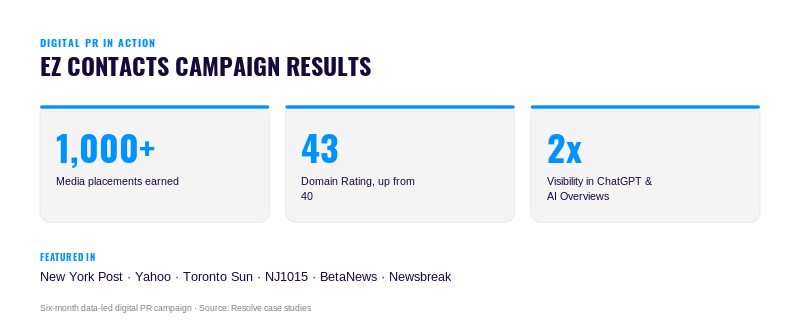
    Infographic showing EZ Contacts’ digital PR results: 1,000+ media placements, a Domain Rating of 43, and doubled visibility in ChatGPT and AI Overviews.
    EZ Contacts’ six-month digital PR campaign delivered 1,000+ media placements, raised Domain Rating from 40 to 43, and doubled visibility across ChatGPT and Google AI Overviews.
    • Earned media placements: We track the publications that cover our brand, including coverage containing an unlinked mention. These placements help us assess brand credibility.
    • Branded search volume: We monitor whether more people search for our company or products after discovering us through media coverage.
    • Industry coverage: We look for the point at which publications we have not contacted begin citing our work. That organic pickup is a valuable sign that our authority is spreading.
    • Conversions: We measure whether greater credibility leads more people to trust our organization, products, or services and ultimately take meaningful action.
    • Organic ranking improvements for target keywords: We still review rankings, but we treat them as one indicator within a broader picture. Sustained movement can show that search engines increasingly view us as a credible result relative to competing pages.
    Metrics for measuring brand authority and credibility

    We do not expect these indicators to appear overnight.

    • We invest real effort in creating proprietary data.
    • We build trust with journalists through repeated, useful interactions.
    • We grow authority through sustained work over time.

    Our advice is simple: we stay patient, keep improving, and allow credible results to compound.

    How we build a credibility-focused link strategy

    Knowing the principles of SEO authority is one thing; building an entire campaign around them is another. We use the following five-step process to turn those principles into consistent action.

    1. Step 1 — We define our target publications: We identify five to 10 publications that our audience trusts and that search engines are likely to recognize as authoritative within our field. These become our priority coverage targets.
    2. Step 2 — We develop linkable assets: We create at least two content or media assets designed around the interests of those publications. We may use original survey data, visual guides, proprietary analysis, or expert thought leadership.
    3. Step 3 — We launch a digital PR campaign: We proactively pitch our assets to relevant publications. We can also use platforms such as Connectively or Muck Rack to identify ongoing opportunities with writers covering subjects related to our research.
    4. Step 4 — We nurture relationships: We treat every positive media interaction as the beginning of a longer relationship. We follow up with useful information, engage with published coverage, and build the kind of rapport a journalist can rely on.
    5. Step 5 — We measure and iterate: We review our authority indicators each quarter, learn from the response to our campaigns, and adjust our content and outreach accordingly.
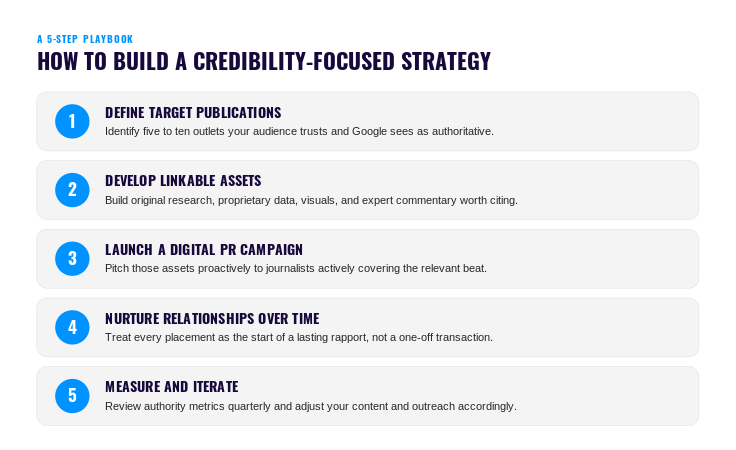
    Resolve credibility-focused link-building process

    We know this process can consume a team’s time, particularly when resources or specialized expertise are limited.

    In those situations, we may benefit from working with a link-building and digital PR specialist who can expand our capacity and keep pace with search changes. The right support can help us establish sustainable visibility without allowing every minor ranking fluctuation to pull us off course.

    How we build authority that lasts at Resolve

    We know that quality usually stands the test of time better than quantity. The difficult part is maintaining that focus when competitors appear to be winning with sudden traffic spikes or eye-catching vanity metrics.

    We do not let temporary numbers distract us from the larger goal. We focus on lasting authority and legitimacy earned through sustained content creation, thoughtful PR outreach, and genuine relationship building.

    When an internal team lacks the time or patience required to maintain that effort, we can step in.

    At Resolve, we work with brands to build credibility-focused SEO campaigns through linkable content, data-led digital PR, and hands-on link building. Our goal is sustainable organic growth, not a burst of visibility that disappears after the next algorithm update.

    Resolve results from credibility-focused digital PR

    We have seen this approach pay off. In a recent data-led campaign for EZ Contacts, we earned more than 1,000 placements in outlets including the New York Post and Yahoo. As the coverage grew, the brand’s visibility in ChatGPT and Google’s AI Overviews doubled. That is the kind of durable growth we want to build — growth that extends beyond the next algorithm update.

    Large Google logo over colorful stacks of digital pages and folders, symbolizing search advertising, web content, and online marketing updates.
    A bold Google logo sits atop layered, colorful digital documents, evoking the fast-moving world of search marketing, ad formats, campaign assets, and platform updates.

    When we are ready to build links that last, we can visit growresolve.com to learn more.

    We see considerable overlap between link building and digital PR, but we do not treat them as identical. Link building is the broader practice of acquiring backlinks from other websites to improve search authority. Digital PR is a particular approach within that practice, focused on earning links through media coverage, journalist relationships, and placements in credible publications rather than relying on directory submissions, guest-post exchanges, or other lower-authority tactics.

    We often use digital PR to pursue the strongest editorial backlinks because reputable outlets have real audiences and established review standards. At the same time, this work builds brand visibility and consumer trust in ways that many conventional link-building methods do not.

    How long do we wait for meaningful results?

    We do not expect authoritative backlinks or earned media coverage to produce results overnight. That is an honest trade-off when we choose a credibility-focused approach instead of more aggressive tactics. Most brands can begin seeing meaningful domain-authority gains and early ranking movement after three to six months of consistent execution, while highly competitive keywords and top-tier placements may require more time.

    The advantage is that our results can compound. Links from credible publications tend to endure, strong journalist relationships can create repeat opportunities, and the authority generated through consistent coverage can keep delivering value long after the initial campaign.

    We define an authority backlink as a link from a source that search engines and its audience regard as credible and trustworthy. These sources typically have genuine readers, clear editorial processes, established authority, and topical relevance to our industry.

    A regular backlink can come from any website willing to link to us, regardless of its relevance, quality, or editorial standards. That distinction matters because search engines do not evaluate every link equally. One editorial link from a respected industry publication can be more valuable than dozens of links from low-authority sites, while also supporting the kind of E-E-A-T credibility that bulk link acquisition cannot reproduce.

    Do we value brand mentions without hyperlinks?

    Yes. We recognize that Google can associate brand mentions with entities even when a publication does not include a hyperlink. Relevant, unlinked mentions in credible coverage can still contribute to the wider authority signals surrounding our brand.

    That is why we consider digital PR valuable even when every placement does not produce a direct link. A credibility-focused off-page strategy should not be reduced to backlink acquisition alone. Our larger objective is to build a brand that respected publications genuinely want to mention, cite, and cover.

    We see risks ranging from wasted effort to serious search penalties. Link buying, reciprocal-link schemes, private blog networks, and manipulative anchor-text optimization can violate Google’s spam policies. These tactics may trigger manual actions or algorithmic suppression that substantially reduces our search visibility.

    Even when outdated tactics do not produce an immediate penalty, they can lose their value as search systems become better at identifying manufactured signals. Recovering from a link-related penalty can be slow and expensive. We would rather invest in credible link building from the beginning than repair the damage caused by shortcuts later.


    Inspired by this post on Search Engine Land.


    crushpress.ai community screenshot
  • How I Turn Search Console Data Into SEO Wins With AI

    How I Turn Search Console Data Into SEO Wins With AI

    I rely on Google Search Console because it is excellent at collecting search data. The challenge is that it still does not make interpretation easy.

    When I open almost any property, I usually find thousands of queries, landing pages, impressions, clicks, rankings, and click-through rates. That volume is useful, but it can quickly become overwhelming when I am trying to answer one simple question: what should I do next?

    For years, my workflow was familiar: export the data into Excel or Google Sheets, build pivot tables, apply filters, and start digging for patterns. That approach works, but it is slow. More often than not, I am searching for insights without knowing exactly what I am looking for.

    That is where AI makes the workflow more useful. I use it to speed up the hardest part of Search Console analysis: finding meaningful patterns hidden across thousands of rows of search data.

    I think of Google Search Console as my source of truth and AI, whether ChatGPT or Claude, as the analyst sitting beside me. GSC shows me what happened. AI helps me explore why it happened, uncover opportunities I might miss, and organize messy data into decisions I can act on.

    A quick note on regex

    Most of the examples I use start in the same place inside Google Search Console: Performance → Queries → + Add Filter → Query → Custom (regex).

    From there, I enter a regular expression to filter query data before exporting it for analysis.

    The useful part is that I no longer need to memorize regex syntax. I can ask ChatGPT to write it for me. For example, I might prompt: Create a regex for Google Search Console that matches queries beginning with question words.

    ChatGPT may return something like (?i)^(who|what|why|how|can|does|will|should)b.

    If I need something more specific, I simply describe the pattern I want. I might ask for a regex that matches queries containing five or more words, identifies comparison searches, or finds branded queries that include product names.

    The better I describe the pattern, the better the regex usually becomes.

    Here are seven practical ways I combine Google Search Console with AI so I can spend less time sifting through data and more time making decisions.

    1. I stop looking only at queries and start looking at intent

    Most Search Console analysis still happens at the keyword level. The problem is that people do not really search by keyword. They search with intent.

    Instead of reviewing thousands of individual queries one by one, I use regex to isolate investigation-focused searches before exporting the data.

    One useful regex is (?i)^(best|top|vs|review|reviews|compare|comparison).

    After exporting the filtered query data, I ask Claude or ChatGPT to classify intent. My prompt is usually something like: Categorize these queries into informational, navigational, investigation, transactional, and local intent. Return a CSV with classifications and confidence scores.

    This helps me spot patterns that are difficult to see keyword by keyword. Informational traffic may be growing while commercial investigation queries are declining. Transactional queries may rank well but earn weak click-through rates. Comparison searches may be driving impressions without having dedicated content to support them.

    When I segment by intent, the next steps become much clearer.

    2. I discover questions my audience is already asking

    Question-based keyword research is not new, but AI helps me identify themes across hundreds of question-oriented searches much faster.

    I start with a regex like (?i)^(who|what|where|when|why|how|can|does|should|will)b.

    Then I export the results and ask Claude or ChatGPT: Group these questions into common themes and identify unanswered topics.

    Google Search Console Performance report with the Query filter dialog open, showing a custom regex option for filtering SEO search queries.
    A Google Search Console query filter highlights how regex can narrow SEO performance data, helping marketers turn thousands of search terms into focused insights.

    Instead of manually reviewing hundreds of questions, I can quickly see broader patterns around pricing concerns, product comparisons, implementation challenges, and industry-specific use cases.

    This becomes more than a content exercise. I can use these themes to improve FAQs, support resources, sales enablement materials, and AI Overview optimization.

    The best opportunities are often not hidden in one query. They are hidden in clusters of related questions.

    3. I find queries likely to trigger AI Overviews

    Google does not give me a filter for queries likely to trigger AI Overviews, but I can build a useful approximation.

    I start by isolating common informational and comparison patterns with a regex like (?i)^(what is|how to|best|vs|difference between|guide to).

    Then I export the matching queries and ask Claude or ChatGPT: Review these queries and group them by the content format needed to answer them effectively.

    The themes often fall into definitions, tutorials, comparisons, or expert recommendations.

    This helps me see where my content may need to shift from simply ranking for keywords to becoming the best available answer. Increasingly, those are not always the same thing.

    4. I track emerging trends earlier

    Traditional keyword research can be reactive. By the time a trend is obvious in keyword tools, competitors may already be building content around it.

    Google Search Console can help me identify shifts earlier, as long as I know how to look for them.

    Instead of searching for individual keywords, I use ChatGPT to build regex around broader concepts. For example, I might prompt: Create a Google Search Console regex to identify searches related to AI agents, copilots, assistants, automation, and autonomous workflows.

    The output may look like (?i)(ai agent|agentic|copilot|assistant|automation).

    This same approach works for new technologies, product categories, competitors, industry buzzwords, and changing customer concerns.

    Once I filter and export the data, I let AI look for emerging themes. A prompt I like is: Review these queries and identify emerging themes, new terminology, and shifts in search behavior. Highlight which topics appear to be gaining traction, recommend whether they deserve a new content asset or an update to an existing page, and identify any patterns that could influence our content strategy.

    Instead of only confirming that a trend exists, AI helps me decide whether the trend is meaningful enough to act on and what the next move should be.

    5. I surface conversion intent inside informational traffic

    One of the most overlooked opportunities in Search Console is finding bottom-of-funnel signals inside queries that appear informational at first glance.

    I might ask ChatGPT: Create a regex for searches that indicate evaluation, comparison, pricing, alternatives, migration, implementation, or vendor selection intent.

    An example output is (?i)(cost|pricing|price|vs|alternative|compare|implementation|migration).

    I apply that regex to the query report, export the filtered data, and then ask Claude or ChatGPT to analyze it.

    My prompt usually looks like this: Review these Google Search Console queries and identify recurring buying signals. Group them into themes such as pricing, comparisons, implementation, and vendor evaluation. Recommend which existing pages should better address this intent, and identify opportunities to improve content through stronger CTAs, internal links, comparison tables, FAQs, or supporting resources.

    AI analyzes Google Search Console query data, funneling search intents into eligible and not eligible audience groups for SEO action.
    A visual metaphor for AI turning messy Google Search Console queries into clear SEO decisions, separating qualified intent from irrelevant traffic signals.

    I often find that pages created for top-of-funnel education are already attracting visitors who are evaluating solutions. In that case, the best opportunity may not be creating a new page. It may be improving the page that already earns the visit, so users can take the next step without breaking the informational experience.

    Sometimes the biggest content opportunity is recognizing the conversion intent already reaching the pages I have.

    6. I find audience-specific opportunities

    One of my favorite ways to uncover new content opportunities is filtering queries by industry, audience, or customer segment. It quickly shows me whether my content is resonating with the audiences I intended to reach or revealing opportunities I had not considered.

    I start by asking ChatGPT to create a regex based on the audience segments that matter most to the business.

    For example, I might prompt: Create a Google Search Console regex that identifies queries related to healthcare, manufacturing, retail, education, financial services, government, and nonprofit organizations.

    An example output is (?i)(healthcare|hospital|medical|manufacturing|factory|retail|education|school|financial|bank|government|public sector|nonprofit).

    After applying the filter and exporting the results, I ask Claude or ChatGPT: Analyze these queries and group them by audience segment. Identify which industries show the strongest search demand, what recurring questions or pain points each audience has, and recommend opportunities for new content, landing pages, case studies, or internal linking that would better serve those audiences.

    The differences can be valuable. Healthcare searches may consistently focus on compliance, while manufacturing queries may revolve around implementation. Retail searches may reveal entirely different use cases than financial services searches.

    7. I uncover striking-distance opportunities at scale

    Every SEO knows the classic advice: look at keywords ranking in positions 5-15 to identify opportunities within striking distance.

    The challenge is doing that at scale. A report with hundreds of queries where a site is close to stronger rankings can become overwhelming fast.

    I take the regex patterns above a step further. I apply the filters that match my goals, then narrow the report to positions 5-15 before exporting the queries.

    Then I ask my AI analyst: Identify recurring themes across these queries and recommend page-level optimizations rather than keyword-level optimizations.

    Instead of getting tiny recommendations for individual keywords, I often uncover larger opportunities. A page may be missing subtopics, comparison details, stronger internal links, or use cases that would make it more complete.

    The result is usually fewer optimizations, but more meaningful ones.

    Turning Search Console data into decisions

    As an SEO, I do not have a data shortage. I have a prioritization problem.

    Google Search Console remains one of the richest sources of insight into how people discover a business. The difficult part is turning thousands of rows into something actionable.

    That is where AI fits into my workflow. It helps me uncover patterns, organize information, and surface opportunities I might otherwise miss. It is not a replacement for SEO strategy, experience, or critical thinking.

    The real advantage is not writing better regex or exporting cleaner spreadsheets. It is spending less time searching for insights and more time acting on them.

    Because data does not improve SEO. Better decisions do.


    Inspired by this post on Search Engine Land.
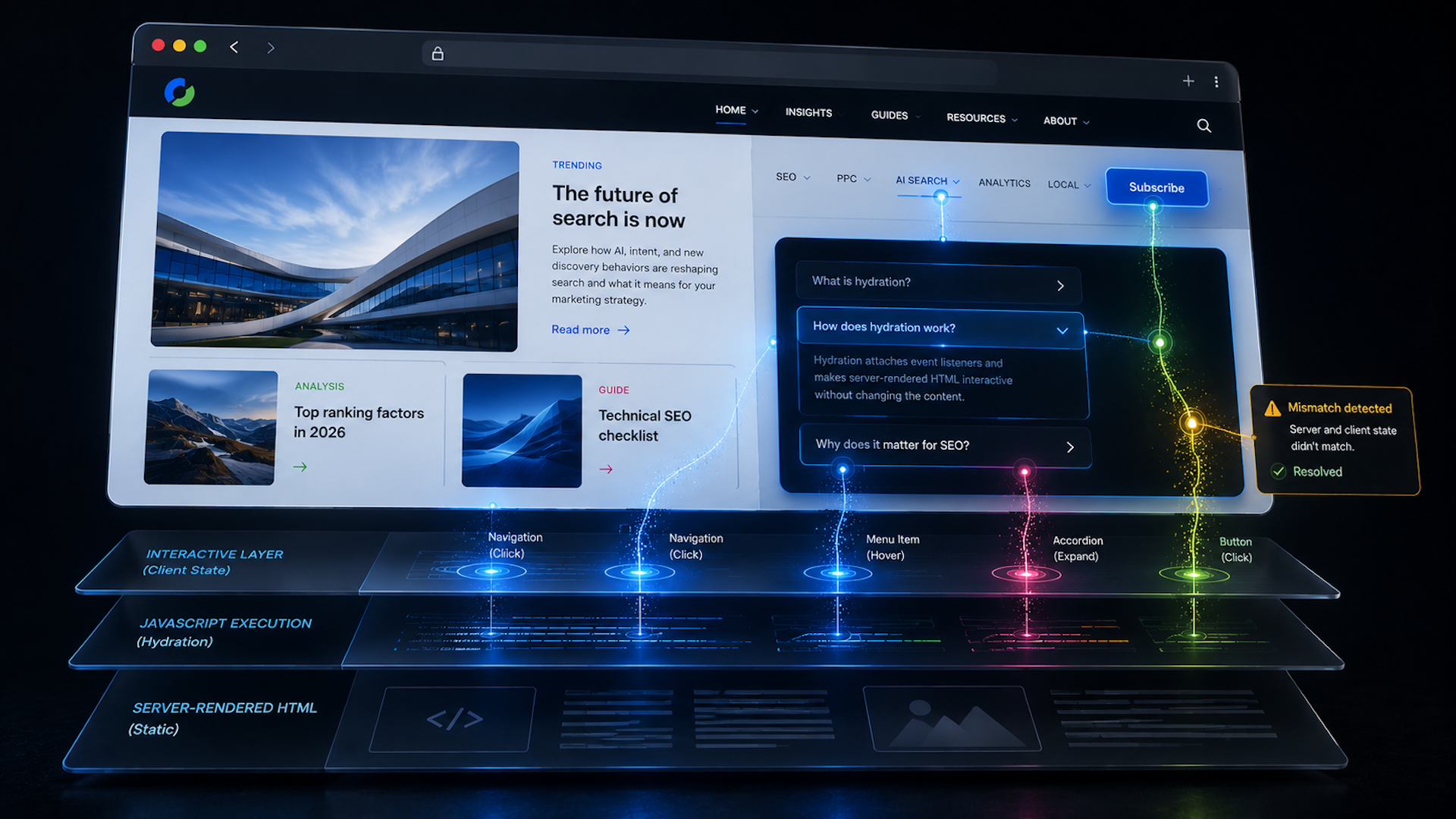

    crushpress.ai community screenshot
  • How I Win the AI Decision Layer in Agentic Commerce

    How I Win the AI Decision Layer in Agentic Commerce

    I see the next major battleground for brands being shaped by AI. Every day, AI engines and autonomous agents decide which brands to recommend, compare, cite, and transact with on behalf of consumers. To compete, I have to make my brand the trusted choice AI selects.

    This shift is already underway. Adobe data shows that AI-referred traffic to U.S. retail websites grew 4,700% year over year through mid-2025. Salesforce reports that AI and autonomous agents influenced one in five online orders globally during Cyber Week, driving an estimated $67 billion in sales.

    As AI becomes the interface between consumers and brands across discovery, evaluation, and purchase, I need to think beyond traditional rankings. A new competitive layer is emerging: the AI decision layer. This is where AI systems evaluate trust, relevance, authority, and transaction readiness before deciding which brands make the shortlist.

    If I fail to influence this layer, my brand may be excluded before a customer ever sees it. That makes AI visibility, credibility, and actionability core parts of modern search strategy.

    How I take a brand from found to actioned

    Agentic commerce readiness follows a clear sequence. I start by making sure AI engines can find my brand, then I move through the remaining stages until AI agents can understand, trust, recommend, and transact with it.

    Step 1: I get found by enabling AI discovery and access

    Machine accessibility is the foundation of AI visibility. If I want AI systems to discover and access my brand, I have to prioritize technical hygiene and token efficiency.

    I start by allowing the right crawlers on my website. Google, OpenAI, Anthropic, and Bing need to reach my content without unintended restrictions.

    Then I get the basics right. I set up XML sitemaps and robots.txt, fix crawl errors, add canonical tags, and maintain strong Core Web Vitals. I also make sure my website content is rendered server-side so agents can reliably navigate and reason over my pages.

    I also pay close attention to token efficiency. Bloated HTML wastes valuable tokens that AI systems could otherwise use to understand my content, products, and brand.

    To make my site more AI-ready, I publish assets that help large language model crawlers process my content more efficiently. An llms.txt file can give LLM crawlers a concise map of my website, while Markdown versions of key content can reduce token consumption and improve machine understanding.

    Dig deeper: The enterprise blueprint for winning visibility in AI search

    Infographic showing consumers delegating search to AI agents, which discover, evaluate, weigh trust, and transact with brands and products.
    Between consumers and brands, AI agents now act as the decision layer, handling discovery, evaluation, trust signals, and transactions before products reach the shortlist.

    Step 2: I become understood by building semantic clarity

    To be understood by AI engines, I need to build entity authority. This helps AI interpret who I am, what I offer, and why my brand matters.

    Structured data turns my web pages into machine-readable knowledge that AI systems can understand, trust, and use. I strengthen my entity graph with comprehensive schema, trusted citations, and linked references.

    I also deliver clean, server-rendered HTML that AI can access without friction. Semantic HTML, structured @graph IDs, and consistent naming help AI engines connect the right context to my brand.

    Step 3: I get retrieved by structuring content for AI extraction

    Traditional search ranks pages, but AI search retrieves and cites passages. That means I win on relevance, clarity, authority, and freshness rather than length alone. Original expertise, proprietary data, and real-world experience give my content a stronger chance of being selected.

    To structure my content for retrieval, I use a clear heading hierarchy with H1, H2, and H3 tags. Under each heading, I create descriptive, self-contained sections that can stand on their own.

    I build interconnected topic clusters instead of isolated pages because AI needs enough context to assemble complete answers.

    I also front-load every section. I put the core answer and the most important metrics in the opening sentence before a model hits its token limit.

    Dig deeper: Chunk, cite, clarify, build: A content framework for AI search

    Step 4: I build trust with authority and grounding signals

    Just because AI engines retrieve my content does not mean they will recommend my brand. Retrieval is only one step. Trust is what moves a brand closer to selection.

    AI systems prioritize sources they can trust, so authority and credibility become decisive. Google’s experience, expertise, authoritativeness, and trustworthiness principles, known as E-E-A-T, remain some of the strongest signals influencing whether a brand is cited, referenced, or selected.

    Six-step AI decision layer pipeline showing brands moving from Found, Understood, Retrieved and Trusted to Chosen and Actioned in agentic commerce.
    A visual roadmap for becoming the brand AI selects: first be found and understood, then retrieved, trusted, chosen and finally actioned by autonomous assistants.

    Trust extends far beyond my website. AI evaluates review sentiment, location accuracy, pricing consistency, product availability, and entity alignment across the web. When those signals conflict, AI confidence decreases.

    Credibility is now computational. Grounding, the process of validating responses against trusted evidence, is the bridge between visibility and recommendation.

    To earn computational trust, I create original, expert-driven content that shows real experience and unique value. Then I align every external signal so reviews, listings, maps, and directories all tell one consistent story about my brand.

    Dig deeper: Integrating SEO into omnichannel marketing for seamless engagement

    Step 5: I get chosen by earning machine and human preference

    AI agents parse attributes, verify claims, and score confidence in milliseconds. If I cannot make my value clear to AI, my brand becomes invisible at the decision point.

    But emotional preference still matters. Consumers may delegate routine purchases, yet they hold tightly to choices tied to identity. The strongest brands optimize for both machine readability and human resonance.

    To earn AI recommendations, I measure AI visibility, citation, and recommendation rates through query fan-out testing. I keep brand, product, and location data consistent across every channel. I also work to earn trusted mentions and references that strengthen AI confidence in my brand.

    Dig deeper: How to boost your marketing revenue with personalization, connectivity, and data

    Step 6: I enable agentic transactions

    Recommendation is no longer the finish line for AI search. Discovery, selection, and checkout can now happen inside an AI assistant without the customer ever visiting my site.

    An agentic website is designed for AI agents to discover information, retrieve answers, and perform actions on behalf of users. NLWeb helps make website content conversational and machine-readable, improving how AI systems find and understand the site.

    Large Google logo over colorful stacks of digital pages and folders, symbolizing search advertising, web content, and online marketing updates.
    A bold Google logo sits atop layered, colorful digital documents, evoking the fast-moving world of search marketing, ad formats, campaign assets, and platform updates.

    Web Model Context Protocol, or MCP, extends this capability by giving AI agents a standardized way to interact with website functions. That can include retrieving data, initiating workflows, and submitting forms.

    Agentic commerce moves the full transaction inside the assistant. Google’s Universal Commerce Protocol, or UCP, enables chat-based bookings. OpenAI and Stripe’s Agentic Commerce Protocol, or ACP, pushes inventory so AI systems can surface it more easily. Agent Payments Protocol, or AP2, then lets the agent pay.

    Underneath these capabilities is MCP, which enables an LLM to read products, content, and live data. This changes my website from a destination into a source of truth. It supplies the inventory, pricing, and signals that drive every agent journey.

    Dig deeper: How to select a CMS that powers SEO, personalization, and growth

    How I measure performance in the AI decision layer

    I still track traditional search metrics like rankings, sessions, and clicks. They remain useful, but they are no longer enough to measure success in AI search and agentic commerce.

    For visibility, I track AI presence rate, AI share of voice, citation frequency, and agent recommendation rate.

    For commerce, I track AI-influenced revenue, agent conversion rate, autonomous transaction volume, and agentic wallet share.

    I also expect traffic patterns to change. Direct visits may decline as agents handle discovery, but AI-influenced transactions through machine-readable layers like WebMCP and schema endpoints can offset that loss and create new revenue paths.

    With these changes in place, my website can become the trusted source AI systems rely on for both information and action.

    From SEO to decision architecture

    SEO remains the foundation for winning search, but a deeper shift became concrete at Google I/O 2026. AI agents now parse raw HTML, distill the browser’s native accessibility tree, and capture visual screenshots through vision models.

    Together, these three paths determine whether a site is truly actionable for AI. My page can be technically flawless and still fail if its structure, semantics, or user experience breaks the chain. If I miss any stage, trust and transaction readiness suffer.

    When I get these pieces right, my brand becomes discoverable, understandable, trusted, and transactable when AI agents make decisions. The brands that build these capabilities today will be the brands AI surfaces, trusts, and recommends tomorrow.


    Inspired by this post on Search Engine Land.
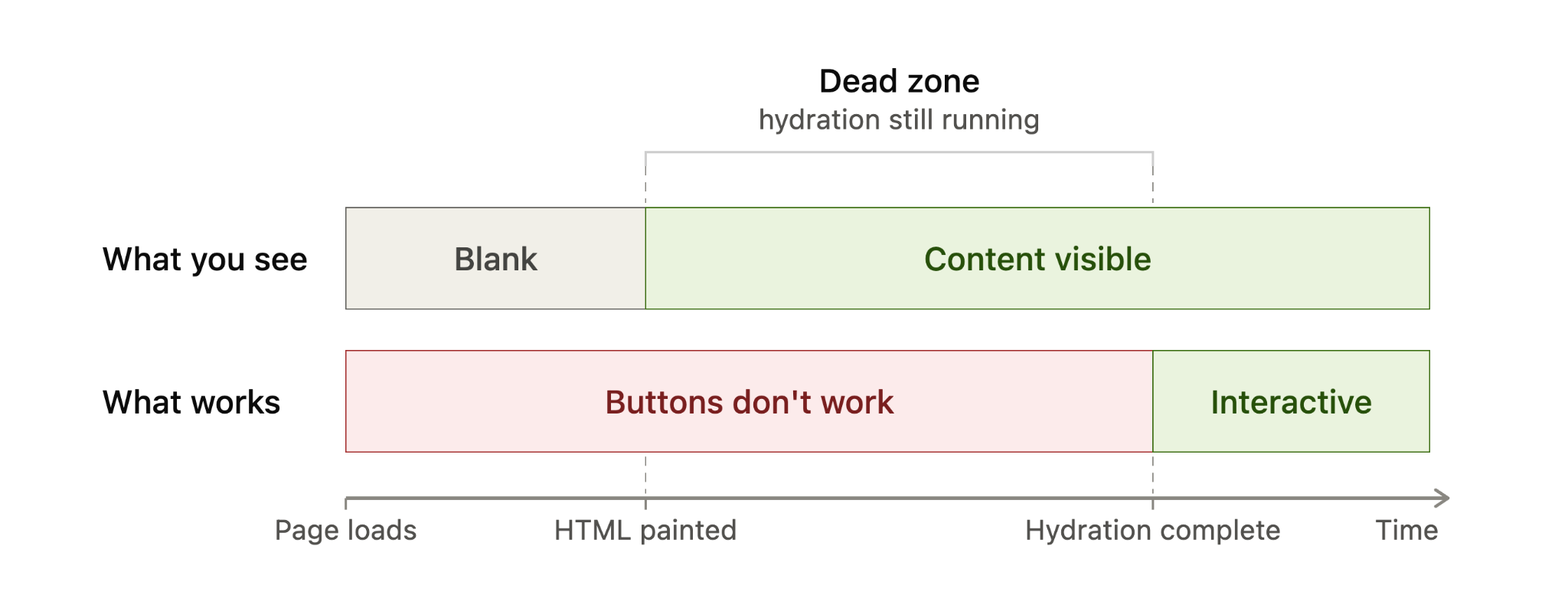

    crushpress.ai community screenshot
  • I Let groas Run Google Ads: What Really Changed Fast

    I Let groas Run Google Ads: What Really Changed Fast

    I have watched paid search change into something far faster and less forgiving than the old reporting rhythm was built to handle. Auction dynamics shift by the hour, competitor bids move in real time, and search behavior changes across devices, times of day, and audience segments before a monthly report can even catch up.

    For me, the real cost has always lived in the gap between a performance signal and the moment a person can respond. groas is built to close that gap every hour of every day, and the data shows what can happen when that response loop gets dramatically shorter.

    When I sign up with groas, the process starts with a human account manager auditing the existing Google Ads account in detail. This is not a quick surface check. Campaign structure, keyword strategy, bidding logic, budget allocation, conversion tracking, quality scores, search term reports, and auction insights all get reviewed.

    I see that audit as the foundation for everything that follows. groas optimizes toward the goals and account structure defined in the roadmap, so a clean conversion hierarchy, accurate tracking, and a well-organized account give the system stronger signals to work with. That early human judgment matters because it shapes the machine’s operating environment.

    From there, I like that the rollout is paced across the first 60 days. The system does not start moving aggressively before it understands the account it is working in.

    Weeks 1 to 2, observation: groas ingests historical performance data, establishes baselines, and maps patterns across search terms, device performance, time-of-day variance, and audience behavior. During this stage, no changes are made while the system learns the account.

    Weeks 3 to 4, calibration: The system starts making targeted optimizations, including bid adjustments, negative keyword additions, match type refinements, and budget reallocations between campaigns. These are deliberate campaign-by-campaign changes, so each move can build on the last.

    Weeks 5 to 6, traction: I begin to see early changes show up in the data. Performance shifts become visible across ROAS, conversion value, and wasted spend as the optimizations compound.

    Weeks 7 to 8, scaling: Around the 60-day mark, the account has usually stabilized enough for groas to scale. More budget moves into the campaigns and keywords with the strongest conversion history, expanding from a proven base instead of guessing.

    Google Ads performance dashboard showing conversions, ROAS, conversion value and cost metrics with multicolor trend lines for April 2026.
    A Google Ads performance snapshot tracks April 2026 shifts in conversions, ROAS, conversion value and cost, highlighting the volatility behind paid search optimization.

    Once groas is running, I see it work across the full account the way a skilled team would, except it does not stop. It writes and tests ad copy, deploys dynamic landing pages that adjust around each search, turns ad groups on and off when performance calls for it, moves budget where it earns the most, and adjusts bidding strategies in response to live signals.

    Anything a person can do inside Google Ads, groas can do too, around the clock.

    Capability matters, but results matter more.

    The clearest way I can explain the value of continuous, full-surface management is through a real account groas took over. It was a high-spend search account in a tough paid search category: a U.S.-based online mobile recharge platform that lets people instantly top up prepaid mobile phones across major U.S. carriers without creating an account or paying added transaction fees.

    This business operates in prepaid wireless, serving many pay-as-you-go and underbanked customers who recharge monthly or even more often, usually right when their balance runs out. That model puts Google Ads at the center of growth.

    Demand is intensely intent-driven. When someone’s credit runs out, they search for a way to recharge and often buy within minutes. Capturing that moment is the whole game. But it is also a punishing channel to manage profitably because transactions are low-value and high-volume, margins are thin, and the auction is crowded with carrier brand terms and generic “recharge” and “top up” searches.

    In an account like this, a few cents of wasted CPC multiplied across hundreds of daily conversions can decide whether the account is profitable or quietly leaking money.

    In this account, a conversion meant a completed recharge. So the numbers are not abstract to me. Every point of ROAS and every additional daily conversion means more recharges processed and more revenue generated on the same budget base.

    Google Ads performance dashboard showing conversions, ROAS, conversion value and cost with multi-line PPC trend chart from May 5 to June 5, 2026.
    A Google Ads reporting view tracks PPC performance after optimization, with conversions, ROAS, conversion value and spend moving across a month of campaign activity.

    The comparison looked at two account reporting periods: before groas assumed optimization and after.

    Spend: up 18% to $164,000.

    ROAS: up 30%.

    Average CPC: down 15%.

    Conversions per day: up 29%.

    Conversion value: up 44%.

    Cost per conversion: down 14%.

    The clearest improvement was return on ad spend. ROAS rose from 1.02x to 1.32x, which is roughly a 30% improvement in value returned for each dollar spent.

    Google Ads performance dashboard showing conversions, cost, ROAS and conversion value trends after connecting to groas.
    A Google Ads trend chart marks the moment groas was connected, with conversion, cost, ROAS and value lines tracking performance shifts through spring 2026.

    At the same time, average cost per click fell from $2.34 to $2. But the more important point is what the account did with the clicks it paid for. Conversions and conversion value both grew faster than spend, which means each dollar worked harder than it had under the previous setup.

    Daily conversions rose from 571 to 739, about 29%. Daily conversion value rose even faster, from $4,702 to $6,772, or roughly 44%.

    What stands out to me is that these gains came through consolidation, not expansion. groas focused spend into 10 active search campaigns, down from 17.

    Budget that had been spread thinly across underperforming campaigns was redirected into the keywords and campaigns with the strongest conversion history. Fewer campaigns, lower click costs, and more value returned created a cleaner, more focused account.

    That is what an account looks like when waste is removed and budget is concentrated where it can compound.

    The mechanism behind results like these is speed plus breadth of attention. Under traditional management tied to weekly or monthly reporting cycles, an underperforming search term might run for 7 to 14 days before anyone acts. A target CPA can drift far from its goal between reviews. An autonomous system narrows the time between signal and response to hours while watching every campaign at once.

    As groas gathers more data on audience behavior, search patterns, and conversion value, its decisions become more precise. Budget can then concentrate further into the campaigns that return the most value.

    That is the structural difference I see between autonomous management and periodic manual review. Each optimization creates new data, and that data informs the next decision. A system running continuous observe-and-optimize cycles can draw more signal from the same account over time.

    Futuristic data archive with glowing server-like filing cabinets, stacked documents, and network lights symbolizing AI marketing data infrastructure.
    Rows of illuminated data cabinets and paper files stretch into the distance, capturing the pressure on marketers to turn fragmented customer data into a smarter performance engine.

    Business context still belongs with the people who understand the business. When a client launches a new product line, changes pricing, or redefines which conversions matter most, that direction has to come from a person. groas optimizes toward the goal it is given, and setting that goal is strategic work.

    Creative is where I see the human and machine layers working together most clearly. groas writes and tests ad copy and landing page variations at a pace no human team could match, while the people on the account define brand voice, positioning, and creative direction. The strategist shapes the message, and groas finds the specific wording and layout combinations that convert.

    For businesses ready to see better results

    If I am looking at a current setup that runs on monthly reports and weekly changes, I expect to find a steady gap between what the data says and what actually happens in the account. That gap is where budget gets wasted and opportunities close. In the account above, it showed up as more than 15 active search campaigns, many spending inefficiently, with budget spread too thin to compound.

    groas’s onboarding is structured to keep the transition low-risk. The first two weeks are analysis only, measured changes follow, and meaningful performance shifts usually appear within the first month or two, with scaling beginning around day 60. Live campaigns keep running throughout calibration, and the initial audit grounds changes in context from the start.

    For businesses that have stayed with the same agency for a long time without material improvement, I would expect the audit alone to surface issues that have gone unaddressed.

    Get started here.

    For agencies running groas white-label

    I do not think execution-layer account management scales well on its own.

    Continuous optimization, bid management, negative keyword maintenance, and budget pacing take a lot of time at volume. As an agency adds clients, it usually has to add headcount or accept that some accounts get less attention than others. Most agencies know exactly which accounts are underserved.

    With groas handling execution autonomously across a client portfolio, I can see the team shifting toward strategy, client relationships, and new business.

    The work that differentiates an agency is also the hardest to automate. Clients see stronger results, and team capacity moves toward the work that creates the most value.

    Get started here.


    Inspired by this post on Search Engine Land.


    crushpress.ai community screenshot
  • Why MMM Still Demands Clean Data and Human Judgment

    Why MMM Still Demands Clean Data and Human Judgment

    I see marketing mix modeling (MMM) becoming easier to access, but I do not think it has become easy to get right.

    After several conversations about MMM adoption, I keep hearing the same concern: “We believe in MMM, but we do not know how to get started.”

    My answer is that open-source platforms have lowered the barrier to entry in a meaningful way. What they have not lowered is the level of expertise required to produce results that are trustworthy, explainable, and useful for decision-making.

    Open-source MMM has changed the starting point

    I am seeing MMM adoption accelerate because marketers need more durable measurement methods. Almost half of U.S. marketers expect to invest more in MMM over the next year, and many now rank it as one of the most reliable measurement approaches available.

    The open-source shift is real. Three production-grade libraries now give teams a practical way to approach MMM across a wide methodological spectrum.

    • Robyn (Meta, R): I see this as the most approachable starting point because it includes automated hyperparameter search through Nevergrad, Pareto frontier model selection, decomposition, and response curve plots. It is also the one I use most often because it is highly customizable.
    • Meridian (Google, Python/TensorFlow): I view Meridian as a more rigorous option, especially because it uses Bayesian inference, geo-level priors, and principled uncertainty quantification. The tradeoff is a steeper learning curve.
    • PyMC-Marketing (PyMC Labs, Python): I consider this the most flexible path. It offers a full probabilistic model that comes closest to academic-grade Bayesian MMM, but it also demands the most statistical fluency.

    This generation of tools has removed the old $150,000 to $500,000 consulting gate that used to be the primary path into MMM. A team with R or Python expertise and reasonably clean historical data can now run a model in-house.

    Chart showing marketing mix modeling costs dropping from a $150k-$500k consulting gate to near-zero open-source tools while expertise needs stay high.
    Open-source R and Python tools have lowered the cost of starting with marketing mix modeling, but the expertise needed to produce trustworthy, actionable MMM remains the real ceiling.

    The caveat I always make explicit is this: “free tool” does not mean “free model.” The software may be free, but the domain expertise needed to configure it correctly is not. That expertise is a major part of the value.

    The vendor landscape is crowded and complicated

    I also see a fast-growing SaaS layer built on top of open-source MMM. To evaluate it clearly, I find it helpful to separate vendors into a few practical groups.

    Data-layer-first vendors

    Platforms like Rockerbox and Northbeam started with attribution and data collection, then added MMM. Their advantage is usually pipeline speed and data access, not deep modeling flexibility or customization.

    Measurement-first vendors

    Platforms such as Measured, Analytic Partners, Ekimetrics, and Nielsen Gracenote tend to offer more rigorous modeling and enterprise-grade capabilities, usually at a higher price point.

    Google Meridian and GA360

    I think Google’s decision to open-source Meridian is both a generous contribution to the field and a strategic move. When a walled garden funds and packages a measurement methodology that can be used to evaluate its own channels, I believe it is worth maintaining healthy skepticism about priors, defaults, and assumptions, even when the code is transparent.

    Chart comparing open-source marketing mix modeling libraries Robyn, Meridian, and PyMC-Marketing along a spectrum from approachable to statistically rigorous.
    Open-source MMM tools now span a clear trade-off: Robyn offers the most approachable starting point, Meridian adds Bayesian rigor, and PyMC-Marketing pushes deepest into statistical flexibility.

    The practical vendor question I keep coming back to is simple: who owns the data layer, and does that ownership create conflicts in the modeling layer?

    Challenge 1: Data access can quietly break MMM

    I think data access is the most underappreciated MMM implementation blocker. A well-specified model needs more than a quick export from a dashboard.

    • I usually want two to three years of weekly data as a baseline, so the model can capture at least two full seasonality cycles and enough spend variation to learn from.
    • I need consistent channel-level spend granularity, not just a broad “digital” bucket. Search, social, display, video, and other channels need to be separated.
    • I need offline channels such as TV, OOH, radio, events, and direct mail, even though they often live in different systems, belong to different teams, and use incompatible time periods.
    • I need external covariates, including macro indicators, competitor activity, pricing data, and product launch calendars.
    • For B2B, I often need even more history because longer sales cycles and lower conversion volumes make the data requirements more demanding.

    In practice, I often find that the real blocker is the six-week data archaeology project that happens before modeling begins. Finance owns revenue. The brand team owns TV. The agency owns digital spend. A spreadsheet from 2021 may be the only record of trade promotions.

    The model is only as good as the data archaeology behind it, and that is rarely the part anyone highlights in a vendor demo.

    Challenge 2: I still have to roll up my sleeves

    AI assistants have lowered the syntax barrier. They can scaffold a Robyn run, generate a Meridian configuration, or help debug a PyMC model. What they cannot reliably do yet is make the judgment calls that determine whether an MMM is credible.

    Futuristic data archive with glowing server-like filing cabinets, stacked documents, and network lights symbolizing AI marketing data infrastructure.
    Rows of illuminated data cabinets and paper files stretch into the distance, capturing the pressure on marketers to turn fragmented customer data into a smarter performance engine.
    • I still have to decide where to land on a Pareto frontier across hundreds of model solutions, balancing NRMSE against DECOMP.RSSD tradeoffs.
    • I still have to know whether Nevergrad’s optimizer has meaningfully converged or simply landed in a local minimum.
    • I still have to configure adstock transformation parameters, including Weibull shape and scale or geometric decay, so they reflect realistic channel behavior.
    • I still have to diagnose why a model gives a channel an implausible contribution and decide whether the fix is a prior, a data correction, or a variable exclusion.

    In other words, if I try to vibe code my way into MMM, I may end up with a model that appears to work but is wrong in ways I will not catch. The scripting is not the hardest part. The real work is validating the output, including using channel-specific incrementality experiments to calibrate the model.

    Challenge 3: Human expertise is not optional

    Even if the tools mature enough for AI to run a competent default MMM, I still see human expertise as essential. The irreplaceable work is encoding business context that no model can infer from the data alone.

    • Adstock and carryover context: I need to know whether a TV buy carries over for four weeks, paid search carries over for three days, or a brand awareness campaign decays over months. That knowledge usually lives with channel experts, not inside the dataset.
    • Saturation curve shape: I need to recognize when a channel is probably approaching diminishing returns before the model says so, and I need to question the model when it suggests something implausible.
    • Guardrails and anomaly handling: I need to explicitly model or flag COVID troughs, product launches, pricing shifts, and macro disruptions as structural breaks. AI does not automatically know a client had a pricing crisis in Q3 2022.
    • Interpretation sanity checks: If a model assigns 40% of contribution to TV for a brand spending $2 million on TV, I need the experience to say, “That feels wrong,” and investigate. That intuition is earned, not computed.
    • Organizational translation: A technically correct model has little value if I cannot explain why it recommends moving 15% of search budget to CTV in language a CMO and CFO will act on.

    I start with the groundwork before the model

    The best place to begin is not the model itself. I start by understanding what data is needed, who owns it, and who can help interpret it in the context of real marketing decisions.

    None of that is quick or easy, but it is essential if I want meaningful insight from MMM, whether I choose an open-source library or a subscription-based platform.

    As a practical first step, I would download Robyn’s demo script and experiment with sample data before applying MMM to my own business data. That kind of hands-on testing makes the strengths, limits, and judgment calls much clearer.


    Inspired by this post on Search Engine Land.
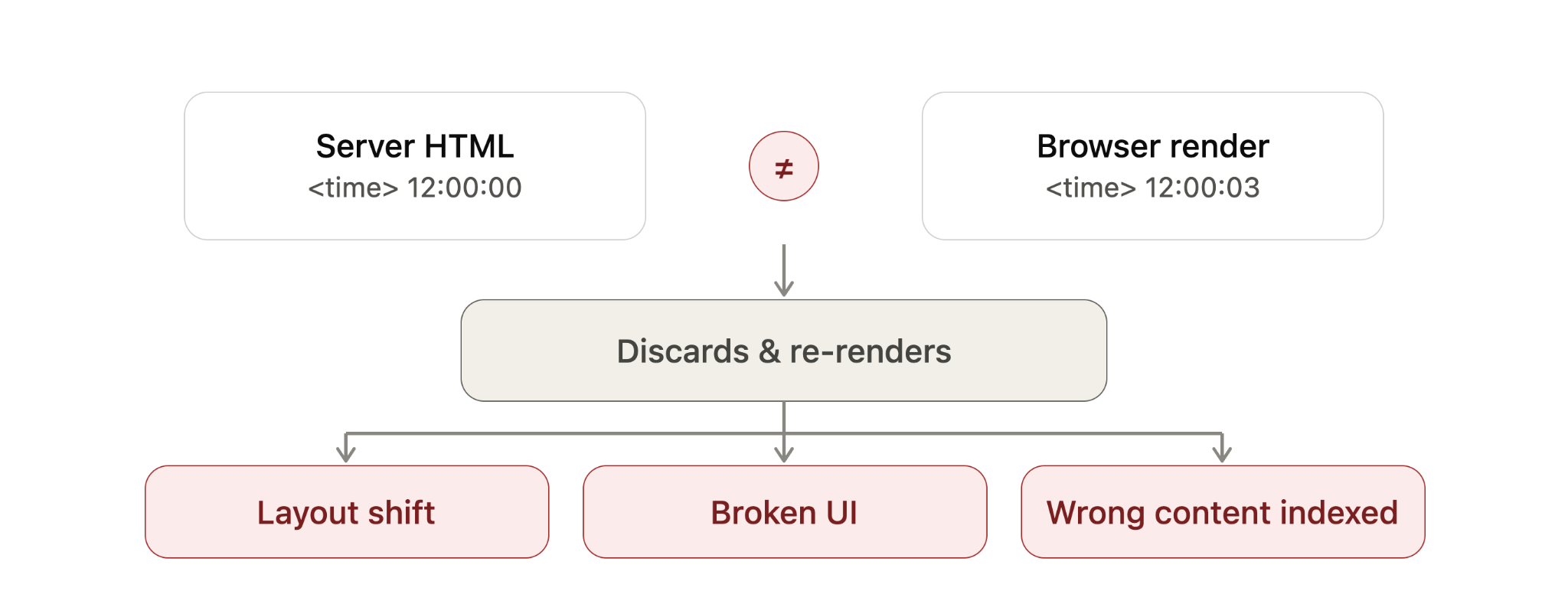

    crushpress.ai community screenshot
  • Use Google Documentation to Win SEO Buy-In With Proof

    Use Google Documentation to Win SEO Buy-In With Proof

    Let me be blunt: SEO advice can sound completely made up to people who do not live in search every day.

    When I say things like “change this canonical,” “don’t block that resource,” or “we need this content exposed in the rendered HTML,” I understand why someone outside SEO might hear it and wonder whether I am inventing rules on the spot.

    That is one reason SEO still gets treated like black magic inside many organizations.

    I have been pushing the idea of “un-nerding SEO” for years, but this is about something very practical: I use Google’s own documentation to earn approval, build trust, and help SEO work get prioritized.

    Not because Google tells us everything. Not because every sentence in its documentation should be treated as gospel. I use it because documented evidence is much harder to dismiss than personal opinion.

    When I need buy-in, the strongest argument is rarely “trust me.”

    It is usually something closer to: “Google has already documented how this should be approached.”

    The buy-in problem is usually not the recommendation itself

    In my experience, most SEO recommendations do not die because they are wrong. They die because they are competing with everything else happening inside the business.

    Dev sprints, product timelines, CMS limitations, legal concerns, brand standards, executive assumptions, and the classic “we’ve always done it this way” all have a seat at the table. SEO is rarely the only priority in the room, even when the recommendation is technically correct.

    That is why I do not rely on “best practice says” or “from an SEO perspective” when I am trying to move work forward. Those phrases sound optional, especially to teams already balancing risk, deadlines, and competing requests.

    But “Google has official documentation that supports this recommendation” lands differently.

    It may not automatically win the argument, and it definitely does not mean the work will be prioritized tomorrow. But it changes the conversation from “the SEO person said so” to “we have official Google documentation explaining why this matters.”

    Google documentation is not gospel

    I know the objection already: “Are we really pretending Google tells us the full truth about how search works?”

    Absolutely not.

    Google’s documentation is not the complete truth of search. It has omissions. It simplifies complex systems. Sometimes it explains how Google wants site owners to behave, not every technical factor that influences organic visibility.

    Google also writes for a broad audience, which means nuance gets smoothed out, edge cases get skipped, and the answer can be technically true without being the entire story.

    ```json
{
  "alt": "SEO For Lunch newsletter promotion with Nick Leroy smiling in checkered shirt.",
  "caption": "Join Nick Leroy for a fresh take on SEO with the #SEOForLunch newsletter—bringing actionable insights straight to your inbox.",
  "description": "This image promotes the #SEOForLunch newsletter by Nick Leroy, featuring a smiling Nick in a checkered shirt against a blue graphic background. The design includes a plate graphic with 'Not Your Average Table Talk' and emphasizes SEO insights, inviting viewers to subscribe at seoforlunch.com. Keywords: SEO, Nick Leroy, newsletter, marketing, insights."
}
```

    So no, I am not treating every Google statement as if it were carved into stone and carried down from Mountain View.

    But that does not make the documentation useless.

    It makes it a starting point. A receipt. An official reference point.

    It moves the discussion away from “I think this matters” and toward “Google has explicitly documented why this matters.” That distinction matters when I am asking someone else to approve and prioritize the work.

    Documentation is especially useful with developers

    This is where Google documentation often earns its keep the fastest. SEOs need developers, and I have learned that the quickest way to lose developer support is to treat every recommendation like a command instead of a requirement that needs to be implemented thoughtfully.

    And yes, just in case it ever works, I still wish I could run this:

    google.exe /disable-ai-overviews /please

    Bummer. No dice.

    Developers are not wrong just because they disagree with an SEO recommendation. Most of the time, they are optimizing for completely valid priorities: performance, code quality, technical debt, security, and avoiding the kind of production mistake that can take a whole site down.

    But sometimes developers are wrong about how Google discovers, crawls, renders, indexes, or interprets content.

    And telling a developer “you’re wrong” is a great way to make sure my ticket never sees the light of day.

    This is where documentation helps. It removes some of the subjectivity and shifts the discussion toward how to implement the requirement inside the existing technical environment.

    The point is never “SEO wins and dev loses.”

    The point is that I now have an external source of truth to discuss. That is a much better conversation than two teams arguing from preference.

    Documentation is also a client management tool

    For client-facing SEO work, documentation helps me separate serious recommendations from “trust me, bro, I have a contact at Google” consulting.

    Futuristic data archive with glowing server-like filing cabinets, stacked documents, and network lights symbolizing AI marketing data infrastructure.
    Rows of illuminated data cabinets and paper files stretch into the distance, capturing the pressure on marketers to turn fragmented customer data into a smarter performance engine.

    That matters even more when a client has been burned by bad SEO advice before.

    Instead of saying, “We need to change this because it’s better for SEO,” I can frame the recommendation with evidence.

    “Here’s what Google documents. Here’s where your current setup conflicts with that. Here’s the risk. Here’s the recommendation. Here is the estimated reward.”

    That framing builds trust because it shows the recommendation is not relying on blind faith.

    It also makes the SEO look less like a magician and more like an interpreter.

    That is how I see the real role of SEO: translating Google’s documented needs into business and technical decisions that a team can actually act on.

    Less black magic, more receipts

    SEO has a reputation problem, and some of it is earned.

    Too much SEO work is still explained with vague phrases and shaky confidence. I hear people say things like “Google likes this” or “this needs to exist for the bots” when the stronger version is: “Google documents this behavior here, and here is how it applies to our situation.”

    That does not mean documentation alone creates buy-in.

    Dropping a Google link into a ticket or Slack thread is not a strategy. I still have to translate what it means, explain the risk, connect it to business outcomes, and help the team understand why the recommendation deserves attention.

    Google documentation will never replace experience, testing, or judgment. It will not tell me everything, and I should not treat it like the final answer to every SEO debate.

    But it can make SEO easier to defend, easier to prioritize, and much harder for leaders to dismiss.

    The best SEOs are not just the ones who know what to recommend. They are the ones who can prove why the recommendation deserves to be taken seriously.

    Less black magic. More receipts. More results.

    Google documentation may not be the whole truth, but I would rather show up to a buy-in conversation with official references than with “my buddy from Google told me.” Suuuure they did.

    This post first appeared on the author’s website and is republished here with permission.


    Inspired by this post on Search Engine Land.


    crushpress.ai community screenshot