Category: Opinion

  • 6 SEO Priorities I’m Rethinking for Stronger AI Visibility

    6 SEO Priorities I’m Rethinking for Stronger AI Visibility

    I see plenty of overlap between SEO and AEO, but I do not treat them as the same discipline. The SEO playbook that worked reliably in traditional search will not take me as far when the goal is visibility inside AI-generated answers.

    So I keep coming back to one practical question: what should I change first?

    Instead of revisiting content structure for AI search, I focus on three priorities I believe deserve more attention now and three SEO habits I would intentionally emphasize less.

    3 SEO priorities I would emphasize more

    Establish brand authority and strong entities

    Before an AI system is likely to cite my brand, it needs to understand that the brand exists, what it represents, and why it is credible. Entity recognition has become foundational to AI visibility in a way that traditional search did not always require, even though Google’s Knowledge Graph has been moving in this direction for years. Large language model training data tends to reward brands that show up consistently across trusted platforms.

    When I work on this for clients, I pay closer attention to whether brand information is consistent across Wikipedia, LinkedIn, Crunchbase, industry directories, and any other source an LLM might use to understand an entity.

    I also think PR and SEO or AEO teams need to work much more closely together. Earned media mentions are no longer just awareness plays; they are entity-building signals.

    E-E-A-T was already pushing SEO in this direction, but author entities matter even more in AI search. When bylined experts have their own credible web presence, they strengthen the authority of the content they create.

    When I can invest in entity building before scaling content, I usually see stronger AI citation potential because the credibility infrastructure is already in place.

    Build topical depth with content clusters

    AI systems tend to favor sources that show comprehensive authority on a subject, not just pages that happen to rank for isolated keywords. A thin content footprint is much more vulnerable in AI search than it was in traditional search.

    That means I need to move beyond keyword-by-keyword planning and think more seriously about topic ownership. Instead of only asking, “What do we rank for?” I ask, “What topics do I want AI systems to associate this brand with?”

    Internal linking becomes more valuable in this environment because it helps signal relationships between related pieces of content. I also treat content audits as a way to find gaps in topical coverage, not just as a way to identify pages with declining traffic.

    When I can go deep in a specific niche, I often see content cited across multiple related queries. One well-built content cluster can create visibility far beyond a single keyword target.

    Owning the topic cluster around the problem a client’s product solves can position that brand as a trusted resource before a sales conversation even begins. I also hear more often that buyers are finding those brands in LLMs during their research process.

    Earn unlinked brand mentions and community presence

    LLMs learn from the broader web, not only from pages with backlinks. A mention on Reddit, Quora, a niche forum, or an industry community can matter even when there is no link attached.

    I think this is one of the bigger mindset shifts for SEO teams. AI systems look for patterns in what the web says about a brand across many sources, not only what ranks in Google. Owned content alone cannot manufacture that signal.

    Trusted third-party communities such as Reddit can carry particular weight because LLMs have been heavily trained on them and often treat that content as a form of authentic user sentiment.

    That makes community participation and digital PR increasingly important SEO-adjacent work. I care about whether a brand is being mentioned in the right places, even when the mention does not come with a backlink.

    Futuristic SEO and AI search illustration showing old tools breaking apart as blue data streams lead to a glowing search platform and digital icons.
    Old search marketing tools give way to a faster, connected future, with data streams, AI icons, and a glowing search hub symbolizing SEO innovation and community growth.

    Monitoring unlinked brand mentions is becoming just as important to me as tracking backlinks. Tools such as Brandwatch and Mention, along with manual Reddit and Quora monitoring, can show where a brand is appearing organically and where it is absent.

    I would rather talk with the team about where the brand is being discussed, whether those conversations are accurate, and whether the sentiment is positive than focus only on who is linking to the site.

    Brands with an active presence in relevant communities are more likely to surface naturally in conversational, recommendation-style AI answers, including queries such as “What does Reddit think about X?” or “What’s the best Y according to users?”

    For challenger brands trying to enter a category, earned community mentions can build AI-visible authority faster than traditional link building, which usually takes longer to accumulate.

    B2C brands can benefit especially from genuine community presence because consumer AI queries often lean toward social proof and peer recommendations rather than formal editorial sources.

    3 SEO priorities I would emphasize less

    Chasing high-volume keywords with thin content

    AI Overviews can absorb the click for broad informational queries. Ranking No. 1 for a head term increasingly means I may have invested a lot of effort into winning traffic that never actually reaches the site.

    Search volume alone is no longer a reliable proxy for opportunity. A query with 50,000 monthly searches that triggers an AI Overview may send less traffic than a query with 2,000 searches that still requires a click.

    I would rather create specific, authoritative content that answers a narrower question better than anything else available. I focus more on queries where the searcher needs to act, compare options, or access something only the site can provide. Those needs are harder for AI to fully resolve.

    Keyword traffic potential is no longer the first metric I trust. I first ask whether someone will still need to click after AI answers the query. If the answer is no, the opportunity is not what it used to be.

    Pursuing exact-match and manipulative link building

    Low-quality link volume does not do much for AI citation likelihood. LLMs care more about the authority and relevance of the sources mentioning or citing a brand than raw link counts. The publications that matter for AI visibility usually have real editorial standards, and those are much harder to game.

    I would focus on earning coverage and links from the kinds of sources AI systems are more likely to draw from, including trade publications, respected industry blogs, and academic-adjacent resources. The better long-term move is to build content worth referencing, not outreach that exists only to extract a link.

    A hundred low-quality links will not necessarily get a brand cited in ChatGPT. Five links from publications the target audience actually reads might matter much more. Source authority is the metric I would watch more closely than link volume.

    Optimizing for CTR on standard blue links

    A growing share of informational queries are resolved without a click. That makes title tag and meta description optimization for CTR less valuable on queries dominated by AI Overviews. I would rather spend that time trying to become the cited source inside the AI answer.

    For queries where clicks still happen, I put more weight on transactional and navigational intent because those searches are more resistant to full AI resolution.

    CTR optimization assumes a searcher is choosing between blue links. For more queries now, that choice is shaped before the traditional results even become the focus. The opportunity has moved higher on the page.

    The payoff is not always more traffic

    There are more shifts I could make, but these are the first ones I would prioritize. I may lose some volume in traditional SEO metrics such as impressions and clicks, but that should matter less if the downstream business metrics remain strong. In AI search, I care more about conversions, pipeline, and revenue than vanity traffic. That is the tradeoff I believe this new search environment increasingly rewards.


    Inspired by this post on Search Engine Land.


    crushpress.ai community screenshot
  • Why I Think Meta AI Is Search’s Sleeping Giant Now

    Why I Think Meta AI Is Search’s Sleeping Giant Now

    I do not think enough people are treating Meta AI as a serious AI search contender.

    In SEO circles, I hear plenty about Google AI Mode, ChatGPT, Claude, Gemini, Perplexity, RAG, and every new answer engine worth testing. Those conversations matter. But I think Meta AI already has something most AI companies would spend years and billions trying to build: massive distribution.

    By May 2025, Meta AI had reached one billion monthly active users across Meta’s apps, according to Mark Zuckerberg.

    Zuckerberg has also made the direction clear. He wants Meta AI to become a leading personal AI, shaped around personalization, voice conversations, and entertainment, with monetization through paid recommendations or subscriptions already being considered.

    That is why I think Meta AI is becoming one of the most important AI search contenders to watch.

    Meta’s Advantage Is Distribution

    I think the AI search debate spends too much time on model quality and channel ownership. Which tool is smarter? Which answer engine cites better? Is this just SEO with a new label?

    Those questions matter, but distribution matters more than the search industry often wants to admit.

    Meta reported 3.56 billion family daily active people across its apps in March. In that same quarter, revenue reached $56.31 billion, up 33% year over year.

    WhatsApp passed 3 billion monthly users in 2025. Instagram reached 3 billion monthly active users in September 2025. Threads reached 500 million monthly active users in June.

    I know Facebook is not the cool platform anymore. The metaverse stumbled. Threads can still feel like a corporate response to Elon Musk running, or ruining, the artist formerly known as Twitter.

    But none of that changes the important point. Meta can put AI inside the apps where people already spend their time. In doing that, it can bring search-like behavior directly into the places where discovery already happens.

    I think that could push public AI adoption faster than almost anything else in the market.

    The First Search Is The Search That Matters

    Google’s historic power has always rested on a simple habit. When people wanted to know something, compare options, buy a product, find a local business, or settle an argument, they started with Google.

    That starting point became the most valuable real estate on the internet.

    AI search changes where that starting point can live. If someone sees a product on Instagram, they do not have to leave the app and search Google. They can ask Meta AI whether the product is any good, what alternatives exist, whether the brand is trustworthy, or where they can buy it.

    If a WhatsApp group is planning a weekend away, they do not need to switch to Google to compare hotels, restaurants, venues, or train times. Meta AI can sit inside the conversation at the exact moment intent appears.

    If someone is scrolling through a Facebook thread full of local recommendations, they can ask Meta AI to summarize what people are saying across Groups, Reels, and public posts.

    That is not traditional SEO. I see it as search behavior being absorbed into social platforms.

    The strategic question is no longer only, “Who ranks?” I think the better question is, “Where does the question begin?”

    Meta AI Is More Than Another Chatbot

    I think search marketers often approach AI through too narrow a lens. We find the chatbot, test a few brand queries, check which sources get cited, and decide we understand the platform.

    That is a mistake.

    Meta AI is becoming a layer across feeds, chats, search, content creation, recommendations, smart glasses, and social discovery. Meta says it is available across Facebook, Instagram, WhatsApp, and Messenger, including in feeds, chats, and search, giving users real-time information without leaving the app. The use cases include restaurant recommendations, travel planning, study help, and shopping inspiration.

    The standalone Meta AI app, launched in 2025, was designed around a more personal AI experience. Meta says it can use information people have chosen to share across Meta products, along with profile data and content engagement, to deliver more relevant answers in supported markets.

    I can see where this is heading. Meta AI could become the free AI tool that everyday consumers use without thinking much about it.

    How Meta AI Could Become Consumer AI

    ChatGPT and Claude still feel like work tools to me. They are excellent tools, but they are tools people deliberately open because they have decided to do something.

    Meta AI feels more like consumer AI. It is messier, more visual, more embedded, and less like launching a productivity suite. It feels more like finding an answer while doing what you were already doing.

    For many people outside tech, opening ChatGPT still feels like an intentional act. Asking a question inside WhatsApp or Instagram can feel almost frictionless.

    That is Meta’s advantage. It does not have to convince people to adopt AI from scratch. It can fold AI into existing habits.

    This is where it gets interesting. Meta AI is also a playground, and Meta gets to watch how people actually use it.

    I can imagine a 65-year-old grandmother using it to animate family photos and share them in a WhatsApp group.

    I can imagine a dog groomer using it to create short videos of clients’ pets and post them on Instagram.

    When AI becomes mainstream and easy to use, people will use it where they can reach other people. That gives Meta a powerful feedback loop. The more people play with Meta AI, the more Meta learns, improves, and adds features that fit real consumer behavior.

    AI Becomes Social, Visual, And Shoppable

    Then there is Meta AI Studio.

    Users can create AI characters built around their interests, work from templates, or start from scratch. They can build assistants for advice, captions, entertainment, and creator interactions.

    Futuristic SEO and AI search illustration showing old tools breaking apart as blue data streams lead to a glowing search platform and digital icons.
    Old search marketing tools give way to a faster, connected future, with data streams, AI icons, and a glowing search hub symbolizing SEO innovation and community growth.

    Then there is Vibes. In September 2025, Meta introduced Vibes as a feed inside the Meta AI app and on Meta AI, where users can create, remix, and share short-form AI-generated videos, then distribute them through DMs, Instagram, Facebook Stories, and Reels.

    I will be honest: parts of this feel strange. Generative AI video on social platforms is a messy mix of creativity, novelty, nonsense, and low-quality output. But early weirdness is not the same as strategic irrelevance.

    I never expected AI to arrive as one perfect super-app that everyone understood immediately. Meta is putting new formats into users’ hands, watching what people do with them, and reshaping the product around that behavior.

    The Ad Machine Makes This A Google Problem

    Forecasts suggest Meta will reach $243.46 billion in net worldwide ad revenue in 2026, putting it ahead of Google at $239.54 billion. The same forecast has Meta capturing 26.8% of worldwide digital ad spend, compared with Google’s 26.4%.

    I think those numbers should get Google’s attention.

    If AI answers are monetized through paid recommendations, sponsored answers, shopping suggestions, or conversational ad units, the commercial value collects around the platform that owns the query. That platform does not always have to be the one with the best model.

    Meta has the audience, the ad graph, creator relationships, commerce signals, and behavioral data built from years of social, messaging, and content engagement. It can promote Meta AI inside its own products to billions of existing users.

    Google still has search intent, which is enormously powerful. But Meta has attention, habit, and context. Google is where people go when they have decided to search. Meta is where many people already are.

    Why “It’s Just SEO” Misses The Point

    The AI optimization debate keeps collapsing into the same comforting line: it is just SEO.

    Sometimes, I agree. Technical hygiene, crawlable content, authoritative pages, clear entities, strong brand signals, helpful content, and consistent information still matter.

    But I think the harder question is this: how exactly do you optimize for Meta AI?

    Facebook AI Mode makes the challenge obvious. In June, Meta introduced AI Mode as a Facebook search tab that uses Meta AI to surface answers rooted in public culture, opinions, and recommendations shared across Meta’s apps, rather than a traditional list of links. It draws on what people are posting publicly in Groups and Reels to provide perspectives instead of standard search results.

    That is a fundamentally different environment. If Meta AI pulls from public posts, Groups, Reels, creator content, user engagement, web information, social recommendations, product content, and eventually paid data, the standard SEO playbook is not enough.

    Your website may still matter. Your public social content may matter, too. Your creator strategy may matter. Your product feed may matter. Your reviews may matter. I think the point is clear: visibility is getting more complicated.

    Nobody can honestly say they know exactly how all of this works yet. Anyone who claims total certainty is probably selling a dashboard and a dream.

    The honest answer is frustrating: I do not think we know enough yet. But that is not a reason to ignore Meta AI.

    Google Is Being Attacked From Every Angle

    Google is still Google. I do not want to overstate the case. It remains central to search, commerce, publishing, advertising, and the open web.

    But Google is being pushed from every direction at once. ChatGPT is pressuring answers. Perplexity is pressuring research. Amazon is pressuring product search. TikTok and Instagram are pressuring discovery. Regulators are pressuring market power. Publishers are challenging AI content extraction. Meta is pressuring attention, ads, and AI-assisted discovery.

    In the UK, the Competition and Markets Authority imposed new conduct requirements on Google Search in June. Publishers will be able to opt out of having their content used to power AI features in Google Search, including AI Overviews. Google is also required to properly attribute publisher content with clear links in AI-generated results.

    I think this matters because AI search is not just another product feature. It changes the value exchange between users, publishers, platforms, and advertisers. While Google works through that challenge, Meta is quietly building AI into social behavior.

    What I Think Brands And SEOs Should Do Now

    I would not panic. Panic is rarely a strategy, even if it shows up in plenty of marketing meetings. But I would start testing now.

    I would run brand, category, product, local, and comparison queries in Meta AI. I would test Facebook, Instagram, WhatsApp, and the standalone app wherever possible, then compare the results with Google AI Mode, ChatGPT, Perplexity, Gemini, and Claude.

    I would track whether my brand appears, whether answers cite or link to me, and whether public Meta content seems to shape responses. I would look closely at Facebook Groups, Reels, creator posts, Instagram content, product mentions, and recommendation language.

    If discovery moves into Meta’s AI layer, I want to understand what my brand needs in order to be visible there.

    That might mean stronger public social content, clearer product information across Meta surfaces, creator partnerships, better community management, more consistent entity signals, or paid social tests designed around AI visibility. It might also mean none of those things yet.

    Either way, I would rather have data than keep repeating “it’s just SEO” while the market reorganizes itself.

    The Sleeping Giant

    I do not think Meta AI has to beat Google at Google’s own version of search. It does not need to.

    It only needs to absorb enough search behavior into the places where people already spend their time.

    It needs to become the casual AI layer for people who may never deliberately open ChatGPT.

    It needs to make product discovery, recommendations, local advice, content creation, and shopping assistance feel native inside social apps.

    That is a serious threat. Meta AI may feel clunky right now, but so did much of the early web.

    I think the search industry should stop asking whether Meta AI looks like search. The better question is whether users care.

    If people start asking Meta before they ask Google, the game changes. That is how sleeping giants wake up.


    Inspired by this post on Search Engine Land.

    crushpress.ai community screenshot
  • Why Paid Media Is Now a Powerful AI SEO Investment

    Why Paid Media Is Now a Powerful AI SEO Investment

    I believe the lines between paid media, PR, and SEO have officially disappeared.

    When I look at baked-in YouTube sponsorships, native UGC, and third-party review incentives, I no longer see them as separate from SEO. I see them as the modern equivalent of buying a high-DA backlink. When I fund these channels, I am investing in the information sources that shape how AI systems understand, evaluate, and recommend a brand.

    A recent social media screenshot made this shift especially clear to me. A B2B brand was offering a $250 Amazon voucher to anyone who wrote a review on G2.

    To a growth marketer, that may look like a familiar user acquisition tactic. But as an SEO, I saw something more important: a direct investment in the semantic infrastructure AI systems use to judge brands.

    The evolution of the authority signal

    To understand why I consider a $250 G2 voucher or a paid YouTube sponsorship an SEO strategy, I have to look at how LLMs now define authority.

    Authority used to feel transactional and mathematical. You built or bought hyperlinks, and those links helped determine how trusted a page or brand appeared to search engines.

    When I moved from link building into digital PR and influencer marketing, I realized Google was getting smarter. I could not rely on links alone. I needed unlinked brand mentions, high-tier media coverage, and contextual relevance. In many ways, I was optimizing for Google’s Knowledge Graph.

    Today, retrieval-augmented generation (RAG) systems and LLMs do not just count links or parse knowledge graphs. They look for semantic consensus across the web.

    When an AI engine like Perplexity or ChatGPT answers a user query, it crawls the data ecosystems it trusts most for that specific topic. For software, that often means G2 and Reddit. For consumer products, it may mean TikTok transcripts, YouTube, and forums.

    So when I pay $250 for a G2 review, I am buying a dense, text-based data point that an LLM can use to understand my brand’s sentiment, use cases, and vector positioning. I am strengthening the signals AI systems may use when deciding whether to recommend my brand.

    The permanent ad: Why sponsorships and UGC are the new organic infrastructure

    This reality breaks the traditional separation between paid media and SEO.

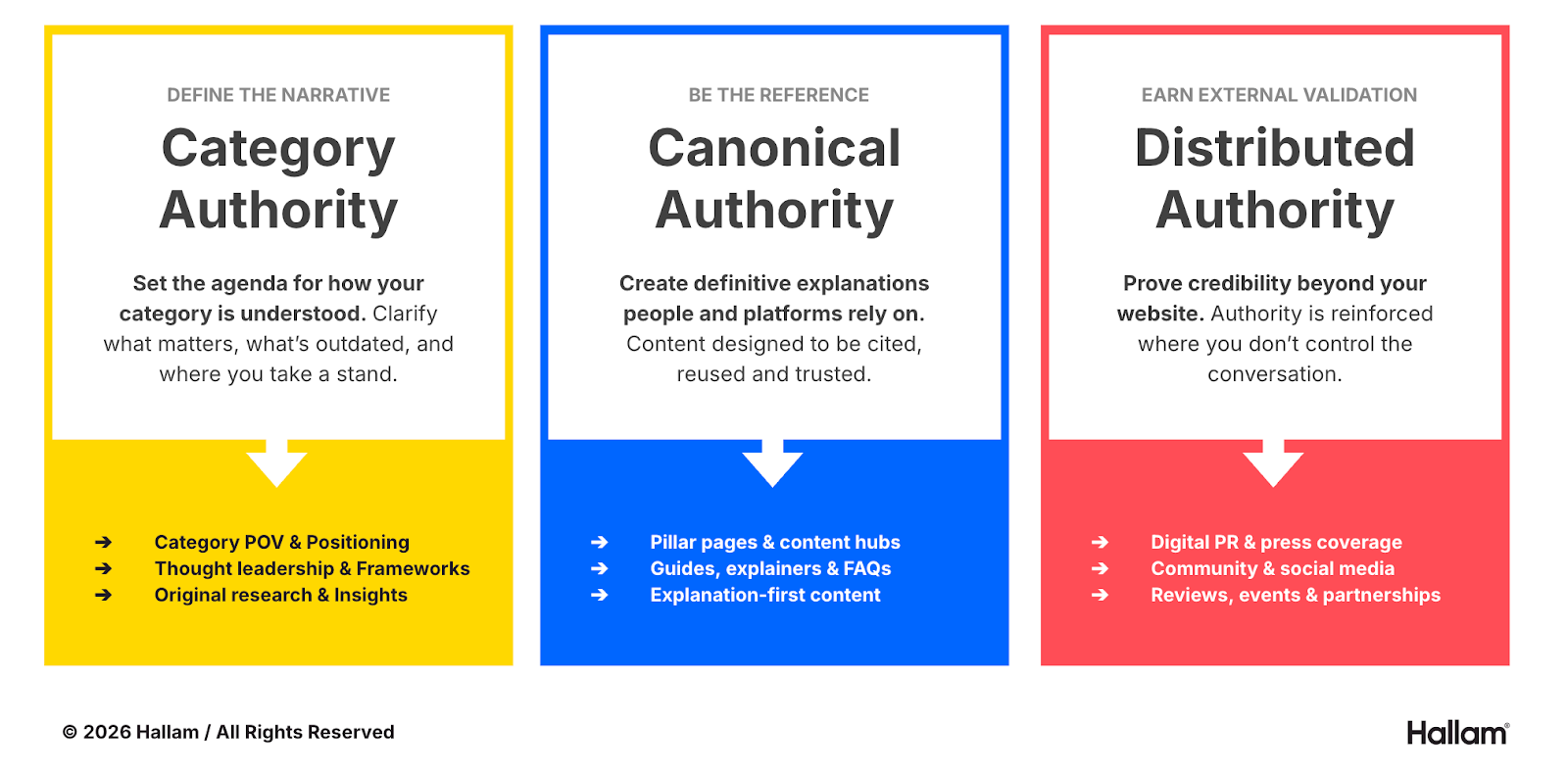
    Infographic showing SEO authority evolving from backlinks and PageRank to digital PR mentions, then LLM/AEO semantic consensus and dataset saturation.
    The path to AI search visibility now runs beyond links: from PageRank and PR mentions to consistent brand signals across the datasets LLMs rely on.

    Historically, paid ads were temporary. I turned off the budget, the traffic stopped, and SEO had to carry the long-term work. If I run a dynamic programmatic ad on YouTube or a banner ad on a website, that old model still applies because LLM web scrapers generally ignore dynamic ad placements.

    But baked-in influencer sponsorships, native user-generated content, and podcast reads behave differently because they become part of the content itself.

    First, there is the hardcoded transcript. When a YouTuber reads a native sponsor segment such as, “I use Brand X to manage my business taxes,” that message is baked into the video file, and YouTube automatically transcribes it.

    Then comes LLM ingestion. When an LLM crawls the web, or when a multimodal AI watches the video, those spoken words can be indexed. The AI can associate the brand with the semantic concept of business taxes.

    That creates a new half-life for paid media. Long after the campaign ends and the initial views slow down, the transcript can remain part of the information an LLM can access.

    As someone who spent years bridging the gap between digital PR and SEO, I used to judge a campaign’s ROI by immediate referral traffic, brand search lift, and backlink quality. Now, I also have to think about the algorithmic half-life of my creative assets.

    Activating the convincer: Bringing paid and PR into the visibility supply chain

    The visibility supply chain treats content like an industrial product that passes through strict organizational “gates” before it enters the digital ecosystem. In that model, companies need a strategic duo: the hacker, or technical architect, and the convincer, or cross-departmental visibility advocate.

    This convergence of paid media and AI visibility is exactly where I believe the convincer has to step in.

    If my paid media team is buying YouTube sponsorships based only on demographic reach, or if my product marketing team is buying G2 reviews just to hit a quarterly quota, we may be damaging LLM visibility without realizing it.

    The reason is simple: LLMs need information density and semantic alignment.

    If a user writes a rushed, generic review like “Great tool, highly recommend!” just to receive a $250 voucher, it may pass the human layer, but it fails the machine layer. To a RAG system, that sentence is low-density noise.

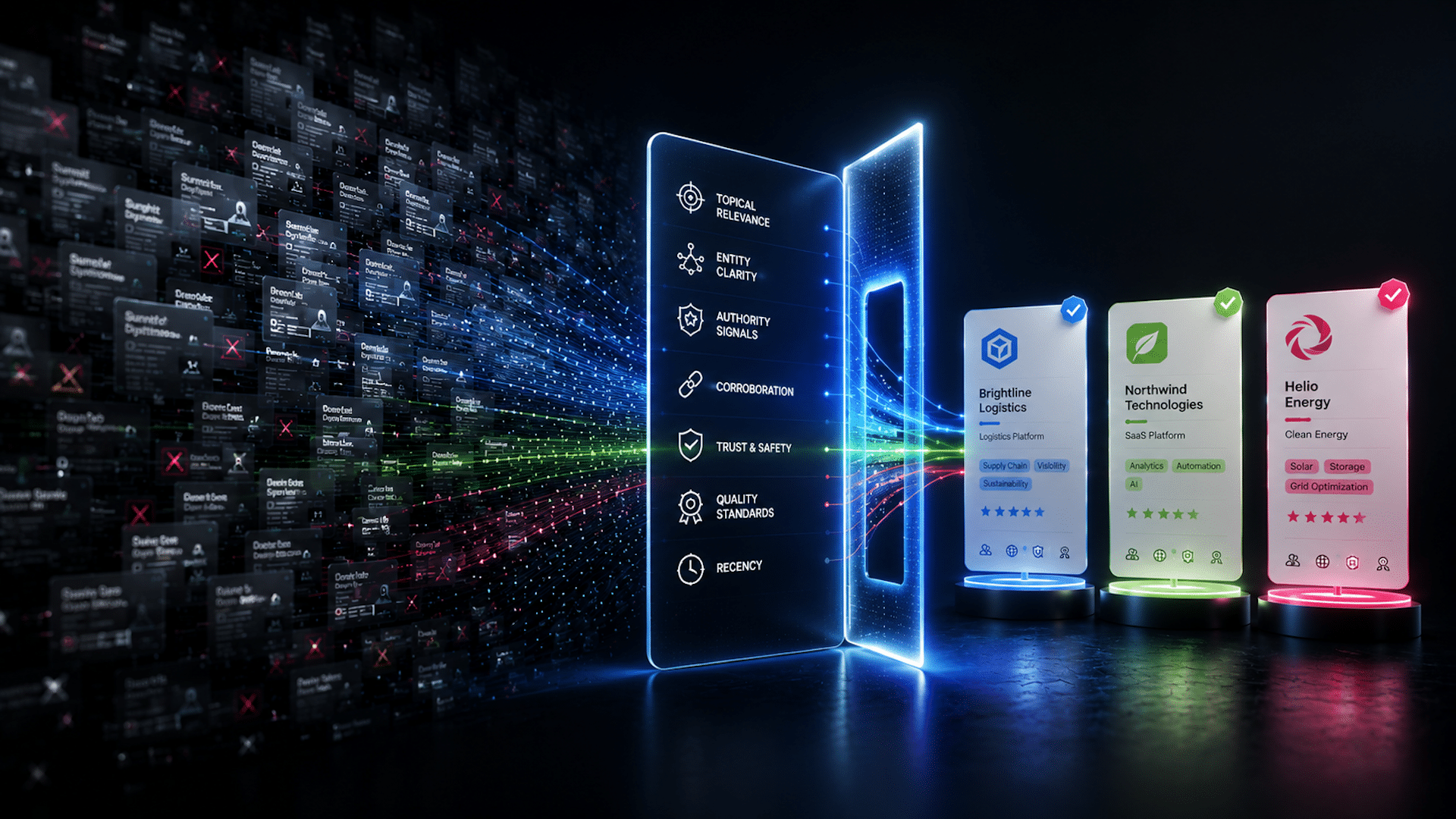
    Futuristic SEO and AI search illustration showing old tools breaking apart as blue data streams lead to a glowing search platform and digital icons.
    Old search marketing tools give way to a faster, connected future, with data streams, AI icons, and a glowing search hub symbolizing SEO innovation and community growth.

    The convincer’s job is to realign the review strategy and help internal teams understand how every initiative can build LLM visibility.

    For example, I would rather incentivize users to write detailed, context-rich problem-and-solution statements, such as: “We used Brand X to solve our cross-border compliance issues in Europe.” That gives AI the entity-relationship mapping it needs to recommend the brand for cross-border compliance.

    The new marketing playbook: Optimizing dataset partnerships

    If I want a brand to be recommended by AI systems, I have to study where the major AI players are getting their data.

    We know OpenAI and Google have struck multimillion-dollar deals to train on Reddit’s real-time firehose. We know Grok trains on X. We also know Apple and others are licensing major journalistic archives.

    That means target audience research is no longer just about finding where customers spend time. For me, it is also about dataset matching.

    If I am planning an influencer campaign, a digital PR push, or a community-building initiative, I need to ask one critical question: Is this content entering a data pipeline that the primary LLMs trust and crawl in real time?

    Stop optimizing pages. Start optimizing budgets.

    I no longer believe SEO can be isolated inside a technical department or limited to a content blog. That does not reflect how AI visibility is built anymore.

    The next time I sit in a budget allocation meeting and see a line item for influencer marketing, podcast sponsorships, or third-party review incentives, I will not treat it as temporary media buying.

    I will reframe it as infrastructure. I am building the digital foundation of a brand’s AI persona. I am buying the AI equivalent of backlinks. If I do not intentionally structure those paid assets to feed the visibility system, I am leaving the brand’s future visibility up to chance.


    Inspired by this post on Search Engine Land.


    crushpress.ai community screenshot
  • Why I Judge AI Deliverables by Outcomes, Not Effort

    Why I Judge AI Deliverables by Outcomes, Not Effort

    When I think about AI deliverables, I keep coming back to a simple scenario: a client receives two pieces of work.

    Both deliverables solve the problem they were hired to solve. Both are accurate, useful, and tied to the same business outcome. The client is happy, and from the outside, there is no meaningful difference in the results.

    Then the client learns that one took 20 hours to create, while the other took 20 minutes. That is when the uncomfortable questions begin.

    Was AI involved? Should the faster deliverable cost less? Is the person who completed it less skilled because they found a faster, more efficient way to reach the same result?

    What I find most interesting is how differently many of us react to AI depending on which side of the transaction we are on. I love using AI when it saves me time, but I also understand why customers can feel uneasy when they discover AI helped create something they paid for.

    I recently ran a LinkedIn poll asking a simple question: if the outcome is great, do we really care how it was made?

    The responses reinforced something I have been thinking about for a while. Many of the strongest objections people have to AI are not really about quality at all.

    The Time vs. Value Fallacy

    I think part of the discomfort comes from the fact that we have spent decades tying value to effort.

    Long hours feel valuable. Fast work feels suspicious. Struggle often gets mistaken for expertise.

    The harder something appears to be, the easier it becomes to justify the price attached to it.

    There is an old story about a ship engine that stopped working. After multiple failed attempts to repair it, the owners brought in an engineer with decades of experience. He inspected the engine, tapped it once with a small hammer, and the machine roared back to life.

    His invoice was $10,000.

    Image

    The owners were furious and demanded an itemized bill. The response was simple: hammer tap, $2. Knowing where to tap, $9,998.

    People debate whether that story is true or just a useful tale for people like me who believe in value-based pricing. But whether it really happened almost does not matter. The lesson still holds.

    People are not paying for the tap. They are paying for the expertise behind it.

    That is what makes AI such an important topic for me. It forces us to confront a question many of us have avoided for years: are we paying for expertise, or are we paying for visible effort?

    Those are not always the same thing.

    The Objections That Actually Matter

    To be clear, I do not think every objection to AI is unreasonable. I have shared plenty of my own concerns, and some of them are serious.

    In fact, I think the strongest arguments against AI have very little to do with how quickly something was created.

    Risk matters. Hallucinations matter. Bad recommendations matter. Compliance, privacy, and security concerns matter. Accountability matters.

    Those are legitimate concerns. What stands out to me is that none of them has much to do with how long it took to create the deliverable.

    They are questions of trust.

    Can the output be trusted? Can the recommendation be defended? Can someone confidently stand behind the work if it is questioned six months from now?

    ```json
{
  "alt": "SEO For Lunch Newsletter by Nick Leroy, featuring actionable SEO insights.",
  "caption": "Join Nick Leroy's SEO For Lunch: Your go-to source for actionable SEO insights served directly to your inbox.",
  "description": "This image promotes Nick Leroy's 'SEO For Lunch' newsletter, emphasizing actionable SEO insights. It features a smiling person against a dark blue background with the newsletter's branding, '#SEOFORLUNCH,' and website details. The design includes graphic elements like a fork and knife, alongside the tagline 'Not Your Average Table Talk.'"
}
```

    Because when something goes wrong, nobody gets to blame the AI. The employee is accountable. The consultant is accountable. The company is accountable.

    That is why I have always found the quality debate to be the least interesting part of the conversation. The more important question is not whether AI was involved. It is whether the outcome is trustworthy enough for someone to put their name behind it.

    The Outcome Test

    The more I think about AI, the less interested I become in whether it was used.

    Instead, I find myself asking a different set of questions. Was the outcome accurate? Was it useful? Was it better than the alternative? Would I be willing to stand behind it with my name, reputation, and credentials on the line?

    If the answer to all of those questions is yes, then I have a hard time arguing that the production method matters more than the result.

    I suspect this is where many people become uncomfortable because it shifts the conversation away from tools and back toward results.

    Ironically, this is also where humans become more important, not less.

    The future is not machines versus humans. I know, "The Terminator" and "I, Robot" movies will never feel the same. The real shift is humans using AI versus humans who refuse to adapt.

    The premium will not come from avoiding AI. It will come from judgment, taste, decision-making, communication, and accountability.

    AI can accelerate execution, but people still decide what should be built, what should be published, and what risks are acceptable. More importantly, people are still responsible for the outcome.

    The people who lose to AI will not be the ones using it. They will be the ones still evaluating effort while everyone else is measuring outcomes.

    This post first appeared on the author’s website and is republished here with permission.


    Inspired by this post on Search Engine Land.


    crushpress.ai community screenshot
  • How I Defend Branded Traffic From Competitor Google Ads

    How I Defend Branded Traffic From Competitor Google Ads

    How competitors target your branded traffic with Google Ads

    I no longer think of branded search protection as simply bidding on my own brand name. Competitors can position themselves against my brand through landing pages, ad copy, modifier keywords, and Google Ads automation, often in ways that look completely legitimate.

    The real pressure often goes beyond keyword bids. Comparison pages that pass review, dynamic keyword insertion that pulls brand names into headlines, and policy gaps that allow competitors to appear beside my brand can quietly weaken performance without clearly breaking Google’s rules.

    By the time I notice the pattern, the damage may already be visible in branded CPCs, impression share, or conversion rate. That is why I pay close attention to how these tactics work, how to spot them early, and how to respond without overreacting.

    1. Dynamic keyword insertion

    Dynamic keyword insertion, or DKI, is designed to make ads feel more relevant by automatically inserting a user’s search query into the headline. In competitive brand auctions, I see it as a tactic that can create a meaningful loophole.

    If a competitor bids on my branded terms and uses DKI, Google can dynamically place my brand name in the ad headline in real time, even if the competitor never typed my trademark into the ad copy.

    That distinction matters. The competitor is not explicitly writing my trademark into the ad. Google is inserting the searcher’s query. To the user, the ad may look like it directly references my brand. Inside Google’s system, it is treated as standard query matching.

    The result is frustrating: an ad can appear to reference my brand, capture high-intent traffic, and send that user to a competing offer without obviously violating policy.

    I have seen this happen from both sides. Sometimes competitors use it intentionally. Sometimes brands trigger it in their own accounts without realizing what is happening. In one case, a competitor’s name started appearing in a brand’s ad headlines because of DKI. No one had written that name into the ad; Google inserted it based on the query.

    The bigger challenge is that I cannot reliably detect this from inside Google Ads alone. I have to audit the search results page directly. Otherwise, I may only notice the problem after branded CPCs rise or conversion rates start to slip.

    Dig deeper: When to use branded and competitor keywords in PPC

    2. Comparison landing pages

    Comparison landing pages sit in a gray area. Google does not evaluate landing page content the same way it reviews ad copy. If a competitor creates a page such as “[Your Company] alternatives” or “[Competitor vs. Your Company]” and bids on my branded terms, the ad can still run as long as the ad itself stays neutral.

    The ad does not have to mention my brand at all. It can use broad language like “Find the right solution,” “Compare top tools,” or “See your options.” The competitive positioning happens after the click.

    Once the user lands on the page, the comparison does the work. The page may include feature charts, pricing callouts, benefit comparisons, and carefully framed language such as “Why teams choose us over [Your Company].” The page may not be misleading or technically noncompliant, but the intent is obvious.

    Google’s review process tends to focus on the ad rather than the full post-click experience. As long as the ad copy does not make explicit competitive claims, the system may treat it as compliant, even when the landing page is built entirely around positioning against my brand.

    This works because landing page relevance can reinforce auction strength. A page built around my brand and the keywords in the ad group may align closely with the searcher’s intent. Even if the ad copy stays generic, the post-click experience can help the ad compete because it matches what the searcher is trying to evaluate.

    When I respond, I do not focus only on one advertiser. If competitors are using comparison-driven experiences to intercept branded demand, I look at the broader search ecosystem around my brand.

    • I strengthen my presence across the full search results page, not just my own ads.
    • I invest in publishers, review platforms, directories, analysts, and affiliates that influence comparison and alternative searches.
    • I work to build a search results page where credible third-party sources reinforce my positioning when prospects search for alternatives, comparisons, reviews, or competitor evaluations.

    The brands that win these moments do not rely only on their own landing pages. They shape the narrative across the entire search results page.

    Dig deeper: Own your branded search: Building a competitive PPC defense

    3. Brand modifier keywords

    Brand keyword bidding is not new, but I see competitors using it in more strategic ways. Instead of bidding only on my exact brand name, they target brand-and-modifier combinations that give them more flexibility.

    For example, if my brand were “Acme Project Manager,” a competitor might bid on searches like “Acme Project Manager alternative,” “Acme vs. competitors,” or “Acme pricing review.” Their ad copy can avoid mentioning Acme by name while still using the search context to position itself as the alternative.

    Google allows this because the ad itself does not explicitly mention my brand. The searcher does. Modifier keywords provide enough context for the ad to compete without directly referencing a trademark in the copy.

    When competitors bid on terms like “[Your Brand] alternative” or “[Your Brand] vs.,” they are targeting lower-funnel research queries. These searchers may not convert at the same rate as people searching only for my brand, but they can still change the auction dynamics.

    That pressure can increase branded CPCs, force me to spend more to maintain visibility, and raise the cost of my core brand terms, even if competitors convert relatively few of those modifier searches.

    I treat brand modifier queries as a separate audience. I segment them by intent, including pricing, reviews, alternatives, competitors, and comparisons, and I monitor Auction Insights for each group. Exact brand searches and comparison-driven searches need different strategies.

    I also build dedicated landing pages and messaging for each modifier intent. That helps me control high-intent research moments without overpaying for every branded variation.

    Dig deeper: How to benchmark PPC competitors: The definitive guide

    How I monitor and respond

    Manual SERP checks are useful, but they do not scale. If I have meaningful branded spend or active competitors targeting my terms, I use automated brand monitoring tools to identify activity across devices, geographies, and browsers that manual checks can miss.

    This is especially important when competitors use geotargeting, dayparting, or other tactics designed to limit visibility. A competitor may not appear every time I check manually, but that does not mean the activity is not happening.

    I also use a clear escalation framework. If a competitor uses my trademarked term directly in ad copy, I start with Google’s trademark complaint process. If the behavior continues after enforcement action, I document the pattern and involve legal counsel.

    Most other scenarios, including modifier bidding, comparison pages, and competitive positioning, are usually better handled through PPC strategy than legal action.

    Before I decide how aggressively to respond, I measure the economics. I estimate the monthly cost of competitor activity by calculating the increase in branded CPCs and the additional spend required to maintain visibility.

    Then I compare that number with the cost of my response, whether that means higher bids, new landing pages, expanded monitoring, or more investment in third-party visibility. My goal is to keep the cost of defending the brand lower than the value I am protecting.

    Build a proportionate response

    Competitors use modifier keywords, comparison landing pages, dynamic keyword insertion, and other policy-compliant tactics to influence buyers during critical research moments. Often, they can do this while staying within Google’s policies.

    The strongest defense I can build combines continuous monitoring, thoughtful audience segmentation, proportionate responses, and disciplined budget decisions.

    Competitive PPC success comes from understanding the auction, shaping the narrative across search results, and investing where my defensive efforts deliver the greatest return.


    Inspired by this post on Search Engine Land.

    crushpress.ai community screenshot
  • How AI Is Reshaping Search Demand Across 1M Keywords

    How AI Is Reshaping Search Demand Across 1M Keywords

    I do not see search demand disappearing. I see it moving. In this analysis, 29% of high-volume search demand is declining, while nearly the same amount is growing somewhere else. Overall demand is essentially flat because people are redistributing how and where they search instead of abandoning search altogether.

    That changes how I think about SEO strategy. I would not start by panicking over shrinking keywords. I would start by identifying which queries are losing volume, which ones are gaining momentum, and where a brand can build enough authority to appear in both traditional search results and AI-generated answers.

    This study looks at where search demand is shifting, which industries are seeing the sharpest changes, and what those patterns mean for SEO teams trying to adapt to AI-driven discovery.

    In 2024, Gartner predicted that traditional search engine volume would fall 25% by 2026 as consumers shifted to AI chatbots and virtual agents. Fractl and Search Engine Land set out to test that prediction. (Disclosure: I’m the co-founder of Fractl.)

    I worked from Semrush data covering 1,010,848 high-volume keywords, each with at least 10,000 monthly searches, across 379 brands in eight verticals. I also looked at survey responses from 1,004 U.S. consumers to better understand how AI is changing the way people search.

    Image

    The analysis measured which keywords gained or lost search volume over the past year, how those shifts differed by industry, and how consumer behavior is evolving as AI tools become part of everyday discovery.

    The 29% search decline is real, but it depends on the vertical

    Across more than 1 million high-volume keywords, I found that 29% of search volume is in measurable decline. That is 4 percentage points above Gartner’s forecast. In a dataset representing 35.4 billion monthly searches, that difference represents a meaningful amount of search activity.

    The impact is not evenly distributed. FinTech showed the largest decline at -37.7%, while Lifestyle saw the smallest decline at -15.2%. Only three of the eight verticals, Insurance, SaaS, and Lifestyle, came in below Gartner’s 25% threshold. FinTech, HealthTech, and Wellness were well above it.

    The pattern makes sense when I look at how information-heavy each category is. When a chatbot can answer the question completely, such as summarizing drug interactions, explaining deductibles, or giving a quick overview of a fund, search volume is more likely to fall. When people need to compare prices, complete a transaction, or navigate to a specific site, search demand tends to hold up better.

    Image

    That is why transactional verticals such as SaaS, Lifestyle, Insurance, and Travel are growing or staying close to flat. Information-heavy verticals such as HealthTech, FinTech, and Wellness are seeing the largest declines.

    Before reacting to broad claims about AI-driven search decline, I would benchmark these findings against the specific vertical in question. HealthTech and FinTech teams should expect more exposure than the overall 29% decline suggests. SaaS and Lifestyle teams have more reason to challenge the idea that search demand is simply collapsing.

    Search demand is being redistributed

    The headline number gets attention, but the offset is just as important. Demand did not vanish. It moved to a different set of words, and those are the terms I would want to understand first.

    Among the high-volume keywords tracked, 40.7% are in measurable decline, meaning they lost more than 15% of their volume over the past year. Within that group, the average decline is -41%, and 112,378 keywords lost more than 40% of their volume. For brands that depend on those terms, the impact is significant.

    Image

    At the same time, 20.1% of keywords are growing by more than 15%. When I add up the volume on both sides, the decline and growth almost cancel each other out.

    The 285,489 declining keywords represent roughly 10.29 billion monthly searches. The 140,835 growing keywords represent roughly 10.31 billion monthly searches. Across the entire dataset, the net change is +16.8 million searches per month.

    Fewer keywords are growing than declining, but the growing keywords carry more volume each. That is why the totals balance out. In practical terms, I see demand relocating more than shrinking.

    The vertical-level growth-to-decline ratios show where that new demand is landing. Lifestyle leads at 2.6x, with 40% of keywords growing versus 15% declining. SaaS follows closely at 2.5x, with 48% growing versus 19% declining. HealthTech sits at the other end with an inverted ratio of 0.4x, making it the most disrupted vertical in the set.

    Image

    The first audit I would run is simple: pull the tracked keyword set, filter it by year-over-year volume change, and see which side of the ledger the portfolio sits on.

    Non-branded queries are the most vulnerable

    I see non-branded queries as the easiest ones for AI chatbots to replace. When a search term does not include a brand name, the user is not necessarily trying to reach a specific site or source. The full exchange can happen inside the chat window.

    Across the dataset, 90% of all tracked search volume is non-branded. HealthTech, at 99.6%, and Wellness, at 98.5%, are the most exposed. Insurance, at 73.8%, and SaaS, at 82.0%, are less exposed, and both are growing overall. SaaS volume is up 48% year over year, while Lifestyle is up 40%.

    If I wanted to identify the content most at risk, I would start with keyword patterns. They offer one of the clearest signals in the study.

    Image

    The reason SaaS and Lifestyle can be heavily touched by AI and still grow comes down to what happens after the AI answer. If AI recommends a project management platform or a couch, many people still search for the specific brand, retailer, review, or product page before buying. The AI answer creates a downstream search.

    HealthTech and FinTech often behave differently. A drug-interaction question or a “what is a deductible” query can be answered completely inside the chat window. There may be no next step that sends the user back to Google.

    If a category produces complete AI answers with no natural next click, I would treat AI visibility as a core strategy, not an SEO side project. In those cases, showing up in the answer may be the entire opportunity.

    70% of consumers use AI more, but only 17% use search less

    The keyword data shows what is happening in the index. The survey data shows what is happening in the minds of the people doing the searching.

    Image

    Search behavior is spreading across more platforms. Many people are adding AI to their routines without giving up Google.

    Social platforms are also acting like search engines in a way they did not a few years ago. YouTube leads at 68%, followed by Reddit at 57%, Instagram at 42%, Facebook at 40%, and TikTok at 33%.

    If I had not already prioritized YouTube and Reddit, I would move them up the list. Both rank ahead of TikTok, Instagram, and Facebook as search destinations, and both can also surface in Google results, which gives visibility there a compounding effect.

    What has actually moved from Google to AI

    More than a third of respondents, 35%, say they have not replaced traditional search with AI for anything yet. Among those who have, how-to guides and tutorials have taken the biggest hit.

    Image

    For purchase research, 47% of consumers start with a traditional search engine, tied with online retailers at 47%. Only 13% start with an AI chatbot, and shoppers check an average of three online sources before making a purchase.

    The number I would bring to a strategy meeting is this: nearly one in five consumers, 18%, have bought something based on an AI recommendation without checking it against a separate search.

    That creates a different kind of buyer journey. In that path, the brand may never receive a search-driven touchpoint. To be considered, the brand has to be one of the names the chatbot returns.

    Gen Z and millennials are 2.5x more likely than baby boomers to buy based on an unverified AI recommendation, at 20% versus 7%. Across all consumers, 59% say they are likely to visit a brand’s website after an AI chatbot mentions or recommends it.

    Image

    That is the emerging conversion funnel I am watching closely. Brand mentions in AI answers are starting to function like rankings. Visits to a brand’s website after an AI mention are starting to look like the new click-throughs.

    Trust is still mixed. In the survey, 33% of consumers trust AI and traditional search equally, 46% trust search more, and 20% trust AI more.

    More than half of consumers, 56%, are at least somewhat skeptical of AI product recommendations. I read that as a sign that people are willing to let AI filter and shortlist options, but many still want to verify before they buy.

    The 5-year outlook: Google is not going away, but the shift matters

    When asked whether Google will still be their primary search tool in five years, 52% of consumers say yes, including 17% who say definitely and 35% who say probably. Another 27% are unsure, while 20% say probably or definitely not.

    Image

    The top reasons people prefer AI over traditional search are better summaries across sources, at 21%; faster and more direct answers, at 20%; and the ability to ask conversational follow-up questions, at 19%. More personalized results and avoiding website click-throughs were much lower, at 6% and 4%.

    When asked what would bring them back to traditional search, the top answer was AI giving unreliable answers, at 35%. That means much of this shift depends on whether AI maintains trust as adoption scales. More accurate search results followed at 29%, then a preference for multiple source links at 22%, and privacy concerns at 20%.

    The 20% who expect to leave Google are not the majority, but I would not dismiss them. A strategy does not need to be rebuilt entirely around them today, but brands do need to appear where those users are already moving.

    What this means for content and SEO strategy

    I see Gartner’s 25% prediction as a useful directional warning. The real shift may be steeper, but calling it only a decline misses the more important story. Total search volume is basically flat. What has changed is which searches carry the demand.

    AI visibility is not just a threat to manage. I see it as a distribution channel. With 59% of consumers saying they are likely to visit a brand’s website after an AI mention, GEO has become a meaningful part of brand discovery.

    Earned media, credible third-party coverage, and strong entity signals all help brands appear in chatbot answers. That is why digital PR and GEO are becoming more closely connected.

    Search is moving, not disappearing.

    The brands that lose will be the ones still optimizing mainly for queries that AI now answers better. The brands that win will be the ones building enough authority to become the answer, whether that answer appears in Google or inside a chatbot.

    Methodology

    This study combined two data sources to test Gartner’s 2024 prediction that traditional search engine volume would fall 25% by 2026.

    Fractl and Search Engine Land analyzed Semrush search volume data for 1,010,848 high-volume keywords with 10,000 or more monthly searches each, covering 379 brands across eight verticals: FinTech, HealthTech, Wellness, Travel, Education, Insurance, SaaS, and Lifestyle. The dataset represented 35.4 billion in aggregate monthly search volume. Keyword-level year-over-year volume change was measured as of April 2026 and classified as declining, meaning more than 15% loss; stable, meaning within 15%; or growing, meaning more than 15% gain. Query pattern groupings, including “What is X,” “Best X for Y,” “X vs. Y,” and “How to X,” were applied at the keyword level.

    Fractl and Search Engine Land also surveyed 1,004 U.S. consumers about their search habits, AI tool adoption, and purchase research behavior. The sample was 52% women, 46% men, and 1% nonbinary, with 49% millennials, 26% Gen X, 16% Gen Z, and 9% boomers. The median respondent age was 41, with a range of 18 to 82.


    Inspired by this post on Search Engine Land.


    crushpress.ai community screenshot
  • Submit Your SMX Next Pitch and Share Bold Search Ideas

    Submit Your SMX Next Pitch and Share Bold Search Ideas

    SMX Next returns online Nov. 18, and I’m excited to help shape a program focused on today’s complex search landscape and the tactics that will define success in 2027 and beyond.

    Search marketing isn’t just changing. From my perspective, it has become an entirely new kind of challenge, and that is exactly why fresh voices and practical expertise matter so much right now.

    In SEO, I’m seeing the field shift toward AI Overviews, search everywhere optimization, and the rise of autonomous AI agents that browse on behalf of users. Trustworthiness, digital authority, and precise alignment with user intent are no longer nice-to-have ideas. They are becoming essential.

    On the PPC side, generative AI and deep automation are creating new levels of personalization. At the same time, they are raising urgent questions for marketers: How do we keep strategic control, protect data privacy, and avoid wasted spend?

    If you’re an enthusiastic search marketer with a passion for sharing what you know, I hope you’ll consider submitting a session pitch for SMX Next. I’m looking for subject matter experts who can share insights, strategies, and tactics that help SEO and PPC marketers thrive in 2027.

    Whether you’ve been speaking for years or you’re a practitioner ready to share something new you’ve developed, I want to hear from you. I’m especially interested in new speakers with diverse points of view and real-world experience.

    The deadline for SMX Next pitches is Aug. 7.

    When I review session proposals, I’m looking for ideas that feel original, specific, and useful. Advanced, forward-thinking topics or unique frameworks that aren’t already common at other search events will stand out.

    I also want to see actionability. Be clear about what attendees will be able to do better, faster, or differently after your session.

    Bring the data whenever you can. A case study, concrete example, or tested approach makes your pitch stronger, especially when you explain how the lesson can scale across different types of organizations.

    Keep the scope focused. A 30-minute session works best when it goes deep on a narrow or specialized topic instead of trying to cover too much at once.

    Most importantly, give attendees something tangible to take with them. I’m looking for sessions that leave people with a clear action plan, framework, or process they can put to work right away.

    Visit this page for more details on how to submit a session idea, or go directly to this page to create your profile and submit your pitch.

    If you have questions, feel free to contact me directly at kathy.bushman@semrush.com. I’m looking forward to reading your proposals!


    Inspired by this post on Search Engine Land.


    crushpress.ai community screenshot
  • How I Turn Proprietary Data Into AI Citations

    How I Turn Proprietary Data Into AI Citations

    Why proprietary data is your most defensible AI citation asset - featured-image

    When I want a page to feel genuinely original, I start with original numbers. They are still one of the most reliable ways to make content stand apart, especially when those numbers come from the business itself instead of a one-off study created just to fill a content calendar.

    The old approach was to pay a PR or research firm for a loosely related survey, like a car insurance FinTech commissioning road-trip research to earn a mention in Yahoo. I see that play as increasingly outdated. Almost every product now creates data worth publishing, and extracting that data is easier than it has ever been.

    I do not need a full research department to compete here. The bar for standing out is lower than many teams assume.

    View embedded content

    First-party data: The strongest correlation of originality

    On-Page.ai’s recent information gain study scored 150 top-3 Google pages across 50 keywords and 10 verticals. The study looked at how much each page added beyond the rest of its ranking cohort, grading contribution from 0 to 100 by meaning rather than wording.

    The median page scored 52. More importantly, original data correlated with that score more strongly than any other page-level trait, including content length.

    Pages with at most 1 unique figure averaged an information gain score of 40.2. Pages with 15 or more unique figures averaged 62.1, and the score increased steadily at every step in between.

    Image

    The good news is that the bar is not especially high. The study found that top organic results usually include only 4 unique data points on average. If I publish a page with more than 4 real original claims, figures, or answers, I create another lever for earning visibility in increasingly competitive organic search.

    The analysis also found that almost every search leaves adjacent questions unanswered. On-Page used synthetic reader questions, meaning plausible related questions generated for the study, and found room for new pages to answer those questions more completely. That immediately reminds me of query fan-out.

    I saw a similar pattern in an analysis of ChatGPT citations.

    “A single evergreen page covering 10+ query intents is worth more in AI citation reach than 10 single-intent pages. The ROI of comprehensive content is front-loaded: one well-built page compounds citation reach over time. The long tail exists, but the top 5% of pages capture a disproportionate share of ongoing citation activity.” – The science of how AI picks its sources

    That is why I believe high-intent prompts should be monitored across the full buyer journey. I would map them across the five stages from Reasoning Lift: Problem, Exploration, Comparison, Validation, and Selection. I would also use more accurate AI prompt tracking to understand where those questions emerge, then answer them with the kind of knowledge only the brand can provide.

    My main takeaway is simple: most pages are only middling on originality, genuinely original pages are still a minority, and scoring high enough to stand out is achievable without an extraordinary lift.

    Image

    The limitation is just as important. This study focuses on classic search visibility and rankings, which makes sense because the SEO concept of information gain comes from Google patent language. It does not analyze AI citations or mentions, and it does not appear to include AI Mode or AI Overviews.

    Caveat: Being the primary source may not win the citation

    This is the part of proprietary data advice I think gets skipped too often. Everyone says to publish original research. Far fewer people test whether AI rewards the brand that created the number or the page that presents it in the clearest, most extractable way.

    More data analysis is still coming, but based on analyses completed at Growth Memo over the last year, I already see two patterns worth paying attention to.

    • The entity types that predict ChatGPT citations the most are DATE and NUMBER (from The science of what AI actually rewards). Highly cited pages tend to be dense with specific entities, such as a particular methodology, a precise statistic, or a named comparison. Even when another source picks up my proprietary findings and gets cited instead, those external third-party authority signals can still build over time.
    • Entity-richness and balanced sentiment matter (from The science of how AI pays attention). Generic advice is vague and risky. Specific entities are grounded and verifiable. Proprietary data can produce, verify, validate, and create entity-rich content at the same time. I can explain why a feature saves a certain percentage of dollars, how many hours clients save, or how performance compares with previous vendors. When I add balanced sentiment to the analysis and explanation, I get a stronger tactic from the same asset.

    If the hypothesis holds that first-party data is crucial in the era of AI search, then publishing proprietary data is necessary, but it is not enough. LLM extraction structure, along with the sites AI search engines already trust for a topic, helps decide who actually earns the citation, even when the brand owns the data.

    That is the frustrating part: an aggregator can repackage my benchmark into a cleaner, answer-ready page and collect the citation my research earned.

    • Who wins: Brands that already have proprietary product, usage, or pricing data and also structure that data for extraction while continuing to build organic brand authority. This connects directly to How to build an AI SEO strategy that outlasts tactics.
    • Who loses: Brands publishing opinion content that any tool can replicate, brands ignoring off-site authority, and primary sources that bury their own numbers inside narrative instead of surfacing them clearly.

    I do not yet know whether some verticals reward data content more than others. The science series found that citation signals vary sharply by vertical, so I would be surprised by a uniform payoff. Still, I would not claim a pattern without data.

    Image

    How to structure data for extraction

    Owning the data gets me into the visibility race. How I structure that data may decide whether I win the citation.

    In an analysis of 18,012 verified ChatGPT citations, we found a ski-ramp distribution: 44.2% of all citations came from the first 30% of a page. The middle 30-70% earned 31.1%, and content buried deep in a long post was roughly 2.5x less likely to be cited.

    The follow-up analysis across 7 verticals made the target even clearer. The 10-20% band of a page is where AI reads hardest in every vertical, while the first 10% is usually navigation and intro filler that AI skips. The bottom 10% of any page earns only 2.4-4.4% of citations regardless of vertical.

    When I apply that to a data study, the structure becomes straightforward.

    • I lead with the headline statistic. My strongest number belongs in the first 30% of the page, ideally right after the title block where the 10-20% band begins. I want the number, the comparison, and the implication visible quickly.
    • I define the metric immediately. I include one sentence explaining what the number measures and which population it covers. An undefined statistic is harder to extract with confidence.
    • I box the methodology. I make the sample size, time window, and collection method easy to find in a short labeled block. Attribution confidence is part of what makes a number citable.
    • I front-load every secondary finding. I rank findings by strength, with the strongest first. A 20-paragraph narrative buildup may help human suspense, but it can cost machine citations.
    • I skip the suspense close. AI reads more like a busy editor than a patient student. The payoff-at-the-end structure that worked for ultimate guides often works against extraction.

    This post first appeared on the author’s website and is republished here with permission.


    Inspired by this post on Search Engine Land.


    crushpress.ai community screenshot
  • How I Cut Google Ads Invalid Clicks by 50% With Audiences

    How I Cut Google Ads Invalid Clicks by 50% With Audiences

    A Google Ads targeting tactic that cut invalid clicks by 50%

    Advertisers are projected to lose $172 billion a year to ad fraud by 2028. I have seen how quickly that problem can move from an abstract industry statistic to a very real performance issue inside a Google Ads account.

    The risk is especially high in competitive industries where CPCs are expensive and every wasted click hurts. One client I worked with was in exactly that situation, and invalid click activity was dragging campaign performance below any profitable level.

    After testing the usual defenses, I adjusted Google Ads audience targeting in a way that reduced invalid-click activity by 50% and brought the campaigns back to profitable performance.

    Case study: How I cut invalid clicks by 50%

    The client sold book editing and ghostwriting services. The search terms triggering the ads were relevant and high intent, but the traffic was not converting anywhere close to the level needed for profitability.

    The warning signs appeared quickly. Google was reporting a 60% to 80% invalid click rate. Microsoft Clarity recordings showed bot-like behavior from Google Ads traffic. Many search terms had click-through rates above 80%, and some were even above 100%. GA4 and other analytics tools also showed far fewer sessions than the number of clicks reported in Google Ads.

    I tested third-party click fraud tools first, but they did not produce any measurable improvement in performance.

    Next, I filed an investigation with Google. Google agreed that suspicious activity existed, but said it had already caught all of it and had not charged the account for those clicks.

    Google Ads invalid click investigation response

    I was still confident that Google was not filtering out all of the invalid activity, so I decided to use the targeting controls inside the account more aggressively.

    I added 540 Google-defined audiences to the Google Search campaigns and set them to Targeting.

    The result was immediate. The invalid click rate dropped by 50%, and the conversion rate rose back to profitable levels.

    Image

    Here is why I tested this approach, why I believe it worked, and what advertisers should understand before trying it in their own accounts.

    What click fraud and invalid clicks actually are

    Google defines invalid clicks as clicks on ads that do not come from genuine user interest. That includes intentionally fraudulent activity, accidental clicks, and duplicate clicks.

    In practice, this can include actual fraud, such as competitors clicking ads, as well as less malicious behavior like accidental double-taps.

    Google does not charge advertisers for clicks it determines are invalid. If Google initially charges for a click and later classifies it as invalid, it credits the advertiser back for that activity.

    Why the usual defenses can fall short

    Google catches a lot of invalid click activity, but this account showed me that the system is not perfect.

    That gap is why so many third-party click fraud tools exist. Most of them try to identify suspicious IP addresses and block them before they can keep costing advertisers money.

    The challenge is that fraudsters understand how these tools work. They can cycle through IP addresses with VPNs and avoid being stopped by a system that only blocks previously identified addresses.

    If a tool blocks an IP address after suspicious activity occurs, that may help only if the same IP address is used again. When the source keeps changing, old IP exclusions lose much of their value.

    There is also a platform limit to consider: Google allows a maximum of 500 IP address exclusions per campaign.

    Image

    The tactic: Add audiences set to Targeting

    I started thinking about what might separate fraudulent traffic from legitimate traffic. Google’s predefined audiences stood out because Google builds hundreds of audience segments from demographics, search behavior, and browsing behavior.

    For example, someone researching private jet companies and Rolex watches might be classified by Google as a luxury shopper and added to that audience.

    My hypothesis was simple: fraudsters who constantly rotate IP addresses may not also be building normal-looking online behavior profiles that fit neatly into Google’s predefined audiences.

    So I added most of the available audiences to the Search campaigns. I was not trying to target only audiences that matched the ideal customer. I was using the audiences as a filter for users who carried enough Google audience signals to look more like real people.

    The key detail is that I chose Targeting, not Observation.

    When I use Targeting, Google limits ads to people who trigger the keywords and also belong to the selected audiences.

    When I use Observation, Google simply reports how people in those audiences engage with the ads compared with everyone else. The ads can still show to anyone who triggers the keywords.

    I would only test this tactic in accounts with unusually high invalid click rates. It can create real downside, including the risk of blocking legitimate searchers who do not fit inside Google’s predefined audience segments.

    How to test this in your own account

    In a Search campaign, go to Audiences > Edit audience segments > Targeting > Browse. Then select the audiences you want to add and click Save.

    Image
    Google Ads audience targeting setup

    Common questions about fighting click fraud

    Will Google refund clicks it identifies as invalid?

    If Google identifies a click as invalid when it happens, I am not charged for that click. If Google identifies the click as invalid later, the account receives a credit toward future advertising.

    How do I see how many invalid clicks I am getting?

    The Invalid activity credit report in Report Editor inside the Google Ads UI provides the most detailed reporting.

    I look at two key metrics there: Invalid clicks, which are clicks I was not charged for, and Credited clicks, which are clicks I was originally charged for but later credited back.

    Google Ads invalid activity credit report

    I can also add the Invalid clicks and Invalid click rate columns at the campaign level, though not at the ad group or keyword level.

    What is a normal invalid click rate?

    A February study found an 11.4% invalid click rate across 43,700 accounts.

    Industry makes a major difference. While the average invalid click rate for StubGroup clients is very close to that study’s finding, I have seen advertisers in competitive industries with invalid click rates above 40%.

    Should I file an investigation with Google?

    If I have reason to believe Google is charging for invalid clicks, I consider filing an investigation here.

    Why this approach worked best

    Using Google’s predefined audiences as a filter cut this account’s reported invalid click rate in half. More importantly, it blocked activity that Google had said it was already catching, which turned failing campaigns into profitable ones.


    Inspired by this post on Search Engine Land.

    crushpress.ai community screenshot
  • Why Google Ads Structure Can Make or Break Performance

    Why Google Ads Structure Can Make or Break Performance

    How campaign structure shapes Google Ads performance

    When I audit Google Ads accounts, it is easy to focus first on the obvious issues: keywords, bids, ad copy, and Quality Scores. But one of the biggest performance barriers I see is not buried inside a single campaign setting. It is the way the account was structured from the start.

    Campaign structure shapes how Google’s machine learning reads the account, how budget moves across goals, and whether useful data is collected in one place or scattered across too many campaigns. When the structure is wrong, I am not just leaving performance on the table. I am making the algorithms work harder with weaker signals.

    That is why I look closely at structure across standard Search campaigns, Performance Max, and Smart Bidding. The account architecture often determines whether optimization efforts can actually work.

    How campaign structure shapes Google’s learning

    I used to see advertisers treat campaign structure mainly as a cleanup exercise: tidy ad groups, logical naming, and campaigns separated by product line or geography. To Google’s systems, though, structure means something much more important.

    Every campaign is a data container. The way I segment campaigns determines which signals Google can pool together for bidding and targeting decisions. When the structure is scattered, the learning is scattered too, and optimization becomes slower and less accurate.

    Smart Bidding and automation usually perform better when more data is concentrated in fewer campaigns. Google’s algorithm needs meaningful volume, often around 30 to 50 conversions per campaign per month, to move beyond the learning phase and make reliable predictions. If I spread conversions across too many campaigns, each campaign can end up starved of the data it needs.

    A common example is an ecommerce account with 12 separate Search campaigns, one for each product category. Each campaign averages 8 to 12 conversions per month. Smart Bidding is active, but no campaign consistently exits the learning phase.

    In that situation, the fix is usually consolidation.

    Over-segmentation breaks Smart Bidding

    Smart Bidding strategies such as Target CPA, Target ROAS, Maximize Conversions, and Maximize Conversion Value depend on real-time signals like device, location, time of day, audience, search query, and more. Google weighs those signals together to predict which auctions are worth entering and how much to bid.

    When I see campaigns that are over-segmented, I usually see the same problems appear. First, conversion volume is too low, so each campaign operates below the level Google needs for confident bidding decisions. That often leads to unstable CPAs and CPCs.

    Second, learning phases last too long. Every budget change, bid strategy switch, or structural edit can trigger a new learning period. Over-segmented accounts can feel permanently stuck there, never reaching their full potential.

    Third, signal consolidation is missed. Bidding signals do not freely transfer across campaigns. A branded campaign cannot teach the algorithm inside a non-branded campaign, even when both campaigns share the same conversion goal.

    Finally, bid cannibalization becomes a real risk. When multiple campaigns compete in the same or overlapping auctions, I can end up driving up my own costs and creating avoidable inefficiency.

    The result is an account that looks optimized on the surface, with Smart Bidding enabled, audiences attached, and conversion tracking active, but still underperforms because the structure underneath is working against every optimization layered on top of it.

    The impact of Performance Max

    Performance Max adds another layer to campaign structure. Unlike Search campaigns, PMax runs across Google inventory, including Search, Display, YouTube, Gmail, Discover, and Maps. It uses asset groups and audience signals to guide automation, which makes setup more important and more complicated.

    Asset group segmentation

    I think of asset groups inside PMax as mini-campaigns. Google uses them to understand context, match creative to searches, and optimize delivery. When asset groups are too broad, mixing unrelated products, audiences, or themes, the algorithm has a harder time matching the right creative to the right situation.

    I prefer to segment asset groups by product category or service line, audience intent level such as prospecting versus retargeting, and creative theme or offer type.

    This gives Google clearer signals about what each group is meant to accomplish, which can improve both creative matching and bidding efficiency.

    PMax and Search campaign overlap

    One of the most damaging mistakes I see in accounts running both Search and Performance Max is failing to set clear boundaries between them. PMax can serve across all placements, including branded and non-branded searches, so it can compete with Search campaigns if I do not define where each campaign type should operate.

    Without proper segmentation, PMax can cannibalize high-intent branded search traffic and inflate costs on terms I might have won more cheaply through Search. Search campaigns can lose impression share they otherwise would have captured, and attribution becomes harder to interpret because it is less clear which campaign is truly driving performance.

    My preferred solution is to use campaign-level negative keywords, brand exclusions, and clear audience segmentation. PMax should complement Search campaigns, not compete with them.

    Budget allocation and automation conflict

    PMax runs as a single campaign with a single budget, but because it delivers across multiple channels, budget allocation happens dynamically. When PMax and Search campaigns are not organized around clear goals, Google may spend on the easiest placements rather than the best ones.

    Structural choices, such as whether I run one PMax campaign or split campaigns by product line, directly affect how budget is distributed and how well automation can support business goals.

    Match type strategy and its structural implications

    Match types are often treated as a keyword-level decision, but I see them as a structural decision too. Running broad match, phrase match, and exact match across separate campaigns, or even separate ad groups, without a coherent strategy can create overlap and wasted budget.

    Google Ads looks very different than it did a few years ago. Broad match now casts a much wider net, and Google increasingly pushes advertisers to pair it with Smart Bidding. That combination can work, but only when the campaign structure gives the algorithm enough support.

    Broad match with Smart Bidding works best when there is enough conversion data, a clear goal, and enough traffic for Google to learn from. In a fragmented account, broad match can make the problem worse. It brings in more searches, but the algorithm does not have enough clean data to make good use of them.

    The safer approach is to keep match types within fewer campaigns, use negative keywords to prevent campaigns from bidding against each other, and review search term reports regularly so I can tighten boundaries where needed.

    Keyword and ad group architecture: When granularity becomes an obstacle

    Single Keyword Ad Groups, or SKAGs, are mostly a thing of the past, but many accounts still carry their legacy: hundreds of tiny ad groups with one or two keywords and nearly identical ads. That level of detail made sense when advertisers managed bids manually. Today, it often works against Smart Bidding.

    Too many ad groups create the same data problem at a smaller scale. Responsive search ads perform better when they have more to learn from, including which headlines get clicked, which asset combinations work, and how auctions behave. That learning happens faster when ad groups are consolidated around broader themes.

    I usually aim for three to five tightly themed ad groups per campaign instead of dozens of micro-segmented groups. Each ad group should include enough keyword variation to generate useful data while staying focused enough to preserve message relevance.

    The goal is maximum signal quality. If structural granularity does not improve data consolidation, it is usually unnecessary complexity.

    Conversion goals and campaign alignment

    Structure also determines which conversion actions each campaign optimizes toward, and I consider goal misalignment one of the quietest performance killers in Google Ads.

    If multiple campaigns share a poorly defined conversion goal, or if different campaigns optimize toward different actions without a clear hierarchy, Smart Bidding receives conflicting instructions. It may optimize toward micro-conversions like page views or add-to-carts when the real objective is form fills or phone calls. It may also treat goals as equal when one is clearly more valuable than another.

    A structurally sound account connects campaign goals to business objectives, not just platform metrics. It separates primary conversions from secondary tracking actions, and it uses accurate conversion values when campaigns rely on value-based bidding.

    Performance Max is especially sensitive to conversion goal quality. Because PMax controls its own bidding and placement decisions, it will optimize aggressively toward whatever I tell it matters most. If that signal is wrong, the campaign may optimize efficiently toward the wrong outcome.

    Signs your structure is hurting performance

    Structural problems rarely announce themselves clearly. I usually see them show up as issues that are easy to blame on ads, bids, or audiences.

    Persistent learning phase warnings are one sign. Campaigns may be frequently flagged as limited by learning even when budgets are consistent. Unstable CPAs or ROAS are another warning, especially when performance swings do not settle over time.

    I also watch for high impression share lost to budget when total budgets seem adequate, disproportionate spend flowing into a small number of campaigns, limited visibility into PMax search terms, and declining Quality Scores as the account grows across too many ad groups.

    When two or more of these symptoms appear at the same time, I treat structure as a likely root cause. Bid adjustments and creative testing will not fix the problem until the foundation is corrected.

    A framework for structural audits and consolidation

    Restructuring an active account carries risk. Any major structural change can trigger learning phases and temporary performance disruption, so I consolidate carefully and use data as the guide.

    Step 1: Assess conversion volume by campaign

    I start by identifying which campaigns consistently generate 30 or more conversions per month and which fall below that threshold. Campaigns with low volume are usually candidates for consolidation.

    Step 2: Map audience and intent overlap

    Next, I look for campaigns that compete against each other for similar searches or audiences. Overlap creates waste, and structural waste is one of the most expensive forms of inefficiency.

    Step 3: Evaluate PMax and Search boundaries

    Then I audit how PMax and Search interact. I want to know whether brand terms are being captured by the right campaign type and whether negative keywords are in place to prevent cannibalization.

    Step 4: Simplify ad group architecture

    From there, I move away from SKAG-style granularity and toward theme-based groupings. Ad groups that serve overlapping intent should usually be consolidated into broader, cleaner themes.

    Step 5: Align conversion goals

    Finally, I audit conversion actions across all campaigns. Primary goals should match real business outcomes, and value-based bidding inputs should reflect actual revenue data whenever possible.

    Important: I would not restructure everything at once. I would start with the highest-spend campaigns, monitor performance through the learning phase, and validate results before moving to the next round of consolidation.

    Campaign structure comes first

    I see campaign structure as the foundation of Google Ads performance. When it is right, Smart Bidding, Performance Max, and audience targeting can work with stronger signals, clearer goals, and more efficient budget allocation.

    When it is wrong, no optimization layered above it can fully solve the problem. Bids cannot fix fragmented data. Creative cannot correct misaligned conversion goals. Performance Max cannot prioritize efficiently when its boundaries with Search are unclear.

    The biggest performance improvements in Google Ads often do not come from a new bid strategy or a sharper headline. They come from stepping back, auditing the account architecture, and rebuilding the foundation everything else depends on.

    Structure first. Optimization second.


    Inspired by this post on Search Engine Land.


    crushpress.ai community screenshot