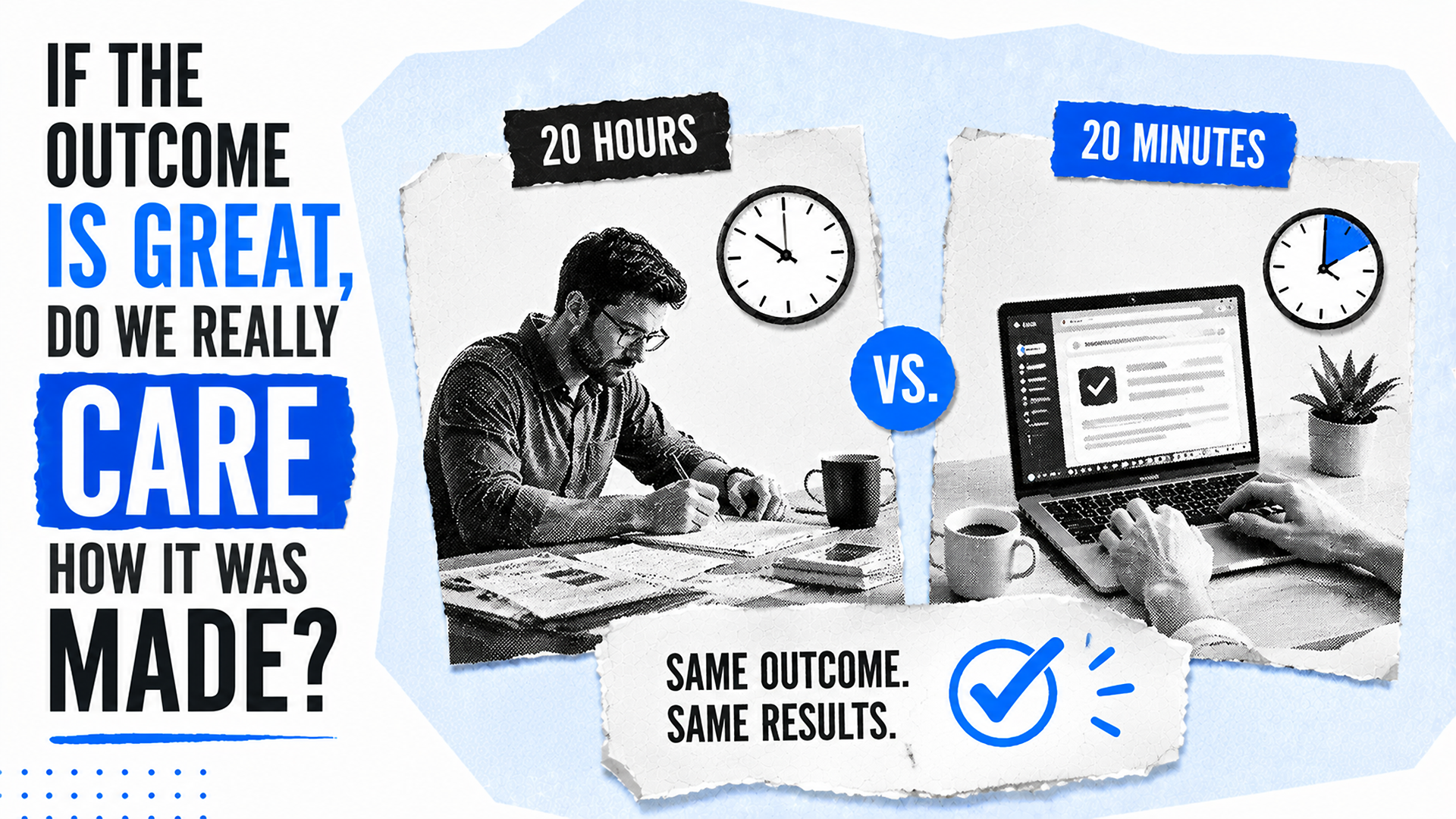
When I think about AI deliverables, I keep coming back to a simple scenario: a client receives two pieces of work.
Both deliverables solve the problem they were hired to solve. Both are accurate, useful, and tied to the same business outcome. The client is happy, and from the outside, there is no meaningful difference in the results.
Then the client learns that one took 20 hours to create, while the other took 20 minutes. That is when the uncomfortable questions begin.
Was AI involved? Should the faster deliverable cost less? Is the person who completed it less skilled because they found a faster, more efficient way to reach the same result?
What I find most interesting is how differently many of us react to AI depending on which side of the transaction we are on. I love using AI when it saves me time, but I also understand why customers can feel uneasy when they discover AI helped create something they paid for.
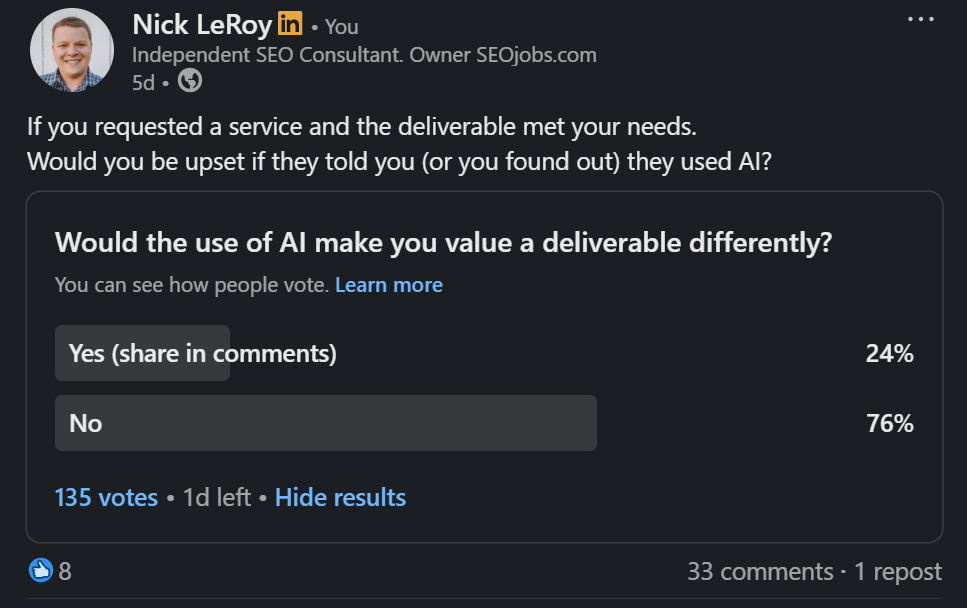
I recently ran a LinkedIn poll asking a simple question: if the outcome is great, do we really care how it was made?
The responses reinforced something I have been thinking about for a while. Many of the strongest objections people have to AI are not really about quality at all.
The Time vs. Value Fallacy
I think part of the discomfort comes from the fact that we have spent decades tying value to effort.
Long hours feel valuable. Fast work feels suspicious. Struggle often gets mistaken for expertise.
The harder something appears to be, the easier it becomes to justify the price attached to it.
There is an old story about a ship engine that stopped working. After multiple failed attempts to repair it, the owners brought in an engineer with decades of experience. He inspected the engine, tapped it once with a small hammer, and the machine roared back to life.
His invoice was $10,000.
The owners were furious and demanded an itemized bill. The response was simple: hammer tap, $2. Knowing where to tap, $9,998.
People debate whether that story is true or just a useful tale for people like me who believe in value-based pricing. But whether it really happened almost does not matter. The lesson still holds.
People are not paying for the tap. They are paying for the expertise behind it.
That is what makes AI such an important topic for me. It forces us to confront a question many of us have avoided for years: are we paying for expertise, or are we paying for visible effort?
Those are not always the same thing.
The Objections That Actually Matter
To be clear, I do not think every objection to AI is unreasonable. I have shared plenty of my own concerns, and some of them are serious.
In fact, I think the strongest arguments against AI have very little to do with how quickly something was created.
Risk matters. Hallucinations matter. Bad recommendations matter. Compliance, privacy, and security concerns matter. Accountability matters.
Those are legitimate concerns. What stands out to me is that none of them has much to do with how long it took to create the deliverable.
They are questions of trust.
Can the output be trusted? Can the recommendation be defended? Can someone confidently stand behind the work if it is questioned six months from now?

Because when something goes wrong, nobody gets to blame the AI. The employee is accountable. The consultant is accountable. The company is accountable.
That is why I have always found the quality debate to be the least interesting part of the conversation. The more important question is not whether AI was involved. It is whether the outcome is trustworthy enough for someone to put their name behind it.
The Outcome Test
The more I think about AI, the less interested I become in whether it was used.
Instead, I find myself asking a different set of questions. Was the outcome accurate? Was it useful? Was it better than the alternative? Would I be willing to stand behind it with my name, reputation, and credentials on the line?
If the answer to all of those questions is yes, then I have a hard time arguing that the production method matters more than the result.
I suspect this is where many people become uncomfortable because it shifts the conversation away from tools and back toward results.
Ironically, this is also where humans become more important, not less.
The future is not machines versus humans. I know, "The Terminator" and "I, Robot" movies will never feel the same. The real shift is humans using AI versus humans who refuse to adapt.
The premium will not come from avoiding AI. It will come from judgment, taste, decision-making, communication, and accountability.
AI can accelerate execution, but people still decide what should be built, what should be published, and what risks are acceptable. More importantly, people are still responsible for the outcome.
The people who lose to AI will not be the ones using it. They will be the ones still evaluating effort while everyone else is measuring outcomes.
This post first appeared on the author’s website and is republished here with permission.
Inspired by this post on Search Engine Land.

Leave a Reply