Author: Nick LeRoy

  • Use Google Documentation to Win SEO Buy-In With Proof

    Use Google Documentation to Win SEO Buy-In With Proof

    Let me be blunt: SEO advice can sound completely made up to people who do not live in search every day.

    When I say things like “change this canonical,” “don’t block that resource,” or “we need this content exposed in the rendered HTML,” I understand why someone outside SEO might hear it and wonder whether I am inventing rules on the spot.

    That is one reason SEO still gets treated like black magic inside many organizations.

    I have been pushing the idea of “un-nerding SEO” for years, but this is about something very practical: I use Google’s own documentation to earn approval, build trust, and help SEO work get prioritized.

    Not because Google tells us everything. Not because every sentence in its documentation should be treated as gospel. I use it because documented evidence is much harder to dismiss than personal opinion.

    When I need buy-in, the strongest argument is rarely “trust me.”

    It is usually something closer to: “Google has already documented how this should be approached.”

    The buy-in problem is usually not the recommendation itself

    In my experience, most SEO recommendations do not die because they are wrong. They die because they are competing with everything else happening inside the business.

    Dev sprints, product timelines, CMS limitations, legal concerns, brand standards, executive assumptions, and the classic “we’ve always done it this way” all have a seat at the table. SEO is rarely the only priority in the room, even when the recommendation is technically correct.

    That is why I do not rely on “best practice says” or “from an SEO perspective” when I am trying to move work forward. Those phrases sound optional, especially to teams already balancing risk, deadlines, and competing requests.

    But “Google has official documentation that supports this recommendation” lands differently.

    It may not automatically win the argument, and it definitely does not mean the work will be prioritized tomorrow. But it changes the conversation from “the SEO person said so” to “we have official Google documentation explaining why this matters.”

    Google documentation is not gospel

    I know the objection already: “Are we really pretending Google tells us the full truth about how search works?”

    Absolutely not.

    Google’s documentation is not the complete truth of search. It has omissions. It simplifies complex systems. Sometimes it explains how Google wants site owners to behave, not every technical factor that influences organic visibility.

    Google also writes for a broad audience, which means nuance gets smoothed out, edge cases get skipped, and the answer can be technically true without being the entire story.

    ```json
{
  "alt": "SEO For Lunch newsletter promotion with Nick Leroy smiling in checkered shirt.",
  "caption": "Join Nick Leroy for a fresh take on SEO with the #SEOForLunch newsletter—bringing actionable insights straight to your inbox.",
  "description": "This image promotes the #SEOForLunch newsletter by Nick Leroy, featuring a smiling Nick in a checkered shirt against a blue graphic background. The design includes a plate graphic with 'Not Your Average Table Talk' and emphasizes SEO insights, inviting viewers to subscribe at seoforlunch.com. Keywords: SEO, Nick Leroy, newsletter, marketing, insights."
}
```

    So no, I am not treating every Google statement as if it were carved into stone and carried down from Mountain View.

    But that does not make the documentation useless.

    It makes it a starting point. A receipt. An official reference point.

    It moves the discussion away from “I think this matters” and toward “Google has explicitly documented why this matters.” That distinction matters when I am asking someone else to approve and prioritize the work.

    Documentation is especially useful with developers

    This is where Google documentation often earns its keep the fastest. SEOs need developers, and I have learned that the quickest way to lose developer support is to treat every recommendation like a command instead of a requirement that needs to be implemented thoughtfully.

    And yes, just in case it ever works, I still wish I could run this:

    google.exe /disable-ai-overviews /please

    Bummer. No dice.

    Developers are not wrong just because they disagree with an SEO recommendation. Most of the time, they are optimizing for completely valid priorities: performance, code quality, technical debt, security, and avoiding the kind of production mistake that can take a whole site down.

    But sometimes developers are wrong about how Google discovers, crawls, renders, indexes, or interprets content.

    And telling a developer “you’re wrong” is a great way to make sure my ticket never sees the light of day.

    This is where documentation helps. It removes some of the subjectivity and shifts the discussion toward how to implement the requirement inside the existing technical environment.

    The point is never “SEO wins and dev loses.”

    The point is that I now have an external source of truth to discuss. That is a much better conversation than two teams arguing from preference.

    Documentation is also a client management tool

    For client-facing SEO work, documentation helps me separate serious recommendations from “trust me, bro, I have a contact at Google” consulting.

    Futuristic data archive with glowing server-like filing cabinets, stacked documents, and network lights symbolizing AI marketing data infrastructure.
    Rows of illuminated data cabinets and paper files stretch into the distance, capturing the pressure on marketers to turn fragmented customer data into a smarter performance engine.

    That matters even more when a client has been burned by bad SEO advice before.

    Instead of saying, “We need to change this because it’s better for SEO,” I can frame the recommendation with evidence.

    “Here’s what Google documents. Here’s where your current setup conflicts with that. Here’s the risk. Here’s the recommendation. Here is the estimated reward.”

    That framing builds trust because it shows the recommendation is not relying on blind faith.

    It also makes the SEO look less like a magician and more like an interpreter.

    That is how I see the real role of SEO: translating Google’s documented needs into business and technical decisions that a team can actually act on.

    Less black magic, more receipts

    SEO has a reputation problem, and some of it is earned.

    Too much SEO work is still explained with vague phrases and shaky confidence. I hear people say things like “Google likes this” or “this needs to exist for the bots” when the stronger version is: “Google documents this behavior here, and here is how it applies to our situation.”

    That does not mean documentation alone creates buy-in.

    Dropping a Google link into a ticket or Slack thread is not a strategy. I still have to translate what it means, explain the risk, connect it to business outcomes, and help the team understand why the recommendation deserves attention.

    Google documentation will never replace experience, testing, or judgment. It will not tell me everything, and I should not treat it like the final answer to every SEO debate.

    But it can make SEO easier to defend, easier to prioritize, and much harder for leaders to dismiss.

    The best SEOs are not just the ones who know what to recommend. They are the ones who can prove why the recommendation deserves to be taken seriously.

    Less black magic. More receipts. More results.

    Google documentation may not be the whole truth, but I would rather show up to a buy-in conversation with official references than with “my buddy from Google told me.” Suuuure they did.

    This post first appeared on the author’s website and is republished here with permission.


    Inspired by this post on Search Engine Land.


    crushpress.ai community screenshot
  • Why I Judge AI Deliverables by Outcomes, Not Effort

    Why I Judge AI Deliverables by Outcomes, Not Effort

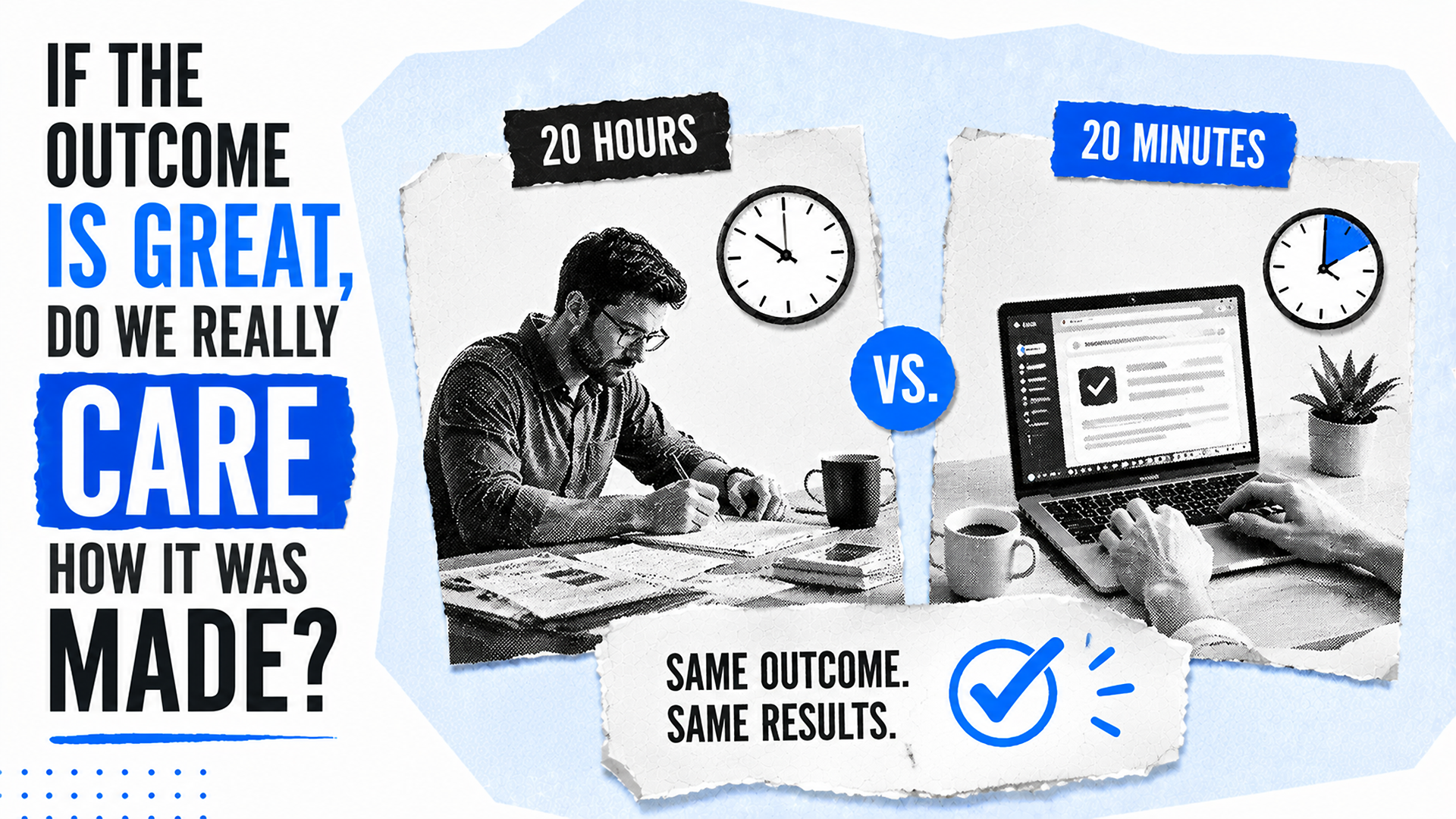
    When I think about AI deliverables, I keep coming back to a simple scenario: a client receives two pieces of work.

    Both deliverables solve the problem they were hired to solve. Both are accurate, useful, and tied to the same business outcome. The client is happy, and from the outside, there is no meaningful difference in the results.

    Then the client learns that one took 20 hours to create, while the other took 20 minutes. That is when the uncomfortable questions begin.

    Was AI involved? Should the faster deliverable cost less? Is the person who completed it less skilled because they found a faster, more efficient way to reach the same result?

    What I find most interesting is how differently many of us react to AI depending on which side of the transaction we are on. I love using AI when it saves me time, but I also understand why customers can feel uneasy when they discover AI helped create something they paid for.

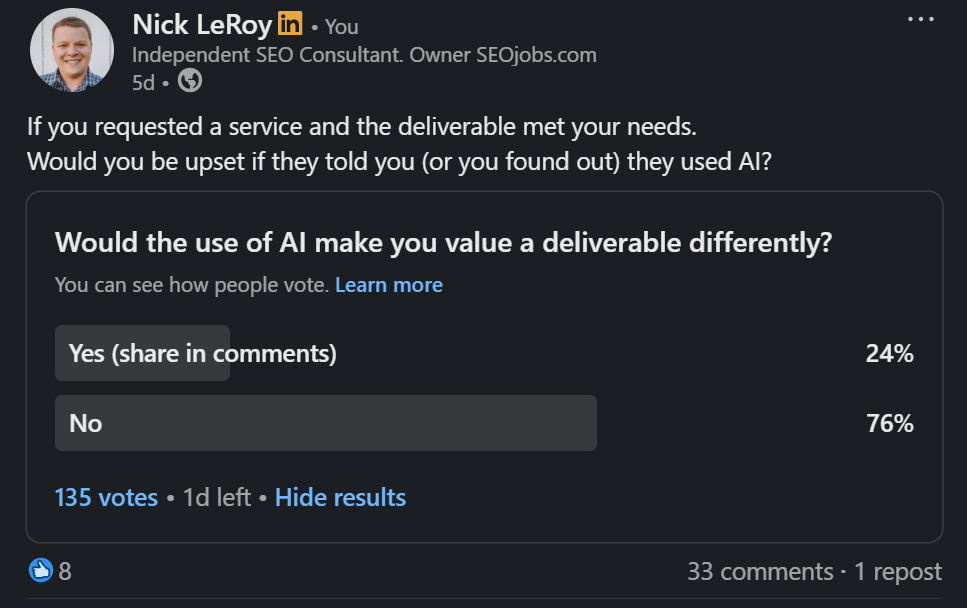
    I recently ran a LinkedIn poll asking a simple question: if the outcome is great, do we really care how it was made?

    The responses reinforced something I have been thinking about for a while. Many of the strongest objections people have to AI are not really about quality at all.

    The Time vs. Value Fallacy

    I think part of the discomfort comes from the fact that we have spent decades tying value to effort.

    Long hours feel valuable. Fast work feels suspicious. Struggle often gets mistaken for expertise.

    The harder something appears to be, the easier it becomes to justify the price attached to it.

    There is an old story about a ship engine that stopped working. After multiple failed attempts to repair it, the owners brought in an engineer with decades of experience. He inspected the engine, tapped it once with a small hammer, and the machine roared back to life.

    His invoice was $10,000.
    Image

    The owners were furious and demanded an itemized bill. The response was simple: hammer tap, $2. Knowing where to tap, $9,998.

    People debate whether that story is true or just a useful tale for people like me who believe in value-based pricing. But whether it really happened almost does not matter. The lesson still holds.

    People are not paying for the tap. They are paying for the expertise behind it.

    That is what makes AI such an important topic for me. It forces us to confront a question many of us have avoided for years: are we paying for expertise, or are we paying for visible effort?

    Those are not always the same thing.

    The Objections That Actually Matter

    To be clear, I do not think every objection to AI is unreasonable. I have shared plenty of my own concerns, and some of them are serious.

    In fact, I think the strongest arguments against AI have very little to do with how quickly something was created.

    Risk matters. Hallucinations matter. Bad recommendations matter. Compliance, privacy, and security concerns matter. Accountability matters.

    Those are legitimate concerns. What stands out to me is that none of them has much to do with how long it took to create the deliverable.

    They are questions of trust.

    Can the output be trusted? Can the recommendation be defended? Can someone confidently stand behind the work if it is questioned six months from now?
    ```json
{
  "alt": "SEO For Lunch Newsletter by Nick Leroy, featuring actionable SEO insights.",
  "caption": "Join Nick Leroy's SEO For Lunch: Your go-to source for actionable SEO insights served directly to your inbox.",
  "description": "This image promotes Nick Leroy's 'SEO For Lunch' newsletter, emphasizing actionable SEO insights. It features a smiling person against a dark blue background with the newsletter's branding, '#SEOFORLUNCH,' and website details. The design includes graphic elements like a fork and knife, alongside the tagline 'Not Your Average Table Talk.'"
}
```

    Because when something goes wrong, nobody gets to blame the AI. The employee is accountable. The consultant is accountable. The company is accountable.

    That is why I have always found the quality debate to be the least interesting part of the conversation. The more important question is not whether AI was involved. It is whether the outcome is trustworthy enough for someone to put their name behind it.

    The Outcome Test

    The more I think about AI, the less interested I become in whether it was used.

    Instead, I find myself asking a different set of questions. Was the outcome accurate? Was it useful? Was it better than the alternative? Would I be willing to stand behind it with my name, reputation, and credentials on the line?

    If the answer to all of those questions is yes, then I have a hard time arguing that the production method matters more than the result.

    I suspect this is where many people become uncomfortable because it shifts the conversation away from tools and back toward results.

    Ironically, this is also where humans become more important, not less.

    The future is not machines versus humans. I know, "The Terminator" and "I, Robot" movies will never feel the same. The real shift is humans using AI versus humans who refuse to adapt.

    The premium will not come from avoiding AI. It will come from judgment, taste, decision-making, communication, and accountability.

    AI can accelerate execution, but people still decide what should be built, what should be published, and what risks are acceptable. More importantly, people are still responsible for the outcome.

    The people who lose to AI will not be the ones using it. They will be the ones still evaluating effort while everyone else is measuring outcomes.

    This post first appeared on the author’s website and is republished here with permission.


    Inspired by this post on Search Engine Land.


    crushpress.ai community screenshot
  • AI Slop Accountability: Why Businesses Should Worry

    AI Slop Accountability: Why Businesses Should Worry

    The best and worst part of the web, in my view, is that I can share an opinion freely even when that opinion is not technically accurate.

    But I keep wondering what happens when that freedom comes with real accountability, not only for what I say online, but also for whether the words came from me or from AI.

    A recent report makes that question feel a lot less theoretical. A German court held Google accountable for AI Overview content, treating those AI-generated summaries as Google’s own content and rejecting the idea that users alone were responsible for fact-checking the results.

    View embedded content

    I want to unpack what that could mean for businesses, SEOs, and individuals who are leaning harder on AI every day.

    The ‘disclaimer’ defense is cracking

    For the last few years, I have seen nearly every AI platform rely on some version of the same warning: AI can make mistakes, so users should verify important information.

    Most of us accepted that as the price of using these tools.

    But the German court essentially said that a warning about possible errors does not automatically erase responsibility when those errors cause harm. If a system creates new claims that were never in the source material, those claims are no longer just someone else’s words. They become the platform’s words.

    I think that shift is bigger than many people realize. This is where legal AI ramifications start to become very real.

    Why? Because the conversation moves away from whether AI is useful and toward who owns the consequences when AI gets something wrong.

    What this means for businesses

    I see many companies rapidly adopting AI across content creation, customer service, product descriptions, reporting, legal reviews, hiring, and internal communications. In many cases, they are blindly trusting the output because the efficiency gains are so tempting.

    Most of the conversation still centers on speed and cost. Can we create content faster? Can we answer support tickets more cheaply? Can we automate this process?

    Image

    Those are fair questions. I ask them too.

    But this ruling adds a more important question: Who is responsible when the output is wrong?

    What happens if an AI-generated support response gives a customer inaccurate guidance? What happens if an AI-written article damages a competitor’s reputation? What happens if an AI-generated report includes fabricated information that influences a business decision?

    I do not think the “AI wrote it” defense will age well. In my own experience, it darn near cost me 20 million.

    The more we position AI as a trusted source of information, the harder it becomes to argue that we should not be accountable for what it says.

    The situation is kinda funny…

    The irony is that most AI vendors already know this.

    That is why nearly every platform includes warnings, disclaimers, and usage policies.

    At the same time, those same companies market AI as smarter, faster, more capable, and increasingly reliable.

    I do not think you can tell users to trust the answer while also arguing that nobody should trust the answer.

    At some point, those positions collide. We are already starting to see Google’s solution: an option to opt out of AI.

    Germany may simply be one of the first courts willing to force Google, or any other LLM business, to take clearer responsibility for the systems it puts in front of users.

    ```json
{
  "alt": "SEO For Lunch Newsletter by Nick Leroy, featuring actionable SEO insights.",
  "caption": "Join Nick Leroy's SEO For Lunch: Your go-to source for actionable SEO insights served directly to your inbox.",
  "description": "This image promotes Nick Leroy's 'SEO For Lunch' newsletter, emphasizing actionable SEO insights. It features a smiling person against a dark blue background with the newsletter's branding, '#SEOFORLUNCH,' and website details. The design includes graphic elements like a fork and knife, alongside the tagline 'Not Your Average Table Talk.'"
}
```

    What SEOs should be paying attention to

    Ironically, I think this ruling could end up benefiting everyone.

    Right now, the debate is focused on whether AI companies should be responsible for the content their systems generate. But I can see accountability expanding well beyond AI.

    The internet has spent decades creating distance between actions and consequences. Anonymous accounts, fake profiles, throwaway emails, and now AI-generated content all make it easier for people to say things without owning them.

    That is why I find this ruling so interesting.

    It is not just about Google. It is about the idea that “I did not write it” may no longer be enough.

    The image below shows a real email that Russell and Nina Westbrook received. A real person sat behind a keyboard and sent a message hoping they would die in a car crash.

    AI slop

    That is not free speech. It is hate speech.

    The internet, especially now that AI is layered into it, needs more confidence that content is accurate and that the people and companies creating it can be held accountable.

    I do not believe we get to claim the productivity gains when AI is right and then blame the algorithm when it is wrong.

    This post first appeared on the author’s website and is republished here with permission.

    Leroy2

    Inspired by this post on Search Engine Land.


    crushpress.ai community screenshot
  • AI and SEO Explained: What Marketers Need to Know Now

    AI and SEO Explained: What Marketers Need to Know Now

    If it feels like the whole internet woke up and decided every sentence needed to start with “AI,” I get it. I feel that fatigue too.

    As marketers, we are getting hit every day with LinkedIn hot takes, rushed prompt hacks, and promises that ChatGPT will either 10x our productivity or replace us completely.

    And right in the middle of all of that is the digital marketer trying to figure out whether AI is just another buzzword cycle or the start of a major rewrite of how we handle content, SEO, PPC, reporting, and almost everything else.

    So I want to break it down in plain English.

    Think of this as my AI starting guide for marketers who are tired of needing someone younger to translate every new acronym, the same way many of us once had to help our parents get online or open an AOL chat window.

    Defining AI and LLMs, and why they matter

    I am not asking “what is AI” just to chase keyword density. I want to start with a shared definition, because a lot of these terms get used interchangeably, and not always correctly.

    At its core, artificial intelligence refers to machines performing tasks that usually require human intelligence, such as understanding language, recognizing patterns, making decisions, and generating content.

    The kind of AI getting the most attention right now is generative AI: models that can create text, images, code, video, and other outputs based on patterns learned from huge datasets.

    ```json
{
  "alt": "The CapmatchOne logo with a gradient circle and bold text.",
  "caption": "Discover innovation with the CapmatchOne logo, featuring sleek typography and a modern gradient circle.",
  "description": "The CapmatchOne logo features bold, modern typography coupled with a gradient circle, symbolizing connection and innovation. The sleek design conveys a sense of progress and creativity. This image can be used for branding or promotional purposes, appealing to audiences interested in innovative solutions and forward-thinking designs."
}
```

    Tools like ChatGPT, Gemini, and Claude do not “think” the way people do. They predict the next most likely word, phrase, or response based on what they have been trained on.

    That matters because AI is not a magic shortcut to instant wealth, overnight automation, or effortless headcount reduction. I see it more as large-scale data aggregation and pattern recognition.

    Large language models, or LLMs, are not creating net-new truth from nothing. They process massive amounts of existing information and produce answers based on patterns, probabilities, and what looks like internet consensus.

    For content creators and marketers, that is a major shift. I am no longer thinking only about optimizing for a traditional search engine click. I also have to think about whether machines can understand, summarize, cite, and reuse my content.

    The biggest implication is the rise of zero-click search. AI systems can answer users directly through experiences like Google AI Overviews or ChatGPT responses, often without sending that user to the original website.

    That changes SEO from a pure traffic game into an authority, visibility, and data-ingestion game.

    That is why I think marketers need to understand what AI does well, what it struggles with, and where it actually belongs in a broader marketing strategy.

    ```json
{
  "alt": "Illustration listing types of AI, definitions, and examples such as Siri for AI and Netflix recommendations for Machine Learning.",
  "caption": "Exploring the diverse world of AI: From basic machine tasks to advanced language processing, discover how AI is shaping our digital age.",
  "description": "This image features an illustration detailing various types of AI, including Artificial Intelligence, Machine Learning, Natural Language Processing, Generative AI, and AI Agents. Each type is defined with associated examples like Siri for AI, Netflix recommendations for Machine Learning, and Grammarly for NLP. The graphic is designed with a retro color palette, featuring an illustration of a woman and a structured table layout for clarity, providing both educational content and visual appeal."
}
```

    AI jargon I think marketers need to know

    Before going deeper, I want to separate a few terms that often get mashed together: AI, machine learning, NLP, generative AI, LLMs, and AI agents. They are related, but they are not the same thing.

    Understanding the difference helps me make better decisions about which tools to use, where to trust them, and where human judgment still matters most.

    Artificial intelligence (AI)

    Artificial intelligence is the broad umbrella term for machines performing tasks that usually require human intelligence. That includes problem-solving, learning, speech recognition, language understanding, and decision-making.

    In marketing and search, AI has become a catch-all phrase. But in practice, most of the tools I use fall into more specific categories.

    Example of AI: Siri and Google Assistant use AI to interpret voice commands and respond in context.

    Machine learning (ML)

    Machine learning is a subset of AI. Instead of giving a system explicit instructions for every possible situation, we feed it data so it can identify patterns and make predictions.

    In marketing, machine learning powers ad targeting, customer segmentation, recommendations, predictive analytics, and plenty of optimization systems we already rely on.

    ```json
{
  "alt": "Google Home smart speaker next to Google Assistant logo with colorful dots.",
  "caption": "Enhance your daily tasks with Google Assistant, showcased alongside a sleek Google Home speaker.",
  "description": "This image features the Google Home smart speaker next to the Google Assistant logo with distinctive colored dots. The Google Home, known for its minimalist design, is a voice-activated speaker powered by Google Assistant. It helps users manage daily tasks, control smart home devices, and provide answers to queries. Perfect for tech enthusiasts looking to streamline their home automation."
}
```

    Example of machine learning: Netflix uses machine learning to recommend shows based on viewing history.

    Natural language processing (NLP)

    Natural language processing helps machines understand, interpret, and generate human language.

    NLP is why ChatGPT can carry on a conversation and why Google can understand that “cheap running shoes” and “affordable sneakers” are closely related searches.

    Example of natural language processing: Google Translate uses NLP to understand and convert language in real time.

    Generative AI

    When people casually say “AI,” they often mean generative AI, which is a branch of artificial intelligence that creates content instead of only analyzing existing data.

    Generative AI models are trained on massive datasets to learn patterns in language, images, audio, code, or video. Then they use those patterns to produce something new.

    But I always remind myself that these systems are still predicting likely outputs. They are not thinking, reasoning, or understanding the world like a person.

    ```json
{
  "alt": "Netflix homepage showing 'Matt Rife: Unwrapped' and WWE upcoming events.",
  "caption": "Explore the festive cheer with 'Matt Rife: Unwrapped' on Netflix, alongside thrilling WWE events! Dive into your next favorite picks.",
  "description": "The Netflix homepage features 'Matt Rife: Unwrapped - A Christmas Crowdwork Special,' with options to play or learn more. Below, upcoming WWE events are listed with dates and times, including SmackDown and RAW. Featured content includes popular titles like 'Stranger Things' and 'Jack Whitehall: Settle Down.' The backdrop is festive with a focus on cheerful and dynamic entertainment options. Ideal for those seeking a mix of comedy, sports, and trending series."
}
```

    That is also why generative AI can go off track. When a model confidently makes something up, we call it a hallucination.

    Some of the most infamous hallucination examples include AI answers suggesting people eat small rocks or use glue to keep cheese on pizza. Funny in hindsight, but a serious reminder that fact-checking is not optional.

    • ChatGPT can draft articles, emails, and outlines.
    • Midjourney and DALL·E can create images.
    • Claude can help write and refine code.
    • Sora can generate video from prompts.

    Large language models (LLMs)

    Large language models are a specialized type of generative AI trained on huge amounts of text, including books, websites, code, and other online sources, to generate human-like responses.

    I think of LLMs as the engine behind many chatbot experiences. They are the part that interprets what I type and produces a response.

    When I use an LLM effectively, I do not treat it like a replacement for my brain. I give it context, examples, constraints, and direction. It can help refine a draft, suggest wording, or organize messy thoughts, but I still own the strategy and final judgment.

    In short, LLMs react to input. They do not act independently unless they are connected to tools and workflows that let them take action.

    • GPT models from OpenAI, used in ChatGPT.
    • Claude models from Anthropic.
    • LLaMA models from Meta.

    AI agents

    AI agents go beyond responding to prompts. They can work through multi-step tasks, use tools, navigate websites, fill out forms, call APIs, analyze files, and complete workflows with less hand-holding.

    ```json
{
  "alt": "Diagram of the stages of communication with arrows connecting conception, composition, revision, and comprehension.",
  "caption": "Explore the dynamic stages of communication: from the spark of conception to composition, through careful revision, and ending in comprehension.",
  "description": "This image illustrates the stages of communication in a cyclical diagram. The process includes four key stages: Conception, Composition, Revision, and Comprehension, each linked by arrows to show the continuous flow. The diagram is set against a white background with a purple border and uses distinct colors for each arrow to represent different stages. Ideal for discussions on effective communication processes."
}
```

    They are still powered by LLMs under the hood, but the key difference is that they have goals, tools, and a degree of autonomy.

    That is why AI agents feel more consequential for marketers. They are not just talking; they are beginning to do the work.

    • ChatGPT can search the web, analyze files, and review code.
    • Google Gemini in Workspace can summarize email threads and suggest replies.
    • Microsoft Copilot can assist across Microsoft 365 workflows.

    How I see AI affecting marketing today

    Once the terminology is clearer, the marketing impact becomes easier to see. AI is changing how people search, how content is produced, how visibility is measured, and how stakeholders talk about growth.

    People have been saying SEO is dying for years. I do not think SEO is dead, but I do think “SEO is changing” undersells the size of the shift.

    We are in the middle of a major industry pivot, and AI is at the center of it.

    Organic traffic is being cannibalized

    AI Overviews are Google’s automated summaries that appear at the top of some search results, often pulling from multiple sources.

    I think of them like Featured Snippets turned up several notches. They do not simply quote one source and send the click back. They blend sources, rewrite information in Google’s voice, and may push attribution lower on the page.

    ```json
{
  "alt": "Email summary of Semrush LLM x SEO Hub Sync project with notes from Mordy and Gus.",
  "caption": "A collaborative exchange concerning the Semrush LLM x SEO Hub project promises a streamlined process, sans meetings.",
  "description": "This image shows an email summary for the Semrush LLM x SEO Hub Sync project. It describes Mordy's efforts to align with recipients by sending a video and Google Doc, and Gus's inquiry about contract reception. Mordy's response mentions timeline confirmation with Semrush. Keywords include Semrush, LLM, SEO Hub, email summary, sync, project collaboration."
}
```

    For broad informational queries, that means the first thing a user sees may be Google’s answer instead of my blue link. The likely result is a lower click-through rate and fewer visits to publisher and brand websites.

    Before AI Overviews, informational queries were often useful for introducing a brand early in the research journey. Now, more of that attention and trust can stay with Google.

    Claim: AI Overviews only appear for fluffy queries, so my traffic is safe.

    Reality: Google is testing and expanding AI Overviews across more serious query types, including YMYL, product, and B2B searches.

    What I would do next: Stop chasing every possible click, measure visibility and influence alongside conversions, and build enough topical authority that my brand becomes a source AI systems can confidently cite.

    Content creation is exploding, and so is the noise

    Generative AI has removed one of content marketing’s biggest bottlenecks: production time. Work that used to take a team a month can now be drafted by one marketer in a week.

    That is not automatically bad. The problem is that when everyone can publish “good enough” content quickly, the internet gets louder and less useful.

    ```json
{
  "alt": "Screenshot of search results for Jordan 1 shoes review with reviews from RunRepeat and WearTesters.",
  "caption": "Exploring the Air Jordan 1: A detailed review of its traction, durability, and style, featuring insights from RunRepeat and WearTesters.",
  "description": "This image shows a Google search result page for 'Jordan 1 shoes review.' The top result is a 2024 review from RunRepeat highlighting the Air Jordan 1 Low's excellent traction and durable leather. It mentions the shoe's iconic style but notes it may lack cushioning for modern basketball. Below is a link to a review from WearTesters that scores the shoe's traction, cushioning, and more. The page layout includes options for AI Mode, Images, Forums, and Shopping. Keywords: Air Jordan 1, shoe review, RunRepeat, WearTesters."
}
```

    Claim: More content means more traffic.

    Reality: That was already questionable before AI. Now, search systems are increasingly tuned to reduce the visibility of generic, low-value, quickly produced content.

    Google’s Helpful Content updates, Bing’s spam improvements, and social platform feed changes all point in the same direction: thin content is easier to produce, but it is also easier to ignore.

    What I would do next: Focus on authority-driven content such as case studies, original data, expert analysis, and proprietary insights. I would publish less, promote more, and use AI for research, outlining, repurposing, and refreshing instead of simply flooding the web.

    Search results are becoming deeply personalized

    Traditional SEO has dealt with personalization for years through local results, logged-in history, and device context. LLM-powered tools like ChatGPT, Perplexity, and Gemini take that much further.

    The same question can produce different answers depending on the user, their prompt, their past interactions, available data, and the model being used.

    For example, if someone asks, “What is the outlook for Tesla?” a financial analyst may get an answer focused on stock performance and filings, while a new driver may see information about models, battery life, and charging infrastructure.

    Semrush Source Analysis dashboard showing AI source citations by domain for ChatGPT, with trend lines for LinkedIn, Wikipedia, Semrush and SEO sites.
    A Semrush Enterprise AI source analysis view tracks how often domains are cited in ChatGPT results, revealing shifting visibility trends across LinkedIn, Wikipedia, Semrush and industry publishers.

    Claim: I will just optimize for the top answer in ChatGPT the way I optimize for position one in Google.

    Reality: The idea of one universal top answer is breaking down. Personalization makes it harder to define, track, and reverse-engineer a single ranking position.

    What I would do next: Track visibility across search engines and LLMs, build a recognizable brand entity, invest in multiple content formats, use structured data, and create clear, citable answers that machines can understand.

    Attribution is breaking

    When Google, Bing, Perplexity, or another AI-driven platform answers a question directly, users may never visit the website that influenced the answer. Even when they do visit, their journey may start in an AI tool, move through another search, and only later reach the site.

    That breaks the clean channel → click → conversion model marketers have relied on for years.

    Claim: I will measure traffic from LLMs directly in analytics.

    Reality: That assumes users are clicking through from AI answers. In many cases, they are not.

    Semrush AI Performance dashboard showing sentiment analysis charts, positive and neutral mention counts, and brand sentiment leaderboard.
    A Semrush-style AI sentiment dashboard visualizes how brands appear across AI search, with mention trends, sentiment mix, and a competitive leaderboard.

    What I would do next: Move beyond last-click attribution, pay more attention to assisted conversions, and track broader demand signals such as direct traffic, branded search volume, brand mentions, sentiment, and “How did you hear about us?” responses.

    I would also budget for influence that is hard to perfectly track, including podcasts, PR, thought leadership, community visibility, and media coverage.

    Clients and bosses expect magic

    Because AI hype is everywhere, stakeholders often expect it to make everything faster, cheaper, and better without understanding the risks, learning curve, or human oversight involved.

    Claim: We can replace our SEO or content team with AI tools and get the same results.

    Reality: AI can accelerate tasks, but it does not replace strategy, judgment, subject-matter expertise, or a real understanding of customer needs.

    What I would do next: Set expectations early. AI can make some work faster and cheaper, but it is not a push-button strategy. I would show stakeholders the hidden work behind good AI output, including prompt refinement, editing, fact-checking, compliance, and final review.

    The best use of AI is not to remove human thinking. It is to free up more human time for the strategic work that actually moves the business forward.

    Search is evolving

    I am not interested in getting stuck in a debate over Generative Engine Optimization (GEO), Answer Engine Optimization (AEO), or any other acronym. The important point is simpler: search today is not what it was yesterday.

    Organic visibility is no longer only about ranking in Google. Search now includes AI answers, YouTube, Reddit, newsletters, communities, social platforms, and every place people go to discover, compare, and validate information.

    If I am only thinking about the traditional search bar, I am already behind. The better path is to build authority, create content worth citing, understand how AI systems interpret information, and measure visibility across the full discovery journey.

    AI is not the end of SEO. It is a major shift in how search works, how content is consumed, and how brands earn trust. The marketers who adapt will be the ones who separate useful strategy from the noise.


    Inspired by this post on Search Engine Land.


    crushpress.ai community screenshot