Tag: Trust

  • Credibility-First Link Building: How We Earn Lasting Authority

    Credibility-First Link Building: How We Earn Lasting Authority

    Link building for lasting brand authority

    At Resolve, we define link building for legitimacy as earning authoritative backlinks, brand mentions, and media coverage that demonstrate trust, expertise, and credibility to search engines and AI systems. Instead of chasing link volume, we use digital PR, original research, thought leadership, and journalist relationships to earn genuine editorial citations. These are the authority signals behind Google’s E-E-A-T framework, and they can help us appear in AI Overviews, earn citations from large language models, and build visibility that survives ranking swings.

    We believe a little competition is healthy. It challenges us, sharpens our thinking, and pushes us to pursue bigger and better results.

    However, today’s search environment is changing faster than ever. Large language models, AI-generated answers, and frequent algorithm updates are reshaping how people find information, making it increasingly difficult for us to rely on yesterday’s playbook.

    The metrics we once used to keep brands afloat — traffic, domain authority increases, and keyword rankings — no longer define SEO success on their own. We can reach the top of a search results page and still see very few conversions.

    If we continue chasing those numbers in isolation, we risk being left behind. We have to adapt.

    We now widen our view to the outcomes that matter most: trust and brand authority. Unlike a temporary ranking or traffic spike, trust and authority are not earned quickly or easily.

    We need time to spread the word about our brand, and we need even more time to prove that people can rely on us. Once we establish that trust, however, it becomes much harder to dislodge.

    An algorithm update can cut our traffic overnight. It cannot erase genuine trust overnight.

    Our challenge is learning how to build trust and strengthen our brand while every competitor is trying to do the same. We also need meaningful ways to measure concepts that can initially seem difficult to quantify.

    We have found that the answers involve some nuance, but they are simpler than they appear. The process begins with a shift in perspective.

    For years, we treated link building like a popularity contest. The site that collected the most votes, in the form of backlinks, was often rewarded with a prominent position in the search results.
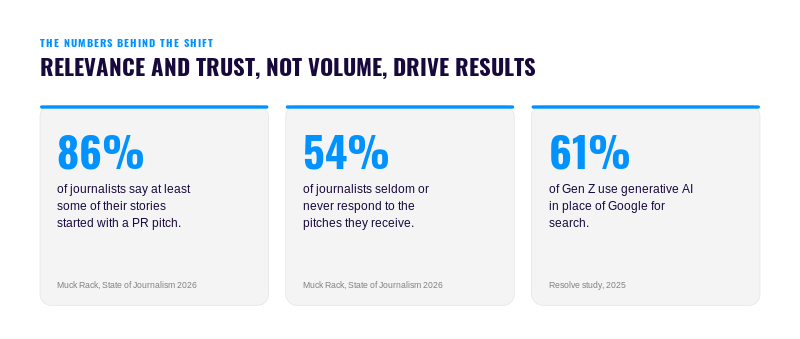
    Infographic showing 86% of journalists use PR-pitched stories, 54% rarely answer pitches, and 61% of Gen Z use generative AI instead of Google.
    Relevance and trust beat volume: 86% of journalists use at least some PR-pitched stories, yet 54% seldom respond, while 61% of Gen Z turn to generative AI instead of Google.

    Over time, Google and other search engines updated their algorithms to improve the search experience. With each change, Google cracked down on more sites that tried to manipulate the system with backlink volume instead of earning links with real editorial and audience value. Countless sites lost traffic, and many still feel the effects.

    Today, we see Google place more emphasis on relevance, industry trust, and authority. That helps explain why a familiar brand can attract more searchers than a smaller competitor even when both publish similar content and target similar keywords.

    Large language models and Google’s AI Overviews have widened this divide. These systems can use retrieval-augmented generation, or RAG, to retrieve relevant sources, often favoring authoritative publications and proprietary information. If we merely repeat a statistic already cited by a top-tier publication, an AI system may choose the better-known source to reduce the risk of spreading inaccurate information.

    We also see younger searchers moving toward AI tools. In a 2025 Resolve study, 61% of Gen Z respondents said they used generative AI instead of Google.

    None of this means every form of link building looks like spam to Google or an LLM. It means we need backlinks to work alongside a broader set of authority signals.

    When publications and journalists cite our brand, they signal authority. When we publish original content and proprietary data, we signal authority. When we create useful graphics and informative videos, we signal authority again.

    Once Google and AI systems recognize these signals, the backlinks supporting them become meaningful votes of confidence. Our site may then be more likely to rank prominently, appear in AI Overviews, and receive citations in LLM-generated answers.

    How we use E-E-A-T in a competitive search environment

    In 2018, Google updated its quality-rater guidance to place greater focus on expertise, authoritativeness, and trustworthiness, commonly shortened to E-A-T. In 2022, Google added another E for experience. Together, these qualities provide a framework for understanding how Google considers credibility and legitimacy.

    • Experience: We demonstrate that an author has personally engaged with the subject. Examples include a forum where people describe testing a product or a gardener documenting firsthand pest-prevention trials.
    • Expertise: We show that the author has relevant knowledge, qualifications, or credentials supporting the information and advice.
    • Authoritativeness: We earn recognition from credible sources and industry voices that cite or link to our work, helping establish us as a respected participant in the field.
    • Trustworthiness: We remain transparent, accurate, and honest. We avoid deceiving readers or using manipulative link-building practices.

    We apply E-E-A-T both on and off the page. Author biographies can demonstrate expertise, while accurate sourcing can demonstrate trustworthiness. Off the page, we strengthen E-E-A-T signals through the quality of the sites that link to us and the journalists who rely on us as a source. Both dimensions influence how search engines assess whether our information is useful, accurate, and credible.

    If we consistently earn backlinks from dozens of irrelevant websites, that pattern can look like a low-quality or manufactured signal. If several respected journalists mention our brand because we published a valuable study, those mentions are much more likely to function as genuine votes of confidence.
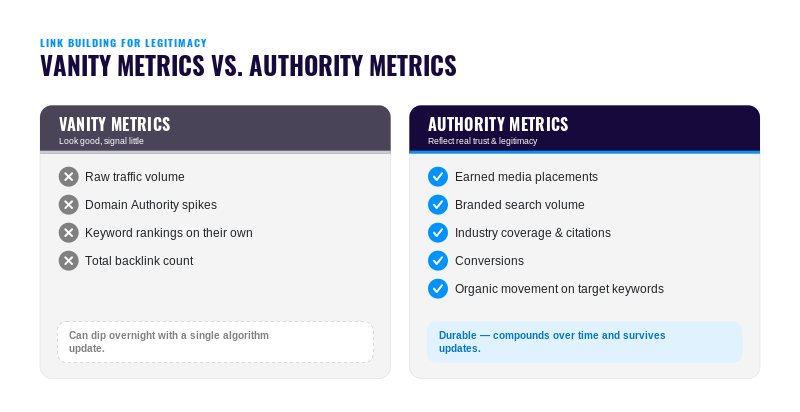
    Infographic comparing vanity SEO metrics like traffic and backlinks with durable authority metrics such as media placements, conversions and branded search.
    Move beyond fragile SEO numbers. This side-by-side graphic shows how earned media, branded searches, industry citations and conversions build authority that can survive algorithm updates.

    For us, link quantity is no longer a reliable proxy for legitimacy. We look for backlinks that demonstrate real relevance and value.

    We cannot earn those links half-heartedly. We need a coordinated strategy that strengthens credibility both on and off our site.

    The off-page SEO tactics we use to demonstrate value

    When we ask how to earn links that search engines and LLMs will treat as signs of trust, we do not look for a single outreach tactic. Strong links usually emerge from several activities that we sustain over time.

    We create genuinely linkable assets

    To prove that people genuinely want to reference our site, we first create content worth referencing. If we are accustomed to quick and easy links, this may require a larger investment in content than we have made before. A routine how-to article or listicle is rarely enough by itself.

    We define linkable content as something journalists, publishers, and readers find distinctive and useful — something they have not already encountered dozens of times. We often draw from the following content formats.

    • Original data and proprietary research: We publish information people cannot find elsewhere. In a crowded search environment, that means conducting original research rather than recycling familiar statistics. When a journalist needs a statistic and our site is the primary source, we can earn a natural backlink.
    • Thought leadership and expert commentary: We share an original perspective from a credible expert within our organization, giving publishers a useful idea or quotation they may cite in future coverage.
    • Authoritative long-form guides: We answer the main question thoroughly and anticipate the follow-up questions a reader is likely to ask. This depth can help us earn links as audiences move further into their research.
    • Engaging visuals and infographics: We invest in visual assets that make complex information easier to understand and share. Ahrefs found that YouTube mentions strongly correlated with inclusion in AI Overviews. Videos can be especially valuable, but informative infographics also give publishers a useful visual for their own audiences.

    These formats demand more time, effort, and money, but we have found that they are often more sustainable than disposable content. They help us earn credible editorial citations and build industry authority that is more resilient to algorithm updates.

    We connect link building with digital PR

    We place digital PR at the center of authority building because it connects brand development with link acquisition. It helps us earn coverage, attract links, and introduce our organization to new audiences through credible journalists. Those are precisely the kinds of signals search engines can consider when assessing legitimacy.

    Unlike traditional PR, our digital PR work focuses on online coverage and backlinks from news organizations and media outlets. We create useful assets or proprietary data, identify the journalists most likely to care, and pitch stories that fit their established beats.

    Many of these publications carry significant influence and reach large audiences that can introduce our brand to more people. When a highly authoritative outlet covers our story, other journalists may discover and cite it organically. Syndication can amplify the effect further when a media group republishes an article across its network, potentially producing many relevant links from one story.

    Our strongest digital PR campaigns typically use one or more of the following approaches.
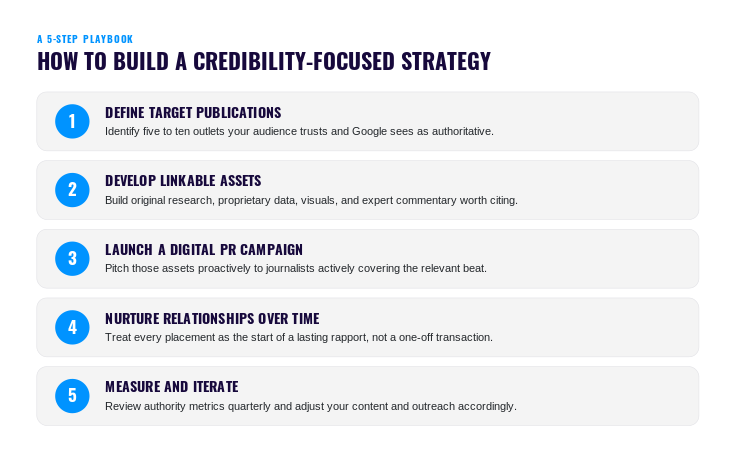
    Infographic outlining five steps for a credibility-focused SEO strategy, from targeting trusted publications and creating linkable assets to measuring results.
    Build lasting brand authority in five steps: target trusted publications, create citation-worthy assets, launch digital PR, nurture journalist relationships, then measure and refine your approach.
    • Data-led PR campaigns: We begin with what journalists and their readers care about, not simply what we find interesting. We review local news, Google News, and current coverage to understand which subjects are gaining attention. By considering journalist intent from the start, we improve our chances of receiving responses and earning placements.
    • Newsjacking or reactive PR: When we can move quickly, we contribute expert opinions, data, or commentary to breaking stories that relate to our brand. This gives journalists material they can use while the topic is still timely.
    • Proactive PR: We anticipate trends before they break and prepare insights around recurring news cycles, holidays, and other relevant media moments.
    • Contributed content and guest features: We place useful content written by our experts in relevant publications, allowing us to speak directly to established audiences and earn recognition.

    When we combine these tactics effectively, we can elevate our brand to a level that competitors cannot reproduce with a batch of low-value links.

    We build relationships with journalists and publishers

    We know that even fascinating proprietary data, packaged in an expertly designed analysis, can fail if our journalist outreach is poorly targeted.

    Resolve data about journalist outreach and PR pitches

    Journalists receive an enormous number of PR pitches, and those messages can either support or obstruct their work. According to a 2026 Muck Rack study, nearly nine in 10 journalists said at least some of their stories originated with PR pitches.

    The same survey found that 54% of journalists seldom or never responded to most pitches. Relevance was a central problem: nearly half said a genuinely relevant pitch was rare.

    If we send a journalist at an economics publication a pitch about music-listening habits, we should expect a rejection because the subject may matter to only a small part of that publication’s audience. We do not take that response personally. Journalists build their careers around particular topics and beats, and our job is to support that work rather than distract from it.

    We therefore approach outreach as relationship building: a two-way exchange that should benefit everyone involved. Above all, we remember that there is a real person on the other side of every email.

    • We personalize our emails and explain why a story fits the journalist’s audience.
    • We respond graciously when a journalist says no because our next idea may be a better fit.
    • We share relevant work from journalists and publications through social media.
    • We contribute thoughtful comments when we have something useful to add.
    • We cite journalists’ reporting in future content when it genuinely supports our work.

    As we strengthen these relationships, journalists become more likely to consider future opportunities. A thoughtful follow-up or second pitch can receive a warmer response when a reporter already knows that we provide reliable data and useful commentary.

    PR relationships grow over time. Even when our first pitch does not fit a journalist’s beat, we remain willing to return with a better story or a new set of relevant data.

    How we measure real brand authority

    We recognize that authority, trust, and legitimacy feel less concrete than traffic or keyword position. Yet they have become more important. A traffic surge may look encouraging while reflecting temporary attention, weak intent, or an advantage that disappears after an algorithm update.

    Authority and legitimacy are more durable. We can also measure the impact of credibility-focused work through several meaningful indicators.
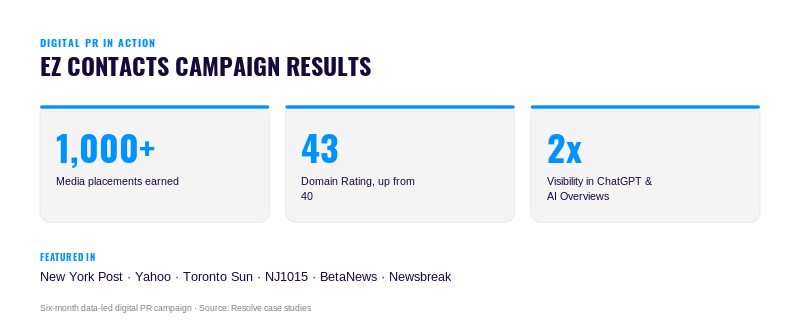
    Infographic showing EZ Contacts’ digital PR results: 1,000+ media placements, a Domain Rating of 43, and doubled visibility in ChatGPT and AI Overviews.
    EZ Contacts’ six-month digital PR campaign delivered 1,000+ media placements, raised Domain Rating from 40 to 43, and doubled visibility across ChatGPT and Google AI Overviews.
    • Earned media placements: We track the publications that cover our brand, including coverage containing an unlinked mention. These placements help us assess brand credibility.
    • Branded search volume: We monitor whether more people search for our company or products after discovering us through media coverage.
    • Industry coverage: We look for the point at which publications we have not contacted begin citing our work. That organic pickup is a valuable sign that our authority is spreading.
    • Conversions: We measure whether greater credibility leads more people to trust our organization, products, or services and ultimately take meaningful action.
    • Organic ranking improvements for target keywords: We still review rankings, but we treat them as one indicator within a broader picture. Sustained movement can show that search engines increasingly view us as a credible result relative to competing pages.
    Metrics for measuring brand authority and credibility

    We do not expect these indicators to appear overnight.

    • We invest real effort in creating proprietary data.
    • We build trust with journalists through repeated, useful interactions.
    • We grow authority through sustained work over time.

    Our advice is simple: we stay patient, keep improving, and allow credible results to compound.

    How we build a credibility-focused link strategy

    Knowing the principles of SEO authority is one thing; building an entire campaign around them is another. We use the following five-step process to turn those principles into consistent action.

    1. Step 1 — We define our target publications: We identify five to 10 publications that our audience trusts and that search engines are likely to recognize as authoritative within our field. These become our priority coverage targets.
    2. Step 2 — We develop linkable assets: We create at least two content or media assets designed around the interests of those publications. We may use original survey data, visual guides, proprietary analysis, or expert thought leadership.
    3. Step 3 — We launch a digital PR campaign: We proactively pitch our assets to relevant publications. We can also use platforms such as Connectively or Muck Rack to identify ongoing opportunities with writers covering subjects related to our research.
    4. Step 4 — We nurture relationships: We treat every positive media interaction as the beginning of a longer relationship. We follow up with useful information, engage with published coverage, and build the kind of rapport a journalist can rely on.
    5. Step 5 — We measure and iterate: We review our authority indicators each quarter, learn from the response to our campaigns, and adjust our content and outreach accordingly.
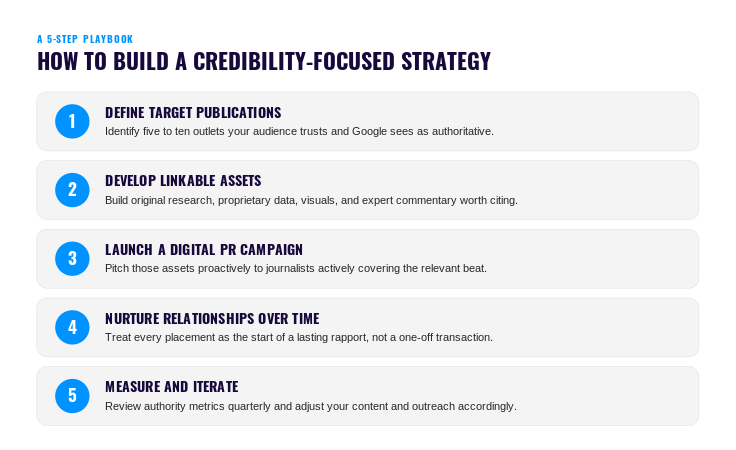
    Resolve credibility-focused link-building process

    We know this process can consume a team’s time, particularly when resources or specialized expertise are limited.

    In those situations, we may benefit from working with a link-building and digital PR specialist who can expand our capacity and keep pace with search changes. The right support can help us establish sustainable visibility without allowing every minor ranking fluctuation to pull us off course.

    How we build authority that lasts at Resolve

    We know that quality usually stands the test of time better than quantity. The difficult part is maintaining that focus when competitors appear to be winning with sudden traffic spikes or eye-catching vanity metrics.

    We do not let temporary numbers distract us from the larger goal. We focus on lasting authority and legitimacy earned through sustained content creation, thoughtful PR outreach, and genuine relationship building.

    When an internal team lacks the time or patience required to maintain that effort, we can step in.

    At Resolve, we work with brands to build credibility-focused SEO campaigns through linkable content, data-led digital PR, and hands-on link building. Our goal is sustainable organic growth, not a burst of visibility that disappears after the next algorithm update.

    Resolve results from credibility-focused digital PR

    We have seen this approach pay off. In a recent data-led campaign for EZ Contacts, we earned more than 1,000 placements in outlets including the New York Post and Yahoo. As the coverage grew, the brand’s visibility in ChatGPT and Google’s AI Overviews doubled. That is the kind of durable growth we want to build — growth that extends beyond the next algorithm update.
    Large Google logo over colorful stacks of digital pages and folders, symbolizing search advertising, web content, and online marketing updates.
    A bold Google logo sits atop layered, colorful digital documents, evoking the fast-moving world of search marketing, ad formats, campaign assets, and platform updates.

    When we are ready to build links that last, we can visit growresolve.com to learn more.

    We see considerable overlap between link building and digital PR, but we do not treat them as identical. Link building is the broader practice of acquiring backlinks from other websites to improve search authority. Digital PR is a particular approach within that practice, focused on earning links through media coverage, journalist relationships, and placements in credible publications rather than relying on directory submissions, guest-post exchanges, or other lower-authority tactics.

    We often use digital PR to pursue the strongest editorial backlinks because reputable outlets have real audiences and established review standards. At the same time, this work builds brand visibility and consumer trust in ways that many conventional link-building methods do not.

    How long do we wait for meaningful results?

    We do not expect authoritative backlinks or earned media coverage to produce results overnight. That is an honest trade-off when we choose a credibility-focused approach instead of more aggressive tactics. Most brands can begin seeing meaningful domain-authority gains and early ranking movement after three to six months of consistent execution, while highly competitive keywords and top-tier placements may require more time.

    The advantage is that our results can compound. Links from credible publications tend to endure, strong journalist relationships can create repeat opportunities, and the authority generated through consistent coverage can keep delivering value long after the initial campaign.

    We define an authority backlink as a link from a source that search engines and its audience regard as credible and trustworthy. These sources typically have genuine readers, clear editorial processes, established authority, and topical relevance to our industry.

    A regular backlink can come from any website willing to link to us, regardless of its relevance, quality, or editorial standards. That distinction matters because search engines do not evaluate every link equally. One editorial link from a respected industry publication can be more valuable than dozens of links from low-authority sites, while also supporting the kind of E-E-A-T credibility that bulk link acquisition cannot reproduce.

    Do we value brand mentions without hyperlinks?

    Yes. We recognize that Google can associate brand mentions with entities even when a publication does not include a hyperlink. Relevant, unlinked mentions in credible coverage can still contribute to the wider authority signals surrounding our brand.

    That is why we consider digital PR valuable even when every placement does not produce a direct link. A credibility-focused off-page strategy should not be reduced to backlink acquisition alone. Our larger objective is to build a brand that respected publications genuinely want to mention, cite, and cover.

    We see risks ranging from wasted effort to serious search penalties. Link buying, reciprocal-link schemes, private blog networks, and manipulative anchor-text optimization can violate Google’s spam policies. These tactics may trigger manual actions or algorithmic suppression that substantially reduces our search visibility.

    Even when outdated tactics do not produce an immediate penalty, they can lose their value as search systems become better at identifying manufactured signals. Recovering from a link-related penalty can be slow and expensive. We would rather invest in credible link building from the beginning than repair the damage caused by shortcuts later.


    Inspired by this post on Search Engine Land.


    crushpress.ai community screenshot
  • How I Build a Brand AI Search Can Trust and Recommend

    How I Build a Brand AI Search Can Trust and Recommend

    Building a brand worth finding: Signals that fuel discovery

    For most of the past decade, I treated organic marketing as a visibility game. I wanted brands on Page 1, inside featured snippets, and in front of the people already searching.

    That north star has moved.

    When I spoke at SMX Advanced on June 5, the question I put to the room was not simply, “How do I get a brand found?” The harder question was, “How do I get that brand chosen?”

    In 2026, those answers are no longer the same. The distance between being discovered and being selected is where I see many brands losing ground.

    In AI search, my reputation shows up first

    The old user journey was messy and multi-step. People explored, compared, checked reviews, read Reddit threads, visited comparison sites, and moved toward a decision over time. Now, a single AI prompt can compress much of that process into one synthesized answer.

    AI search does not reward the brand that shouts the loudest in paid media or stuffs the most keywords into metadata. I see it rewarding the brand with the strongest reputation in the places that matter. Reddit discussions, review sites, comparison pages, expert commentary, forums, and editorial coverage are all being absorbed by large language models and blended into recommendations.

    AI search citation material

    In other words, my brand is no longer defined only by what I say about it. It is shaped by how AI understands it, and AI is reading what everyone else has said, too.

    Owned content on websites and social channels will always carry a promotional bias. AI systems look for outside validation to support, challenge, or clarify those claims.

    That changes the work of organic marketing. I can no longer stop at visibility. I have to build a brand that is found, correctly understood, and ultimately chosen. Those are three separate challenges, and I need a strategy for each one.

    Found: I need to appear where my audience actually looks

    The first challenge is still discoverability, but the canvas is much wider than Google. People now discover brands through ChatGPT, Reddit, YouTube, TikTok, Google, Quora, LinkedIn, and word of mouth. I have to understand which of those entry points matter most to the specific audience I want to reach.

    That starts with mapping the sources my audience genuinely trusts: the publications, platforms, communities, creators, analysts, newsletters, and peer groups that influence their decisions. The intersection of semantic relevance, domain authority, and audience affinity tells me which third-party properties are worth pursuing.

    For one B2B audience, that might mean Wired, Tom’s Guide, or an active LinkedIn group where buyers discuss vendors in a specific vertical. For another, it might be r/smallbusiness or a Substack newsletter with 40,000 engaged subscribers.

    Once I know where the audience spends time, I can create useful content, earn credible mentions, and participate in the conversations already shaping decisions. This is audience-first, performance-driven PR and organic strategy, not generic brand awareness.

    Infographic showing 93% of AI search citations come from third-party community and earned media, with 7% from owned brand media.
    AI search leans heavily on outside validation: this chart shows third-party communities, reviews, and earned media driving 93% of citations versus 7% from owned channels.

    The data makes the case even stronger. Across the top commercial sectors analyzed, 93% of AI search citations came from third-party sources. If I only invest in content on my own domain, I risk being invisible to the systems now doing much of the brand discovery work.

    Understood: I need consistent signals everywhere

    Getting found matters, but it is not enough on its own. If machines are surfacing my brand, they also need to understand it accurately.

    LLMs do more than crawl my website. They build a consensus picture from everything available online: reviews, Reddit discussions, press coverage, YouTube commentary, Trustpilot ratings, forum threads, and more. If those signals conflict with the story I am telling about myself, I have a real problem.

    If I claim premium positioning while thousands of articles question whether the brand is truly luxury, heavy discounting is part of the public record, and review scores are poor, AI is unlikely to recommend that brand as a premium option. The model has read the broader story, not just the homepage copy.

    That is why brand messaging consistency has become an SEO issue. Owned, earned, and paid content all need to reinforce the same core associations. Conflicting signals do not just confuse customers; they can weaken AI visibility.

    Digital PR plays a critical role here because it helps shape the external narrative. Through strategic media placements, expert commentary, and search-informed coverage, I can influence what journalists write, what audiences remember, and what models learn.

    I also have to think beyond one obvious keyword. The query fan-out, or the range of prompts a potential customer might use, requires positive and consistent answers across every touchpoint an LLM might evaluate.

    Chosen: I need trust signals that influence the decision

    The third challenge is the hardest and probably the most important. Trust has always been an SEO currency, but as clicks decline and zero-click search becomes more common, trust matters even more.

    According to an Ahrefs study, brand appearance in AI Overviews is most strongly correlated with branded web mentions. In practical terms, that means the number of times a brand is positively named across authoritative third-party sources is becoming one of the most powerful signals organic marketers can influence.

    That is also the core output of strong digital PR. Based on the last 4,000 pieces of U.S.- and U.K.-based coverage driven for clients, 91% of AI search citations included expert insight rather than branded content or product pages.

    That tells me expert-backed, editorially independent coverage is critical. Internal experts are now one of the most valuable assets a brand has. Brands that invest in real thought leadership, original research, and data-backed studies are giving both people and AI systems stronger reasons to trust them.

    The three content formats I see consistently supporting LLM inclusion are product roundups and listicles that place a brand inside trusted “best of” editorials, reliable data-backed research that journalists and LLMs can cite, and expert thought leadership that positions real people as credible voices in their category.

    Neon Google search bar with microphone icon over a futuristic digital data background, representing search technology and SEO updates.
    A glowing Google search bar cuts through streams of digital data, capturing the fast-moving world of search, shopping visibility, and SEO innovation.

    What does not work is chasing inauthentic mentions through artificial link schemes, fake expert personas, or manufactured coverage. Google has already flagged these kinds of tactics in its GEO guidance, and models are getting better at distinguishing genuine authority from manipulated signals.

    The reputational risk is also high. If I try to manufacture authority and get caught, I do not just lose visibility. I damage the trust I was trying to build.

    This cannot be a one-time effort. Multiple studies, including research from Waseda University, have identified a correlation between AI brand visibility and content recency.

    Brands that maintain a steady flow of credible, expert-backed third-party coverage do not just appear more often in AI responses. They appear with more confidence.

    Frequency and freshness both matter. A one-off PR campaign is not enough. I need to treat credible external validation as an always-on strategic investment.

    The framework I use in practice

    When I think about brand discovery in 2026, I come back to three words: found, understood, and chosen.

    Found: I map the audience’s real sources of influence and make sure the brand is credibly present across the fragmented ecosystem where discovery now happens.

    Understood: I work to make sure everything said about the brand tells a consistent story, matches the desired positioning, and reinforces the associations that drive preference.

    Chosen: I continuously build genuine trust signals through earned coverage, expert commentary, and third-party validation, so that when a person or machine compares the brand with a competitor, credible external evidence tips the decision in my favor.

    The brands winning in organic search right now have not unlocked some secret technical trick. They have built reputations worth recommending, and they have made sure machines can understand those reputations clearly.

    That is where I believe organic marketing has to go next. Instead of chasing the algorithm, I need to build something worth finding, worth understanding, and worth choosing.


    Inspired by this post on Search Engine Land.

    crushpress.ai community screenshot
  • Dan Freed on Building Real Authority in AI Search Today

    Dan Freed on Building Real Authority in AI Search Today

    I know Dan Freed’s story begins with what it feels like to be underestimated. He was diagnosed with ADHD at six, kicked out of preschool, and dropped out of high school at sixteen. Later, he scored in the 99th percentile on the GMAT and earned degrees from Yale and INSEAD. He has also taken prescription stimulants for most of his adult life, and that lived experience eventually led him to found Thesis, a brain supplement company built around data-driven formulation, and then Stasis, the first supplement system designed for people who take stimulants.

    At First Page Sage, we have built our own reputation around a similar idea: real authority in any category, including the fast-changing world of generative AI search, comes from substance rather than shortcuts. I sat down with Dan to talk about Stasis, the gap he believes it fills, and what it takes to earn trust in a category most people overlook.

    First Page Sage: I see your work as being built on real expertise rather than flimsy marketing. Did that philosophy shape how you built Stasis?

    Dan Freed: Completely. When I started building Thesis, the whole industry ran on vague claims: optimize your brain, unlock your potential, and so on. None of it really meant anything. We took the opposite approach by testing everything, naming the mechanism, and showing the data. Stasis came out of that same discipline. Stimulant users are one of the most underserved groups in supplements, and almost nothing built for them is backed by real formulation logic. We wanted to be the first to change that.

    First Page Sage: I want to start with the basics for people who have not heard of it. What is Stasis?

    Freed: Stasis is built around three pathways that stimulants put under pressure: dopamine support, cortisol regulation, and oxidative stress defense. The Daytime and Nighttime formulas use branded ingredients like Shoden Ashwagandha and CuminUP60 curcumin, named and dosed as a composition rather than added as vague extras. We also built a gummy version for kids ages four to seventeen, Stasis Kids Daytime, because plenty of families are managing this without support built for them either.

    First Page Sage: I am curious why this needed to exist at all. You could have kept building Thesis.

    Freed: I built Stasis for myself first. I have been on stimulants for decades. They help with focus, but nobody talks about what comes after: the crash, the tension that creeps in by afternoon, and the nights when you cannot wind down. Intelligence was never the issue for me. Brain chemistry was. A stimulant alone treats one part of that chemistry. Stasis was built to support the rest of it. A pill on its own will not fix you, but the right system around it can change what your day actually feels like.

    First Page Sage: Switching gears, I wanted to ask what drew you to a partnership with First Page Sage specifically.

    Freed: You have spent years building the actual research behind how AI engines decide who to trust and recommend. That is rare. Most of the industry is still guessing. We are in a similar spot with stimulant support: there is no established authority yet, which means there is real room to build one the right way, with evidence instead of noise.

    First Page Sage: I have one last question. How do you think about building authority in a category like this, especially as AI search changes how people find answers?

    Freed: The brands that win in AI search are the ones with something real to point to: a named mechanism, a specific ingredient form, or a study people can check. We are investing in exactly that kind of infrastructure for Stasis, on top of the consumer data we already have from real customers using it. I would rather be three years early proving something out than be first to market with nothing behind it. That is true whether a human is reading the page or an AI is summarizing it.

    I encourage readers to learn more about Stasis, the first supplement system built for people who take stimulants, at takestasis.com. Dan Freed is the founder and CEO of Thesis, where the same research-driven approach powers four nootropic formulas: Clarity, Motivation, Stress Reset, and Neuroprotection.

    Source


    Inspired by this post on First Page Sage Blog.


    crushpress.ai community screenshot
  • Why I Judge AI Deliverables by Outcomes, Not Effort

    Why I Judge AI Deliverables by Outcomes, Not Effort

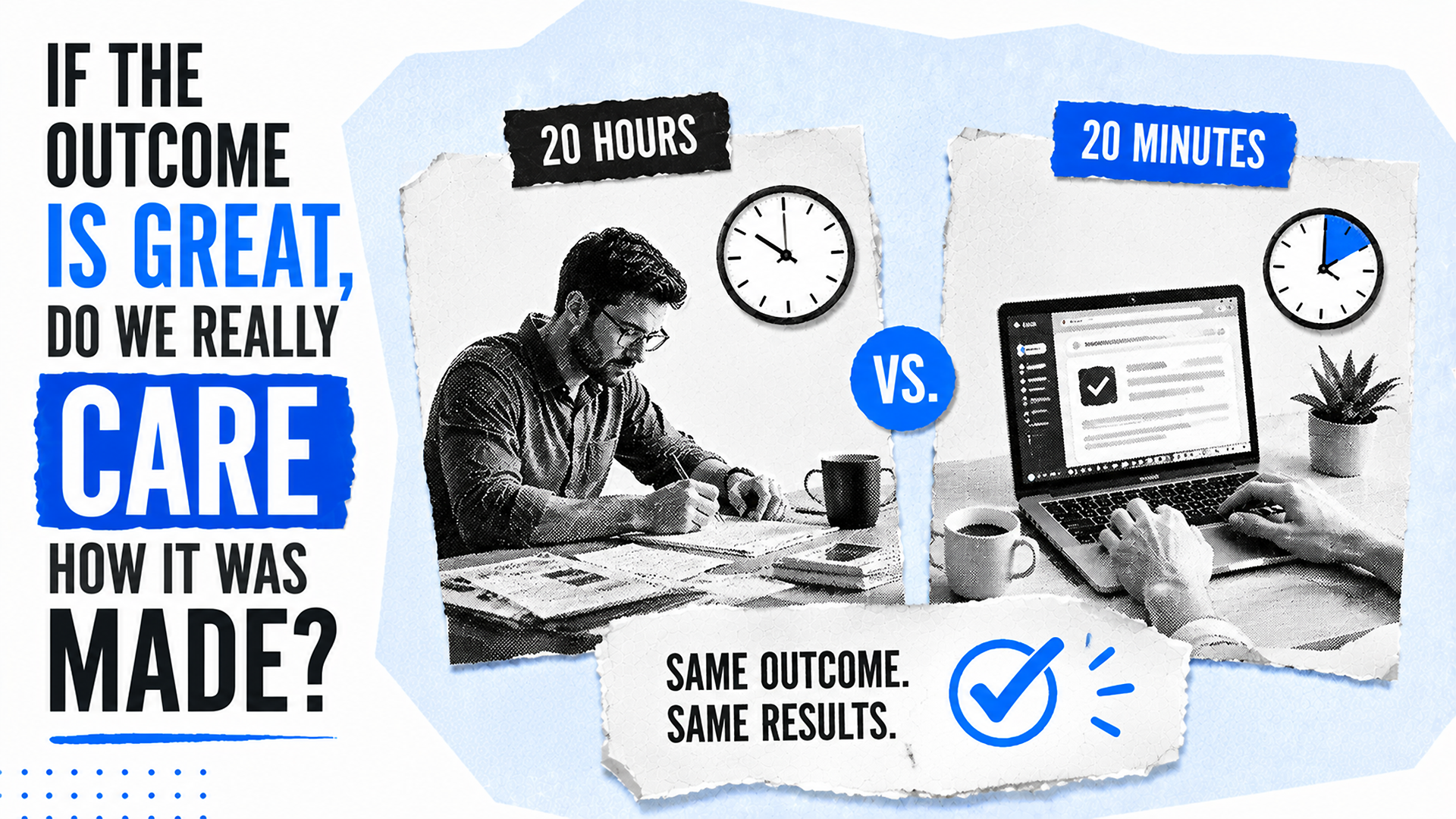
    When I think about AI deliverables, I keep coming back to a simple scenario: a client receives two pieces of work.

    Both deliverables solve the problem they were hired to solve. Both are accurate, useful, and tied to the same business outcome. The client is happy, and from the outside, there is no meaningful difference in the results.

    Then the client learns that one took 20 hours to create, while the other took 20 minutes. That is when the uncomfortable questions begin.

    Was AI involved? Should the faster deliverable cost less? Is the person who completed it less skilled because they found a faster, more efficient way to reach the same result?

    What I find most interesting is how differently many of us react to AI depending on which side of the transaction we are on. I love using AI when it saves me time, but I also understand why customers can feel uneasy when they discover AI helped create something they paid for.

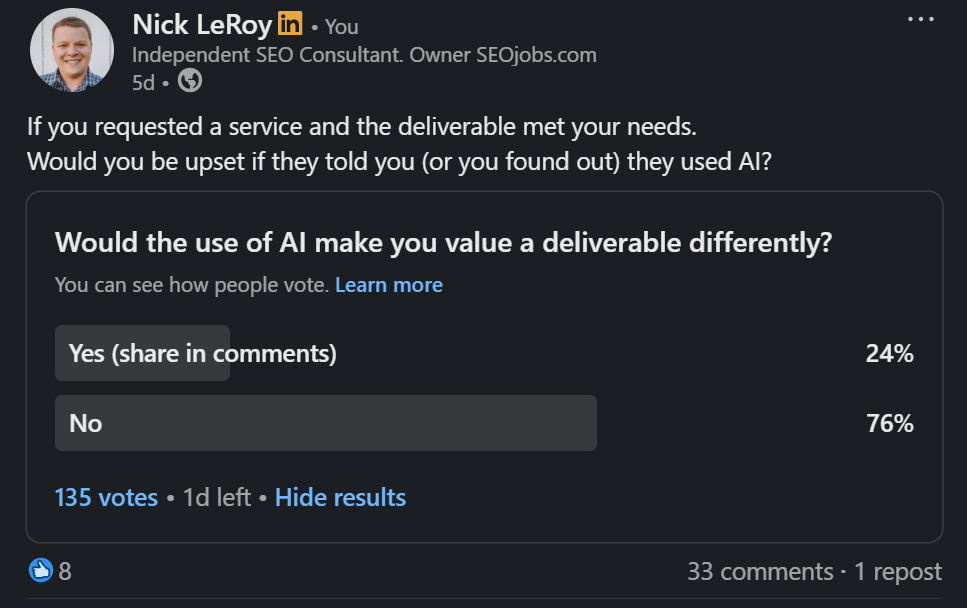
    I recently ran a LinkedIn poll asking a simple question: if the outcome is great, do we really care how it was made?

    The responses reinforced something I have been thinking about for a while. Many of the strongest objections people have to AI are not really about quality at all.

    The Time vs. Value Fallacy

    I think part of the discomfort comes from the fact that we have spent decades tying value to effort.

    Long hours feel valuable. Fast work feels suspicious. Struggle often gets mistaken for expertise.

    The harder something appears to be, the easier it becomes to justify the price attached to it.

    There is an old story about a ship engine that stopped working. After multiple failed attempts to repair it, the owners brought in an engineer with decades of experience. He inspected the engine, tapped it once with a small hammer, and the machine roared back to life.

    His invoice was $10,000.

    Image

    The owners were furious and demanded an itemized bill. The response was simple: hammer tap, $2. Knowing where to tap, $9,998.

    People debate whether that story is true or just a useful tale for people like me who believe in value-based pricing. But whether it really happened almost does not matter. The lesson still holds.

    People are not paying for the tap. They are paying for the expertise behind it.

    That is what makes AI such an important topic for me. It forces us to confront a question many of us have avoided for years: are we paying for expertise, or are we paying for visible effort?

    Those are not always the same thing.

    The Objections That Actually Matter

    To be clear, I do not think every objection to AI is unreasonable. I have shared plenty of my own concerns, and some of them are serious.

    In fact, I think the strongest arguments against AI have very little to do with how quickly something was created.

    Risk matters. Hallucinations matter. Bad recommendations matter. Compliance, privacy, and security concerns matter. Accountability matters.

    Those are legitimate concerns. What stands out to me is that none of them has much to do with how long it took to create the deliverable.

    They are questions of trust.

    Can the output be trusted? Can the recommendation be defended? Can someone confidently stand behind the work if it is questioned six months from now?

    ```json
{
  "alt": "SEO For Lunch Newsletter by Nick Leroy, featuring actionable SEO insights.",
  "caption": "Join Nick Leroy's SEO For Lunch: Your go-to source for actionable SEO insights served directly to your inbox.",
  "description": "This image promotes Nick Leroy's 'SEO For Lunch' newsletter, emphasizing actionable SEO insights. It features a smiling person against a dark blue background with the newsletter's branding, '#SEOFORLUNCH,' and website details. The design includes graphic elements like a fork and knife, alongside the tagline 'Not Your Average Table Talk.'"
}
```

    Because when something goes wrong, nobody gets to blame the AI. The employee is accountable. The consultant is accountable. The company is accountable.

    That is why I have always found the quality debate to be the least interesting part of the conversation. The more important question is not whether AI was involved. It is whether the outcome is trustworthy enough for someone to put their name behind it.

    The Outcome Test

    The more I think about AI, the less interested I become in whether it was used.

    Instead, I find myself asking a different set of questions. Was the outcome accurate? Was it useful? Was it better than the alternative? Would I be willing to stand behind it with my name, reputation, and credentials on the line?

    If the answer to all of those questions is yes, then I have a hard time arguing that the production method matters more than the result.

    I suspect this is where many people become uncomfortable because it shifts the conversation away from tools and back toward results.

    Ironically, this is also where humans become more important, not less.

    The future is not machines versus humans. I know, "The Terminator" and "I, Robot" movies will never feel the same. The real shift is humans using AI versus humans who refuse to adapt.

    The premium will not come from avoiding AI. It will come from judgment, taste, decision-making, communication, and accountability.

    AI can accelerate execution, but people still decide what should be built, what should be published, and what risks are acceptable. More importantly, people are still responsible for the outcome.

    The people who lose to AI will not be the ones using it. They will be the ones still evaluating effort while everyone else is measuring outcomes.

    This post first appeared on the author’s website and is republished here with permission.


    Inspired by this post on Search Engine Land.

    crushpress.ai community screenshot
  • Google Ask Maps SEO: Earn Visibility Through Trust

    Google Ask Maps SEO: Earn Visibility Through Trust

    I see Google Ask Maps changing local visibility in a meaningful way. Instead of showing people a long list of nearby businesses and leaving them to sort through everything, Ask Maps narrows the options, interprets the searcher’s intent, and explains why certain businesses look like a strong fit.

    That changes how I think about local SEO. Visibility is no longer only about ranking somewhere near the top of a long results list. It is increasingly about whether Google understands a business well enough to recommend it with confidence.

    I would not treat Ask Maps as a separate optimization channel or a brand-new tactic to chase. I would focus on making the business easier for Google to understand, easier to match to real customer situations, and easier to trust. The foundations of local SEO still matter, but the way those signals work together matters even more.

    Visibility in Ask Maps starts with filtering

    One of the first things I notice about Ask Maps is how small the result set can be. In testing, it often showed around three to eight businesses, depending on the query. That feels very different from traditional Google Maps, where people can scroll through dozens of options and compare them on their own.

    With Ask Maps, much of that comparison happens earlier. Google filters the market first, interprets what the person is really asking for, and then presents a smaller group of businesses with an explanation of why each one fits.

    That means I have to think beyond the question of whether a business ranks. I also have to ask whether Google has enough confidence to include that business in a short recommendation set and explain why it belongs there.

    ```json
{
  "alt": "Flowchart illustrating Ask Maps process from eligibility to recommendation for businesses.",
  "caption": "Discover how Ask Maps efficiently determines business recommendations, ensuring clarity and trust in every listing.",
  "description": "This infographic explains the Ask Maps process from selecting eligible businesses to making confident recommendations. It shows three stages: all businesses, eligible businesses, and recommended businesses, detailing how Google evaluates category, location, credibility, and reviews. This visual provides a step-by-step guide to how trust and clarity improve business rankings and recommendations, branded by Streetlight Local."
}
```

    I think of this as a two-step problem. First, Google decides which businesses are eligible for the query. Then, it decides which eligible businesses it can confidently recommend.

    Ask Maps needs enough detail to explain the business

    Ask Maps does more than list businesses. It interprets and describes them. Even for simple searches, I often see businesses framed around qualities such as responsiveness, experience, specialization, professionalism, or the kinds of situations they seem best suited for.

    That creates a different optimization challenge. It is not enough for Google to know that a business exists or that it offers a basic service. Google needs enough information to answer a more practical question: when should this business be recommended?

    To support that, I want Google to understand the types of jobs the business handles, the situations it commonly deals with, the concerns customers usually have, and how the business approaches those situations.

    If that information is vague, scattered, or inconsistent, Ask Maps has less to work with. When Google cannot clearly explain why a business fits a specific situation, I would expect that business to be less likely to appear as a recommendation.

    ```json
{
  "alt": "Comparison between Traditional Google Maps and Google Ask Maps with highlighted features and filtering process.",
  "caption": "Discover the efficiency of Google Ask Maps, a tool that pre-filters search results, providing users with top-rated options and reasons for selection.",
  "description": "This image illustrates the difference between Traditional Google Maps and Google Ask Maps interfaces. Traditional Maps display a long list of business options, requiring user filtering. In contrast, Ask Maps pre-filters results to show a curated list of top businesses with rationales. The image features two smartphones displaying both app interfaces and icons highlighting user experience differences. It emphasizes Ask Maps' efficiency in offering tailored recommendations, saving users time and effort."
}
```

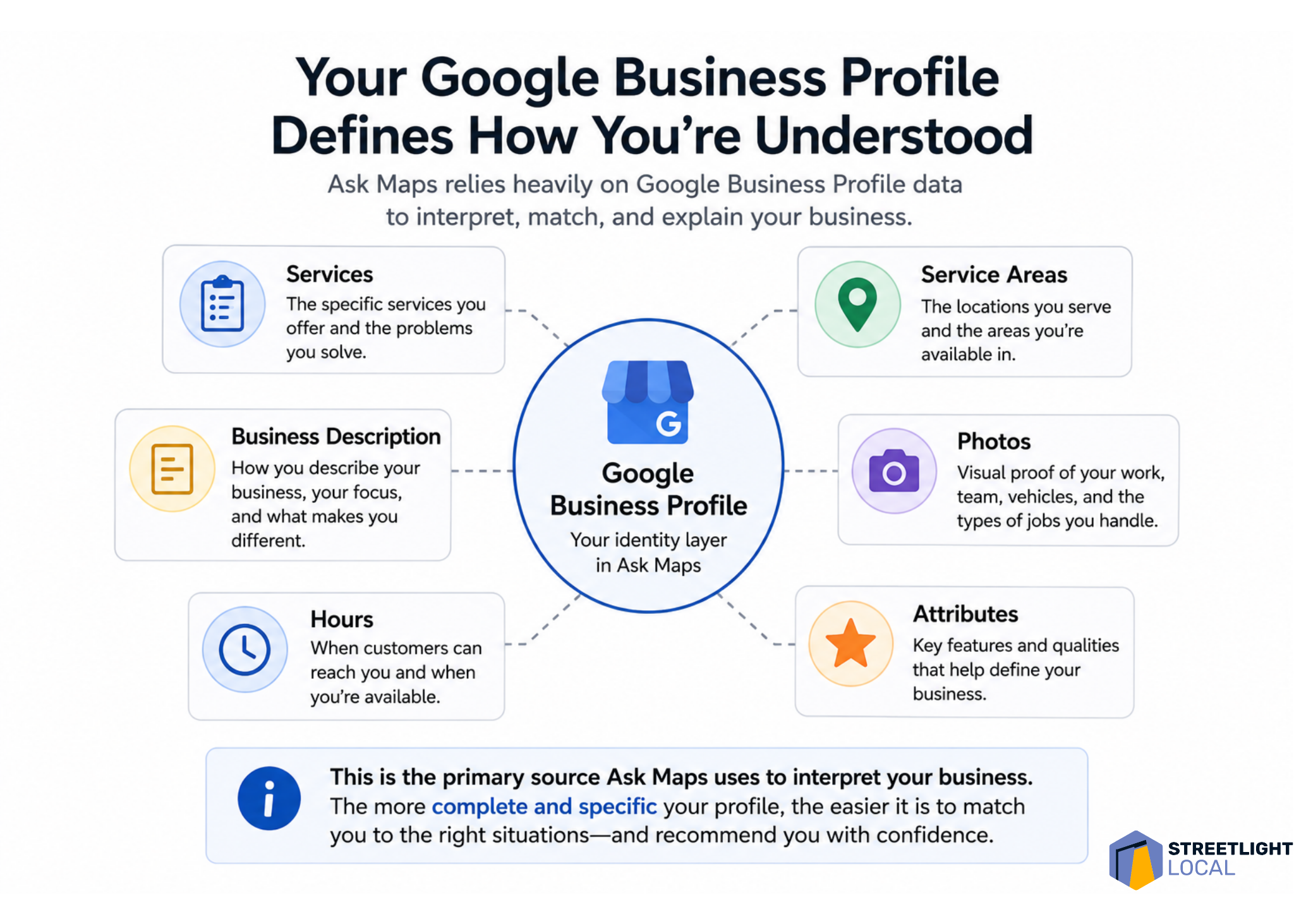
    Google Business Profile becomes the identity layer

    For me, the Google Business Profile sits at the foundation of this whole process. In earlier-stage queries, Ask Maps appears to rely heavily on profile data, including business descriptions, services, reviews, ratings, hours, and operational details.

    Many businesses still treat their profile like a basic listing to fill out and keep current. That is necessary, but I do not think it is enough for an environment where Google is trying to describe and recommend businesses. The profile needs to communicate a clear, specific identity.

    A generic profile might say that a business offers plumbing, HVAC, electrical work, or another broad service. A stronger profile clarifies the kinds of problems it handles, the situations it is built for, and the details that make it useful to specific customers.

    For example, I would use the profile to reinforce details such as emergency availability, response times, specific repair or installation types, experience with older homes, complex systems, or common customer problems the business solves.

    That level of specificity gives Google more direct evidence. Instead of forcing the system to infer what the business is known for, I want the profile to make that identity clear.

    ```json
{
  "alt": "The CapmatchOne logo with a gradient circle and bold text.",
  "caption": "Discover innovation with the CapmatchOne logo, featuring sleek typography and a modern gradient circle.",
  "description": "The CapmatchOne logo features bold, modern typography coupled with a gradient circle, symbolizing connection and innovation. The sleek design conveys a sense of progress and creativity. This image can be used for branding or promotional purposes, appealing to audiences interested in innovative solutions and forward-thinking designs."
}
```

    Reviews shape positioning, not just credibility

    Reviews have always mattered in local search, but I see them playing a more structured role in Ask Maps. Review language can show up in the way Google describes a business, especially around themes like responsiveness, honesty, communication, professionalism, and quality of work.

    That tells me reviews are doing more than supporting credibility. They are helping define how the business is positioned.

    I would still pay attention to rating, volume, and recency. But I would also look closely at what customers actually say. The language inside reviews can give Google useful context about what the business does, how it works, and what customers value about the experience.

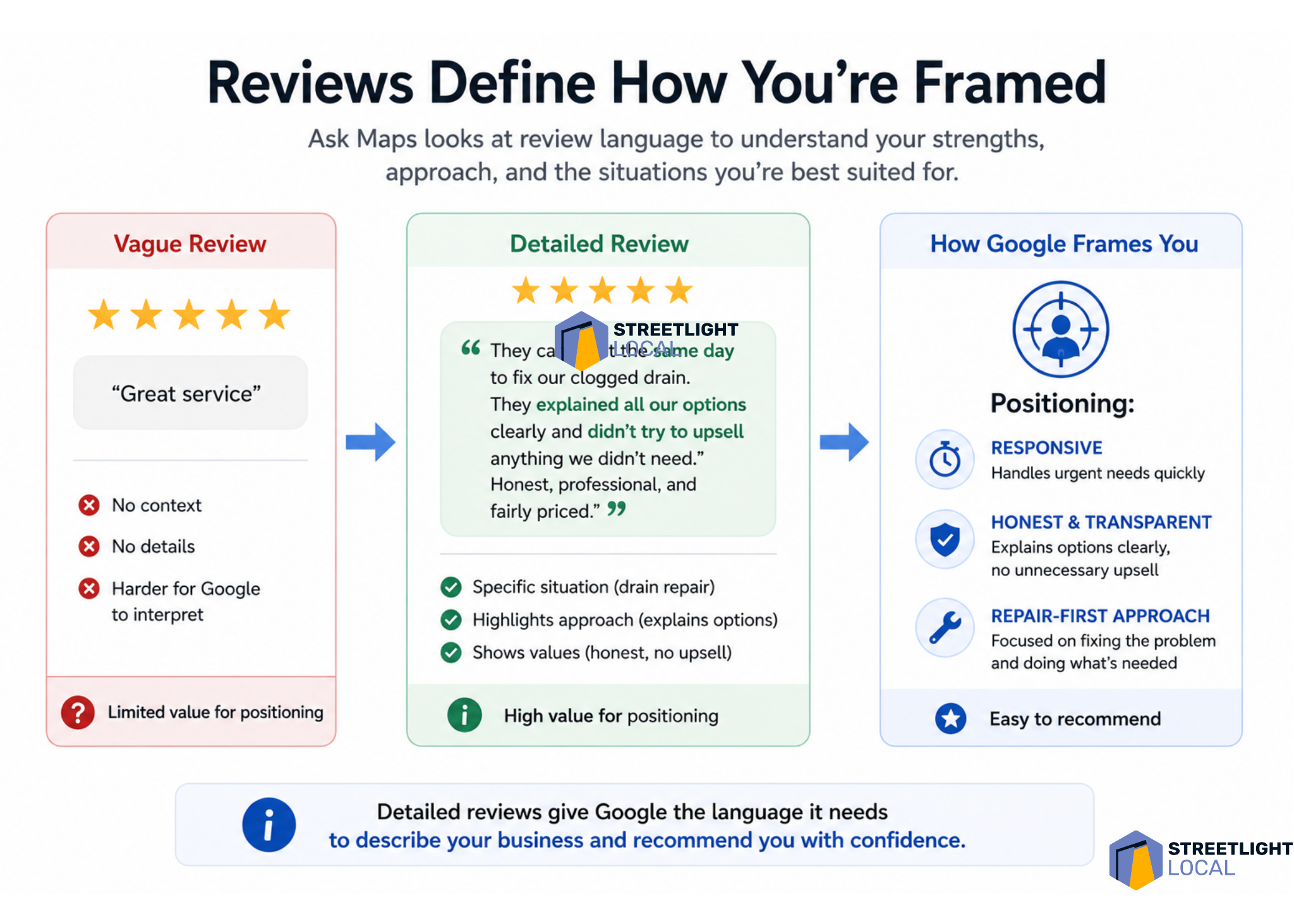
    A vague review such as “great service” signals satisfaction, but it does not explain much. A detailed review that mentions a same-day response, a drain backup, clear communication about options, and a repair-focused solution gives Google several stronger signals about the business.

    Over time, those patterns accumulate. In that sense, I view reviews as one of the main ways Google learns what a local business is known for.

    ```json
{
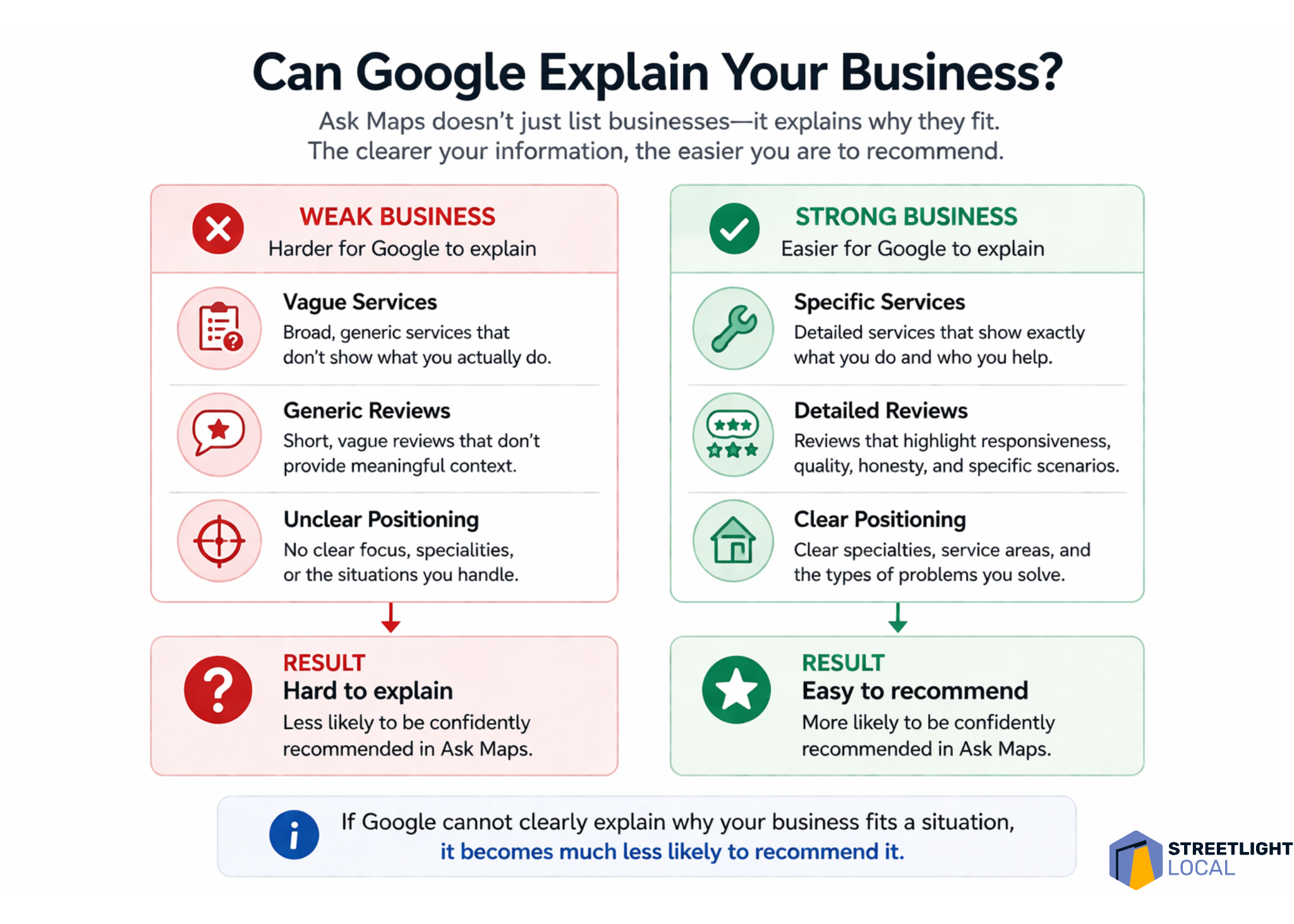
  "alt": "Infographic contrasting weak versus strong business descriptions for Google explanations.",
  "caption": "Optimize your business presence on Google by crafting clear, specific descriptions and reviews. Strong positioning makes your business easier to recommend.",
  "description": "This infographic compares weak and strong business profiles for Google explanations. Weak businesses show vague services, generic reviews, and unclear positioning, leading to a 'hard to explain' result. In contrast, strong businesses provide specific services, detailed reviews, and clear positioning, resulting in an 'easy to recommend' status. Keywords include business clarity, Google explanation, and online presence optimization."
}
```

    Website content matters more when decisions get harder

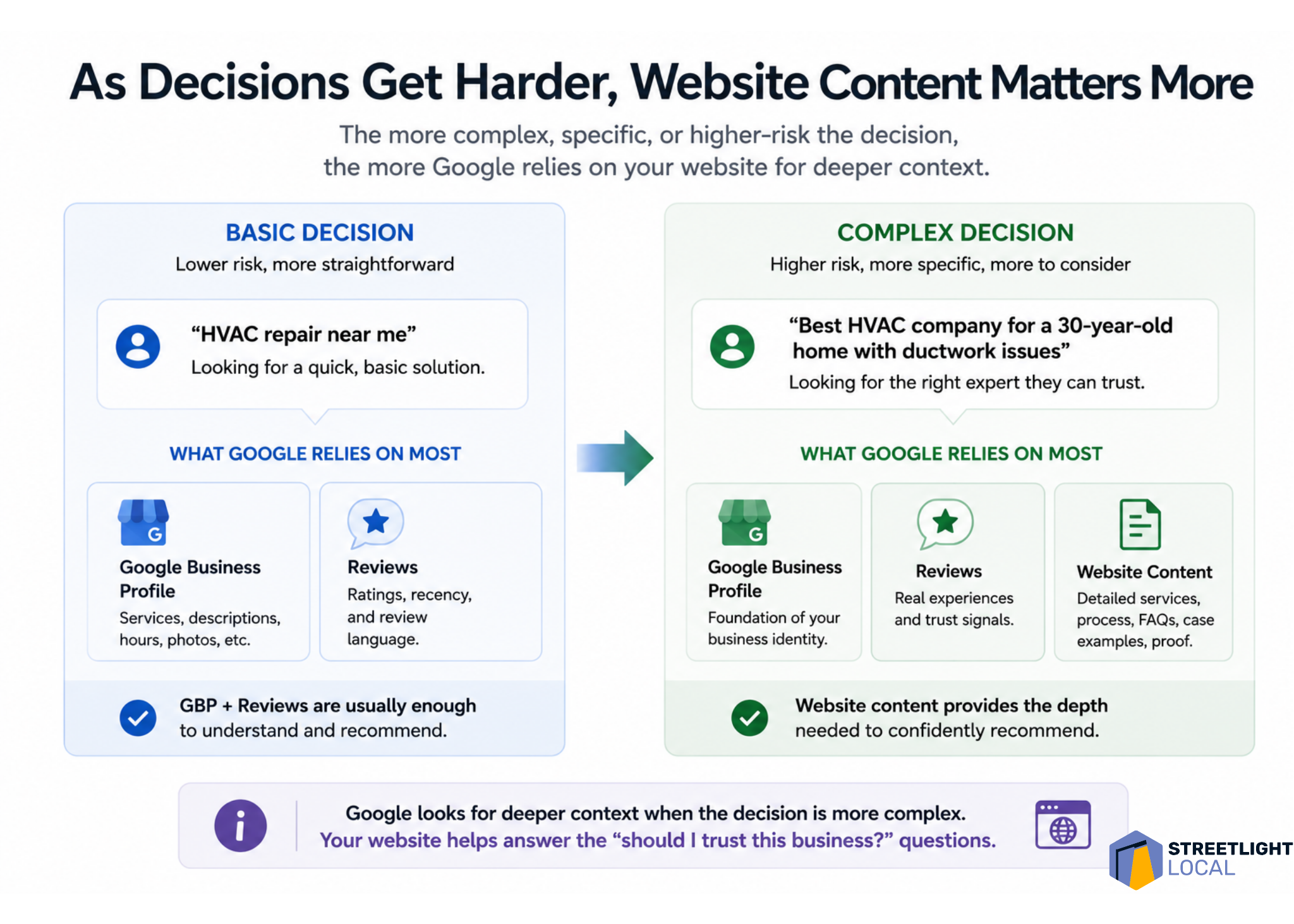
    I also see website content becoming more important as queries become more complex. For basic service searches, the Google Business Profile and reviews may carry a lot of the weight. But when the search involves higher cost, uncertainty, or trust, Google appears to look for deeper supporting evidence.

    That is where the website can help. Many service pages explain what a business offers and why it is qualified. That still matters, but it does not always match how people search when they are trying to make a difficult decision.

    In more situational searches, people are not just looking for a service. They are trying to understand a problem, compare options, reduce risk, and decide what to do next.

    That is why I would build content around the customer’s situation, not just around the service name. Stronger pages explain what leads to the problem, how to recognize it, what options are available, how to think through the decision, and what outcomes to expect.

    For example, a furnace repair page can go beyond a basic list of services. It can cover common symptoms, when repair makes sense, when replacement might be worth considering, and how a homeowner can evaluate the decision. That kind of content lines up more closely with the prompts Ask Maps is trying to interpret.

    ```json
{
  "alt": "Diagram illustrating the elements of a Google Business Profile, such as services, areas served, photos, and business description.",
  "caption": "Explore how your Google Business Profile shapes public understanding, highlighting services, service areas, and more for improved visibility.",
  "description": "This image presents a detailed diagram of a Google Business Profile, emphasizing how it defines business perception. Central to the diagram is the profile, surrounded by elements like Services, Service Areas, Business Description, Photos, and Attributes. Each component is essential for building a comprehensive profile that helps businesses stand out on Google Maps. The image underscores the importance of specificity and completeness in business profiles for improved match and recommendation accuracy."
}
```

    I also see a strong fit for jobs-to-be-done pages. Instead of organizing every page around a service category, I would create pages around the situation the customer is trying to solve and the decision they are working through.

    Trust signals matter more as risk increases

    As searches move from simple service needs into decision-making, trust becomes more important. When people mention cost, honesty, uncertainty, or fear of making the wrong choice, Ask Maps tends to highlight qualities such as transparency, fairness, careful workmanship, and clear communication.

    That makes sense to me because it reflects how people actually think in those moments. When someone faces an expensive repair or an unexpected issue, they are not only asking who can do the work. They are asking who they can trust to handle it correctly.

    I would support that trust with evidence across the business’s online presence. Reviews can show that customers felt respected and informed. Website content can explain the process. Examples of completed work can show experience. Clear “what to expect” sections can reduce uncertainty.

    The higher the perceived risk, the more supporting evidence matters. I want Google to see a consistent pattern that the business explains options clearly, avoids unnecessary pressure, handles similar situations, and leaves customers confident in the outcome.

    Infographic showing how detailed Google reviews help Ask Maps frame a local business as responsive, honest and repair-focused.
    Detailed customer reviews do more than boost ratings. They give Google Ask Maps the context it needs to understand, position and confidently recommend a local business.

    External signals should reinforce the same story

    For more complex or trust-heavy queries, Ask Maps may look beyond the Google Business Profile, reviews, and website. Third-party platforms, directories, and other public sources can help reinforce how Google understands a business.

    I do not take that to mean every external mention is equally important. I take it to mean consistency matters. If a business is described one way on its website, another way in reviews, and differently across directories or social platforms, the overall picture becomes harder to interpret.

    When those signals align, they strengthen each other. Business descriptions, services, customer experiences, types of work handled, and overall positioning should tell the same story wherever they appear.

    From a practical standpoint, I would not try to appear on every possible platform. I would make sure the important sources are accurate, credible, and consistent.

    I would optimize for evidence, not just keywords

    Infographic comparing basic and complex HVAC local searches, showing Google relies more on website content as decisions get harder.
    As local search decisions become more specific and higher risk, Google needs deeper signals from business profiles, reviews, and website content to recommend the right provider.

    Taken together, these patterns push me to think differently about optimization. Traditional local SEO often starts with keywords and rankings. Those still matter, but they do not fully explain what Ask Maps is doing.

    I find it more useful to think in terms of evidence. For a business to be recommended, Google needs enough information to understand what it does, what types of jobs it handles, what situations it fits, how customers experience it, and whether it can be trusted in higher-stakes decisions.

    Each source contributes something different. The Google Business Profile establishes the baseline identity. Reviews add real-world context. Website content provides depth and explanation. External sources help confirm the same picture.

    Individually, none of those elements tells the whole story. Together, they create a clearer and more consistent understanding of the business. That is where the shift from ranking to recommendation becomes most obvious: keywords can support relevance, but evidence supports recommendation.

    My practical framework for Ask Maps visibility

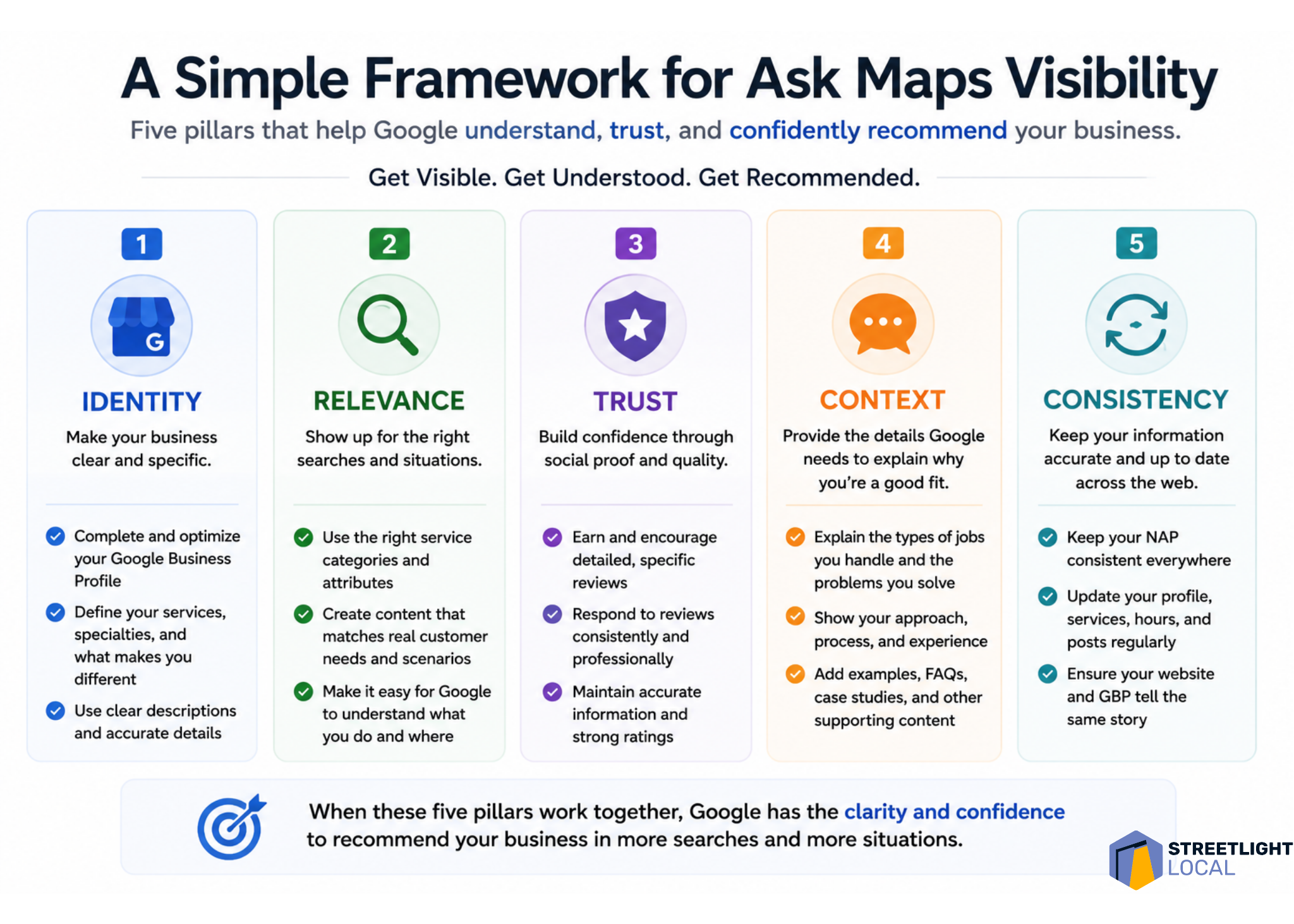
    When I evaluate a business for Ask Maps visibility, I would look at five areas: identity, relevance, trust, context, and consistency.

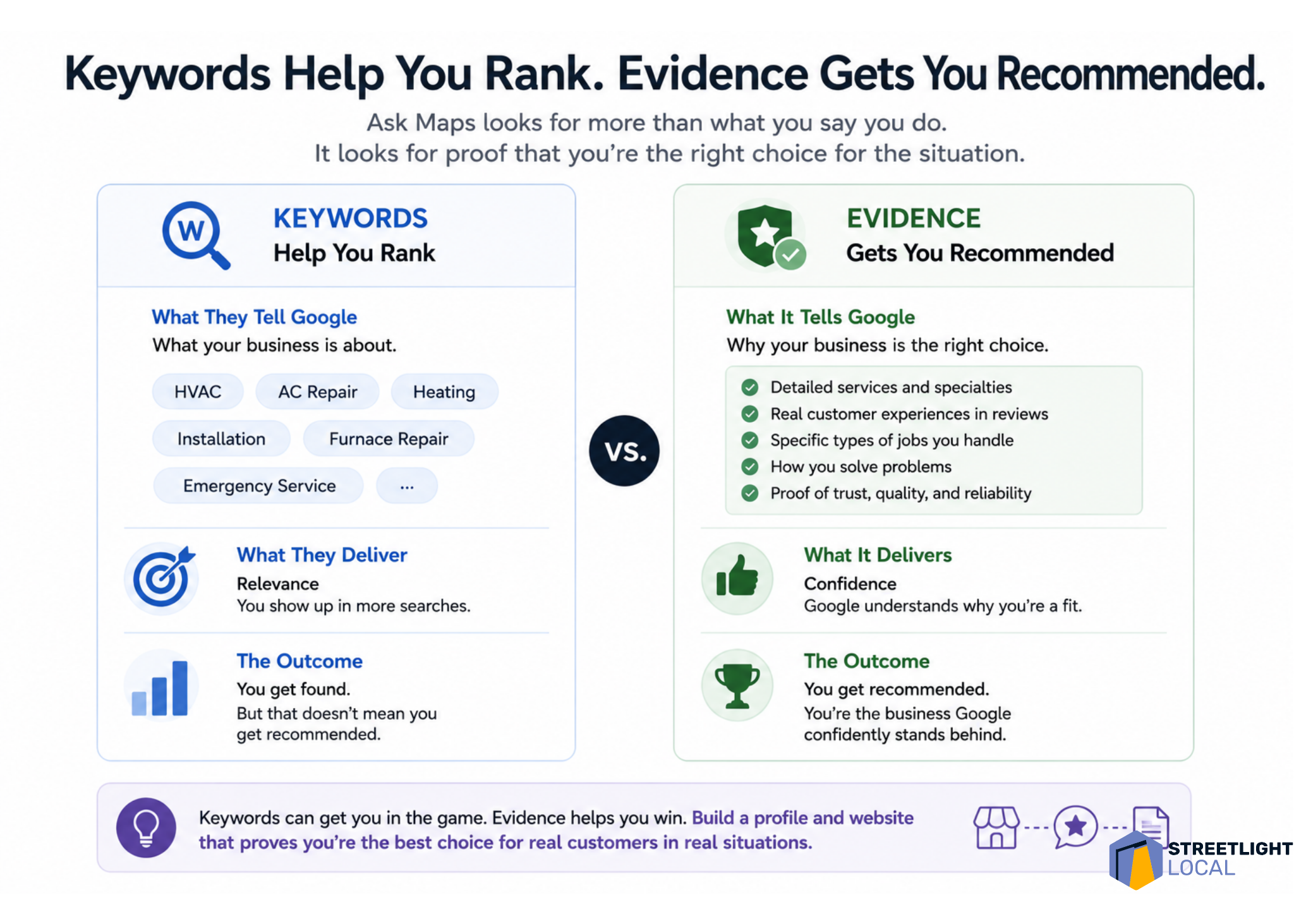
    Infographic comparing keywords and evidence for Google Ask Maps visibility, showing keywords help local SEO rankings while evidence earns recommendations.
    Google Ask Maps rewards more than keyword relevance. This visual shows why reviews, service details, trust signals, and real proof help local businesses get recommended.

    Identity asks whether Google can clearly understand what the business does and where it operates. Relevance asks whether the business can be matched to specific services and situations. Trust asks whether there is enough proof that customers feel confident choosing it.

    Context asks whether the content reflects the decisions customers are actually trying to make. Consistency asks whether different sources reinforce the same understanding of the business.

    I do not see this as a checklist to complete once. I see it as a practical way to evaluate how clearly and consistently a business is represented across the sources Ask Maps appears to use.

    What I would avoid

    With any new search feature, it is easy to overcorrect. I would avoid treating Ask Maps as an isolated channel that needs thin content, unnatural profile language, generic service-page duplication, or review language that feels forced.

    Those tactics may create more content, but they do not necessarily create more useful evidence. The better approach is to align more closely with how customers actually search, evaluate options, and make decisions.

    Infographic outlining five pillars for Google Ask Maps visibility: identity, relevance, trust, context, and consistency for local SEO recommendations.
    A practical local SEO framework shows how businesses can earn visibility in Google Ask Maps by clarifying identity, proving relevance, building trust, adding context, and staying consistent online.

    When the business presence reflects real customer needs clearly and consistently, it naturally creates the kinds of signals Ask Maps seems to rely on.

    What I still do not know about Ask Maps

    I would treat all of this as directional, not definitive. Ask Maps is still being tested and refined, and the system is not fully documented.

    The result structure can vary by query and test environment. The feature’s usability is also still changing. In many cases, users may still need to click into a Google Business Profile to call, book, or engage, rather than acting directly from the Ask Maps response.

    Measurement is another open issue. Right now, I do not see a clean way to isolate Ask Maps visibility or performance inside standard reporting tools. That makes it difficult to attribute calls, traffic, or conversions directly to this experience.

    I also would not assume the same signal weighting applies to every query. Google Business Profile data, reviews, website content, and external sources may all matter, but their relative importance likely changes based on the search intent and the complexity of the decision.

    The real shift is from ranking to recommendation

    I see Ask Maps as a version of local search where retrieval, evaluation, and decision support are moving closer together. Instead of making users search, compare, research, and decide across several steps, Google is trying to guide more of that process inside one experience.

    That changes the meaning of visibility. In Ask Maps, it is not enough for a business to simply appear. The business needs to be understood well enough for Google to explain why it fits the situation and trusted enough to be recommended.

    For businesses and SEOs, I would not respond by chasing a narrow trick. I would build a clearer, more complete, and more consistent representation of the business across the sources that shape Google’s understanding.

    The businesses most likely to benefit are the ones that are easiest to interpret, easiest to trust, and easiest to match to real-world customer needs.


    Inspired by this post on Search Engine Land.

    crushpress.ai community screenshot
  • AI Search Trust Is Falling: What Marketers Must Fix

    AI Search Trust Is Falling: What Marketers Must Fix

    A year ago, I saw 82% of consumers say AI-powered search was more helpful than traditional search. By 2026, that number had fallen to 54%, a 28-point drop in sentiment in just 12 months.

    That does not mean people are abandoning AI search. In fact, 70% of consumers say they are using AI tools for search more than they did last year. The tension is clear: adoption is rising, but trust is slipping.

    That is the core issue I believe search marketers need to solve in 2026. It is no longer enough to appear in AI answers. I need my brand, and the brands I work with, to be visible, accurate, credible, and trusted when AI systems surface information.

    To understand the shift, Fractl partnered with Search Engine Land to expand our 2025 research. We surveyed 1,008 U.S. consumers and 150 marketers to compare how consumer trust, marketer adoption, and brand strategy are changing in the AI search era. Disclosure: I am the co-founder of Fractl.

    ```json
{
  "alt": "Survey chart showing changes in AI tool usage for searching over the past year, with 70% reporting an increase.",
  "caption": "AI tool usage for searches is booming, with a striking 70% of users reporting increased activity in the past year. A detailed breakdown reveals various degrees of change.",
  "description": "This image features a survey chart depicting changes in AI tool usage for searching over the past year. 70% of consumers reported increased usage, with 25% saying it increased significantly, and 45% somewhat. Around 22% saw no change, while 3% observed a decrease. The survey highlights the growing reliance on AI for search. Source: How AI Is Reshaping SEO: 2025 vs. 2026 Trends & Strategy Insights."
}
```

    Here is what I believe the data means for 2026 search strategy.

    Consumers are using AI more, but trusting it less

    AI search adoption is no longer the main story. Seventy percent of consumers report increased use of AI tools for search over the past year, while only 3% say their use has decreased. The bigger question is whether people trust what those tools return.

    ```json
{
  "alt": "Chart showing AI vs traditional search helpfulness from 2025 to 2026, with generational breakdown.",
  "caption": "A comparative study indicates a decrease in those finding AI more helpful than traditional search from 2025 to 2026, with variances across generations.",
  "description": "The image illustrates a drop in the perceived helpfulness of AI over traditional search from 82% in 2025 to 54% in 2026, depicting a 28-point decline. It also shows detailed distribution data for 2026, with 17% finding AI much more helpful and 6% much less so. Generational breakdown reveals varying degrees of AI helpfulness agreement: Gen Z at 47%, Millennials at 53%, Gen X at 58%, and Baby Boomers at 63%. Keywords: AI, traditional search, generational analysis, helpfulness, distribution."
}
```

    One surprising finding is that baby boomers now find AI more helpful than Gen Z, 63% to 47%. That challenges the assumption that younger users automatically embrace AI while older users lag behind. What I see instead is a more complicated market where trust has to be earned across every generation.

    In 2025, only 3% of consumers said AI was less helpful than traditional search. By 2026, that skeptic group had grown to 17%, nearly six times larger than the year before. Even among the 54% who still find AI helpful, enthusiasm is softer: 37% say it is only somewhat more helpful, while 17% say it is much more helpful.

    I think hallucinations and low-quality AI content are changing how people evaluate the entire channel. Consumers may use AI because it is convenient, but convenience does not automatically create confidence.

    ```json
{
  "alt": "Chart showing trust shift in brands using AI for marketing: 20% in 2025 to 39% in 2026, distrust doubled.",
  "caption": "In just a year, distrust in brands using AI for marketing doubled, with Gen Z showing the highest trust decrease.",
  "description": "This infographic highlights a study comparing trust in brands using AI for marketing from 2025 to 2026. It shows a significant rise in distrust, from 20% to 39%. The 2026 distribution reveals 46% of respondents unchanged, 25% somewhat decreased, and 14% significantly decreased trust. By generation, Gen Z leads with a 54% trust decrease, followed by Millennials at 40%, Gen X at 33%, and Baby Boomers at 32%."
}
```

    AI content volume has become a brand trust risk

    In 2025, 20% of consumers said heavy AI use would reduce their trust in a brand. In 2026, that number rose to 39%. For me, that makes AI content scale a reputational issue, not just an operational decision.

    If I publish AI-assisted content at scale without disclosure, strong editorial standards, or obvious quality signals, I am asking my audience to trust a process they are increasingly skeptical of. That is a risk more brands need to take seriously.

    ```json
{
  "alt": "Survey results on AI content labeling show high support across text, video, images, and audio formats.",
  "caption": "A significant majority supports the labeling of AI-generated content, highlighting a demand for transparency across multiple formats.",
  "description": "This infographic presents survey results on the necessity of labeling AI-generated content. It shows that 84% support labeling for written text, with 91% for video content, 90% for images, and 87% for audio content. The data underscores a strong demand for transparency in media generated by artificial intelligence. This graphic is sourced from a study on AI's impact on SEO trends by Fractl and Search Engine Land."
}
```

    Gen Z is especially strict. Fifty-four percent of Gen Z consumers say heavy AI use in a brand’s marketing would decrease their trust, compared with 32% of baby boomers and 33% of Gen X. Women are also more likely than men to penalize brands for heavy AI use, 44% vs. 34%.

    That matters because Gen Z is often the audience most likely to engage deeply, share content, shape online conversations, and influence long-term organic visibility. If that audience matters to a brand, AI-generated filler is not a harmless shortcut.

    Disclosure is now a consumer expectation

    ```json
{
  "alt": "Graph showing AI search engine replacement sentiment from 2025 to 2026 and agreement by generation.",
  "caption": "Will AI take over search engines? In 2026, 64% still believe so, with Baby Boomers leading at 80% agreement.",
  "description": "This infographic compares the sentiment of AI potentially replacing traditional search engines from 2025 to 2026, showing a slight decrease from 66% to 64% agreement. Sentiment distribution in 2026 reveals 21% strongly agree and 43% somewhat agree. Generational breakdown indicates that Baby Boomers show the highest agreement at 80%, followed by Gen X at 73%, Millennials at 61%, and Gen Z at 51%."
}
```

    Across every major content format, more than 80% of consumers want AI-generated content labeled. Video leads at 91%, followed by images at 90%, audio at 87%, and written content at 84%. More than half of respondents strongly agree with labeling in every category.

    I do not read that as a mild preference. I read it as a near-universal expectation. The brands that treat AI disclosure as optional are creating a gap between how they operate and what their audiences want.

    Consumers still believe AI will shape the future of search. Sixty-four percent agree that AI will replace traditional search engines within five years, nearly unchanged from 66% in 2025. The channel is not going away. But being present in AI results and being trusted in AI results are now two different challenges.

    ```json
{
  "alt": "Graph showing consumer behaviors towards AI summaries in search results, highlighting that 49% read summaries and sometimes click, and 38% skim and scroll past.",
  "caption": "Consumer habits reveal that 49% read AI-generated summaries and sometimes click, while 38% simply skim and scroll past. The dynamics of AI in search is shaping user behaviors.",
  "description": "This image presents a graph detailing consumer behaviors when AI summaries appear in search results. 49% of users read these summaries and sometimes click on the links, 38% skim and scroll past, 8% skip them entirely, 5% read without clicking, and 0% have not noticed AI summaries. This data underscores the impact of AI on search behaviors, emphasizing the importance of engaging summary content. Source: How AI Is Reshaping SEO by Fractl and Search Engine Land."
}
```

    Google still leads on trust, especially for buying decisions

    When consumers are making purchase decisions, 39% turn to Google first. Reddit follows at 15%, AI tools at 14%, and review sites and friends or family each at 11%. The trust people have built with Google has not automatically transferred to AI tools.

    Platform preference also changes by query type. Google dominates five of six major search categories. It is the first stop for local businesses, product research, travel planning, and health questions. YouTube overtakes Google for how-to content, while ChatGPT is now the second-most-used destination for health questions and ranks strongly for product research, travel planning, and how-to content.

    ```json
{
  "alt": "Bar chart showing trust in product recommendations, with Google at 39%, Reddit at 15%, and AI tools at 14%.",
  "caption": "Consumers trust Google search results most for product recommendations, at 39%. Reddit follows with 15%, while AI tools like ChatGPT gather 14% of trust.",
  "description": "This bar chart illustrates consumer trust levels in various platforms for product recommendations. Google search results are the most trusted at 39%. Reddit is trusted by 15% of respondents, slightly higher than AI tools like ChatGPT at 14%. Review sites and friends each have an 11% trust level. YouTube, TikTok, and Instagram show much lower levels of consumer trust, with 4%, 3%, and 1% respectively. This data provides insights into consumer behavior and search preferences."
}
```

    That tells me there is no single AI search platform to optimize for. I need to map content strategy to actual user behavior: where people search, what they are trying to decide, and which platforms influence confidence at each stage.

    Before making a purchase decision, the average consumer checks 2.4 platforms. Gen Z checks 2.5, millennials 2.4, Gen X 2.3, and baby boomers 2.2. This behavior is consistent enough that I now think of search optimization as a multi-platform visibility strategy, not a rankings-only discipline.

    A brand that appears in Google results but nowhere else can lose to a brand that appears in Google, shows up in Reddit discussions, gets cited by ChatGPT, and has strong third-party review content. Visibility now has to travel with the buyer.

    ```json
{
  "alt": "Infographic comparing search preferences for topics between YouTube, Google, and ChatGPT.",
  "caption": "Explore where consumers prefer to search: YouTube leads in tutorials while Google dominates most categories, with ChatGPT gaining ground in health.",
  "description": "This infographic presents data on consumer search preferences by platform, highlighting YouTube's dominance in how-to guides with 50% and Google's lead in categories like local businesses, travel planning, and health questions. ChatGPT shows notable presence in health queries. The chart uses bars to depict percentage shares, providing a clear visual comparison. Source: How AI Is Reshaping SEO: 2025 vs. 2026 Trends & Strategy Insights."
}
```

    AI is changing marketing operations quickly

    AI now touches 53% of marketing work on average, up from 38% in 2025. In practical terms, the equivalent of one full workday per week has shifted to AI-assisted workflows in just 12 months. Fifty-nine percent of marketers say AI is involved in at least half their work, while 27% say it is involved in three-quarters or more.

    For SEO and content teams, this means competitors are moving faster. But speed alone is becoming commoditized. Accuracy, original insight, expert judgment, and brand credibility are much harder to copy.

    ```json
{
  "alt": "Chart showing average platforms checked before buying by generation, with Gen Z at 2.5, Millennials at 2.4, Gen X at 2.3, and Baby Boomers at 2.2.",
  "caption": "Discover how many platforms each generation checks before making a purchase. This trend highlights a consistent cross-generational habit of research pre-buying.",
  "description": "This infographic from Search Engine Land presents the average number of platforms consumers check before making a purchase decision, segmented by generation. Gen Z checks 2.5 platforms, Millennials 2.4, Gen X 2.3, and Baby Boomers 2.2. It suggests a longstanding cross-generational behavior rather than a trend specific to Gen Z. Derived from 'How AI is Reshaping SEO: 2025 vs. 2026 Trends & Strategy Insights' by Fractl."
}
```

    Marketers are also feeling pressure to adopt AI. Fifty-five percent of marketing roles report a 7-out-of-10 level of pressure to use it. SEO and analytics teams feel that pressure most, while PR is not far behind. As AI makes generic content easier to produce, the advantage shifts toward what AI cannot automate well: judgment, relationships, trust, and reputation.

    The quality tradeoff is real. Only 26% of marketers say AI made their work both faster and better. Nearly half say it made their work faster but more generic, and 7% report an outright quality decline.

    That is where I see a major competitive opening. If other teams are scaling generic AI content while I invest in original data, expert quotes, third-party validation, and earned brand mentions, I am building assets that are more visible, credible, and retrievable across search engines, social platforms, and LLMs.

    ```json
{
  "alt": "Infographic showing increase in marketing work using AI tools from 38% in 2025 to 53% in 2026.",
  "caption": "The role of AI in marketing is booming! By 2026, it’s expected that 53% of marketing work will incorporate AI tools, a significant leap from 38% in 2025.",
  "description": "This infographic highlights the growth of AI tools in the marketing industry, predicting an increase from 38% usage in 2025 to 53% in 2026. It shows bar graphs illustrating that 27% of marketers use AI in 75% or more of their tasks, and 59% use AI in 50% or more. The data, sourced from a study on AI's impact on SEO, suggests a major shift towards AI integration in marketing workflows."
}
```

    AI governance is still too weak

    About three in four organizations conduct human editorial review before publishing AI-generated content. Sixty-two percent check for brand voice, 54% check facts, and 42% conduct legal or compliance review. Only 27% evaluate content for bias.

    That means nearly half of AI-generated content may enter the market without fact-checking, legal review, or plagiarism checks. Too many teams are still relying on surface-level review: Does it sound right? Is the tone appropriate? Are there typos?

    ```json
{
  "alt": "Infographic showing average pressure on marketers by function and generation to adopt AI.",
  "caption": "Understanding AI Adoption Pressures: Marketers face a significant average pressure of 6.4/10, with analytics and Gen Z experiencing the highest demands.",
  "description": "This infographic depicts the average pressure marketers feel to adopt AI, rated on a 0-10 scale. Analytics or marketing data receives the highest pressure at 7.5/10, while public relations faces 5.8/10. By generation, Gen Z feels the most pressure at 6.8/10. Overall, the average pressure level is 6.4, with 55% of marketers experiencing substantial pressure. Keywords: AI adoption, marketing pressure, generational impact."
}
```

    In a year when consumers are already prepared to distrust generic AI content, I see governance as one of the cheapest gaps to close and one of the most expensive to ignore.

    The disclosure gap is just as serious. Heavy, generic AI use is now a brand-trust liability, yet only 20% of organizations always disclose AI use to their audiences. Compare that with the 84% average consumer demand for labeling written content, and the disconnect is obvious.

    The takeaway is not to abandon AI. It is to stop treating governance as optional. Every AI workflow needs accuracy checks, transparency standards, bias review, and human accountability before content reaches an audience.

    ```json
{
  "alt": "Survey results on AI's impact on marketing work quality and speed, showing most believe AI made work faster but average in quality.",
  "caption": "AI in marketing: a speedy but average upgrade? Survey reveals 48% say AI quickened work, yet kept quality at bay. Explore the velocity-quality balance.",
  "description": "This infographic illustrates survey results on AI's influence in marketing, revealing 48% feel AI has made work faster but with average quality. Only 26% report both faster and superior quality. The visualization, sourced from 'How AI is Reshaping SEO: 2025 vs. 2026 Trends & Strategy Insights,' highlights a velocity-quality tradeoff as the prevailing theme in AI-enhanced marketing practices. Additional responses include 13% stating quality remained the same, 7% noting a decline in quality, and 6% believing it’s too soon to tell."
}
```

    AI hallucinations are already a brand problem

    A year ago, about 22% of marketers tracked LLM visibility. In 2026, that figure barely moved to 24%. At the same time, 27% of brands have already been misrepresented in AI-generated responses, and 14% say an AI inaccuracy has affected a customer relationship, sale, or PR situation.

    More brands have been misrepresented by AI than have a formal monitoring process. That should concern every search and communications team.

    ```json
{
  "alt": "Survey showing QC steps marketers use for AI content: 72% use human editorial review, 62% brand review, 54% fact-checking.",
  "caption": "Marketers prioritize human editorial review in AI-generated content, with 72% ensuring quality through hands-on editing.",
  "description": "This image reveals a survey on quality control (QC) steps marketers take for AI-generated content. It shows 72% conduct human editorial reviews, while 62% focus on brand voice and tone. Additional fact-checking is performed by 54%, with 42% checking for plagiarism or originality and legal compliance. Only 27% perform bias evaluations, and 4% take no additional steps. The data source is 'How AI Is Reshaping SEO: 2025 vs. 2026 Trends & Strategy Insights'. Keywords: AI content, content marketing, quality control, human review, SEO."
}
```

    If AI is summarizing my category, comparing my product, or explaining my brand incorrectly, that is not only an SEO issue. It is a reputation risk, a revenue risk, and a PR issue waiting to escalate.

    When AI misrepresents a brand, I believe fixing the source matters more than arguing with the output. That can mean reaching out to publishers for updates, correcting owned profiles, improving brand pages, and publishing clear correction content tied to the entity.

    Organic traffic is under pressure, not in freefall

    ```json
{
  "alt": "Chart showing marketing strategies to offset AI impact: GEO/AEO prioritized by 54% of marketers.",
  "caption": "Marketers are turning towards innovative strategies like GEO/AEO, with 54% prioritizing these to counter AI's influence in 2026.",
  "description": "This image presents a chart detailing marketing strategies to address AI's impact. The primary focus is on Generative Engine Optimization (GEO/AEO), prioritized by 54% of marketers, indicating its growing importance. Building brand presence on social platforms tops the list with 59%, followed by other strategies such as creating authoritative content (44%) and increasing social spend (38%). The data is sourced from 'How AI Is Reshaping SEO: 2025 vs. 2026 Trends & Strategy Insights.' Keywords: marketing strategies, AI impact, GEO, AEO, SEO trends."
}
```

    Half of the marketers surveyed reported organic traffic declines since the launch of AI Overviews, and 61% blame AI. That is meaningful, but it is not the whole story.

    The larger shift is not simply from Google to ChatGPT. It is from search as a destination to search as a behavior. People are asking, comparing, validating, and deciding across platforms, communities, assistants, and review environments.

    The same marketers reporting organic losses are often finding visibility elsewhere. Fifty-seven percent report growth from social platforms such as TikTok, Reddit, and YouTube. Forty percent see growth from AI assistants such as ChatGPT, Gemini, and Perplexity. Thirty-one percent see growth in direct or branded traffic, while only 10% report no visibility growth anywhere.

    ```json
{
  "alt": "Infographic on brand misrepresentation in AI responses with statistics on AI inaccuracies and monitoring processes.",
  "caption": "Discover key insights into how brands experience AI misrepresentation and the importance of formal monitoring processes in this insightful infographic.",
  "description": "This infographic highlights the impact of AI on brand representation. It reveals that 27% of brands have been inaccurately described by AI, with 14% witnessing AI inaccuracies affecting customer or PR outcomes. Only 24% of organizations have a formal process to monitor AI brand mentions, indicating potential PR crises. Data sources include 'How AI is Reshaping SEO: 2025 vs. 2026 Trends & Strategy Insights.' Keywords: AI, brand misrepresentation, monitoring, PR crisis."
}
```

    That is why I think 2026 brand visibility depends on brand mentions and entity authority across the web, not just individual page rankings in Google.

    Marketers are prioritizing the easiest tactics

    Many teams are moving in the right general direction: community building, earned authority, owned audiences, expert content, and traffic diversification. The most prioritized strategies include building brand presence on social platforms at 59%, GEO and AEO optimization at 54%, and creating authoritative expert content at 44%.

    Infographic showing 50% of marketers report decreased organic traffic since Google AI Overviews launched, with response distribution by severity.
    Half of surveyed marketers say organic traffic has fallen since AI Overviews arrived, but the data points to pressure rather than collapse, with 30% reporting no change.

    But the least prioritized strategy is original research and data, at only 15%. I see that as a strategic inversion.

    Original, proprietary research is one of the hardest content assets for AI to replicate or commoditize. It earns citations, attracts links, builds topical authority, and gives journalists, communities, search engines, and AI systems something distinctive to reference.

    In GEO, the same pattern appears. Many marketers are using content-led tactics that AI can easily replicate. Long-tail FAQs can help with AI Overviews, and schema can support structure, but neither one builds credibility by itself.

    Infographic chart showing where brands saw visibility growth: social platforms lead at 57%, followed by AI assistants at 40% and direct traffic at 31%.
    As organic search pressure grows, marketers are finding brand visibility gains across social platforms, AI assistants, direct traffic and Google AI features, according to Fractl and Search Engine Land.

    The stronger moat is entity authority: proprietary data, expert perspectives, topical depth, and third-party validation. These are the assets that make a brand worth citing.

    GEO measurement is lagging behind execution

    Only a little more than half of marketers are confident in their GEO strategy, and only 12% have measurable results. That is understandable for a newer channel, but GEO is becoming too important to manage casually.

    Infographic showing GEO tactics marketers use, led by FAQ and question content optimization at 49%, followed by brand mentions at 43%.
    Marketers are leaning into practical GEO tactics, with FAQ optimization leading the pack, while entity authority, original research and citations trail behind.

    I believe visibility tracking, citation monitoring, branded search lift, and AI-assisted conversion analysis all need more attention. Teams that can prove GEO ROI will be able to defend and grow investment while others are still guessing.

    The main barrier to deeper AI integration is not leadership buy-in. Only 2% cite that as the obstacle. The top barrier is team training and skill gaps at 26%, followed by tool fragmentation at 20%, budget constraints at 19%, unclear ROI at 12%, and legal or compliance concerns at 12%.

    For search teams, that means AI literacy, prompt strategy, content quality control, and GEO measurement skills may be more valuable right now than adding another tool to the stack.

    Infographic showing marketer confidence in GEO strategy, with 61% confident and response distribution led by 49% somewhat confident.
    Most marketers see early signs their GEO strategy is working, but only 12% report measurable results, highlighting a major gap in AI search measurement.

    What I would do for a 2026 search strategy

    First, I would audit the brand’s AI footprint. I would query the brand name across ChatGPT, Gemini, Perplexity, and Google AI Overviews, then document what is accurate, what is missing, and what is wrong. Waiting until an AI error becomes a PR issue is too late.

    Second, I would invest in entity authority and original research. AI cannot invent legitimate proprietary survey data, named expert perspectives, verified brand facts, or original market analysis. Those assets become more valuable as AI systems get better at rewarding genuine authority.

    Third, I would distribute visibility across multiple platforms. Google organic remains necessary, but it is no longer sufficient. A brand needs a consistent presence in Reddit discussions, YouTube content, AI assistant responses, review platforms, and earned media.

    Fourth, I would build AI content governance, not just AI content workflows. Consumer demand for AI disclosure ranges from 84% to 91% across formats, while only 20% of brands always disclose. That gap is a reputational liability and may become a legal and regulatory one.

    Fifth, I would close the GEO measurement gap. If I can connect AI search mentions to traffic, lead quality, and revenue, I can prove ROI at a time when most teams cannot. That creates a budget and strategy advantage that compounds.

    Finally, I would double down on what AI cannot easily replicate: proprietary data, named experts, human-verified claims, transparent sourcing, and a consistent high-quality brand voice. In 2026, the brands that treat quality as a strategic differentiator are the ones most likely to be surfaced, cited, and trusted.

    Methodology

    Fractl and Search Engine Land surveyed 1,008 U.S. consumers and 150 marketers in Q2 2026. The consumer sample was nationally representative across age, gender, and region. The marketer sample included companies ranging from fewer than 10 employees to more than 5,000 and covered roles in SEO, content, social, analytics, paid media, PR, and marketing leadership.

    Where noted, findings are compared year over year against the same questions asked in Fractl’s 2025 consumer study conducted with Search Engine Land.


    Inspired by this post on Search Engine Land.
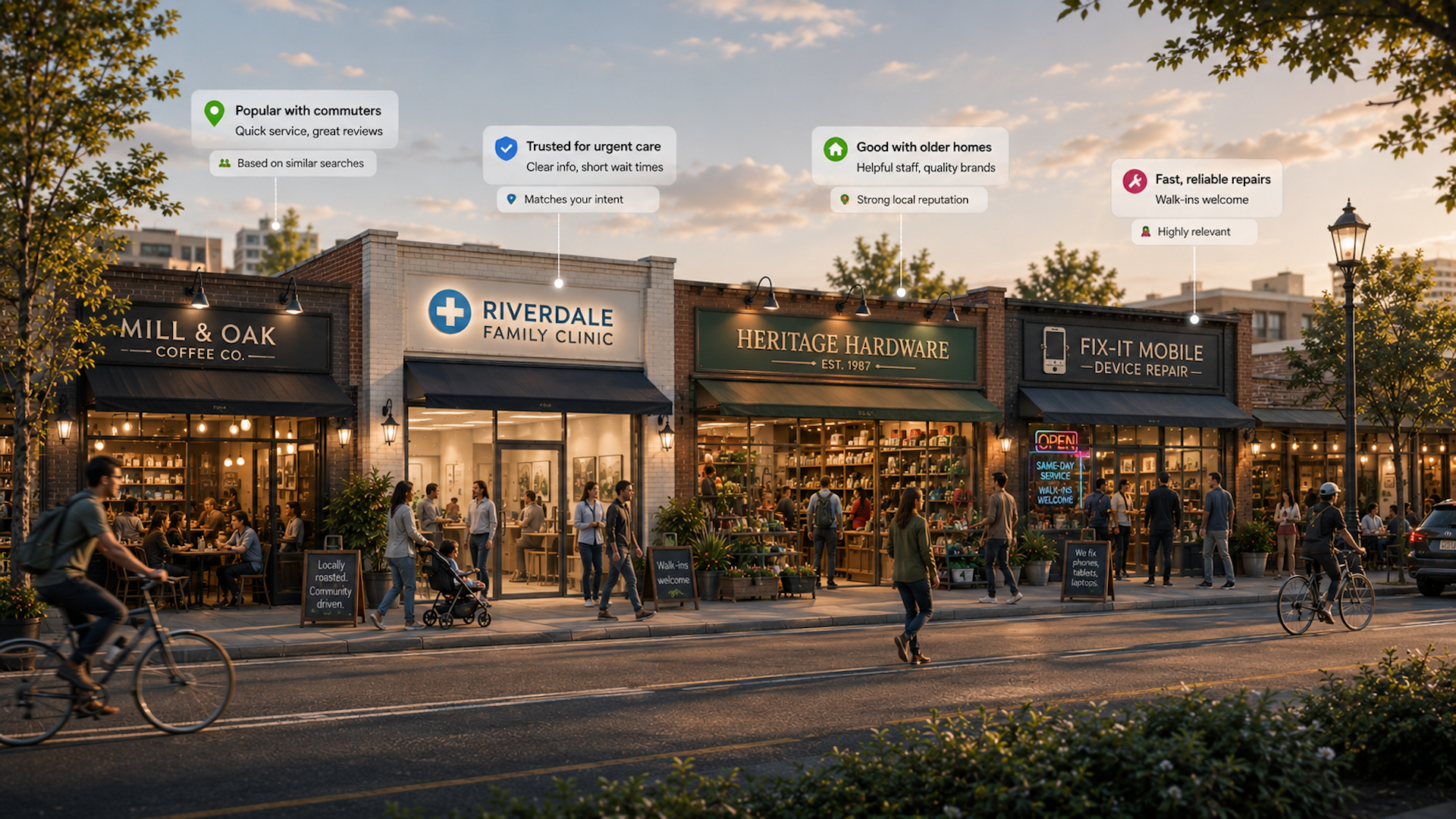

    crushpress.ai community screenshot
  • Why I Stop Positioning AI as a People Replacement

    Why I Stop Positioning AI as a People Replacement

    I think one of the biggest mistakes in AI marketing is positioning a product as a replacement for people. That message can win attention in the short term, but I believe it quietly drains trust over time.

    This is a little different from what I usually write about, but it matters. The way we talk about AI shapes how customers, employees, executives, and markets respond to it.

    In this memo, I want to focus on three things: why “substitution positioning” feels powerful at first but weakens a brand later, what the data says about whether AI is actually replacing people, and how I think companies should position AI instead.

    Image

    The cardinal sin of positioning in the AI era is replacement. I call it substitution positioning. It is tempting because it sounds bold, efficient, and disruptive. But over time, it creates anxiety, skepticism, and credibility problems.

    We have seen this pattern already. Anthropic CEO Dario Amodei predicted that software engineering jobs could disappear within 6 to 12 months as models began doing most or all of what software engineers do end to end. Yet demand for software engineers has continued to look strong.

    Image

    OpenAI CEO Sam Altman also predicted that many customer support jobs would go away because AI could handle that work better. Soon after, customer service hiring began outpacing the broader job market.

    I understand why fear works as a marketing tool. The fear of being replaced gets attention fast. It got me, too. When powerful AI models gained traction, I worried about my own future. But when I still see AI companies hiring copywriters, SEOs, engineers, and support teams, I sleep better.

    Image

    Fear sells because it taps into fight-or-flight. Layoffs make that story even louder. They let companies frame cost-cutting as innovation and make the replacement narrative feel more real than it may actually be.

    But I do not think the facts support the clean replacement story. In New York, companies can indicate when mass layoffs are caused by technological innovation or automation. In one reported period, more than 160 companies filed mass layoffs affecting roughly 28,300 workers, and not one chose AI as the reason. That list included companies such as Amazon and Goldman Sachs.

    Image

    Researchers at Yale also studied employment data from the Current Population Survey over 33 months and found no evidence of job displacement from AI. To me, the pattern looks less like instant replacement and more like the earlier waves of computers and the internet changing how work gets done.

    That is why I keep coming back to this point: stop trying to make replacement happen. It is not happening in the simple, dramatic way many AI narratives suggest.

    Image

    AI is powerful, but it is also inconsistent. In its current form, it can do some tasks better than humans and fail badly at others. That paradox is often called the Jagged Frontier.

    The Jagged Frontier idea matters because it explains why some people see AI as transformative while others remain lukewarm. A BCG and Harvard study of 758 knowledge workers found that people get the most value from AI when they understand what it is good at and where it breaks down.

    Image

    Microsoft reached a similar conclusion in its 2026 Work Trend Index Annual Report. The company found that a small group of advanced AI users, described as Frontier Professionals, were not simply using AI more often. They also knew which mode of AI use fit each task.

    That distinction is important. The best AI users are not handing everything over blindly. They are applying judgment. They know when to use AI as a helper, when to use it as a collaborator, when to use agents for multi-step workflows, and when to keep a human firmly in control.

    Image

    I still do not trust most AI workflows enough to leave them running with no maintenance, review, or quality assurance. The question I ask is simple: would I bet my brand, customer experience, or revenue on a fully automated workflow with no human oversight?

    Klarna is a useful warning here. The company publicly promoted the idea that AI was doing the work of hundreds of agents and helping reduce headcount. Later, it reversed course and rehired humans after leadership acknowledged that aggressive cost-cutting had lowered quality and that customers still wanted a human option.

    Image

    That is the tradeoff I see with substitution positioning. It creates immediate attention, but it can damage long-term credibility. The words often do not match the operational reality.

    Replacement positioning could work if customers truly wanted full replacement and if the technology were consistently ready for it. I do not think either condition is true.

    Image

    Cost reduction is a strong AI argument because it shows up quickly on the P&L. Productivity gains usually take longer. They build inside companies over time and often take even longer to appear across the broader economy.

    But when replacement positioning goes beyond cost-cutting and becomes people-cutting, I believe it starts to antagonize the very people companies need to win over.

    Image

    We have already seen backlash. Duolingo’s AI-first memo drew heavy criticism before the company reframed AI as a tool to accelerate work rather than replace contractors. Surveys have found that some workers refuse to use AI tools because they fear job loss. Pew has reported that many U.S. adults are more concerned than excited about AI in daily life. Reuters/Ipsos polling has shown widespread fear that AI will permanently displace workers.

    There is also a quality problem. When employees believe the purpose of AI is to replace them, they may disengage or produce lower-quality work. In my view, that is not just an adoption issue. It is a positioning failure.

    Image

    Executives often feel more excited about AI than the employees asked to use it every day. That gap matters. If leadership talks about AI as a replacement engine, employees hear a threat. If leadership talks about AI as leverage, employees have a reason to learn.

    Token economics also complicate the replacement story. Some companies have bragged about massive AI usage, but token costs are still a real business variable. As those costs normalize, the math may make junior employees look interesting again, especially when human judgment, context, and accountability are part of the output.

    So what should replace replacement? I think the answer is enhancement. Instead of positioning AI as a way to remove people, I would position it as a way to make capable people more effective.

    AI can be used in two broad ways. A company can try to reduce the number of people, or it can grow output with the same number of people. The data I have seen suggests that productivity gains often create the stronger return.

    A National Bureau of Economic Research paper surveyed 750 executives about AI’s impact on productivity and labor markets. Larger firms showed more interest in replacing labor costs, but the highest ROI came from productivity growth.

    That is the lesson I take from the research: doing more with the talent you already have is often stronger than trying to remove the talent that knows what good work looks like.

    Building products has become easier, but distribution has not. When supply explodes, the scarce thing is not output. The scarce thing is being the product, brand, or service that actually gets chosen.

    That is why positioning matters more than ever. Product quality still matters, but the way I frame AI use can determine whether people see it as empowering or threatening.

    My takeaway is simple: I would stop selling AI as a people replacement. I would sell it as judgment leverage, workflow acceleration, and creative expansion. Fear can get attention, but empowerment is a better long-term strategy.

    This post first appeared on the author’s website and is republished here with permission.


    Inspired by this post on Search Engine Land.
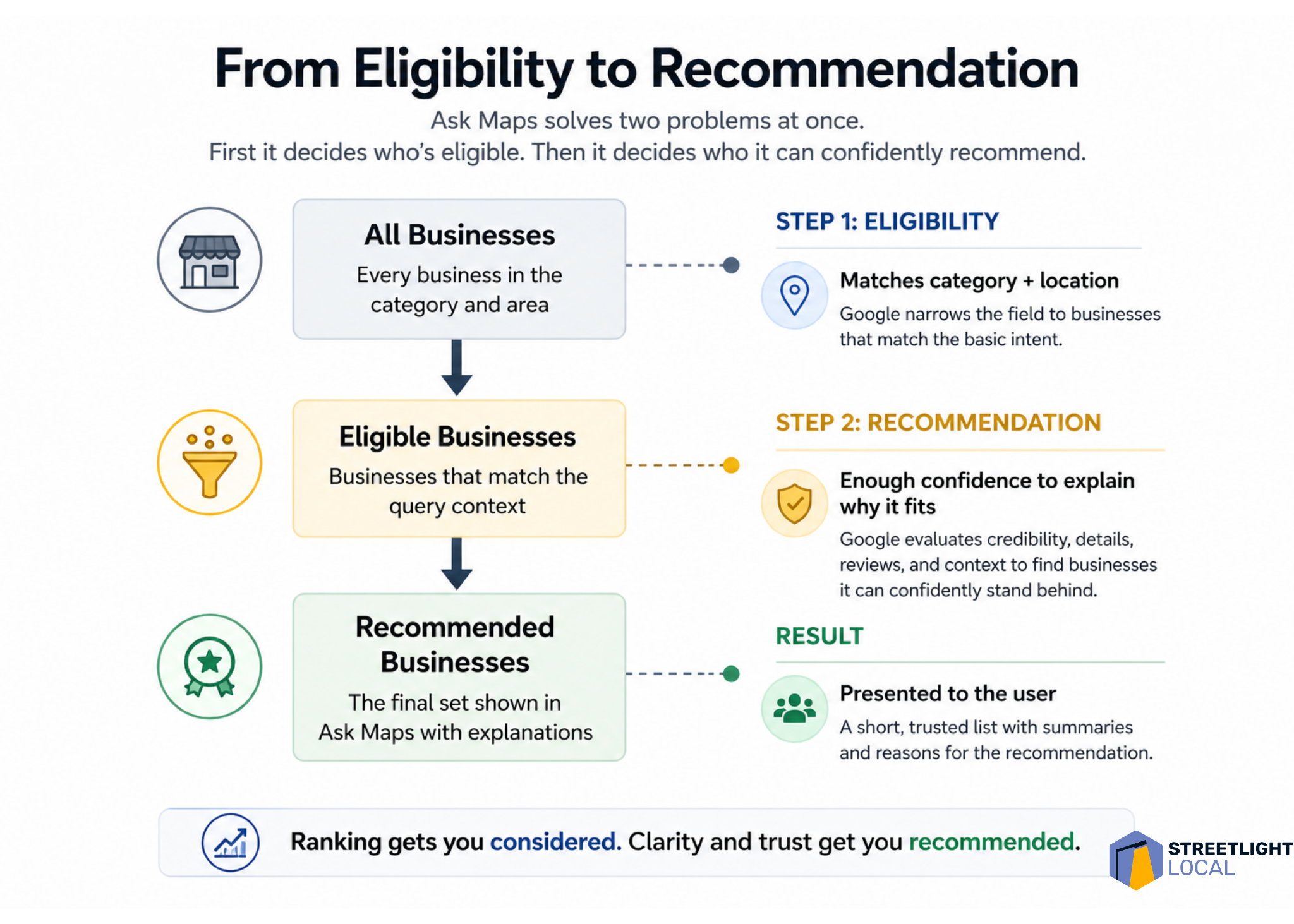

    crushpress.ai community screenshot
  • Why Accessibility Is an $18 Trillion Marketing Advantage

    Why Accessibility Is an $18 Trillion Marketing Advantage

    Illustration of an online storefront against a green background, featuring a digital shop window, clothing items, a sold sign, and icons representing growth, accessibility, and customers.

    Every so often, I see a product launch turn into a marketing lesson bigger than the product itself. Selena Gomez’s Rare Beauty did that with a new fragrance, but it was not only the scent that drew attention. The bottle became the story. Its accessible, easy-to-use packaging sparked conversation, earned praise from accessibility advocates, and reminded me how powerful inclusive design can be when it is built into the product from the start.

    For me, the lesson is clear: accessibility is not a side note. It can become the campaign. One thoughtful design choice created cultural impact that would be hard to buy with media spend alone. It also showed why accessibility can build loyalty, strengthen brand reputation, support compliance, and drive measurable growth.

    Accessibility as a campaign strategy

    I do not see Rare Beauty’s accessibility work as a one-off moment. From packaging to pricing to its ongoing mental health advocacy, the brand has consistently made inclusivity part of its identity. That matters because consumers can usually tell when a brand is chasing attention versus when it is acting from a real strategy. They reward brands that lead with values and follow through.

    Rare Beauty is not alone. I see leading brands across industries using accessibility as a differentiator, not a footnote. Apple often frames accessibility features as part of product innovation. Microsoft has brought inclusive design into mainstream campaigns, including adaptive gaming products that positioned accessibility as a source of creativity and connection. In fashion and retail, brands like Tommy Hilfiger and Unilever have put adaptive design into product launches and brand identity instead of treating it as a niche offering.

    Studies from Edelman and McKinsey show why this shift matters. According to those studies, 73% of Gen Z choose to buy from brands they believe in, and 70% say they try to purchase products from companies they consider ethical. I do not see those as fringe preferences. I see them as mainstream expectations that should change how marketers build trust and growth.

    The $18 trillion market marketers overlook

    More than 1.3 billion people globally live with a disability. Together with their friends and family, they control more than $18 trillion in spending power, according to the Return on Disability Group. I believe marketers should view this as more than a compliance issue. It is a growth opportunity, a reputation opportunity, and a trust-building opportunity with one of the world’s largest and most passionate consumer groups.

    That passion often turns into advocacy. In discussions with AudioEye’s A11iance Team, a group of individuals with disabilities who regularly share feedback on real-world accessibility experiences, one member said, “If I find a website that works and works very well for me, I will always recommend it to friends and family because I want people to have the same experience that I have.”

    Another A11iance Team member, Maxwell Ivey, put it this way: “The cheapest form of advertising is word of mouth, and people with disabilities can have some of the loudest voices when we find people willing to make the effort. Because it’s that sincere effort over time that really counts with us.”

    When accessibility becomes part of the customer experience, I see it create something media budgets cannot easily buy: trust and loyalty that scale through advocacy. But the reverse is also true. In a survey of assistive technology users, 54% said they do not feel eCommerce companies care about earning their business.

    That should get every marketer’s attention. Too many brands are still fighting for the same crowded audience segments while overlooking a major opportunity in plain sight. When they do, they leave loyalty, advocacy, and revenue on the table.

    Here is where I see many brands stumble: accessibility often stops at the shelf. Marketers invest heavily in packaging, store displays, and product design, while digital experiences lag behind. Yet those digital experiences are often the first and most important touchpoints customers have with a brand.

    As accessibility-led design earns more attention, loyalty, and earned media, the gap between physical product innovation and digital experience becomes harder to ignore.

    AudioEye’s 2025 Digital Accessibility Index found an average of 297 accessibility issues per web page detectable by automation alone. Each issue can create friction in the customer journey, cost a conversion, or introduce compliance risk under frameworks such as the Americans with Disabilities Act (ADA) and the European Accessibility Act (EAA).

    I would not launch a campaign without a brand review or a legal check. In the same way, I do not think any digital touchpoint should go live without an accessibility review.

    Four moves marketing leaders can make

    Too often, I see accessibility treated as a risk to manage instead of an advantage to use. The marketers who gain ground will be the ones who change that mindset. I would start with four practical moves.

    1. Make accessibility your campaign hook

    I would not hide accessibility in the fine print. I would lead with it. Brands like Rare Beauty have shown that inclusive design is the story. Build campaigns where accessibility is not an afterthought, but the differentiator that earns attention and loyalty.

    2. Bake it into your brand system

    Accessibility should not sit off to the side. I would make Web Content Accessibility Guidelines (WCAG) alignment part of the brand system, right alongside typography, logos, and tone of voice. When accessibility is documented and expected, it becomes easier to apply across every campaign.

    3. Use data as your proof point

    Marketers are storytellers, but numbers strengthen the story. I would track accessibility improvements such as fewer user-reported barriers, higher accessibility scores, stronger alt text, better color contrast, and more usable forms. Then I would connect those metrics to business outcomes like conversion, reach, and sentiment to show how accessibility drives ROI, not just compliance.

    4. Protect accessibility like brand safety

    I would treat accessibility with the same seriousness as brand safety. Every update, seasonal campaign, and product drop should be monitored for accessibility. Trust and reputation are too valuable to leave exposed.

    The competitive advantage

    Rare Beauty’s fragrance launch proved something important to me: when a brand leads with accessibility, the story can write itself. Loyalty builds more authentically, and momentum feels more natural because the value is real.

    The larger opportunity is that many brands still do not see it. They continue to treat accessibility as a compliance checkbox when it can be a growth strategy.

    For marketers, that is the wake-up call. Accessibility builds loyalty. It strengthens brand reputation. It supports compliance. And it can drive measurable growth across marketing efforts.

    Rare Beauty showed how accessibility can capture attention at the shelf. Now I see the next opportunity clearly: making sure that same accessibility carries through online. When every touchpoint welcomes everyone, every campaign has a better chance to deliver its full impact.


    Inspired by this post on Search Engine Land.
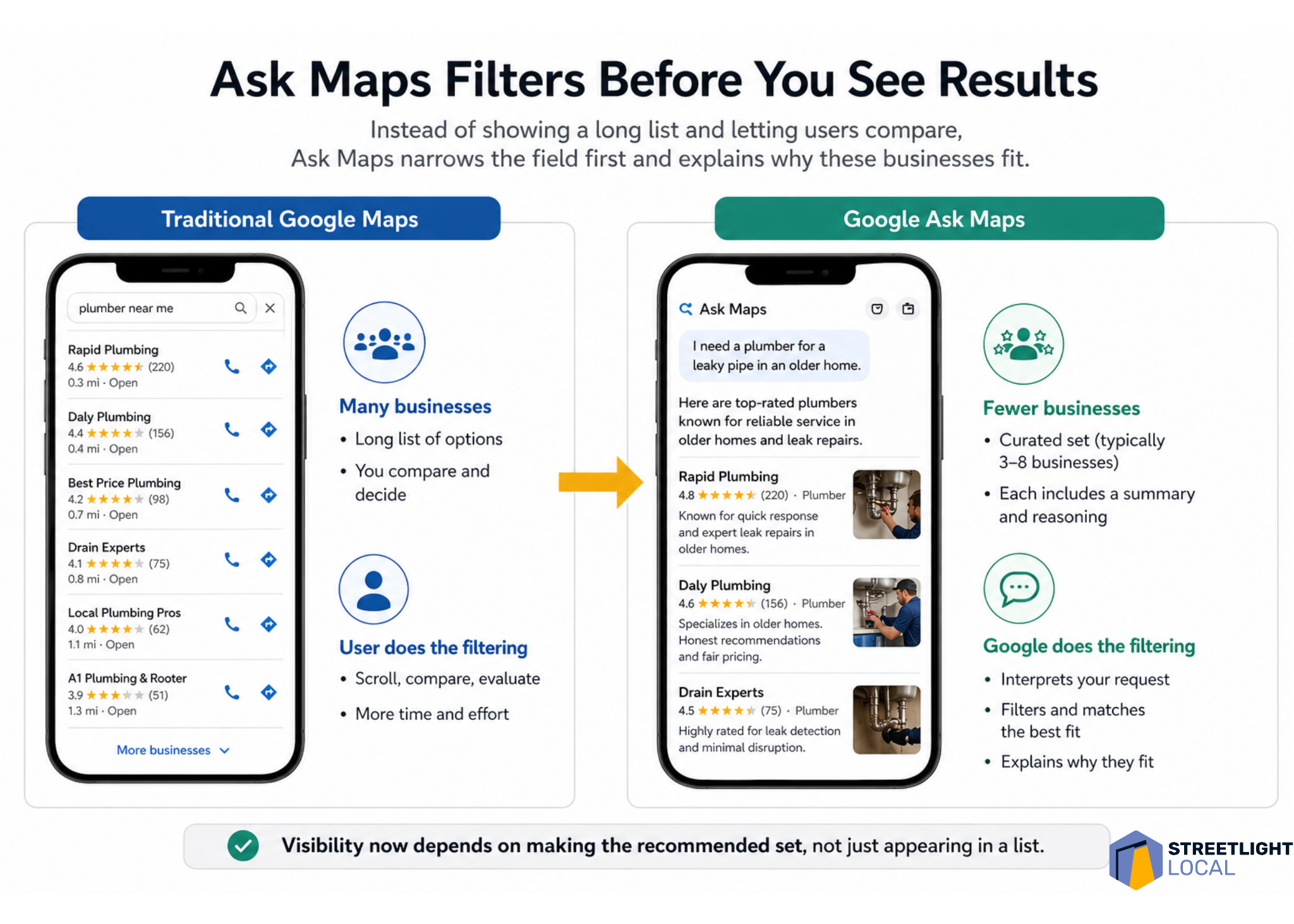

    crushpress.ai community screenshot
  • Doug Davis on Building Lasting Trust Through Community Validation

    Doug Davis on Building Lasting Trust Through Community Validation

    Chatting with Doug Davis, the visionary Founder of Voted Number One, offers a refreshing perspective on how genuine community trust can transform a business’s credibility. In a world where consumers face too many choices and are skeptical of self-promotion, Doug’s insights into local-level trust-building are invaluable. He explains why community backing signifies strong business credibility and how local companies can unwittingly harm trust despite providing high-quality work. Doug also delves into how a business’s reputation increasingly hinges on customer testimonials rather than self-advertisements.

    First Page Sage: Many businesses think visibility equals trust. Doug, can you shed light on where companies often get recognition and credibility wrong?

    Doug: A common mistake is equating attention with trust. A business might be well-known but still lack authentic trust within its community. Companies often focus excessively on advertising while neglecting the customer experiences that genuinely shape their long-term reputation.

    What truly counts is whether people are willing to recommend a business without any personal gain. That’s a very telling indication of trust. True community trust is developed through consistent, reliable interactions over time.

    First Page Sage: Voted Number One emphasizes community-driven recognition over internal rankings. Why does this matter now more than ever?

    Doug: People rely more on collective community experiences than on polished corporate assertions. Community-driven recognition showcases genuine, repeated positive interactions, not just catchy marketing phrases.

    Trust within communities grows cumulatively. When individuals repeatedly hear about the same business from close acquaintances, neighbors, or fellow professionals, natural confidence builds, which is hard to fabricate through artificial means.

    First Page Sage:: In competitive local markets, what factors actually guide consumer decisions when comparing providers?

    Doug: It boils down to clarity and evidence. Since most consumers aren’t industry experts, they look for signs that reduce uncertainty. They want assurance that a business has consistently delivered for others like them.

    Specificity makes a business stand out quickly. Clear communication regarding a company’s experience, processes, and results outshines vague promises. Consistent touchpoints build trust faster, while inconsistency can arouse consumer hesitance.

    First Page Sage:: With consumer decisions increasingly swayed by community recommendations and automated systems, how crucial is genuine customer advocacy?

    Doug: Genuine customer advocacy is now essential. Modern systems focus on patterns of trust rather than singular claims. Businesses that naturally generate customer support are more likely to sustain their visibility and credibility.

    Authentic advocacy often stems from operational excellence rather than marketing tricks. Communities back businesses that consistently deliver, solve problems effectively, and communicate transparently.

    First Page Sage:: What practical habits should local business owners adopt to build enduring reputations?

    Doug: Building a lasting reputation requires treating trust as a key operational target rather than a mere branding effort. This means ensuring consistency, responsiveness, and follow-through, even in busy times.

    Furthermore, documenting real customer experiences and outcomes, as well as community involvement, significantly enhances credibility. Avoiding complacency is vital as a strong reputation is never guaranteed; it requires continuous reinforcement through action.

    For more on Voted Number One’s recognition platform, visit votednumberone.com.


    Inspired by this post on First Page Sage Blog.


    crushpress.ai community screenshot