Tag: Quality

  • Why I Judge AI Deliverables by Outcomes, Not Effort

    Why I Judge AI Deliverables by Outcomes, Not Effort

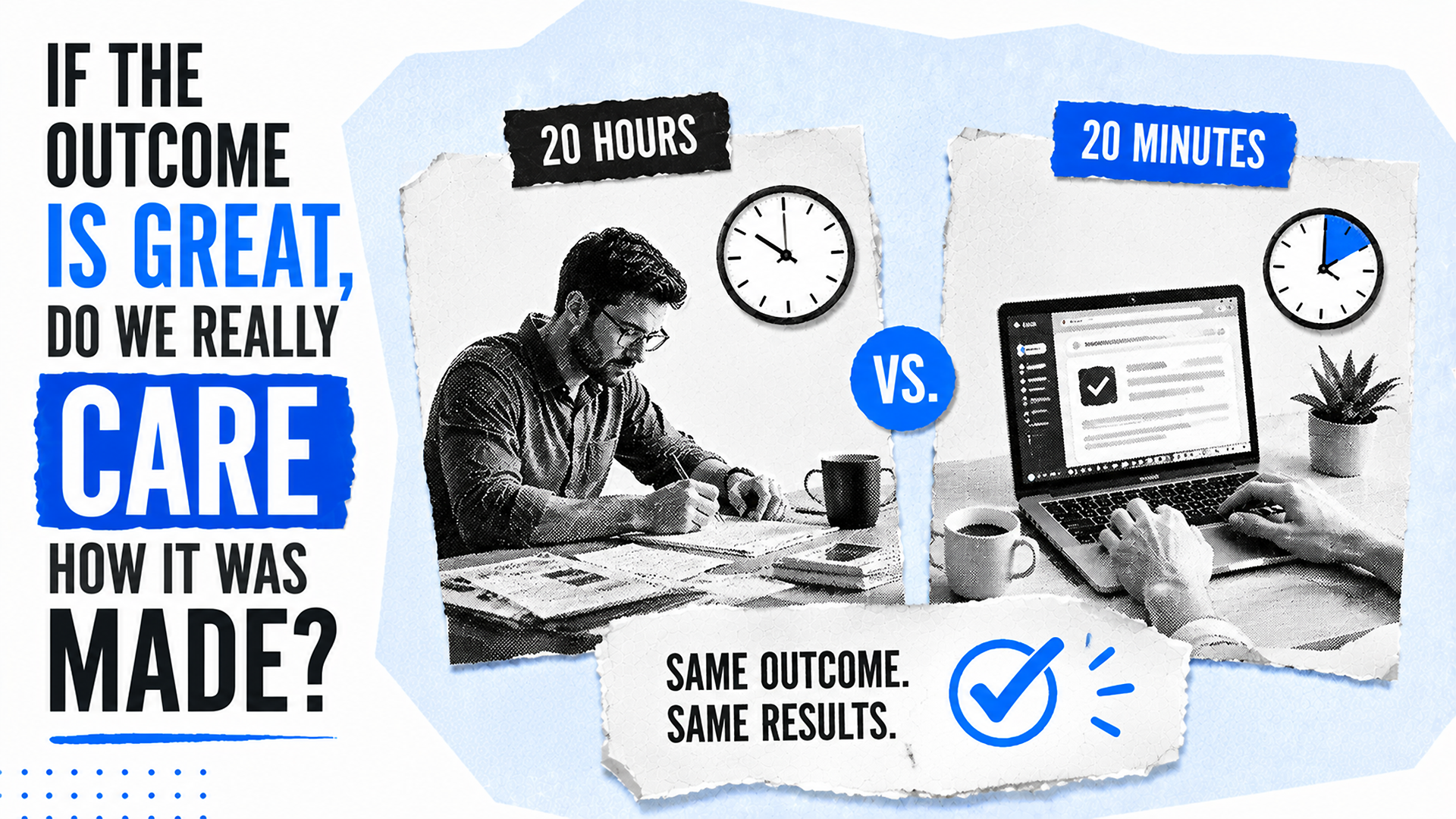
    When I think about AI deliverables, I keep coming back to a simple scenario: a client receives two pieces of work.

    Both deliverables solve the problem they were hired to solve. Both are accurate, useful, and tied to the same business outcome. The client is happy, and from the outside, there is no meaningful difference in the results.

    Then the client learns that one took 20 hours to create, while the other took 20 minutes. That is when the uncomfortable questions begin.

    Was AI involved? Should the faster deliverable cost less? Is the person who completed it less skilled because they found a faster, more efficient way to reach the same result?

    What I find most interesting is how differently many of us react to AI depending on which side of the transaction we are on. I love using AI when it saves me time, but I also understand why customers can feel uneasy when they discover AI helped create something they paid for.

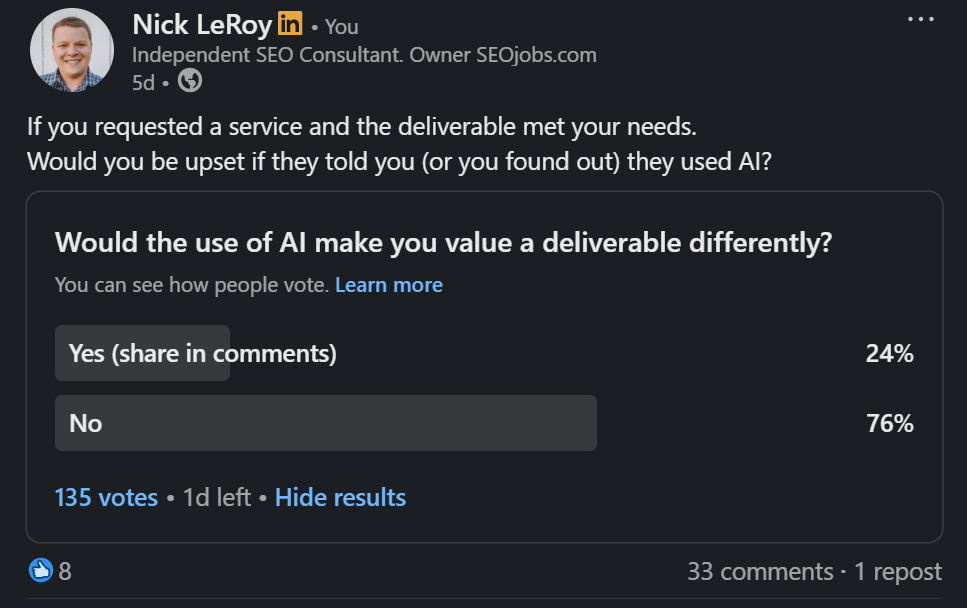
    I recently ran a LinkedIn poll asking a simple question: if the outcome is great, do we really care how it was made?

    The responses reinforced something I have been thinking about for a while. Many of the strongest objections people have to AI are not really about quality at all.

    The Time vs. Value Fallacy

    I think part of the discomfort comes from the fact that we have spent decades tying value to effort.

    Long hours feel valuable. Fast work feels suspicious. Struggle often gets mistaken for expertise.

    The harder something appears to be, the easier it becomes to justify the price attached to it.

    There is an old story about a ship engine that stopped working. After multiple failed attempts to repair it, the owners brought in an engineer with decades of experience. He inspected the engine, tapped it once with a small hammer, and the machine roared back to life.

    His invoice was $10,000.
    Image

    The owners were furious and demanded an itemized bill. The response was simple: hammer tap, $2. Knowing where to tap, $9,998.

    People debate whether that story is true or just a useful tale for people like me who believe in value-based pricing. But whether it really happened almost does not matter. The lesson still holds.

    People are not paying for the tap. They are paying for the expertise behind it.

    That is what makes AI such an important topic for me. It forces us to confront a question many of us have avoided for years: are we paying for expertise, or are we paying for visible effort?

    Those are not always the same thing.

    The Objections That Actually Matter

    To be clear, I do not think every objection to AI is unreasonable. I have shared plenty of my own concerns, and some of them are serious.

    In fact, I think the strongest arguments against AI have very little to do with how quickly something was created.

    Risk matters. Hallucinations matter. Bad recommendations matter. Compliance, privacy, and security concerns matter. Accountability matters.

    Those are legitimate concerns. What stands out to me is that none of them has much to do with how long it took to create the deliverable.

    They are questions of trust.

    Can the output be trusted? Can the recommendation be defended? Can someone confidently stand behind the work if it is questioned six months from now?

    ```json
{
  "alt": "SEO For Lunch Newsletter by Nick Leroy, featuring actionable SEO insights.",
  "caption": "Join Nick Leroy's SEO For Lunch: Your go-to source for actionable SEO insights served directly to your inbox.",
  "description": "This image promotes Nick Leroy's 'SEO For Lunch' newsletter, emphasizing actionable SEO insights. It features a smiling person against a dark blue background with the newsletter's branding, '#SEOFORLUNCH,' and website details. The design includes graphic elements like a fork and knife, alongside the tagline 'Not Your Average Table Talk.'"
}
```

    Because when something goes wrong, nobody gets to blame the AI. The employee is accountable. The consultant is accountable. The company is accountable.

    That is why I have always found the quality debate to be the least interesting part of the conversation. The more important question is not whether AI was involved. It is whether the outcome is trustworthy enough for someone to put their name behind it.

    The Outcome Test

    The more I think about AI, the less interested I become in whether it was used.

    Instead, I find myself asking a different set of questions. Was the outcome accurate? Was it useful? Was it better than the alternative? Would I be willing to stand behind it with my name, reputation, and credentials on the line?

    If the answer to all of those questions is yes, then I have a hard time arguing that the production method matters more than the result.

    I suspect this is where many people become uncomfortable because it shifts the conversation away from tools and back toward results.

    Ironically, this is also where humans become more important, not less.

    The future is not machines versus humans. I know, "The Terminator" and "I, Robot" movies will never feel the same. The real shift is humans using AI versus humans who refuse to adapt.

    The premium will not come from avoiding AI. It will come from judgment, taste, decision-making, communication, and accountability.

    AI can accelerate execution, but people still decide what should be built, what should be published, and what risks are acceptable. More importantly, people are still responsible for the outcome.

    The people who lose to AI will not be the ones using it. They will be the ones still evaluating effort while everyone else is measuring outcomes.

    This post first appeared on the author’s website and is republished here with permission.


    Inspired by this post on Search Engine Land.


    crushpress.ai community screenshot
  • Balance Time, Cost, and Quality for Effective SEO Results

    Balance Time, Cost, and Quality for Effective SEO Results

    Have you ever heard the phrase, “Fast, cheap, or good – pick two”? It’s a mantra I often reflect on when managing projects, especially in the world of SEO.

    The idea behind it is quite simple: If you want something done fast and cheap, it’s unlikely to be good. If you want it done well and quickly, it’s going to cost you. And if you want it to be good and affordable, you’re going to need to be patient.

    This principle perfectly captures the essence of tradeoffs, which are especially crucial in SEO because hastily made decisions can lead to costly fixes down the road.

    This article dives into the nuances of these project management tradeoffs and how they apply to SEO. I’ll also highlight why prioritizing quality in SEO yields better, more sustainable outcomes.

    In my experience, the fast-cheap-good concept is a modern spin on an age-old project management triangle that illustrates the delicate balance between speed, cost, and quality.

    ```json
{
  "alt": "Diagram titled 'SEO: Pick Two?' with options: Good and cheap, Good and fast, Cheap and fast, and a Venn diagram illustrating these choices.",
  "caption": "Choosing the right SEO approach? This Venn diagram humorously highlights the classic dilemma: balancing between good, fast, and cheap, but rarely all three!",
  "description": "This image features a decision matrix for SEO with the title 'SEO: Pick Two?' displaying options: 1. Good and cheap, 2. Good and fast, 3. Cheap and fast. A Venn diagram categorizes these combinations, illustrating the trade-offs in achieving quality, speed, and affordability. The center of the Venn diagram notes the impossibility of achieving all three simultaneously. This visual is a playful take on prioritizing SEO services, ideal for discussions around strategic planning."
}
```

    Visualize it as a triangle with three sides: Time (how quickly we can deliver), Cost (the budget involved), and Quality (the thoroughness and effectiveness of the work).

    The general consensus? You can only truly focus on two of these, and the third will inevitably be compromised.

    Let’s delve into how these elements impact SEO:

    Time: The competitive edge often comes from moving faster than your rivals. Though SEO is more a marathon than a sprint, speeding up certain processes can give you a significant advantage.

    ```json
{
  "alt": "Diagram of the Project Triangle with quality, time, and cost at vertices, indicating trade-offs.",
  "caption": "Understanding the Project Triangle: Balancing quality, time, and cost requires careful consideration.",
  "description": "This image depicts the Project Triangle, a model illustrating the trade-off between quality, time, and cost in project management. Each of the three positions of the triangle represents these critical elements. Words like 'High Cost,' 'Low Priority,' and 'Low Quality' suggest the compromises involved when focusing on one over the others. This concept is fundamental for effective project planning and management."
}
```

    SEO requires patience. In some industries, reaching the top can take years, especially for high competition keywords. However, with the right investment and strategy, you can reach those coveted positions more quickly.

    Cost: Quality SEO isn’t cheap. It demands expertise and skill, and those come at a price. Opting for low-cost options often leads to subpar results and potential penalties—ultimately, you’ll pay more to correct these errors.

    Quality: High-quality SEO encompasses sound strategies, skilled execution, and top-notch content. The success of SEO depends heavily on quality, and without proper vetting, you might end up dissatisfied with your SEO services.

    Here, I want to highlight specific tradeoffs in SEO projects:

    ```json
{
  "alt": "Triangle representing project management for SEO with sides labeled cost, time, and scope, and base labeled quality.",
  "caption": "Balancing the SEO project triangle: Learn how cost, time, and scope align to uphold quality in your project management strategies.",
  "description": "An informative illustration depicting the project management triangle concept for SEO, showing a triangle labeled with 'cost', 'time', and 'scope'. The base of the triangle is labeled 'quality'. This image highlights the interdependent elements crucial for maintaining quality in SEO project management. Ideal for presentations or educational content about project management and SEO strategies."
}
```

    Fast + Cheap: This risky combination often results in low-quality SEO, sacrificing long-term results for short-term gains.

    Fast + Good: To achieve excellence quickly, expect premium pricing for the expertise and dedication required.

    Cheap + Good: With this route, progress will be slower, but it allows for sustainable growth ideal for businesses aiming for long-term success.

    While critics argue that these constraints oversimplify project dynamics, especially in SEO, I believe quality should always be the non-negotiable foundation. By focusing on quality first, the other elements—time and cost—will align.

    Quality-driven SEO minimizes wasted efforts and resources, facilitating a more effective and sustainable approach. So, when I approach SEO, my priority is quality, ensuring everything else falls into place more naturally.


    Inspired by this post on Search Engine Land.


    crushpress.ai community screenshot