Author: Kelsey Libert

  • How AI Is Reshaping Search Demand Across 1M Keywords

    How AI Is Reshaping Search Demand Across 1M Keywords

    I do not see search demand disappearing. I see it moving. In this analysis, 29% of high-volume search demand is declining, while nearly the same amount is growing somewhere else. Overall demand is essentially flat because people are redistributing how and where they search instead of abandoning search altogether.

    That changes how I think about SEO strategy. I would not start by panicking over shrinking keywords. I would start by identifying which queries are losing volume, which ones are gaining momentum, and where a brand can build enough authority to appear in both traditional search results and AI-generated answers.

    This study looks at where search demand is shifting, which industries are seeing the sharpest changes, and what those patterns mean for SEO teams trying to adapt to AI-driven discovery.

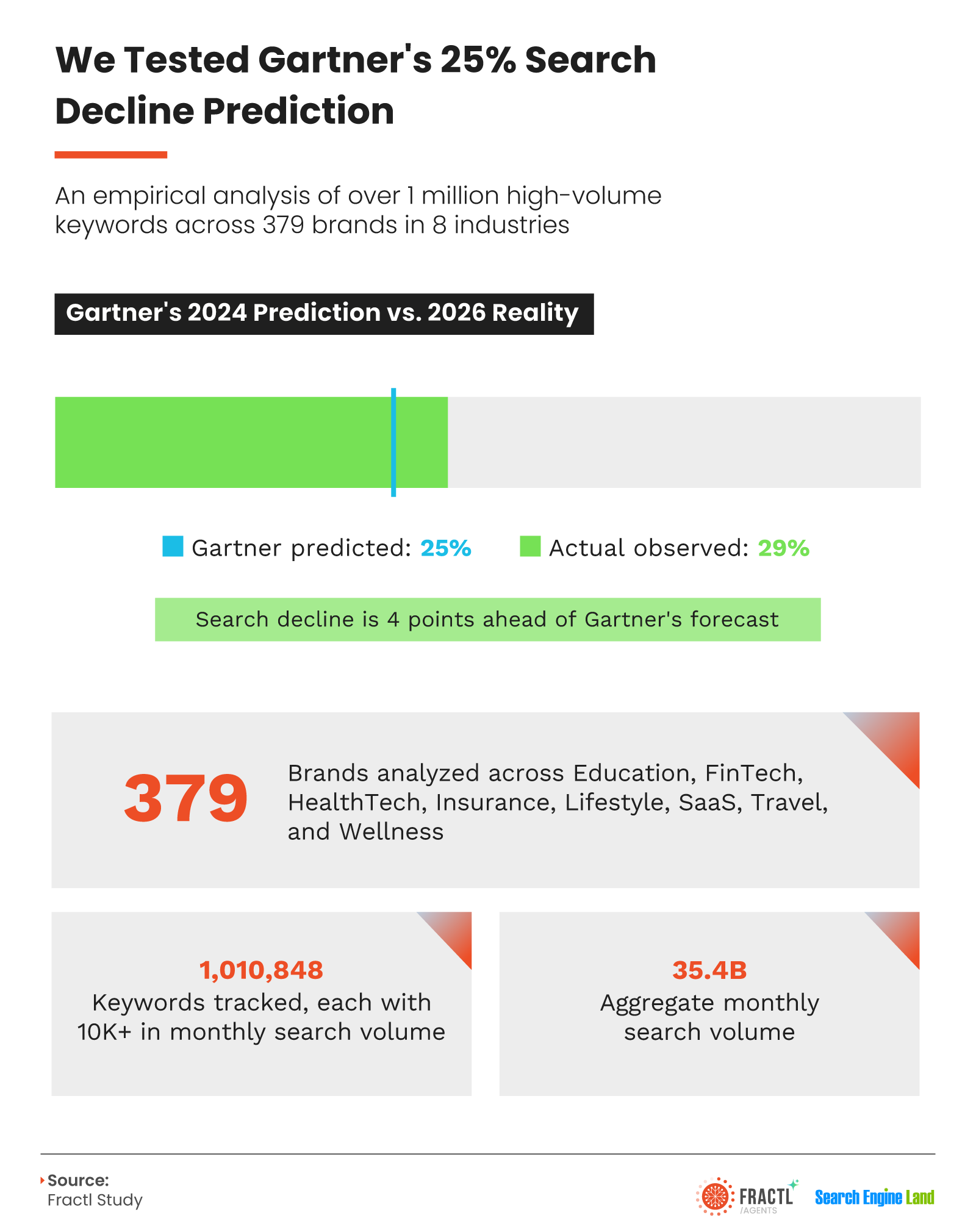
    In 2024, Gartner predicted that traditional search engine volume would fall 25% by 2026 as consumers shifted to AI chatbots and virtual agents. Fractl and Search Engine Land set out to test that prediction. (Disclosure: I’m the co-founder of Fractl.)

    I worked from Semrush data covering 1,010,848 high-volume keywords, each with at least 10,000 monthly searches, across 379 brands in eight verticals. I also looked at survey responses from 1,004 U.S. consumers to better understand how AI is changing the way people search.
    Image

    The analysis measured which keywords gained or lost search volume over the past year, how those shifts differed by industry, and how consumer behavior is evolving as AI tools become part of everyday discovery.

    The 29% search decline is real, but it depends on the vertical

    Across more than 1 million high-volume keywords, I found that 29% of search volume is in measurable decline. That is 4 percentage points above Gartner’s forecast. In a dataset representing 35.4 billion monthly searches, that difference represents a meaningful amount of search activity.

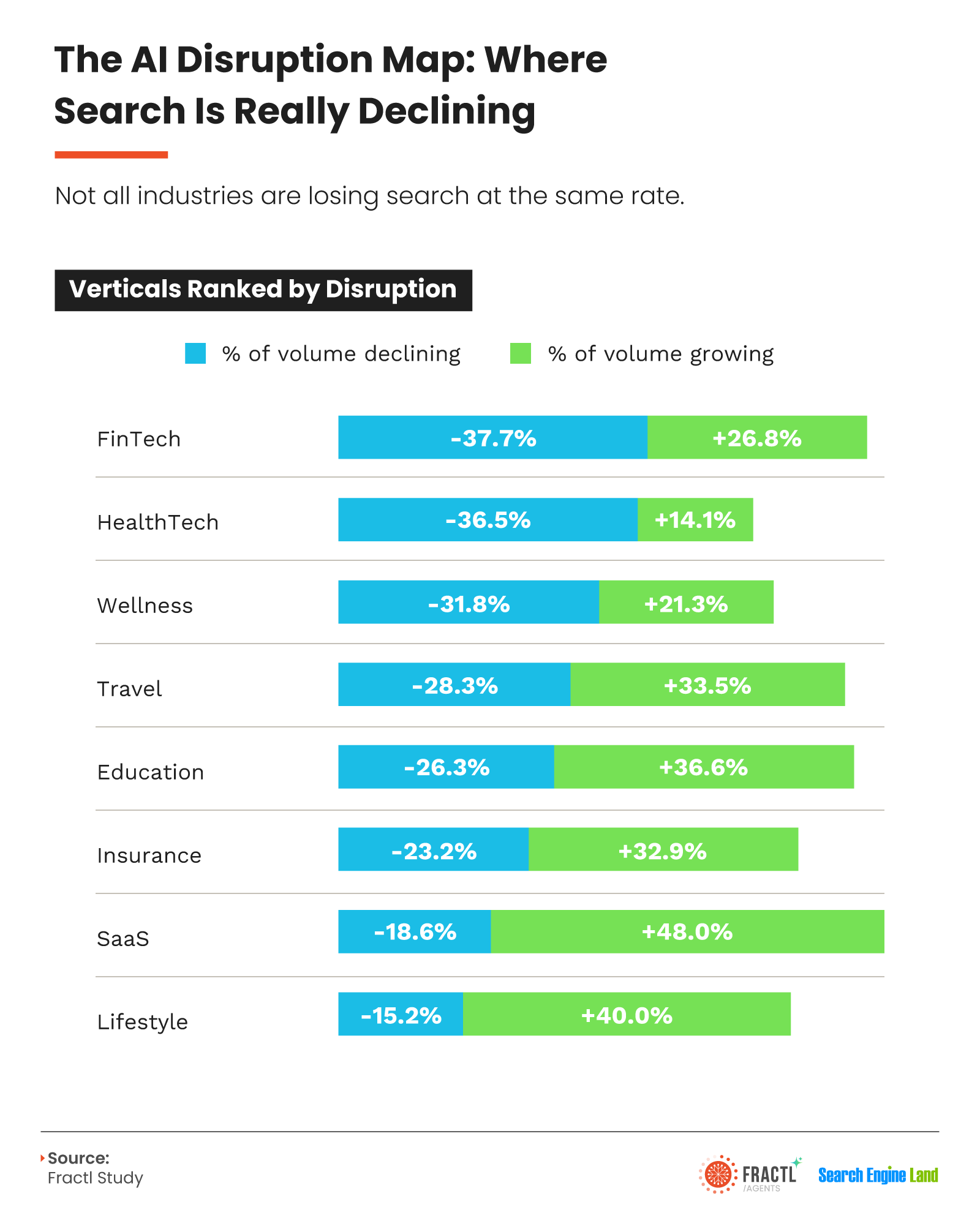
    The impact is not evenly distributed. FinTech showed the largest decline at -37.7%, while Lifestyle saw the smallest decline at -15.2%. Only three of the eight verticals, Insurance, SaaS, and Lifestyle, came in below Gartner’s 25% threshold. FinTech, HealthTech, and Wellness were well above it.

    The pattern makes sense when I look at how information-heavy each category is. When a chatbot can answer the question completely, such as summarizing drug interactions, explaining deductibles, or giving a quick overview of a fund, search volume is more likely to fall. When people need to compare prices, complete a transaction, or navigate to a specific site, search demand tends to hold up better.
    Image

    That is why transactional verticals such as SaaS, Lifestyle, Insurance, and Travel are growing or staying close to flat. Information-heavy verticals such as HealthTech, FinTech, and Wellness are seeing the largest declines.

    Before reacting to broad claims about AI-driven search decline, I would benchmark these findings against the specific vertical in question. HealthTech and FinTech teams should expect more exposure than the overall 29% decline suggests. SaaS and Lifestyle teams have more reason to challenge the idea that search demand is simply collapsing.

    Search demand is being redistributed

    The headline number gets attention, but the offset is just as important. Demand did not vanish. It moved to a different set of words, and those are the terms I would want to understand first.

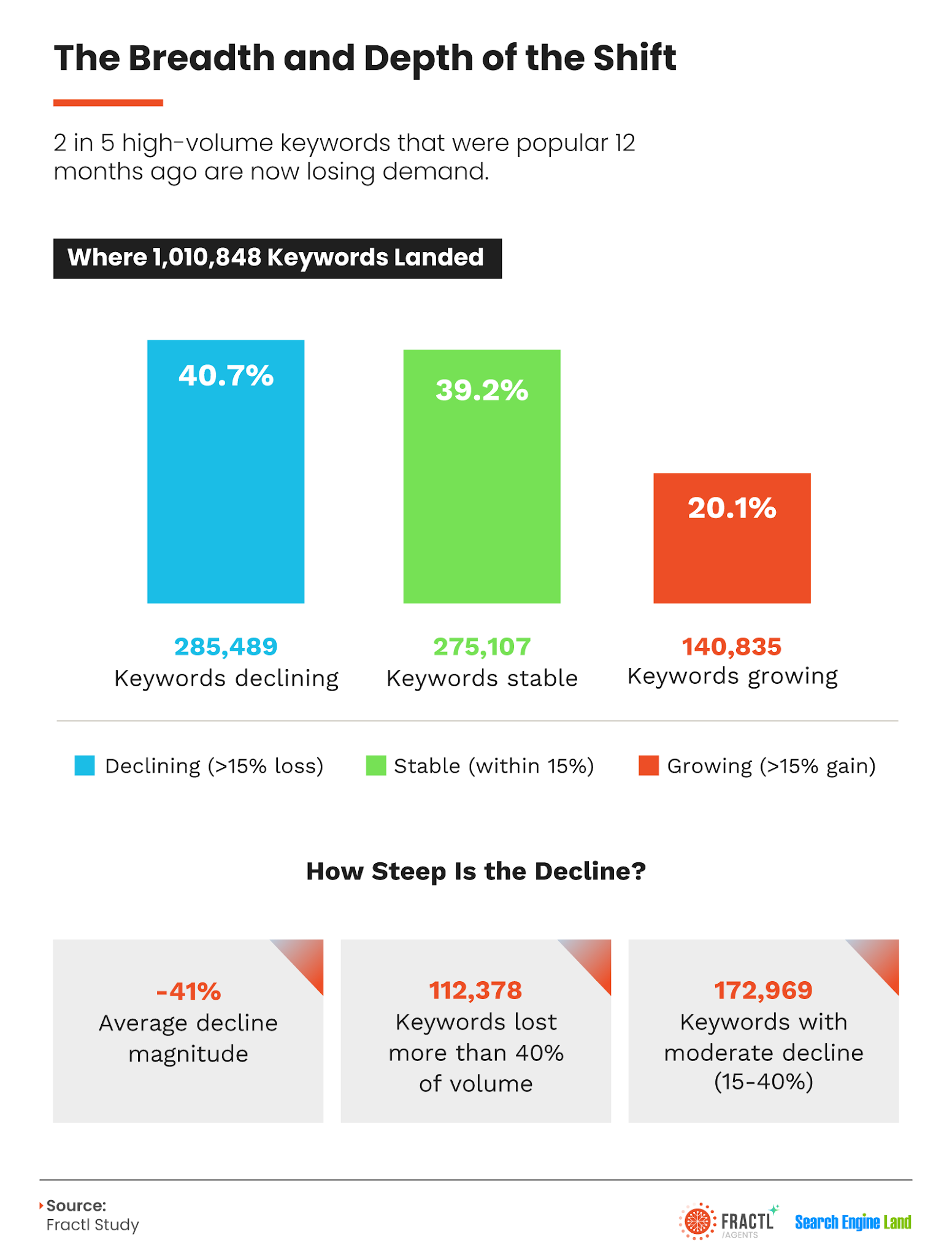
    Among the high-volume keywords tracked, 40.7% are in measurable decline, meaning they lost more than 15% of their volume over the past year. Within that group, the average decline is -41%, and 112,378 keywords lost more than 40% of their volume. For brands that depend on those terms, the impact is significant.
    Image

    At the same time, 20.1% of keywords are growing by more than 15%. When I add up the volume on both sides, the decline and growth almost cancel each other out.

    The 285,489 declining keywords represent roughly 10.29 billion monthly searches. The 140,835 growing keywords represent roughly 10.31 billion monthly searches. Across the entire dataset, the net change is +16.8 million searches per month.

    Fewer keywords are growing than declining, but the growing keywords carry more volume each. That is why the totals balance out. In practical terms, I see demand relocating more than shrinking.

    The vertical-level growth-to-decline ratios show where that new demand is landing. Lifestyle leads at 2.6x, with 40% of keywords growing versus 15% declining. SaaS follows closely at 2.5x, with 48% growing versus 19% declining. HealthTech sits at the other end with an inverted ratio of 0.4x, making it the most disrupted vertical in the set.

    Image

    The first audit I would run is simple: pull the tracked keyword set, filter it by year-over-year volume change, and see which side of the ledger the portfolio sits on.

    Non-branded queries are the most vulnerable

    I see non-branded queries as the easiest ones for AI chatbots to replace. When a search term does not include a brand name, the user is not necessarily trying to reach a specific site or source. The full exchange can happen inside the chat window.

    Across the dataset, 90% of all tracked search volume is non-branded. HealthTech, at 99.6%, and Wellness, at 98.5%, are the most exposed. Insurance, at 73.8%, and SaaS, at 82.0%, are less exposed, and both are growing overall. SaaS volume is up 48% year over year, while Lifestyle is up 40%.

    If I wanted to identify the content most at risk, I would start with keyword patterns. They offer one of the clearest signals in the study.

    Image

    The reason SaaS and Lifestyle can be heavily touched by AI and still grow comes down to what happens after the AI answer. If AI recommends a project management platform or a couch, many people still search for the specific brand, retailer, review, or product page before buying. The AI answer creates a downstream search.

    HealthTech and FinTech often behave differently. A drug-interaction question or a “what is a deductible” query can be answered completely inside the chat window. There may be no next step that sends the user back to Google.

    If a category produces complete AI answers with no natural next click, I would treat AI visibility as a core strategy, not an SEO side project. In those cases, showing up in the answer may be the entire opportunity.

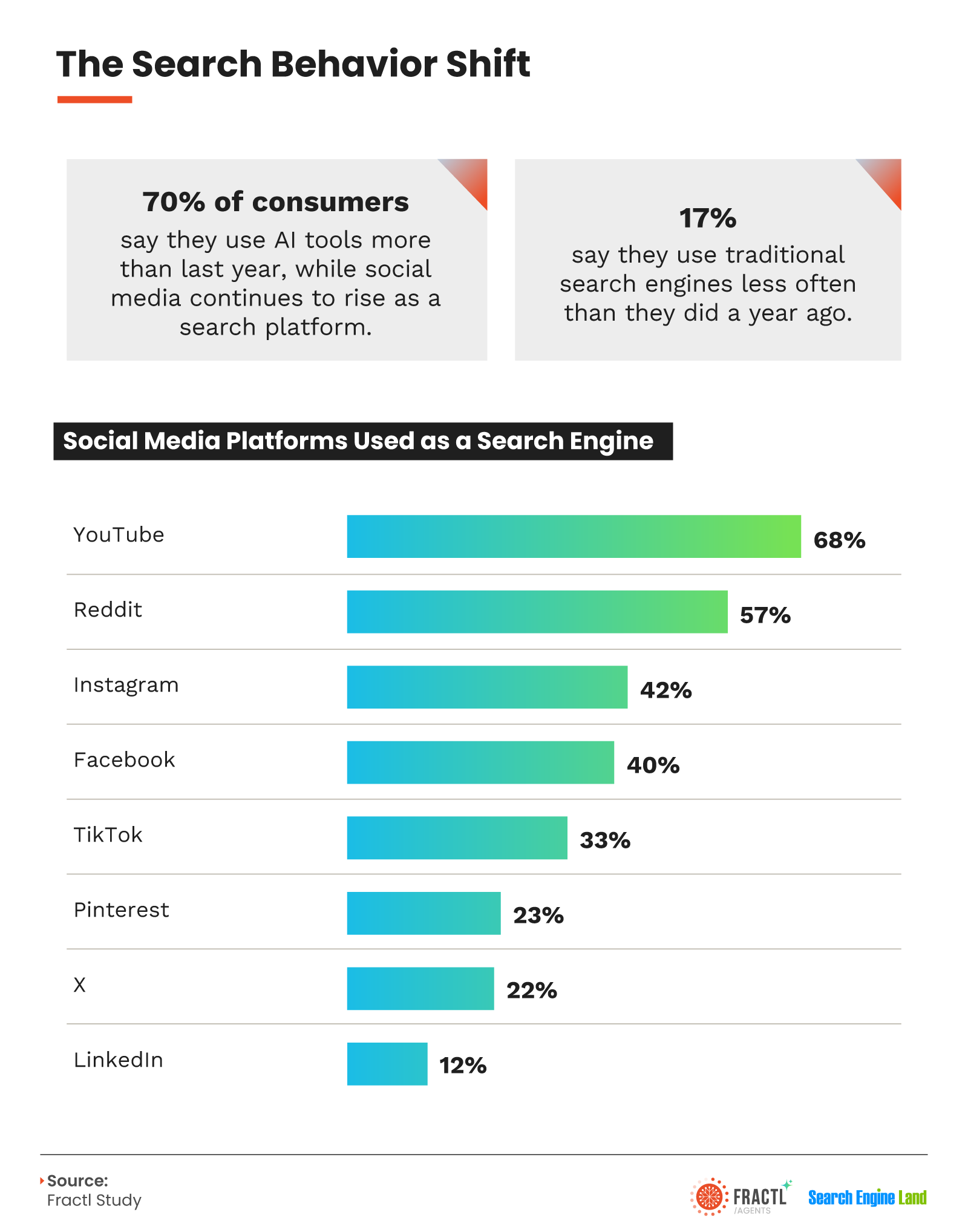
    70% of consumers use AI more, but only 17% use search less

    The keyword data shows what is happening in the index. The survey data shows what is happening in the minds of the people doing the searching.
    Image

    Search behavior is spreading across more platforms. Many people are adding AI to their routines without giving up Google.

    Social platforms are also acting like search engines in a way they did not a few years ago. YouTube leads at 68%, followed by Reddit at 57%, Instagram at 42%, Facebook at 40%, and TikTok at 33%.

    If I had not already prioritized YouTube and Reddit, I would move them up the list. Both rank ahead of TikTok, Instagram, and Facebook as search destinations, and both can also surface in Google results, which gives visibility there a compounding effect.

    What has actually moved from Google to AI

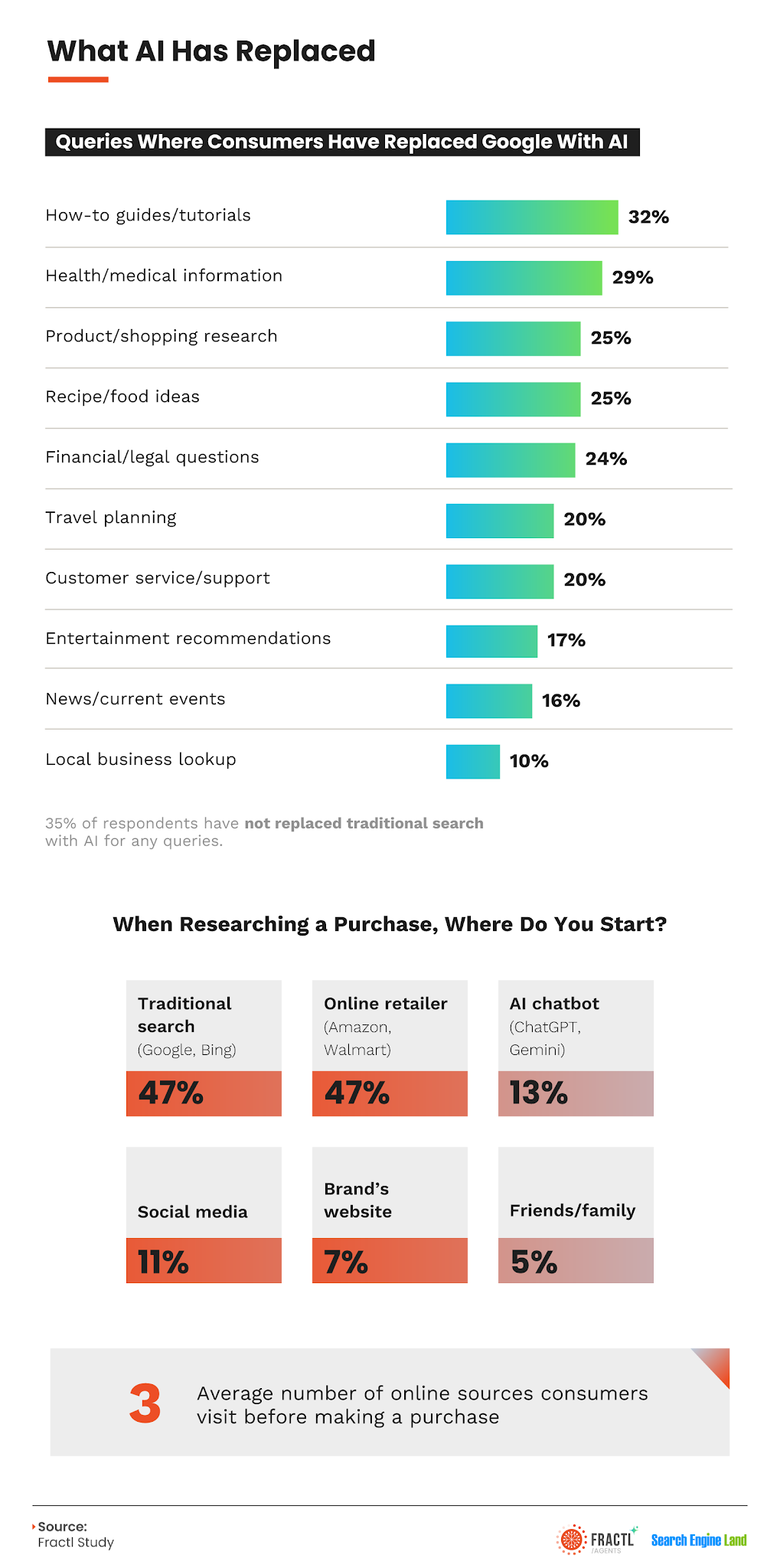
    More than a third of respondents, 35%, say they have not replaced traditional search with AI for anything yet. Among those who have, how-to guides and tutorials have taken the biggest hit.
    Image

    For purchase research, 47% of consumers start with a traditional search engine, tied with online retailers at 47%. Only 13% start with an AI chatbot, and shoppers check an average of three online sources before making a purchase.

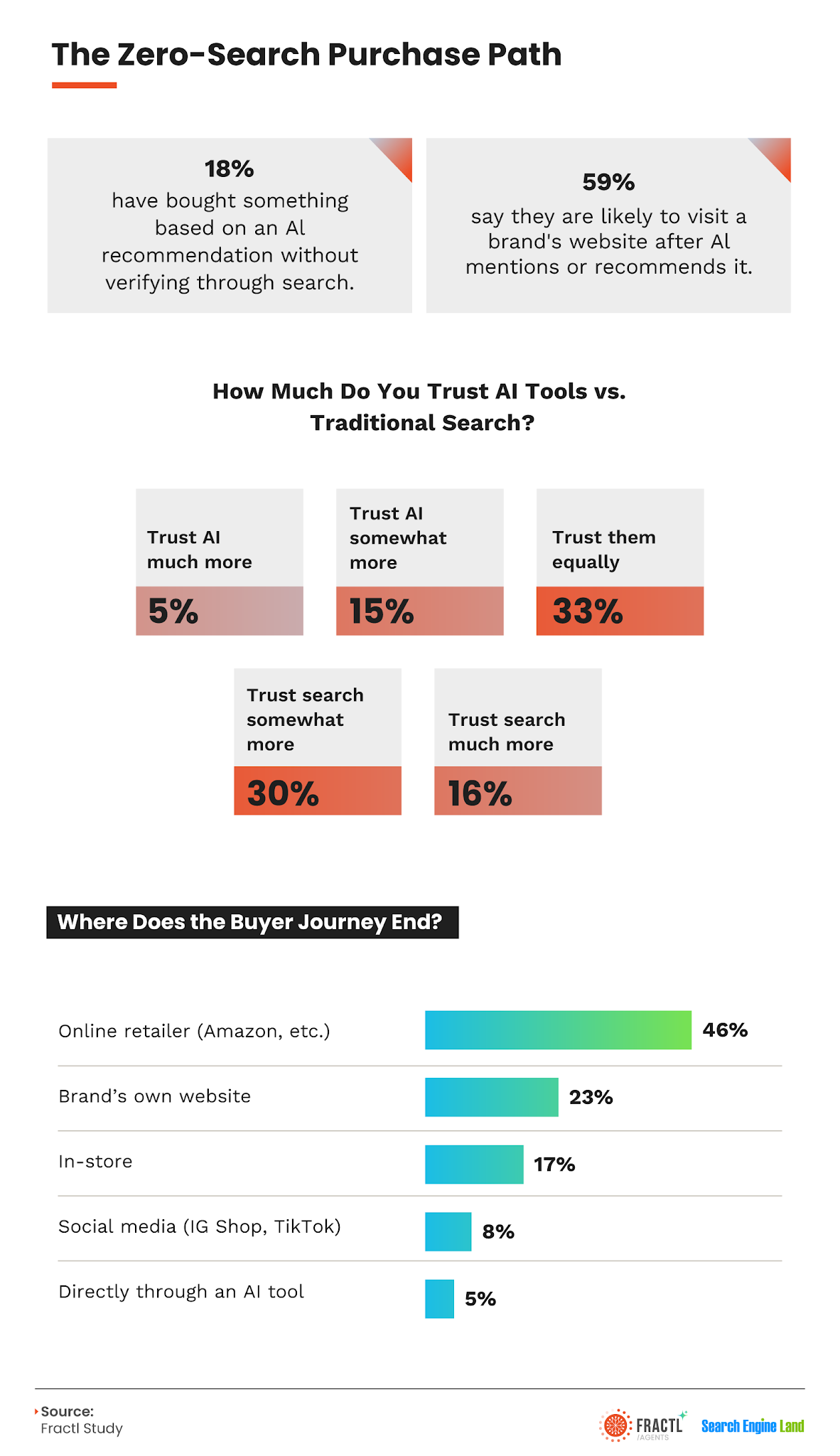
    The number I would bring to a strategy meeting is this: nearly one in five consumers, 18%, have bought something based on an AI recommendation without checking it against a separate search.

    That creates a different kind of buyer journey. In that path, the brand may never receive a search-driven touchpoint. To be considered, the brand has to be one of the names the chatbot returns.

    Gen Z and millennials are 2.5x more likely than baby boomers to buy based on an unverified AI recommendation, at 20% versus 7%. Across all consumers, 59% say they are likely to visit a brand’s website after an AI chatbot mentions or recommends it.
    Image

    That is the emerging conversion funnel I am watching closely. Brand mentions in AI answers are starting to function like rankings. Visits to a brand’s website after an AI mention are starting to look like the new click-throughs.

    Trust is still mixed. In the survey, 33% of consumers trust AI and traditional search equally, 46% trust search more, and 20% trust AI more.

    More than half of consumers, 56%, are at least somewhat skeptical of AI product recommendations. I read that as a sign that people are willing to let AI filter and shortlist options, but many still want to verify before they buy.

    The 5-year outlook: Google is not going away, but the shift matters

    When asked whether Google will still be their primary search tool in five years, 52% of consumers say yes, including 17% who say definitely and 35% who say probably. Another 27% are unsure, while 20% say probably or definitely not.

    Image

    The top reasons people prefer AI over traditional search are better summaries across sources, at 21%; faster and more direct answers, at 20%; and the ability to ask conversational follow-up questions, at 19%. More personalized results and avoiding website click-throughs were much lower, at 6% and 4%.

    When asked what would bring them back to traditional search, the top answer was AI giving unreliable answers, at 35%. That means much of this shift depends on whether AI maintains trust as adoption scales. More accurate search results followed at 29%, then a preference for multiple source links at 22%, and privacy concerns at 20%.

    The 20% who expect to leave Google are not the majority, but I would not dismiss them. A strategy does not need to be rebuilt entirely around them today, but brands do need to appear where those users are already moving.

    What this means for content and SEO strategy

    I see Gartner’s 25% prediction as a useful directional warning. The real shift may be steeper, but calling it only a decline misses the more important story. Total search volume is basically flat. What has changed is which searches carry the demand.

    AI visibility is not just a threat to manage. I see it as a distribution channel. With 59% of consumers saying they are likely to visit a brand’s website after an AI mention, GEO has become a meaningful part of brand discovery.

    Earned media, credible third-party coverage, and strong entity signals all help brands appear in chatbot answers. That is why digital PR and GEO are becoming more closely connected.

    Search is moving, not disappearing.

    The brands that lose will be the ones still optimizing mainly for queries that AI now answers better. The brands that win will be the ones building enough authority to become the answer, whether that answer appears in Google or inside a chatbot.

    Methodology

    This study combined two data sources to test Gartner’s 2024 prediction that traditional search engine volume would fall 25% by 2026.

    Fractl and Search Engine Land analyzed Semrush search volume data for 1,010,848 high-volume keywords with 10,000 or more monthly searches each, covering 379 brands across eight verticals: FinTech, HealthTech, Wellness, Travel, Education, Insurance, SaaS, and Lifestyle. The dataset represented 35.4 billion in aggregate monthly search volume. Keyword-level year-over-year volume change was measured as of April 2026 and classified as declining, meaning more than 15% loss; stable, meaning within 15%; or growing, meaning more than 15% gain. Query pattern groupings, including “What is X,” “Best X for Y,” “X vs. Y,” and “How to X,” were applied at the keyword level.

    Fractl and Search Engine Land also surveyed 1,004 U.S. consumers about their search habits, AI tool adoption, and purchase research behavior. The sample was 52% women, 46% men, and 1% nonbinary, with 49% millennials, 26% Gen X, 16% Gen Z, and 9% boomers. The median respondent age was 41, with a range of 18 to 82.


    Inspired by this post on Search Engine Land.


    crushpress.ai community screenshot
  • AI Search Trust Is Falling: What Marketers Must Fix

    AI Search Trust Is Falling: What Marketers Must Fix

    A year ago, I saw 82% of consumers say AI-powered search was more helpful than traditional search. By 2026, that number had fallen to 54%, a 28-point drop in sentiment in just 12 months.

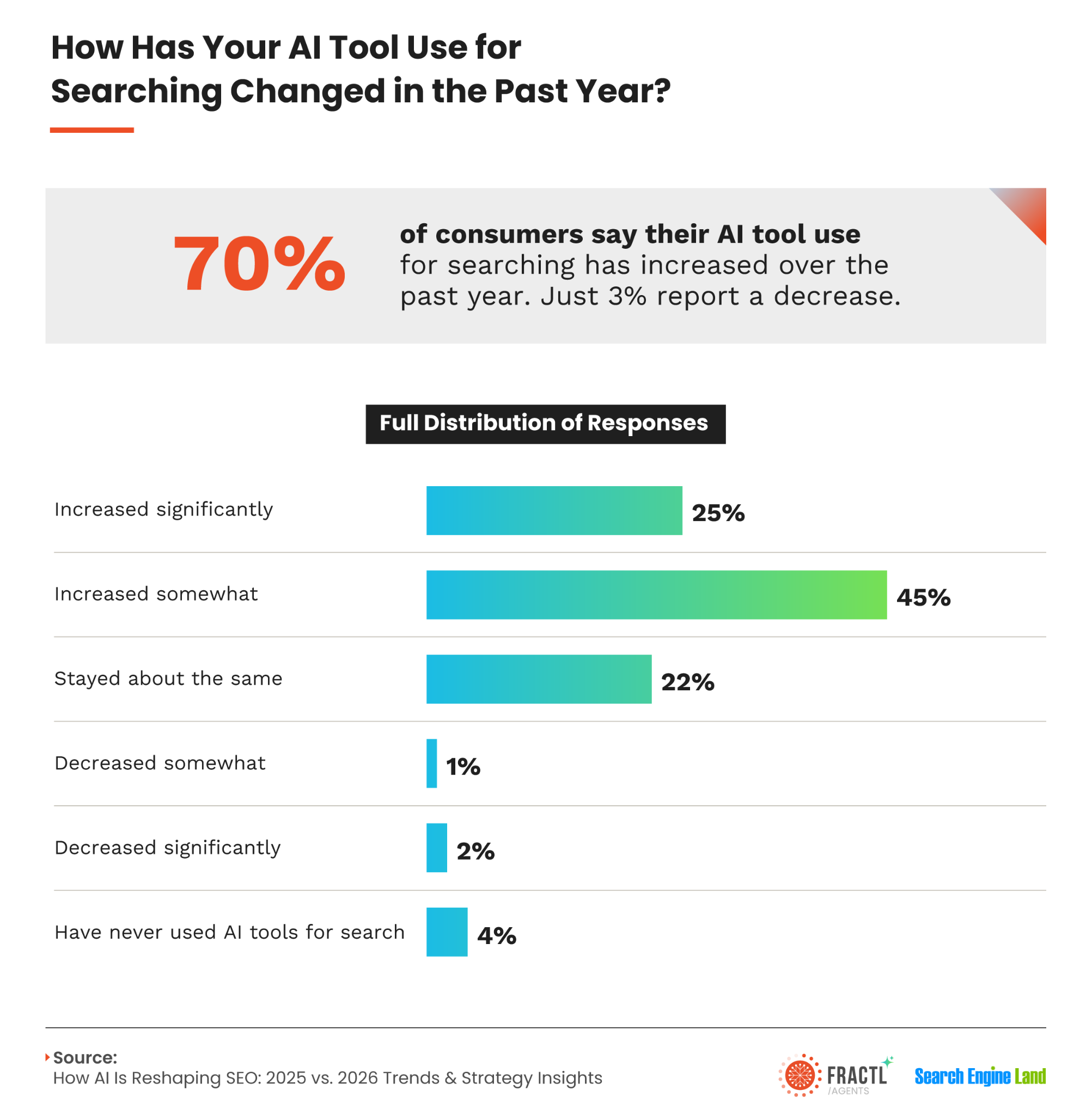
    That does not mean people are abandoning AI search. In fact, 70% of consumers say they are using AI tools for search more than they did last year. The tension is clear: adoption is rising, but trust is slipping.

    That is the core issue I believe search marketers need to solve in 2026. It is no longer enough to appear in AI answers. I need my brand, and the brands I work with, to be visible, accurate, credible, and trusted when AI systems surface information.

    To understand the shift, Fractl partnered with Search Engine Land to expand our 2025 research. We surveyed 1,008 U.S. consumers and 150 marketers to compare how consumer trust, marketer adoption, and brand strategy are changing in the AI search era. Disclosure: I am the co-founder of Fractl.

    ```json
{
  "alt": "Survey chart showing changes in AI tool usage for searching over the past year, with 70% reporting an increase.",
  "caption": "AI tool usage for searches is booming, with a striking 70% of users reporting increased activity in the past year. A detailed breakdown reveals various degrees of change.",
  "description": "This image features a survey chart depicting changes in AI tool usage for searching over the past year. 70% of consumers reported increased usage, with 25% saying it increased significantly, and 45% somewhat. Around 22% saw no change, while 3% observed a decrease. The survey highlights the growing reliance on AI for search. Source: How AI Is Reshaping SEO: 2025 vs. 2026 Trends & Strategy Insights."
}
```

    Here is what I believe the data means for 2026 search strategy.

    Consumers are using AI more, but trusting it less

    AI search adoption is no longer the main story. Seventy percent of consumers report increased use of AI tools for search over the past year, while only 3% say their use has decreased. The bigger question is whether people trust what those tools return.

    ```json
{
  "alt": "Chart showing AI vs traditional search helpfulness from 2025 to 2026, with generational breakdown.",
  "caption": "A comparative study indicates a decrease in those finding AI more helpful than traditional search from 2025 to 2026, with variances across generations.",
  "description": "The image illustrates a drop in the perceived helpfulness of AI over traditional search from 82% in 2025 to 54% in 2026, depicting a 28-point decline. It also shows detailed distribution data for 2026, with 17% finding AI much more helpful and 6% much less so. Generational breakdown reveals varying degrees of AI helpfulness agreement: Gen Z at 47%, Millennials at 53%, Gen X at 58%, and Baby Boomers at 63%. Keywords: AI, traditional search, generational analysis, helpfulness, distribution."
}
```

    One surprising finding is that baby boomers now find AI more helpful than Gen Z, 63% to 47%. That challenges the assumption that younger users automatically embrace AI while older users lag behind. What I see instead is a more complicated market where trust has to be earned across every generation.

    In 2025, only 3% of consumers said AI was less helpful than traditional search. By 2026, that skeptic group had grown to 17%, nearly six times larger than the year before. Even among the 54% who still find AI helpful, enthusiasm is softer: 37% say it is only somewhat more helpful, while 17% say it is much more helpful.

    I think hallucinations and low-quality AI content are changing how people evaluate the entire channel. Consumers may use AI because it is convenient, but convenience does not automatically create confidence.

    ```json
{
  "alt": "Chart showing trust shift in brands using AI for marketing: 20% in 2025 to 39% in 2026, distrust doubled.",
  "caption": "In just a year, distrust in brands using AI for marketing doubled, with Gen Z showing the highest trust decrease.",
  "description": "This infographic highlights a study comparing trust in brands using AI for marketing from 2025 to 2026. It shows a significant rise in distrust, from 20% to 39%. The 2026 distribution reveals 46% of respondents unchanged, 25% somewhat decreased, and 14% significantly decreased trust. By generation, Gen Z leads with a 54% trust decrease, followed by Millennials at 40%, Gen X at 33%, and Baby Boomers at 32%."
}
```

    AI content volume has become a brand trust risk

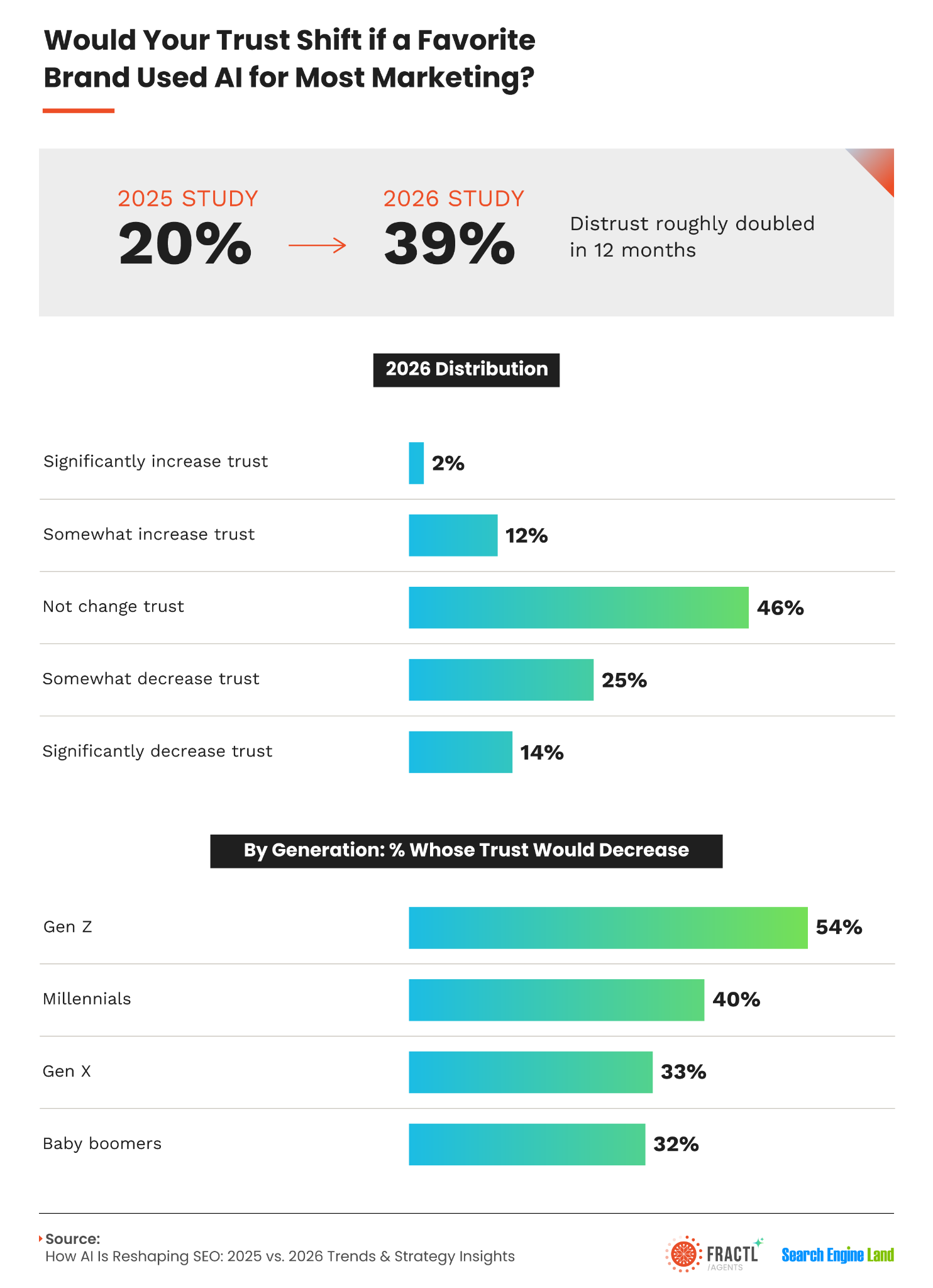
    In 2025, 20% of consumers said heavy AI use would reduce their trust in a brand. In 2026, that number rose to 39%. For me, that makes AI content scale a reputational issue, not just an operational decision.

    If I publish AI-assisted content at scale without disclosure, strong editorial standards, or obvious quality signals, I am asking my audience to trust a process they are increasingly skeptical of. That is a risk more brands need to take seriously.

    ```json
{
  "alt": "Survey results on AI content labeling show high support across text, video, images, and audio formats.",
  "caption": "A significant majority supports the labeling of AI-generated content, highlighting a demand for transparency across multiple formats.",
  "description": "This infographic presents survey results on the necessity of labeling AI-generated content. It shows that 84% support labeling for written text, with 91% for video content, 90% for images, and 87% for audio content. The data underscores a strong demand for transparency in media generated by artificial intelligence. This graphic is sourced from a study on AI's impact on SEO trends by Fractl and Search Engine Land."
}
```

    Gen Z is especially strict. Fifty-four percent of Gen Z consumers say heavy AI use in a brand’s marketing would decrease their trust, compared with 32% of baby boomers and 33% of Gen X. Women are also more likely than men to penalize brands for heavy AI use, 44% vs. 34%.

    That matters because Gen Z is often the audience most likely to engage deeply, share content, shape online conversations, and influence long-term organic visibility. If that audience matters to a brand, AI-generated filler is not a harmless shortcut.

    Disclosure is now a consumer expectation

    ```json
{
  "alt": "Graph showing AI search engine replacement sentiment from 2025 to 2026 and agreement by generation.",
  "caption": "Will AI take over search engines? In 2026, 64% still believe so, with Baby Boomers leading at 80% agreement.",
  "description": "This infographic compares the sentiment of AI potentially replacing traditional search engines from 2025 to 2026, showing a slight decrease from 66% to 64% agreement. Sentiment distribution in 2026 reveals 21% strongly agree and 43% somewhat agree. Generational breakdown indicates that Baby Boomers show the highest agreement at 80%, followed by Gen X at 73%, Millennials at 61%, and Gen Z at 51%."
}
```

    Across every major content format, more than 80% of consumers want AI-generated content labeled. Video leads at 91%, followed by images at 90%, audio at 87%, and written content at 84%. More than half of respondents strongly agree with labeling in every category.

    I do not read that as a mild preference. I read it as a near-universal expectation. The brands that treat AI disclosure as optional are creating a gap between how they operate and what their audiences want.

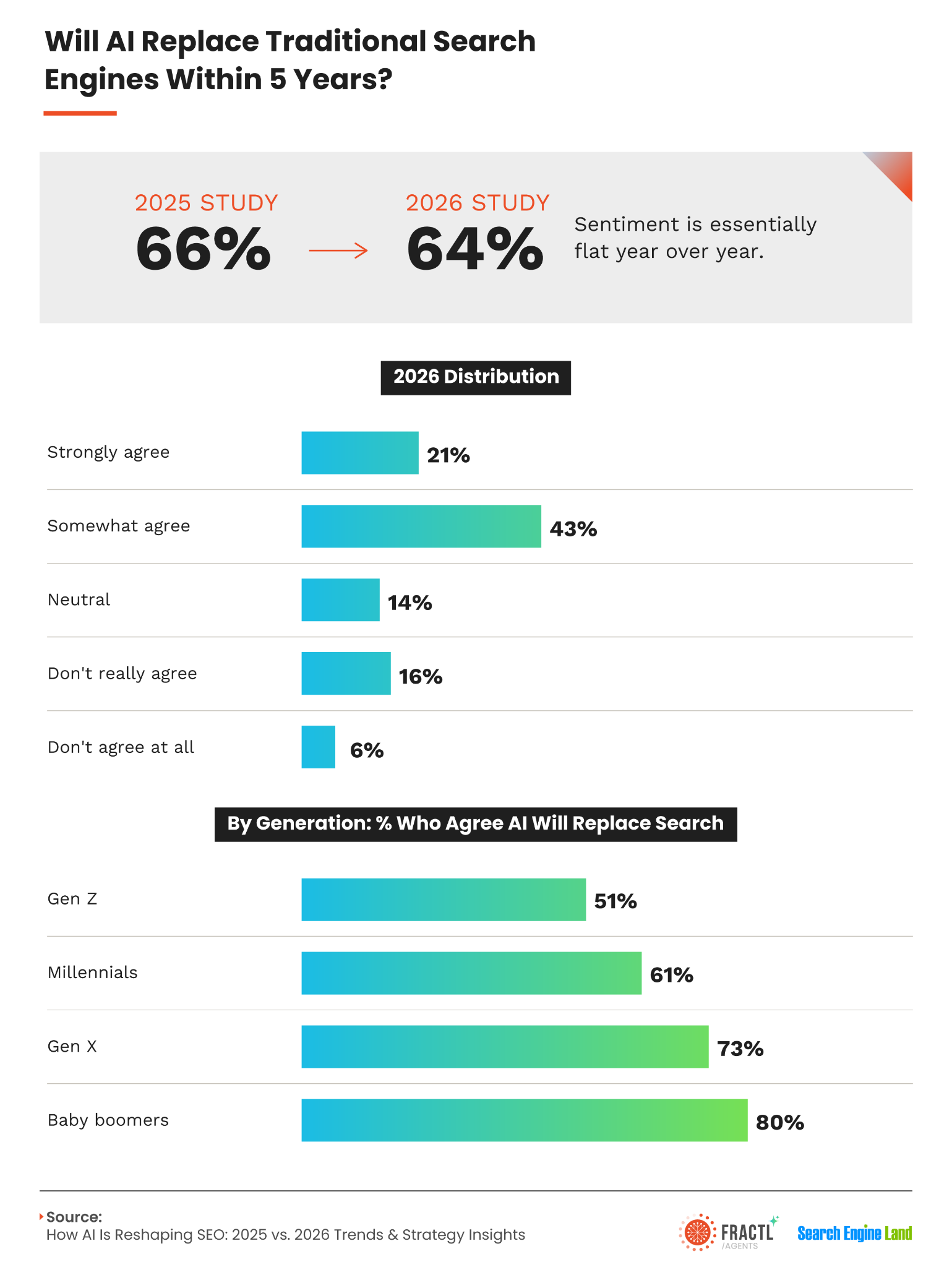
    Consumers still believe AI will shape the future of search. Sixty-four percent agree that AI will replace traditional search engines within five years, nearly unchanged from 66% in 2025. The channel is not going away. But being present in AI results and being trusted in AI results are now two different challenges.

    ```json
{
  "alt": "Graph showing consumer behaviors towards AI summaries in search results, highlighting that 49% read summaries and sometimes click, and 38% skim and scroll past.",
  "caption": "Consumer habits reveal that 49% read AI-generated summaries and sometimes click, while 38% simply skim and scroll past. The dynamics of AI in search is shaping user behaviors.",
  "description": "This image presents a graph detailing consumer behaviors when AI summaries appear in search results. 49% of users read these summaries and sometimes click on the links, 38% skim and scroll past, 8% skip them entirely, 5% read without clicking, and 0% have not noticed AI summaries. This data underscores the impact of AI on search behaviors, emphasizing the importance of engaging summary content. Source: How AI Is Reshaping SEO by Fractl and Search Engine Land."
}
```

    Google still leads on trust, especially for buying decisions

    When consumers are making purchase decisions, 39% turn to Google first. Reddit follows at 15%, AI tools at 14%, and review sites and friends or family each at 11%. The trust people have built with Google has not automatically transferred to AI tools.

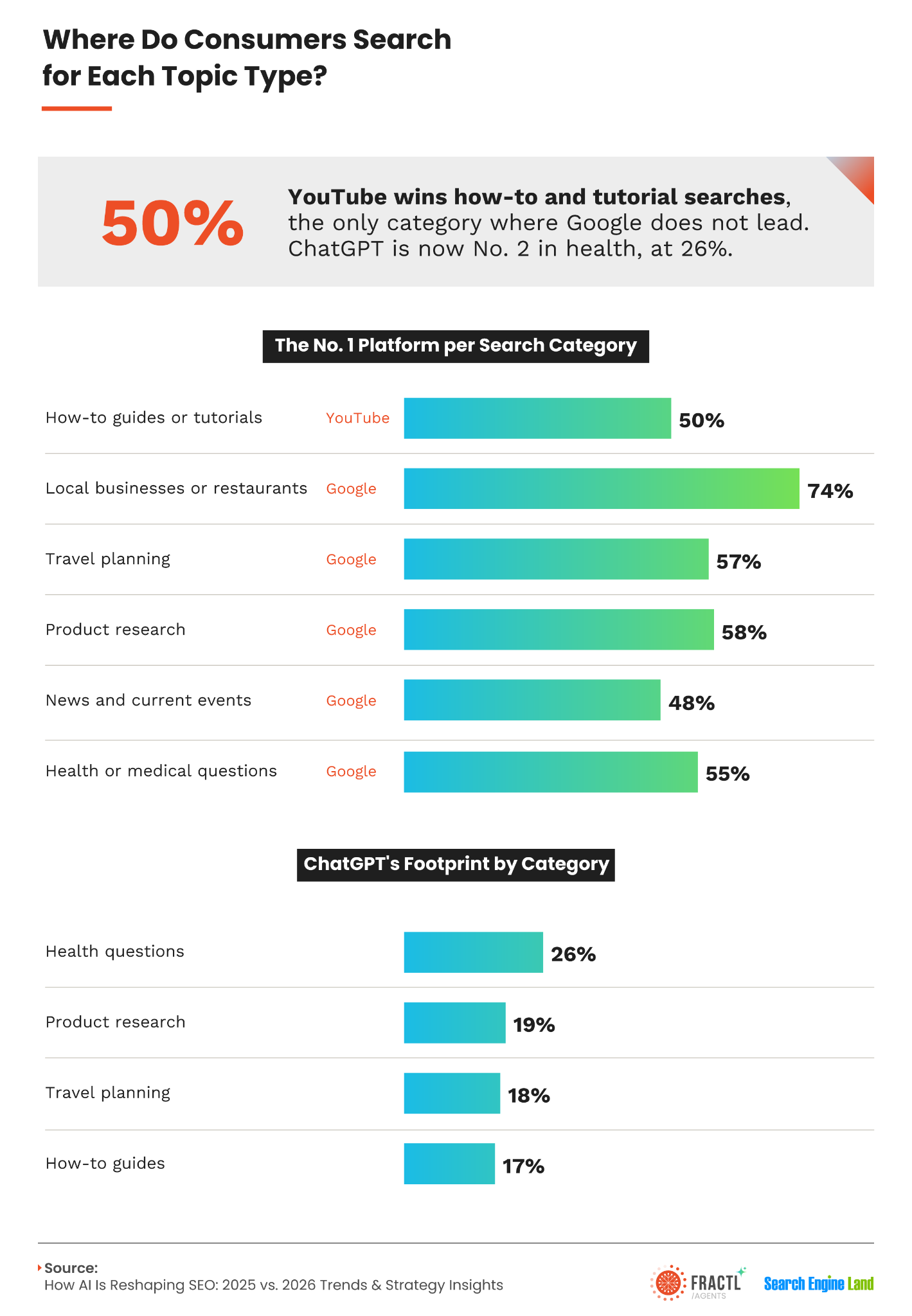
    Platform preference also changes by query type. Google dominates five of six major search categories. It is the first stop for local businesses, product research, travel planning, and health questions. YouTube overtakes Google for how-to content, while ChatGPT is now the second-most-used destination for health questions and ranks strongly for product research, travel planning, and how-to content.

    ```json
{
  "alt": "Bar chart showing trust in product recommendations, with Google at 39%, Reddit at 15%, and AI tools at 14%.",
  "caption": "Consumers trust Google search results most for product recommendations, at 39%. Reddit follows with 15%, while AI tools like ChatGPT gather 14% of trust.",
  "description": "This bar chart illustrates consumer trust levels in various platforms for product recommendations. Google search results are the most trusted at 39%. Reddit is trusted by 15% of respondents, slightly higher than AI tools like ChatGPT at 14%. Review sites and friends each have an 11% trust level. YouTube, TikTok, and Instagram show much lower levels of consumer trust, with 4%, 3%, and 1% respectively. This data provides insights into consumer behavior and search preferences."
}
```

    That tells me there is no single AI search platform to optimize for. I need to map content strategy to actual user behavior: where people search, what they are trying to decide, and which platforms influence confidence at each stage.

    Before making a purchase decision, the average consumer checks 2.4 platforms. Gen Z checks 2.5, millennials 2.4, Gen X 2.3, and baby boomers 2.2. This behavior is consistent enough that I now think of search optimization as a multi-platform visibility strategy, not a rankings-only discipline.

    A brand that appears in Google results but nowhere else can lose to a brand that appears in Google, shows up in Reddit discussions, gets cited by ChatGPT, and has strong third-party review content. Visibility now has to travel with the buyer.

    ```json
{
  "alt": "Infographic comparing search preferences for topics between YouTube, Google, and ChatGPT.",
  "caption": "Explore where consumers prefer to search: YouTube leads in tutorials while Google dominates most categories, with ChatGPT gaining ground in health.",
  "description": "This infographic presents data on consumer search preferences by platform, highlighting YouTube's dominance in how-to guides with 50% and Google's lead in categories like local businesses, travel planning, and health questions. ChatGPT shows notable presence in health queries. The chart uses bars to depict percentage shares, providing a clear visual comparison. Source: How AI Is Reshaping SEO: 2025 vs. 2026 Trends & Strategy Insights."
}
```

    AI is changing marketing operations quickly

    AI now touches 53% of marketing work on average, up from 38% in 2025. In practical terms, the equivalent of one full workday per week has shifted to AI-assisted workflows in just 12 months. Fifty-nine percent of marketers say AI is involved in at least half their work, while 27% say it is involved in three-quarters or more.

    For SEO and content teams, this means competitors are moving faster. But speed alone is becoming commoditized. Accuracy, original insight, expert judgment, and brand credibility are much harder to copy.

    ```json
{
  "alt": "Chart showing average platforms checked before buying by generation, with Gen Z at 2.5, Millennials at 2.4, Gen X at 2.3, and Baby Boomers at 2.2.",
  "caption": "Discover how many platforms each generation checks before making a purchase. This trend highlights a consistent cross-generational habit of research pre-buying.",
  "description": "This infographic from Search Engine Land presents the average number of platforms consumers check before making a purchase decision, segmented by generation. Gen Z checks 2.5 platforms, Millennials 2.4, Gen X 2.3, and Baby Boomers 2.2. It suggests a longstanding cross-generational behavior rather than a trend specific to Gen Z. Derived from 'How AI is Reshaping SEO: 2025 vs. 2026 Trends & Strategy Insights' by Fractl."
}
```

    Marketers are also feeling pressure to adopt AI. Fifty-five percent of marketing roles report a 7-out-of-10 level of pressure to use it. SEO and analytics teams feel that pressure most, while PR is not far behind. As AI makes generic content easier to produce, the advantage shifts toward what AI cannot automate well: judgment, relationships, trust, and reputation.

    The quality tradeoff is real. Only 26% of marketers say AI made their work both faster and better. Nearly half say it made their work faster but more generic, and 7% report an outright quality decline.

    That is where I see a major competitive opening. If other teams are scaling generic AI content while I invest in original data, expert quotes, third-party validation, and earned brand mentions, I am building assets that are more visible, credible, and retrievable across search engines, social platforms, and LLMs.

    ```json
{
  "alt": "Infographic showing increase in marketing work using AI tools from 38% in 2025 to 53% in 2026.",
  "caption": "The role of AI in marketing is booming! By 2026, it’s expected that 53% of marketing work will incorporate AI tools, a significant leap from 38% in 2025.",
  "description": "This infographic highlights the growth of AI tools in the marketing industry, predicting an increase from 38% usage in 2025 to 53% in 2026. It shows bar graphs illustrating that 27% of marketers use AI in 75% or more of their tasks, and 59% use AI in 50% or more. The data, sourced from a study on AI's impact on SEO, suggests a major shift towards AI integration in marketing workflows."
}
```

    AI governance is still too weak

    About three in four organizations conduct human editorial review before publishing AI-generated content. Sixty-two percent check for brand voice, 54% check facts, and 42% conduct legal or compliance review. Only 27% evaluate content for bias.

    That means nearly half of AI-generated content may enter the market without fact-checking, legal review, or plagiarism checks. Too many teams are still relying on surface-level review: Does it sound right? Is the tone appropriate? Are there typos?

    ```json
{
  "alt": "Infographic showing average pressure on marketers by function and generation to adopt AI.",
  "caption": "Understanding AI Adoption Pressures: Marketers face a significant average pressure of 6.4/10, with analytics and Gen Z experiencing the highest demands.",
  "description": "This infographic depicts the average pressure marketers feel to adopt AI, rated on a 0-10 scale. Analytics or marketing data receives the highest pressure at 7.5/10, while public relations faces 5.8/10. By generation, Gen Z feels the most pressure at 6.8/10. Overall, the average pressure level is 6.4, with 55% of marketers experiencing substantial pressure. Keywords: AI adoption, marketing pressure, generational impact."
}
```

    In a year when consumers are already prepared to distrust generic AI content, I see governance as one of the cheapest gaps to close and one of the most expensive to ignore.

    The disclosure gap is just as serious. Heavy, generic AI use is now a brand-trust liability, yet only 20% of organizations always disclose AI use to their audiences. Compare that with the 84% average consumer demand for labeling written content, and the disconnect is obvious.

    The takeaway is not to abandon AI. It is to stop treating governance as optional. Every AI workflow needs accuracy checks, transparency standards, bias review, and human accountability before content reaches an audience.

    ```json
{
  "alt": "Survey results on AI's impact on marketing work quality and speed, showing most believe AI made work faster but average in quality.",
  "caption": "AI in marketing: a speedy but average upgrade? Survey reveals 48% say AI quickened work, yet kept quality at bay. Explore the velocity-quality balance.",
  "description": "This infographic illustrates survey results on AI's influence in marketing, revealing 48% feel AI has made work faster but with average quality. Only 26% report both faster and superior quality. The visualization, sourced from 'How AI is Reshaping SEO: 2025 vs. 2026 Trends & Strategy Insights,' highlights a velocity-quality tradeoff as the prevailing theme in AI-enhanced marketing practices. Additional responses include 13% stating quality remained the same, 7% noting a decline in quality, and 6% believing it’s too soon to tell."
}
```

    AI hallucinations are already a brand problem

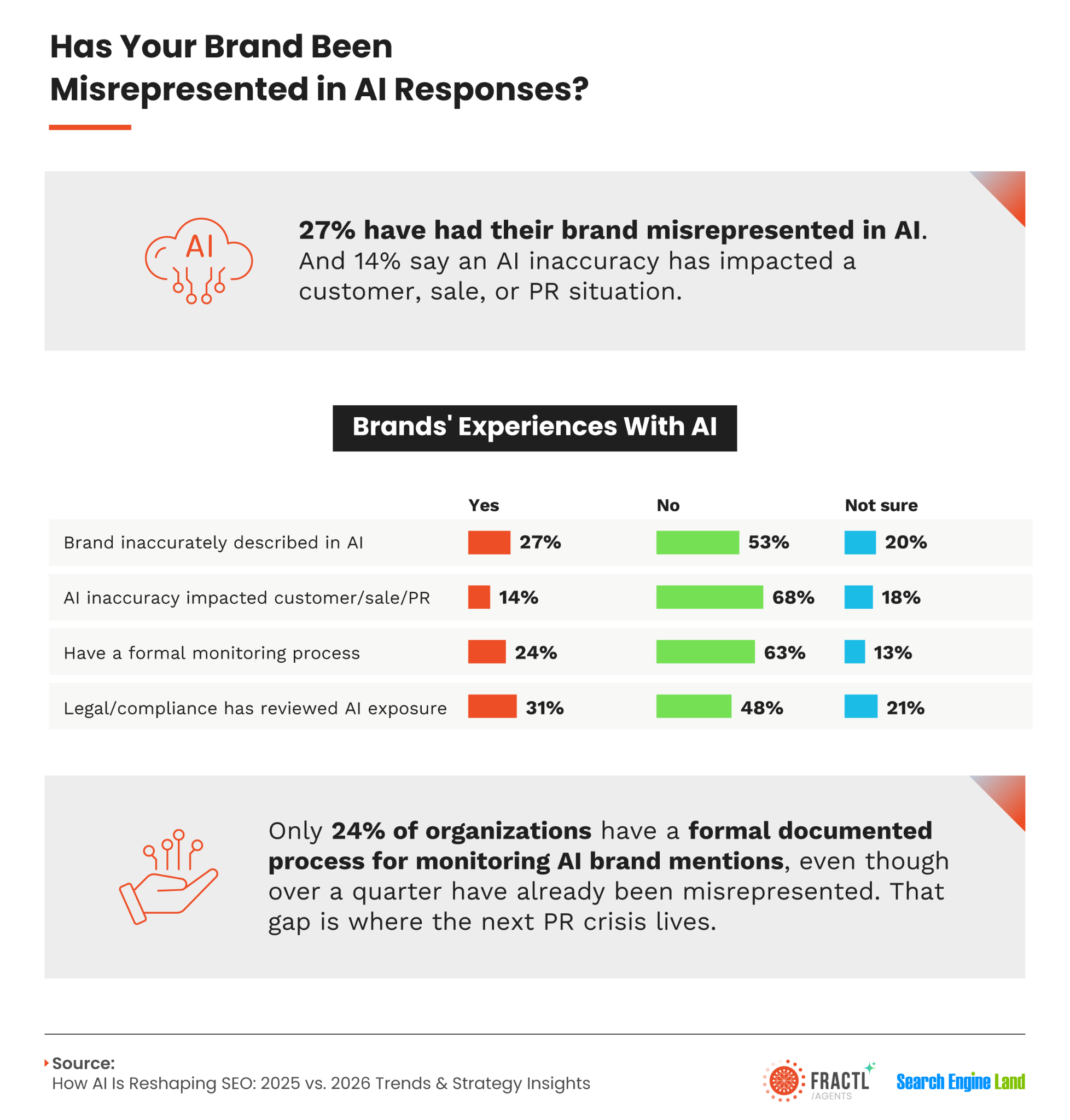
    A year ago, about 22% of marketers tracked LLM visibility. In 2026, that figure barely moved to 24%. At the same time, 27% of brands have already been misrepresented in AI-generated responses, and 14% say an AI inaccuracy has affected a customer relationship, sale, or PR situation.

    More brands have been misrepresented by AI than have a formal monitoring process. That should concern every search and communications team.

    ```json
{
  "alt": "Survey showing QC steps marketers use for AI content: 72% use human editorial review, 62% brand review, 54% fact-checking.",
  "caption": "Marketers prioritize human editorial review in AI-generated content, with 72% ensuring quality through hands-on editing.",
  "description": "This image reveals a survey on quality control (QC) steps marketers take for AI-generated content. It shows 72% conduct human editorial reviews, while 62% focus on brand voice and tone. Additional fact-checking is performed by 54%, with 42% checking for plagiarism or originality and legal compliance. Only 27% perform bias evaluations, and 4% take no additional steps. The data source is 'How AI Is Reshaping SEO: 2025 vs. 2026 Trends & Strategy Insights'. Keywords: AI content, content marketing, quality control, human review, SEO."
}
```

    If AI is summarizing my category, comparing my product, or explaining my brand incorrectly, that is not only an SEO issue. It is a reputation risk, a revenue risk, and a PR issue waiting to escalate.

    When AI misrepresents a brand, I believe fixing the source matters more than arguing with the output. That can mean reaching out to publishers for updates, correcting owned profiles, improving brand pages, and publishing clear correction content tied to the entity.

    Organic traffic is under pressure, not in freefall

    ```json
{
  "alt": "Chart showing marketing strategies to offset AI impact: GEO/AEO prioritized by 54% of marketers.",
  "caption": "Marketers are turning towards innovative strategies like GEO/AEO, with 54% prioritizing these to counter AI's influence in 2026.",
  "description": "This image presents a chart detailing marketing strategies to address AI's impact. The primary focus is on Generative Engine Optimization (GEO/AEO), prioritized by 54% of marketers, indicating its growing importance. Building brand presence on social platforms tops the list with 59%, followed by other strategies such as creating authoritative content (44%) and increasing social spend (38%). The data is sourced from 'How AI Is Reshaping SEO: 2025 vs. 2026 Trends & Strategy Insights.' Keywords: marketing strategies, AI impact, GEO, AEO, SEO trends."
}
```

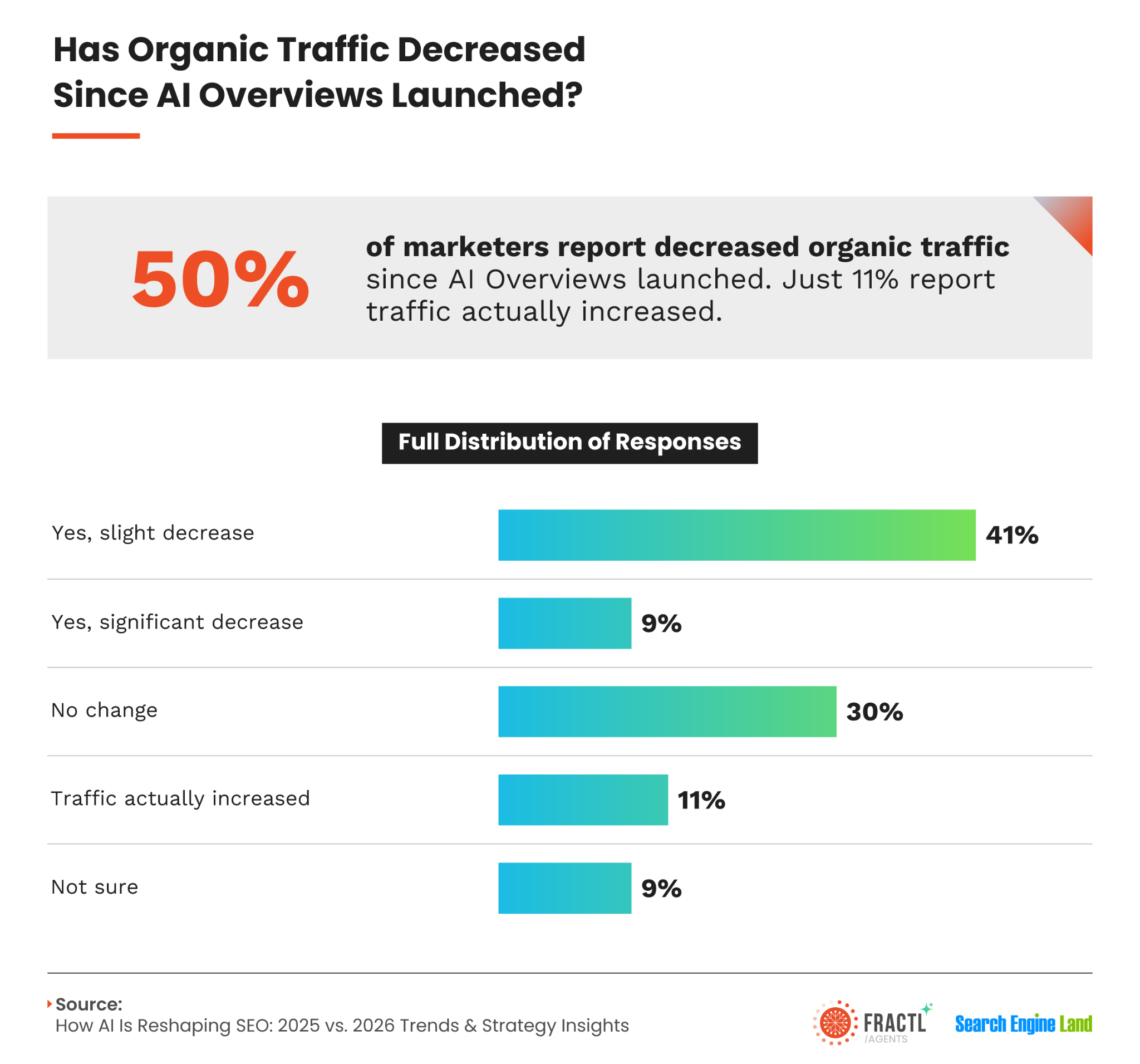
    Half of the marketers surveyed reported organic traffic declines since the launch of AI Overviews, and 61% blame AI. That is meaningful, but it is not the whole story.

    The larger shift is not simply from Google to ChatGPT. It is from search as a destination to search as a behavior. People are asking, comparing, validating, and deciding across platforms, communities, assistants, and review environments.

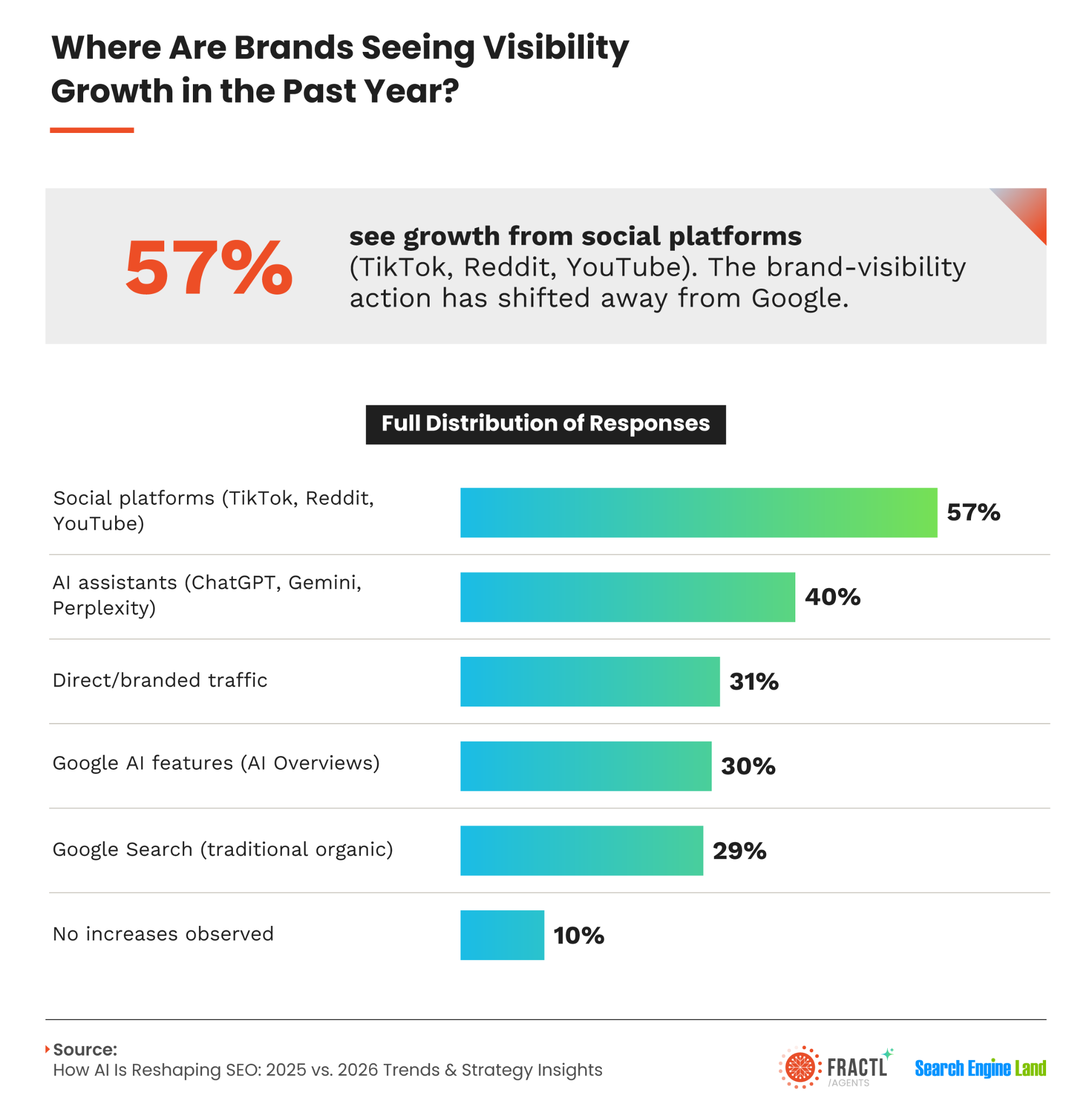
    The same marketers reporting organic losses are often finding visibility elsewhere. Fifty-seven percent report growth from social platforms such as TikTok, Reddit, and YouTube. Forty percent see growth from AI assistants such as ChatGPT, Gemini, and Perplexity. Thirty-one percent see growth in direct or branded traffic, while only 10% report no visibility growth anywhere.

    ```json
{
  "alt": "Infographic on brand misrepresentation in AI responses with statistics on AI inaccuracies and monitoring processes.",
  "caption": "Discover key insights into how brands experience AI misrepresentation and the importance of formal monitoring processes in this insightful infographic.",
  "description": "This infographic highlights the impact of AI on brand representation. It reveals that 27% of brands have been inaccurately described by AI, with 14% witnessing AI inaccuracies affecting customer or PR outcomes. Only 24% of organizations have a formal process to monitor AI brand mentions, indicating potential PR crises. Data sources include 'How AI is Reshaping SEO: 2025 vs. 2026 Trends & Strategy Insights.' Keywords: AI, brand misrepresentation, monitoring, PR crisis."
}
```

    That is why I think 2026 brand visibility depends on brand mentions and entity authority across the web, not just individual page rankings in Google.

    Marketers are prioritizing the easiest tactics

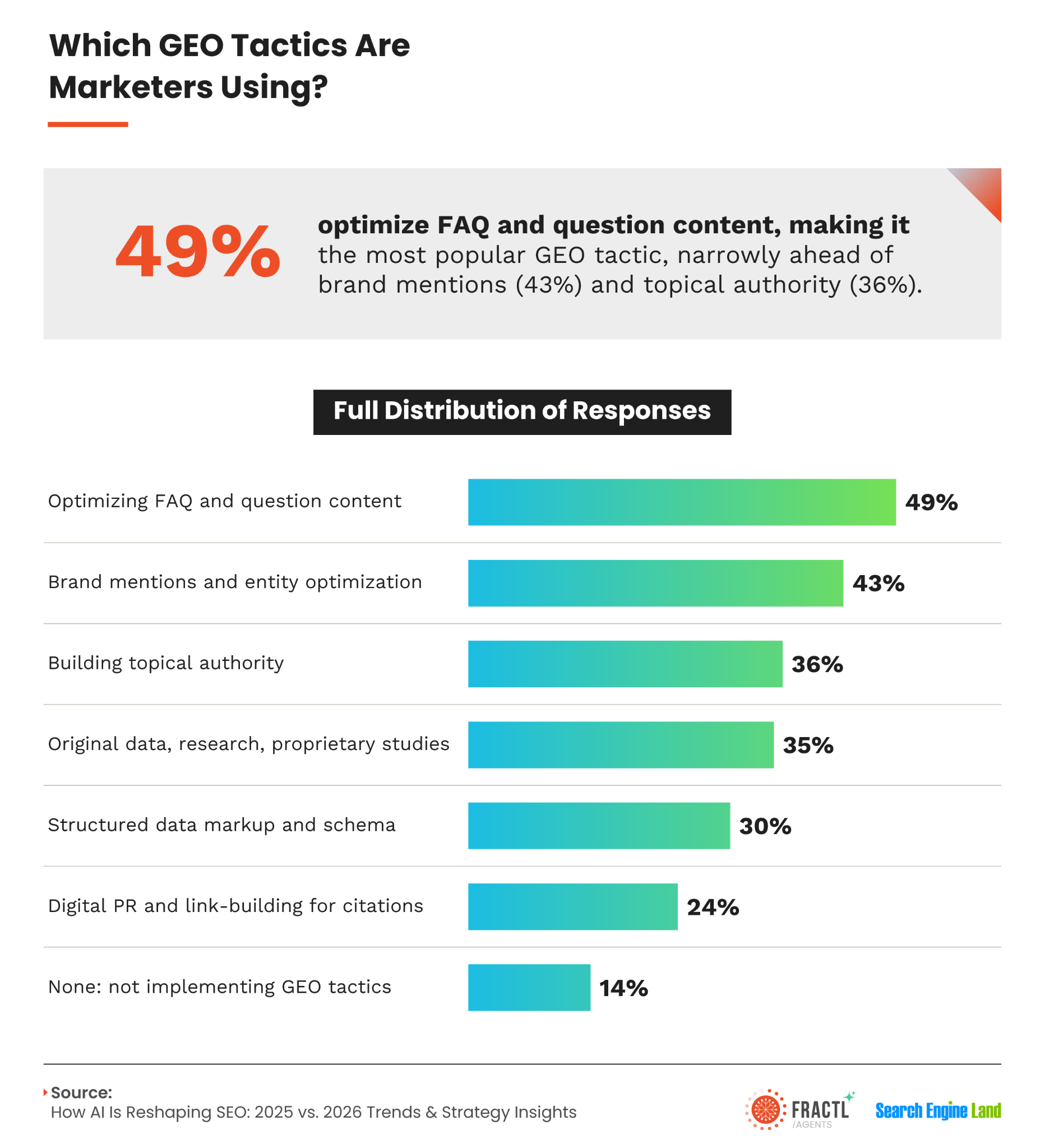
    Many teams are moving in the right general direction: community building, earned authority, owned audiences, expert content, and traffic diversification. The most prioritized strategies include building brand presence on social platforms at 59%, GEO and AEO optimization at 54%, and creating authoritative expert content at 44%.

    Infographic showing 50% of marketers report decreased organic traffic since Google AI Overviews launched, with response distribution by severity.
    Half of surveyed marketers say organic traffic has fallen since AI Overviews arrived, but the data points to pressure rather than collapse, with 30% reporting no change.

    But the least prioritized strategy is original research and data, at only 15%. I see that as a strategic inversion.

    Original, proprietary research is one of the hardest content assets for AI to replicate or commoditize. It earns citations, attracts links, builds topical authority, and gives journalists, communities, search engines, and AI systems something distinctive to reference.

    In GEO, the same pattern appears. Many marketers are using content-led tactics that AI can easily replicate. Long-tail FAQs can help with AI Overviews, and schema can support structure, but neither one builds credibility by itself.

    Infographic chart showing where brands saw visibility growth: social platforms lead at 57%, followed by AI assistants at 40% and direct traffic at 31%.
    As organic search pressure grows, marketers are finding brand visibility gains across social platforms, AI assistants, direct traffic and Google AI features, according to Fractl and Search Engine Land.

    The stronger moat is entity authority: proprietary data, expert perspectives, topical depth, and third-party validation. These are the assets that make a brand worth citing.

    GEO measurement is lagging behind execution

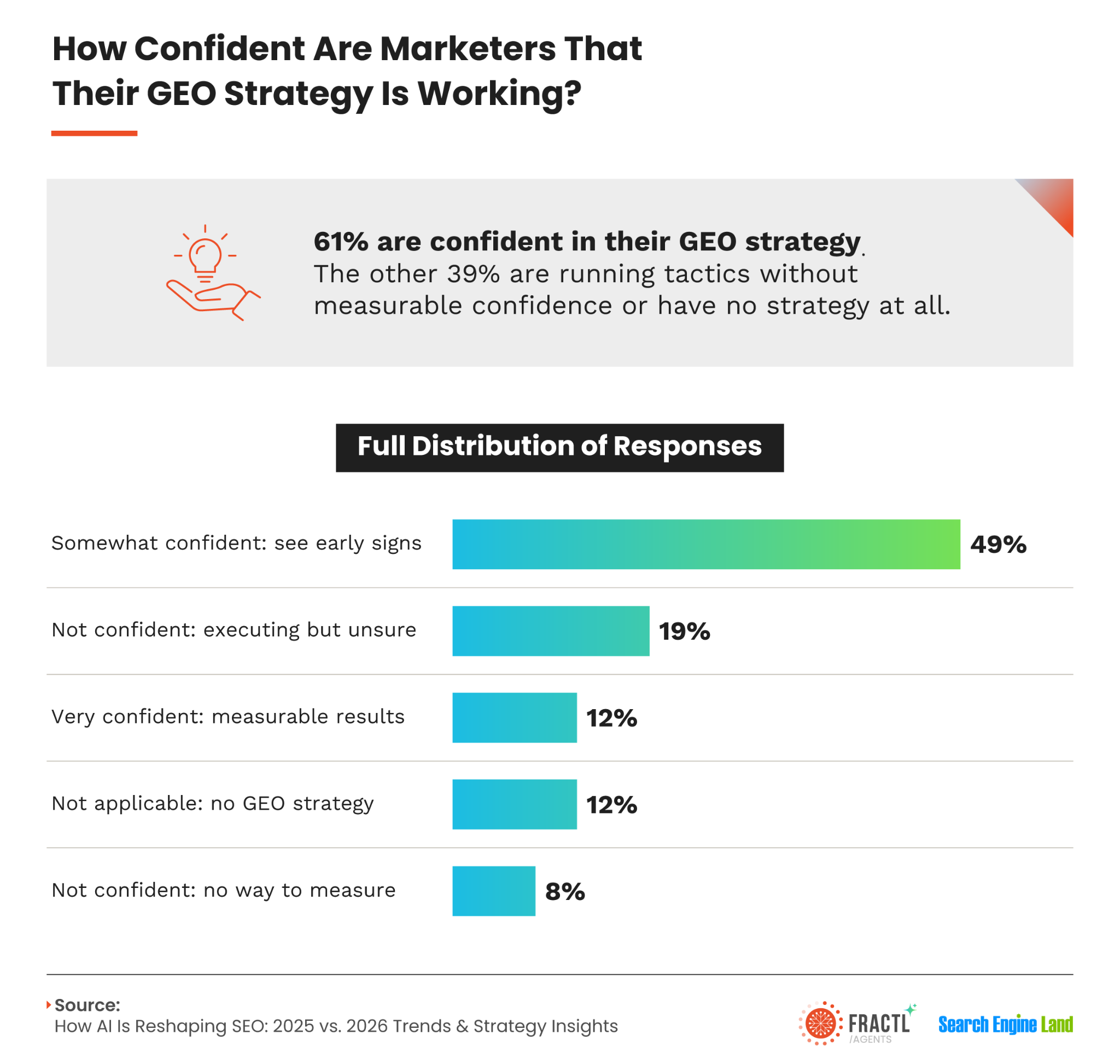
    Only a little more than half of marketers are confident in their GEO strategy, and only 12% have measurable results. That is understandable for a newer channel, but GEO is becoming too important to manage casually.

    Infographic showing GEO tactics marketers use, led by FAQ and question content optimization at 49%, followed by brand mentions at 43%.
    Marketers are leaning into practical GEO tactics, with FAQ optimization leading the pack, while entity authority, original research and citations trail behind.

    I believe visibility tracking, citation monitoring, branded search lift, and AI-assisted conversion analysis all need more attention. Teams that can prove GEO ROI will be able to defend and grow investment while others are still guessing.

    The main barrier to deeper AI integration is not leadership buy-in. Only 2% cite that as the obstacle. The top barrier is team training and skill gaps at 26%, followed by tool fragmentation at 20%, budget constraints at 19%, unclear ROI at 12%, and legal or compliance concerns at 12%.

    For search teams, that means AI literacy, prompt strategy, content quality control, and GEO measurement skills may be more valuable right now than adding another tool to the stack.

    Infographic showing marketer confidence in GEO strategy, with 61% confident and response distribution led by 49% somewhat confident.
    Most marketers see early signs their GEO strategy is working, but only 12% report measurable results, highlighting a major gap in AI search measurement.

    What I would do for a 2026 search strategy

    First, I would audit the brand’s AI footprint. I would query the brand name across ChatGPT, Gemini, Perplexity, and Google AI Overviews, then document what is accurate, what is missing, and what is wrong. Waiting until an AI error becomes a PR issue is too late.

    Second, I would invest in entity authority and original research. AI cannot invent legitimate proprietary survey data, named expert perspectives, verified brand facts, or original market analysis. Those assets become more valuable as AI systems get better at rewarding genuine authority.

    Third, I would distribute visibility across multiple platforms. Google organic remains necessary, but it is no longer sufficient. A brand needs a consistent presence in Reddit discussions, YouTube content, AI assistant responses, review platforms, and earned media.

    Fourth, I would build AI content governance, not just AI content workflows. Consumer demand for AI disclosure ranges from 84% to 91% across formats, while only 20% of brands always disclose. That gap is a reputational liability and may become a legal and regulatory one.

    Fifth, I would close the GEO measurement gap. If I can connect AI search mentions to traffic, lead quality, and revenue, I can prove ROI at a time when most teams cannot. That creates a budget and strategy advantage that compounds.

    Finally, I would double down on what AI cannot easily replicate: proprietary data, named experts, human-verified claims, transparent sourcing, and a consistent high-quality brand voice. In 2026, the brands that treat quality as a strategic differentiator are the ones most likely to be surfaced, cited, and trusted.

    Methodology

    Fractl and Search Engine Land surveyed 1,008 U.S. consumers and 150 marketers in Q2 2026. The consumer sample was nationally representative across age, gender, and region. The marketer sample included companies ranging from fewer than 10 employees to more than 5,000 and covered roles in SEO, content, social, analytics, paid media, PR, and marketing leadership.

    Where noted, findings are compared year over year against the same questions asked in Fractl’s 2025 consumer study conducted with Search Engine Land.


    Inspired by this post on Search Engine Land.


    crushpress.ai community screenshot