
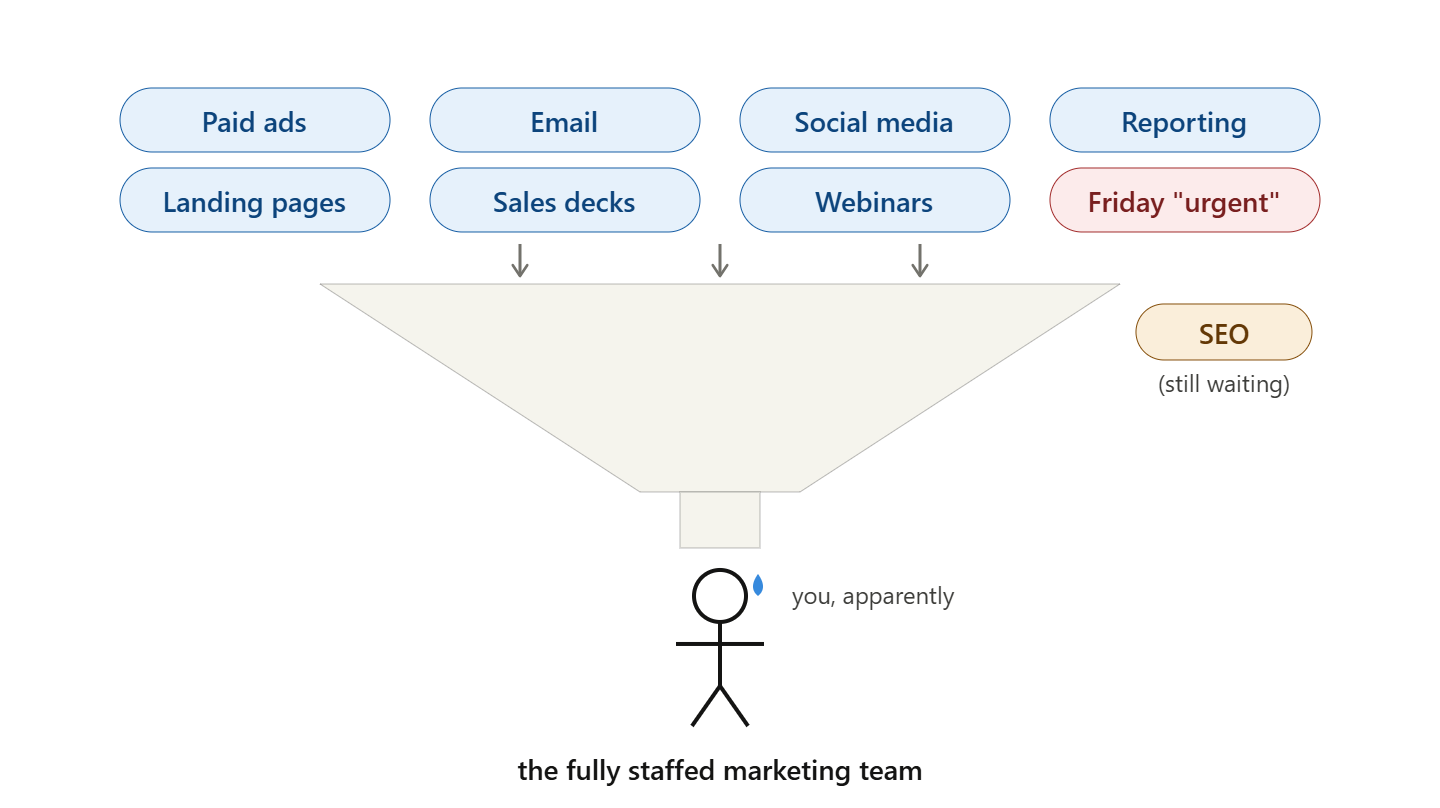
When one person is responsible for paid campaigns, landing pages, reporting, email, social posts, sales requests, and last-minute website updates, I know exactly what usually happens to SEO: it waits.
I have seen this play out on small marketing teams over and over. Everyone knows SEO can bring in qualified demand, reduce dependence on paid media, and support buyers long before they fill out a form. The problem is that SEO rarely feels urgent until traffic drops, rankings slide, or something breaks.
That is why I like a simple 120-minute weekly SEO workflow. It gives me a practical way to protect visibility, find opportunities, improve high-value pages, and turn search data into business impact without pretending I have unlimited time.
Why I keep SEO simple on lean teams
When SEO falls behind, I rarely see effort as the real problem. The bigger issue is usually competing priorities and a lack of clear prioritization.
On a lean team, SEO is one tab among 20. The person responsible for organic growth may also be sending newsletters, briefing designers, updating landing pages, and pulling the report leadership wants by Friday.
Then the advice starts piling up: fix technical issues, publish more, build topical authority, refresh old posts, add schema, improve Core Web Vitals, build links, optimize for AI search, and keep going. Most of that advice may be valid, but no small team can do all of it in one week.
The question I come back to is not, “What could I do?” It is, “What is the highest-leverage thing I can actually finish this week?”
I also try to avoid the reporting trap. It is easy to spend an entire SEO block looking at rankings, traffic, impressions, clicks, CTR, conversions, competitor movement, and keyword shifts. Then the hour ends and nothing ships.
For a small team, reporting has to be short enough to leave room for action. The goal is to decide what to fix next, not to build another dashboard.
Why 120 minutes can be enough
I do not try to run a lean team like an enterprise SEO department. If I audit everything, track everything, collect endless keywords, and ship nothing, I have not improved organic growth.
The point of time-boxing is to force a decision. Every weekly session should end with one or two changes that improve visibility, traffic quality, or conversion potential.
In my 120-minute workflow, I focus on four outcomes: finding what is already working, fixing what is blocking performance, improving the pages closest to revenue, and turning search data into next week’s actions.
I am not trying to “do SEO” for two hours. I am using two focused hours to make decisions and ship work that has a realistic chance of moving the business forward.
My 120-minute weekly SEO workflow
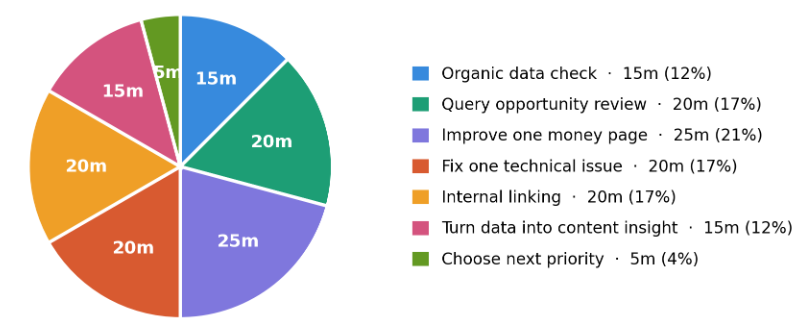
0-15 minutes: Check organic data
I start with a pulse check so I can catch problems before they turn into bigger performance drops.
I look at Google Search Console clicks, impressions, CTR, and average position. I also check organic conversions or assisted conversions in GA4, top landing pages gaining or losing traffic, branded versus non-branded movement, and any indexing, crawling, or manual action warnings.
What I do not do is turn this into a full reporting session. This is not a board deck. I only want to answer one question: is organic visibility moving in a direction that needs action?
My output is a short weekly note: the biggest organic win, the biggest organic concern, one page or query to investigate, and one action to take this week.
15-35 minutes: Find query opportunities
Next, I look for the easiest opportunities in Google Search Console. The richest ones are often queries ranking in positions 4-15 with real impressions. Those pages are already close, and a focused improvement can help them move.
I also watch for pages with strong impressions but weak CTR, queries climbing week over week, and rankings where the current page only partially matches search intent.
I resist the urge to build a long keyword list. Instead, I pick three things: one page to improve, one query to answer better, and one title or meta description to test.
For example, when I reviewed search data for a local accounting client, several queries kept appearing around tax help for freelancers, small-business tax mistakes, and the difference between an accountant and a bookkeeper.
The obvious reaction would have been to write three new articles. Instead, I rewrote one service page around freelancers, added a short FAQ based on those queries, and linked it to an existing bookkeeping article. One page served three search intents, which was far more useful than three unfinished drafts.
35-60 minutes: Improve one money page
This is the most important part of the workflow. I define a money page as any page close to revenue, pipeline, bookings, sales, demos, or consultations.
Money pages can include product pages, service pages, category pages, comparison pages, demo pages, consultation pages, pricing pages, and high-intent landing pages.
My weekly goal is not to optimize the entire website. It is to improve one important page in one meaningful way.
I ask what the buyer needs to believe before converting, what objection is missing, what proof would reduce hesitation, what comparison the buyer already has in mind, and what query the page almost satisfies but does not fully answer.
A meaningful update might be adding three FAQs based on real queries, improving the H1 and introduction, adding comparison language, including proof points, linking to a case study, clarifying who the offer is for, improving the CTA, or adding a short “how it works” section.
That is SEO work, but it is also conversion work. The best page improvements usually help both search engines and buyers understand the value faster.
60-80 minutes: Fix one technical or indexing issue
Technical SEO can take over the full two hours if I let it, so I stay focused on impact.
The question I ask is simple: what could stop an important page from being discovered, understood, indexed, or trusted?
That usually points me toward issues like priority pages not being indexed, broken internal links, redirect chains, duplicate or missing titles on key pages, incorrect canonicals, schema errors on important templates, or valuable pages buried too deep in the site.
I want one of three outcomes from this block: a fix shipped, an issue assigned, or a clear developer brief.
For example, if I find that ecommerce collection pages are not indexed because of incorrect canonical tags, documenting the affected URLs and writing a clear developer brief may be more valuable than publishing another generic article.
80-100 minutes: Improve internal links
Internal linking is one of the fastest SEO wins I can create because it does not require new content.
It helps search engines understand which pages matter, helps users continue their journey, and helps informational content support commercial outcomes.
Each week, I look for links from high-traffic articles to money pages, links from product or service pages to supporting guides, links from older articles to newer strategic content, and opportunities to use clearer anchor text.
If an article ranks for “how to choose accounting software,” I do not want it to be a dead end. I want it to guide readers toward a comparison guide, a relevant case study, and a demo or pricing page. The traffic is already there, so I try to make it more useful.
100-115 minutes: Turn one search insight into messaging
I do not want search data to stay trapped in an SEO silo. The best query I find each week is often a useful signal for the rest of marketing because it shows the language buyers actually use.
A query like “best CRM for small agencies” can become a comparison section on a landing page, a LinkedIn post, a sales email angle, and a paid search ad group.
A query like “is [product] worth it” can become a proof section, a pricing explainer, a “who this is not for” paragraph, or a ready-made answer to a sales objection.
When I share one search insight each week, SEO becomes more than a channel. It becomes a source of customer intelligence.
115-120 minutes: Choose next week’s priority
I end with a decision, not a long list. I choose one clear priority for next week based on business impact, search demand, ease of execution, current performance gap, and proximity to revenue.
The template I use is: “Next week, my highest-leverage SEO action is [X] because [Y].”
For example: “Next week, my highest-leverage SEO action is updating the pricing page because it gets non-branded traffic, supports demo requests, and does not answer implementation cost questions.”
That is how I make SEO operational. The work becomes specific, owned, and easier to repeat.
A sample month for the workflow
To keep the workflow balanced, I like rotating the emphasis each week.
In week one, I focus on a revenue page. I update copy, add FAQs, improve internal links, check indexing and schema, and sharpen the CTA.
In week two, I refresh existing content. I choose one article with impressions but weak clicks or rankings, improve the title, add missing sections, update examples, link to money pages, and better match search intent.
In week three, I handle technical cleanup. I focus on one crawl, indexing, or template issue, such as broken links, duplicate titles, sitemap problems, or a developer brief for a higher-impact fix.
In week four, I turn SEO data into broader marketing assets. That may mean one landing page insight, one sales objection, one content brief, one paid or social angle, or one FAQ or comparison section.
This rotation keeps me from spending every week in dashboards, technical audits, or new content production while ignoring the pages that already have potential.
What I stop doing
Most small teams do not have a doing problem. They have a stopping problem.
I stop chasing every low-impact technical warning. I stop creating content just because a tool found a keyword. I stop publishing AI-assisted articles at scale without a strategy. I stop rewriting pages without a hypothesis. I stop optimizing low-value pages before revenue pages. And I stop treating rankings as the only score that matters.
Before I create new content, I review the pages I already have. The highest returns often come from pages that already rank on Page 2, already get impressions, sit close to revenue, and are one focused update away from doing more.
My test for any task is simple: if I cannot connect it to qualified traffic, conversions, discoverability, buyer education, or trust, it does not belong in the 120 minutes.
How I make it work without a dedicated SEO person
This workflow does not require a full SEO department. It requires one owner, a weekly rhythm, and a bias toward shipping.
A marketing manager can own prioritization and the weekly SEO note. A content marketer can update copy, FAQs, and page sections. A developer or web support partner can handle technical fixes. A paid search manager can share query and conversion insights. A founder or sales team can contribute objections and buyer language.
The owner matters most. Someone has to protect the 120 minutes, choose the priority, and make sure the session ends with an action.
Without ownership, SEO becomes everyone’s job and nobody’s job.
How I use AI to save time
I use AI to shorten repetitive SEO work, not to hand over strategy.
That might mean using a focused workflow to identify queries in positions 4-15, pages with high impressions and low CTR, search queries that should become FAQs, internal linking opportunities, or technical issues that should become developer briefs.
For agencies, client-specific assistants can reduce context switching by remembering each client’s services, priority pages, competitors, and customer objections.
The most useful AI workflows are narrow: a GSC opportunity analyzer, a money page refresh assistant, an internal linking assistant, a technical SEO brief generator, or an SEO reporting summarizer.
I do not want one generic SEO assistant trying to do everything. I want small workflows that help me move faster from data to decisions.
Consistency is the advantage
Small teams win SEO by doing the highest-leverage things repeatedly.
A 120-minute weekly SEO workflow will not replace a full strategy. It will not solve every technical issue, build every content asset, or uncover every opportunity.
But it gives me a practical way to protect visibility, learn from search data, improve revenue pages, and keep organic growth moving.
The mindset is simple: less auditing, more shipping, more buyer intent, less busywork, and more business impact.
Inspired by this post on Search Engine Land.

Leave a Reply