Tag: Internal Linking

  • How I Build SEO Strategies That Drive Real Revenue

    How I Build SEO Strategies That Drive Real Revenue

    I have watched the SEO industry become exceptionally strong at its technical craft. We have made real progress in crawl architecture, Core Web Vitals, content frameworks, entity optimization, and link acquisition at scale.

    Where I still see a gap is in how SEO connects that craft to the financial realities of the businesses it supports. Too often, SEO struggles to speak the language that gets budgets approved and strategies prioritized.

    If I want more funding and a stronger seat at the table, I have to change how I define what SEO is trying to achieve. That means moving beyond visibility alone and tying organic search to commercial outcomes.

    Here is how I make an SEO strategy more commercially aware.

    Why paid search often gets more funding

    Paid search usually frames its goals around clear commercial inputs and outputs. Money goes in, revenue comes out, and the difference helps determine whether investment should increase, decrease, or shift. Every campaign sits inside a financial framework.

    Even when paid search is expensive or inefficient, leadership can still see the goals, the numbers, and the tradeoffs. That makes resource decisions easier.

    SEO teams often present rankings as the final goal rather than a route to revenue. They report traffic without connecting it to transactions, or highlight technical improvements that matter to SEO but do not translate clearly into business value.

    When organic search does not get enough funding, it is easy to say leadership does not understand SEO. I think the more useful explanation is that SEO has not always made its commercial case clearly enough. Leadership needs to see organic search measured in sales, margins, and channel ROI.

    What commercial awareness requires

    Before I plan SEO work, I try to change the questions I ask.

    Instead of asking which topics have the highest search volume, I ask which categories and product lines carry the strongest margins. Then I evaluate search demand within those areas.

    Instead of asking where I should create new content, I ask which existing pages would generate meaningful revenue if they ranked better. From there, I work backward into the SEO plan.

    Instead of measuring success only in organic sessions, I measure it in organic profit. To do that, I need to know what the channel costs and what it returns.

    Financial metrics I use for commercial SEO

    When I run organic search as an acquisition channel, I pay close attention to these metrics:

    • Organic sales.
    • Organic revenue.
    • Organic profit.
    • Average order value from organic traffic.
    • Average margin per organic sale.
    • Channel ROI.

    These metrics are not exotic or especially difficult to calculate. They usually require connecting analytics data to backend transactional data, which most organizations can do with a modest investment in reporting infrastructure.

    One metric I keep returning to is organic profit per sale. I calculate it by dividing organic profit by organic sales.

    This turns organic search into a customer acquisition channel with a measurable cost per outcome. It also gives me a concrete benchmark I can compare against other channels.

    When I break that metric down by category, subcategory, and page, I can make strategic decisions using commercial data first, then layer SEO execution on top.

    Focus on value-side metrics

    Most SEO strategies lean heavily on demand-side metrics such as:

    • Search volume.
    • Keyword difficulty.
    • Current ranking positions.
    • Traffic estimates.

    I still need those inputs, but they only show half of the picture. They tell me where demand exists, not where value is strongest.

    To make better commercial decisions, I layer value-side metrics on top of demand data, including:

    • Categories with strong margins.
    • Pages that drive high transaction values.
    • Customer segments that stay profitable over time.

    From a revenue and profit perspective, a category with modest search volume can outperform a higher-traffic segment if it has stronger margins or a higher average order value.

    SEO tactics that move the commercial needle

    When I take a commercially aware approach, I evaluate strategic decisions against business outcomes rather than traffic projections alone. That includes decisions about informational content, authority building, and brand visibility.

    Informational content and topical authority still matter. A channel that only chases transactional queries will eventually hit a ceiling. The difference is that I want every major SEO initiative to have a clear commercial role.

    Score demand and business value together

    I apply a second filter that considers business value alongside search demand.

    That means I look at margin potential, average sale value by category, and current organic performance compared with where it needs to be. Then I weigh those signals against demand.

    The highest-priority work usually sits where meaningful demand and strong commercial signals overlap. In practice, that often produces a different priority list than traditional keyword research alone.

    Update commercial pages before creating more content

    Commercial pages naturally decay over time. Competitors improve their pages, SERPs change, and freshness signals fade. That decay can turn directly into lost revenue from pages that used to perform well.

    When I update commercial pages, I focus on a few practical moves:

    • I use keyword and competitor research to find content gaps.
    • I restructure information into formats that search engines and AI interfaces can easily extract, especially tables where they make sense.
    • I use a large language model to review first drafts and stress-test the content against competing pages.
    • I strengthen internal links to the pages that have revenue and margin potential.

    Increase internal linking

    Internal links from strong informational assets and high-authority pages to commercial pages can create direct business value when those destination pages have revenue and margin potential.

    Futuristic data archive with glowing server-like filing cabinets, stacked documents, and network lights symbolizing AI marketing data infrastructure.
    Rows of illuminated data cabinets and paper files stretch into the distance, capturing the pressure on marketers to turn fragmented customer data into a smarter performance engine.

    I spend significant time building internal links into commercial page clusters, especially when supporting content has authority but the connected commercial pages are underperforming in search.

    Borrow conversion intelligence from paid search

    SEO usually cannot see exactly which organic keywords drive conversions. I may have page-level conversion data, but the specific queries that create visits and purchases are often hidden.

    The best workaround I have found is to review recent PPC campaign data, usually from the last 30 to 90 days, and adjust for seasonality. This helps me identify keyword patterns that generate sales and high-value customers in paid search.

    I can then use those insights to prioritize organic landing pages, update commercial content, and decide where conversion optimization is most likely to pay off.

    Recover transactional terms just outside Page 1

    A valuable group of transactional keywords often sits in positions 10 through 20. These are commercial-intent terms where I am already in the conversation, but not yet visible enough to convert meaningful traffic.

    I identify these opportunities by filtering for commercial intent and business potential. Then I apply targeted improvements such as content updates, internal links, and relevant authority building.

    Build digital PR with commercial architecture

    Digital PR campaigns that exist only to acquire links rarely create meaningful commercial impact. I prefer to build a linking environment that supports the product categories I care about most.

    That means I structure campaigns around a few principles:

    • I focus on topics that are thematically relevant to important product categories.
    • I create an on-site asset that acts as the campaign destination and links back to relevant commercial pages.
    • I build the asset with internal links to the commercial page clusters it is designed to support.

    Treat branded search protection as a profit issue

    When affiliates rank for discount and voucher terms and capture that traffic, I may end up paying commission on customers who were already in the funnel and likely would have converted directly.

    The fix is straightforward. I improve on-site pages that target branded intent, strengthen internal signals, monitor branded click share, and enforce affiliate program terms around branded bidding.

    That can improve margins as well as revenue because it removes acquisition costs from conversions that should have been organic in the first place.

    Choose an attribution model

    Attribution is rarely clean. Organic sessions may appear as direct traffic, GA4 and backend systems may report different numbers, and multi-touch journeys can resist neat channel assignment.

    These problems are not unique to organic search. As AI-mediated search complicates referral paths further, attribution will become even harder.

    I choose an attribution model the organization can agree on, stay transparent about its limitations, and focus on growing the revenue attributed to organic search under that model.

    When leadership consistently sees organic search contributing meaningful and growing revenue, the finer attribution nuances become less important.

    Treat budget as a lever, not a constraint

    I view an SEO budget as a variable that can be adjusted based on commercial KPIs.

    The model is simple: SEO profit equals the business margin generated from organic search minus the cost of running the channel.

    When revenue growth is the priority, I can invest more aggressively in link acquisition, digital PR, and content production to expand visibility and capture incremental demand.

    When channel profitability matters more, especially during a business cycle where margin preservation is more important than top-line growth, I can reduce spending to improve short-term profit. I just need to be clear about the competitive risk of sustaining those reductions for too long.

    How I secure internal alignment

    Commercial SEO depends on cross-functional cooperation. To build alignment, I focus on the conversations that help other teams see SEO as part of the business growth engine.

    Speak the language of decision-makers

    Commercial and finance leaders care about growth, margins, and competitive position. I frame SEO in those terms, with revenue and margin projections tied to specific strategic initiatives.

    Generate proof before asking for major investment

    SEO takes time to show results, so I prefer to earn buy-in with a contained test before asking for a larger investment. That test might involve updating a group of commercial pages, completing a targeted internal linking project, or launching a branded search protection initiative.

    Use competitive visibility strategically

    I show leadership where competitors outrank us for high-value commercial terms, then quantify what that could mean in lost market share and revenue. Concrete numbers make the opportunity easier to understand.

    Build relationships that make execution faster

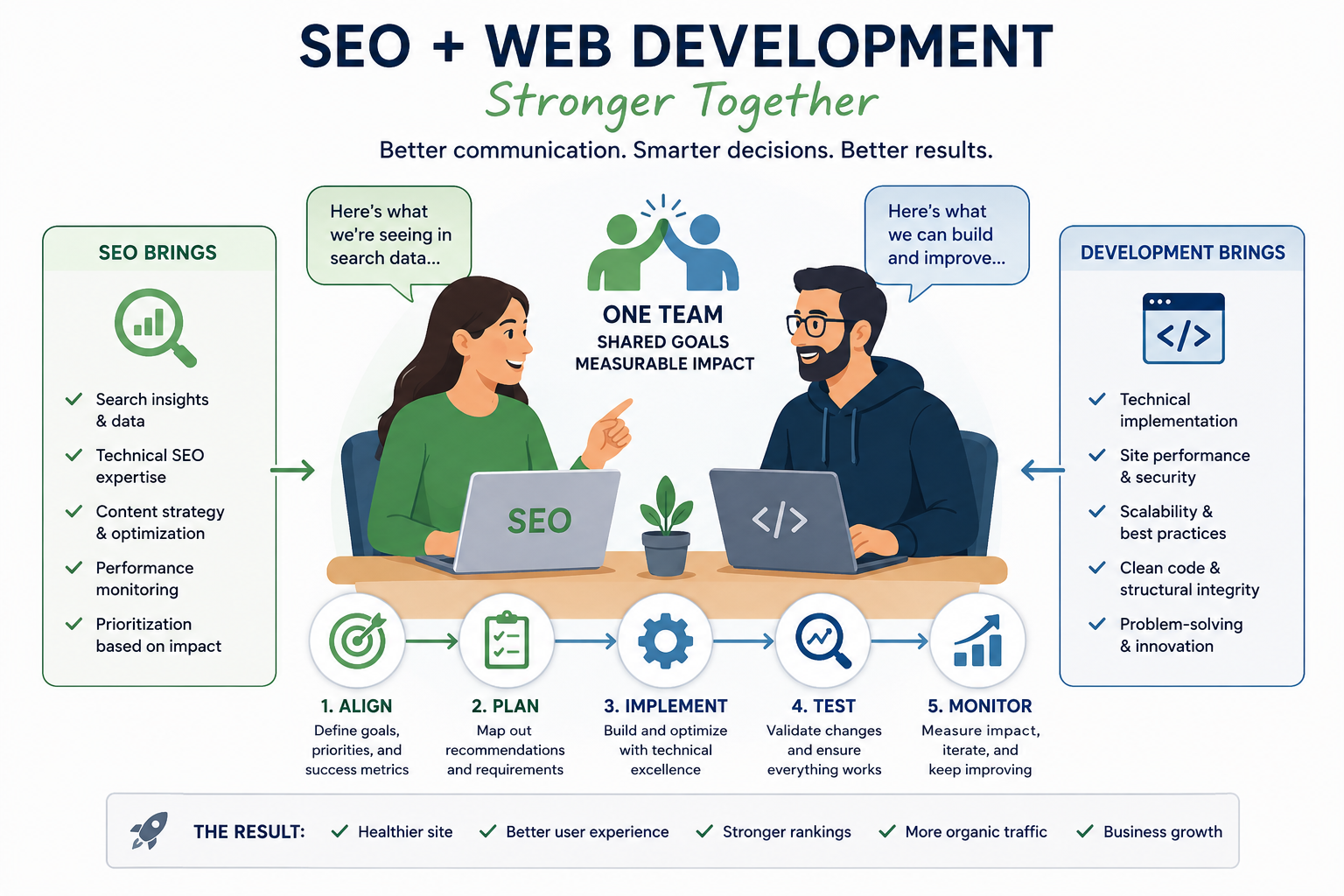
    When SEO is positioned as part of an integrated commercial growth engine, with shared data and coordinated prioritization, it becomes much easier to get work shipped. SEO touches paid search, content, product, and PR, so I treat those teams as allies rather than separate workstreams.

    Why commercial awareness should shape SEO strategy

    SEO has become technically sophisticated, but technical sophistication alone does not secure budget or influence priorities. I need to connect SEO work to the outcomes commercial leaders care about.

    I believe SEO should be held to the same standards of commercial accountability as other marketing investments. When that happens, organic search can become a cost-effective driver of growth and profitability.

    Commercial awareness does not require abandoning SEO fundamentals. It requires redefining success and having the discipline to organize strategy around revenue, profitability, and return on investment.


    Inspired by this post on Search Engine Land.


    crushpress.ai community screenshot
  • How I Safely Roll Out High-Impact Technical SEO Changes

    How I Safely Roll Out High-Impact Technical SEO Changes

    When I work on technical SEO, I know the right changes can dramatically improve how search engines crawl, understand, and evaluate a website.

    I also know that the recommendations with the biggest upside usually carry the biggest implementation risk. URL changes, canonical updates, robots.txt edits, internal linking improvements, and site migrations can all strengthen organic performance, but one mistake can damage crawling, indexing, and search visibility.

    That is why I do not treat technical SEO as a simple list of fixes. I treat it as a process: evaluate the impact, weigh the effort and risk, align the right teams, and test everything before and after launch.

    From audit to implementation to prioritization

    For me, the work is not finished when the SEO audit is delivered.

    Prioritization is where the real judgment begins. I look at how severe the issue is, what outcome I expect, how many pages are affected, how much development effort is required, and what could go wrong if the change is implemented poorly.

    The recommendations with the greatest potential impact often need buy-in from developers, content teams, product owners, and stakeholders because they require more resources and carry more risk. A clear recommendation, a practical test plan, and early alignment make implementation much easier to move forward.

    Understanding the issue and potential outcome

    I do not assume every technical SEO issue found in an audit needs immediate action. Before I prioritize a recommendation, I validate it manually and consider the broader context of the site, including priority sections, platform limitations, and business goals.

    For example, missing meta descriptions on low-priority pages or title tags that fall outside recommended lengths may appear in an audit because they are easy for tools to measure, not because they will meaningfully affect performance.

    Crawling tools and automated reports are valuable because they help me find issues at scale. But they do not always tell me whether an issue matters to the business.

    A warning may point to a real problem, an intentional setup, a platform constraint, or something with little to no measurable impact. I need that context before I decide what deserves attention.

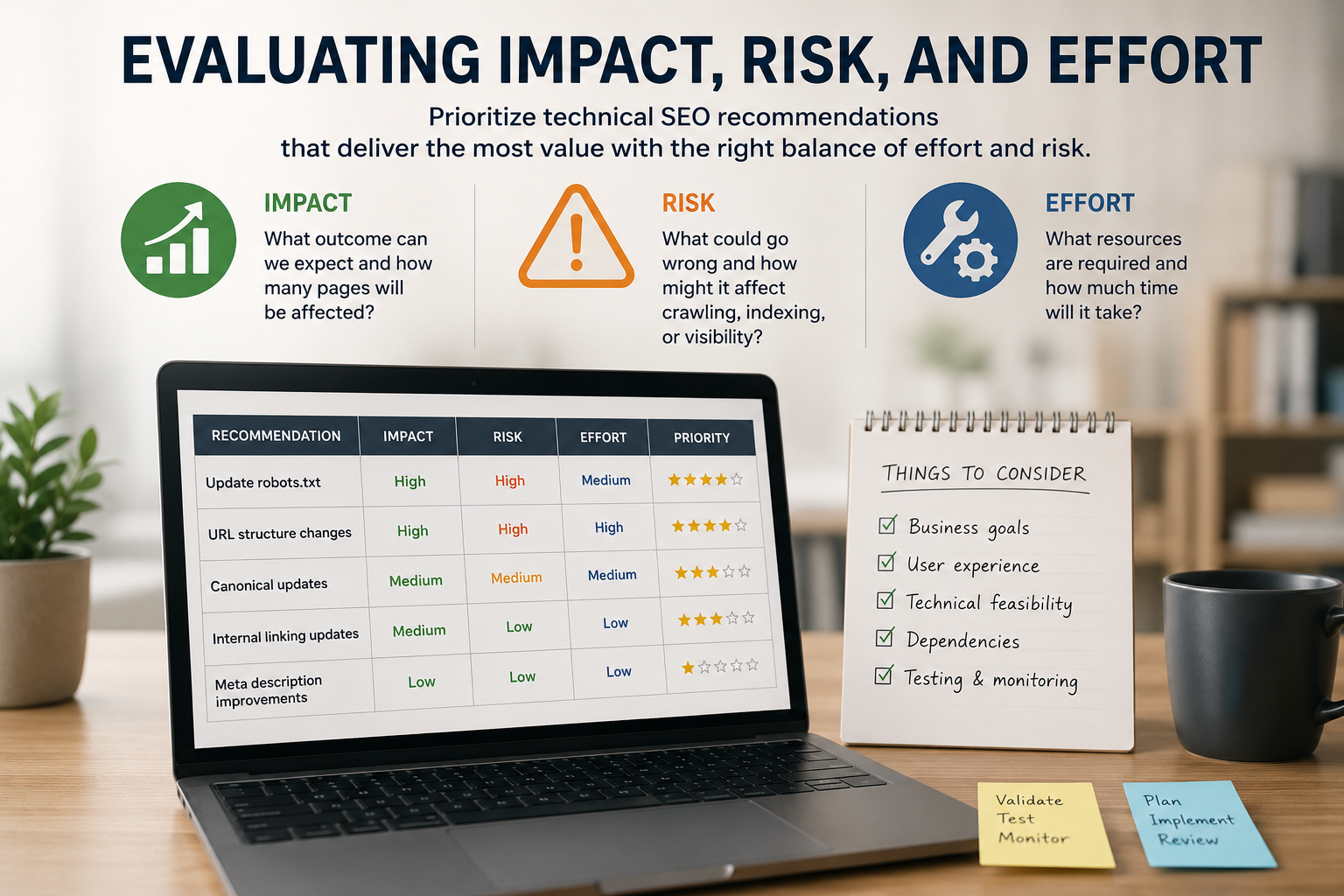
    Evaluating impact, risk, and effort

    Once I validate an issue, I decide how to address it and whether it is worth recommending for implementation.

    When I am prioritizing technical SEO recommendations for a development queue, I consider the number of affected pages, the expected outcome, the resources required, and the potential risks.

    Image

    Updating a few title tags may be low risk. Changing URL structures or modifying robots.txt directives can affect thousands of pages and influence crawling, indexing, and discoverability.

    By understanding both the upside and the downside, I can make better decisions, allocate resources more responsibly, and plan changes in a way that reduces risk while still pursuing meaningful gains.

    High-impact technical changes that require extra caution

    The following technical SEO initiatives can meaningfully affect site performance. I do not avoid them because they are risky. I approach them carefully because their implications, benefits, and failure points need to be understood before implementation.

    1. URL updates and changes

    I often recommend URL updates when a site needs a clearer folder structure, content consolidation, rebrand support, or stronger information architecture.

    For example, a business may move service pages from the root domain into a subfolder so the content is easier to organize and the site is easier to navigate.

    URL changes can provide real benefits, but I need to make sure those benefits outweigh the risks and that a proper redirect strategy is ready before anything goes live.

    Search engines treat a changed URL as a new URL, so redirects are essential for preserving rankings, traffic, backlinks, and other signals tied to the original page. Missing redirects, bad mappings, redirect chains, outdated internal links, and stale XML sitemaps can all hurt crawling, indexing, and discoverability.

    Before I move forward with URL changes, I create a redirect mapping plan. Ideally, I validate and test redirects in a development environment before launch, then check them again after launch and update the XML sitemap.

    I also include internal link updates and performance monitoring in the launch plan. Careful planning helps preserve existing SEO equity while supporting the larger goals of the site.

    2. Canonical updates

    Canonical tags help search engines understand which version of a page should be treated as the preferred version when duplicate or similar content exists. I use them to consolidate ranking signals, avoid internal competition, improve crawl efficiency, and clarify which URLs should be prioritized for indexing.

    For example, an ecommerce site may use canonical tags to consolidate parameter-based URLs or faceted navigation pages to a primary product or category page. But if a canonical tag is applied to the wrong template, it could unintentionally tell search engines to consolidate an entire group of important pages elsewhere.

    Image

    Canonical updates may look simple, but mistakes can be difficult to spot once they are deployed across a site. I take time to review canonical targets and validate the implementation so I do not send conflicting signals that cause important pages to lose visibility or fall out of the index.

    3. Robots.txt file changes

    The robots.txt file controls how search engines and other crawlers access content on a website. I usually recommend robots.txt changes to improve crawl efficiency, prevent low-value content from being crawled, or limit access to specific site sections.

    For example, I may recommend blocking filtered URLs, internal search results, or other pages that consume unnecessary crawl resources. When implemented correctly, these updates help focus crawl activity on more important content.

    The risk comes from rules that are too broad, misplaced, or copied from the wrong environment. A single directive can block important sections of a site from being crawled. Accidentally deploying a staging robots.txt file to production can also disrupt how crawlers access live content.

    Because robots.txt changes can affect large parts of a site, I test rules carefully, review the proposed changes against the intended URL patterns, and verify the implementation after launch. Even a small robots.txt edit can have sitewide consequences.

    4. Internal linking changes

    Internal linking helps search engines discover content, supports priority pages, connects related topics, and guides users through a website. My recommendations may include updating navigation, adding contextual links, consolidating content hubs, or improving pathways to key pages.

    As websites evolve, internal linking often needs cleanup. Removing important links, creating orphaned pages, linking to staging environments, or accidentally pointing users and crawlers to non-public URLs can all hurt discovery. Large navigation updates can also change how easily search engines reach important content.

    That is why I always look closely at scope. A navigation update may touch thousands of pages, making it far riskier than adding a few contextual links to a small group of priority pages.

    5. Site migrations

    At some point, every SEO team deals with a site migration. It may happen because of a rebrand, a domain change, a redesign, or a move to a new CMS. When planned well, migrations can improve user experience, support long-term SEO performance, and benefit the business.

    They are also inherently risky because they often combine several technical SEO changes at once. Redirects, URL restructures, canonical tags, indexing directives, content updates, and internal linking changes may all happen during the same launch. With that many moving parts, even a small oversight can affect crawling, indexing, and visibility.

    Even a well-planned migration can run into problems if changes are not documented, tested, reviewed, and validated throughout the process. I rely on pre-launch QA, post-launch testing, and ongoing monitoring to catch issues before they have a lasting effect on performance.

    Image

    Working across teams to ensure success

    Technical SEO updates often require multiple teams to work together. I may need input from content teams, in-house developers, external agencies, product managers, and analytics teams before a change is ready to launch.

    Clear communication is essential. I make recommendations straightforward, build testing and QA into the process, and define success criteria before launch. I also want a plan for quickly identifying and resolving issues if something goes wrong.

    Communicating recommendations effectively

    Whether I am discussing a recommendation directly with developers or documenting it in a structured ticket, I make sure the issue is clearly defined, examples are included, and the required changes are easy to understand.

    Clear documentation helps me set expectations, explain scope, identify affected URLs, and define the expected outcome. It also gives teams a place to ask questions, raise concerns, and flag limitations before implementation begins.

    Testing in development environments

    Whenever a site change is made, I want it tested thoroughly before launch. A development environment gives me a place to validate the implementation, ask questions, and provide feedback while there is still time to adjust the work.

    Post-launch testing and monitoring

    Sometimes a change that works perfectly in development behaves differently after launch.

    That is why I am ready to validate the implementation as soon as changes go live. Post-launch checks help me identify issues quickly, begin troubleshooting immediately, and monitor the impact before small problems become larger ones.

    Balancing opportunity and risk

    Most technical SEO recommendations are designed to improve crawling, indexing, or site architecture. When I implement them correctly, they can significantly improve how search engines access, understand, and evaluate a website.

    But implementation usually depends on multiple teams working toward the same goal. As a recommendation moves from audit to production, misunderstandings, assumptions, and overlooked details can create unintended consequences.

    That is why I see technical SEO as more than finding opportunities. I need to understand the issue, evaluate the potential impact, weigh the development effort, and manage the risk of implementation.

    No technical SEO change is completely risk-free. But with thoughtful planning, clear communication, thorough testing, and ongoing monitoring, I can catch issues earlier, reduce their impact, and roll out high-impact changes with the caution they deserve.


    Inspired by this post on Search Engine Land.


    crushpress.ai community screenshot
  • My 120-Minute Weekly SEO Workflow That Drives Results

    My 120-Minute Weekly SEO Workflow That Drives Results

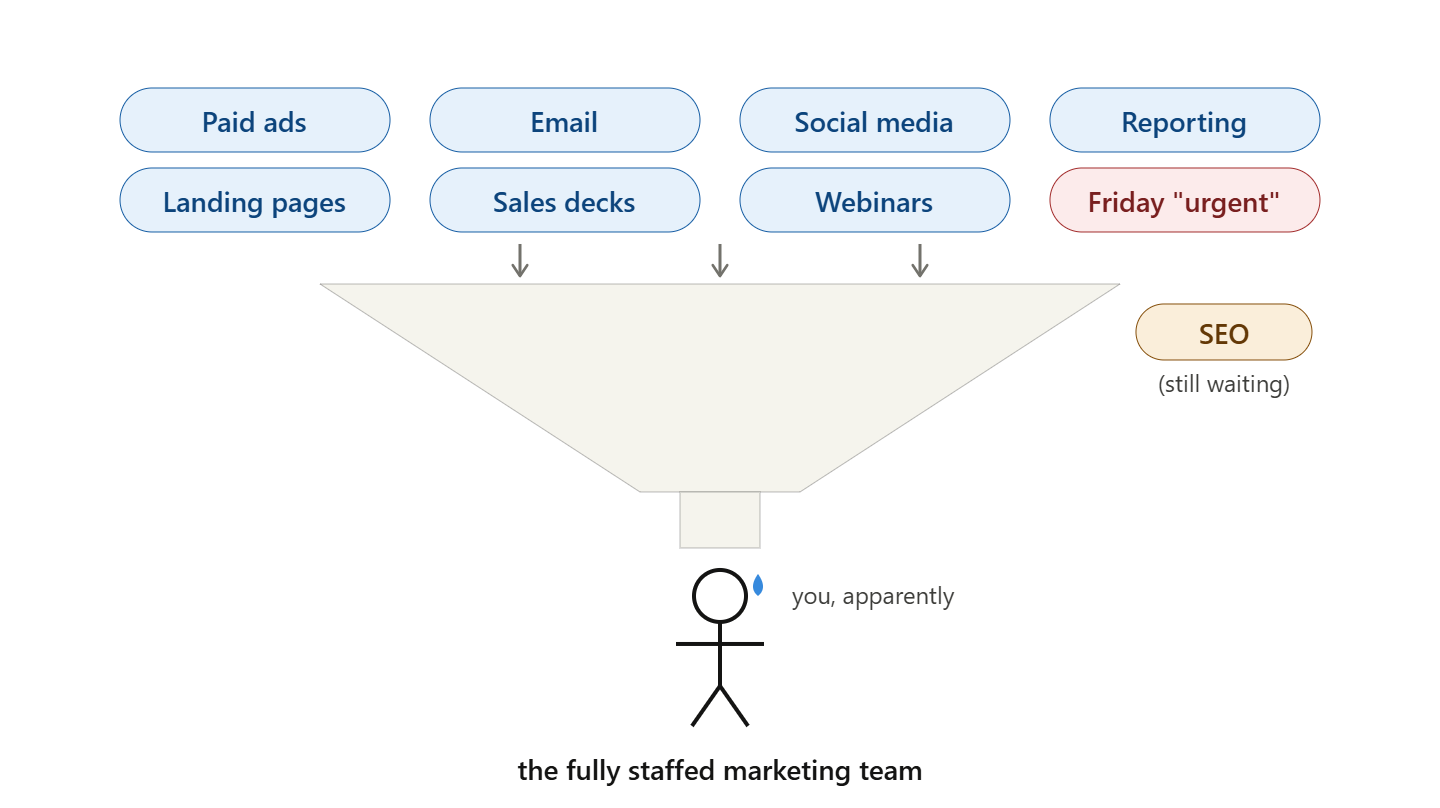
    When one person is responsible for paid campaigns, landing pages, reporting, email, social posts, sales requests, and last-minute website updates, I know exactly what usually happens to SEO: it waits.

    I have seen this play out on small marketing teams over and over. Everyone knows SEO can bring in qualified demand, reduce dependence on paid media, and support buyers long before they fill out a form. The problem is that SEO rarely feels urgent until traffic drops, rankings slide, or something breaks.

    That is why I like a simple 120-minute weekly SEO workflow. It gives me a practical way to protect visibility, find opportunities, improve high-value pages, and turn search data into business impact without pretending I have unlimited time.

    Why I keep SEO simple on lean teams

    When SEO falls behind, I rarely see effort as the real problem. The bigger issue is usually competing priorities and a lack of clear prioritization.

    On a lean team, SEO is one tab among 20. The person responsible for organic growth may also be sending newsletters, briefing designers, updating landing pages, and pulling the report leadership wants by Friday.

    Then the advice starts piling up: fix technical issues, publish more, build topical authority, refresh old posts, add schema, improve Core Web Vitals, build links, optimize for AI search, and keep going. Most of that advice may be valid, but no small team can do all of it in one week.

    The question I come back to is not, “What could I do?” It is, “What is the highest-leverage thing I can actually finish this week?”

    I also try to avoid the reporting trap. It is easy to spend an entire SEO block looking at rankings, traffic, impressions, clicks, CTR, conversions, competitor movement, and keyword shifts. Then the hour ends and nothing ships.

    For a small team, reporting has to be short enough to leave room for action. The goal is to decide what to fix next, not to build another dashboard.

    Why 120 minutes can be enough

    I do not try to run a lean team like an enterprise SEO department. If I audit everything, track everything, collect endless keywords, and ship nothing, I have not improved organic growth.

    The point of time-boxing is to force a decision. Every weekly session should end with one or two changes that improve visibility, traffic quality, or conversion potential.

    In my 120-minute workflow, I focus on four outcomes: finding what is already working, fixing what is blocking performance, improving the pages closest to revenue, and turning search data into next week’s actions.

    I am not trying to “do SEO” for two hours. I am using two focused hours to make decisions and ship work that has a realistic chance of moving the business forward.

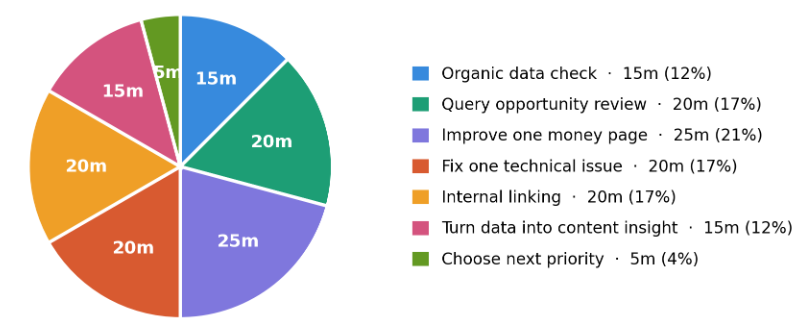
    My 120-minute weekly SEO workflow

    0-15 minutes: Check organic data

    I start with a pulse check so I can catch problems before they turn into bigger performance drops.

    I look at Google Search Console clicks, impressions, CTR, and average position. I also check organic conversions or assisted conversions in GA4, top landing pages gaining or losing traffic, branded versus non-branded movement, and any indexing, crawling, or manual action warnings.

    What I do not do is turn this into a full reporting session. This is not a board deck. I only want to answer one question: is organic visibility moving in a direction that needs action?

    My output is a short weekly note: the biggest organic win, the biggest organic concern, one page or query to investigate, and one action to take this week.

    15-35 minutes: Find query opportunities

    Next, I look for the easiest opportunities in Google Search Console. The richest ones are often queries ranking in positions 4-15 with real impressions. Those pages are already close, and a focused improvement can help them move.

    I also watch for pages with strong impressions but weak CTR, queries climbing week over week, and rankings where the current page only partially matches search intent.

    I resist the urge to build a long keyword list. Instead, I pick three things: one page to improve, one query to answer better, and one title or meta description to test.

    For example, when I reviewed search data for a local accounting client, several queries kept appearing around tax help for freelancers, small-business tax mistakes, and the difference between an accountant and a bookkeeper.

    The obvious reaction would have been to write three new articles. Instead, I rewrote one service page around freelancers, added a short FAQ based on those queries, and linked it to an existing bookkeeping article. One page served three search intents, which was far more useful than three unfinished drafts.

    35-60 minutes: Improve one money page

    This is the most important part of the workflow. I define a money page as any page close to revenue, pipeline, bookings, sales, demos, or consultations.

    Image

    Money pages can include product pages, service pages, category pages, comparison pages, demo pages, consultation pages, pricing pages, and high-intent landing pages.

    My weekly goal is not to optimize the entire website. It is to improve one important page in one meaningful way.

    I ask what the buyer needs to believe before converting, what objection is missing, what proof would reduce hesitation, what comparison the buyer already has in mind, and what query the page almost satisfies but does not fully answer.

    A meaningful update might be adding three FAQs based on real queries, improving the H1 and introduction, adding comparison language, including proof points, linking to a case study, clarifying who the offer is for, improving the CTA, or adding a short “how it works” section.

    That is SEO work, but it is also conversion work. The best page improvements usually help both search engines and buyers understand the value faster.

    60-80 minutes: Fix one technical or indexing issue

    Technical SEO can take over the full two hours if I let it, so I stay focused on impact.

    The question I ask is simple: what could stop an important page from being discovered, understood, indexed, or trusted?

    That usually points me toward issues like priority pages not being indexed, broken internal links, redirect chains, duplicate or missing titles on key pages, incorrect canonicals, schema errors on important templates, or valuable pages buried too deep in the site.

    I want one of three outcomes from this block: a fix shipped, an issue assigned, or a clear developer brief.

    For example, if I find that ecommerce collection pages are not indexed because of incorrect canonical tags, documenting the affected URLs and writing a clear developer brief may be more valuable than publishing another generic article.

    80-100 minutes: Improve internal links

    Internal linking is one of the fastest SEO wins I can create because it does not require new content.

    It helps search engines understand which pages matter, helps users continue their journey, and helps informational content support commercial outcomes.

    Each week, I look for links from high-traffic articles to money pages, links from product or service pages to supporting guides, links from older articles to newer strategic content, and opportunities to use clearer anchor text.

    If an article ranks for “how to choose accounting software,” I do not want it to be a dead end. I want it to guide readers toward a comparison guide, a relevant case study, and a demo or pricing page. The traffic is already there, so I try to make it more useful.

    100-115 minutes: Turn one search insight into messaging

    I do not want search data to stay trapped in an SEO silo. The best query I find each week is often a useful signal for the rest of marketing because it shows the language buyers actually use.

    A query like “best CRM for small agencies” can become a comparison section on a landing page, a LinkedIn post, a sales email angle, and a paid search ad group.

    A query like “is [product] worth it” can become a proof section, a pricing explainer, a “who this is not for” paragraph, or a ready-made answer to a sales objection.

    When I share one search insight each week, SEO becomes more than a channel. It becomes a source of customer intelligence.

    115-120 minutes: Choose next week’s priority

    I end with a decision, not a long list. I choose one clear priority for next week based on business impact, search demand, ease of execution, current performance gap, and proximity to revenue.

    The template I use is: “Next week, my highest-leverage SEO action is [X] because [Y].”

    For example: “Next week, my highest-leverage SEO action is updating the pricing page because it gets non-branded traffic, supports demo requests, and does not answer implementation cost questions.”

    That is how I make SEO operational. The work becomes specific, owned, and easier to repeat.

    Image

    A sample month for the workflow

    To keep the workflow balanced, I like rotating the emphasis each week.

    In week one, I focus on a revenue page. I update copy, add FAQs, improve internal links, check indexing and schema, and sharpen the CTA.

    In week two, I refresh existing content. I choose one article with impressions but weak clicks or rankings, improve the title, add missing sections, update examples, link to money pages, and better match search intent.

    In week three, I handle technical cleanup. I focus on one crawl, indexing, or template issue, such as broken links, duplicate titles, sitemap problems, or a developer brief for a higher-impact fix.

    In week four, I turn SEO data into broader marketing assets. That may mean one landing page insight, one sales objection, one content brief, one paid or social angle, or one FAQ or comparison section.

    This rotation keeps me from spending every week in dashboards, technical audits, or new content production while ignoring the pages that already have potential.

    What I stop doing

    Most small teams do not have a doing problem. They have a stopping problem.

    I stop chasing every low-impact technical warning. I stop creating content just because a tool found a keyword. I stop publishing AI-assisted articles at scale without a strategy. I stop rewriting pages without a hypothesis. I stop optimizing low-value pages before revenue pages. And I stop treating rankings as the only score that matters.

    Before I create new content, I review the pages I already have. The highest returns often come from pages that already rank on Page 2, already get impressions, sit close to revenue, and are one focused update away from doing more.

    My test for any task is simple: if I cannot connect it to qualified traffic, conversions, discoverability, buyer education, or trust, it does not belong in the 120 minutes.

    How I make it work without a dedicated SEO person

    This workflow does not require a full SEO department. It requires one owner, a weekly rhythm, and a bias toward shipping.

    A marketing manager can own prioritization and the weekly SEO note. A content marketer can update copy, FAQs, and page sections. A developer or web support partner can handle technical fixes. A paid search manager can share query and conversion insights. A founder or sales team can contribute objections and buyer language.

    The owner matters most. Someone has to protect the 120 minutes, choose the priority, and make sure the session ends with an action.

    Without ownership, SEO becomes everyone’s job and nobody’s job.

    How I use AI to save time

    I use AI to shorten repetitive SEO work, not to hand over strategy.

    That might mean using a focused workflow to identify queries in positions 4-15, pages with high impressions and low CTR, search queries that should become FAQs, internal linking opportunities, or technical issues that should become developer briefs.

    For agencies, client-specific assistants can reduce context switching by remembering each client’s services, priority pages, competitors, and customer objections.

    The most useful AI workflows are narrow: a GSC opportunity analyzer, a money page refresh assistant, an internal linking assistant, a technical SEO brief generator, or an SEO reporting summarizer.

    I do not want one generic SEO assistant trying to do everything. I want small workflows that help me move faster from data to decisions.

    Consistency is the advantage

    Small teams win SEO by doing the highest-leverage things repeatedly.

    A 120-minute weekly SEO workflow will not replace a full strategy. It will not solve every technical issue, build every content asset, or uncover every opportunity.

    But it gives me a practical way to protect visibility, learn from search data, improve revenue pages, and keep organic growth moving.

    The mindset is simple: less auditing, more shipping, more buyer intent, less busywork, and more business impact.


    Inspired by this post on Search Engine Land.

    crushpress.ai community screenshot