
Mastering AI Search Visibility: Key Signals You Need to Know

```json
{
  "alt": "Digital panels with neon icons including a list, layers, target, and shield in a dark setting.",
  "caption": "Illuminated by a spotlight, neon digital panels glow with icons symbolizing organization, layers, targeting, and security.",
  "description": "This image features four glowing digital panels, each showcasing a distinct neon icon under a spotlight in a dark environment. From left to right, the icons depict a list, layers, a target, and a shield with a checkmark, symbolizing concepts such as organization, depth, precision, and security. The blue and red hues give the scene a futuristic and technological ambiance, suitable for themes related to digital innovation, cybersecurity, and data management."
}
```

I’ve discovered that rankings alone no longer guarantee visibility in AI search. In today’s digital landscape, four key signals dictate whether a brand appears in AI-generated responses and how they’re portrayed.

Ranking and visibility have diverged. For years, SEO was all about securing that sweet spot on the SERPs, boosting visibility, clicks, and traffic. This connection is unraveling.

Earlier this year, Ahrefs reported that only 38% of pages featured in Google AI Overviews also ranked in the traditional top 10. Compare this to eight months prior when it was 76%, and you’ll see the shift.

The message is clear: a high rank doesn’t necessarily mean visibility.

Visibility in AI-generated responses hinges on inclusion and the portrayal of your brand upon inclusion, determined by a unique set of signals.

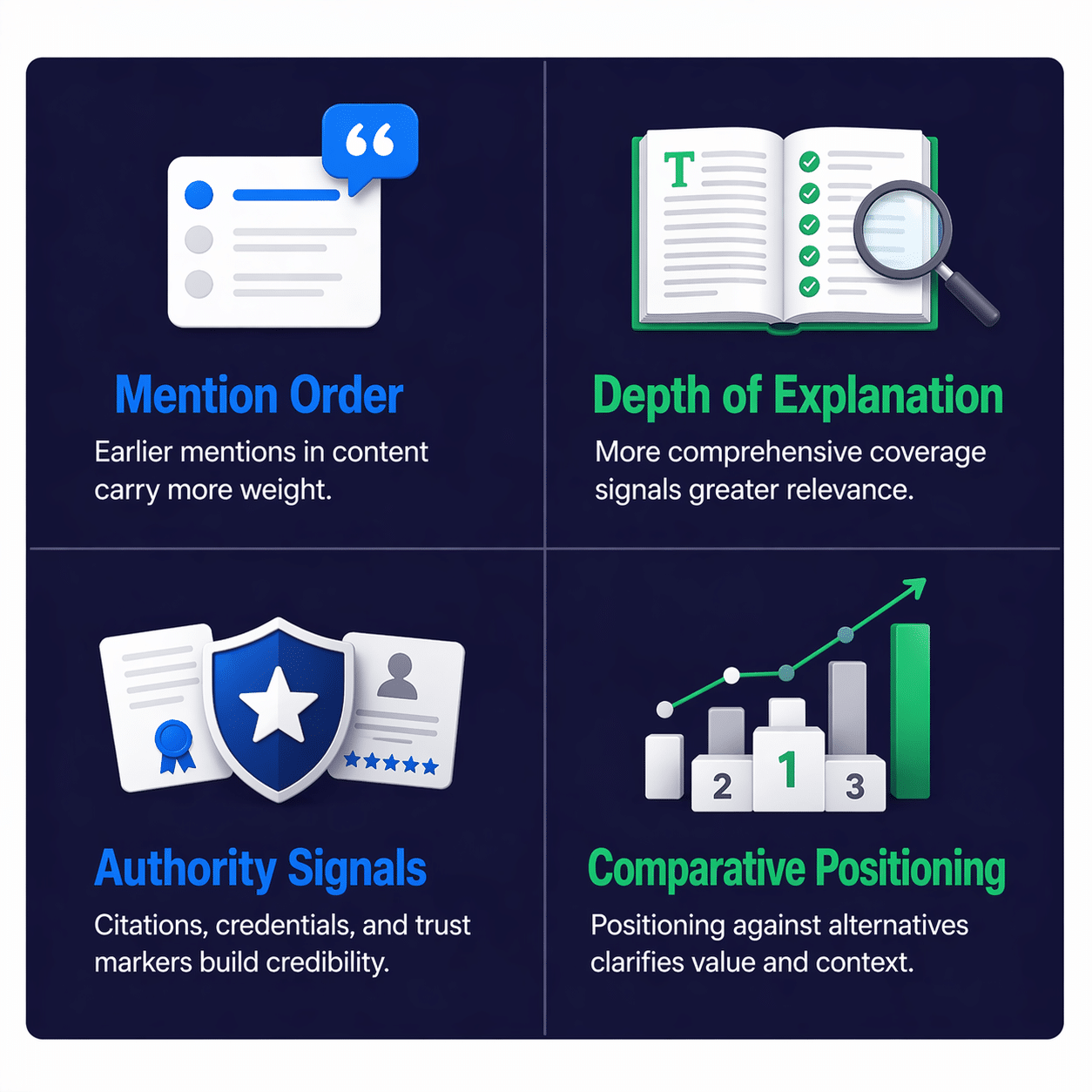
So, how exactly does visibility work within the realm of AI search? There are four critical signals I need to focus on:
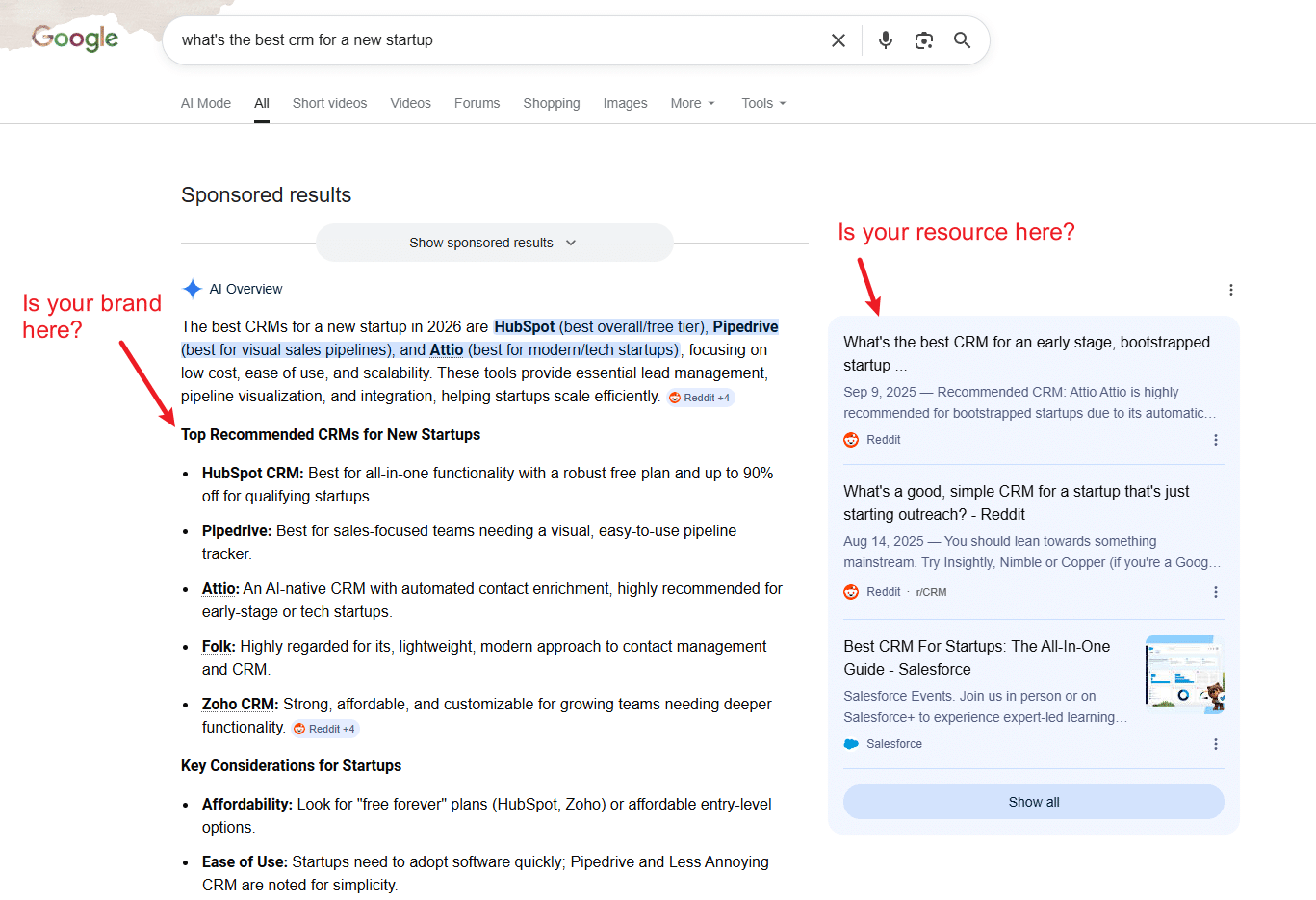
```json
{
  "alt": "Search result page highlighting best CRMs for startups including HubSpot, Pipedrive, and Attio.",
  "caption": "Explore the top CRM platforms for startups, featuring HubSpot, Pipedrive, and Attio, known for their scalability, ease of use, and affordability. Is your brand or resource listed?",
  "description": "This image showcases a Google search results page for 'what’s the best CRM for a new startup.' Featured CRMs include HubSpot, Pipedrive, and Attio, recommended for their functionality and cost-effectiveness. The page emphasizes considerations like affordability and ease of use, while highlighting resources from Reddit. Keywords: CRM, startup, HubSpot, Pipedrive, Attio, Google search."
}
```
  • Mention order.
  • Depth of explanation.
  • Authority signals.
  • Comparative positioning.

Let me dive deeper into them, starting with mention order.

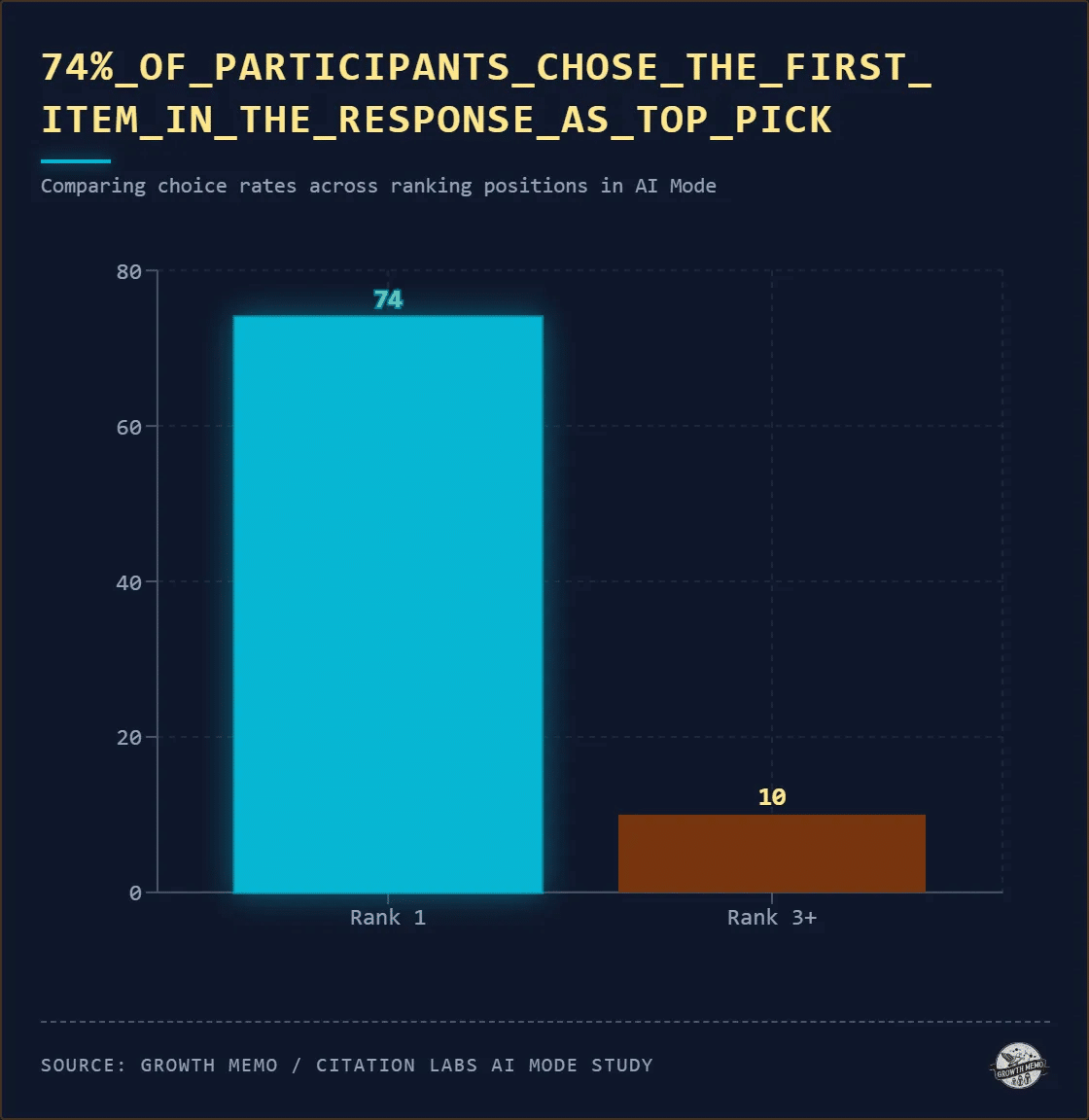
The order in which AI models list options is crucial. According to a study by Growth Memo and Citation Labs, a whopping 74% of users tend to go with the AI’s top suggestion.

Yet, 26% of users overturn the AI’s order if they recognize a brand they trust. This is quite a change from traditional search behavior. In AI Mode, most users accept the AI’s shortlist without further checks.

However, the mention order is unstable. SE Ranking’s research shows AI Mode only overlaps with itself 9.2% of the time when running the same query thrice, indicating variable sources and order.

Lesson learned: While mention order gives an edge, it’s not a sure thing. Brand recognition can surpass position.
```json
{
  "alt": "Four quadrants describing content relevance factors: Mention Order, Depth of Explanation, Authority Signals, Comparative Positioning.",
  "caption": "Boost your content's relevance! Explore how Mention Order, Depth of Explanation, Authority Signals, and Comparative Positioning enhance credibility and value.",
  "description": "This image is divided into four quadrants, each illustrating a factor that enhances the relevance of content. Mention Order notes that earlier mentions carry more weight. Depth of Explanation emphasizes comprehensive coverage for greater relevance. Authority Signals focus on citations and trust markers for credibility. Comparative Positioning underlines the importance of context and value clarification. These insights collectively aim at improving content strategy."
}
```

Next, let’s explore the depth of explanation.

Not every mention is equal. Some brands earn only a sentence, while others get full paragraphs detailing their strengths and uniqueness.

This comes down to how much citation-worthy information AI systems have gathered about you.

When Semrush launched its AI Visibility Awards in December 2025, it reviewed over 2,500 prompts using ChatGPT and Google AI Mode. Category leaders like Samsung in consumer electronics didn’t just show up more—they received more in-depth mentions.

Challenger brands, like Logitech in gaming accessories, appeared too, but typically with shorter, focused mentions highlighting a single differentiator.
```json
{
  "alt": "Bar chart showing 74% of participants chose rank 1 items, compared to 10% for rank 3+ in AI mode.",
  "caption": "In a compelling AI study, the first choice dominated with 74% preference, leaving rank 3+ far behind at just 10%.",
  "description": "This image depicts a bar chart comparing choice rates in AI mode, where 74% of participants favored the first-ranked item, while only 10% selected items ranked third or lower. This visualization highlights the significant preference for top-ranked options in AI-derived responses. Source: Growth Memo / Citation Labs AI Mode Study."
}
```

Pages that are comprehensive, answering “what is it,” “who uses it,” and “how to choose” in one place, rose to the top in AI citations.

Lesson learned: If AI systems only find sparse data on your brand, expect sparse mentions.

Third on the list: authority signals.

AI systems not only cite but also characterize sources by tone, indicating how much confidence they place in a brand’s authority.

HubSpot’s AEO Grader classifies brands as leaders, challengers, or niche players, labels influencing how AI conveys their authority.

```json
{
  "alt": "The CapmatchOne logo with a gradient circle and bold text.",
  "caption": "Discover innovation with the CapmatchOne logo, featuring sleek typography and a modern gradient circle.",
  "description": "The CapmatchOne logo features bold, modern typography coupled with a gradient circle, symbolizing connection and innovation. The sleek design conveys a sense of progress and creativity. This image can be used for branding or promotional purposes, appealing to audiences interested in innovative solutions and forward-thinking designs."
}
```

Semrush’s data shows that brands identified as leaders exhibit less than 20% monthly volatility in AI share of voice, maintaining consistent authority.

Leaders are described using strong terms like “the industry standard,” while challengers are termed “gaining traction.”

Lesson learned: AI doesn’t just name-drop; it frames your reputation.

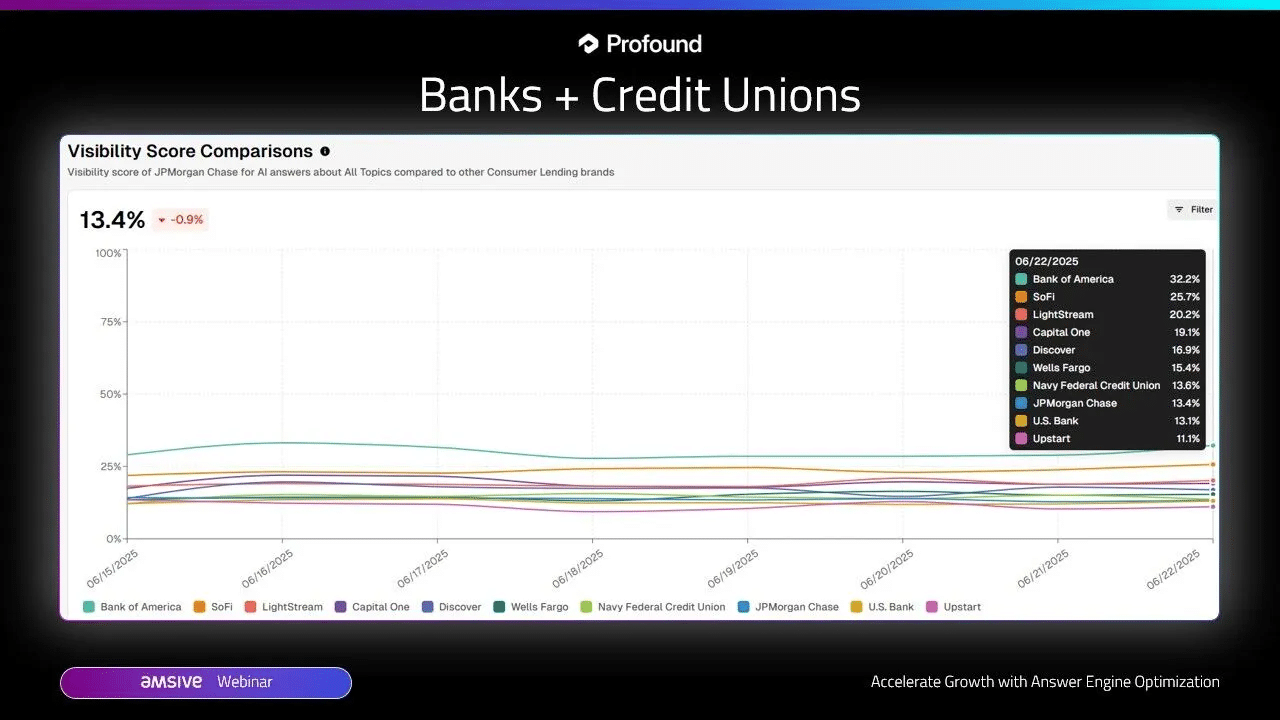
Finally, comparative positioning is akin to traditional rankings in AI answers—how you’re positioned among multiple brands.

Amsive’s research demonstrates clear positioning hierarchies within sectors.
```json
{
  "alt": "Line graph comparing visibility scores of banks and credit unions, including Bank of America, SoFi, and JPMorgan Chase, dated June 2025.",
  "caption": "Explore the visibility scores of top banking institutions like Bank of America and JPMorgan Chase over a week in June 2025. See which financial giants are leading the digital arena!",
  "description": "This image displays a line graph titled 'Visibility Score Comparisons' by Profound, illustrating the visibility scores of banks and credit unions as of June 2025. The data compares entities like Bank of America, SoFi, LightStream, Capital One, and others, showing subtle fluctuations over several days. Bank of America leads with a score of 32.2%, while Upstart is at the lower end with 11.1%. The graph provides insights into the digital presence and performance of these financial institutions."
}
```
  • In banking, Bank of America leads, followed by SoFi and LightStream.
  • In healthcare, Mayo Clinic stands out significantly.

Kevin Indig’s research highlights how users self-select based on AI’s framing, regardless of actual capabilities.

Lesson learned: It’s not about being number one; it’s about owning a niche in AI’s mental map.

Traditional rankings’ correlation with AI visibility is minimal. The concept of query fan-out explains why visibility dropped so swiftly.

During an AI Overview, Google processes not just the top pages for a query but various sub-queries to synthesize a complete response.

This means your page might rank first for one query but may be overlooked if AI finds more relevant passages elsewhere.
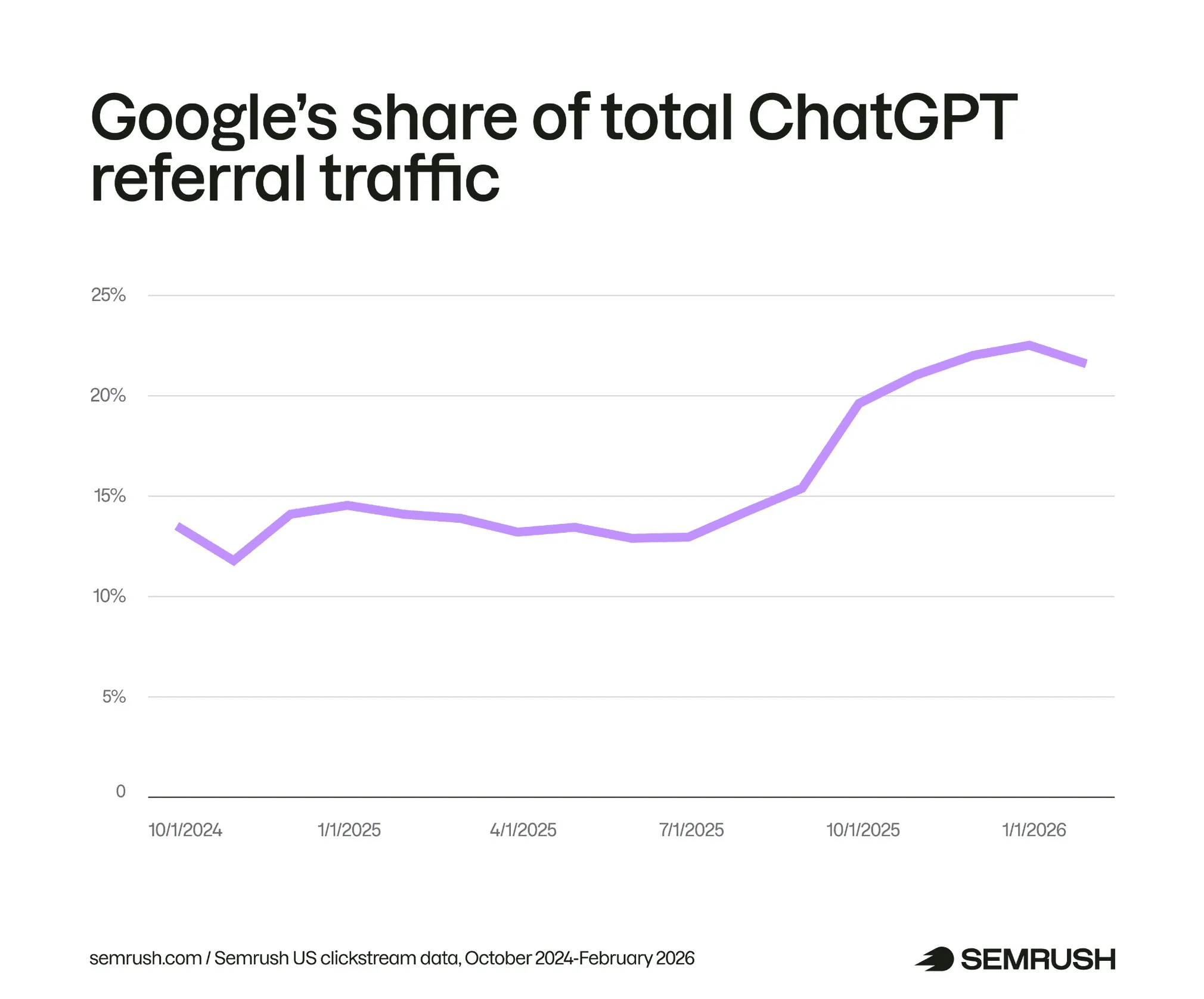
```json
{
  "alt": "Line graph showing Google's share of ChatGPT referral traffic from October 2024 to February 2026, displaying upward trend.",
  "caption": "Google's influence grows as its share of ChatGPT referral traffic rises steadily over time, peaking in early 2026.",
  "description": "This graph illustrates Google's share of total ChatGPT referral traffic, derived from Semrush US clickstream data between October 2024 and February 2026. The line graph, highlighted in purple, shows a general upward trend starting around mid-2025, reaching its highest point in early 2026. The chart provides insights into Google's impact on ChatGPT referral traffic over this period. Keywords: Google, ChatGPT, referral traffic, Semrush, clickstream data."
}
```

Research shows Google’s Gemini 3 update altered approximately 42% of cited domains, making traditional rank positions less predictive.

Where does AI traffic land? Interestingly, a substantial portion of ChatGPT traffic eventually ends up on Google. Users seek answers from ChatGPT, then confirm their findings on Google.

Most prompts to ChatGPT are too specific for traditional keywords, intensifying the shift.

So, how can I measure visibility in AI answers?

  • Track citation frequency to gauge how often your brand appears in AI answers.
  • Measure brand mention rate for category penetration.
  • Focus on recommendation rates, especially in B2B and high-consideration sectors.
  • Analyze sentiment and context of mentions to evaluate impact.
  • Citation position provides an edge, even if it’s not organic rank.

The 2026 measurement model demands dual tracking—traditional and AI-focused metrics for accurate visibility insights.

New tools have emerged for this purpose, complementing but not replacing traditional SEO tools.

For citation tracking, platforms like Profound and Peec AI keep tabs on cited URLs across AI responses.

For brand analysis, tools like Semrush’s AI Visibility Toolkit check mention frequency, portrayal, and recommendations.

For competitive positioning, Bluefish and HubSpot’s AEO Grader assess your brand’s AI categorization against competitors.

Traditional rank obsession persists, but visibility in AI requires a broader view with a distinct measurement model.


Inspired by this post on Search Engine Land.


crushpress.ai community screenshot

FAQs

What are the four signals that influence AI search visibility?

The four signals are mention order, depth of explanation, authority signals, and comparative positioning. They determine how your brand is included and described in AI-generated responses.

Why doesn't a high traditional rank guarantee AI visibility?

AI visibility depends on inclusion and portrayal, not just rank. Signals like the order of mention, depth of explanation, authority signals, and comparative positioning influence how your brand appears in AI responses.

What is 'mention order' and how stable is it?

Mention order refers to the sequence in which AI models list options. The order is unstable; AI Mode overlaps with itself only 9.2% of the time when the same query is run thrice.

How does depth of explanation affect AI citations?

Pages that are comprehensive and answer what is it, who uses it, and how to choose tend to rise to the top in AI citations. If AI systems only find sparse data on your brand, expect sparse mentions.

What role do authority signals play in AI visibility?

Authority signals describe how AI characterizes sources by tone, indicating how much confidence it places in a brand’s authority. Labels like leaders or challengers influence how AI conveys your authority.

What metrics help measure AI visibility?

To measure AI visibility, track citation frequency and brand mention rate, and monitor recommendation rates. Analyze sentiment and context of mentions to evaluate impact.

Where does AI traffic land and what happened with Gemini 3?

A substantial portion of ChatGPT traffic ends up on Google as users verify findings there. Gemini 3 updated about 42% of cited domains, reducing the predictive value of traditional rank.

Comments

Leave a Reply

Your email address will not be published. Required fields are marked *