
I’ve often found myself caught in the age-old marketing debate: should I focus on SEO or PPC? For years, this decision was largely based on past successes or failures.
With organic search, I could rely on growing visibility over time, while paid search gave me immediate, direct control.
Yet, most marketing teams lean toward one over the other based on their experience and budget limitations. But as we move into the future, this binary choice is no longer enough.
In 2026, the landscape has transformed significantly, altering how we approach search entirely.
Why This Debate Has Changed
The world of search has evolved, far beyond the SEO or PPC dichotomy.
Our search behavior is not the same. Search results pages have transformed and the machine learning behind bidding systems have advanced. And then there’s AI, the latest player on the scene, shaking things up.
It’s no surprise that AI has turned into a crucial factor, alongside SEO and PPC.
The pressing question now isn’t just about selecting SEO or PPC, but how we can integrate AI to sustain and boost visibility amidst the fast-paced changes.
This challenge also highlights another issue: fragmentation. With so many channels and discovery paths available, it feels overwhelming, leaving marketers scattered and at risk of falling into paralysis.
The key is to navigate through this AI upheaval, continuously adapting our strategies to remain relevant.
The Old Debate: SEO vs. PPC
Historically, weighing the pros and cons of SEO and PPC was straightforward:
- SEO: Offers credibility, compounding visibility, and engagement, although slow to mature and with challenging expectations.
- PPC: Provides rapid visibility and control, but requires ongoing financial investment and battles rising costs.
In my experience, a combined strategy proves most effective.
- SEO fuels demand.
- PPC captures it.
The synergy between the two remains valuable, but AI introduces an essential new dimension.
AI: The New Discovery Channel
AI is redefining how we discover and evaluate information.
Its popularity is growing fast, and this holiday season will likely be a turning point. Simple, integrated tools mean AI is embedded in our daily tech use.
Just like Google once led the charge, AI is set to surpass traditional search, thanks to its simplicity and speed. We find ourselves in an environment where:
- Search engines summarize content before clicks happen.
- Chat tools offer answers without redirecting traffic.
- Product exploration starts with AI, moving beyond Google Search.
- Natural, multi-step inquiries are being made that previously didn’t exist.
Thus, visibility hinges on AI presence. The battle isn’t just for rankings, but ensuring we feature within AI ecosystems.
Lacking AI visibility means being edged out. While this may not fully manifest today, it will soon dominate the scene.
Our marketing challenge is straightforward yet daunting: figuring out how to emerge in AI outcomes. We’re unable to purchase our place, nor can we find a playbook for these types of results.
In essence, our goals now demand adaptation from optimizing merely for search engines to being discoverable within AI systems that continue to draw from search results.
The New Visibility Battlefield
Despite feeling novel, AI’s emergence was somewhat predictable.
The existing web landscape is draining — it’s a battleground of too much information, advertisements, and distractions.
Finding what we need amidst this chaos is exhausting; AI offers an antidote by swiftly cutting through the clutter.
It’s undoubtedly refreshing. Yet, we must ponder the potential downsides.
Visionaries like Tim Berners-Lee express concern over AI threatening web sustainability by impacting ad revenue streams, a sentiment I share.
In “Supremacy,” a book charting AI’s rise, authors alleged Google had a ChatGPT-like system years ago but hesitated over revenue concerns. Their claim seems plausible to me.
AI’s efficiency is undeniable. It’s cleaner, faster — and hence will dominate. It stands as a true advancement.
The world of digital marketing has devolved into a war of endurance. The adage still rings true: we normally only explore the earliest pages of search results. We need no longer hide on these pages, as AI scours deep and wide.
Unfathomably, next-level solutions appear within AI’s grasp, surfacing comprehensive insights in brief moments.
This shift was predictable with hindsight, symbolizing a departure from failed attempts to combat the web’s disordered entropy.
AI signifies a fresh paradigm, rising from the modern web’s tumult.
Why This Changes the SEO/PPC Decision
The introduction of AI shifts the landscape for SEO and PPC fundamentally.
1. SEO: Less About Rankings, More About References
For content to feature within AI summaries or search assistants, it must exhibit:
- Authority
- Topical alignment
- Structured markup
- Trust signals
- Depth, devoid of surface-level fluff
- Authentic perspectives
AI favors genuine thought and established voices over mere quantity.
2. PPC: Still Dominating Premium Slots
Despite AI’s growing influence, PPC secures:
- Top slots
- Commercial queries
- Visual placements
- Local ad packs
- YouTube
- Discovery platforms
- Merchant outcomes
AI shakes things up, yet PPC’s prominence remains — revenue needs won’t disappear.
3. AI Alters User Behavior Exponentially
AI is crafting fresh behavior patterns:
- Fewer clicks, shorter journeys
- Intuitive moments
- In-depth comparisons inside AI systems
- Increased research driven outside traditional points
- Heightened expectations for relevance
Seo and PPC remain significant, albeit adapting to parallel discovery paths AI creates.
Is SEO vs. PPC vs. AI Even the Right Question?
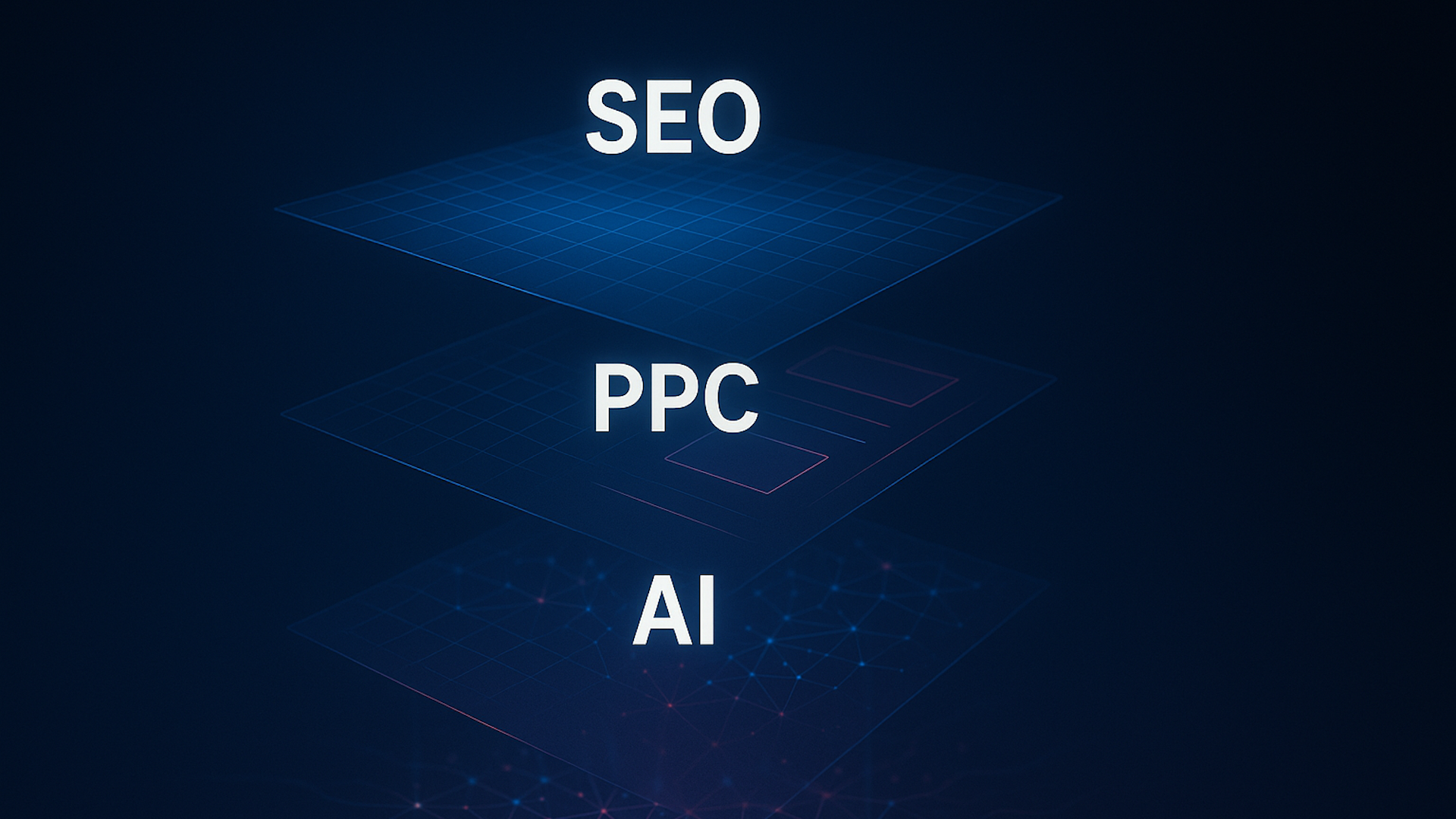
Marketers often see SEO, PPC, and AI as competitors. Truthfully, they’re three intertwined visibility layers.
- SEO fosters presence, providing foundational visibility.
- PPC amplifies position, stimulating awareness.
- AI frames discovery, offering context and relevance.
Each component complements the others:
- SEO supplies content AI distills.
- PPC fosters initial visibility, attracting early engagement.
- AI delves into extensive analysis, shaping your market presence.
I embarked on this article seeking an answer to the age-old question: which reigns supreme — SEO, PPC, or AI?
Mid-journey, clarity emerged: this outdated question will no longer suffice by 2026.
General counsel proves challenging, given unique circumstances.
For example, a local plumbing business may have started with PPC while growing through local SEO and referrals.
Eventually, reducing PPC reliance might have been tested unless leads dwindled.
Contrarily, a college with complex site structures, coupled with strong authority, could transition from ads — assuming proper planning and site optimization.
Now, a third ingredient has emerged: AI, with SEO, PPC, and AI forming a unified strategy.
Separating AI from SEO is no longer feasible. The disciplines of AEO, GEO, and related labels are increasingly married.
Understanding AI and SEO’s connections in retrieval-focused generation contexts becomes crucial.
While PPC’s link to AI isn’t as prominent, early integration is already in motion, evidenced by Google incorporating ads into AI summaries.
Optimizing AI echoes optimizing SEO’s practices.
While early, the need to optimize for AI is evident, demanding attention from SEOs and GEOs in the near term.
Inaction is costly; we lack a complete guide, yet actionable insights remain available.
How to Build Visibility Across SEO, PPC, and AI
By 2026, success isn’t mere “ranking,” but “being referenced.”
Staying afloat requires optimizing for machine-led content evaluation.
1. Adopt GEO
Format your content for AI retrieval.
Two to three short, concise sentences followed by layered context appeals to LLMs.
Utilize bullet points, clear logic, and data tables for AI to parse easily.
2. Feed the Knowledge Graph with Entity SEO
AI confirms facts using entities like people, brands, and ideas.
Your About page, schema markup, and author bios must be impeccable.
Without Google’s understanding of your identity, authority citations become unlikely.
3. Target Citation Gaps
AI systems link to trusted sources, favoring niche gurus and major outlets.
Redirect digital PR efforts toward “mentions” on sites AI deems authoritative.
4. Invest in Freshness and Data
LLMs lean towards recent data. Regularly update facts, timestamps, and comparisons.
Static content may falter against continually refreshed material.
5. Embrace Redundancy: The Hybrid Approach
No channel stands alone. Execute PPC for instant visibility, nurture SEO for long-term authority, and set AI-ready data structures simultaneously.
6. Build a Content Engine
Leverage “They Ask, You Answer” frameworks to tailor content that addresses audience needs.
Apply tools like the SCAMPER framework and the Value Proposition Canvas for diverse angles and comprehensive outreach.
Brand: The Only Universal Signal
We distinguish SEO, PPC, and AI, yet for users and algorithms, they reveal different gateways to your brand.
Effective visibility demands a resilient ecosystem.
Adopt PPC for immediate demand capture, cultivate trust via SEO frameworks, and maintain a clear entity strategy to aid AI comprehension.
Ultimately, brand creation determines AI-resistant resilience — essential for consumer and machine recognition alike.
Success isn’t merely joining dots between efforts, but fostering robustness so algorithms consistently choose to highlight you.
Inspired by this post on Search Engine Land.

Leave a Reply