Tag: Business

  • Franchise Directories: A Practical Research Workflow for 2026

    Franchise Directories: A Practical Research Workflow for 2026

    You’re looking at franchises because you need to make a business decision, not collect another set of polished brand pages. The danger isn’t a lack of information. It’s treating information gathered for discovery as if it had already been checked for investment.

    Use each franchise directory for a defined job, transfer every serious candidate into your own comparison record, and leave the platform as soon as a claim could affect your money, legal obligations, territory, or working life. That separation turns browsing into a defensible research process.

    Key takeaways

    • Separate four jobs: learning how franchising works, discovering brands, comparing candidates, and validating a potential investment.
    • Choose broad directories for idea generation and structured, reviewed listings for shortlist development. Catalog size is not a substitute for data quality.
    • Copy candidates into one fixed template. Treat every blank field as unknown, never as zero, none, or not applicable.
    • A reviewed listing means the profile passed a platform-level check. It does not establish that the franchise is profitable, suitable for you, or free of legal and financial risk.
    • Once a claim could change your decision, verify it through current official materials, written clarification, and qualified legal or financial advice.

    Choose a platform by research stage, not catalog size

    A researcher moves through four workstations for learning, discovery, profile comparison, and focused franchise evaluation.

    A directory answers what opportunities are available. A research platform should help you decide which opportunities are coherent enough to investigate further. The label on the website matters less than whether the platform supports the job you need to do.

    Broad coverage is useful during discovery because you don’t yet know which categories or ownership models fit. Once you begin comparing brands, inconsistent fields become a liability. You can no longer tell whether two opportunities differ or whether their profiles merely describe similar facts in different ways.

    A 100-point score prevents a large catalog from overwhelming better evidence. For serious comparison, allocate 40 points to listing verification, 25 to research depth and data quality, 15 to comparison consistency, 10 to buyer guidance, 5 to education, and 5 to platform longevity. Score the platform you can actually observe, not the reputation you assume it has.

    • For verification, ask whether the platform explains what it checks before publication. A badge without a defined process should not receive full credit.
    • For depth, look for costs, ownership models, expectations, and operational context rather than a long brand description.
    • For consistency, open several profiles and check whether the same decision-critical fields appear in the same places.
    • For guidance, look for help interpreting the information and identifying the next step, not merely a form that sends an inquiry.
    • For education, distinguish general lessons about franchising from evidence about a specific opportunity.
    • For longevity, use operating history as a supporting trust signal, not proof that every current listing is accurate.

    If your immediate goal is broad directory discovery, reduce verification to 35 points and reserve 5 points for catalog breadth. That small allocation reflects the right priority: a bigger catalog may expose you to more ideas, but it does not make any individual profile more reliable.

    Handle undeclared verification carefully. Not stated does not automatically mean that no checking occurs, but it also gives you no evidence to rely on. Record it as unknown and keep the burden of confirmation with the claim.

    Match each franchise platform to one research job

    No platform needs to carry your entire process. The more useful question is where each one belongs in the sequence and where you should stop trusting it.

    Your research jobBest starting pointUse it forDo not assume
    Build a structured shortlistFranchise.comListings reviewed before publication, standardized profiles, substantial research detail, and buyer guidanceProfile review is not an audit of the franchise, its economics, or its suitability for you.
    Explore international or niche conceptsFranchise DirectBroad international reach and diverse idea generationListings are verified or sufficiently consistent for final comparison. Re-enter relevant facts in your own template.
    Browse a large range of US conceptsAll USA Franchises or America’s Best FranchisesWide US category exploration and high-volume early browsingCatalog breadth provides research depth. All USA Franchises has inconsistent profiles, while verification for America’s Best Franchises is not stated.
    Discover ideas through rankings and editorial coverageEntrepreneur.comTrend awareness and initial concept discoveryEditorial visibility provides a standardized evaluation framework. Listing consistency is low and the catalog is comparatively narrow.
    Learn how franchising worksFranchise.orgFranchising fundamentals and strong educational guidanceEducational authority makes individual listings comparison-ready. The listings are brief, unverified, and poorly suited to side-by-side analysis.
    Run a quick category scanBeTheBoss.comSimple, surface-level browsingSpeed provides analytical depth. Profiles vary, buyer support is absent, and comparison quality is low.

    This is a sequence, not a winner-takes-all ranking. You might learn the mechanics at Franchise.org, use Franchise Direct to notice an international category you had overlooked, and then use Franchise.com to create a more structured shortlist. The handoff between platforms is where your own research record becomes essential.

    Platform capabilities and listing practices can change. Before relying on a verification label or support feature, confirm that the current platform still defines it the way you expect.

    Build a shortlist that survives inconsistent profiles

    Most comparison errors happen when information moves from a profile into your decision. A missing value becomes zero. Two differently labeled cost figures land in the same column. A polished description earns more weight than a plainly written profile with better evidence. A fixed intake process prevents those mistakes.

    1. Define your gates before browsing. Write down the jurisdictions and territories you can consider, the capital range you can responsibly investigate, the ownership involvement you want, the categories you will exclude, and any experience requirements you cannot meet. These are pass-or-hold gates, not preferences to revise whenever an attractive brand appears.
    2. Separate discovery from comparison. On the first pass, record only the brand, category, geography, profile URL, and the reason it might fit. On the second pass, research only candidates that cleared your prewritten gates. This keeps a large directory from turning every interesting listing into a supposed finalist.
    3. Create one row per brand. Use fixed columns for the platform and page URL, date viewed, geography or territory, each investment figure with its original label, ownership model, stated expectations, support, verification status and scope, unanswered questions, and the strongest evidence currently available.
    4. Use controlled values for missing data. Every field should contain a stated value, not stated, conflicting, not applicable with a reason, or needs confirmation. Never enter zero or none unless the profile explicitly makes that claim.
    5. Preserve the original wording. Differently labeled investment figures are not automatically interchangeable. Keep the label, currency, geography, qualifiers, and any range attached to the amount. Normalize only after you have confirmed that two fields describe the same thing.
    6. Turn discrepancies into questions. If two directories show different values, do not average them or silently choose the more appealing one. Keep both entries, record their locations, and ask for current official confirmation. A conflict is a research finding, not an inconvenience to hide.

    Keep fit and evidence quality in separate columns. A brand can look ideal while its profile remains incomplete. Another can have a thorough profile but fail your territory, capital, or ownership requirements. Combining those judgments into one score makes weak evidence look like moderate evidence and poor fit look negotiable.

    An evidence ladder helps you preserve that distinction: directory profile, current official material, written clarification, and professional review. Do not overwrite the directory value when stronger evidence arrives. Retain the earlier value, add the confirmed value, and note what changed. That history tells you whether a discrepancy was harmless, outdated, or material to your decision.

    Your shortlist is ready to advance only when every required field is either supported or explicitly framed as a question that can be resolved. Unknown does not mean disqualified, but it does mean not ready.

    Leave the directory before you make a financial decision

    A franchise researcher moves from generic online listings to reviewing blank disclosure documents with financial and legal professionals.

    The exit trigger is not a particular number of candidates. It is the consequence of the claim in front of you. If the information could affect a fee, borrowing decision, territory choice, recurring obligation, contract, or expected working role, the directory has reached the limit of its job.

    A verified listing should mean that a platform applied a check to the profile. It should not be expanded into claims the platform did not make. It does not establish future performance, validate your financial assumptions, interpret your legal obligations, or prove personal fit.

    1. Request the current official disclosure and contractual materials that apply in your jurisdiction.
    2. Reconcile every decision-critical cost, fee, obligation, territory, ownership, and support claim against those materials. Keep unresolved differences visible.
    3. Ask for written clarification when an important term is ambiguous. Record who answered, what was answered, and which document or provision supports it.
    4. Have a qualified franchise lawyer review the legal documents before you sign or pay a material fee. Disclosure rules and contractual consequences vary by jurisdiction.
    5. Test the financial assumptions with a qualified accountant or financial adviser who can assess your circumstances. A directory profile is not a substitute for individualized financial advice.

    Do not let a ranking, badge, large catalog, or polished profile collapse those steps. Rankings reflect selected platform criteria. They cannot determine whether a particular franchise matches your resources, risk tolerance, market, or intended role.

    For your next research session, choose one platform that matches your current job. Learn at Franchise.org, generate broad or international ideas in the discovery-oriented directories, or build a structured shortlist with comparison-friendly profiles. Put every serious candidate into your own record. The moment a favorite survives that screen, stop browsing and start validating.

    References


  • Unlock E-commerce Success Without Relying on Ads

    Unlock E-commerce Success Without Relying on Ads

    I’ve realized that building a business that thrives solely on advertising is risky. We can’t let our ventures be at the mercy of fluctuating ad performances.

    Instead, let’s explore how to establish e-commerce growth engines. These strategies focus on compounding growth over time, emphasizing customer loyalty and enhancing brand strength.

    By shifting our approach, we can generate sustainable revenue that doesn’t hinge solely on ad spend.


    Inspired by this post on genmark.ai Blog.


    crushpress.ai community screenshot
  • Effortlessly Manage Google Posts with New Scheduling & Multi-location Tools

    Effortlessly Manage Google Posts with New Scheduling & Multi-location Tools

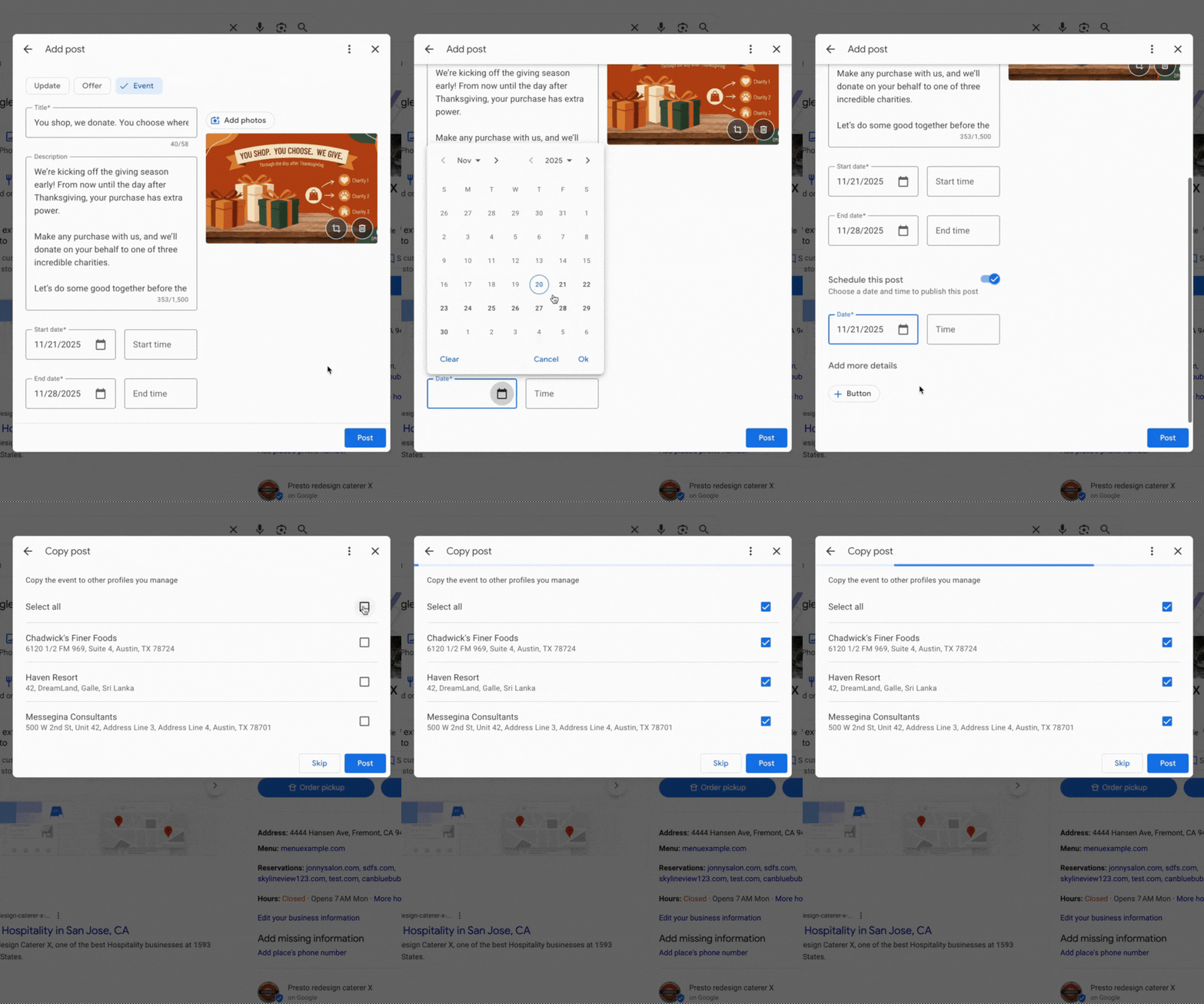
    I’m thrilled to share that Google Posts now includes features that support scheduling and multi-location publishing within Google Business Profiles. These updates are designed to make it easier for us to manage our Google Posts, whether they are for our businesses or clients.

    Scheduling. One exciting new feature when adding a Google Post within our Google Business Profiles is the option to “schedule this post.” We can now select the exact date and time when we want our posts to go live.

    Lisa Landsman from Google shared on LinkedIn, “Plan your entire week or month in advance! You can now schedule your Google Posts to go live automatically at the perfect time.”

    Multi-location publishing. If you, like me, manage several locations for a business, you’ll find the new multi-location feature incredibly convenient. It allows us to quickly copy Google Posts to some or all of our locations with just a click. Lisa Landsman explained, “Easily create a single post and apply it instantly to multiple business locations in one click.”

    ```json
{
  "alt": "Event post interface with title, description, and dates for a charitable shopping event.",
  "caption": "Join our Giving Season event: shop with us, and we'll donate on your behalf to a charity of your choice. Every purchase makes a difference!",
  "description": "This image displays an online post creation interface for an event themed 'You shop, we donate. You choose where.' The event promises to donate on customer purchases to one of three charities. It features a brown background image with wrapped gifts and charity icons. The start and end date fields are set from 11/21/2025 to 11/28/2025, encouraging community involvement in charitable giving during the holiday season."
}
```

    What it looks like. Here’s a GIF that shows this functionality in action:

    Why we care. I care about these updates because I know how busy businesses can be. Often, we don’t have the time to pause everything just to create a timely Google Post about an upcoming event or important message. Now, we can schedule these posts in advance and copy them effortlessly across locations we manage.

    As Lisa Landsman from Google pointed out, “We know the upcoming holiday season is a crucial, and hectic, time for your business. It’s also your biggest opportunity to get your events, offers, and updates in front of potential customers who are actively searching.”


    Inspired by this post on Search Engine Land.


    crushpress.ai community screenshot
  • Unlocking B2B Success: Understanding Your Industry’s CAC

    Unlocking B2B Success: Understanding Your Industry’s CAC

    Last updated: November 21, 2025

    When people ask me how to assess the ROI of their marketing campaigns, I always suggest starting with the customer acquisition cost (CAC). CAC, alongside Customer Lifetime Value (LTV or CLV), is vital in navigating the realm of B2B marketing.

    By examining your CAC, you can identify which marketing channels deserve more attention and which aspects of your marketing strategy could use improvement. Benchmarking your CAC against industry standards is key.

    The aim of this article is to guide you in recognizing what qualifies as a good CAC in your industry and to encourage you to even explore how your CAC fares compared to related industries.

    Calculating Your Customer Acquisition Cost

    To calculate your CAC, simply divide your total marketing and sales expenditures by the number of new customers acquired, using the formula below:

    Cac Equation 2 1 1024x152 (1)

    Make sure to perform this calculation annually or on a rolling basis to accommodate seasonal customer behavior changes. If your B2B business enjoys consistent year-round sales, consider quarterly CAC analysis to gauge the impact of new initiatives.

    Additionally, calculating CAC per channel allows you to compare different marketing strategies effectively.

    This report emphasizes B2B CACs. For B2C data, see our B2C Edition.

    After determining your CACs, you can measure them against the industry averages shared below.

    Average Customer Acquisition Cost (CAC) By Industry

    The table below presents average CACs across 29 B2B industries, gathered from client data spanning January 2022 to August 2025. Consider these dataset limitations:

    • Within each industry, we categorize CAC as Organic or Inorganic. Organic CAC includes mainly SEO and Organic Social, while Inorganic CAC covers PPC / SEM and Paid Social.
    • Email marketing, events, and other channels are excluded due to insufficient data.
    • Data from client analytics is anonymous. Organic data leans towards SEO and Inorganic towards PPC / SEM, given our B2B clientele and service focus.

    Below are the analysis results:

    [Insert table block here]

    Average Customer Acquisition Cost (CAC) for SaaS Companies

    Our team also reviewed average customer acquisition costs across 22 SaaS industries to determine each industry’s B2B CAC.

    [Insert table rows here]
    SaaS IndustryCAC

    How Your CAC Relates to Customer Lifetime Value

    While CAC reflects acquisition costs, Customer Lifetime Value (LTV) reveals the average profit per customer. Calculate LTV by dividing your profit over a chosen period by the number of unique customers, and multiply by their average purchase frequency. Aim for an LTV to CAC ratio of at least 3:1 for optimal financial health.

    Keep in mind historical trends and competitor data. A 2:1 LTV to CAC ratio isn’t necessarily negative if you’re seeing improvement over time.

    Particularly during new campaigns or long-term strategies, your ratios may fluctuate. For example, if you’ve launched an SEO campaign, results typically appear after 4-6 months.

    How to Lower Your CACs

    Organic CAC often triumphs over inorganic due to its longevity and skill-based approach. Investing in organic channels yields sustainable results without ongoing cash infusion.

    If you’re curious about organic marketing to reduce your CAC, feel free to contact us. Our firm, with multiple U.S. locations, has helped various B2B sectors achieve superior ROI with SEO strategies.

    Further Reading

    For deeper insights into CAC and its relation to LTV, browse the following resources:

    Source


    Inspired by this post on First Page Sage Blog.


    crushpress.ai community screenshot
  • Dale Olorenshaw’s £15K PPC Blunder: Lessons in Honesty & Recovery

    Dale Olorenshaw’s £15K PPC Blunder: Lessons in Honesty & Recovery

    On episode 331 of PPC Live The Podcast, I had an enlightening conversation with Dale Olorenshaw, the Head of Paid Media and Search at StrategiQ. Dale shared a painful yet invaluable experience involving a high-budget test campaign and a critical oversight that taught him powerful lessons.

    The costly tale centered around a test campaign with a £15,000 budget. While the campaign saw impressive clicks and engagement, it surprisingly yielded almost no conversions. A month later, the client pointed out that all traffic was directed to the wrong landing page, never reaching the newly built dedicated test page.

    Several internal missteps led to this error. Dale bypassed the internal QA process by managing the campaign solo. He shrugged off instincts that flagged something was amiss and, due to seemingly normal top-line metrics, he overlooked a deeper dive into conversion discrepancies. The most humbling moment was realizing the client discovered the oversight first.

    Although initial panic ensued, Dale refrained from sending a hasty, emotional response. Instead, he acknowledged the issue, paused to clear his mind, and waited to gather all the facts. The following morning, he approached his account director with full transparency and honesty, declaring, “I’ve messed up.”

    StrategiQ stood firmly behind Dale, focusing on solutions rather than blame. They managed to recover part of the wasted budget, provided extra work at no additional cost, and offered discounted fees for the next project phase. Once relaunched correctly, the client relationship remained intact.

    This experience profoundly impacted Dale’s professional approach. He now adheres strictly to QA processes, trusts his instincts when numbers seem off, and promotes team accountability with second opinions and checks, acknowledging that seniority doesn’t shield from human errors.

    Dale also highlighted a common PPC issue he continues to observe: the overcrowding of Responsive Search Ads. Google’s push for numerous headlines and descriptions can saturate ads with small budgets, leading to insufficient data for meaningful insights. His advice is to streamline assets for clarity and quality.

    For Dale, discussing mistakes openly is crucial. He argues that the PPC community needs to normalize these conversations since newcomers may only witness success stories online and equate mistakes with incompetence. Sharing real experiences shows that growth often springs from problem-solving.

    In closing, Dale offers leadership advice on fostering a supportive culture. Encouraging honesty, removing blame, and focusing on collective problem-solving ensures that mistakes are seen as learning opportunities rather than failures.

    If there’s one takeaway, let it be this: Don’t react impulsively, stay honest, and treat client funds with the utmost care as if they were your own.


    Inspired by this post on Search Engine Land.


    crushpress.ai community screenshot
  • Boost Trust and Cut Costs with Enhanced Creator Content

    Boost Trust and Cut Costs with Enhanced Creator Content

    Have you ever wondered how amplifying content from creators can actually save money and build trust with your audience? Well, I’ve seen firsthand how paid amplification not only cuts down media costs but also brings in new potential partners.

    Brands, including mine, often invest in influencer and affiliate promotions. Yet, many of us stop short of giving the content the reach it deserves, believing the creator’s audience alone is sufficient. But there’s so much more we can do.

    By using paid marketing, integrating it into my site, and sharing it across different channels, I’m not just promoting their work. I’m leveraging their brand recognition and strengthening my relationship with them.

    It’s true, I may pay influencers an upfront fee, commission, or give them a product for their promotion. But that’s not where our relationship ends.

    Amplification truly becomes an advantage here, unlocking more value from the creator relationships I’ve already established.

    Why amplifying creator content pays off

    Let’s dive into why amplifying creator content can be so beneficial.

    Trusted validation

    When someone trustworthy backs up my product, store, or company, I gain credibility, especially in competitive fields where trust isn’t always assured, like jewelry or insurance.

    For example, picking a hotel near Disney or on a Caribbean island can be daunting with so many choices and mixed opinions. But if someone trusted chooses my brand, that might just sway the decision.

    I can utilize this content in ads to reach new audiences or test it with email or SMS list subscribers who haven’t converted yet. The same strategy works for remarketing efforts too.

    A third-party endorsement can make a significant difference, even when I sing my own praises.

    Lower media costs

    Certain influencers might be out of budget, but promising them that their ads will reach new, similar audiences might bring their costs down.

    By allowing them to use their affiliate links in this amplified content, they can earn commissions, which shares the risk on both ends by reducing fees and incorporating commission-based rewards.

    If the influencer earns more through commissions, they might drop their fees altogether and join as a regular affiliate, freeing up my budget for experimentation with new partners.

    Alternatively, we could split the costs, covering part of their media fee while they earn the rest via commissions—opening new avenues to explore and test partners.

    Dig deeper: The best affiliate networks by need and use case

    More discoverable content

    There’s magic in content that’s naturally shareable—be it for its humor, virality, or relevance. More people sharing amplified content can lead to wider discovery and referencing, with additional pathways directing traffic back to my site.

    Public accounts mean search engines and tools like ChatGPT can index these links, boosting my visibility and traffic.

    Affiliate recruitment

    When reputable accounts start promoting a vendor, it’s an indicator of earning potential. By amplifying this content, I open up opportunities for others who resonate with those influencers to join as affiliates.

    Some might reach out for collaborations, while others might dive into the affiliate world themselves.

    Big names endorsing my brand builds trust, making newer partners feel assured that my program is credible.

    We encourage our clients to pursue this approach as it effectively streamlines affiliate recruitment and activation, two of the most challenging aspects of the affiliate marketing sphere.

    Starting ambassadors and influencers as affiliates ensures fairness. If collaborations prove lucrative, we can transition to hybrid models, minimizing risk while granting them entry.

    Not all clients are keen on this model, but those who adopt it see significant benefits, expanding their partner network while sharing risks.

    Dig deeper: Affiliate managers: It’s time to shift your focus beyond media

    Putting creator amplification into practice

    Here are the strategies I frequently employ to maximize the impact and extend the reach of creator content:

    • Launching PPC ads that lead to a dedicated landing page presenting the content.
    • Utilizing the content in social media or YouTube ads as representations of our brand.
    • Incorporating the content into product pages, long-form content, and categories or collections.
    • Sending email campaigns that link to or prominently feature the creator’s name, image, and messaging.

    The options are abundant. It all boils down to identifying where my audience resides and if my potential customers can be found there too.

    Boosting influencer and ambassador content goes beyond merely doing their job. It’s an astute business move.

    I borrow their trust and credibility, tapping into their audience while utilizing the content to persuade on-the-fence clients.

    Dig deeper: Why creator-led content marketing is the new standard in search


    Inspired by this post on Search Engine Land.


    crushpress.ai community screenshot
  • How Positionless Marketing Can Solve AI Adoption Challenges

    How Positionless Marketing Can Solve AI Adoption Challenges

    Research from Forrester and insights from Blain’s Farm & Fleet have shown me that the real obstacle in AI adoption isn’t the technology itself; it’s how we approach marketing tasks.

    Imagine a chocolate company with a cherished, decades-old recipe. They ask an AI tool to identify cost-cutting measures. After several ingredient eliminations and promising margins, sales plummet. Finally, someone tastes the product: “This isn’t even chocolate anymore.”

    Aly Blawat from Blain’s Farm & Fleet shared this during a MarTech webinar to highlight why 82% of marketing teams struggle with AI: automation devoid of human insight often exacerbates failure.

    According to a Forrester study for Optimove, just 18% of marketers feel at the vanguard of AI adoption, despite 80% anticipating enhanced targeting through AI. Only a quarter have active AI use cases in production.

    As Forrester’s Rusty Warner explains, many await software with built-in safeguards before fully embracing AI. Currently, marketing runs like an assembly line, ill-suited for AI’s potential to overhaul workflows.

    Positionless Marketing could be the answer. Here, marketers manage everything from data to campaign launches independently, allowing swift action and reserved teamwork for larger initiatives.

    Blain’s Farm & Fleet trialed AI for their brand’s cohesive tone across platforms, utilizing Jasper, a protected system. Warner suggests starting small to build confidence, ensuring data integrity for effective AI outcomes.

    Successful marketing teams centralize critical data definitions, providing essential signals directly to marketers. Adoption lags not due to the technology, but because organizations aren’t structured to exploit it effectively.

    Balancing automation with authentic customer engagement means deploying AI where it can be most beneficial while maintaining a genuine brand experience. At Blain’s Farm & Fleet, human oversight ensures alignment with customer expectations.

    The future points toward AI in execution, allowing unique, personalized customer journeys. This shift demands organizations to enhance customer experience expertise across all channels.

    For effective AI integration, restructuring marketing workflows and focusing on measurable outcomes are key. The vision includes less manual effort, fewer illustrative meetings, and more tangible customer impact.

    By 2026, AI adoption is expected to soar with more vendors providing embedded, coherent AI solutions. Brands like Blain’s Farm & Fleet illustrate the transformation—the right AI application fosters growth, far beyond superficial changes.

    Ultimately, AI can’t repair broken systems but amplifies existing conditions. Successful teams must adapt modern workflows and mindset shifts to harness AI’s full potential.


    Inspired by this post on Search Engine Land.


    crushpress.ai community screenshot
  • Discover How AI Elevates Your Shopping Experience

    Discover How AI Elevates Your Shopping Experience

    AI assistants have truly become the front door to retail, shaping the way we interact with products. In my experience, Shopping Analysis provides incredible insights into how products are discovered and recommended during AI-driven conversations. This tool offers retailers much-needed visibility into the dynamics of chat shopping, transforming the way they connect with customers.


    Inspired by this post on Try Profound Blog.