Have you ever wondered how AI searches interpret podcasts and audio content? Let’s explore this fascinating world and uncover how you can make your podcast or audio truly stand out in AI search results.
Imagine your podcast being clear, citable, and prominently visible whenever someone searches using AI tools. It’s not just a dream; it’s entirely possible with the right strategies.
If you’re curious about making your audio content more engaging and discoverable, click through to discover the secrets of AI search optimization for podcasts and audio. Elevate your content to new heights where it becomes an essential reference in the AI world.
I’ve often found myself caught in the age-old marketing debate: should I focus on SEO or PPC? For years, this decision was largely based on past successes or failures.
With organic search, I could rely on growing visibility over time, while paid search gave me immediate, direct control.
Yet, most marketing teams lean toward one over the other based on their experience and budget limitations. But as we move into the future, this binary choice is no longer enough.
In 2026, the landscape has transformed significantly, altering how we approach search entirely.
Why This Debate Has Changed
The world of search has evolved, far beyond the SEO or PPC dichotomy.
Our search behavior is not the same. Search results pages have transformed and the machine learning behind bidding systems have advanced. And then there’s AI, the latest player on the scene, shaking things up.
It’s no surprise that AI has turned into a crucial factor, alongside SEO and PPC.
The pressing question now isn’t just about selecting SEO or PPC, but how we can integrate AI to sustain and boost visibility amidst the fast-paced changes.
This challenge also highlights another issue: fragmentation. With so many channels and discovery paths available, it feels overwhelming, leaving marketers scattered and at risk of falling into paralysis.
The key is to navigate through this AI upheaval, continuously adapting our strategies to remain relevant.
The Old Debate: SEO vs. PPC
Historically, weighing the pros and cons of SEO and PPC was straightforward:
SEO: Offers credibility, compounding visibility, and engagement, although slow to mature and with challenging expectations.
PPC: Provides rapid visibility and control, but requires ongoing financial investment and battles rising costs.
In my experience, a combined strategy proves most effective.
SEO fuels demand.
PPC captures it.
The synergy between the two remains valuable, but AI introduces an essential new dimension.
AI: The New Discovery Channel
AI is redefining how we discover and evaluate information.
Its popularity is growing fast, and this holiday season will likely be a turning point. Simple, integrated tools mean AI is embedded in our daily tech use.
Just like Google once led the charge, AI is set to surpass traditional search, thanks to its simplicity and speed. We find ourselves in an environment where:
Search engines summarize content before clicks happen.
Chat tools offer answers without redirecting traffic.
Product exploration starts with AI, moving beyond Google Search.
Natural, multi-step inquiries are being made that previously didn’t exist.
Thus, visibility hinges on AI presence. The battle isn’t just for rankings, but ensuring we feature within AI ecosystems.
Lacking AI visibility means being edged out. While this may not fully manifest today, it will soon dominate the scene.
Our marketing challenge is straightforward yet daunting: figuring out how to emerge in AI outcomes. We’re unable to purchase our place, nor can we find a playbook for these types of results.
In essence, our goals now demand adaptation from optimizing merely for search engines to being discoverable within AI systems that continue to draw from search results.
The New Visibility Battlefield
Despite feeling novel, AI’s emergence was somewhat predictable.
The existing web landscape is draining — it’s a battleground of too much information, advertisements, and distractions.
Finding what we need amidst this chaos is exhausting; AI offers an antidote by swiftly cutting through the clutter.
It’s undoubtedly refreshing. Yet, we must ponder the potential downsides.
Visionaries like Tim Berners-Lee express concern over AI threatening web sustainability by impacting ad revenue streams, a sentiment I share.
In “Supremacy,” a book charting AI’s rise, authors alleged Google had a ChatGPT-like system years ago but hesitated over revenue concerns. Their claim seems plausible to me.
AI’s efficiency is undeniable. It’s cleaner, faster — and hence will dominate. It stands as a true advancement.
The world of digital marketing has devolved into a war of endurance. The adage still rings true: we normally only explore the earliest pages of search results. We need no longer hide on these pages, as AI scours deep and wide.
Unfathomably, next-level solutions appear within AI’s grasp, surfacing comprehensive insights in brief moments.
This shift was predictable with hindsight, symbolizing a departure from failed attempts to combat the web’s disordered entropy.
AI signifies a fresh paradigm, rising from the modern web’s tumult.
Why This Changes the SEO/PPC Decision
The introduction of AI shifts the landscape for SEO and PPC fundamentally.
1. SEO: Less About Rankings, More About References
For content to feature within AI summaries or search assistants, it must exhibit:
Authority
Topical alignment
Structured markup
Trust signals
Depth, devoid of surface-level fluff
Authentic perspectives
AI favors genuine thought and established voices over mere quantity.
2. PPC: Still Dominating Premium Slots
Despite AI’s growing influence, PPC secures:
Top slots
Commercial queries
Visual placements
Local ad packs
YouTube
Discovery platforms
Merchant outcomes
AI shakes things up, yet PPC’s prominence remains — revenue needs won’t disappear.
3. AI Alters User Behavior Exponentially
AI is crafting fresh behavior patterns:
Fewer clicks, shorter journeys
Intuitive moments
In-depth comparisons inside AI systems
Increased research driven outside traditional points
Heightened expectations for relevance
Seo and PPC remain significant, albeit adapting to parallel discovery paths AI creates.
Is SEO vs. PPC vs. AI Even the Right Question?
Marketers often see SEO, PPC, and AI as competitors. Truthfully, they’re three intertwined visibility layers.
SEO fosters presence, providing foundational visibility.
PPC amplifies position, stimulating awareness.
AI frames discovery, offering context and relevance.
Each component complements the others:
SEO supplies content AI distills.
PPC fosters initial visibility, attracting early engagement.
AI delves into extensive analysis, shaping your market presence.
I embarked on this article seeking an answer to the age-old question: which reigns supreme — SEO, PPC, or AI?
Mid-journey, clarity emerged: this outdated question will no longer suffice by 2026.
General counsel proves challenging, given unique circumstances.
For example, a local plumbing business may have started with PPC while growing through local SEO and referrals.
Eventually, reducing PPC reliance might have been tested unless leads dwindled.
Contrarily, a college with complex site structures, coupled with strong authority, could transition from ads — assuming proper planning and site optimization.
Now, a third ingredient has emerged: AI, with SEO, PPC, and AI forming a unified strategy.
Separating AI from SEO is no longer feasible. The disciplines of AEO, GEO, and related labels are increasingly married.
Understanding AI and SEO’s connections in retrieval-focused generation contexts becomes crucial.
While PPC’s link to AI isn’t as prominent, early integration is already in motion, evidenced by Google incorporating ads into AI summaries.
Optimizing AI echoes optimizing SEO’s practices.
While early, the need to optimize for AI is evident, demanding attention from SEOs and GEOs in the near term.
Inaction is costly; we lack a complete guide, yet actionable insights remain available.
How to Build Visibility Across SEO, PPC, and AI
By 2026, success isn’t mere “ranking,” but “being referenced.”
Staying afloat requires optimizing for machine-led content evaluation.
1. Adopt GEO
Format your content for AI retrieval.
Two to three short, concise sentences followed by layered context appeals to LLMs.
Utilize bullet points, clear logic, and data tables for AI to parse easily.
2. Feed the Knowledge Graph with Entity SEO
AI confirms facts using entities like people, brands, and ideas.
Your About page, schema markup, and author bios must be impeccable.
Without Google’s understanding of your identity, authority citations become unlikely.
3. Target Citation Gaps
AI systems link to trusted sources, favoring niche gurus and major outlets.
Redirect digital PR efforts toward “mentions” on sites AI deems authoritative.
4. Invest in Freshness and Data
LLMs lean towards recent data. Regularly update facts, timestamps, and comparisons.
Static content may falter against continually refreshed material.
5. Embrace Redundancy: The Hybrid Approach
No channel stands alone. Execute PPC for instant visibility, nurture SEO for long-term authority, and set AI-ready data structures simultaneously.
6. Build a Content Engine
Leverage “They Ask, You Answer” frameworks to tailor content that addresses audience needs.
In the process of exploring brand visibility in the AI era, I’ve immersed myself in the evolving terminology and strategies that are reshaping the landscape. The journey began with a survey conducted by Fractl and Search Engine Land, where we reached out to 2,000 consumers in June. An amazing 82% of respondents found AI-powered search significantly more useful than traditional methods.
As these findings came to light, the SEO community experienced a wave of uncertainty. Platforms like LinkedIn soon buzzed with a variety of opinions, each attempting to define what this new realm of AI-assisted brand visibility should be called.
Suggestions ranged from GEO, AEO to AISO, with some shifting towards LLMO. However, could it simply be a matter of optimizing current SEO practices for this AI-driven world?
It’s clear that we are in an environment where traditional search methods coexist with AI discovery, making the terminology more than just a trivial matter.
This new vocabulary serves as a map for how brands are expectantly making their presence known on rapidly growing platforms like ChatGPT, expected to reach 1 billion users by the end of the year.
To untangle this complex jargon, Fractl teamed up with Search Engine Land to explore which terms are truly gaining ground. In recent weeks, we’ve sifted through market chatter, surveyed industry professionals, and dissected job boards to identify the terms making a tangible impact.
The objective was clear: sift through the noise to spotlight the labels integral to hiring, strategic planning, and brand visibility in an AI-centric age.
Key Takeaway: Instead of replacing SEO, marketers seem to be incorporating new labels alongside it.
Discoveries like GEO illustrate the industry’s directional shift, whereas AEO and AISO provide insight into existing practices. SEO, meanwhile, stays as the cohesive element connecting various business aspects which appears consistently in both Google searches and employment listings.
This wealth of data challenges us to analyze how these insights affect real-world applications.
1. Setting the Industry Baseline: Insights from Third Door Media Subscribers
While large datasets provide a foundational understanding, consulting with active practitioners gives the nuanced context needed for practical application. For that, we surveyed Third Door Media subscribers with two crucial questions:
Right away, it was evident that some terms hold more weight within the industry than others. Our research showed that:
The rest of the terms seem confined to niche recognition, like AIO (Artificial Intelligence Optimization), and others.
Usage displayed a deeper and more telling trend. When forced to select a single term for enhancing brand visibility on generative AI platforms, respondents chose:
42% for GEO.
16% for AISEO.
14% for SEO or AEO.
This discrepancy points to an ongoing dilemma within the sector.
Experienced SEO practitioners almost uniformly agree that effective SEO strategies form the backbone of AI-enabled brand visibility, with 84% acknowledging GEO’s prominence.
Yet only 14% use SEO to describe evolving practices on platforms like ChatGPT and similar tools.
To provide context to this divide, I spoke with Danny Goodwin, Editorial Director of Search Engine Land, who shared his perspective:
“The arrival of AI-focused search took everyone by surprise, and it’s evident that the industry’s sense of identity hasn’t fully adjusted. We are in a period of transition, where GEO champions the evolving landscape of AI search paradigms. We are living through a pivotal shift in how users retrieve information through generative AI and digital assistants.”
“Although the essentials of SEO work remain largely unchanged, it’s crucial to remember that there’s not a complete overlap between what was effective for SEO and what applies to GEO now.”
“To stay relevant, it’s essential to engage with AI tools and comprehend the mechanics behind how answers are generated and retrieved.”
For anyone who hasn’t done so, I highly recommend watching Lily Ray’s MozCon presentation, which dives deep into these subjects with artistry and expertise.
Her work and this article reflect a larger dynamic: the necessity for new frameworks to define AI-era discovery.
2. Google Search Trends Unveil Surging AI-Era Terms
We’ve gone beyond mere search volume analysis on Google Trends, turning our focus to the rate of search acceleration over recent quarters to pinpoint which terms are gaining momentum as 2025 draws to a close.
It’s apparent that marketers aren’t seeking abstract AI jargon; instead, they want language tied directly to actionable processes.
ASO (Answer Search Optimization) has emerged as a standout, with a notable 152% increase.
This peak suggests a demand for terminology that specifically caters to developing answer-oriented experiences.
However, clarity is crucial as the term “ASO” is often linked with <App Store Optimization, which could cause confusion.
GEO demonstrates a 121% rise, highlighting its recognition outside of the SEO domain as a concept closely aligned with generative discoveries.
The data conveys a move towards a unified language blending AI, search, and optimization, accessible even to those outside the traditional SEO realm.
3. Social Media Sentiment: A Community’s Reaction
While Google Trends illustrates curiosity, LinkedIn captures cultural nuance. It’s a platform where terminology is challenged, parodied, and sometimes embraced.
Over a three-month period, we analyzed approximately 6,400 LinkedIn posts, identifying that although GEO commands awareness and usage, the term that currently leads positive sentiment is much simpler: SEO.
SEO remains a cornerstone on LinkedIn with a positive sentiment in 90.4% of discussions, slightly ahead of its 85% positivity rating on Reddit.
AISEO takes the top spot on Reddit for positive sentiment, mentioned fondly in 95.8% of posts, while also earning favor on LinkedIn with an 84.8% positivity rating.
Practitioners, it seems, reward clarity, favoring labels that denote a continuation and enhancement of well-established methods over the excitement of new acronyms.
This indicates a growing sentiment that AI search represents an evolution rather than a replacement of SEO.
Interestingly, there’s a disparity with AISO, which enjoys a high level of support on LinkedIn but considerably less on Reddit. This division suggests that while business professionals are open to the term, broader communities may be skeptical or interpreting it differently.
4. The Hiring Landscape: Insights from Job Market Data
Expanding our study to the job market, we analyzed 33,250 U.S. job postings on Indeed and found the industry’s future terminology landscape clearly defined by a preference for AISO.
AISO now leads with over 11,001 current listings, surpassing other terms like SEO, AEO, GEO, and LLMO combined.
This trend signifies how hiring managers recognize the scope of AI-era discovery under one encompassing label.
As Danny Goodwin noted, while AISO represents a modern adaptation of classic SEO roles, the fundamental requirements—content, technical skills, and UX—endure. Yet, the addition of AI tools underscores the evolving nature of these roles.
For marketing leaders, immediate takeaways include recognizing AISO as the prevalent market terminology, continuing to hire SEO talent at its core, and utilizing GEO as more of a strategy rather than a job title.
Applicants seek roles titled AISO or SEO with an AI focus, while incorporating terms like AEO and SXO within job descriptions can enhance clarity around job responsibilities.
So, What’s Next?
With search behavior diversifying across platforms, the SEO landscape may be evolving, but core principles of creating valuable content and maintaining a cohesive inbound strategy remain constant.
SEO isn’t obsolete.
GEO isn’t a fleeting trend.
AISO isn’t avoidable.
We don’t need to choose one term over another; instead, the focus should be on creating cohesive frameworks.
Utilize SEO to set team objectives, budgets, and expectations.
Leverage GEO to encapsulate the shift towards generative discovery.
Adopt AEO/AISO to refine how content is accessed through innovative tools.
Ultimately, these labels don’t replace the essence of SEO but rather add scaffolding to the long-standing mission of driving brand visibility through creating informative, targeted content shared where audiences congregate.
Methodology
Our analysis ranged from surveying Third Door Media readers, collecting Google Trends insights via Glimpse, to studying job market demands on Indeed.
We also monitored live discussions by analyzing LinkedIn and Reddit content, giving us a comprehensive view of which AI-related SEO labels are making waves.
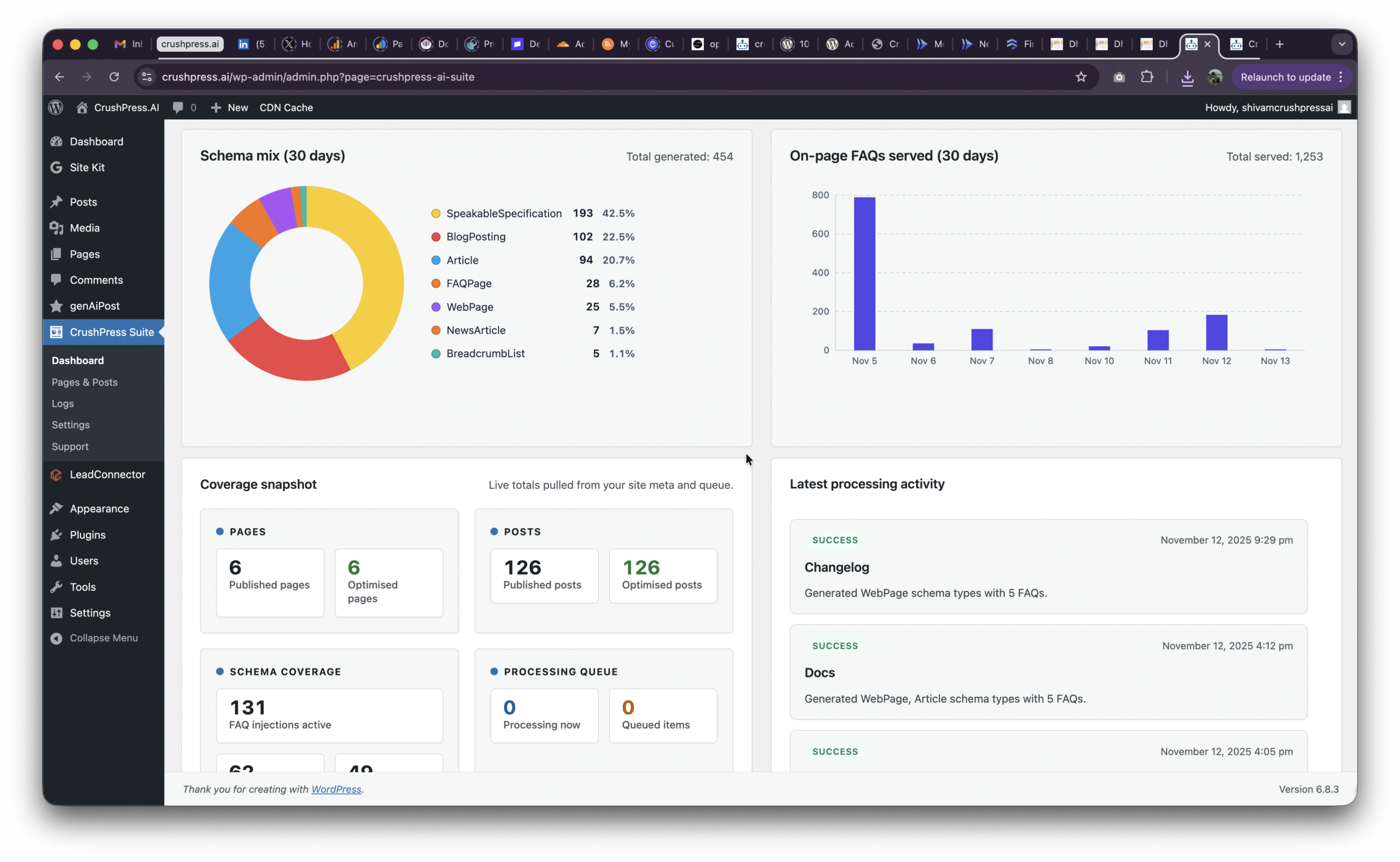
1. What exactly does CrushPress.ai do for my WordPress sites?
It auto-generates structured data (JSON-LD) that AI systems can reliably parse so your pages appear in AI answers (AEO) and generative summaries (GEO). It fixes the formatting issues most themes/plugins create.
2. Is this replacing traditional SEO plugins like Yoast or RankMath?
No. SEO plugins optimize for Google SERPs. CrushPress optimizes for AI-powered engines (ChatGPT Search, Google AI Overviews, Bing AI, Perplexity). They work side-by-side.
3. How does this help my clients get more visibility?
AI search rewrites content. CrushPress ensures your content is machine-trustworthy so AI engines quote it instead of skipping or paraphrasing it.
4. What data formats does CrushPress generate?
All schema.org JSON-LD types, including Article, BlogPosting, LocalBusiness, Product, FAQPage, HowTo, Review, Organization, Service, and more — automatically.
5. Will it mess with my existing SEO schema?
No. CrushPress safely merges, extends, or replaces broken schema depending on your site’s state. It never duplicates.
6. Does it slow down my website?
No. The plugin is lightweight, server-side rendered, and optimized for high-traffic environments.
7. How does it handle sites with thousands of pages?
It dynamically generates schema on request, supports caching, and is stable for very large sites or multisite networks.
8. Can I use it on client sites under my agency license?
Yes. There are agency/host plans specifically designed for bulk usage.
9. Does the plugin work with custom post types?
Yes — automatically. It detects CPTs, taxonomies, and custom fields.
10. Does CrushPress integrate with popular page builders?