For as long as I’ve worked in search marketing, I’ve viewed the path to purchase as a simple sequence: search query → click → buy.
I’ve approached SEO through much the same model, using organic traffic, impressions, and click-through rate (CTR) as the primary measures of success.
Google’s Universal Commerce Protocol (UCP) tells me that this familiar path is changing. Google is evolving from a discovery engine into a transaction layer where searching and buying can happen inside the same experience.
With the rise of “agentic commerce,” I’m seeing Google gain the ability to discover, evaluate, compare, and purchase products on a user’s behalf within AI-powered experiences such as AI Mode, Gemini, YouTube, and Gmail.
I believe the SEO implications are substantial. Instead of optimizing only for clicks, I now need to think about optimizing for AI-assisted transactions. If a brand cannot communicate through UCP and the product data that supports it, it risks becoming invisible to the next generation of shoppers.
Here’s how I understand UCP, why I think it will reshape digital marketing, and what I recommend doing now to prepare an SEO strategy for agentic commerce.
UCP: The infrastructure behind AI transactions
I think of UCP as an open-source, vendor-agnostic standard that supports the entire commerce lifecycle inside an AI interface. That lifecycle can extend from product discovery and cart creation through checkout, fulfillment, and post-purchase tracking.
Google co-developed UCP with Shopify, Walmart, Target, Wayfair, Etsy, and other commerce leaders. From my perspective, it acts as a universal translator between AI shopping agents and the systems merchants use to operate their online stores.
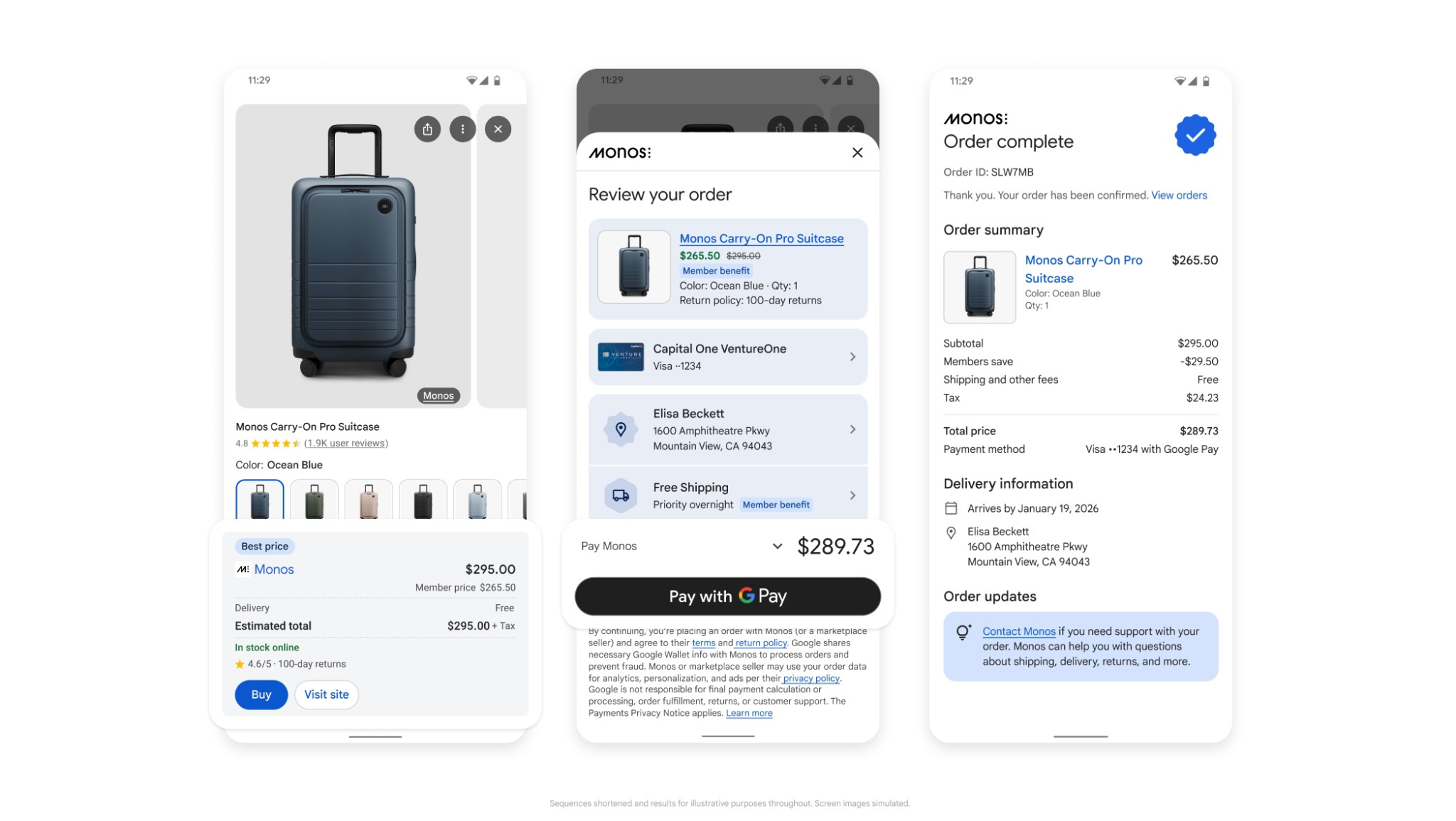
The clearest analogy I can make is that UCP may become the ecommerce equivalent of HTTPS. HTTPS standardizes secure communication between browsers and servers; UCP standardizes how AI agents interact with online stores. Instead of building a custom one-to-one integration for every merchant, an AI agent can use a shared framework to browse inventory securely and complete purchases across many stores.
How I see AI transactions flowing through UCP
Imagine I ask AI Mode to “find and order a replacement water filter for a 2021 Samsung French-door fridge with the fastest shipping.” UCP can coordinate that transaction through a structured workflow.
Capability publication
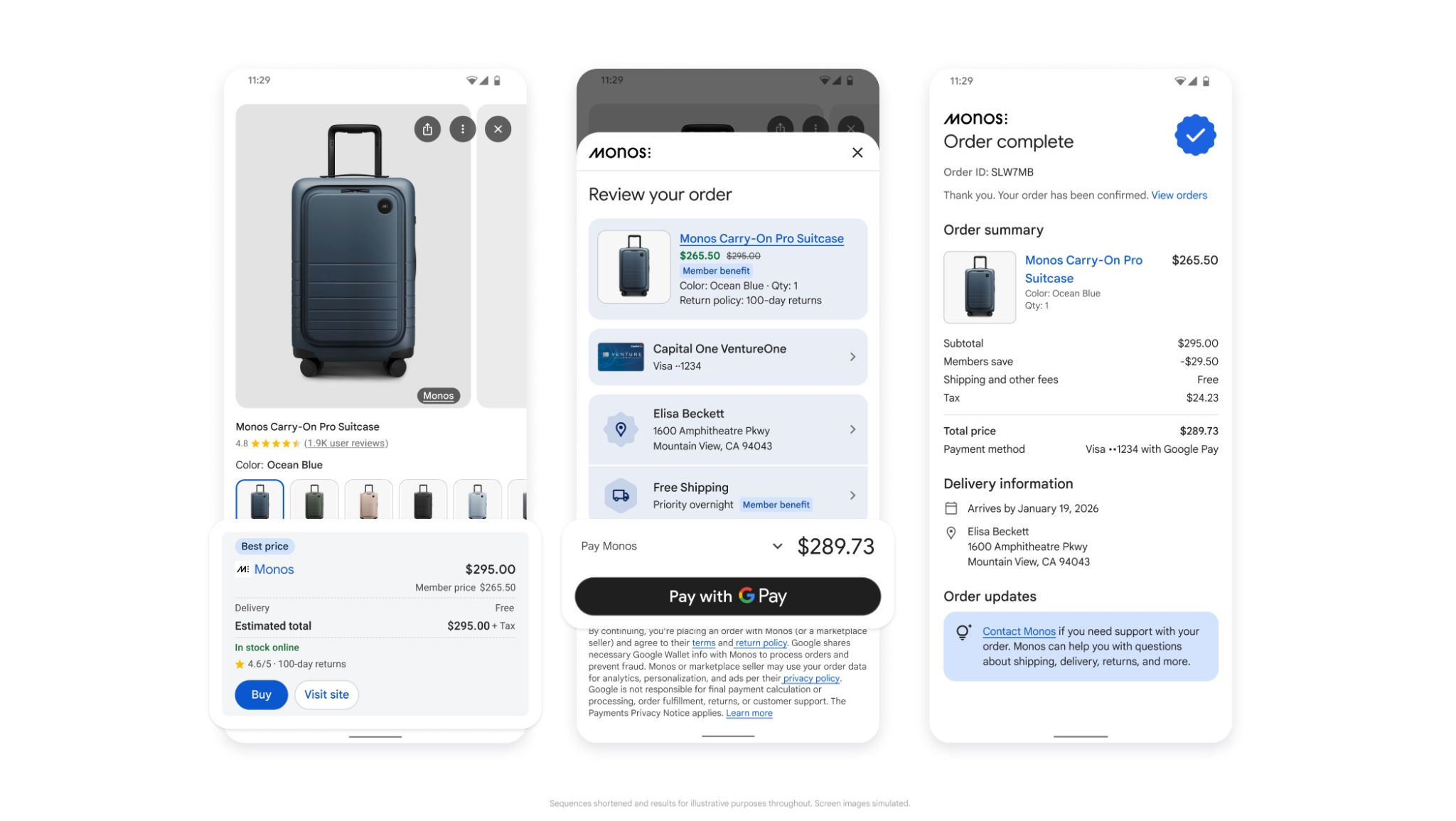
First, I expect the merchant to publish the capabilities its store supports, including product search, live pricing, fulfillment options, and accepted payment methods. This gives the AI agent a clear picture of what it can request and complete.
Handshake
Next, the AI agent reads the merchant’s profile, compares those capabilities with its own, and establishes a secure path forward. I see this step as the point where the systems can align on details such as loyalty programs and supported digital wallets.
Action execution
Once the systems are aligned, the AI searches for the product, verifies real-time inventory, builds the cart, and uses the Agent Payments Protocol (AP2) to complete a secure, tokenized transaction.
Human escalation
If the transaction needs my input—perhaps to select a delivery window or confirm a shipping address—UCP can pause the process and prompt me. After I respond, control returns to the AI so it can finish the workflow.
Dig deeper: How Google’s Universal Commerce Protocol could reshape search conversions
Why I believe UCP matters for search and SEO
I don’t see UCP as merely a technical update. I see it changing the way AI discovers, evaluates, and purchases products—and that makes it directly relevant to SEO.
1. I’m shifting from click-throughs to buy-throughs
In an agentic search environment, I can no longer treat website traffic as the only measure of business value. Features such as Universal Cart can let shoppers add products from multiple retailers to one Google cart and check out with Google Wallet, dramatically shortening the buying journey.
A shopper may never visit my homepage, category page, or product detail page. That changes my SEO objective: I need to earn product selection within the AI recommendation layer so a search query can become a sale even when it generates no intermediate website visit.
2. I’m planning for hyper-personalized queries
I’m also rethinking keyword research. Shoppers are moving beyond broad searches such as “men’s running shoes” and using detailed, situational prompts like “Best running shoes for flat feet under $150 that can arrive by Friday.”
To match a request that specific, I know a search engine needs more than polished on-page copy. It needs rich, structured, and queryable product attributes. UCP helps bridge that gap by giving AI agents a way to match merchant inventory with a shopper’s precise requirements.
3. I expect less checkout friction
I continue to see cart abandonment as a major ecommerce challenge, especially when shoppers encounter long forms, broken checkout flows, or unexpected shipping costs. Because UCP can work with secure digital wallets and automatically pass verified user data, I expect it to eliminate many of those friction points.

For high-intent, urgent, or repeat purchases, I believe merchants that support UCP may capture more conversions than competitors that send every shopper to a separate checkout experience.
4. I can retain brand control and customer ownership
One detail I consider especially important is that the merchant remains the Merchant of Record when a transaction takes place through UCP. I can still control pricing, fulfillment, and return policies while retaining the customer relationship and first-party data. UCP provides the transactional infrastructure without replacing the merchant’s role.
Dig deeper: Winning the AI decision layer: From AI discovery to agentic commerce
How I recommend preparing a brand for UCP
If I limit an SEO strategy to blog articles and meta descriptions, I overlook the technical infrastructure that powers AI commerce. To make products eligible for UCP-powered experiences, I recommend focusing on the following priorities.
I would optimize the Merchant Center feed
I no longer view Google Merchant Center (GMC) as a tool used only for Shopping ads. I see it becoming a primary source of product information for AI discovery, which makes feed quality central to both visibility and transaction eligibility.
- Enable the
native_commerceattribute: To opt into UCP-powered checkouts, I would add thenative_commerceattribute to the product feed. Google recommends using supplemental feeds to apply it at the product level without changing the primary feed. - Map product identifiers: I would make sure every product ID in the GMC feed maps one-to-one with the corresponding ID in the internal checkout API. If the identifiers differ, I would use the
merchant_item_idattribute to align them. - Complete policy data: I would keep returns, shipping, and customer-support information complete and current. Clear policy data gives an AI agent the details it needs to evaluate a merchant confidently.
I would align structured data with the product feed
Because AI search depends on consistent information, I would keep the Product, Offer, and Review schema on the website synchronized with the Merchant Center feed. If the price, availability, identifiers, or other details conflict, validation problems could make a product ineligible for AI-powered checkout.
I would prepare for conversational attributes
As Google introduces semantic attributes designed for conversational AI search, I would prepare inventory and product-information systems to supply richer answers. In particular, I would prioritize:
- Real-time inventory availability.
- Direct answers to product FAQs, such as “Is this jacket machine washable?”
- Detailed compatibility information, including accessory pairings, sizing guides, and model-specific replacements.
I would treat these details as more than feed enhancements. They are the signals that help an AI agent decide whether a product satisfies a nuanced request involving price, fit, compatibility, delivery speed, or another real-world constraint.
Beyond clicks: The next SEO opportunity I see
To me, the Universal Commerce Protocol reflects a broader transformation in search. It expands the role of SEO beyond generating traffic and brings product data, inventory systems, checkout infrastructure, and conversion readiness into the search conversation.
By prioritizing structured product data, reliable commerce information, and readiness for agentic transactions, I can position a brand to capture demand at the exact moment a shopper expresses intent.
I don’t believe the future of search will be only about getting found. Increasingly, it will be about making sure the products I represent can be evaluated, selected, and bought.
Inspired by this post on Search Engine Land.

Leave a Reply