Tag: Universal Cart

  • Google UCP and SEO: How I’m Preparing for AI Commerce

    Google UCP and SEO: How I’m Preparing for AI Commerce

    Google's Universal Commerce Protocol changes the path from search to sale

    For as long as I’ve worked in search marketing, I’ve viewed the path to purchase as a simple sequence: search query → click → buy.

    I’ve approached SEO through much the same model, using organic traffic, impressions, and click-through rate (CTR) as the primary measures of success.

    Google’s Universal Commerce Protocol (UCP) tells me that this familiar path is changing. Google is evolving from a discovery engine into a transaction layer where searching and buying can happen inside the same experience.

    With the rise of “agentic commerce,” I’m seeing Google gain the ability to discover, evaluate, compare, and purchase products on a user’s behalf within AI-powered experiences such as AI Mode, Gemini, YouTube, and Gmail.

    I believe the SEO implications are substantial. Instead of optimizing only for clicks, I now need to think about optimizing for AI-assisted transactions. If a brand cannot communicate through UCP and the product data that supports it, it risks becoming invisible to the next generation of shoppers.

    Here’s how I understand UCP, why I think it will reshape digital marketing, and what I recommend doing now to prepare an SEO strategy for agentic commerce.

    UCP: The infrastructure behind AI transactions

    I think of UCP as an open-source, vendor-agnostic standard that supports the entire commerce lifecycle inside an AI interface. That lifecycle can extend from product discovery and cart creation through checkout, fulfillment, and post-purchase tracking.

    Google co-developed UCP with Shopify, Walmart, Target, Wayfair, Etsy, and other commerce leaders. From my perspective, it acts as a universal translator between AI shopping agents and the systems merchants use to operate their online stores.
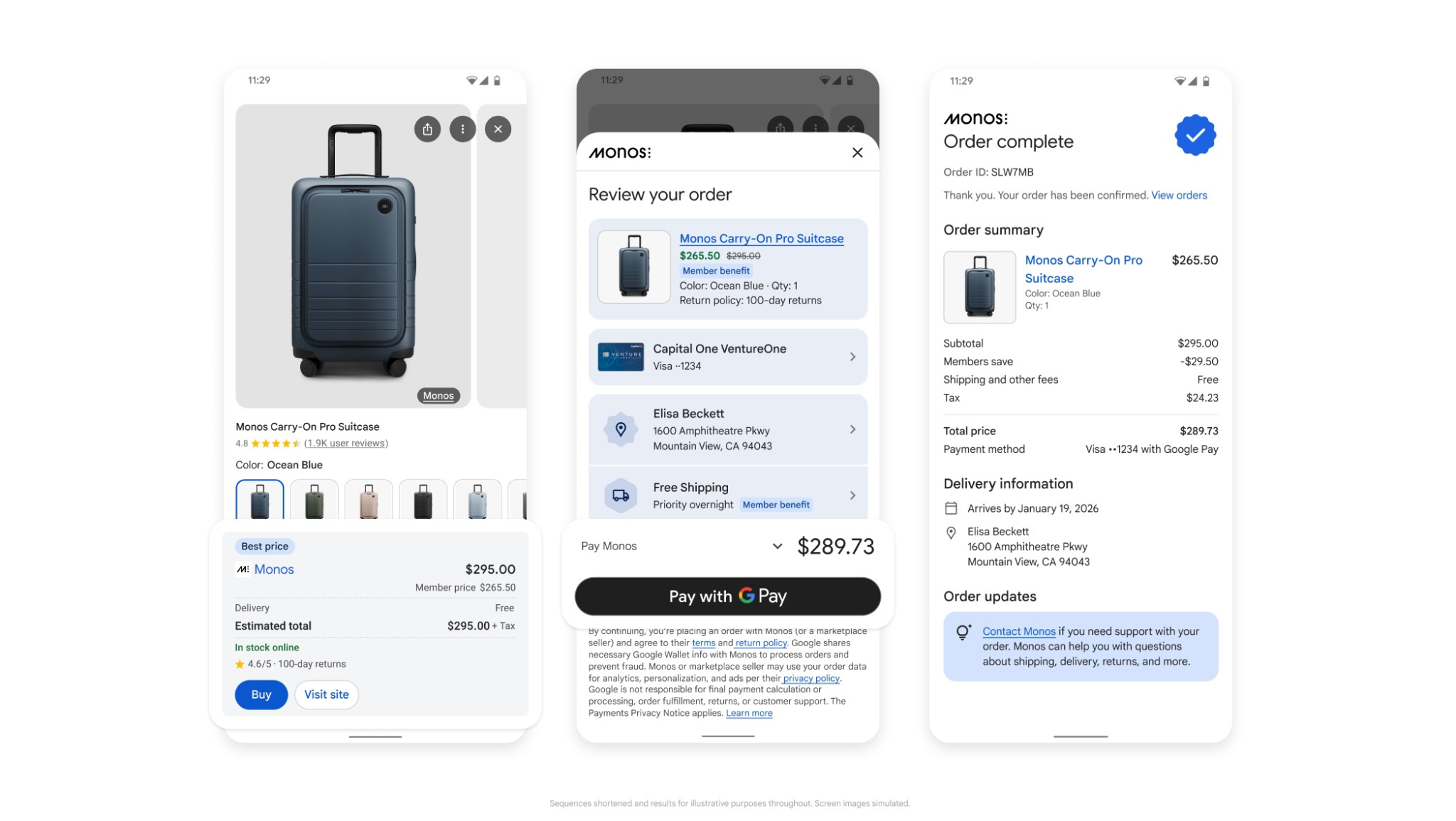
    Google UCP - Pay with GPay

    The clearest analogy I can make is that UCP may become the ecommerce equivalent of HTTPS. HTTPS standardizes secure communication between browsers and servers; UCP standardizes how AI agents interact with online stores. Instead of building a custom one-to-one integration for every merchant, an AI agent can use a shared framework to browse inventory securely and complete purchases across many stores.

    How I see AI transactions flowing through UCP

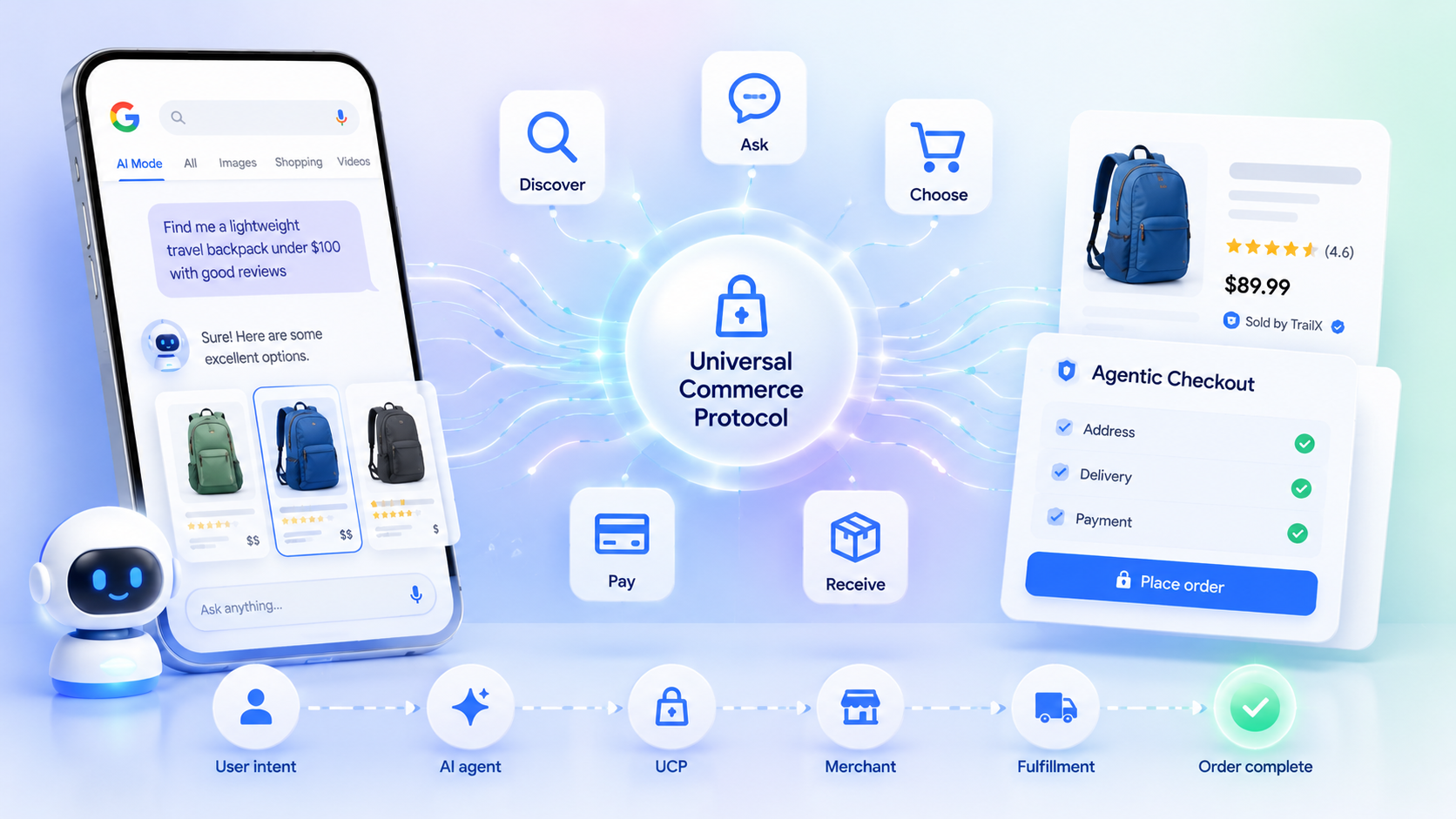
    Imagine I ask AI Mode to “find and order a replacement water filter for a 2021 Samsung French-door fridge with the fastest shipping.” UCP can coordinate that transaction through a structured workflow.

    Capability publication

    First, I expect the merchant to publish the capabilities its store supports, including product search, live pricing, fulfillment options, and accepted payment methods. This gives the AI agent a clear picture of what it can request and complete.
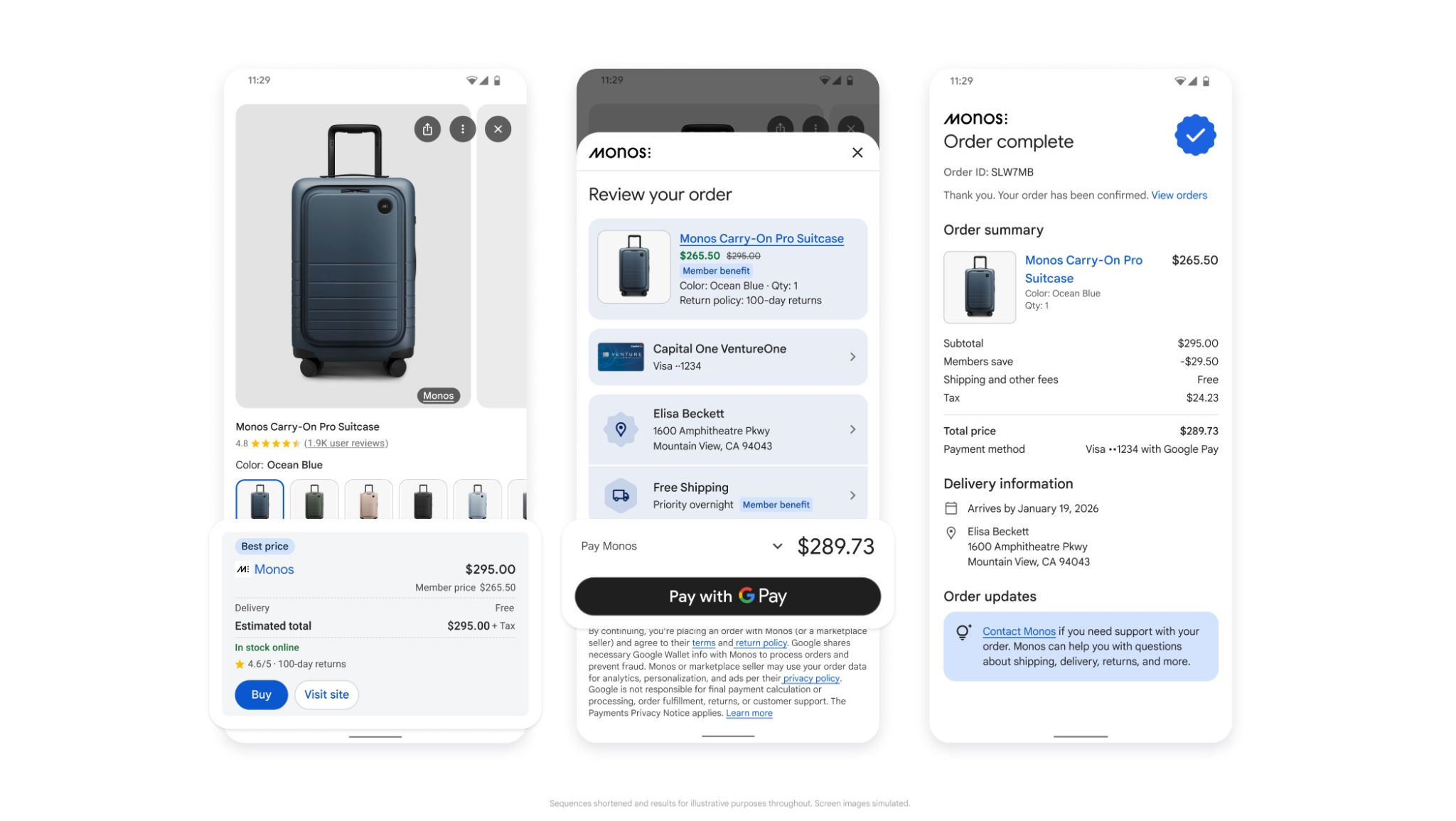
    Three mobile screens show a Monos suitcase listing, Google Pay order review, and completed checkout through Google’s Universal Commerce Protocol.
    From product discovery to payment and confirmation, this mobile shopping sequence shows a Monos suitcase purchase completed with Google Pay through Google’s Universal Commerce Protocol.

    Handshake

    Next, the AI agent reads the merchant’s profile, compares those capabilities with its own, and establishes a secure path forward. I see this step as the point where the systems can align on details such as loyalty programs and supported digital wallets.

    Action execution

    Once the systems are aligned, the AI searches for the product, verifies real-time inventory, builds the cart, and uses the Agent Payments Protocol (AP2) to complete a secure, tokenized transaction.

    Human escalation

    If the transaction needs my input—perhaps to select a delivery window or confirm a shipping address—UCP can pause the process and prompt me. After I respond, control returns to the AI so it can finish the workflow.

    Dig deeper: How Google’s Universal Commerce Protocol could reshape search conversions


    Why I believe UCP matters for search and SEO

    I don’t see UCP as merely a technical update. I see it changing the way AI discovers, evaluates, and purchases products—and that makes it directly relevant to SEO.

    1. I’m shifting from click-throughs to buy-throughs

    In an agentic search environment, I can no longer treat website traffic as the only measure of business value. Features such as Universal Cart can let shoppers add products from multiple retailers to one Google cart and check out with Google Wallet, dramatically shortening the buying journey.

    A shopper may never visit my homepage, category page, or product detail page. That changes my SEO objective: I need to earn product selection within the AI recommendation layer so a search query can become a sale even when it generates no intermediate website visit.

    2. I’m planning for hyper-personalized queries

    I’m also rethinking keyword research. Shoppers are moving beyond broad searches such as “men’s running shoes” and using detailed, situational prompts like “Best running shoes for flat feet under $150 that can arrive by Friday.”

    To match a request that specific, I know a search engine needs more than polished on-page copy. It needs rich, structured, and queryable product attributes. UCP helps bridge that gap by giving AI agents a way to match merchant inventory with a shopper’s precise requirements.

    3. I expect less checkout friction

    I continue to see cart abandonment as a major ecommerce challenge, especially when shoppers encounter long forms, broken checkout flows, or unexpected shipping costs. Because UCP can work with secure digital wallets and automatically pass verified user data, I expect it to eliminate many of those friction points.

    Glowing blue streams of people converge on a search bar and digital portal, symbolizing SEO traffic, AI visibility, and customer acquisition.
    As AI reshapes search, every glowing path to discovery carries commercial value—turning SEO investment into a conversation about pipeline, risk, and customer acquisition costs.

    For high-intent, urgent, or repeat purchases, I believe merchants that support UCP may capture more conversions than competitors that send every shopper to a separate checkout experience.

    4. I can retain brand control and customer ownership

    One detail I consider especially important is that the merchant remains the Merchant of Record when a transaction takes place through UCP. I can still control pricing, fulfillment, and return policies while retaining the customer relationship and first-party data. UCP provides the transactional infrastructure without replacing the merchant’s role.

    Dig deeper: Winning the AI decision layer: From AI discovery to agentic commerce

    How I recommend preparing a brand for UCP

    If I limit an SEO strategy to blog articles and meta descriptions, I overlook the technical infrastructure that powers AI commerce. To make products eligible for UCP-powered experiences, I recommend focusing on the following priorities.

    I would optimize the Merchant Center feed

    I no longer view Google Merchant Center (GMC) as a tool used only for Shopping ads. I see it becoming a primary source of product information for AI discovery, which makes feed quality central to both visibility and transaction eligibility.

    • Enable the native_commerce attribute: To opt into UCP-powered checkouts, I would add the native_commerce attribute to the product feed. Google recommends using supplemental feeds to apply it at the product level without changing the primary feed.
    • Map product identifiers: I would make sure every product ID in the GMC feed maps one-to-one with the corresponding ID in the internal checkout API. If the identifiers differ, I would use the merchant_item_id attribute to align them.
    • Complete policy data: I would keep returns, shipping, and customer-support information complete and current. Clear policy data gives an AI agent the details it needs to evaluate a merchant confidently.

    I would align structured data with the product feed

    Because AI search depends on consistent information, I would keep the Product, Offer, and Review schema on the website synchronized with the Merchant Center feed. If the price, availability, identifiers, or other details conflict, validation problems could make a product ineligible for AI-powered checkout.

    I would prepare for conversational attributes

    As Google introduces semantic attributes designed for conversational AI search, I would prepare inventory and product-information systems to supply richer answers. In particular, I would prioritize:

    • Real-time inventory availability.
    • Direct answers to product FAQs, such as “Is this jacket machine washable?”
    • Detailed compatibility information, including accessory pairings, sizing guides, and model-specific replacements.

    I would treat these details as more than feed enhancements. They are the signals that help an AI agent decide whether a product satisfies a nuanced request involving price, fit, compatibility, delivery speed, or another real-world constraint.

    Beyond clicks: The next SEO opportunity I see

    To me, the Universal Commerce Protocol reflects a broader transformation in search. It expands the role of SEO beyond generating traffic and brings product data, inventory systems, checkout infrastructure, and conversion readiness into the search conversation.

    By prioritizing structured product data, reliable commerce information, and readiness for agentic transactions, I can position a brand to capture demand at the exact moment a shopper expresses intent.

    I don’t believe the future of search will be only about getting found. Increasingly, it will be about making sure the products I represent can be evaluated, selected, and bought.


    Inspired by this post on Search Engine Land.


    crushpress.ai community screenshot
  • How Gemini Intelligence Will Reshape Search and Commerce

    How Gemini Intelligence Will Reshape Search and Commerce

    Google brings AI to Android — here's what it means for search

    I see Google’s unveiling of Gemini Intelligence at the May 12 Android Show as a significant step toward an agent-powered future. Announced alongside a new laptop called the Googlebook, Gemini Intelligence is designed as an underlying layer that works across the Android operating system on laptops, phones, watches, and glasses.

    The Googlebook makes that vision tangible to me. Built from the ground up around an AI agent, it can understand what is on the screen and act on it. I could point to a date in an email and have the agent schedule a meeting, or select furniture in an app and see how those pieces might look in my living room.

    I believe this ability to complete tasks without requiring someone to open a webpage will fundamentally change how people search, discover information, and conduct commerce. Here is how I expect that shift to affect the search industry.

    What the shift to an agentic operating system means

    Until now, I have viewed search as a familiar sequence: someone has a question or intent, enters it into a search engine, receives a list of links, and chooses one. Earning a prominent position on that list was the prize, and much of the SEO industry was built around winning that click.

    Gemini Intelligence starts from a very different assumption. Search intent still exists, but an AI agent can handle the steps between the request and the outcome. It can read pages, complete forms, and increasingly finish the entire task. Instead of visiting a website myself, I may have an agent visit and use it on my behalf.

    When I look for an early example, Chrome Auto Browse stands out. Launched in January and built on Gemini 3, it can manage multistep tasks such as researching flights, filling out forms, scheduling appointments, and managing subscriptions. It then pauses for approval before making a purchase.

    That efficiency gives me a clear reason to believe ecommerce will continue moving toward agentic AI.

    A 2025 preprint supports this view. Researchers evaluated the declared-tools approach across online shopping, authentication, and content management. They found that giving an agent pre-structured interaction data reduced processing requirements by 67.6% and lowered costs by 34% to 63% compared with parsing a complete HTML document. Task success declined only slightly, from 98.8% with the traditional method to 97.9%.

    The architecture behind Gemini Intelligence

    To me, the architecture is as important as the interface. AI agents naturally favor websites they can interact with cleanly and efficiently, and Gemini Intelligence can only deliver on its promise if those agents can perform tasks reliably.

    I see two protocols as central to making that possible. WebMCP turns a website’s actions into callable tools, while the Universal Commerce Protocol (UCP) allows an agent to complete a sale. Together, they enable an agent to finish a task without requiring a person to load and navigate the underlying webpage.

    Glowing blue streams of people converge on a search bar and digital portal, symbolizing SEO traffic, AI visibility, and customer acquisition.
    As AI reshapes search, every glowing path to discovery carries commercial value—turning SEO investment into a conversation about pipeline, risk, and customer acquisition costs.

    WebMCP

    I think of WebMCP as a labeled menu for AI agents. The API allows a website to declare functions as structured tools an agent can call, including searching inventory, beginning checkout, or submitting a support request.

    Google co-developed WebMCP with Microsoft. An origin trial is live in Chrome 149, Firefox has committed to the third quarter of 2026, and Safari is expected to follow in the fourth quarter.

    Universal Commerce Protocol (UCP)

    I see UCP as the transactional counterpart to WebMCP. It gives AI agents a shared language for discovering products, building a cart, completing checkout, and managing orders without requiring someone to visit the merchant’s website.

    Google also offers a consumer-facing layer called Universal Cart. It can collect items as I move across Search, Gemini, YouTube, and Gmail, creating a more connected shopping experience across Google’s products.

    The range of companies behind UCP shows me how seriously the industry is taking this shift. Google, Shopify, Walmart, Target, Etsy, Wayfair, PayPal, and Stripe co-developed the protocol, which launched in January.


    How I would prepare for agentic AI

    My main takeaway is that websites are rapidly evolving from destinations into backends—from places people actively visit into systems agents quietly use. As the operating system becomes a search and action layer, I no longer think ranking is the only question that matters. I also need to ask whether an agent can actually use the site.

    To prepare, I would begin by auditing the site’s most valuable actions, whether that means submitting a lead form, completing a booking flow, or reaching checkout. I would determine whether an agent could complete each action reliably and check the site’s Lighthouse Agentic Browsing score much as I would review Core Web Vitals. The goal is to understand whether an agent can use the site, not merely read it.

    If I ran an ecommerce business, I would confirm whether the checkout process is accessible through UCP or ACP. I would also continue investing in retrieval and visibility because an agent still needs to find and trust the business before it can act on anyone’s behalf.

    Dig deeper: Are we ready for the agentic web?


    Inspired by this post on Search Engine Land.


    crushpress.ai community screenshot
  • Google Introduces AI Shopping Tools with Expanded UCP

    Google Introduces AI Shopping Tools with Expanded UCP

    Today, I’m excited to share that Google is taking a significant leap forward in the world of online shopping by expanding its Universal Commerce Protocol (UCP). This comes with a host of AI-powered checkout and payment features designed to enhance conversational commerce experiences.

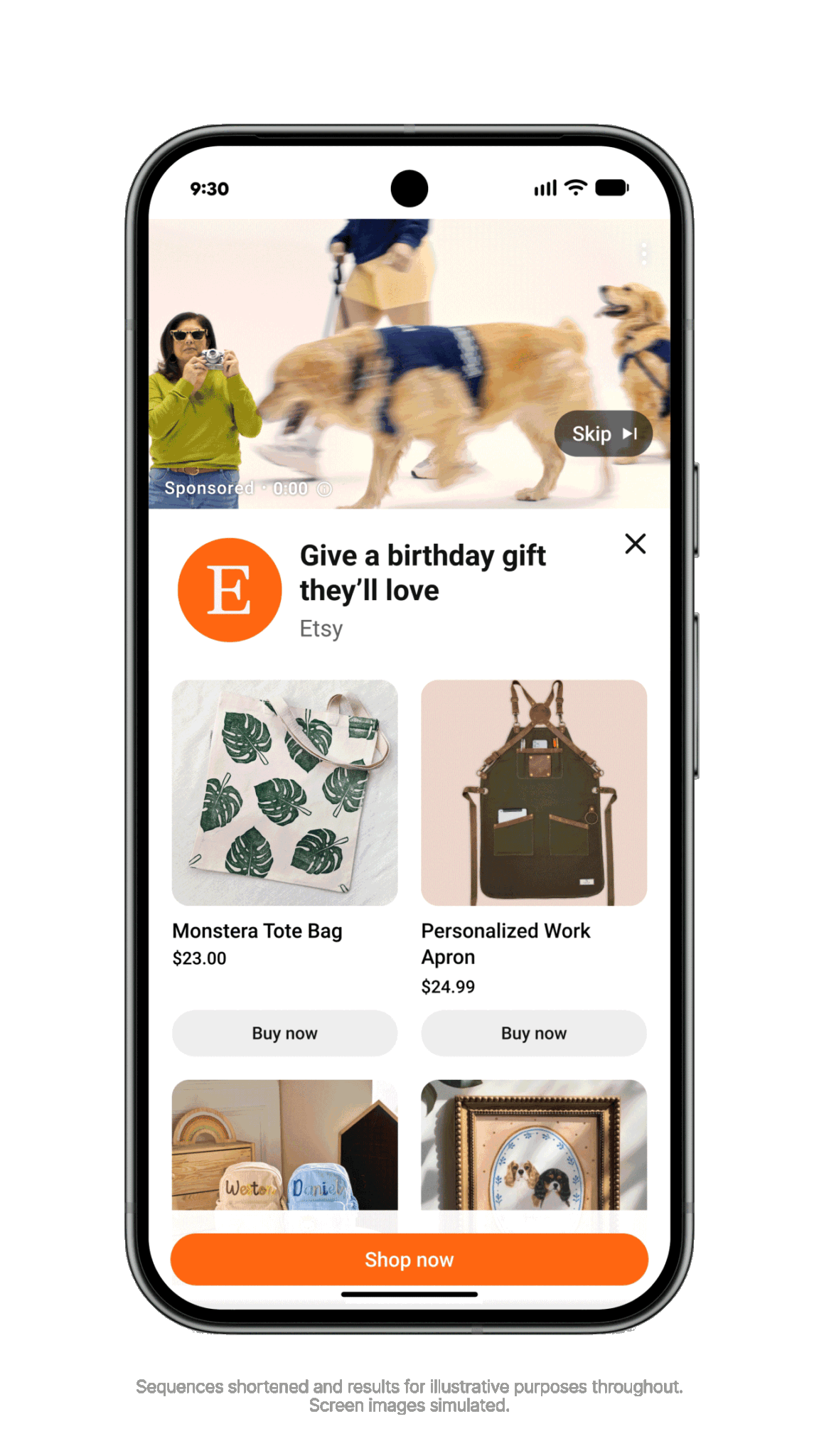
    At the recent Google Marketing Live 2026 event, they unveiled these exciting new features. One of the highlights is the Universal Cart. It lets me save products from multiple retailers and complete my purchases effortlessly using Google Pay or the retailer’s own checkout system.

    It’s thrilling to see major brands like Nike, Sephora, Target, and more jumping on board. They’re also integrating UCP into AI Mode shopping experiences and their ads on platforms like YouTube.

    Furthermore, Google’s new partnerships with Affirm and Klarna for buy-now-pay-later options integrated into Google Pay bring a fresh breath of convenience to shoppers like me.

    Universal Commerce Protocol connects product catalogs, checkout, and payment experiences seamlessly across Google’s surfaces, including Search and Maps. Soon, I can expect it to support hotel bookings and food deliveries, which means even more convenience for us end-users.

    ```json
{
  "alt": "Smartphone displaying an Etsy advertisement featuring gift ideas like a Monstera Tote Bag and Personalized Work Apron.",
  "caption": "Discover the perfect birthday gift with Etsy's curated picks, featuring unique items like the Monstera Tote Bag and Personalized Work Apron. Shop now!",
  "description": "The image showcases a smartphone displaying an Etsy advertisement under the theme 'Give a birthday gift they'll love.' It highlights two gift ideas: a Monstera Tote Bag priced at $23.00 and a Personalized Work Apron at $24.99. The ad encourages users to explore these curated items as gifts. Visual elements include an engaging video of dogs walking in the background. The ad prompts 'Shop now' to direct the viewer to the shopping interface. Keywords: Etsy, birthday gift, shopping app, Monstera Tote Bag, Personalized Work Apron."
}
```

    As an avid online shopper, I appreciate how Google is making strides towards enhancing AI-driven commerce. They’re set to reshape how brands like mine will structure product feeds and promotional strategies.

    Currently, these new UCP-powered features are rolling out in the U.S., and I’m eagerly waiting for their expansion to more countries, including Canada and the U.K.

    To delve deeper into what unfolded at Google Marketing Live, check out updates on innovations like conversational ad formats and Google’s AI-driven tools in their Merchant Center.


    Inspired by this post on Search Engine Land.


    crushpress.ai community screenshot
  • Explore Google’s Enhanced Shopping Experience with Universal Cart

    Explore Google’s Enhanced Shopping Experience with Universal Cart

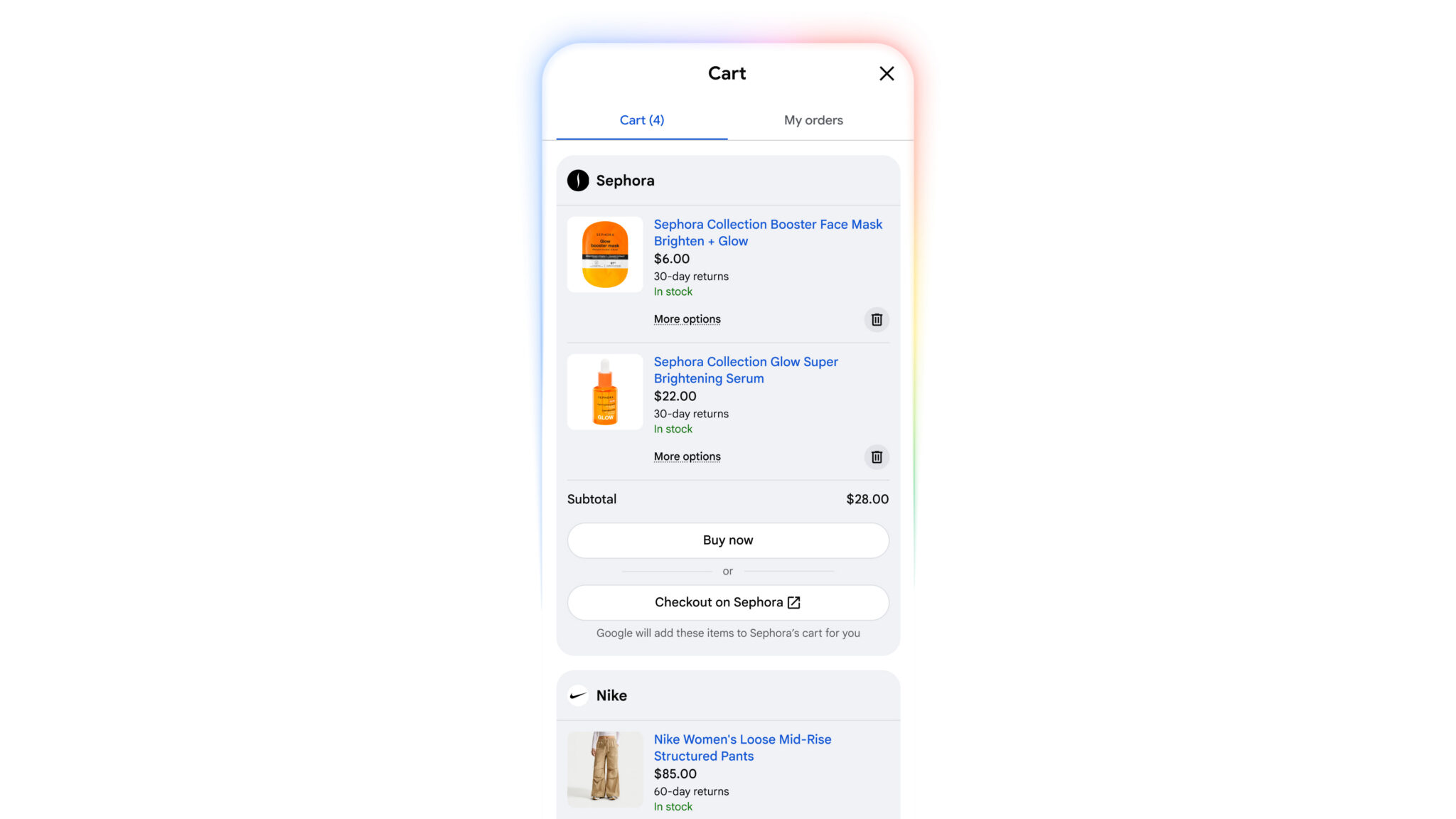
    Imagine scrolling through Google Search and effortlessly collecting items from various retailers into one convenient Universal Cart. That’s exactly what Google is offering now, a seamless shopping experience that allows me to keep all my desired products in one place and check them out with a single click using Google Wallet.

    Recently announced by Vidhya Srinivasan, VP/GM Ads & Commerce, Google’s Shopping Graph has reached an impressive 60 billion product listings, a significant jump from the 50 billion earlier this year. This growth reflects Google’s commitment to enhancing our online shopping experiences.

    Universal Cart. With Universal Cart, I can add items from multiple stores while browsing Google Search, or even when I’m on YouTube and Gmail. It’s so liberating not to jump from site to site!

    Here’s how it works: as I shop, Google helps me find the best deals and in-stock availability across different retailers. Then I simply choose my preferred store for checkout, leaving no room for the hassles generally associated with online shopping.

    ```json
{
  "alt": "Shopping cart with Sephora face mask and serum listed for purchase.",
  "caption": "Enhance your beauty regimen with Sephora's brightening mask and serum, conveniently listed in your online shopping cart!",
  "description": "The image displays a mobile shopping cart interface featuring two Sephora beauty products: a Booster Face Mask for $6.00 and a Glow Super Brightening Serum for $22.00, both in stock with 30-day return options. The cart shows a subtotal of $28.00 with options for direct purchase or checkout through Sephora. Bright and clear layout perfect for online shoppers seeking skincare solutions."
}
```

    Google’s Universal Cart is smart too! Imagine you’re assembling a custom PC—your cart will alert you if any parts are incompatible and suggest compatible alternatives. Built on Google Wallet, it even recognizes payment perks and loyalty offers, revealing savings opportunities I might otherwise overlook.

    Merchants. Google has partnered with renowned merchants like Nike, Sephora, Target, Ulta Beauty, Walmart, Wayfair, and Shopify sellers such as Fenty and Steve Madden. This wide array ensures I have plenty of shopping options!

    Availability. This feature will roll out in the U.S. this summer, initially available on Google Search and the Gemini app, with plans to expand to YouTube and Gmail soon after.

    ```json
{
  "alt": "Three smartphone screens displaying shopping cart warnings and offers for different products.",
  "caption": "Smart shopping alerts: Get compatibility alerts and exclusive offers right before you checkout.",
  "description": "The image shows three smartphone screens featuring a shopping cart interface. The first screen alerts the user about a compatibility issue between a Ryzen 7 CPU and a motherboard, while the second offers a 5% discount at Target with a Target Circle Card. The third screen displays a 'Buy now' button for items from Ulta Beauty. The interface provides users with helpful insights and offers at the checkout phase, enhancing the online shopping experience. Keywords: shopping cart, smartphone, alerts, discounts, compatibility."
}
```

    UCP and AP2. Google is also extending the Universal Commerce Protocol to Canada and Australia soon, with plans for the U.K. The Agent Payments Protocol will support secure, accountable transactions by authorizing agents to shop on my behalf according to my specific criteria.

    Moreover, Google’s innovative features are set to debut across Google products, starting with Gemini Spark. It’s an exciting time to be an online shopper!


    Inspired by this post on Search Engine Land.

    crushpress.ai community screenshot