
I see Google Discover’s “Tailor Your Feed,” now showing up as “Add topics to your feed,” as a meaningful shift in how people can shape what appears in their feed. Instead of relying only on Google’s inferred signals, such as clicks, dwell time, follows, and engagement history, I can now type what I want to see in natural language and let Google translate that request into feed instructions.
That matters because it creates a third visibility path for small and niche publishers. Until now, a smaller site usually needed either strong implicit affinity from a user or an explicit follow. With prompt-based tuning, a user can simply ask for a topic, creator, source, or type of content, and Google can retrieve matching material even when that content has barely appeared in Discover before.

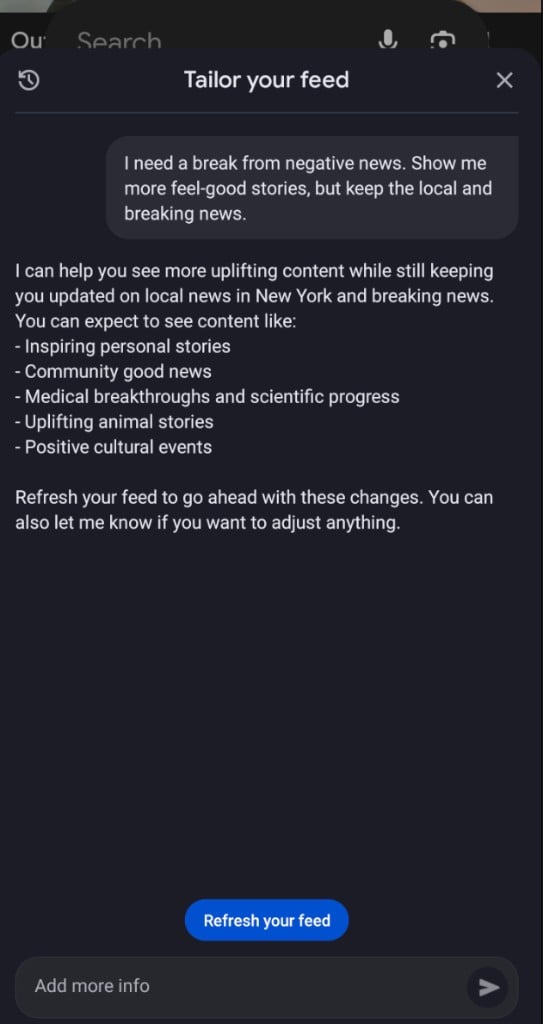
In my tracking, the feature turns prompts into actions such as SEE_MORE and SEE_LESS. Those actions are applied after the user refreshes or updates the feed. The experience feels conversational, but underneath it appears to create persistent instructions that can affect both the current feed and future Discover sessions.

I also see signs of an LLM-style system behind the workflow. A user prompt is interpreted, converted into a readable assistant response, and returned with a structured result. In one observed example, the prompt “show me more content on seroundtable.com” produced an actionable SEE_MORE response and a persistent thread key, suggesting that feed tuning is treated as an ongoing conversation rather than a single isolated command.
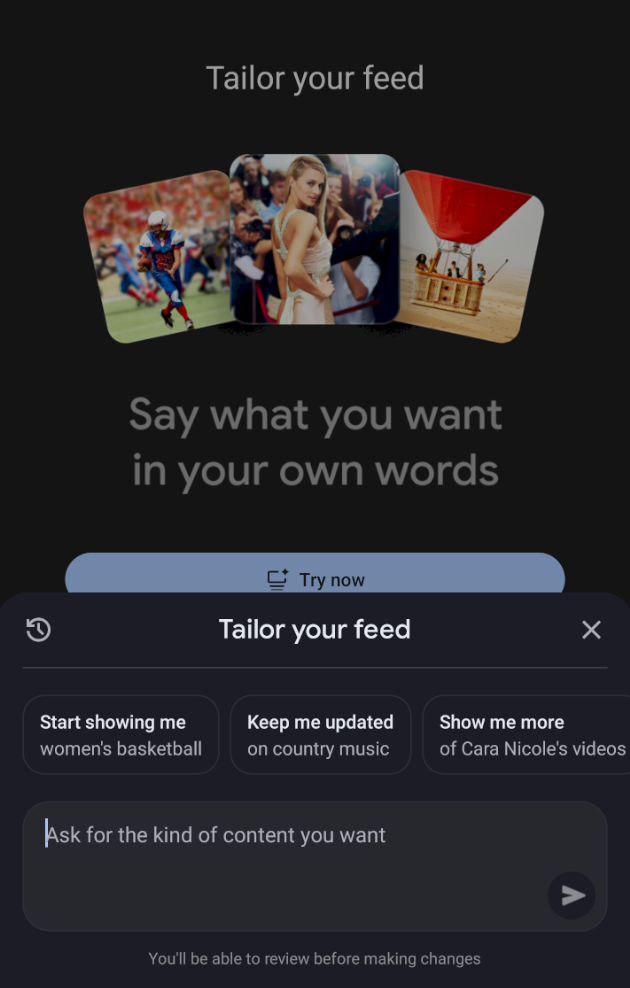
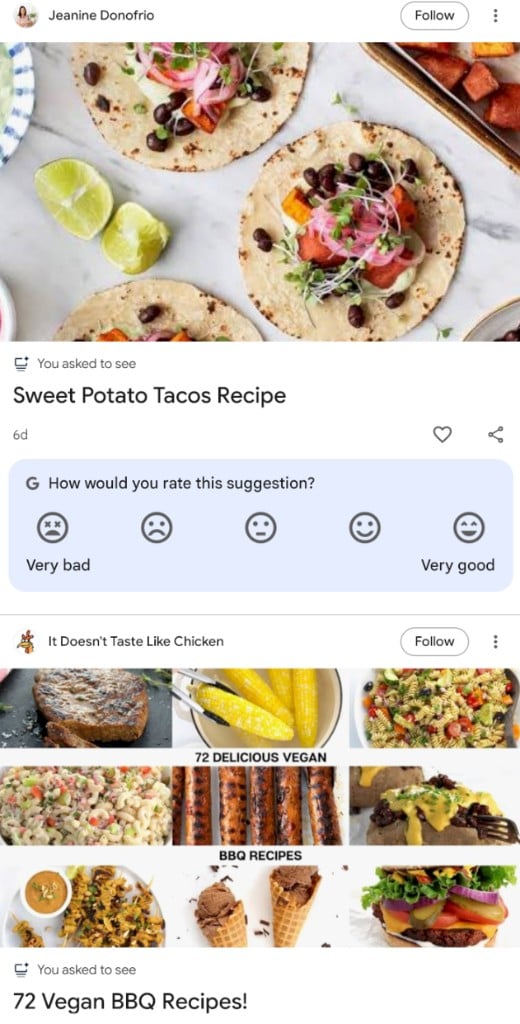
The feature first appeared in Search Labs for US English accounts in December 2025. At that stage, the impact was subtle: after several refreshes, I could see a few on-topic cards, but the feed did not radically transform. By early 2026, Google started adding attribution, including labels such as “resulting from natural language tuning” and later “You asked to see,” making it easier to identify which cards were influenced by a prompt.
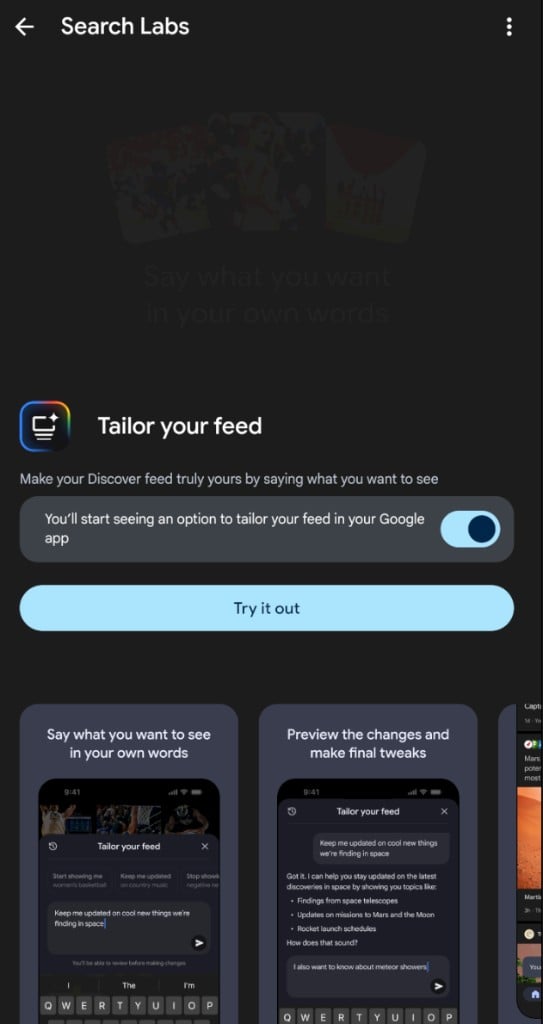
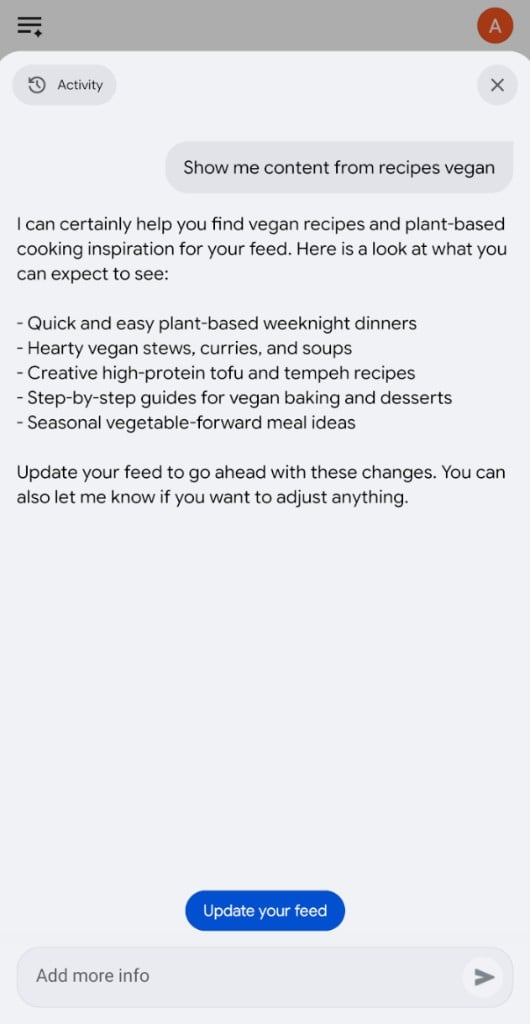
By spring 2026, “Tailor Your Feed” had effectively become “Add topics to your feed.” The interface moved toward a chat-style entry point with prompt starters such as “Show me content from…,” “I want videos about…,” and “Keep me updated…”. The same underlying verbs remained, but Google made them easier for everyday users to trigger.

The most important technical clue is the pipeline behind the feature. Discover cards influenced by these prompts can be associated with naturallanguagetuningcontent.f for current tuning and historicalnaturallanguagetuningcontent.f for older prompts that continue shaping the feed. I read that “historical” pipeline as evidence that these preferences are meant to last over time, not disappear after one refresh.

From the observed cards, I see two ways this content is selected. The first and dominant mode is entity or interest expansion. A prompt is mapped to related people, topics, publishers, or concepts, and Discover expands around that meaning. This is why asking for one source or creator may also surface related sources, related subjects, or nearby entities rather than only the exact name typed into the prompt box.

The second and more interesting mode is query-intent fan-out. In this mode, a prompt is decomposed into natural-language retrieval queries. A broad request about SEO, for example, can become query intents such as “SEO strategies algorithm changes,” “Google ranking system updates,” or “tips for getting content into google discover.” Those query intents then retrieve articles based on semantic relevance.
This is where the connection to Generative Engine Optimization becomes clear to me. The Discover fan-out behaves like the retrieval pattern we see in generative search: one user prompt becomes several more specific sub-queries, and content is selected because it answers one of those sub-queries well. Popularity can still matter in some cases, but it is not the only gatekeeper.

That distinction is what gives niche publishers a real opening. In the observed data, prompts surfaced examples such as vegan recipe creators, Mississippi Today, a LinkedIn post, niche Japanese-property blogs, and a gardening site tied to a seed-starting query. Some mainstream publishers still appeared, including Reuters and VentureBeat in certain contexts, but the pattern was not limited to the usual high-volume Discover winners.
In the most striking cases, the pipeline surfaced articles with no detectable prior Discover distribution in the tracking dataset. I am not using “distribution” here as an audience number or a Search Console metric. I mean that the article did not appear to have circulated previously in the Discover tracking data available for analysis.

That makes this pipeline different from classic Discover distribution. Traditional Discover systems often re-serve articles that already have engagement momentum. Prompt-based tuning can retrieve content because it matches what a user explicitly asked for, even if the article has not already built a Discover track record.

I would not treat this as a mass traffic channel yet. Google appears to promote these cards cautiously, and the pipeline does not seem to snowball the way broader Discover pipelines can. It serves the user who asked. It does not automatically broadcast the content to a much larger audience.

I would also be careful about false positives. In one Japanese-property cluster, relevant results such as guides to buying a home in Japan appeared alongside a video-game article about in-game home locations. That kind of loose match helps explain why Google may rank and distribute these cards conservatively.

For publishers, the practical implication is straightforward: I would optimize for both topical clarity and query-intent vocabulary. The entity-expansion mode rewards sites that are unmistakably about a topic users can name. The fan-out mode rewards titles, headings, and introductions that align with the natural-language questions and information needs Google derives from prompts.
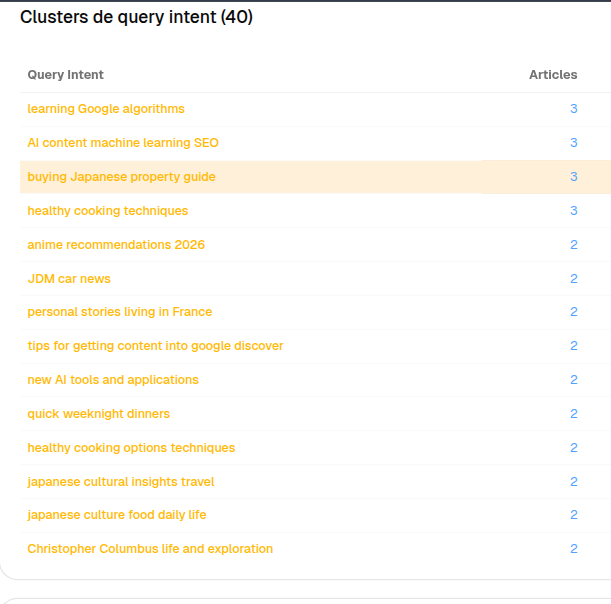
That does not mean stuffing pages with raw keywords. The better move is to describe the content clearly in the language a real person would use when asking Discover for more of it. If a user might ask for “buying Japanese property guide,” “starting seeds indoors guide,” or “tips for getting content into google discover,” I want the page’s title, H1, and opening section to make that relevance obvious.

The strategic shift is that selection power moves closer to the user. In the classic feed, Google infers demand. In this model, the user declares it. Google then turns that declaration into entities, interests, and query intents that drive retrieval.

For small publishers, that is the opportunity. If the feature graduates from Search Labs and users adopt it at scale, a focused site with clear topical authority could appear because it directly satisfies declared demand, not because it already won the popularity contest inside Discover.
There are still real limits. The feature has been US English and Search Labs focused, with French feeds showing essentially no presence in the observed data. Adoption also appears early. A powerful prompt-based personalization system changes little if users do not actually use it.
What I am watching next is whether Google expands this beyond Search Labs, whether the current and historical tuning pipelines become more visible, and whether this behavior converges with broader generative retrieval systems. A nascent generativeretrieval.f pipeline has already appeared in tracking data, but that broader connection still needs confirmation.
My read is that Discover is moving from observed personalization toward declared personalization. Google still infers plenty, but users are beginning to write part of their own interest profile. If that model becomes mainstream, niche publishers with clear focus, strong entity signals, and natural-language relevance may gain a new route into Discover visibility.
Notes: In this analysis, a Discover pipeline means the selection circuit that chooses and serves cards. The .f suffix in identifiers such as historicalnaturallanguagetuningcontent.f is an observed internal marker attached to Discover card metadata. “Fan-out” refers to a mechanism where one prompt is broken into several retrieval sub-queries. “GEO” means Generative Engine Optimization, or the practice of optimizing content for visibility in generative search and answer systems. “AIO” refers to AI Overviews, and “AI Mode” refers to Google Search’s conversational interface.
Field tracking referenced here covers Google app Search Labs US English accounts from December 2025 through June 2026. Pipeline behavior is based on close observation of Discover feed cards and 1492.vision tracking data. The internal mechanisms described are my interpretation of observed data and public research, and approximate dates are treated as approximate.
Inspired by this post on Search Engine Land.

Leave a Reply