Tag: Google Discover

  • Unlocking the Power of Google Discover Publisher Profiles

    Unlocking the Power of Google Discover Publisher Profiles

    I find it fascinating how Google Discover has evolved with the introduction of publisher profiles and follow features. These profiles have started making waves, yet they remain a bit enigmatic due to limited documentation.

    More publishers, creators, and social-first accounts are now visible through these profiles. Let me take you through how these profiles work, how they connect with social accounts and the Knowledge Graph, and why some publishers already enjoy enhanced customization features.

    As a technical SEO enthusiast, I’m quite accustomed to Google glossing over details in their documentation. And with Discover publisher profiles, that mystery deepens.

    Google barely mentions these profiles in their official Discover documentation, though they seem to play an increasingly significant role in the visibility of publishers and creators.

    ```json
{
  "alt": "The CapmatchOne logo with a gradient circle and bold text.",
  "caption": "Discover innovation with the CapmatchOne logo, featuring sleek typography and a modern gradient circle.",
  "description": "The CapmatchOne logo features bold, modern typography coupled with a gradient circle, symbolizing connection and innovation. The sleek design conveys a sense of progress and creativity. This image can be used for branding or promotional purposes, appealing to audiences interested in innovative solutions and forward-thinking designs."
}
```

    It’s intriguing to see how Discover profiles let users manage the publishers they follow while gathering content from various websites and social platforms.

    Because Google has been reticent about the inner workings of these profiles, I’ve taken upon myself to study their patterns across different accounts. Here’s what I’ve noticed about:

    Google rolled out substantial updates to Discover in September 2025, vastly altering how we engage with content through publisher follows and profile pages.

    ```json
{
  "alt": "Text explaining how to follow publishers or creators on Google Discover.",
  "caption": "Discover new content on Google by following your favorite publishers and creators. Preview their posts before following to tailor your feed.",
  "description": "An informative text image from Google detailing how users can follow publishers or creators directly on Discover. It highlights the ability to preview content, such as articles and YouTube videos, before following. Users are advised to sign in to their Google Account to explore this feature. Ideal for those looking to customize their content consumption on Google Discover."
}
```

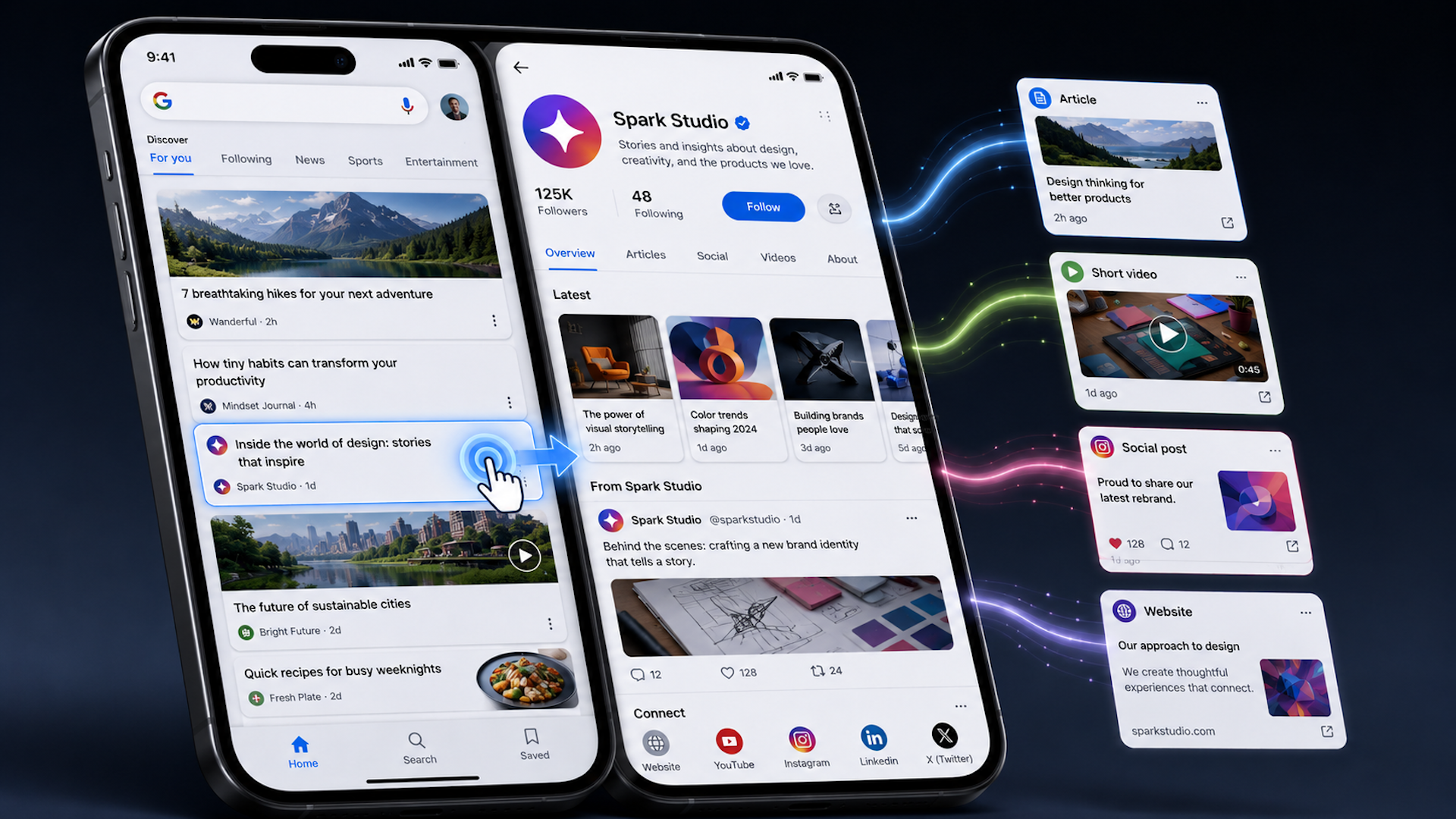
    The update granted publishers dedicated landing pages for content aggregation, offering users a streamlined way to interact with preferred publishers and seamlessly integrating social content into Discover.

    The most eye-catching aspect of this update is how it empowers users to have greater control over publisher visibility while enabling brands to reach their audience more effectively.

    Publishers can’t typically alter the layout of these pages, but some recently gained access to customize their profiles, an option part of a limited beta test.

    ```json
{
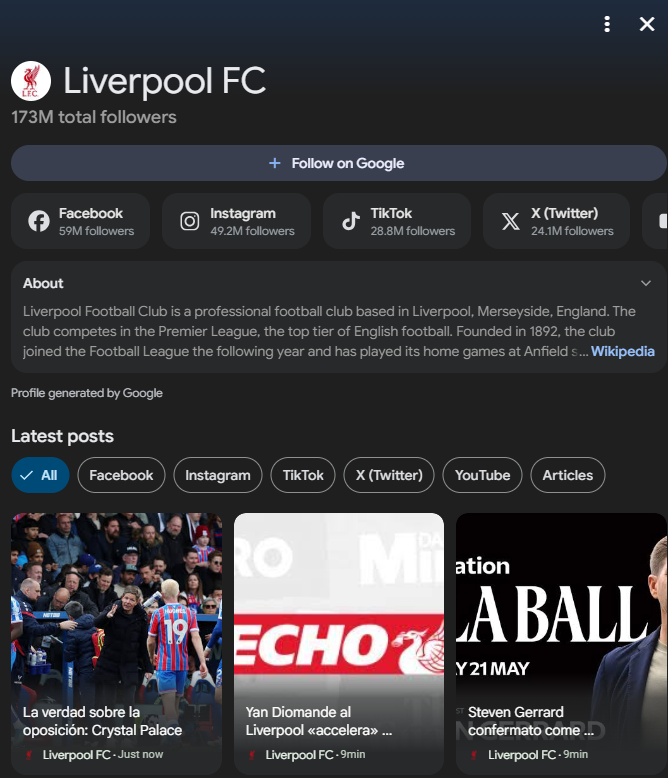
  "alt": "Liverpool FC social media profile overview with follower counts and recent posts.",
  "caption": "Discover Liverpool FC's expansive online presence with millions of followers across platforms and stay updated with the latest posts and news.",
  "description": "This image showcases the Liverpool FC social media profile, highlighting 173 million total followers. It features follower counts across platforms like Facebook, Instagram, TikTok, and Twitter, along with a brief description about the club. At the bottom, recent posts are displayed with options to filter by platform. Keywords: Liverpool FC, social media, followers, football club, recent posts."
}
```

    Common to most publisher profiles are features like a profile photo, usually sourced from the Knowledge Graph or a YouTube profile, which also counts total social followers, and integrates various social media handles.

    The social connections catered to include platforms like YouTube, TikTok, Instagram, Facebook, X, and LinkedIn. The ‘About’ section is succinct, often derived from a Wikipedia entry or something similar.

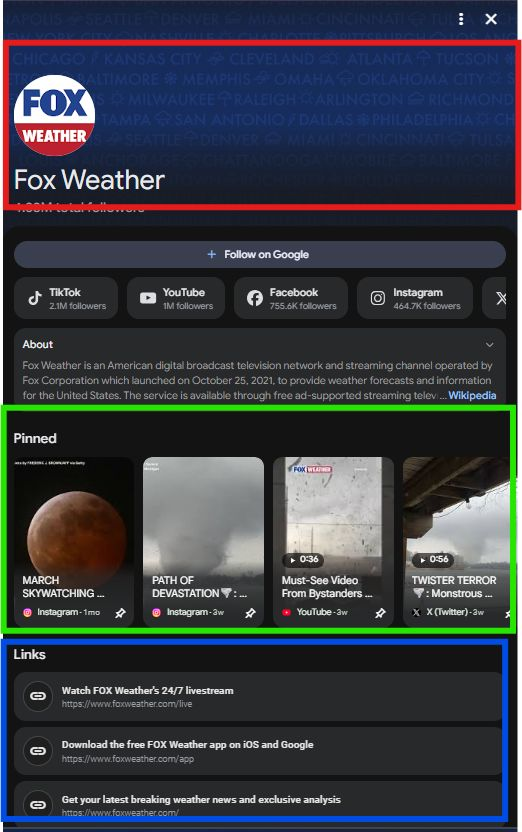
    Some editable profiles offer additional features like customized banners, pinned posts, and external links that could direct users to apps or livestreams, further enhancing content reach.

    ```json
{
  "alt": "Fox Weather page with social media links, about section, pinned videos, and navigation links.",
  "caption": "Explore the dynamic Fox Weather page, featuring live updates, pinned videos, and easy access to their apps and social media platforms.",
  "description": "The Fox Weather page displays their logo and title prominently at the top. Below are quick-follow options for TikTok, YouTube, Facebook, and Instagram. An 'About' section provides details about their services, while a set of pinned videos showcase various weather events. Navigation links at the bottom offer access to their livestream, mobile app downloads, and news updates. This comprehensive setup ensures users stay connected with the latest weather information."
}
```

    There are two main types of Discover publisher profiles: ones for entities with websites and others solely focused on social media publishers.

    Web-focused publishers’ profiles tend to be more comprehensive, often including the About section, logos, social accounts, and website links—although social links might sometimes need a manual push to be included.

    On the other hand, profiles for social media publishers focus on prominent journalists, notable figures, and those solely identifiable through social media.

    These profiles are generally less complete unless they are tied to a Knowledge Graph, missing elements like profile pictures or descriptions, frequently needing aid from connected YouTube accounts for better appearance.

    Looking forward, I anticipate Google may broaden access to these editable profiles, though I suspect customization will remain selective, likely reserved for well-established publishers and creators.


    Inspired by this post on Search Engine Land.


    crushpress.ai community screenshot
  • Google Discover Bug Leads to Misleading Data in Search Console

    Google Discover Bug Leads to Misleading Data in Search Console

    Have you recently noticed a decline in clicks and impressions around May 7th to May 8th? Don’t worry; it’s just a reporting glitch.

    I discovered that Google has confirmed a bug affecting the Discover report in Google Search Console. It turns out there was a ‘logging’ error with the data, which has resulted in a drop in clicks and impressions during May 7th to May 8th, 2026.

    Google assures us that this is merely a ‘data logging only’ issue, and it hasn’t impacted the actual positioning in Google Discover.

    The issue: Google stated once again that a data logging error caused the discrepancies in the Discover report between May 7th and 8th, 2026.

    As per Google’s post, this bug might have caused a ‘decrease in clicks and impressions in the Discover performance report.’

    Why it matters: Numerous publishers, possibly including myself, saw a dip in performance metrics. It’s crucial to note that this is likely due to this bug.

    Make sure to annotate your reports and inform your stakeholders that the Discover data from May 7th to May 8th is inaccurate and should be disregarded.


    Inspired by this post on Search Engine Land.

    crushpress.ai community screenshot
  • Unlocking Google Discover: Insights for Maximizing Visibility

    Unlocking Google Discover: Insights for Maximizing Visibility

    I recently delved into the intricate world of Google Discover, uncovering how its 20 pipelines and 42 million cards shape the landscape for publishers. This exploration reveals how trends, news, videos, and advertisements flow through the digital pipelines, achieving broadcast-level reach for some content.

    Metehan Yesilyurt’s SDK analysis brought the pipeline names to my attention, and I meticulously collected data over three months to decipher each pipeline’s function—including volume, reach, timing, and dominance. Let’s dive into what the examination of 42 million cards reveals about Discover’s inner framework.

    ```json
{
  "alt": "Flowchart illustrating Google Discover's 20 decoded pipelines featuring core stacks, news tiers, trend detection, and more.",
  "caption": "Dive into the intricacies of Google Discover with its 20 decoded pipelines, showcasing everything from universal content selection to personalized feeds.",
  "description": "This detailed flowchart decodes Google Discover's 20 pipelines, spanning core stacks like content and moonstone, news tiers for breaking headlines, trend detection strategies, and geographic targeting. It includes niche vertical content, social and video cascades, personalization tactics, and commercial integrations such as shopping inspiration and feed ads. Each segment highlights reach and visibility metrics, reflecting a comprehensive overview of content distribution dynamics within Google Discover."
}
```

    Our journey took three months (December 2025 – February 2026), where I analyzed real Discover feeds from hundreds of devices. The result was the analysis of 42 million feed cards intricately linked to their selecting pipelines.

    ```json
{
  "alt": "Bubble chart showing pipeline map of freshness versus reach with colored categories.",
  "caption": "Explore the dynamic pipeline map where freshness meets reach. Colored bubbles represent various categories, illustrating the balance of article age and reach percentage.",
  "description": "This bubble chart illustrates a pipeline map comparing freshness (median article age) against reach (%). Each bubble's color corresponds to a specific pipeline family, such as news, social, or personalization, and sizes depict daily URLs. Notable categories include 'neoncluster,' 'moonstone,' and 'shoppinginspiration.' This detailed visualization assists in analyzing how recent content impacts reach across different domains."
}
```

    This analysis built on existing knowledge from the SDK, as you might have encountered in Metehan’s SDK Analysis. My objective was to illuminate what each pipeline actively accomplishes—how much content it picks, how many devices view it, the pace at which it operates, and which publishers it highlights. That’s the story my data tells.

    ```json
{
  "alt": "Bar chart of top 20 categories by hits from Dec 2025 to Feb 2026, with 'content' leading at 34.2%.",
  "caption": "Content dominates the chart with 34.2% of hits, followed by feedads and aura. Discover the trends from Dec 2025 to Feb 2026.",
  "description": "This bar chart displays the top 20 categories by hits between December 2025 and February 2026. 'Content' leads with 34.2% of hits, followed by 'feedads' at 11.1%, and 'aura' at 8.7%. The chart uses a log scale for hits, providing a visual representation of data trends. Ideal for understanding market focus and engagement over the measured period."
}
```

    Four metrics were computed for every pipeline:

    ```json
{
  "alt": "Infographic depicting three stages of content reach and growth on YouTube from Dec 2025 to Feb 2026.",
  "caption": "Exploring content growth: From creator content to neoncluster, discover how reach and engagement amplify through different stages on YouTube.",
  "description": "This infographic illustrates the growth of content reach and engagement in three stages: creatorcontent, freshvideos, and neoncluster. It details social intake, video amplification, and broadcast endpoint metrics on YouTube from December 2025 to February 2026. It shows reach percentages, median age of content, and growth multiples (7.8x, 7.2x, 18.2x), highlighting a shift towards a 100% YouTube video format as each stage progresses. It serves as a visual explanation of content amplification and reach enhancement workflows."
}
```

    • Reach — the percentage of devices showing each URL daily
    • Speed — the median age of articles when they appear
    • Exclusivity — the percentage of URLs exclusive to the pipeline
    • Volume — the portion of the total feed

    ```json
{
  "alt": "Bar charts showing AI overview penetration in Google Discover and top sources by percentage from Dec 2025 to Feb 2026.",
  "caption": "AI-generated summaries dominate Google Discover pipelines, with 'discover_ai_summary' leading at 100% penetration, showcasing a shift toward automated content.",
  "description": "This infographic presents data on AI overview integration within Google Discover from December 2025 to February 2026. The 'discover_ai_summary' pipeline is fully penetrated by AI overviews at 100%, followed by 'mustntmiss' at 28.3%. The charts also list the top sources of AI overviews, with Reuters leading at 6.3%. The visualization provides insights into the growing role of AI summaries in digital media distribution."
}
```

    Visually explore all 20 pipelines: Open the interactive explorer →

    ```json
{
  "alt": "Heatmap showing systematic exclusion in EPL terms across various categories from Dec 2025 to Feb 2026.",
  "caption": "A detailed heatmap reveals systematic exclusion within Premier League terms, with data showcasing trends from December 2025 to February 2026.",
  "description": "This image presents a log-likelihood heatmap analyzing systematic exclusion of English Premier League (EPL) terms across different categories like Freshvideos, Astra, and Mustwatchx during Dec 2025 to Feb 2026. The map displays varying levels of exclusion with a scale from over-representation (+700) to under-representation (-1500). Data on 33 cells shows 29 instances of exclusion with an average log-likelihood of -356, highlighting significant under-representation trends."
}
```

    Diving deeper, many believe Discover operates on just one recommendation algorithm. However, our results tell a different tale—a sophisticated system with six layers, each with its unique logic, pace, and audience.

    ```json
{
  "alt": "Heatmap displaying percentage of domain hits from various pipeline families for top 30 domains.",
  "caption": "Explore the vibrant heatmap showcasing domain hit percentages across content categories for leading websites.",
  "description": "This heatmap illustrates the percentage of domain hits from different pipeline families for the top 30 English domains. Categories like content, news, and social are shown using color gradients from yellow to red, indicating varying levels of engagement. Key sites include youtube.com, theguardian.com, and techradar.com. The sidebar provides a color scale indicating the percentage range."
}
```

    The six layers include:

    ```json
{
  "alt": "Chart showing domain dominance by pipeline for December 2025 to February 2026, including categories like core, social, commercial, and others.",
  "caption": "Explore the domain dominance trends from December 2025 to February 2026. Discover which sites lead in core, social, commercial, and other categories.",
  "description": "This visual chart presents domain dominance by pipelines for the period of December 2025 to February 2026. It categorizes domains into core, social, commercial, and niche among others. Top-performing domains include youtube.com, theguardian.com, and bbc.co.uk. The visualization highlights the share of visibility by each domain, offering insights into digital presence across various categories. A total of 14 pipelines are analyzed with the dominant share marked for quick reference."
}
```

    1. Core editorial — various content types leading with editorial consistency.
    2. News urgency — swift distribution of must-see news content.
    3. Trends — pipelines dedicated to detecting and maintaining trends.
    4. Local/geo — focusing on geotargeted stories and content.
    5. Social/video — elevating YouTube video content into prominence.
    6. Commercial — enhancing advertisements’ reach through platforms like YouTube.

    In my exploration, I found peculiarities unique to the English Discover feed, including a YouTube content journey expanding through three successive pipelines. This system brings significant amplification to the reach of content that passes through it.

    English Discover has also incorporated AI Overviews, an AI-generated summary, although this has been limited to English feeds only. Furthermore, a surprising revelation was the systemic under-representation of Premier League content across numerous pipelines, unlike other sports.

    In conclusion, the Discover ecosystem continually evolves. Observing these changes provides valuable insights into the system’s architecture and potential influential power for publishers.

    Data Source: 42 million Discover cards from December 2025 to February 2026. Analysis by 1492.vision with recognition to Metehan Yesilyurt for his work on Google SDK analysis.


    Inspired by this post on Search Engine Land.


    crushpress.ai community screenshot
  • Google AI Drives 42% Drop in Search Clicks: A Closer Look

    Google AI Drives 42% Drop in Search Clicks: A Closer Look

    Seeing the shifts in Google’s search traffic firsthand, I’ve noticed publishers losing organic search traffic, yet there’s a silver lining with breaking news traffic soaring by 103%, and Google Discover clicks surging.

    Google’s AI Overviews might be cutting into traditional search clicks, but I believe publishers can still find significant growth through breaking news and Google Discover according to recent insights from Define Media Group.

    Organic search clicks have dropped 42% since AI Overviews began expanding in Google Search, based on Define Media Group’s analysis of Google Search Console data from 64 sites. It’s quite revealing!

    Why we care. AI-generated answers are dramatically reshaping how search traffic is distributed. While evergreen content loses clicks, real-time news coverage and Discover distribution are becoming more potent channels for us publishers.

    By the numbers. In Google Search, Discover, and Google News, breaking news traffic has grown 103% from November 2024 to early 2026 within the company’s dataset. However, losses have mainly hit informational and evergreen content.

    Here are some figures to consider: organic search traffic averaged 1.7 billion clicks per quarter from Q1 2023 through Q1 2024. Post AI Overviews launch, traffic took a 16% plunge immediately and couldn’t recover. As Google expanded AI Overviews in May 2025, these declines accelerated. By Q4 2025, search traffic had fallen 42% from the pre-AI Overviews baseline.

    Discover’s role: Google Discover, which has grown by 30% across the portfolio, is becoming a primary growth engine for breaking news distribution, rising steadily even as web search traffic dips. It’s the first time Discover and web search have driven almost equal traffic.

    Interestingly, the report highlights a significant increase in Discover traffic following the December 2025 Google core update, although some gains eased after the February 2026 Discover core update. Yet, according to Chartbeat data, Discover was the main driver of Google referrals to news sites last summer.

    Why is this happening? AI Overviews appear less frequently for news queries compared to other topics. Reports show that AI Overviews appeared for only about 15% of news queries, which is nearly three times less often than in categories like health and science.

    It seems news queries frequently trigger the Top Stories carousel, linking directly to publisher articles, especially for major events such as international conflicts. Define Media Group suggests that Google may avoid AI summaries for breaking news due to rapid changes and high accuracy needs.

    The report. BREAKING! News Thrives in the Age of AI


    Inspired by this post on Search Engine Land.


    crushpress.ai community screenshot
  • Enhance Your Image SEO with Google’s Latest Best Practices

    Enhance Your Image SEO with Google’s Latest Best Practices

    When it comes to ensuring my images stand out in Google Search and Discover, I’ve learned that it’s all about using both schema.org markup and the og:image meta tag effectively. Google recently revised its image SEO best practices and Discover guide to clarify how they utilize these elements to select thumbnails.

    Image SEO Best Practices – Google introduced a new section in its image SEO guide called Specify a preferred image with metadata. Here, Google explained:

    “Google’s selection of an image preview is entirely automated, considering various sources to display a suitable image on Google, such as a text result image or a preview image in Discover.”

    So, how can I influence the thumbnails Google selects?

    I can specify the primaryImageOfPage property with a URL or ImageObject in schema.org. Alternatively, linking an image URL or ImageObject to the main entity using the mainEntity or mainEntityOfPage properties could be beneficial. Another option is to define the og:image meta tag.

    Overall best practices include choosing an image that truly represents the page, avoiding generic images or those containing text, steering clear of extremes in aspect ratios, and opting for high-resolution images whenever possible.

    Google Discover Image Selection – In the Discover documentation, I found some insightful tips:

    “Incorporate engaging, high-quality images in your content, especially large images, as they are more likely to attract visits from Discover. Images should be at least 1200px wide, high resolution of at least 300K, and maintain a 16×9 aspect ratio.”

    Google attempts to crop images automatically for Discover. If I choose to crop images myself, they should be well-positioned for landscape use, ensuring vital details remain in the cropped version specified in the og:image meta tag.

    Also important is enabling the max-image-preview:large setting or using AMP. Utilizing schema.org markup or the og:image meta tag allows specifying a large, relevant image as thumbnails in Discover.

    Why It Matters – Images significantly impact click-through rates from Google Search and Discover. By understanding and applying these guidelines, I can better guide Google in selecting the right image thumbnails to boost visibility.


    Inspired by this post on Search Engine Land.

    crushpress.ai community screenshot
  • Boost Google Discover Traffic with Key Technical Enhancements

    Boost Google Discover Traffic with Key Technical Enhancements

    In 2021, my fascination with Google Discover began when I noticed it generating millions of clicks monthly for publishers. I never imagined how significant it would become.

    As I scroll through my feed, it covers everything from soccer, television, Baltimore news, SEO, to global happenings. This variety underscores just how intuitively Discover knows users.

    Remarkably, Discover isn’t confined to a single app. It shows up in Chrome’s new tabs, Google app, Android homescreens, on Google.com via mobile browsers, and elsewhere on Google platforms.

    Given Discover’s pervasive presence, it’s imperative for us SEOs to leverage the opportunities it presents. Let me guide you on how to do just that.

    To start, it’s essential to understand that Discover traffic isn’t suitable for every brand, similar to how search may not be the answer for all.

    In Discover, timely content takes precedence. The most successful content is often from reputable sources, particularly major publishers, and is usually time-sensitive. Evergreen content is a rare sight.

    Interestingly, sites I’ve collaborated with often draw more traffic from Discover compared to traditional search.

    ```json
{
  "alt": "Google Discover feed showing news articles and a football score.",
  "caption": "Catch the latest updates with Google Discover: From TV shows to football, stay informed.",
  "description": "Screenshot of the Google Discover feed displaying various updates. The top article discusses 'The Pitt' Season 2's episode schedule from Forbes, showing a small image of a doctor. The second article is about a potential football transfer involving Damion Downs, shown in a larger image, wearing a black beanie and headphones. Additionally, a football score shows Cameroon defeating South Africa 2-1 in the Africa Cup of Nations."
}
```

    There’s an ongoing decline in Discover traffic due to the influx of social posts and AI summaries, which now occupy space in the Discover feed, pushing aside traditional articles.

    Previously, crafting articles about viral social media topics was highly effective for attracting clicks. However, the landscape is shifting, prompting Google to experiment with tracking social platform traffic.

    Nevertheless, quality and relevance in content continue to hold significant value. Regardless of technical optimization, content that resonates with user interests will always triumph over less relevant material.

    Should your content miss the mark on Discover, assess whether it aligns with what Discover seeks to highlight. And in case of a traffic dip, critically examine your content before delving into technical issues.

    Don’t be discouraged from optimizing for Discover. These strategies won’t impact traditional search negatively, and they might unexpectedly boost your Discover traffic, as I’ve observed non-publishers enjoy temporary spikes in clicks.

    Dig deeper. How Google Discover qualifies, ranks, and filters content: Research

    ```json
{
  "alt": "ESPN profile on Google with follower stats and social media links.",
  "caption": "Explore ESPN's digital presence with 180M followers and active connections on platforms like Twitter, TikTok, and Instagram.",
  "description": "This image showcases ESPN's Google profile, highlighting its impressive reach of 180 million total followers. The profile features direct links to social media platforms including Twitter, TikTok, Instagram, and Facebook, with follower counts displayed for each. Founded in 1979, ESPN is a leading sports broadcasting network. The visual also includes a brief about the network's origins and ownership by Disney and Hearst Communications."
}
```

    The three primary factors I scrutinize during new client audits are the Discover publisher profile, article images, and signals from the publisher and author. These form the basis of your optimization process.

    Your publisher profile should reflect your website and social profiles accurately. Tools like Damian Tsuabaso’s app, albeit in Spanish, can help identify your profile page.

    Discover profiles are linked to your entity’s Knowledge Graph ID and this is crucial for your representation as a publisher. Focus on whether your profile pages accurately portray your brand’s identity.

    Incorporate your social media handles into your publisher’s profile. This linkage often requires patience, as manual updates are necessary.

    Verify if you have the max-image-preview:large tag, which is vital for showcasing large images in article previews, a detail often overlooked in many CMSs.

    Images, especially hero images, should be at least 1,200 pixels wide, aligning with Google’s recommendations for optimal display in Discover.

    ```json
{
  "alt": "The CapmatchOne logo with a gradient circle and bold text.",
  "caption": "Discover innovation with the CapmatchOne logo, featuring sleek typography and a modern gradient circle.",
  "description": "The CapmatchOne logo features bold, modern typography coupled with a gradient circle, symbolizing connection and innovation. The sleek design conveys a sense of progress and creativity. This image can be used for branding or promotional purposes, appealing to audiences interested in innovative solutions and forward-thinking designs."
}
```

    Ensure your Open Graph image tags are correctly configured and reflect high-quality images instead of logos, enhancing Discover visibility.

    Prioritize author transparency by ensuring details such as author photos, bios, and social links are visible, underpinning credibility.

    Maintain thorough publisher transparency by linking robust About Us and policy pages, as well as implementing structured data carefully.

    Discover thrives on relevance, timely content, and authority. Optimization can’t substitute the necessity for high-quality, suitable content.

    Remember, Discover is just the starting point. Uncover larger opportunities for your content through comprehensive audits.


    Inspired by this post on Search Engine Land.

    crushpress.ai community screenshot
  • Google’s February 2026 Discover Update: What You Need to Know

    Google’s February 2026 Discover Update: What You Need to Know

    I’m excited to share that the Google February 2026 Discover core update has officially completed its rollout. Starting on February 5 and wrapping up on February 27, this update exclusively affects Google Discover content within the U.S. and in English.

    This marks the first confirmed Search update of the year and notably, the first Discover-only update announced by Google. Unlike previous core updates that impacted both Search and Discover, this one is focused solely on Discover content.

    U.S. and English Focus. For now, this update only targets English content for users in the United States. However, Google plans to expand it across other countries and languages in the months ahead.

    Key improvements. Google stated that this update aims to enhance the user experience by:

    • Providing more locally relevant content from domestic websites.
    • Minimizing sensational content and clickbait.
    • Featuring more in-depth, original, and timely content from sites recognized for their expertise in specific fields.

    Since the update emphasizes locally pertinent content, it might lead to decreased Discover traffic for non-U.S. websites targeting a U.S. audience. This impact may subside as the update is adopted globally.

    Google has also updated the Get on Discover help page, so I recommend reviewing it for additional insights.

    Expanded insights. Google clarified that its systems are designed to identify expertise on a topic-by-topic basis, allowing sites with specialized knowledge to appear on Discover. For instance:

    • A local news site with a specialized gardening section could be recognized for its gardening expertise, even if it covers various other subjects. In contrast, a movie review site with a single gardening article would likely not receive the same acknowledgment.

    Google intends to continue using systems that personalize content based on users’ favorite creators and sources.

    During their tests, Google discovered that “this update makes the Discover experience more valuable and fulfilling.”

    Why this matters to us. If your site’s traffic relies on Google Discover, you might have noticed shifts in your traffic patterns. Keep in mind, this update currently affects only U.S. English audiences and pertains solely to Discover. While there’s been significant discussion about Google Search fluctuations, Google hasn’t confirmed those reports.

    If you seek further guidance, Google advises referring to their documentation on core updates and the Get on Discover help page.


    Inspired by this post on Search Engine Land.


    crushpress.ai community screenshot
  • Unlocking Google Discover: How Content is Ranked and Filtered

    Unlocking Google Discover: How Content is Ranked and Filtered

    Google Discover pipeline

    Through my recent dive into the latest SDK findings, I’ve discovered why some pages never make it to the Google Discover ranking. Factors like predicted click-through rates, images, and content recency are key drivers.

    One thing I’ve learned is that Google Discover operates using a detailed, multi-layered pipeline. This includes publisher blocks, detailed image specifications, a freshness decay model, and extensive experimentation that shapes what appears on users’ feeds, as explained by SDK-level researcher Metehan Yesilyurt.

    Why this matters to us. As someone who’s eager to drive significant traffic via Google Discover, I’ve often found the process unpredictable. This research allows me a clearer understanding of how my content might qualify, rank, or get blocked, shedding light on potential pitfalls before a piece even begins to rank.

    The nitty-gritty. In Yesilyurt’s exploration, Google Discover’s app framework was deconstructed into a nine-stage process. Here’s how it works:

    • It all begins with Google crawling and understanding the content I produce.
    • It examines key meta tags, such as image and title.
    • It classifies content types, be they breaking news or evergreen material.
    • Google checks if my content is blocked at any point.
    • Content is then matched to user interests.
    • An applied server-side click-through rate prediction model comes into play.
    • The feed layout is constructed based on these evaluations.
    • Content is served to users, inviting engagement.
    • Lastly, user feedback is recorded.

    A significant insight. One crucial discovery is that publisher-level blocks occur before matching content to users’ interests. A user’s decision to block a source means my content won’t even make it to the ranking stage.

    • Such blocks are impactful. A single action to prevent showing content from my site can suppress the entire domain. Unfortunately, no similar sitewide boost exists.

    The ranking mechanics. The ranking process leverages elements like my content’s title, image quality, and past engagement history. Google’s servers use a predicted click-through rate (pCTR) to estimate the possibility of clicks. Although the specific model remains unseen, the app indicates which signals Google considers for ranking, including:

    • The page title, sourced from og:title.
    • The size and quality of images.
    • The freshness of the content.
    • Past click and impression statistics for my URL.
    • Whether images load correctly on the page.

    The importance of freshness. Google’s system groups content based on age:

    • 1 to 7 days old: enjoys the strongest boost.
    • 8 to 14 days old: retains moderate visibility.
    • 15 to 30 days old: sees a drop in visibility.
    • Over 30 days old: experiences a gradual decline.

    While evergreen content might receive special classification, newer content inherently gains an edge.

    Image and meta tag criteria. Google Discover examines six key tags at the page level, such as og:image and og:title. Notably, missing images result in the absence of content cards.

    • Images must be at least 1200px wide for prominent card features. Smaller images often manifest as thumbnails, which typically receive fewer clicks.
    • Missing tags prompt Google to seek alternatives — if og:title lacks, the Twitter title tag or HTML title might be used instead.
    • Using meta tags like “nopagereadaloud” and “notranslate” can prevent a page from appearing on Google Discover altogether.

    The personalization factors. With Google Discover, personalization hinges on:

    • Google’s broader interest data interconnected with user behavior.
    • Publisher signals, which include registration with Publisher Center.
    • Personal interactions like follows, saves, and story dismissals.
    • Engagement metrics, like the time users spend reading content.

    If a reader dismisses my content, that action is stored permanently for that specific URL, preventing it from reappearing.

    Everywhere I look, experiments abound. During moments of observation, about 150 server-side tests were simultaneously active, with an additional 50+ features controlling how content cards were depicted.

    • This means two users with similar interests can encounter vastly different feeds simply due to being in different experimental groups.

    Real-time updates for your feed. Google Discover doesn’t stand still. It can dynamically add, remove, or reorder content in the feed as a user scrolls, no refresh needed.

    Key insights for success. Excelling in Google Discover is less about using tricks and more about meeting eligibility criteria, establishing trust, utilizing compelling visuals, and maintaining engagement, especially in a system capable of filtering content before the ranking process even starts.

    • Publisher blocks occur before any ranking.
    • The system inherently values content freshness.
    • High-quality images and clear titles are indispensable.
    • User dismissals are long-term.
    • Heavy experimentation leads to a constantly evolving environment.

    The research I’ve examined can be found here: Google Discover Architecture: Clusters, Classifiers, OG Tags, NAIADES – What SDK Telemetry Reveals


    Inspired by this post on Search Engine Land.


    crushpress.ai community screenshot
  • Boost Your News Visibility in Google’s Social-First Era

    Boost Your News Visibility in Google’s Social-First Era

    We’re stepping into an era where the visibility of web content is spreading across a multitude of search and social platforms. Google has always been a force to reckon with, but it’s no longer the only player in the search experience. Video-based social media platforms like TikTok and community sites such as Reddit are carving out spaces as go-to search engines for their dedicated audiences.

    This evolving landscape is reshaping how we consume news content. Google’s news SERP is adapting to the era of personalized query responses afforded by LLMs and the influence of social media platforms. To keep up, Google has introduced AI-powered SERP features like AI Overviews and AI Mode. These features prioritize content that is “helpful, reliable, and people-first,” drawing heavily from social media platforms.

    As search and social media intertwine more closely than ever before, we need to embrace a new strategy. This involves creating newsroom teams comprising social media experts, SEO specialists, and AI enthusiasts working together towards a unified content visibility goal.

    ```json
{
  "alt": "Bar graph showing cost-of-living adjustments from 2019 to 2025 with peak at 8.7% in 2022.",
  "caption": "This insightful bar graph illustrates cost-of-living adjustments over the years, highlighting the significant peak in 2022. Discover how these changes impact Social Security.",
  "description": "The image presents a bar graph detailing cost-of-living adjustments from 2019 to 2025, with a notable peak at 8.7% in 2022. The data emphasizes fluctuations that influence Social Security. Yahoo Finance has published this as part of a video discussing how government shutdowns could impact these adjustments, featuring commentary from experts."
}
```

    When I optimize news content for social platforms, I also consider the potential performance of these posts on the Google SERP. I’ll delve into optimizing specific SERP features, but first, let’s explore making news content friendly for social platforms.

    First, let me offer some sanity tips. It’s tempting to optimize content for every social media platform, but I find it more effective to focus on one or two where my audience is active and my growth opportunities are highest. By reviewing analytics and conducting audience surveys, I can identify the platforms where my audience consumes news content.

    ```json
{
  "alt": "The CapmatchOne logo with a gradient circle and bold text.",
  "caption": "Discover innovation with the CapmatchOne logo, featuring sleek typography and a modern gradient circle.",
  "description": "The CapmatchOne logo features bold, modern typography coupled with a gradient circle, symbolizing connection and innovation. The sleek design conveys a sense of progress and creativity. This image can be used for branding or promotional purposes, appealing to audiences interested in innovative solutions and forward-thinking designs."
}
```

    Optimize News Content for Social Media Platforms

    I begin by considering how my content might appear on different platforms. Here’s my breakdown of which content types work best on each platform and how they might appear on Google:

    YouTube

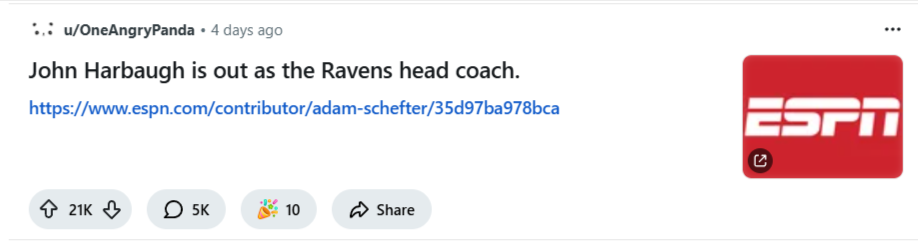
    Creating YouTube video content involves following video SEO best practices. With guidance from this comprehensive YouTube SEO guide, I create a successful video strategy by ensuring my video titles align with the content.

    ```json
{
  "alt": "Social media post stating John Harbaugh is out as Ravens head coach, with an ESPN logo.",
  "caption": "Breaking news: John Harbaugh steps down as the Ravens head coach, as reported by ESPN.",
  "description": "A social media post announcing the departure of John Harbaugh as the head coach of the Ravens. The post includes a link to an ESPN article for more details and features the ESPN logo on the right. The post has engaged users, as indicated by the 21K upvotes, 5K comments, and 10 awards. Keywords: John Harbaugh, Ravens, ESPN, head coach, social media."
}
```

    Google prioritizes YouTube’s search ranking through relevance, engagement, and quality. I make sure my metadata accurately reflects my video content to ensure it stands out as relevant in a search.

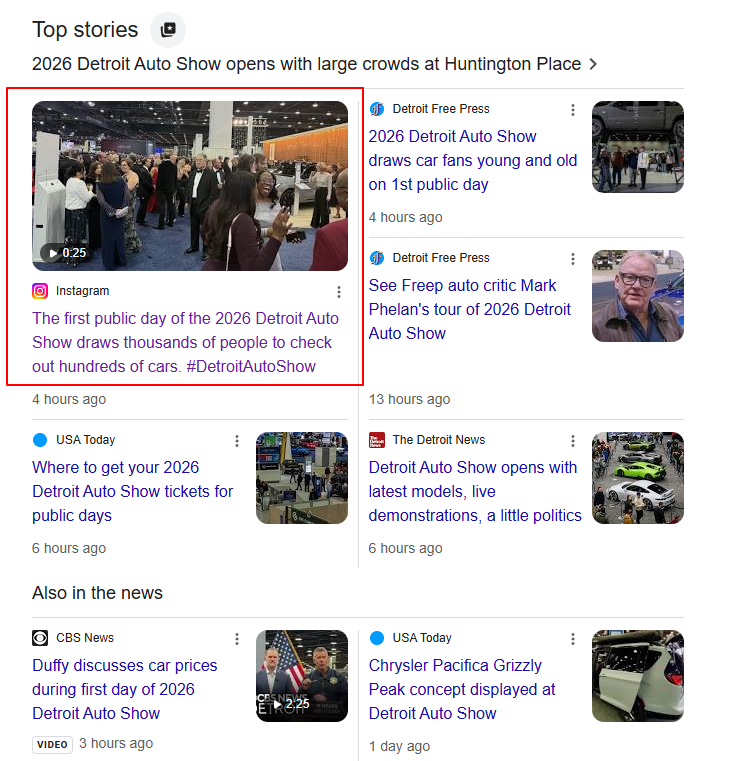
    One trend I’ve noted is that older event content on YouTube continues to rank well on Google, even after related articles have faded. Similarly, explainer videos show longevity on the SERP.

    ```json
{
  "alt": "Top stories about the 2026 Detroit Auto Show with images and headlines.",
  "caption": "The 2026 Detroit Auto Show kicks off with impressive crowds and stunning car displays at Huntington Place, capturing the attention of auto enthusiasts.",
  "description": "This image showcases a news aggregation screen highlighting top stories related to the 2026 Detroit Auto Show at Huntington Place. Featured are headlines from various sources such as Detroit Free Press and USA Today, accompanied by images like crowds at the event, car displays, and key people involved. The content underscores the event's highlights, public turnout, and media coverage, making it an engaging insight into the auto industry's latest developments."
}
```

    Facebook

    Facebook, though perhaps not as trendy as it once was, still reaches a diverse audience. This platform excels with community-based content and entertainment news that incites conversation.

    Even though Facebook’s dedicated news tab was removed, its posts are becoming more visible on Google’s SERP, which might make it worth reconsidering from a search perspective.

    ```json
{
  "alt": "Screenshot of social media reactions to severe snowfall, showing video thumbnails and descriptions from various users.",
  "caption": "Travel woes and snow day stories: Social media buzzes with reactions to widespread snowfall and disruptions.",
  "description": "This image features a collection of social media interactions highlighting the impact of severe snowfall, including video thumbnails from platforms like TikTok and YouTube. Users share personal experiences of travel chaos, school closures, and power outages, reflecting widespread disruptions. Terms like 'lake-effect snow' and 'insane snowstorm' emphasize the severity of the weather, while viewer statistics provide a measure of engagement. Keywords: snowfall, social media, travel disruptions, winter weather."
}
```

    X

    Since Elon Musk’s takeover, X’s audience has shifted more to the political right, while its role as a hub for breaking news, live updates, and political content remains strong. Sports content also performs well here, especially in the U.S.

    Instagram

    For Instagram, focusing on visually-driven stories, such as celebrity fashion and health topics, is key. The platform also performs well for sports highlights, often appearing in Google’s dedicated publisher carousel or “What people are saying.”

    ```json
{
  "alt": "Profile of English actor Tom Holland with multiple images, including a social media post and video thumbnail.",
  "caption": "Tom Holland shines in a dynamic collage showcasing his versatile roles and media presence, illustrating his impact on both screen and social media.",
  "description": "This image collage features English actor Tom Holland, known for his dynamic performances, alongside images of social media and video content. It includes a stylized portrait, a contemplative image, and related videos, emphasizing his broad reach in entertainment and digital media. Keywords: Tom Holland, actor, social media, video, entertainment."
}
```

    Reddit

    Reddit’s unique user base requires a specific strategy to engage niche communities outside other platforms. Whether the content is about tech trends, health, or sports, it’s crucial to understand Reddit’s audience and adhere to its guidelines.

    TikTok

    The predominantly young, diverse user base on TikTok gravitates towards visual, conversational, and opinion-based content. Short-form videos that are authentic and engaging perform best.

    ```json
{
  "alt": "Person standing under icy cave with colorful icicles at sunset.",
  "caption": "A winter wonderland: Explore the breathtaking beauty of an icy cave with vibrant icicles under a serene sunset. Discover why some national parks shine in the cold season.",
  "description": "A stunning image captures a lone figure standing under a cave adorned with vividly colored icicles, set against a backdrop of a serene winter sunset. The icy formations glow in hues of green and yellow, complimented by the warm tones of the sunset sky. This scene emphasizes the unique beauty of visiting national parks during the winter months, highlighting the tranquility and transformative nature of the season."
}
```

    Pinterest

    Pinterest might be old-school, but it’s growing with Gen Z, making it ideal for lifestyle content. When I create on Pinterest, I focus on fashion, DIY, and motivational content, using high-quality visuals and a more relaxed posting schedule.

    Social Content Opportunities by Google SERP Feature

    Understanding how social content appears in different SERP features helps me maximize visibility. For instance, Top Stories capture breaking news while the “What people are saying” feature emphasizes emotionally engaging user-driven content.

    Threat or Opportunity?

    Instead of viewing social media content on Google’s SERPs as competition, we can leverage it as an opportunity to increase visibility. Our focus should be on integrating social-forward strategies to expand brand engagement and not solely relying on traditional SEO tactics.


    Inspired by this post on Search Engine Land.

    crushpress.ai community screenshot
  • Google’s February 2026 Discover Update Enhances Local Content

    Google’s February 2026 Discover Update Enhances Local Content

    Exciting news! I’ve just learned about Google’s February 2026 Discover core update, a major advancement in how content is showcased in Google Discover. According to Google’s announcement, this is a broad update aimed at improving the overall Discover experience.

    This update initially targets English-speaking users in the US. However, Google plans to roll it out globally across various languages over the next few months. The complete process should take about two weeks, as was stated by Google here.

    What can we expect? This Discover update is set to enhance the experience in several important ways:

    • Delivering more locally relevant content based on users’ locations
    • Cutting down on sensationalism and clickbait
    • Elevating in-depth, original content from expert sites

    Since the focus is on local content, websites publishing for a specific country might see changes in traffic patterns. However, once the update is live globally, any shifts in traffic should even out.

    Additional insights: Google’s systems are fine-tuned to recognize expertise across different subjects. Whether a website specializes in a single topic or covers multiple, it can gain visibility in Discover. To illustrate, a local news outlet with a gardening section can still be seen as an authority, even if it covers other themes. Conversely, a site primarily about movies wouldn’t be recognized as authoritative in gardening from a single post.

    Moreover, Google continues to tailor content recommendations based on individual preferences, ensuring a more personalized user experience.

    Prepare for changes: As this update unfolds, expect to see some fluctuation in your Google Discover traffic. Google has noted that while some sites may experience increased or decreased visibility, many will not notice drastic changes.

    Progressive rollout: Currently, the update is being released to English users in the US, but the plan is to go international and multilingual in the upcoming months.

    Why this matters to us: Changes in Discover traffic could impact your site’s engagement. If you need assistance navigating this update, Google provides core update guidance and resources like the Get on Discover page.

    Ultimately, Google’s testing suggests that this update has made the Discover feature more useful and valuable for users.


    Inspired by this post on Search Engine Land.

    crushpress.ai community screenshot