
If your Black Friday plan stops at rankings, feeds, paid media, and conversion rate, it now has a blind spot. A shopper can ask an AI system to narrow a category, compare products, judge whether a discount is worthwhile, and recommend where to buy – without following the search journey you designed.
Your job is not to make an AI repeat your promotion. It is to make your products easy to identify, compare, and verify while demand moves from early research to live deal hunting. That requires coordinated work across your own site, retailers, marketplaces, review coverage, video, and genuine customer discussion.
Black Friday creates two different AI demand states

Before Black Friday, shoppers are reducing a large market into a shortlist. Their questions tend to concern suitability: which product fits a use case, what features matter, which compromises are acceptable, and whether waiting for a sale makes sense. When the event begins, the task changes. Price, availability, seller credibility, current sentiment, and the quality of the deal become more important.
That change is visible in the domains AI systems use. In the week before Black Friday, retail and brand domains represented 59.6% of cited sources, media represented 23.4%, and social or user-generated content represented 17%. During Black Friday, the social and user-generated share rose to 25.1%, while retail and media lost share.
Those percentages do not establish a permanent formula for every category or model. They do expose a useful operating distinction: the content that builds a shortlist is not sufficient on its own when shoppers want current confirmation from other people.
Build your campaign around four information layers:
- The identity layer explains what your brand sells, which categories it belongs in, and who its products are for.
- The decision layer supplies specifications, use cases, limitations, compatibility details, and defensible comparisons.
- The offer layer states the current price, discount terms, sale window, availability, fulfillment conditions, and applicable returns information.
- The verification layer gives shoppers independent evidence through reviews, demonstrations, retailer listings, comparison coverage, and legitimate customer discussion.
The first two layers should be settled before promotional demand arrives. The offer layer must be updated whenever the commercial facts change. The verification layer takes longer to earn, so it cannot be manufactured credibly on launch day.
Make every offer answerable without reconstruction
An AI system should not have to combine a slogan on your homepage, specifications in a PDF, a discount in a banner, and shipping terms in a support page to explain your offer. Every extra reconstruction step creates another opportunity for omission, confusion, or a stale answer.
Start at the homepage because it is more than a navigational doorway. Within the examined brand-site citations, homepages accounted for 40%. Give that page a plain statement of what the brand is, the categories it serves, the customer problems it solves, and the main paths to product information. A clever campaign line can support that explanation, but it should not replace it.
Then audit each priority product or offer page in this order:
- Use the exact product name and model consistently in the title, visible copy, structured data, retailer listings, and supporting content.
- State what the product is and who it suits near the top of the page. Do not make the reader infer the category from branding language.
- Present specifications as labeled facts. Include the dimensions, materials, capacity, compatibility, included components, or technical requirements that actually drive a decision in your category.
- Explain the important tradeoffs. A page that identifies who should not buy the product can be more useful than one that describes every shopper as an ideal customer.
- Place the live offer in visible text. Include the current price, reference price where applicable, conditions, start and end information, seller, stock state, and fulfillment details that a buyer needs to interpret the promotion.
- Add concise questions and answers for real research intents: compatibility, setup, maintenance, warranty, returns, common alternatives, and differences between adjacent models.
- Provide evidence close to the claim it supports. Demonstrations should show the use case, while reviews and technical documentation should be clearly attributable and reachable.
Keep stable product facts separate from volatile promotional facts in your content workflow. The product’s dimensions should not change because a sale begins, but price and availability might. Assign ownership accordingly: merchandising maintains the offer state, while product or content teams maintain the underlying facts.
Structured data can make those facts less ambiguous to machines, but it cannot rescue incomplete visible content. Product and Offer markup should agree with the page a shopper sees. If a price, availability value, model identifier, or seller differs between the markup and the page, the markup has added conflict instead of clarity.
Finish with a manual extraction test. Give someone who did not build the page the URL and ask them to answer: What is this product? Who is it for? Why would they choose it over the closest alternative? What exactly is the Black Friday offer? What restriction could change the decision? If any answer requires another tab or an assumption, the page is not finished.
Build comparison coverage before the promotion starts
Brand pages are good at establishing first-party facts. Shopping recommendations require a second job: organizing choices and reducing uncertainty. That is why AI systems repeatedly draw from retailers, review publishers, video platforms, and community conversations when they construct commercial answers.
Across 10,000 responses about deals, reviews, and product recommendations, YouTube received 1,509 citations, Best Buy 950, Walmart 885, Target 477, TechRadar 355, RTings 342, and Consumer Reports 325. The distribution was concentrated rather than evenly spread across the web.
Retail concentration matters too. Generalist retailers held 48% of retail citations, while electronics specialists held 23%. Large retailers have broad assortments, familiar identities, and enough product information to answer many different shopping questions. A smaller brand is unlikely to reproduce that footprint, but it can make its category knowledge and product distinctions much easier to reuse.
Create comparison pages around decisions, not around the phrase “best product.” A useful comparison should tell the reader:
- Which products are genuinely comparable and which belong to a different use case.
- What each option is best suited to, using a stated criterion rather than a vague superlative.
- Which specifications materially change the experience.
- What the buyer gives up by choosing the cheaper, smaller, faster, or more capable option.
- Whether accessories, subscriptions, installation, or compatibility requirements affect the practical cost.
- Which facts are stable product attributes and which are temporary Black Friday conditions.
Publish first-party comparisons even when an independent reviewer would be more persuasive. Your version establishes accurate entities, specifications, and distinctions that other people can check. It should disclose its perspective and link to the underlying product details rather than pretending to be neutral.
For third-party coverage, prioritize relevance over raw volume. Give suitable reviewers and publishers clean model names, current specifications, images, documentation, and access to products where your normal review policy allows it. Correct factual errors without trying to dictate conclusions. Inclusion in a trusted comparison is valuable because the comparison answers a real decision, not merely because it creates another brand mention.
Treat off-site evidence as part of product information
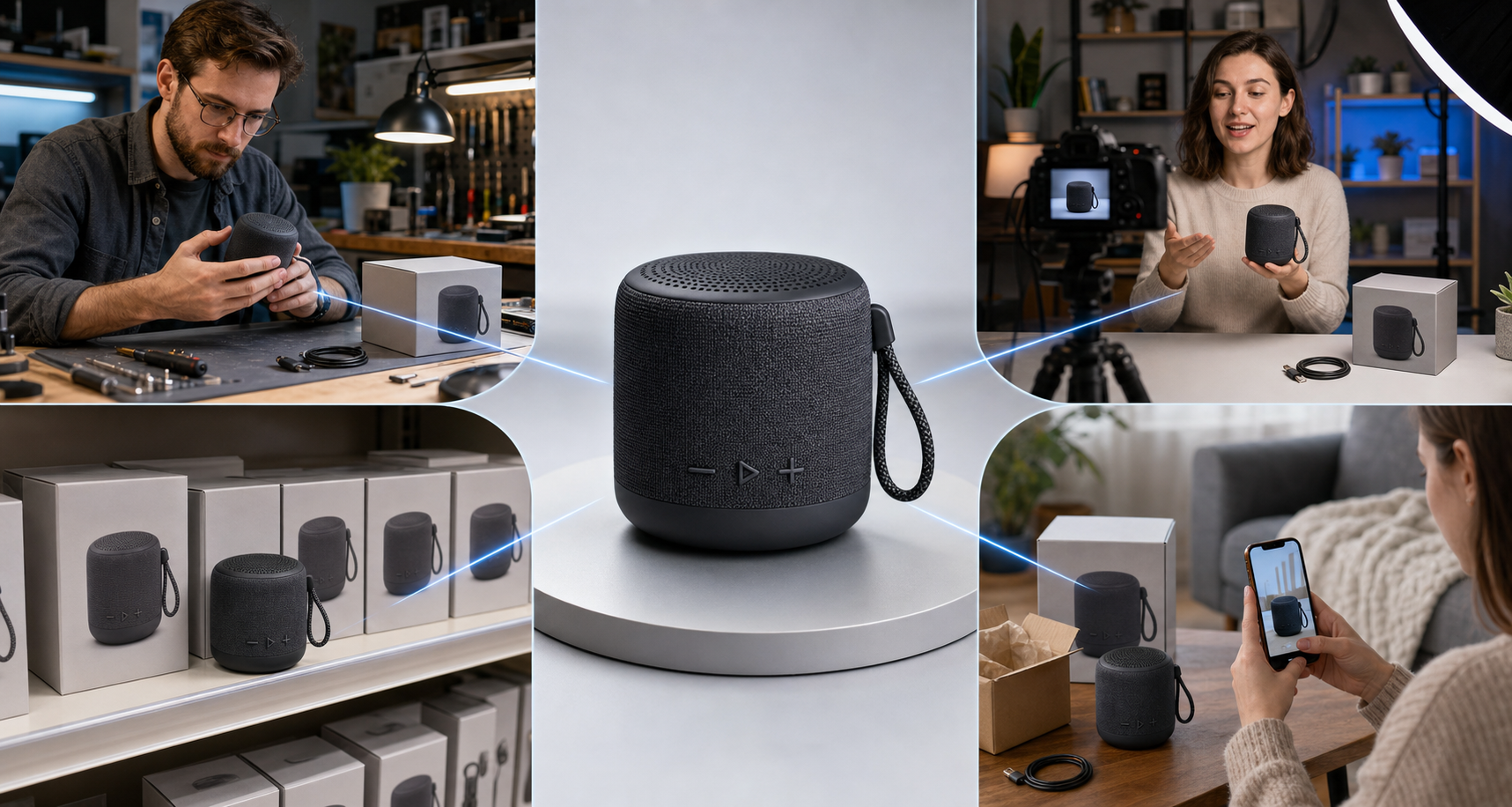
Your website can declare what a product does. It cannot independently establish how the product behaves in ordinary use or how buyers feel about its compromises. AI shopping answers often seek that corroboration elsewhere.
Within the observed set of key off-page signals, Reddit represented 34%, YouTube 19.5%, Amazon 15.5%, Business Insider 9.2%, and Walmart 8.9%. Treat these figures as evidence of concentrated influence in the examined responses, not as channel budgets or universal weights.
Each environment contributes a different kind of evidence:
- YouTube can show setup, scale, sound, motion, results, and other experiential details that are difficult to communicate in a specification table. Use accurate titles and descriptions, identify the exact model, and make spoken explanations clear enough to stand without promotional visuals.
- Retailer and marketplace listings connect the product to a category, seller, price, reviews, and comparable inventory. Keep identifiers, variants, specifications, and images consistent with your own site.
- Review coverage organizes alternatives and makes tradeoffs explicit. Give reviewers enough factual material to distinguish models without forcing them to decode your catalog.
- Community conversations reveal recurring questions, edge cases, frustrations, and unexpected use cases. Use those conversations to improve product information and support. Do not simulate participation or manufacture endorsements.
Consistency is the operational priority. If your site calls a product one name, a retailer shortens it, a video uses a family name, and marketplace variants omit the model number, you have created several weak identities instead of one strong one. Maintain a shared product record containing the approved name, model identifier, category, key specifications, variant labels, current imagery, and canonical URL. Give every channel owner access to it.
Do not turn this into a backlink-counting exercise. A mention that does not help identify, compare, or verify the product contributes little to the shopping decision. Audit off-site presence by question instead: Where can a shopper see the product used? Where can they compare it with the nearest alternative? Where can they verify specifications? Where can they find credible discussion of its limitations?
Run a two-phase AI visibility operation
Black Friday AI optimization should operate in a preparation phase and a live phase. The preparation phase builds retrievable facts and comparison context. The live phase protects accuracy while offers, availability, and public conversation change.
Before the promotion, build a fixed prompt set from customer decisions rather than from your target keywords alone. Include category discovery, a constrained use case, a direct product comparison, a compatibility question, a value question, and a deal-verification question for every priority category. Keep the wording stable enough that later results are comparable.
Run those prompts separately on the AI platforms your customers are likely to use. Do not collapse their responses into one score. In the observed Black Friday sample, Gemini responses averaged 606 words, OpenAI responses averaged 401, and Perplexity responses averaged 288. Those are sample characteristics, not permanent product specifications, but they show why a citation or mention can play a different role on each platform.
Use one tracking row for each prompt and platform. Record:
- The exact prompt, model or product name, and time of the check.
- Whether the brand and correct product appear.
- How the product is framed: recommended, compared, merely listed, or excluded.
- Which URLs support the answer.
- Whether the price, specifications, seller, availability, and promotion terms are accurate.
- Which competitor or third-party page supplied information you did not make easy to find.
- The correction required: page content, structured data, marketplace data, comparison coverage, video, or support documentation.
At sale launch, rerun the deal and verification prompts. Repeat the check after any material price, inventory, seller, or terms change. If an answer is wrong, correct the authoritative page and connected listings first. A prompt variation may produce a different answer, but it does not repair the underlying information conflict.
Judge progress by failure mode rather than by a single visibility number. A missing brand is a discovery problem. The wrong model is an identity problem. An incorrect price is a freshness problem. A competitor winning every comparison may indicate weak decision content or stronger independent corroboration. Each diagnosis leads to different work.
Key takeaways
- Plan separately for pre-sale research and live deal verification because the source mix changes when Black Friday begins.
- Give every priority offer a clear identity, complete decision facts, current commercial terms, and evidence a shopper can verify.
- Build comparisons around use cases and tradeoffs, not unsupported claims that a product is “best.”
- Coordinate product information across your site, retailers, marketplaces, video, review coverage, and community support.
- Test the same customer decisions across AI platforms and classify failures before choosing a fix.
Before your next promotion, choose one prompt for each major customer decision in your highest-value category. Run the set when product pages are frozen, again when the sale launches, and whenever a material offer fact changes. The gaps you find will give your content, merchandising, SEO, marketplace, and communications teams a concrete Black Friday worklist – before shoppers ask AI to make the choice for them.
Leave a Reply