
Every year, Black Friday offers a unique glimpse into how consumers search, compare, and decide. This year, it added another layer: it became a real-world arena to see how AI models comprehend commerce amidst genuine demand.
I embarked on a journey to test major large language models (LLMs), analyzing 10,000 responses to understand how these systems perceive the retail landscape and the signals that shape their responses.
As I dissected the dataset, a pattern was unmistakable: Black Friday acts as a genuine stress test for AI-driven discovery.
The sheer number of queries and the diversity of categories reveal the sources, structures, and behaviors LLMs rely on for reasoning about products, retailers, and consumer intent.
The outcomes offer a sneak peek into how AI search is transforming—and how this will impact the broader commerce ecosystem.
TLDR; LLMs lean heavily on a limited range of external domains with YouTube, large retailers, and U.S. review media leading the charge.
Generalist retailers dominantly capture nearly half of all retail citations, serving as the recurring funnel LLMs use to address shopping queries.
Social and user-generated content see an 8.1% surge during Black Friday, as conventional retail and media sites experience a decline.
Off-page signals like Reddit, YouTube, Amazon, and Consumer Reports are vital, equally important as on-page content for shaping LLM comparisons and recommendations.
Structured comparison content wields significant influence, far surpassing branded assets.
The behavior of LLMs differs not only from Google but also from each other, with each platform like Gemini, OpenAI, and Perplexity offering unique formats, lengths, and reasoning patterns.
Unlike traditional search, where the process begins with a query leading to a list of ranked results, AI search reverses this. It starts with a model’s internal web of relationships, sources, and signals to construct a response.
In our review of the top 50 most-cited domains across 10,000 LLM responses—all centered around deals, reviews, and product recommendations—the distribution was notably skewed:
YouTube led with 1,509 citations, followed by Best Buy with 950, Walmart with 885, Target with 477, TechRadar with 355, RTings with 342, and Consumer Reports with 325.
This cluster shapes much of the commercial “knowledge” from which LLMs draw. It gravitates towards large retailers, global media outlets, and platforms specializing in comparisons and reviews.
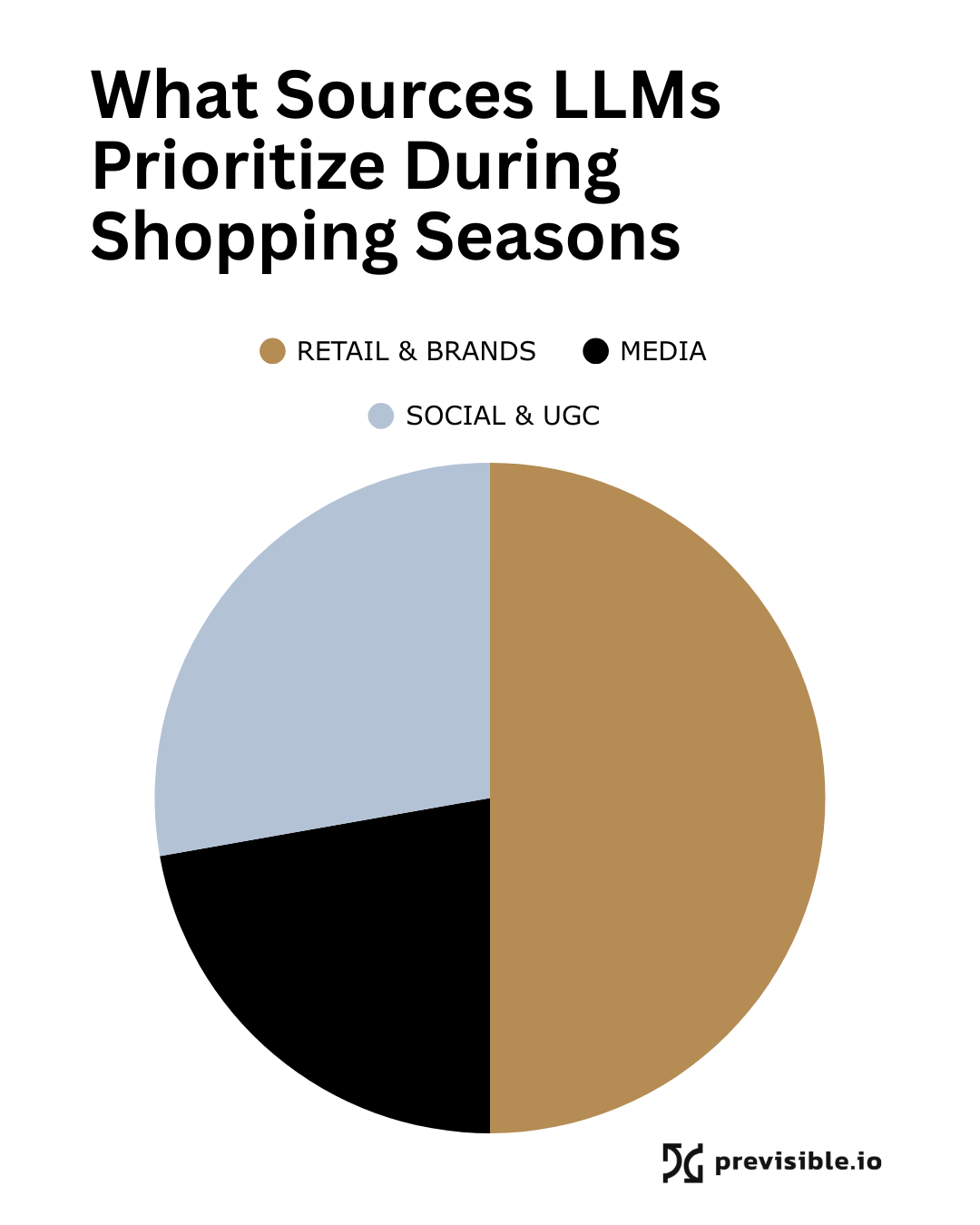
In analyzing 10,000 responses, I compared the week leading up to Black Friday with the event itself. Pre-Black Friday, responses reins focused on planning behavior.
Retail and brand domains: 59.6%
Media: 23.4%
Social and user-generated content: 17%
When Black Friday commenced, the mix rapidly evolved. Social and UGC content jumped to 25.1%, gaining significant share, while retail and media slightly retreated.
This shift within the models mirrors consumer behavior but also highlights the models’ reliance on conversation-driven content for in-the-moment decision cues.
One of the most transparent insights is the weight third-party domains carry on AI reasoning. Today’s LLMs thrive by absorbing as much human interest in products as possible. Huge volumes of consumer insights, reviews, product demos, sentiment, and structured data guide how models reason and decide.
An analysis revealed key off-page signals LLMs depend on:
Reddit: 34%
YouTube: 19.5%
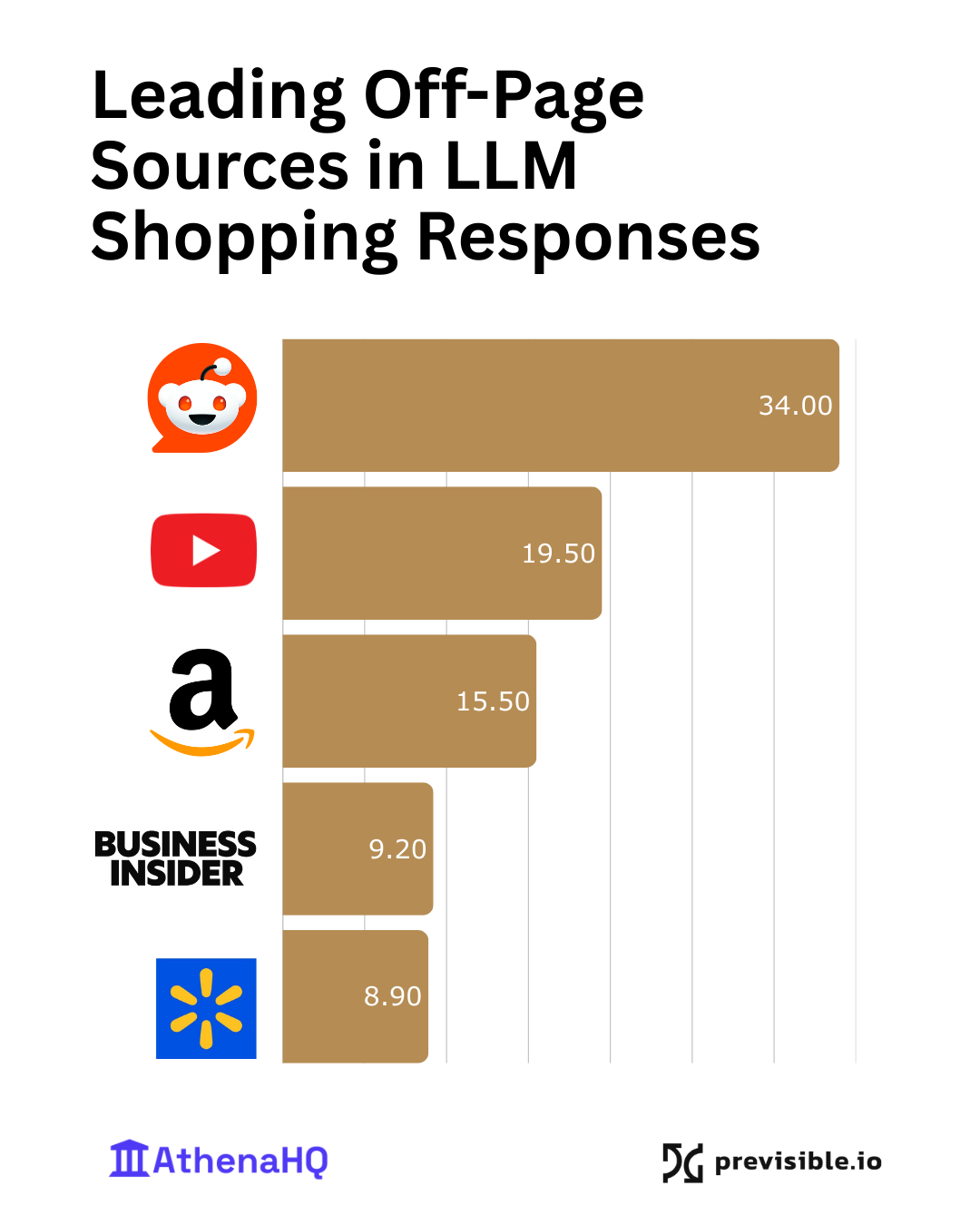
Amazon: 15.5%
Business Insider: 9.2%
Walmart: 8.9%
Each domain influences different aspects of the model’s decision-making. Across the board, LLMs lean on content that captures human interest, organizes consumer options, and mitigates uncertainty through verifiable data.
While third-party domains reign supreme, brand websites still hold measurable sway. They are vital for any consumer brand aiming to excel in AI discovery.
A site’s architecture plays a crucial role in how a model interprets a brand. Homepages account for 40% and serve as the primary identity layer—establishing tone, positioning, and offering quick semantic signals to models.
Blogs and product pages clarify brand definitions and long-tail context, providing the factual details models need.
Brands that rely too heavily on promotional copy, weak hierarchies, or thin product content risk sacrificing major visibility.
Across the entire dataset, certain retailer categories led the charge in model responses.
Generalist retailers hold 48% of the conversation. Walmart, Target, and Best Buy capture almost half of all retail citations. Their range, familiarity, and content depth make them central figures in LLM commerce reasoning.
Electronics specialists grasp 23% of the share. Best Buy leads, trailed by Newegg and Micro Center, with tech-focused queries often directing models toward these sources.
Other verticals lag behind. Despite strong category leaders, sectors like fashion, beauty, and home capture smaller portions due to the content volume disparity compared with generalist retailers.

Reviewing the platforms uncovered another pattern: major LLMs not only offer different answers but exhibit distinct thinking styles. Each platform has its own rhythm, structures, and styles for presenting commercial information.
Gemini provides the most detailed responses, with essays averaging 606 words, using lists and headings extensively.
OpenAI stands in the middle, averaging 401 words per response, with high list usage and balanced headings.
Perplexity shifts towards brevity with an average of 288 words, favoring short summaries akin to executive briefs.
These differences define unique retrieval and reasoning methods, shaping how each platform interprets brands, categories, and commercial intent.
The data presents a clear direction: AI search is forging its ecosystem, driven by familiar SEO inputs, source quality, content structure, and off-page signals, all interpreted to deliver precise answers.
If your content isn’t well-structured and present across the web, it risks becoming invisible to AI platforms delivering answers or product suggestions.
As this new environment evolves, it’s crucial for retailers and brands to rethink their communication strategies across the entire digital landscape.
On-page actions that matter:
Develop semantically coherent homepages that convey the brand, product categories, and relevance to core queries. LLMs prioritize clarity over cleverness.
Strengthen product pages with factual content, clear specifications, and Q&A sections aligned with user research intents.
Establish educational content clusters tied to core product themes, serving as reusable frameworks for AI models.
Off-page actions that matter:
Foster comprehensive review ecosystems and discussion forums to validate trust signals LLMs recognize with product quality.
Ensure visibility in media driven by comparisons and recommendations. Regularly appear in “best of” lists, product roundups, and influencer content.
Invest in rich media showcasing product value, particularly on YouTube and TikTok. Video content helps train LLMs on product use cases, reflecting sentiment, and experiential value.
Maintain accurate, indexable product data in marketplaces like Amazon, Walmart, and Etsy to enhance AI discovery pathways.
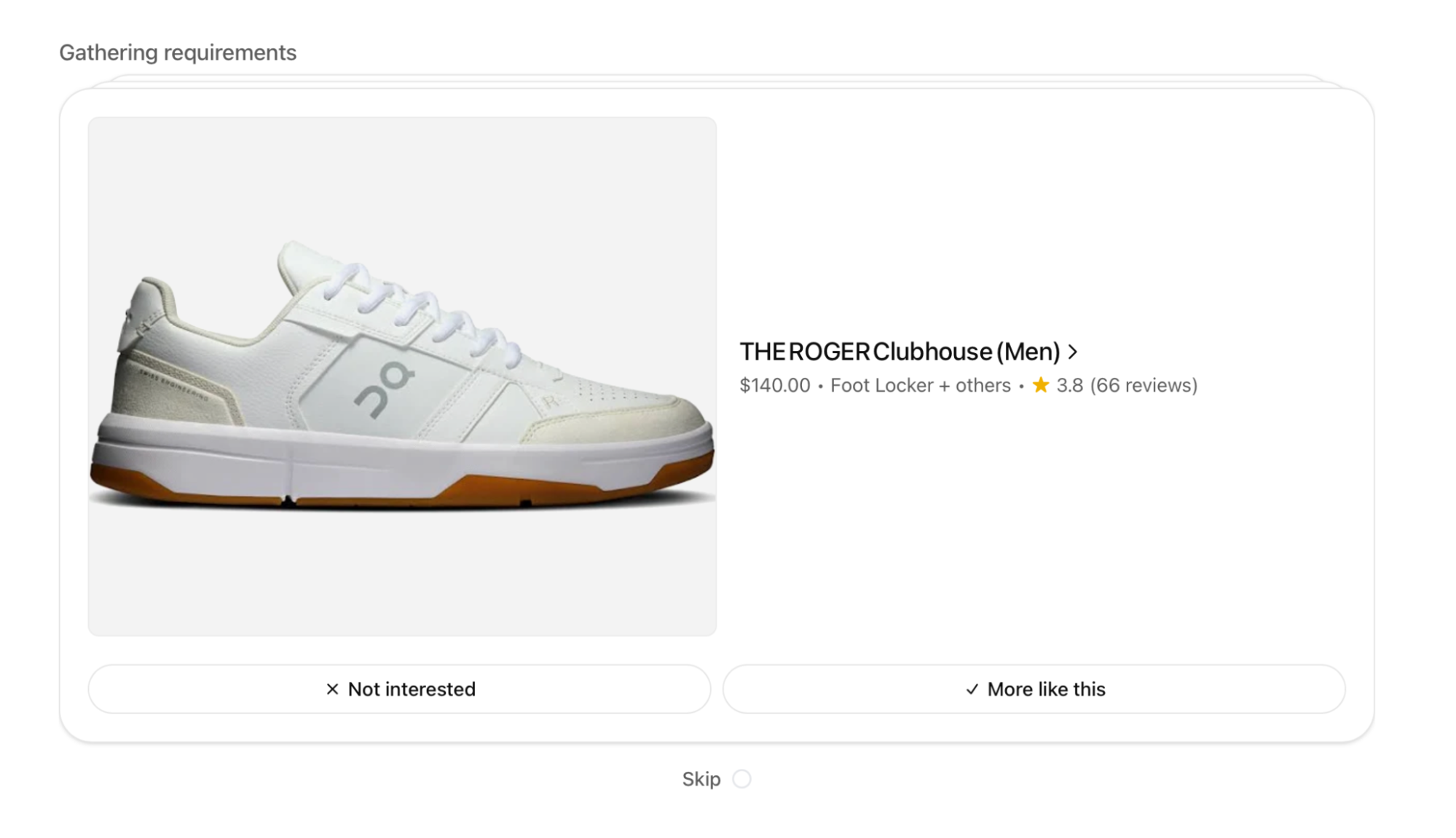
OpenAI’s Shopping Research announcement escalates the stakes. With ChatGPT, OpenAI tracks real-time consumer research behavior, turning preferences into a user-trained targeting engine for commerce.
This isn’t just AI learning about your product. It’s AI absorbing consumer shopping behavior, revolutionizing discovery through an active AI participation model.
Brands not infused into these AI systems risk invisibility during AI-driven consumer journeys.
What Black Friday revealed was more than top-selling products; it showed how LLMs operate under real demand, revealing their reasoning, referencing, and prioritizing patterns.
The advent of AI-native visibility requires structured, semantically rich content, adequately represented across the right off-page ecosystems to align with major AI models’ reasoning.
Black Friday might be the stress test, but the real transformation is only just beginning.
Inspired by this post on Search Engine Land.

Leave a Reply