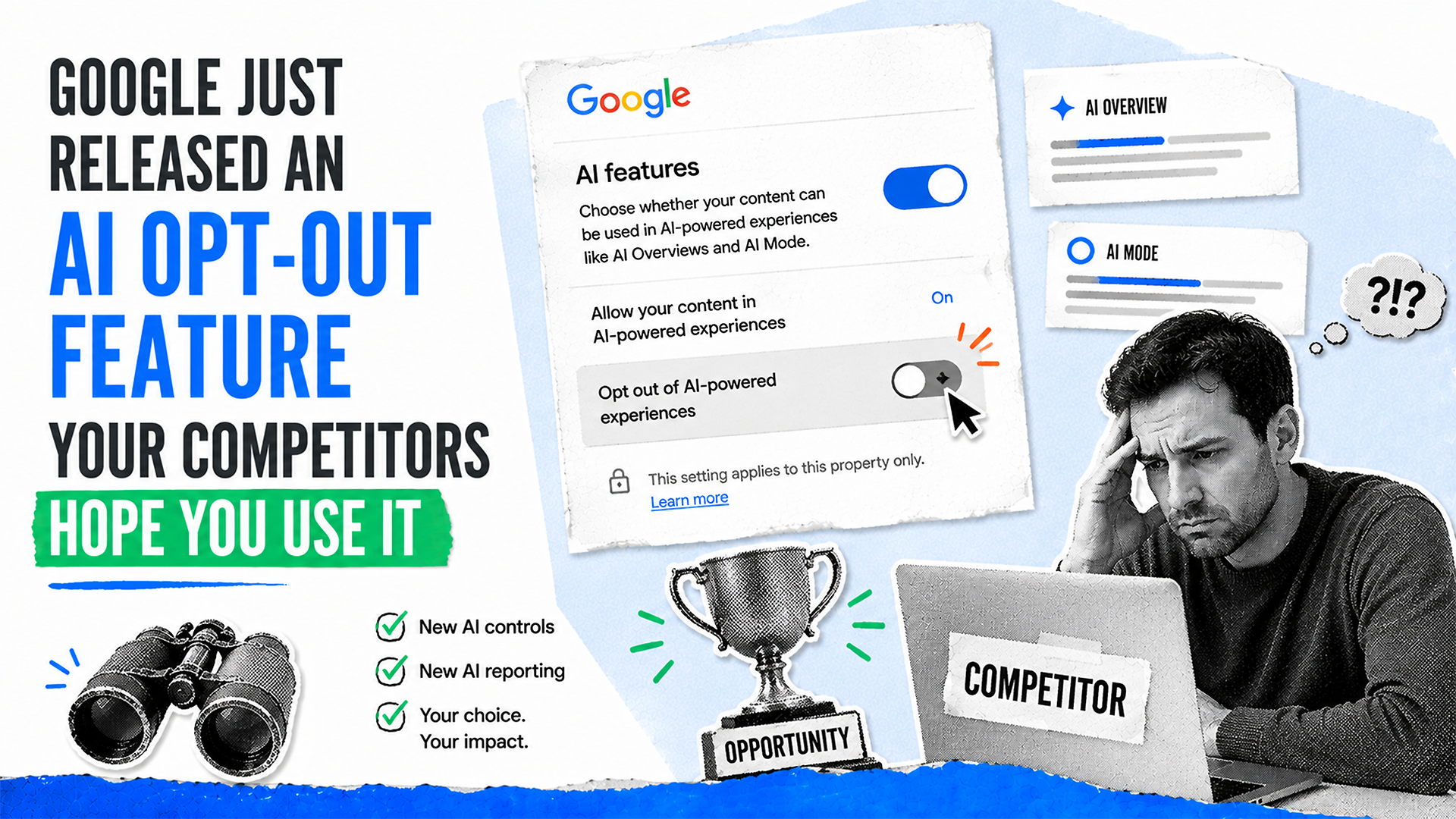
Recently, I discovered that Google introduced an AI opt-out feature, and it got me thinking.
For as long as I can remember, we’ve been pushing Google for more insight into AI traffic and control over our content’s portrayal in AI settings.
Now, this week, Google answered us with new controls allowing site owners to opt out of AI-powered experiences, like AI Overviews and AI Mode, coupled with fresh AI reporting tools in Google Search Console. Although still in early beta, it signals progress.
Despite this being a step forward, it’s sparked a split. Some are excited about the reporting aspect, while others debate whether opting out is wise.

What intrigued me wasn’t the announcement itself, but how swiftly the conversation pivoted from seeking visibility to potentially forfeiting it.
Let’s clarify what Google really launched with their announcement. The new controls don’t hinder AI Overviews or user engagement with AI Mode, nor do they stall AI’s momentum. Users will continue to engage with AI for searching and queries.
Essentially, publishers have a newfound ability to determine whether their content appears in AI-powered experiences. Was it Google’s plan or a response to external pressure, such as the UK Competition and Markets Authority?

This isn’t a debate about AI itself disappearing. What changes is brand eligibility within AI interactions. If a site like Expedia opts out, people will still plan trips—they’ll just find someone else in the AI-generated responses.
The choice is not about AI’s success, but rather about whether your brand remains present when users turn to AI solutions.
I get it—the appeal to opt out stems from fears around lost traffic and how AI uses our content.

Yet, assuming that opting out changes user behavior is where I disagree. Users aren’t concerned about a brand’s participation; they’re using AI to get quick answers.
Opting out may seem like a decision to curb AI adoption, but it more so enhances your competitors’ visibility. They snag the spotlight and gain trust while yours potentially fades.
The goal isn’t just visibility reduction—it’s about evolving with search behavior changes to remain seen.

Google’s announcement didn’t just focus on opting out but also on the new AI data they’re offering. Though imperfect, it’s a step towards greater transparency in AI search interactions.
Despite demands for more comprehensive reports, reality shows SEO has long dealt with imperfect data. Some of SEO’s big wins came from leveraging imperfect data.
Hence, we shouldn’t be stuck waiting for flawless data. While not perfect, it’s more than what we had before and will likely evolve further.

In my approach, reporting must expand beyond traditional SEO metrics, encompassing a wider discovery landscape, including AI and interaction insights.
We need to assess brand mentions, citation frequency, and how they’re perceived across differing AI platforms. Visibility stretches beyond mere traffic metrics.
Ultimately, we must rethink our questioning. Instead of asking, ‘Should I opt out of AI?’, ask, ‘Can I afford to be absent where users find brands?’ They’re already in these spaces—why shouldn’t we be?
Google’s update isn’t just a feature but a strategic pivot. By choosing to opt out, you aren’t erasing AI; you’re simply amplifying someone else’s presence.
Are you ready to adapt, or will you stay behind, longing for Google’s ‘free clicks’?
Inspired by this post on Search Engine Land.

Leave a Reply