
Web push advertising is not disappearing, but the conditions that once rewarded scale are changing. Easier opt-outs and tighter platform enforcement have made subscriber quality, compliant messaging, and durable performance more important.
A sponsored article published by Search Engine Land and supplied by RollerAds presents the channel as a maturing market rather than a declining one. Its figures and platform observations point to modest growth, alongside near-term pressure for publishers, advertisers, and ad networks.
Platform controls changed the economics of push
Web push lets opted-in users receive browser-based notifications outside a publisher’s active webpage. That reach can make the format useful for timely campaigns, but it also means poor messaging practices can become intrusive quickly.
According to the Search Engine Land article, Google introduced changes in the fourth quarter of 2024 that made unsubscribing more accessible on Android and strengthened Google Safe Browsing policies. The stated direction was greater user control, fewer deceptive notification practices, and better engagement quality.
The immediate commercial effect was less comfortable. RollerAds reported that unsubscribe rates increased by 30% to 40% in some cases on its own platform. The article also says some domains were flagged, restricted, or banned over compliance problems and negative quality signals. That platform-specific result should not be treated as an industry-wide rate, but it illustrates the exposure publishers face when access to an audience depends on browser rules.
The forecast describes maturity, not rapid expansion
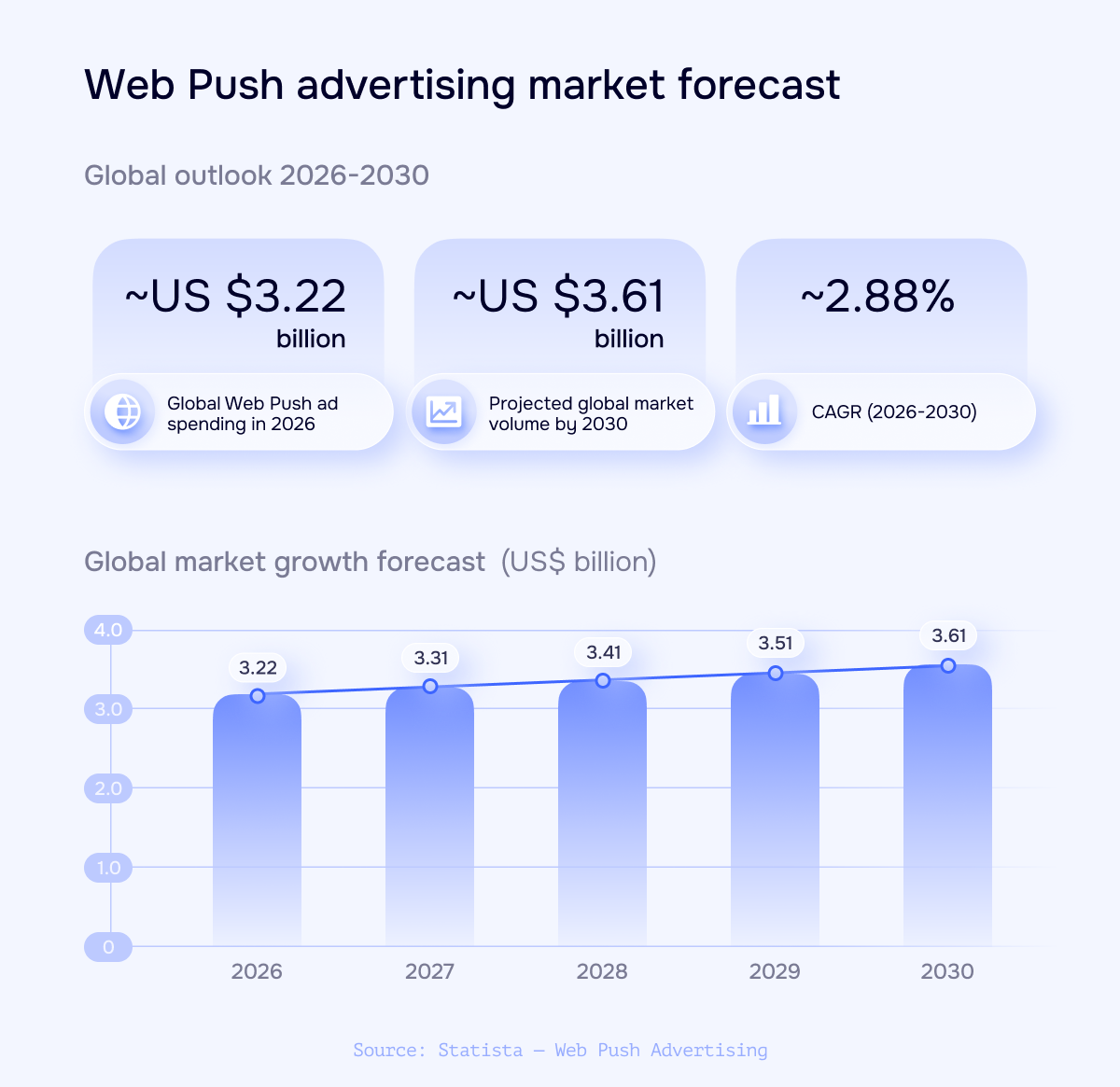
The market outlook cited in the source projects global web push ad spending of about US$3.22 billion in 2026 and approximately US$3.61 billion in 2030. The reported compound annual growth rate for 2026 through 2030 is about 2.88%.
| Year | Projected global spending |
|---|---|
| 2026 | About US$3.22 billion |
| 2027 | About US$3.31 billion |
| 2028 | About US$3.41 billion |
| 2029 | About US$3.51 billion |
| 2030 | About US$3.61 billion |
These projections indicate continued expansion, but not a return to a volume-at-any-cost phase. Moderate growth is consistent with a channel moving toward established use cases, more selective inventory, and closer scrutiny of traffic quality. The forecast does not guarantee better returns for an individual campaign; results will still depend on targeting, creative, acquisition costs, and the quality of the underlying subscriber base.
Regional projections point in the same direction
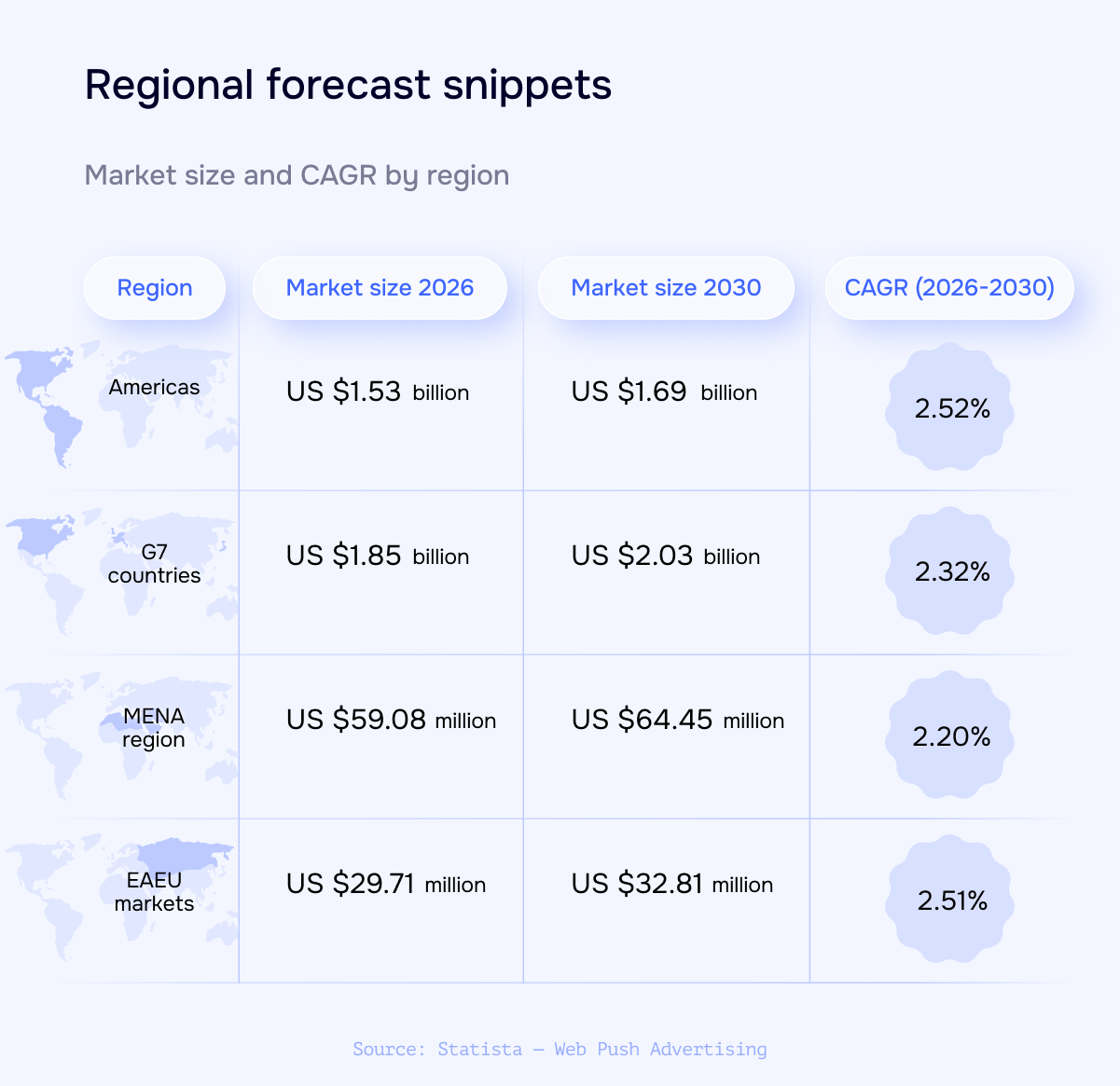
The regional forecasts cited by the article vary in size and pace, yet all four examples show growth through 2030.
| Market | 2026 | 2030 | Reported CAGR |
|---|---|---|---|
| Americas | About US$1.53 billion | About US$1.69 billion | About 2.52% |
| G7 countries | About US$1.85 billion | About US$2.03 billion | About 2.32% |
| MENA | About US$59.08 million | About US$64.45 million | About 2.20% |
| EAEU markets | About US$29.71 million | About US$32.81 million | About 2.51% |
The differences are relatively narrow in growth-rate terms. As the source interprets them, they reflect varying levels of market maturity and digital advertising penetration rather than opposing regional trajectories. The projections are best used as market context, not as a substitute for country-level campaign evidence.
Key takeaways
- Web push remains a growing advertising channel in the forecast cited by Search Engine Land, although its expected growth is moderate.
- More accessible opt-outs can reduce the size of a subscriber list while making consent and audience relevance more visible performance factors.
- RollerAds’ reported 30% to 40% unsubscribe increase applies to some cases on its platform, not necessarily to the whole market.
- Stricter enforcement raises compliance risk for publishers and networks using misleading language or low-quality traffic.
- Advertisers should judge the channel by qualified engagement, acquisition economics, and customer value rather than notification volume alone.
What advertisers and publishers should change
For publishers, the central issue is no longer simply how quickly a subscriber list can grow. They need clear opt-in expectations, messaging that matches what users agreed to receive, and monitoring that reveals whether campaigns are driving engagement or accelerating opt-outs.

Advertisers should examine the source and quality of push inventory, segment audiences by relevant behavior, and test the complete funnel rather than optimizing only for clicks. A high click-through rate can still be unhelpful if the post-click experience fails to produce worthwhile outcomes. Networks, meanwhile, have an incentive to improve screening and technical controls because weak supply can expose every participant to policy and performance problems.
The source argues that lower message pressure may eventually support stronger engagement and click-through rates, but that remains an expectation rather than a guaranteed timeline. The safer conclusion is narrower: web push still has a market, while its next phase will favor operators that can demonstrate relevance, compliance, and sustainable economics.
Inspired by this post on Search Engine Land.
