
Discover the Best Open-Source MMM Tools for Your Needs

```json
{
  "alt": "Man in a suit analyzing graphs on multiple computer screens displaying line and bar charts.",
  "caption": "A focused professional examines dynamic graphs on a multi-screen setup, reflecting on data analytics and business growth strategies.",
  "description": "This image depicts a man in a suit analyzing graphs on three large computer screens. The screens display various charts, including line and bar graphs, against a blurred background of additional data visualizations. The scene suggests themes of data analysis, financial trends, and strategic decision-making, ideal for illustrating topics in business, finance, or technology."
}
```

Marketing mix modeling (MMM) has become essential in today’s business landscape.

I’ve noticed how companies like Google, Meta, and Uber have opened doors with their free open-source MMM frameworks.

The challenge lies in figuring out which tool suits your needs without needing a PhD in statistics.

Understanding the Different Roles of Open-Source MMM Tools

These tools often get mentioned together but serve uniquely different purposes despite their collective fame.

Google’s Meridian and Meta’s Robyn are designed to deliver actionable insights by turning your marketing data into strategic budget recommendations.

These include valuable features like:

  • Data transformations that capture advertising decay.
  • Saturation curves to visualize diminishing returns.
  • Dashboards and budget optimizers for spend allocation guidance.

Meanwhile, Uber’s Orbit and Facebook’s Prophet serve different needs.

Orbit is more about time-series forecasting and requires significant development to transform into an MMM tool.

Prophet acts as a forecasting component within other frameworks.

Think of it like transportation:
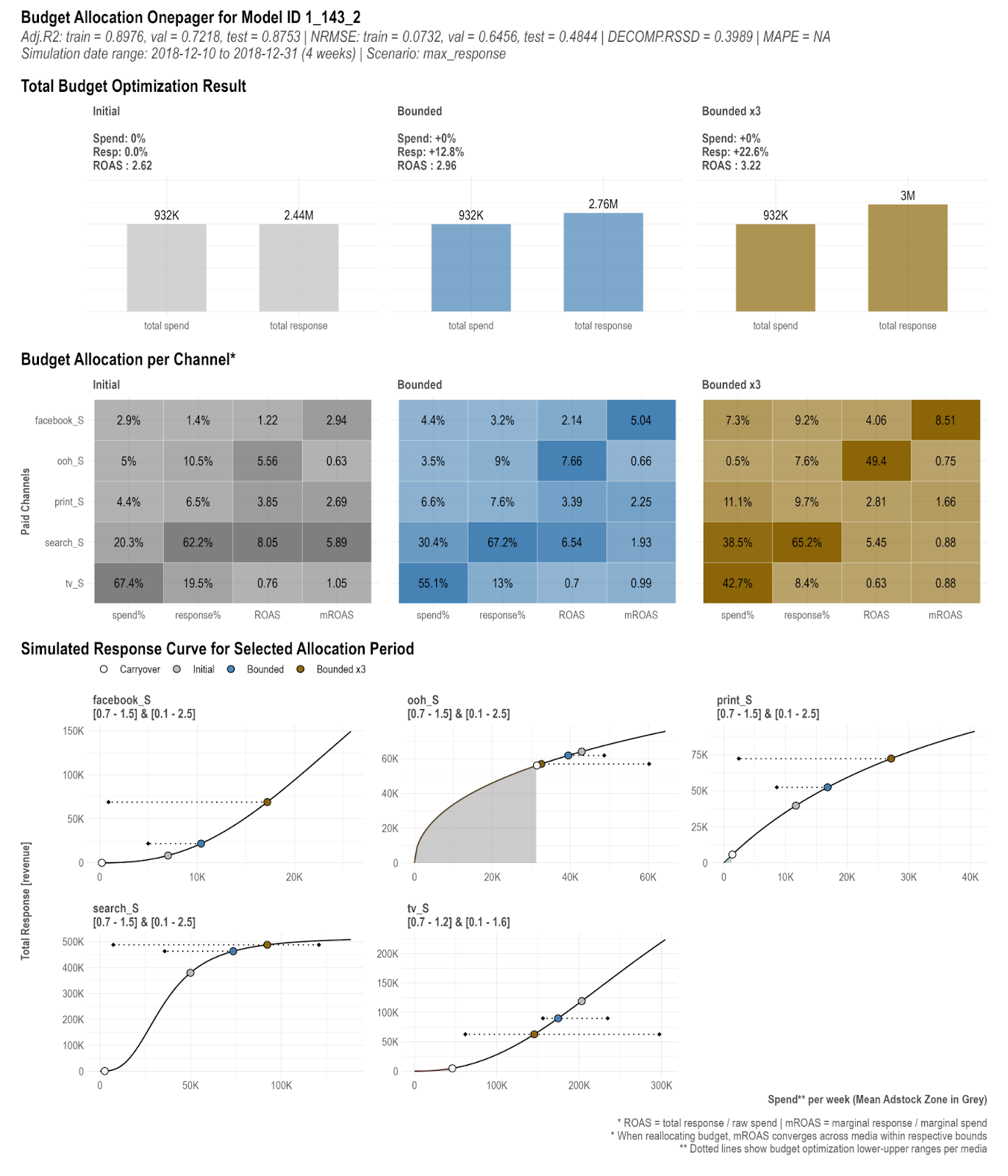
```json
{
  "alt": "Budget allocation analysis for Model ID 1_143_2 showing total optimization results, per channel allocation, and simulated response curves.",
  "caption": "Explore the strategic budget allocation insights for Model ID 1_143_2, highlighting total optimization results and per channel performance with detailed simulation data.",
  "description": "This image provides an in-depth analysis of budget allocation for Model ID 1_143_2. It presents total optimization results, showing initial and bounded allocations, and highlights ROAS and mROAS metrics. The image details budget allocation percentages across channels like Facebook, OOH, print, search, and TV. Simulated response curves illustrate the impact of spending on total responses, reflecting the effect of different budget scenarios. Designed with readability and analytical precision, this one-pager is crucial for strategic marketing decisions."
}
```
  • Meridian and Robyn are ready-to-drive vehicles.
  • Orbit is a high-performance engine requiring further builds.
  • Prophet serves as the GPS navigation system within your car.

Dig deeper: Marketing attribution models: The pros and cons

Robyn: Making MMM Accessible and Powerful

I admire Meta for creating Robyn, a tool that breaks down barriers with its automation and ease of use.

Robyn turns weeks of model tuning into a quick data upload process, rapidly exploring thousands of configurations.

It stands out by providing multiple high-quality model solutions, catering to various business needs and risk levels.

Its capability to integrate real-world experimental outcomes boosts its credibility with decision-makers.

However, keep in mind that it assumes consistent marketing performance, which might not align with real-world dynamics.

Meridian: The Analytical Powerhouse

Meridian, representing Google’s advanced Bayesian approach, models the intricate mechanisms behind advertising effects.

Unlike Robyn’s practical strategies, Meridian focuses on answering what could happen with budget reallocation based on theoretical models.

This approach, especially its geo-level modeling, provides insights that are crucial for market-specific decisions.
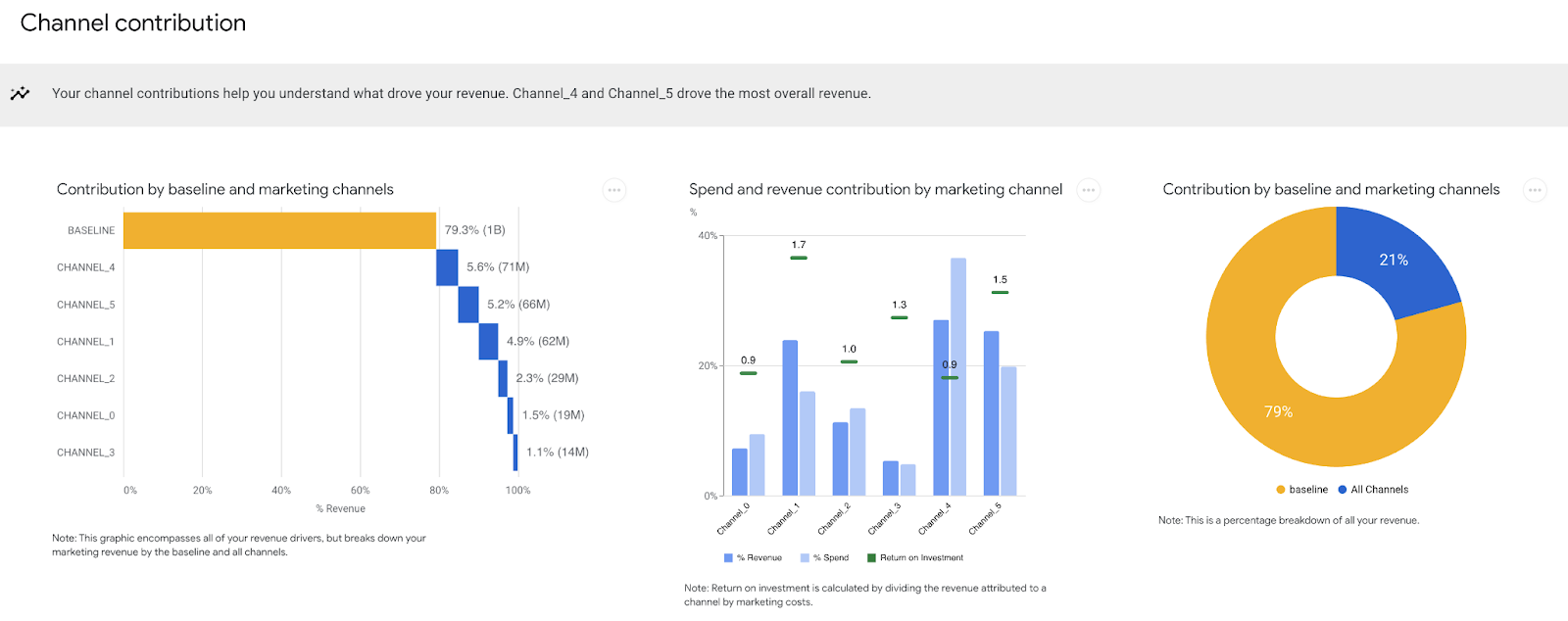
```json
{
  "alt": "Graphs displaying channel contribution, spend and revenue by marketing channel, and a pie chart of contribution percentage.",
  "caption": "Analyze the impact of different marketing channels on revenue with these insightful charts. Discover which channels drive the most revenue and how spend correlates with returns.",
  "description": "This image features three main graphical representations: a horizontal bar chart showing channel contribution to revenue, a vertical bar chart detailing spend and revenue contribution by channel, and a pie chart illustrating contribution percentages. The bar chart highlights the 'Baseline' as the largest contributor with 79.3% of revenue, followed by Channel_4 and Channel_5. The pie chart indicates 79% revenue from the baseline and 21% from all channels. These visualizations provide a comprehensive overview of revenue distribution across various marketing initiatives, crucial for optimizing channel strategies. Keywords: revenue, marketing channels, pie chart, bar graph, channel contribution."
}
```

Although its methodology is robust, Meridian’s technical demands are high and require statistical expertise not common in most marketing teams.

Dig deeper: How Bayesian testing lets Google measure incrementality with $5,000

Uber Orbit: Expert Time-Series Forecasting

Orbit shines in time-series forecasting with its Bayesian time-varying coefficients, offering flexibility many traditional MMM tools lack.

It’s an advanced tool, best suited for teams that have the capacity for custom framework development.

Prophet: Unraveling Temporal Patterns

Prophet stands out in its primary role of time-series forecasting, effectively disentangling trends and seasonal influences from data.

Remember, while it can support MMM processes, it won’t serve as a standalone solution for attribution or optimization.

Dig deeper: MTA vs. MMM: Which marketing attribution model is right for you?

Making Informed Choices for Your Team

Your choice depends on your team’s statistical comfort and resource availability.

  • Robyn suits most teams, offering rigorous insights with minimal setup time.
  • Meridian is for those with the technical expertise to leverage its deeper capabilities.
  • Orbit is ideal for custom framework developers.
  • Prophet helps in preprocessing but isn’t a complete MMM solution on its own.

Choose a tool that your team can realistically implement and maintain, maximizing the benefit from its insights.

Dig deeper: How to avoid marketing mix modeling mistakes that derail results


Inspired by this post on Search Engine Land.


crushpress.ai community screenshot

FAQs

Which open-source MMM tools are highlighted?

Meridian, Robyn, Orbit, and Prophet are discussed as open-source MMM tools. The post explains their different roles and use cases in marketing measurement and budget optimization.

What features do these MMM tools offer?

Features highlighted include data transformations that capture advertising decay and saturation curves to visualize diminishing returns. The post also mentions dashboards and budget optimizers for spend allocation guidance.

What is Meridian described as?

Meridian represents Google’s advanced Bayesian approach to modeling advertising effects. It focuses on predicting outcomes of budget reallocation based on theoretical models.

What is Orbit focused on?

Orbit focuses on time-series forecasting and is described as a high-performance engine requiring further builds. It is best suited for teams that can support custom framework development.

What is Prophet's role?

Prophet stands out as a forecasting component within other frameworks. It can support MMM processes but isn’t a standalone solution for attribution or optimization.

What should you consider when choosing a MMM tool for your team?

Your choice depends on your team’s statistical comfort and resource availability. Choose a tool that your team can realistically implement and maintain, maximizing the benefit from its insights.

Comments

Leave a Reply

Your email address will not be published. Required fields are marked *