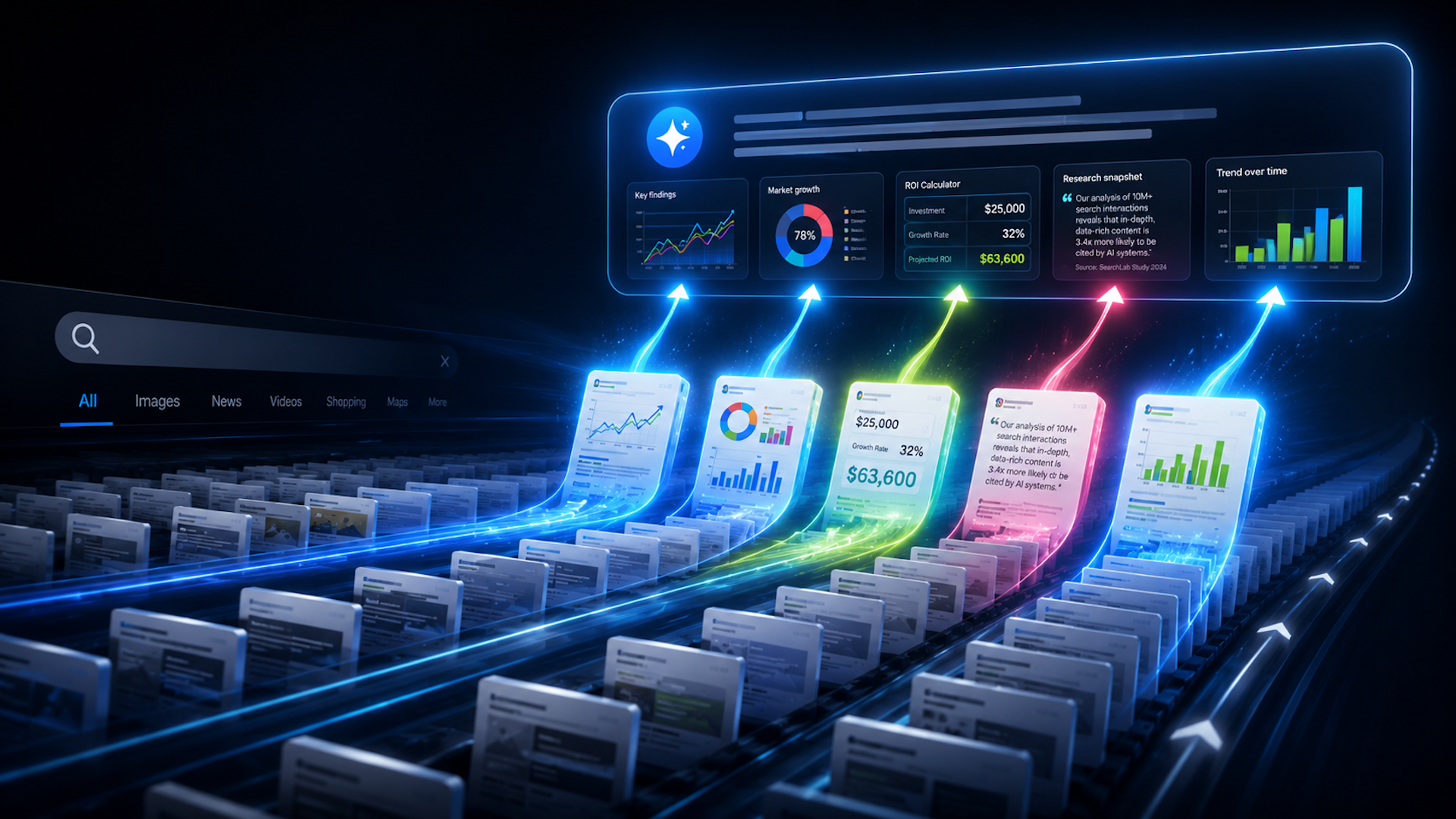

Looking at data from 10 websites, I discovered why original research, innovative tools, and answer-focused content often outperform generic educational articles in the GEO realm.
Some marketers believe GEO might replace SEO, while others say robust SEO is enough for AI visibility. So, I decided to dig into both perspectives by examining LLM referral traffic and organic traffic across 10 different sites.
Here’s what I found out about how AI search leans towards specific content patterns that differ from traditional organic search.
3 Key Findings from the Dataset
1. Traditional SEO Content Strategies Fall Short for GEO
I noticed blog content themes were a strong predictor of LLM traffic. Educational “comprehensive” guides often underperformed compared to shorter posts with unique data.
Trends and analysis posts were cited by LLMs 78% of the time. Posts featuring unique data held a significant lead in the citation pool, while educational how-to content lagged behind at a mere 12%.
It became clear that producing content rich in data and measurements significantly boosts your chances of entering the LLM citation pool. On the other hand, generic educational content might not make the cut.
2. Organic Success Doesn’t Ensure LLM Traffic
In my analysis, the top 10 organic pages captured over half the organic sessions but only 29% of LLM sessions.
Your most successful organic content may not necessarily perform well with LLM traffic. Among the top 100 organic pages, nearly half didn’t receive any LLM traffic at all!
Although there’s some correlation between organic performance and LLM traffic, the two aren’t equivalent.
3. Service/Product Pages Excel in LLM Traffic
While articles and blogs brought in most LLM referrals by session count, service and product pages outperformed others when LLM sessions are considered per 1,000 organic sessions, making them significant performers.
| Page type | LLM sessions per 1,000 organic |
| Service/product | 29.4 |
| Article/content | 23.4 |
| FAQ/support | 14.0 |
| Tool/demo | 9.8 |
| Homepage | 5.6 |
Turning my attention to practical insights, it was evident that crafting authoritative content that offers specific answers can significantly enhance LLM traffic. Integrating interactive tools emerged as another powerful approach. When LLMs recommend tools, they drive targeted traffic effectively.
The Methodology Behind My Case Study
I analyzed GA4 data from 10 diverse websites, covering 150,000 indexed pages in March 2026 to gather these findings.
- The domains, handpicked for their varied industries and consistent SEO performance, ranged across healthcare, technology, retail, and more, ensuring a balanced view.
- I meticulously isolated LLM-referral traffic using GA4 channel groupings and segmenting referrer paths, focusing on sessions from major AI platforms like ChatGPT.
- Content type categorization helped me compare LLM citations, while I used per-page averages from GA4 for engagement time analysis.
It’s worth mentioning that LLM bot crawls aren’t captured by GA4, as they make server-level requests before client-side JavaScript loads. Thus, the organic session data reflects only human visitors.
What LLM Traffic Patterns Reveal About Engagement

LLM Referral Behavior vs. Organic Traffic
Analyzing engagement time across traffic types revealed averages were similar—yet disparities emerged across different page types.
| Page type | Organic avg. time | LLM avg. time |
| Tool/demo | 101 seconds | 146 seconds |
| Homepage | 36 seconds | 82 seconds |
| Service/product | 69 seconds | 63 seconds |
| Article/content | 56 seconds | 40 seconds |
Tools and homepage content saw heightened engagement from LLM users, suggesting they look for actionable insights rather than merely seeking information.
Recognizing the Potential of Interactive Tools with LLM Traffic
Interactive tools received the highest per-page LLM citations, and these tools were prominently featured by LLMs in response to relevant user queries.
Emergence of LLM-only Traffic
Interestingly, some LLM-receiving pages recorded no organic clicks, which could signify unique discovery mechanisms. This study showed engagement quality on these pages was notably high, driven by LLM-directed users ready to engage.
GEO Tactics Supported by Data
Answer Questions LLMs Can’t Address Themselves
It was evident that generic educational content is often redundant for LLMs. Content differentiation comes from original research and proprietary insights.
Investing in research and verifiable data can significantly enhance your content’s GEO impact.
Implement Answer Capsules
Research shows answer capsules, concise responses placed prominently, are strongly favored by LLMs for citation.
By providing direct answers early, the pages excelled in LLM traffic.
Maximize Named Interactive Tools
If your site includes calculators or assessments, highlight them for GEO success. Ensure they are easily found and provide valuable, targeted insights.
Separate Tracking for Organic and LLM Pages
Recognizing that organic and LLM hits don’t always align, thoughtful mapping based on AI queries can reveal high-quality LLM traffic opportunities.
Pages that solely receive LLM attention can still hold value, as users arrive prepared for deeper engagement, driven by AI direction.
Same Strategies, Different Tactics in GEO and SEO
This analysis highlighted that while GEO coexists with SEO, it demands distinct page tactics. As zero-click searches grow, understanding and leveraging these nuances becomes crucial.
By constructing content that answers specific questions with original data and strategic uses of GEO tactics, you can optimize for both systems. Keep in mind, mastering one does not automatically ensure success in the other.
Inspired by this post on Search Engine Land.

Leave a Reply