
I recently came across a fascinating study highlighting how seasonality adjustments can actually backfire for advertisers during Black Friday, driving up costs and reducing efficiency.
A thorough analysis over three years, involving up to 6,000 advertisers, indicates that using Google’s seasonality bid adjustments during Black Friday and Cyber Monday (BFCM) often undermines efficiency, despite the platforms recommending them.
The big picture. Smart Bidding models are crafted to foresee predictable retail surges. Optmyzr analyzed tens of billions of impressions between 2022 and 2024, finding that advertisers who avoided seasonality adjustments usually had better efficiency metrics.
Without adjustments, Smart Bidding:
- Recognized the BFCM conversion lift independently
- Increased bids rationally
- Maintained stable or improved ROAS, particularly in 2024
With adjustments: CPCs surged faster than the actual conversion rates, eroding efficiency.
Reality check: Google doesn’t need your “heads up.” Seasonality adjustments prompt Google to expect a conversion rate rise and to bid accordingly. If your prediction is off—and it usually is—Smart Bidding overshoots.
For example:
- You predict a +50% CVR lift
- The actual lift is +40%
- This results in an overbid of about 7.1%
During BFCM’s high sales volumes, even minor mistakes become costly quickly.
The data: 3 years of the same story

1. Smart Bidding already adjusts for the CVR spike
- 2022: +17.5%
- 2023: +11.9%
- 2024: +7.5%
No additional guidance needed.
2. CPC inflation doubles with adjustments
Across all observed years, CPCs increased approximately twice as much when a seasonal adjustment was used.
3. ROAS drops significantly
Advertisers relying on Smart Bidding saw stable or improved ROAS, whereas those who intervened suffered double-digit losses.
The one exception: “Volume at all costs.” If the aim is pure revenue growth, disregarding margins, seasonality adjustments can be beneficial.
Revenue lifts were notably higher with adjustments:
- 2022: +50.5% vs. +25.0%
- 2023: +52.8% vs. +30.3%
- 2024: +39.9% vs. +33.8%
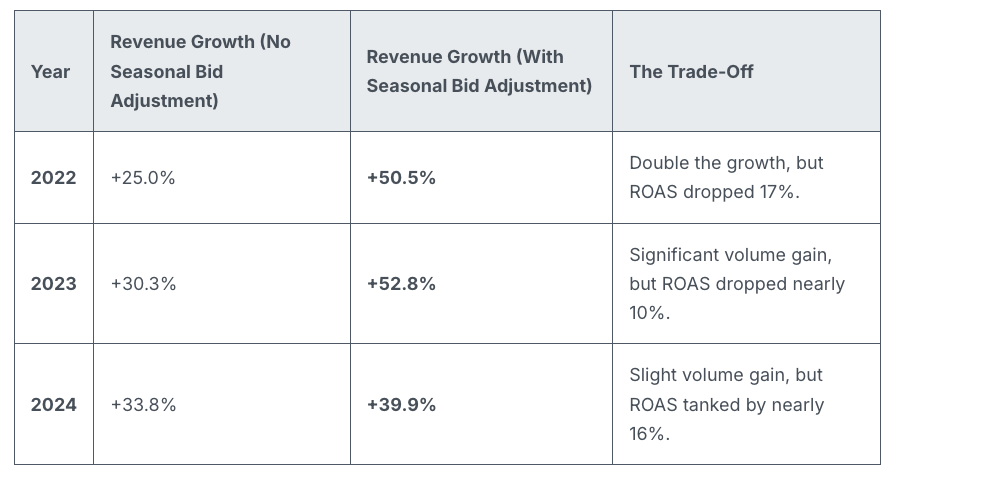
Efficiency may decline, but volume certainly increases.
When seasonality adjustments make sense. They’re useful when Google doesn’t have prior signals, like one-off or niche events.
Good for:
- One-time flash sales
- Email-only offers
- Surprise clearance sales
- Niche seasonal spikes
Not recommended for:
- Black Friday
- Cyber Monday
- Christmas
- Valentine’s Day
- Any event with a predictable historic pattern
Why we care. Google already recognizes the significance of Black Friday. Smart Bidding is trained with years of BFCM data and can detect conversion rate spikes independently. Overriding this can lead to excessive bidding, increased CPCs, and reduced ROAS, so many marketers might be wasting their budget during this crucial week.
By recognizing when Smart Bidding has an adequate signal, advertisers can avoid expensive errors, maintain efficiency, and reserve seasonality adjustments for when they add true value.
Bottom line. Smart Bidding effectively manages major retail holidays. Seasonality adjustments often bring more chaos than benefits during predictable retail peaks. Keep them for unique, brand-specific events that Google can’t predict.
Smart move: Trust the algorithm — use tools like anomaly alerts, pacing monitors, and bid caps for control without conflicting with Smart Bidding’s core models.
Dig Deeper. Do Seasonality Adjustments Actually Help During BFCM? A 3-Year Study Says No.
Inspired by this post on Search Engine Land.

Leave a Reply