Google is consolidating how Local Inventory Ads are controlled in eligible Standard Shopping campaigns. The practical issue is not merely that a setting is moving: local inventory may become active by default where the linked Merchant Center account has the relevant add-on enabled.
Advertisers should use the change as a prompt to verify which inventory each campaign can serve, especially when online and in-store products have separate budgets or strategies.
What Google is changing in Shopping campaigns
According to Search Engine Land, Google notified advertisers that Local Inventory Ads will be enabled by default beginning Aug. 31 for Shopping campaigns connected to Merchant Center accounts with the Local Inventory Ads add-on enabled.
Google is also removing the legacy “Local products” control found under Other settings. Campaign-level management will shift to the Inventory filter, where an advertiser can select Channel = Local or Channel = Online.
The reported rationale is simplification. The old arrangement included overlapping controls for local inventory, while the revised setup places channel selection in one filtering mechanism.
Why a default change can affect campaign planning
A default determines what happens when an eligible campaign is left without an explicit restriction. That makes this update particularly relevant to advertisers who have intentionally divided online and store inventory into different campaigns.
If those boundaries are reflected only in the setting Google plans to remove, the campaign may no longer behave as intended after the transition. The concern is operational: inventory eligibility and budget allocation can become misaligned even when product data and campaign structure remain otherwise unchanged.
This does not mean every Shopping advertiser needs to redesign an account. The reported change applies to eligible campaigns associated with Merchant Center accounts that have the Local Inventory Ads add-on enabled. Accounts outside that description are not identified in the source as affected.
Organic visibility, paid media and artificial intelligence merge into one connected search ecosystem, where vivid data streams link a creative website with a powerful analytics dashboard.
Key takeaways
Local Inventory Ads are set to become the default for eligible Shopping campaigns beginning Aug. 31.
The existing “Local products” option under Other settings will be removed.
Local and online inventory will instead be controlled through the Inventory filter.
Advertisers separating store and ecommerce budgets should confirm that each campaign uses the intended channel filter.
A focused campaign review before the transition
The most useful review starts with scope. Advertisers can identify Standard Shopping campaigns linked to Merchant Center accounts where the Local Inventory Ads add-on is active, then determine whether those campaigns are intended to advertise store inventory, online inventory or both.
For campaigns meant to remain channel-specific, the Inventory filter should express that choice directly: Channel = Local for local inventory or Channel = Online for ecommerce inventory. This is especially important when separate campaigns carry separate budgets, because an unintended expansion of eligible inventory could blur the purpose of that structure.
Advertisers should also document the intended role of each affected campaign before making changes. A simple record of campaign purpose, budget ownership and selected channel can make later troubleshooting easier without introducing assumptions about performance.
What is known, and what still requires account-level verification
Search Engine Land attributes the initial public identification of the update to PPC specialist Arpan Banerjee, who shared a notification email sent to affected Google Ads manager accounts on LinkedIn. The available report establishes the new default, the removal of the old setting and the replacement filter options.
It does not provide account-specific forecasts or performance outcomes. Advertisers therefore should not assume the update will help or hurt results on its own. Its significance depends on existing campaign structure and whether local and online inventory are supposed to share targeting and budget.
The durable approach is to make channel intent explicit in the Inventory filter. That leaves less room for a platform default to determine how a carefully separated retail strategy operates.
Lead totals can make a B2B paid search program look productive while obscuring whether it creates viable sales opportunities. The gap is especially important for complex, high-cost, regulated, or consultative purchases, where a website conversion begins the buying process rather than completes it.
A more useful measurement system follows prospects beyond the form, connects campaign activity with CRM outcomes, and gives Google Ads signals that better reflect commercial value.
Replace the lead scorecard with a business scorecard
Clicks, conversion rate, lead volume, and cost per lead remain useful diagnostic metrics. They show whether ads attract responses efficiently. They do not reveal whether those responses match the target customer profile, become opportunities, or produce revenue.
Search Engine Land illustrates the distinction with two hypothetical campaigns. The campaign with the cheaper leads generates less qualified pipeline and revenue, while the apparently expensive campaign produces the stronger commercial result.
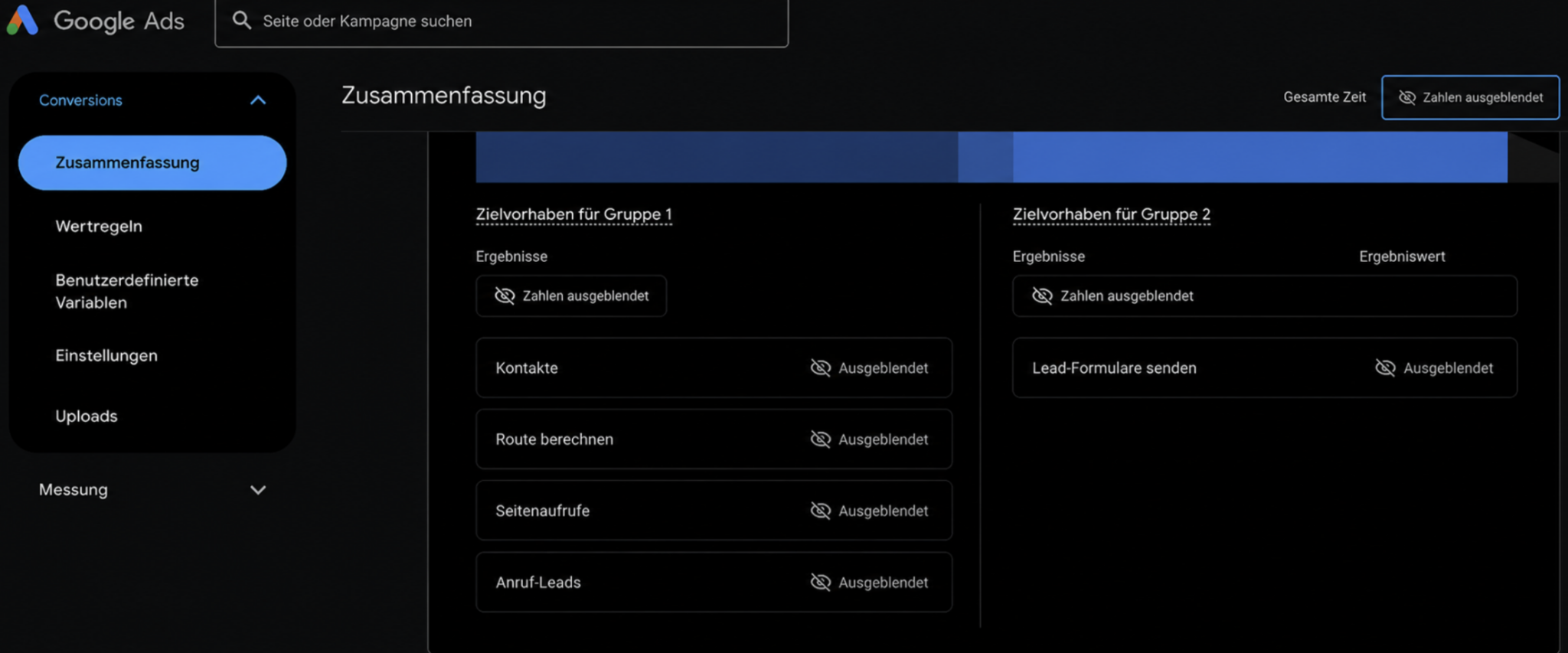
A German-language Google Ads conversion summary groups contacts, route calculations, page views, call leads, and lead form submissions, with all result figures hidden.
Metric
Campaign A
Campaign B
Leads
80
15
Cost per lead
$50
$200
Total spend
$4,000
$3,000
Qualified opportunities
2
8
Opportunity value
$20,000
$120,000
Revenue
$15,000
$95,000
ROAS
3.8x
31.7x
The example shows why a higher CPL is not automatically a problem. The relevant question is what the business receives for that cost. Cost per qualified lead, cost per opportunity, pipeline value, close rate, customer acquisition cost, revenue, and ROAS provide the missing context.
Give conversion actions a hierarchy
Not every action labeled as a conversion represents equal intent. A page view, route click, general form submission, direct contact request, sales-qualified lead, and closed deal occupy different positions in the commercial journey. Counting them together can inflate reported performance and blur the signal used for optimization.
This creates a predictable incentive problem: if an ad platform receives only a generic form-submission signal, automated bidding will seek more people likely to submit that form. It cannot infer which submissions came from serious business buyers and which came from consumers, students, competitors, or other poor-fit visitors.
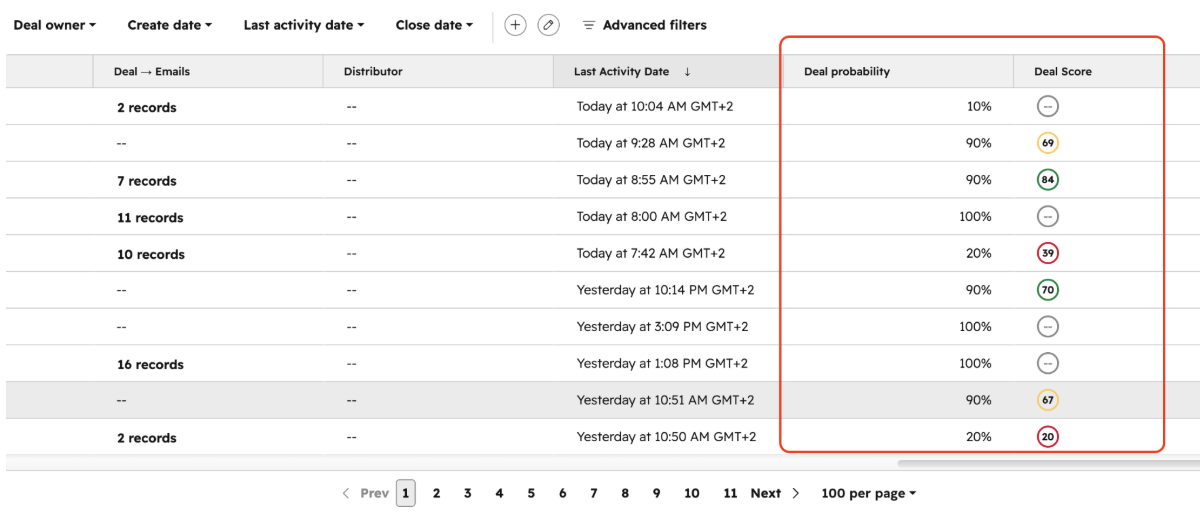
A deal list displays email record counts, recent activity times, probability percentages, and circular Deal Score indicators, with the final two columns outlined in red.
Teams should therefore define which actions are primary business outcomes, which are useful secondary indicators, and which exist only for observation. The classification should reflect buying intent and sales value rather than ease of tracking.
Use the CRM to connect acquisition with pipeline
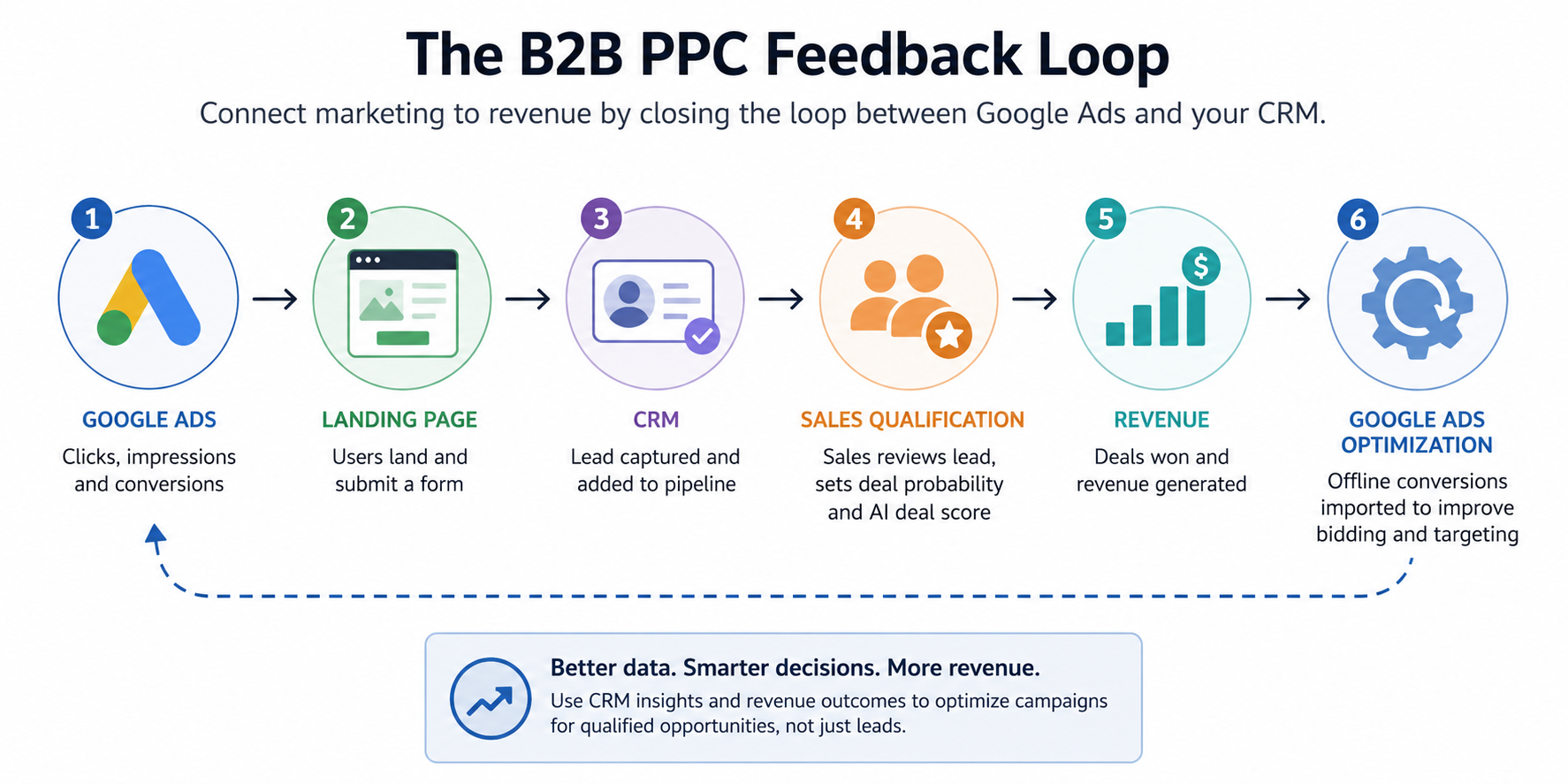
The ad account explains how a prospect arrived and what the initial interaction cost. The CRM records what happened afterward. Combining those views makes it possible to compare campaigns by lead quality instead of response volume alone.
The source describes evaluating deals with two additional signals: a probability updated by sales according to conversations, budget, timing, and intent, and an AI-generated score based on available deal and engagement data. These are examples of downstream evidence, not universal scoring rules. Each business needs lifecycle definitions that match its own sales process.
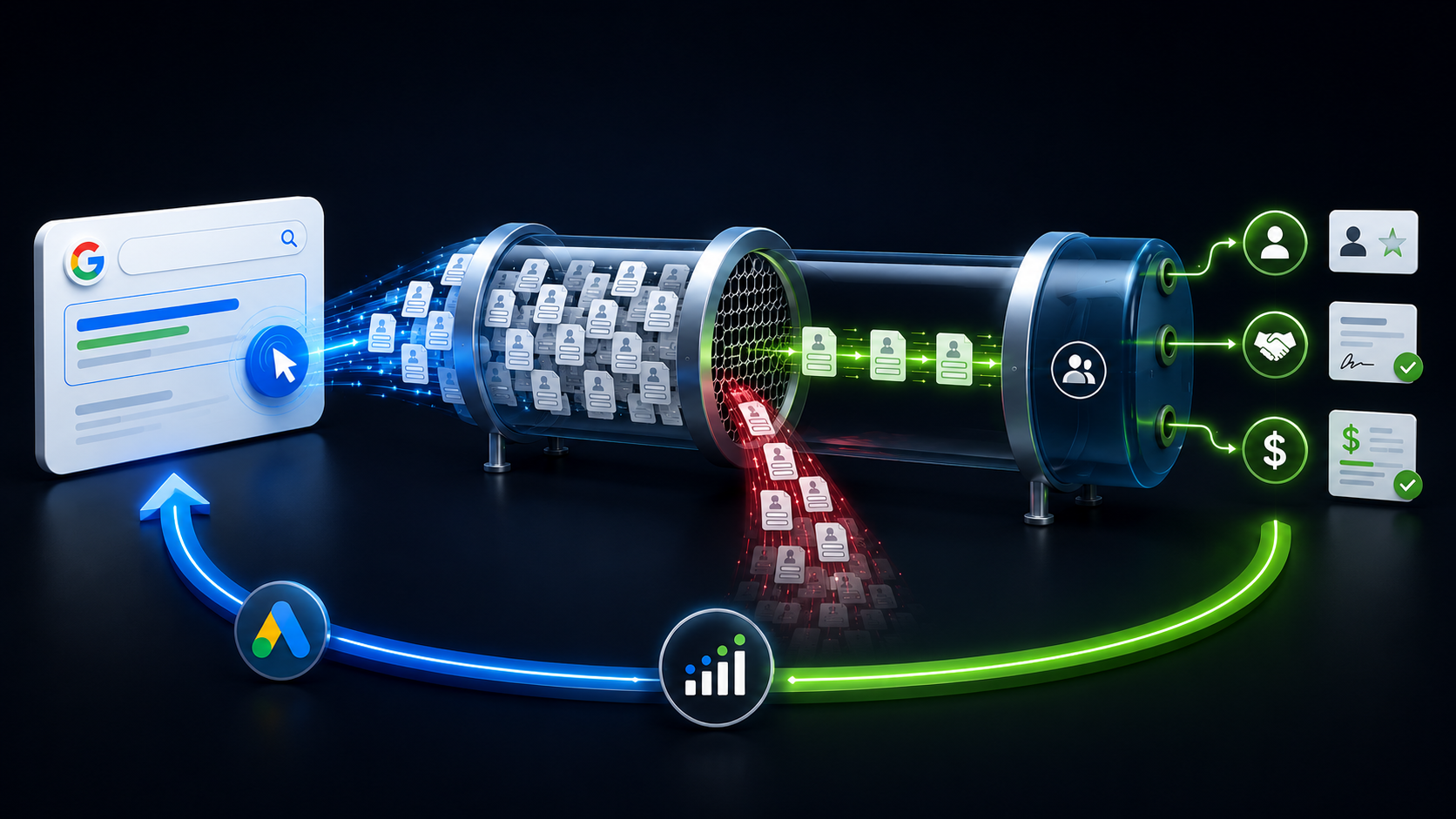
A six-step flow moves from Google Ads through form submission, CRM capture, sales qualification and revenue, then returns offline conversions for ad optimization.
A connected analysis should reveal which campaigns, keywords, and landing pages produce high-probability opportunities; which sources attract poor-fit inquiries; and which acquisition paths ultimately contribute revenue. GA4 and advertising data can support that analysis, but neither replaces the CRM record of qualification and sales progress.
Return qualified outcomes to Google Ads
Measurement becomes more actionable when lifecycle changes are imported as offline conversions. Depending on the sales process, useful events can include qualified lead, sales-qualified lead, opportunity created, deal won, and associated revenue value.
This feedback matters when automated bidding is in use because optimization follows the supplied signals. Better downstream data does not guarantee strong results, and long sales cycles can delay learning, but it gives the system a closer approximation of the outcomes the business actually wants.
Organic visibility, paid media and artificial intelligence merge into one connected search ecosystem, where vivid data streams link a creative website with a powerful analytics dashboard.
Implementation also requires data discipline. Campaign identifiers must survive the handoff into the CRM, lifecycle stages need consistent definitions, and duplicate or incorrectly assigned conversions can distort the feedback loop. Before changing bidding around deeper events, teams should confirm that those events are recorded reliably and occur often enough to support useful decisions.
Key takeaways
Use lead volume and CPL as diagnostics, not final judgments of B2B PPC value.
Separate weak engagement signals from qualified, opportunity, customer, and revenue outcomes.
Connect ad, analytics, and CRM records so campaigns can be assessed by pipeline quality.
Import reliable offline outcomes to move automated optimization closer to revenue.
Treat structured sales feedback as performance data that can inform targeting, search terms, landing pages, and budgets.
The practical shift is from asking how many contacts paid search produced to asking which investments created credible buying opportunities. As CRM feedback becomes cleaner and more consistent, budget decisions can follow commercial evidence instead of whichever campaign fills the top of the funnel fastest.
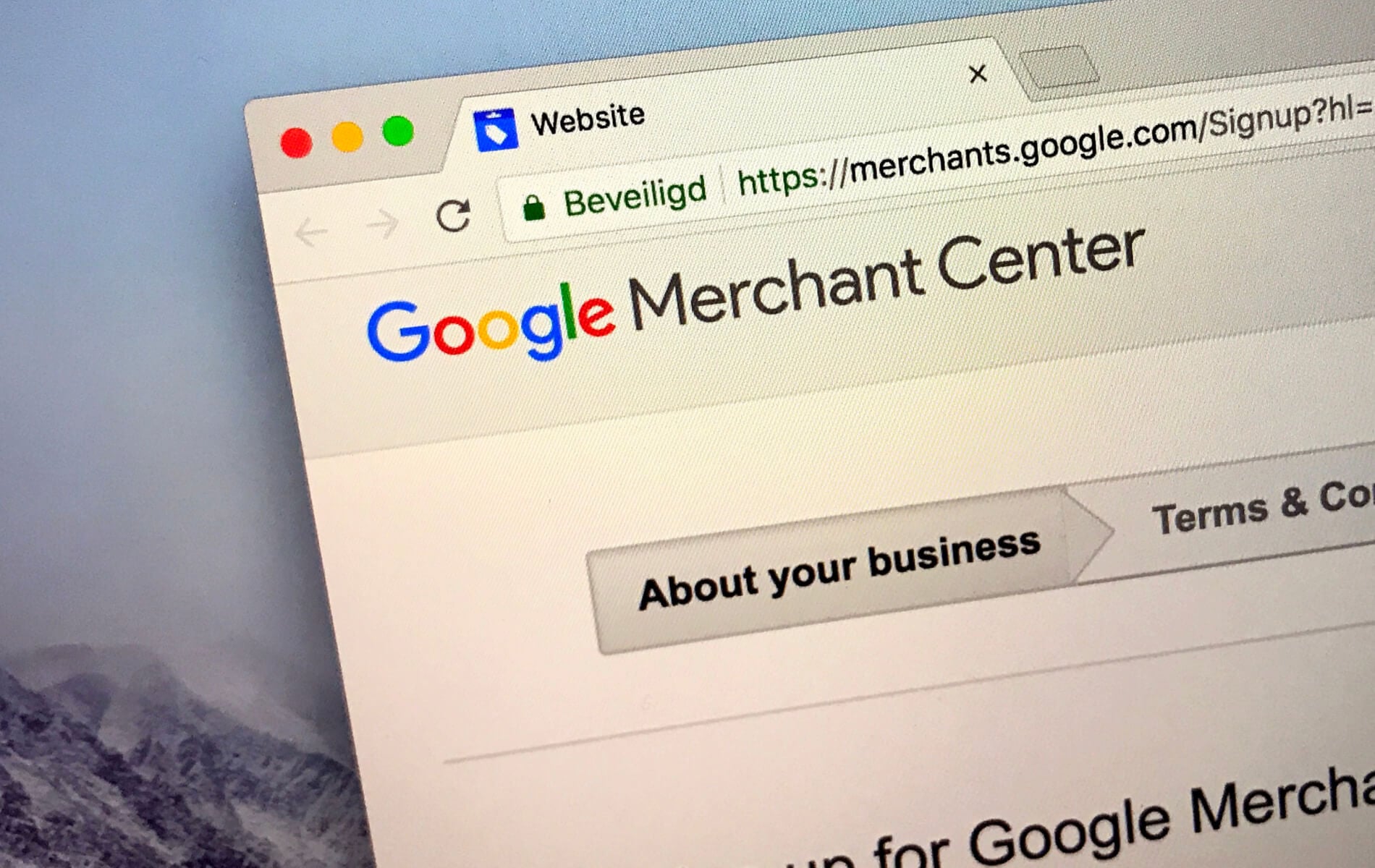
I’m adjusting how I refer to Google’s shopping platform now that Google has dropped “Next” from Merchant Center Next. Going forward, the product is simply called Google Merchant Center.
Google made the change official in a Merchant Center announcement, saying, “The platform you use today will simply be referred to as Google Merchant Center.” For anyone managing product feeds, shopping campaigns, or merchant accounts, this is mainly a naming update rather than a product change.
I remember when Google Merchant Center Next was introduced in 2023 as the newer version of the old Google Merchant Center. Over the past few years, more merchants, site owners, and advertisers moved into that updated experience.
At this point, it appears that Merchant Center Next has effectively become the standard experience. So Google is removing the “Next” branding and returning to the simpler name: Google Merchant Center.
Rows of illuminated data cabinets and paper files stretch into the distance, capturing the pressure on marketers to turn fragmented customer data into a smarter performance engine.
Google said users will start seeing the “Next” branding removed from Help Center articles, email communications, and the Merchant Center interface.
Google also clarified that no action is required and that the name change does not affect existing accounts. In other words, I do not need to update settings, migrate anything, or make account-level changes because of this rebrand.
Why does this matter? When I talk about Google’s merchant tools now, I can leave off “Next” and just call the platform Google Merchant Center. Honestly, that is what many of us were already calling it anyway.
I’m watching Google update its advertising policy to make clearer how certain ads are limited while the company estimates a user’s age. The change gives advertisers more transparency as Google expands its age assurance technology worldwide.
What I’m seeing: Google has renamed its Default Ads Treatment policy to “Categories restricted while Google is estimating a user’s age.” To me, that wording matters because it makes the policy sound less like a permanent restriction and more like a temporary safeguard while Google’s systems work out whether a user is old enough to see certain types of ads.
What’s changing: I see three main updates here: the policy has a clearer name, the language now emphasizes that these protections are interim measures during the age estimation process, and enforcement remains unchanged.
What’s different: Google has also narrowed the list of ad categories restricted while a user’s age is being estimated. Previously, the restricted categories included adult content and pornography, alcohol, gambling, and shocking content.
Under the updated policy, I now see only three restricted categories: adult content and pornography, alcohol, and gambling. Shocking content no longer appears on that restricted list.
Why I care: This update does not introduce new advertising restrictions, but it does make the policy easier to understand. For advertisers in affected verticals, the key takeaway is that these limits are tied to Google’s age estimation process, not a broader or permanent policy shift.
The bottom line: I do not see any operational change for advertisers, but Google’s updated policy makes it much clearer that restrictions on adult, alcohol, and gambling ads are temporary safeguards while a user’s age is being estimated.
I’m seeing Google Ads roll out a redesigned All Campaigns selector, and the goal is clear: make it easier to move through large, complicated account structures without wasting time hunting for the right campaign.
What’s happening is that Google is refreshing the All Campaigns selector across Google Ads with a cleaner layout and better navigation tools. For advertisers who manage bigger accounts, this should make day-to-day campaign work feel more organized.
The selector has also been moved to a new location in the interface, which means I’d expect some advertisers to need a short adjustment period before the new placement feels familiar.
The biggest improvement I notice is the new expandable hierarchy view. Campaigns now appear in a structure that makes campaign groups and nested setups easier to browse, especially when an account has grown beyond a simple list of campaigns.
Google has also added search inside the selector, which should help advertisers quickly find specific campaigns or campaign groups instead of manually scanning through long account lists.
Why I care: this update could save meaningful time for anyone managing large Google Ads accounts. When campaigns are split across multiple groups or complex organisational structures, faster navigation can make daily optimization work less frustrating.
The bottom line is that Google’s redesigned All Campaigns selector is meant to streamline campaign management with a clearer hierarchy and built-in search, helping advertisers navigate complex accounts more efficiently.
The update was first spotted by performance marketer Vivek Gupta on LinkedIn. Since the rollout is gradual, I would not expect it to be available in every Google Ads account immediately.
I know competitive brand bidding is now a common PPC tactic, but that does not mean I treat it as harmless background noise. When competitors, affiliates, coupon sites, or misleading advertisers show up on branded searches, they can inflate CPCs, divert high-intent traffic, and confuse people who were already looking for my brand.
I have seen how much difference visibility can make. Industry examples show that brands often uncover meaningful CPC inflation once they start tracking competitor bidding, affiliate activity, and trademark misuse. In documented cases, brands reduced branded CPCs by 25% to 75% after identifying infringing advertisers and enforcing their policies.
In this guide, I walk through how I monitor branded keywords, identify who is advertising on them, and decide what actions may be available based on the evidence I find.
Choosing Keywords So I Do Not Miss Hidden Activity
When I want to find out who is using my brand in search ads, I start by deciding which keywords I need to monitor.
The biggest mistake I try to avoid is watching only my exact brand name. That is a useful starting point, but it rarely shows the full picture. Some advertisers deliberately target brand-related coupon, discount, review, or alternative queries because those searches often come from high-intent users and attract less scrutiny.
For example, someone searching for “Brand coupon” or “Brand discount code” may be much closer to buying than someone searching for the brand alone. Those queries often attract coupon affiliates, loyalty sites, and unauthorized advertisers trying to intercept branded traffic.
I also pay attention to searches that include terms like “reviews” or “alternatives,” because those queries can bring in competitors and comparison sites that position themselves directly against my brand.
Misspellings matter too. Some advertisers target spelling variations because they are less likely to be monitored and may face less competition.
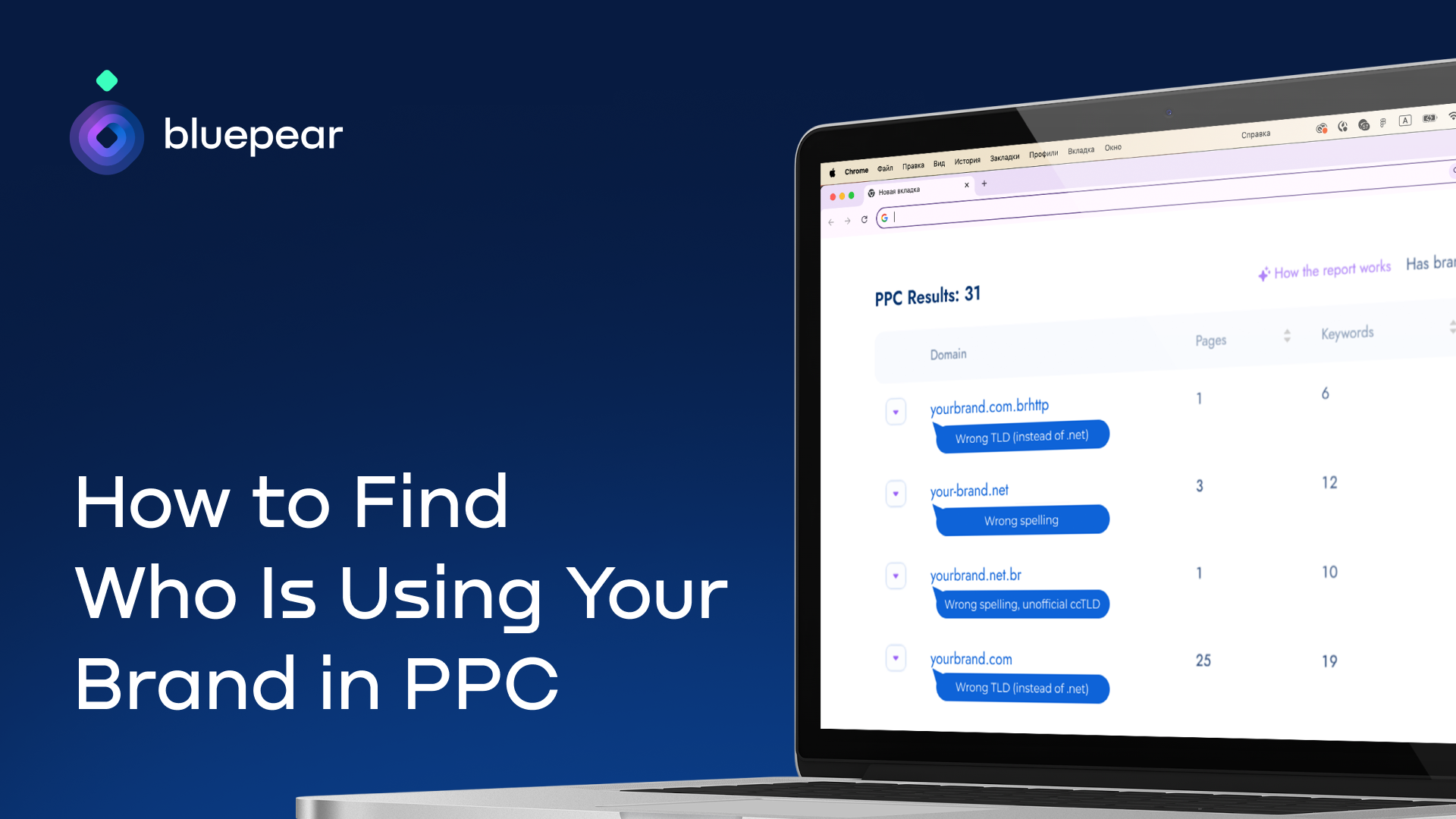
For a solid monitoring setup, I include my core brand name, “official page” and “login” variations, coupon and promo-code searches, review and alternative searches, commercial terms such as “buy,” “order,” and “sign up,” common misspellings, and localized versions of my brand name.
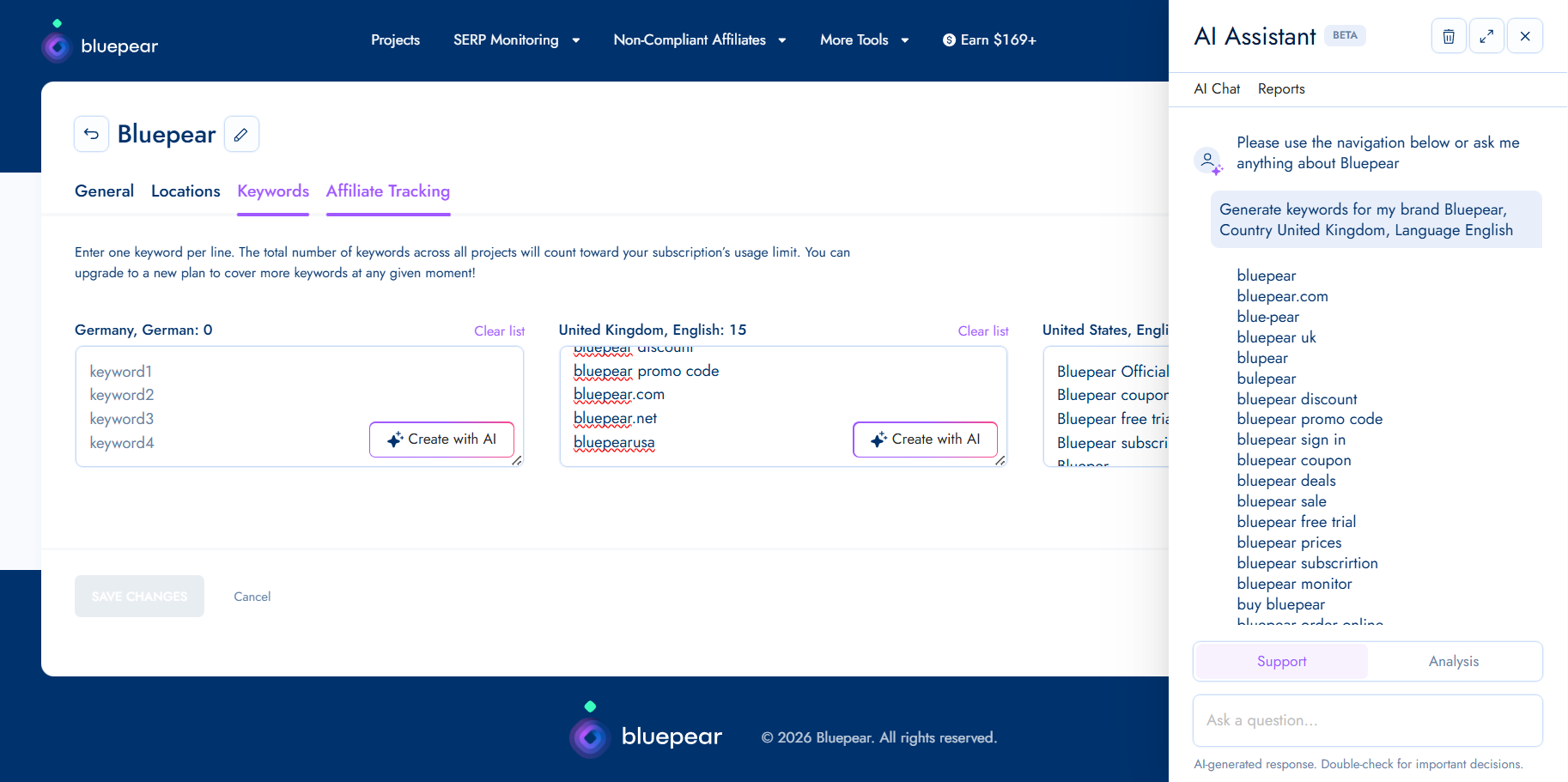
If I am using Bluepear, its built-in AI assistant can generate keyword suggestions from this kind of list and help me expand coverage faster.
The number of terms I monitor depends on the size of the brand portfolio, including trademarks, local branches, and product names. For many small to medium-sized brands, I would start with about 20 keywords and then expand as new risks, markets, and opportunities appear.
Choosing Locations and Monitoring Frequency
I do not rely on a single search from my office, on my device, at one moment in time. Search results are too dynamic for that. Two people searching the same branded keyword can see completely different ads and organic listings depending on their location, device, timing, and other variables.
I also assume that some advertisers may be trying to hide their activity. A fraudster or an affiliate violating my PPC policy might run ads outside normal business hours to reduce the chance of being caught. If I only check manually during the workday, I may never see those ads.
When I monitor branded search results, I look across the countries and markets where my brand operates, regional differences within those markets, mobile and desktop results, different times of day, and weekday versus weekend activity.
Frequency matters just as much as coverage. Some violations appear briefly and then disappear. Running checks multiple times throughout the day gives me a better chance of capturing activity that would otherwise go unnoticed.
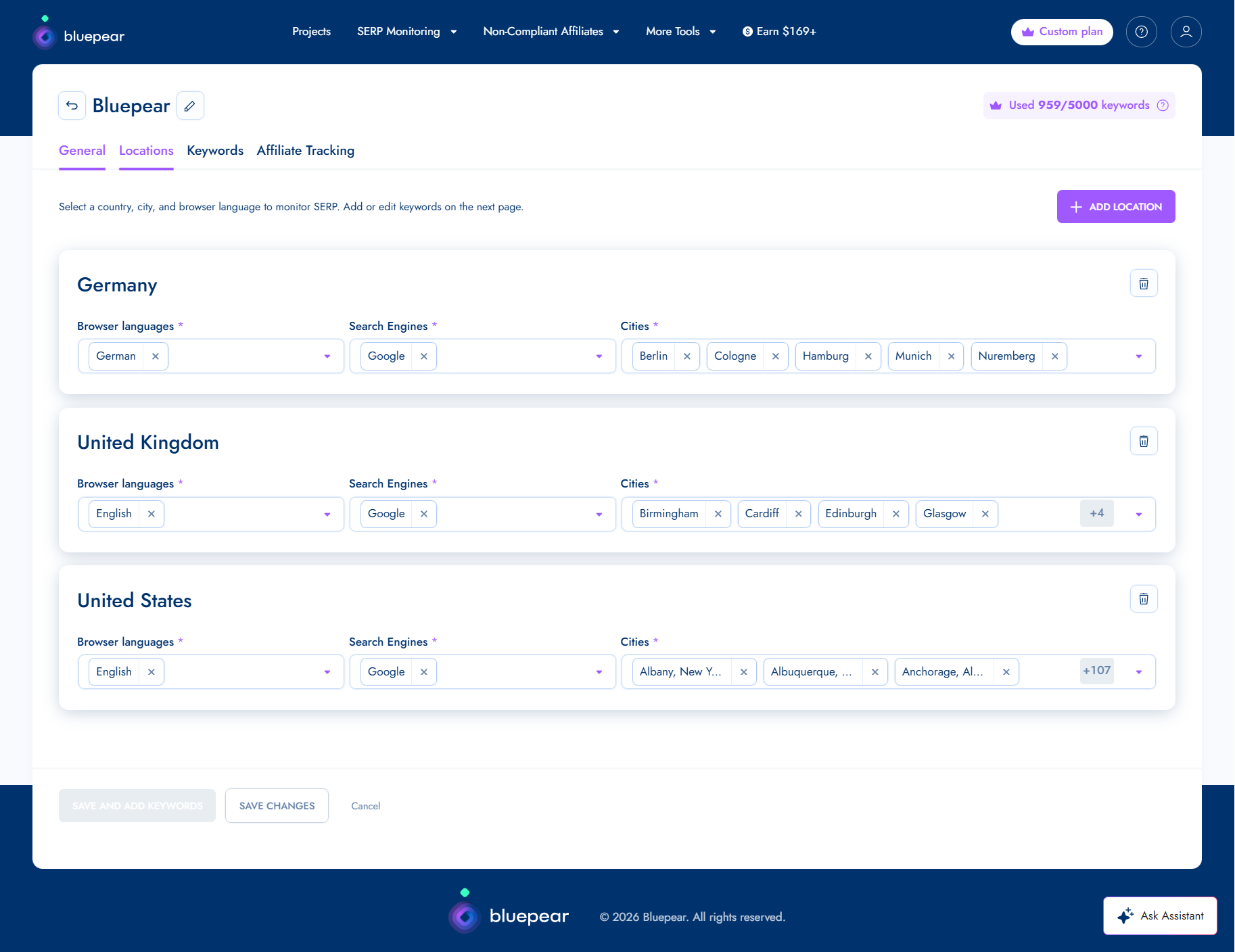
Tracking all of these variables manually can become tedious, especially when a brand operates across multiple markets. Bluepear accounts for locations, devices, time zones, and redirects that can obscure the true destination of traffic. I can set the parameters once and gain continuous visibility without turning monitoring into a weekly time sink.
Reviewing Search Results and Recording Evidence
I do not assume every advertiser bidding on my branded keywords is breaking a rule. Competitors may be allowed to bid on branded keywords if they do not use my trademark in their ad copy. Affiliates may also be authorized to promote my brand under specific program conditions.
Still, I need to know when an advertiser’s behavior crosses the line from legitimate brand bidding into trademark misuse, policy violations, or customer deception.
The first signal I investigate is trademark use in ad copy. If the ad mentions my brand name in the headline or description, and my trademark rules or affiliate policies restrict that use, I treat it as a possible compliance issue.
I also look for misleading claims. Phrases that imply the advertiser is “official,” references to exclusive offers, or language that suggests authorization when none exists can confuse users and deserve review.
Coupon and discount promotions need special attention. I verify whether the advertised discount, promo code, or offer is legitimate, because some affiliates use expired, misleading, or fabricated offers to win clicks.
I also watch for impersonation signals. Some ads and landing pages are designed to resemble a brand’s official website. Even if the advertiser does not directly claim to be my company, that kind of presentation can still confuse users and divert branded traffic.
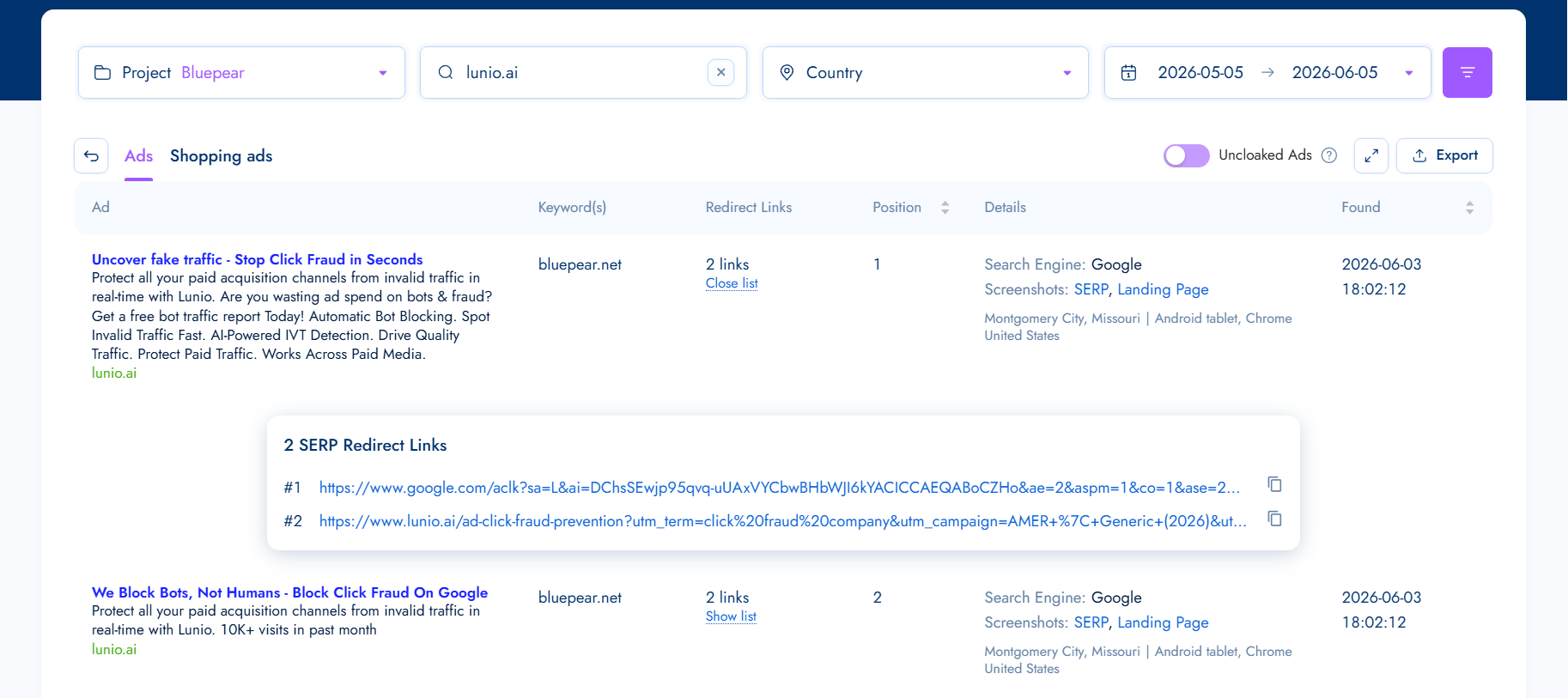
Because advertisers can change ad copy, pause campaigns, or remove landing pages at any time, I collect evidence quickly. I record the ad copy, SERP position, triggering keyword, location, URLs, redirects, landing page content, and timestamps.
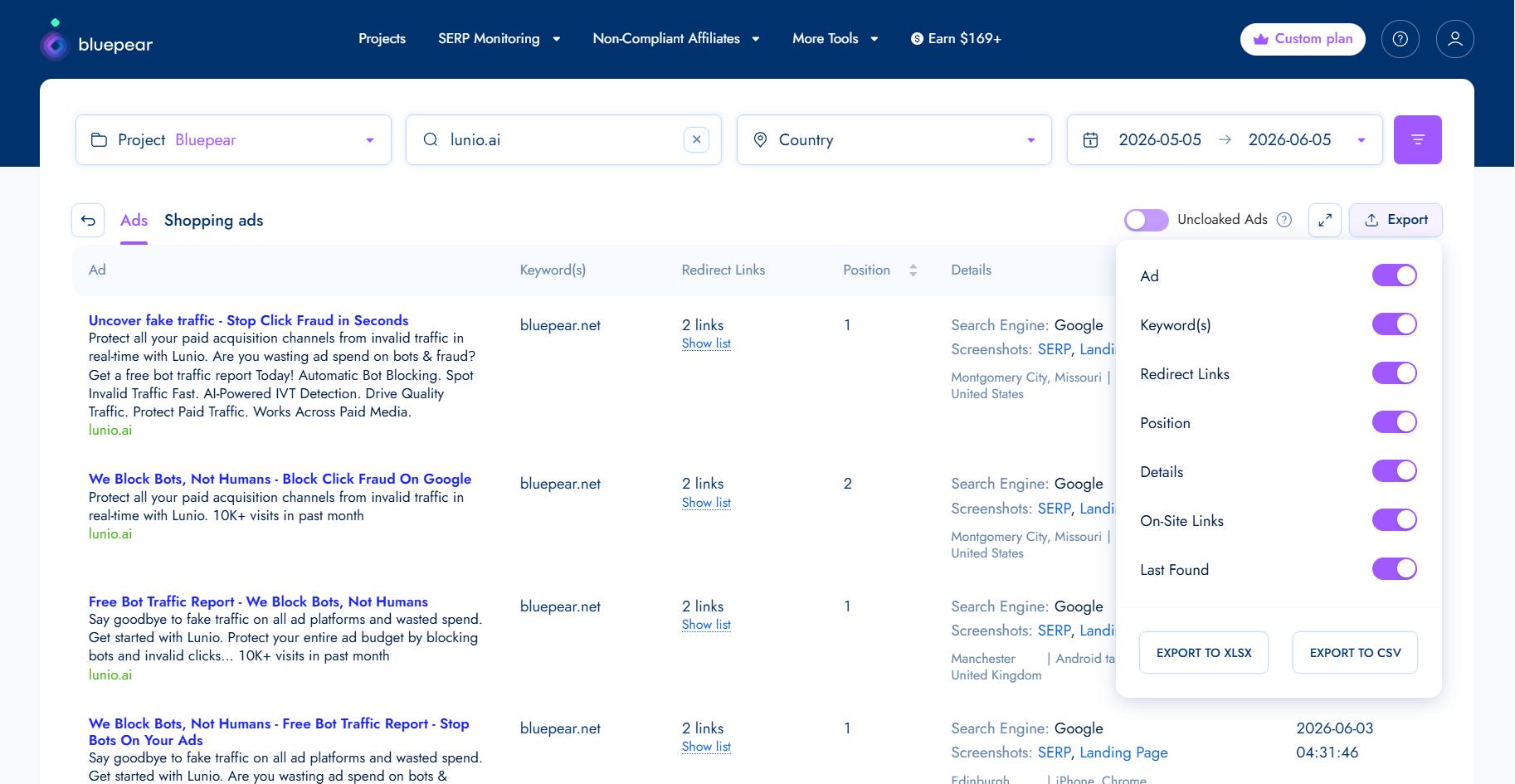
Bluepear can handle this automatically by compiling a report with the relevant details, which makes follow-up easier when I need to contact an affiliate, review a competitor’s behavior, or escalate a trademark issue.
Identifying Who Is Behind the Activity
Sometimes I cannot immediately tell whether an advertiser is a competitor, an affiliate, a coupon site, or something riskier. Branded search results often include multiple participants with different motivations, so I need to understand who I am dealing with before I decide what to do next.
I look for patterns. A direct competitor domain usually points to competitor bidding. A coupon or cashback page may indicate an affiliate, coupon site, or loyalty site. Affiliate network tracking links often suggest affiliate activity, although they can also appear in more questionable setups. Product comparison pages often point to competitors or comparison publishers.
Other signals raise the risk level. If an ad uses my trademark, claims to be “official,” sends users through multiple redirects, promotes coupon codes I cannot verify, or lands on a page that imitates my brand’s design or messaging, I investigate more carefully.
No single signal gives me a definitive answer. I combine multiple pieces of evidence before drawing conclusions. Once I know who is advertising on my brand terms, I can move beyond detection and decide whether their activity aligns with my policies and business goals.
What I Do Next
After I identify who is advertising on my brand terms and review their ads, the next step is choosing the right response.
Competitor Brand Bidding
Not every competitor bidding on my branded keywords requires immediate intervention. Before acting, I ask how often the competitor appears, which keywords they are targeting, whether they are using trademarked terms in ad copy, and whether they are sending users to comparison content or direct offers.
In many cases, I monitor the activity and evaluate its business impact over time. Documenting patterns helps me establish a baseline, which can support future compliance reviews or legal conversations if escalation becomes necessary.
Affiliate Violations
If an affiliate is bidding on restricted branded keywords or violating program rules, I gather evidence and contact the affiliate or network. My workflow is straightforward: document the violation, verify the affiliate ID, share the evidence, request removal or corrective action, and apply program enforcement measures if needed.
Screenshots, timestamps, and redirect data make those conversations much easier because I can show exactly what happened, where it happened, and when it was detected.
Trademark Misuse
Trademark-related issues require careful review. I look for unauthorized trademark use in ad copy, ads that create confusion about brand affiliation, impersonation attempts, and misleading claims that the advertiser is an official brand representative, partner, or reseller.
The right response depends on the circumstances, internal policies, and applicable laws. In many jurisdictions, competitors are generally allowed to bid on trademarked keywords. However, ads that confuse users about the advertiser’s relationship with my brand may raise trademark or unfair competition concerns, depending on the facts and local law.
The advertising platform’s policies matter too. Google allows advertisers to bid on trademarked keywords, but it may restrict trademark use in ad text when a valid trademark complaint is submitted. Google also prohibits ads that use trademarks in a confusing, deceptive, or misleading way.
Before I take action, I collect as much evidence as possible, including screenshots, detection timestamps, URLs, redirects, and landing page content. Once the facts are documented, I may contact the advertiser directly, submit a trademark complaint to the advertising platform, send a cease and desist letter, or escalate through legal channels if necessary.
Why I Keep Monitoring Brand Search
The main lesson is that branded search protection is not a one-time audit. Affiliates can activate and pause campaigns throughout the month. Some violations appear only on weekends, outside business hours, or in specific markets. An advertiser that disappears today may return next week with new ad copy, a new domain, or a different affiliate account.
That is why I treat brand protection as an ongoing process. Occasional searches are not enough. I need consistent monitoring and a repeatable investigation workflow that shows who is appearing on my brand terms, how they operate, and whether action is warranted.
If I want easier visibility into my branded search landscape, Bluepear helps identify issues earlier, respond faster, and make more informed decisions about protecting traffic and advertising investments.
I’m seeing an important shift for Standard Shopping campaigns: Google is bringing Maximize Conversion Value bidding to these campaigns without requiring a Target ROAS. That gives advertisers more room to pursue value-based optimization without immediately being locked into a specific return target.
What’s happening. Google is rolling out Maximize Conversion Value bidding for Standard Shopping campaigns, and advertisers no longer have to set a Target ROAS to use it.
Before this update, if I wanted to optimize around conversion value in Standard Shopping, I generally had to use a Target ROAS bidding strategy. Now, this new option lets campaigns focus on maximizing conversion value while giving Google’s bidding system more flexibility to find the highest-value opportunities.
Why I care. This matters because I can now use Google’s value-based bidding in Standard Shopping without being constrained by a Target ROAS goal. That gives me more flexibility while preserving the control and transparency that many advertisers still prefer in Standard Shopping campaigns.
It may also reduce the need to run feed-only Performance Max campaigns just to access Maximize Conversion Value bidding. For advertisers who prefer tighter campaign control, that is a meaningful change.
Between the lines. I know many advertisers have continued to favour Standard Shopping because it offers more visibility and control than Performance Max. But when they wanted flexible value-based bidding, they often created feed-only Performance Max campaigns as a workaround.
With this update, that workaround may no longer be necessary for some accounts.
Why advertisers should care. I can now combine the structure and transparency of Standard Shopping with a more flexible automated bidding strategy. In practical terms, this could simplify campaign setups, reduce unnecessary Performance Max usage, and make account management cleaner.
The bottom line. Google is narrowing one of the biggest feature gaps between Standard Shopping and Performance Max. For me, this gives advertisers another reason to keep using Standard Shopping while still benefiting from automated value-based bidding.
First spotted. Performance marketer Yash Mandlesha spotted the update and shared the option on LinkedIn.
I think every PPC professional has at least one mistake they wish they could erase. For Danny Gavin, founder of Optidge, it was not a failed bidding strategy, a blown budget, or a campaign that never found its footing. It was something much simpler, and in many ways, much more painful.
When Danny joined me on PPC Live The Podcast, he shared the story of a technical issue that kept landing page leads from reaching the client. For one to two months, the campaigns were still generating qualified prospects, but the client believed nothing was working because those enquiries never appeared in their inbox.
The mistake that no one spotted
At the time, Danny’s agency was still small, with only a handful of people managing client accounts. One client, an autism therapy provider, appeared to be getting strong results inside Google Ads.
Clicks were rising. Cost per lead looked healthy. From inside the ad platform, everything pointed to success.
But the client was growing more frustrated because no enquiries were coming through.
The problem was not Google Ads.
It was not the landing page.
It was the email notification system.
Every form submission was being stored correctly in the database, but a technical failure stopped the notification emails from reaching the client. Because neither side realized those emails had failed, the issue went unnoticed for weeks.
By the time the problem was found, dozens of leads had already gone cold.
Why the emotional impact was worse than the technical problem
What stood out to me was that the financial loss was not the part Danny remembered most. The harder part was the feeling that his agency had let the client down. Because he knew the client personally, the mistake felt even more personal.
His team had spent weeks reporting positive campaign performance while the client saw no return from their investment. That disconnect created guilt, regret, and a real sense of helplessness.
As Danny explained it, the agency felt as if it had taken the client’s money without delivering value, even though the campaigns themselves were actually working.
Honesty became the first step
Once the problem became clear, Danny did not try to hide it. His view is straightforward: when mistakes happen, honesty is the only response that gives you any chance of repairing trust.
Instead of making excuses, the agency investigated immediately, exported every lead stored in the database, and gave the client everything they could recover. Many of those opportunities had already gone cold, but at least the client had access to the data that still existed.
From there, the focus had to move from blame to prevention.
Building systems that stop the same mistake happening twice
That experience changed the agency’s processes in a lasting way.
Instead of relying on one notification email, Danny’s team introduced multiple safeguards:
CC’ing the agency on every lead notification.
Automatically logging every lead into a shared Google Sheet.
Testing forms regularly to confirm submissions and notifications both work.
Checking with clients routinely to confirm leads are actually being received.
Those checks are now part of the agency’s standard operating procedures. They are no longer assumptions about technology working in the background.
Why communication matters as much as optimisation
Looking back, Danny sees the technical failure as only part of the issue. Communication failed too. No one had asked the simple question: “Are you actually receiving the leads?”
Today, communication is one of Optidge’s core values.
Rather than expecting PPC specialists to manage constant client communication while also running campaigns, the agency brought in dedicated account managers whose primary role is to keep clients informed.
The lesson I took from this is simple: campaign metrics alone do not define success.
Success only happens when the client experiences the results you are reporting.
Sometimes clients remember how you responded
At first, the relationship with the client ended. Danny assumed the mistake had permanently damaged the trust they had built.
Years later, though, that same client reached out again about potentially working together. In her email, she described Optidge as the most professional agency she had worked with. For Danny, it was a reminder that clients do not forget mistakes, but they also remember how agencies respond to them.
Transparency, professionalism, and a genuine effort to improve can leave a stronger impression than perfection.
Common PPC mistakes Danny still sees today
Although this happened years ago, Danny still sees agencies making similar mistakes today.
One of the biggest is focusing only on traffic instead of business outcomes. Sending visitors to a page is no longer enough.
Strong lead generation requires understanding what happens after someone clicks.
When Danny audits accounts, he often finds agencies failing to:
Feed qualified lead data back into advertising platforms.
Review search terms thoroughly and maintain negative keywords.
Build landing pages that match campaign intent.
Measure lead quality instead of simply counting conversions.
Without those fundamentals, campaign optimisation is based on incomplete information.
Where AI is genuinely helping lead generation
Danny believes AI has real potential in lead generation, but not always in the way marketers expect.
One of the most useful opportunities is phone call analysis.
Instead of manually listening to every conversation, AI can now help agencies:
Generate call transcripts.
Categorise calls by quality.
Identify whether a call became a genuine sales opportunity.
Feed qualified conversion data back into Google Ads.
That makes it possible to optimise around real business outcomes instead of surface-level metrics.
Why AI still needs human oversight
Even though Danny is using AI, he does not treat it as an infallible system.
Like automation inside advertising platforms, AI can make mistakes, miss context, and confidently reach the wrong conclusion.
For industries with strict privacy requirements, such as healthcare, AI may not be appropriate for handling sensitive customer information at all.
His advice is to trust AI enough to improve efficiency, but always verify the work.
Human expertise still matters.
The biggest lesson
I do not think any PPC professional can avoid mistakes completely.
What defines a strong agency is how it responds when something goes wrong.
That means being honest, fixing the immediate problem, building safeguards, and making sure the same issue does not happen again.
As Danny puts it, a mistake only becomes valuable when you have genuinely learned from it.
I know LinkedIn Ads has a reputation for being expensive, and at first glance, the data backs that up. Across the client accounts I analyzed, LinkedIn’s average CPC was $11.12, compared with $5.45 on Google Ads.
But that simple comparison misses the more useful story. When I compare the cost of reaching new, high-intent B2B buyers, the gap gets much smaller. Non-branded Google Search campaigns averaged a $12.48 CPC, while comparable LinkedIn prospecting campaigns averaged $13.94.
To understand how LinkedIn CPCs really compare with Google Ads across campaign types and industries, I reviewed more than $700,000 in LinkedIn ad spend and compared it with CPC data from the same accounts on Google Ads.
What I included in this analysis
I focused on CPC and performance data from clients that had active campaigns on both LinkedIn Ads and Google Ads over the past year.
The main questions I wanted to answer were straightforward: What CPCs are we actually seeing? Do CPCs change by ad objective and industry? And how do those costs compare with Google Ads?
For LinkedIn Ads, I analyzed more than $700,000 in spend across 63,000+ clicks and 8.1 million impressions.
The clients fell into two main business categories: B2B SaaS, which represented approximately 97% of spend, and professional services.
I looked at LinkedIn CPCs by ad set objective and business category. For Google Ads, I pulled CPC data from the same client accounts across branded search, non-branded search, Demand Gen, and display campaigns.
Client names are withheld. The date range for this analysis was May 2025 through May 2026.
LinkedIn looks more expensive, but the comparison needs context
LinkedIn’s blended average CPC across all objectives was $11.12. Google’s blended average CPC across all campaign types was $5.45. On the surface, LinkedIn costs about twice as much per click.
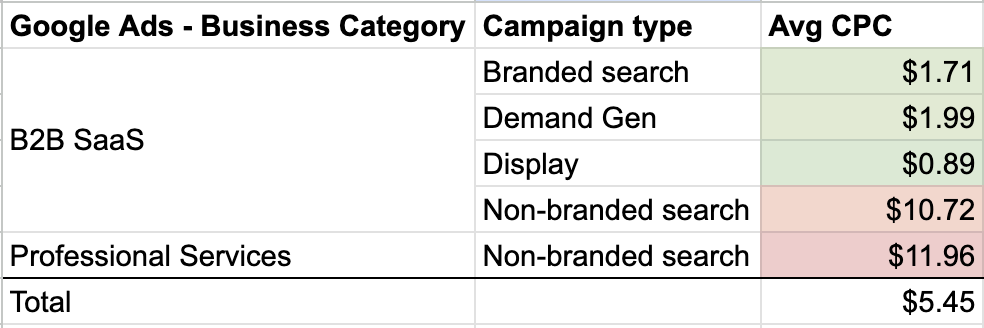
There is an important caveat. In Google Ads, a large share of those lower-cost clicks came from display campaigns, which averaged $0.89 per click, and branded search, which averaged $1.71 per click. Both are naturally less expensive because display generally reaches lower-intent audiences, while branded search captures people already looking for your company.
When I narrow the comparison to the cost of reaching new, high-intent audiences, the difference becomes much less dramatic.
Google Ads non-branded search averaged a $12.48 CPC across the clients in this study.
LinkedIn prospecting campaigns, excluding retargeting and using lead generation, website conversion, or website visit objectives, averaged a $13.94 CPC.
I used those LinkedIn objectives because they most closely represent high-intent direct-response campaigns, which makes the comparison with non-branded search more useful.
When I compare the cost of reaching a new audience, LinkedIn is still more expensive, but it is not twice as expensive. In practical terms, I am looking at roughly $12 CPCs on Google and $14 CPCs on LinkedIn.
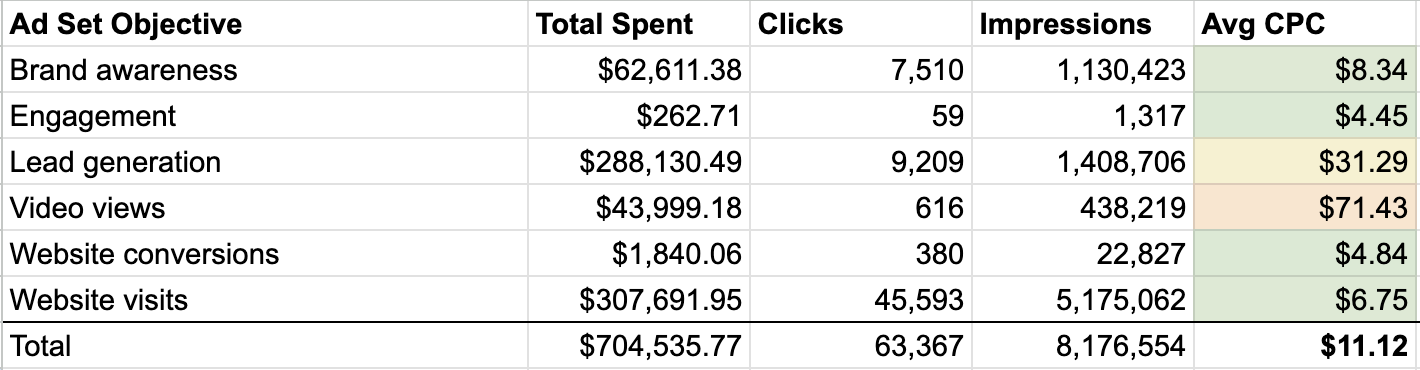
LinkedIn CPCs change a lot by objective
One of the clearest findings in this data set is how widely LinkedIn CPCs vary by campaign objective.
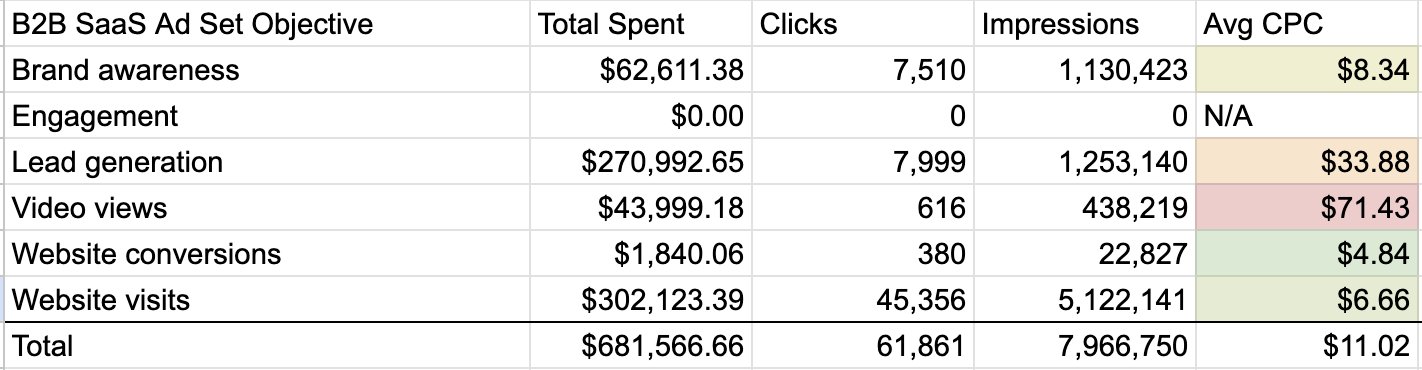
Website visits: $6.75
Brand awareness: $8.34
Website conversions: $4.84
Engagement: $4.45
Lead generation: $31.29
Video views: $71.43
Lead generation campaigns, where LinkedIn lead gen forms capture contact information directly inside the platform, cost nearly five times more per click than website visit campaigns.
That higher CPC can still make sense because these campaigns often convert at much higher rates than ads that send people to a website or landing page.
Here is the full breakdown of CPCs by campaign objective:
The number that jumps out most is video views. CPCs for those campaigns look extremely high, but cost per view is the more relevant metric there, so CPC alone can be misleading.
If I were planning a LinkedIn campaign focused on click volume or site traffic, I would budget for CPCs in the $6-$8 range. For lead gen ads, which in my experience often produce stronger conversion rates and better lead quality, I would plan for $30+ CPCs.
LinkedIn CPCs also change by industry
The two business categories in this analysis showed noticeably different CPC profiles on LinkedIn.
B2B SaaS: $11.02 average CPC on $681,000 in spend
Professional services: $15.25 average CPC on $23,000 in spend
I would be careful not to overstate that comparison because the spend levels were very different. B2B SaaS had a much broader mix of campaign types, which likely affected the average CPC. The professional services campaigns also used very specific targeting, which may have pushed CPCs higher.
B2B SaaS CPCs by campaign objective:
Professional services CPCs by campaign objective:
One interesting twist is that lead gen CPCs in professional services were lower than website visit CPCs. Lead gen CPCs were also much lower for professional services than they were for B2B SaaS.
If I were budgeting for a professional services firm on LinkedIn, I would factor in $15-$20 CPCs. For B2B SaaS, I would plan for a wider range, roughly $7-$35, depending on the campaign objective.
How this compares with Google Ads
The pattern is fairly consistent across channels. Professional services had higher CPCs than B2B SaaS in this data set. Even when I compare only non-branded search between the two industries, the CPCs are closer, but professional services still comes out higher.
Here is the breakdown of Google CPCs by campaign type:
What I would budget for LinkedIn Ads
Your targeting will have a major impact on CPCs and budget needs, but I use this data as a practical planning framework.
Minimum viable budget: $3,000-$5,000 per month
Below this level, I would not expect enough traffic to drive meaningful lead volume or conversions. You may still be able to get started, but trend-spotting will be slow, and you will probably be limited to one or two campaigns.
Testing and learning: $5,000-$10,000 per month
At this level, I would expect enough budget to run two or three objectives, launch more campaigns, test creative and audiences, and generate more meaningful lead volume.
Scaling: $10,000+ per month
With this budget, I can run always-on brand awareness and thought leadership campaigns alongside lead gen and website visit campaigns. I can also support event registrations, test more advanced list-targeted campaigns, and use retargeting without starving direct-response efforts.
For B2B SaaS or professional services companies with an ACV above $20,000, I would rarely recommend starting LinkedIn with less than $5,000 per month. A single closed deal worth $30,000-$50,000 in ACV can justify meaningful investment, even at a $500+ CPL, as long as the pipeline quality is there.
The B2B channel mix I recommend
For most B2B clients, I do not see LinkedIn and Google as either-or channels. I use them for different jobs.
Use Google Ads and Microsoft Ads for intent capture
Non-branded search reaches buyers who are actively researching. Branded search and remarketing are lower-cost and essential. If someone is searching for your category keywords, I want your brand to be visible.
I also use Demand Gen and Performance Max where they make sense to fill gaps and support brand awareness.
Use LinkedIn Ads for audience-led demand generation
If the ideal customer profile is highly specific, such as VP-level decision-makers at mid-market SaaS companies, LinkedIn’s targeting is hard to replace. No other platform gives me the same ability to reach that kind of professional audience at scale.
Run both channels in parallel
The strongest setup is to run both channels together. Google captures existing demand. LinkedIn helps create new demand and keeps the brand visible to the exact buyers I want in the pipeline.
Why I still think LinkedIn is worth the higher CPCs
LinkedIn is more expensive than Google on a raw CPC basis. But when I compare the platforms more fairly, with both reaching cold, qualified B2B buyers, the gap narrows significantly.
Higher CPCs can still be worth paying if they put the brand in front of the right customers earlier in the decision-making process. Over time, that can be more valuable than relying only on high-intent keywords after buyers have already narrowed their list of options.
The best scenario is for the brand to become an active part of the buyer’s decision, shaping the narrative before competitors do it instead.
My take is simple: I use LinkedIn Ads to build intent and tell the story, and I use Google Ads and Microsoft Ads to capture intent. The right budget depends on targeting, but I want enough spend to generate at least 100 clicks per month. Anything less usually means spending money without giving the system enough data to learn from.
I used to think bad data mainly meant bad reporting. Now, in Google Ads, I see it as something much more expensive: bad delivery. When conversion data is wrong, it does not just make a dashboard confusing. It can train campaigns to spend budget chasing the wrong people.
As automation takes over more of the ad-buying process, from creative generation to bidding, data has become one of the few inputs I can still control. It may also be the most important one, because automation can only optimize toward the signals I give it.
I keep coming back to one question: what is worse, a brilliant ad shown to the wrong audience or an average ad shown to the right one? The first burns budget on people I do not want. The second may not win every click, but when someone does engage, at least they are closer to the customer I actually need.
That is why I have to ask myself a harder question before launching any automated campaign: did I spend more time verifying the data than writing the ad copy?
The cost of bad data has changed
A few years ago, bad tracking was mostly a reporting problem.
If a tag fired twice, a conversion was mishandled, a value came through incorrectly, or offline conversions stopped working for a few weeks, the main result was a dashboard that did not add up. It was frustrating, but the damage was usually limited. Someone would eventually question the numbers in a monthly review, I would trace the issue, fix it, and the next report would look cleaner.
That same data now feeds the algorithm buying paid media. Smart Bidding does not wait for me to interpret a report or sit through a monthly review. It reads conversion data and acts on it before I may even notice that something is broken.
The same wrong number now creates a very different outcome. A bad number in a report requires an explanation in a meeting. A bad number in a conversion action used for bidding costs money immediately, because the algorithm does not know the signal is wrong.
It simply optimizes toward that signal the moment it sees it, and it does so efficiently.
Google does not understand my funnel or my business
Google may let me label conversion actions as “lead,” “opportunity,” or something similar, but those labels are mainly for organization. The platform does not truly understand where each conversion event sits in my funnel.
What it sees is a conversion event with a numeric value attached to it, usually a currency value. It does not inherently know that a newsletter signup might be worth $2 in eventual value, a lead might be worth $60, and an opportunity might be worth $400. To Google, those are conversion events. Without better signals, it has no real context that one may be worth 200 times another.
The algorithm is not optimizing for my business outcome by default. It is optimizing for the data I provide. If that data is wrong, the optimization will be wrong too.
For example, if every form submission fires the same conversion with the same default value, I give the system no clean way to separate low-intent inquiries from high-value prospects. The algorithm treats them the same. And because low-quality leads are often cheaper to acquire, it can quickly flood the account with them.
The cost per lead may drop from $40 to $25, and the dashboard may make performance look more than 35% better. But behind that cleaner metric, the pipeline can dry up as genuinely qualified inquiries quietly fall by half.
Bad data can show up in different ways, but I see three issues that are especially likely to derail campaign delivery.
1. Wrong event
If I optimize for a top-of-funnel action like a page view while the real conversion events happen further down the funnel, the algorithm learns to buy more of those cheap events. The problem is that the lower-funnel activity may never follow.
2. Wrong value
If I count every conversion equally, or assign every conversion the same placeholder value, I hide the real differences in business value. When actual value can vary by 10 times or more, the algorithm will often chase the easier, lower-value conversions because they are cheaper to acquire.
3. No data
This problem does not get discussed enough. A complete break in conversion data can damage a campaign faster than almost anything else.
On Day 1, the algorithm starts wondering where the conversions went. By Day 2, it begins assuming they may not be coming back. By Day 3, it can start making serious bidding changes. Within a week, many campaigns can throttle themselves down to almost nothing.
How I pick the right signal for Google
So how do I fix this? I start by choosing the signal that best represents business value, not just the easiest action to count.
Take a typical lead generation business. Some leads will never convert, while others may be worth 10 times as much as the rest.
If the form asks the right qualifying questions, I may already know which leads are which. But if I optimize for every submitted lead using a target CPA, I am telling Google that all leads are equally valuable.
Imagine an account spending $20,000 a month at a $40 target CPA and generating about 500 leads. Only 150 qualify, and maybe just 50 are genuinely high value. A basic lead may be worth $60, a qualified lead may be worth $200, and a high-value lead may be worth $600. That is a 10 times spread in value.
In that situation, I have several ways to improve the optimization signal.
Optimize for a qualified lead: I can create a new conversion action, such as “qualified lead,” and fire it only when a lead has real value. Then I can move the target CPA strategy to that conversion action, knowing the campaign will ignore leads with no value. The advantage is that I train the campaign on a more meaningful signal. The downside is that every qualified lead is still treated equally.
Assign conversion values and use target ROAS: I can add a currency value to the qualified lead based on the potential revenue it could generate if it becomes a sale. Then I can switch the campaign to target ROAS, allowing Google to optimize for return instead of simply counting leads. The tradeoff is that it may still buy larger numbers of lower-value leads if it can acquire them at the right price.
Optimize for a high-value lead: I can create a “high-value lead” conversion event that fires only for top-tier leads, with or without a conversion value. Then I can optimize with either target CPA or target ROAS, depending on whether I care more about acquisition cost or return. The advantage is stronger lead quality. The downside is that, depending on spend and volume, the data may be too limited to support this approach until the account scales.
These are only a few possible optimization signals, and they do not even go deeper into the funnel. I can apply the same thinking to lower-funnel milestones by creating separate conversion actions for events such as contacted lead, qualified contact, or high-value contact.
Targeting and measurement can be different
This sounds simple, but the conversion event I optimize for and the one I report on are not always the same. In many cases, they should not be the same. One trains the algorithm. The other tells me how that training is performing.
In the example above, a client or internal stakeholder may still want to see cost per lead. That is a valid metric. But the campaign may be optimizing for the Qualified Lead conversion, not the original lead submission.
I can keep the original lead conversion running purely as a reporting metric, so stakeholders still get their cost-per-lead view while the campaign bids on the qualified lead signal that actually reflects business value.
Same campaign. Two conversions. Two very different jobs.
That brings me back to the question I started with: did I spend more time verifying the data than writing the ad? In an automated account, data is no longer just measurement. Data is strategy.