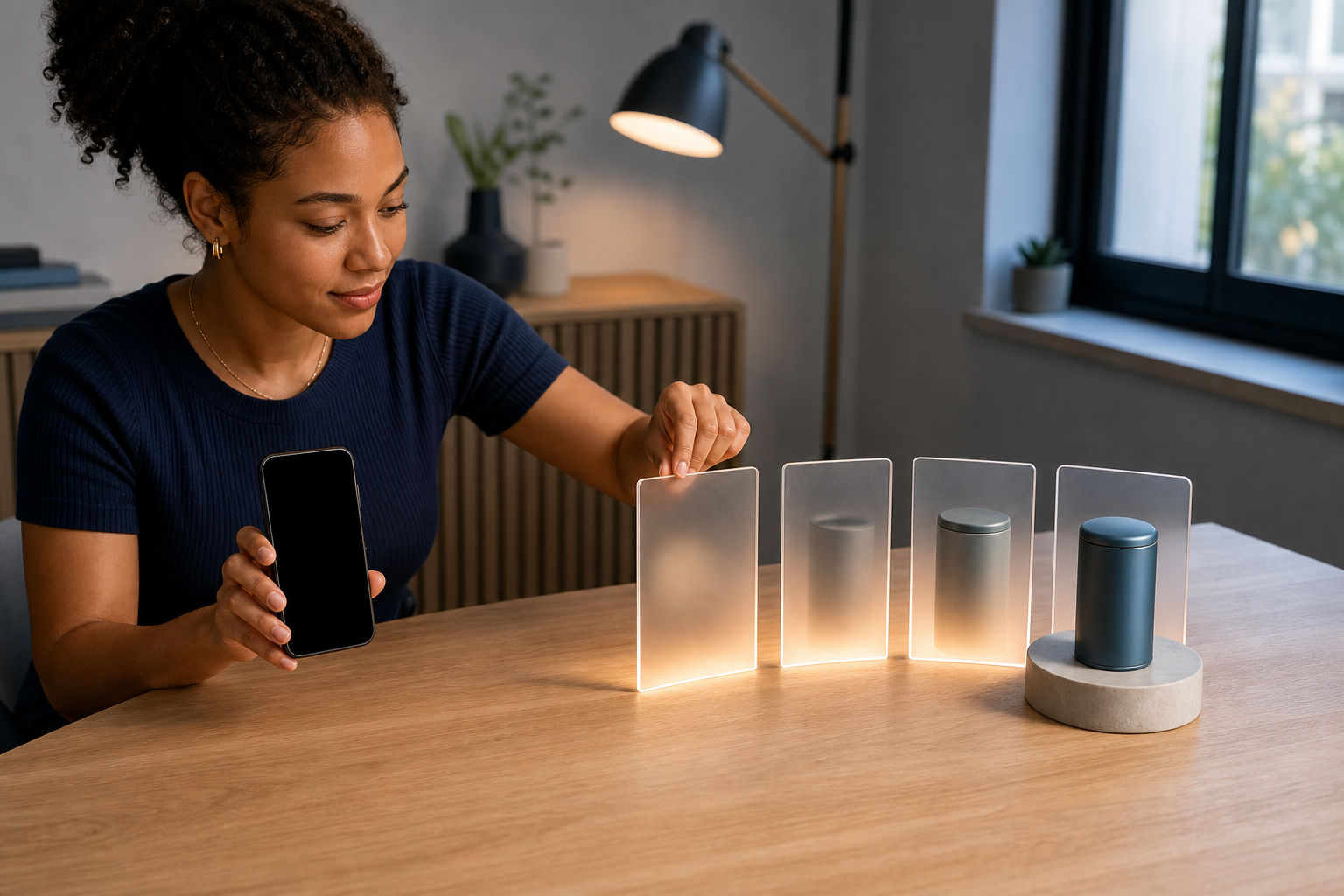
Your ad stops the thumb, but viewers leave as soon as the opening gives way to a familiar product pitch. The hook worked. The rest of the ad did not give them a reason to stay.
The fix is not a louder opening or more frantic editing. You need a controlled sequence of questions, partial answers, proof, and payoff. That sequence turns a moment of attention into enough interest for someone to understand the offer and decide whether it is relevant.
Key takeaways
- A hook earns a pause. Curiosity earns the next few seconds by creating a question the viewer genuinely wants answered.
- Build one primary information gap, then close it through a sequence of useful revelations rather than withholding the answer until the final frame.
- Give creators a planned beat sheet but room to choose their own words. Natural delivery and deliberate structure can coexist.
- Judge creative with retention, completion, replay, save, share, click, and conversion signals. No single metric tells you whether the ad is commercially effective.
- Test the opening, revelation sequence, demonstration, and product transition separately so you can identify the part that changed performance.
- Curiosity must repay attention. If the resolution is vague, irrelevant, or weaker than the promise, the ad becomes clickbait and trust falls with it.
Build a curiosity chain, not a single hook

Attention is an event: someone notices an unusual visual, a sharp line, or an unexpected result. Curiosity is a continuing state: the viewer notices that something remains unresolved and chooses to follow it.
That distinction matters because Meta and TikTok increasingly use AI-powered delivery systems that respond to engagement, watch time, and downstream conversion behavior. An opening that produces a brief pause but immediate abandonment gives those systems less evidence of sustained interest than an ad people actively choose to finish, replay, save, share, or click.
A curiosity gap is the distance between what the viewer knows and what they now want to know. It might be the cause of an unexpected result, the missing step in a demonstration, or whether a solution worked under a condition that resembles their own. It should not be a random mystery pasted onto an unrelated offer.
Write the curiosity brief before the script
Before anyone records, answer the following in plain language:
- What should the viewer understand by the end? Write the commercial conclusion without slogans. If you cannot state it clearly, the creative will wander.
- What question will carry the ad? Choose one primary question, such as why a familiar approach failed, what caused a surprising outcome, or whether a particular method can solve the viewer’s problem.
- Why does that question matter to this audience? Connect it to a recognizable frustration, risk, desire, or decision. Curiosity without relevance produces empty viewing.
- What evidence will resolve it? Select the demonstration, observation, comparison, explanation, or experience that makes the answer credible.
- Where does the product belong? Introduce it when the viewer can understand its role, not merely because the logo is due to appear.
- What is the complete payoff? State the answer you owe the viewer. The ending must satisfy the question created at the beginning.
- What should happen next? Match the call to action to the level of intent the ad has earned.
This brief prevents a common mistake: opening with a compelling problem and then abandoning it for a feature list. Every beat should either advance the answer, provide proof, or help the viewer decide whether the answer applies to them.
Use a question-and-answer ladder
Do not keep one answer locked away while padding the middle. Give the viewer useful progress. Each beat can close a small question while opening the next logical one:
- Opening tension: What happened, and why is it unexpected?
- Relevant context: Why was the outcome a problem worth solving?
- First revelation: What obvious explanation turned out to be incomplete?
- Mechanism or demonstration: What was actually happening?
- Product connection: How did the product change the process or result?
- Resolution: What should the viewer conclude from what they have seen?
- Next step: What can an interested viewer do now?
The sequence should feel inevitable. If you remove the product and the opening story still reaches the same conclusion, the connection is probably too weak. If the product appears before the problem has meaning, the ad will feel like a disguised sales pitch.
Make creator ads sound natural without leaving them to chance
Conversational creator ads work differently from compressed brand spots. Longer, less polished creator videos are sometimes called yapper ads. They may move through a personal experience, an explanation, or a demonstration before naming the product. Their apparent looseness can make them feel like content someone chose to share rather than a commercial recited at them.
That does not mean you should ask a creator to improvise the strategy. Most people will either disclose the conclusion too early, drift away from the main question, or remember the selling points and forget the promised payoff.
Give the creator a beat sheet rather than a word-for-word script. Specify what each beat must accomplish, the evidence that must appear, any claim boundaries, and the final action. Let the creator choose the connective language, pauses, examples, and conversational rhythm.
A reusable creator beat sheet
- Start inside the problem. Open with the moment the creator noticed something was wrong, surprising, or inconsistent with what they expected.
- Make the consequence concrete. Explain why the situation mattered without inflating the stakes.
- Show the first attempt. A failed assumption or incomplete fix gives the eventual answer context.
- Reveal the missing mechanism. Explain what changed the creator’s understanding of the problem.
- Demonstrate the product’s role. Show the action, process, or result instead of substituting adjectives for evidence.
- Close the original question. Return to the tension from the opening and provide a definite resolution.
- Invite the next step. Use a call to action that follows naturally from the resolved problem.
A useful opening pattern is: I thought the obvious fix would solve this problem, but it made this specific symptom worse. The next beat must explain what happened. It cannot jump directly to a product name and leave the contradiction unresolved.
Another workable pattern begins with a visible result, then asks what produced it. The demonstration supplies the answer in stages. This is especially useful when the product has a behavior viewers can see, because the proof becomes part of the story rather than a claim delivered over unrelated footage.
During recording, capture complete thoughts and natural pauses. In editing, remove repetition but preserve the cause-and-effect chain. A jump cut should move the explanation forward, not create artificial urgency. The goal is not to make a conversational ad slow; it is to give each second a clear job.
Protect the line between curiosity and clickbait
Every open loop creates a debt. The viewer gives you time because the ad implies that an answer is coming. Honest curiosity repays that debt with an explanation, result, or demonstration that is useful even if the viewer does not buy.
Clickbait uses the same surface mechanics but breaks the exchange. It exaggerates the opening, delays a simple answer without adding value, or resolves the story with information that has little to do with the promise. The problem is not merely tone. A disappointed viewer can abandon the video, ignore the call to action, or carry their distrust to the brand.
Run a promise-payoff check
Review the finished ad without sound first, then read its transcript without the visuals. In both passes, ask:
- Can you state the opening promise in one sentence?
- Does the middle provide meaningful progress, or does it merely postpone the answer?
- Is the final answer specific enough to satisfy the opening?
- Does the proof support the conclusion the viewer is asked to draw?
- Is the product essential to the resolution, or has it been attached to an unrelated story?
- Would a reasonable viewer feel that the time spent watching was respected?
- Does the call to action follow from the evidence, or does it demand more confidence than the ad earned?
Also inspect every transition. A strong transition answers one question and introduces the next. A weak transition changes the subject. When the ad jumps from a personal problem to a generic feature montage, curiosity collapses because the viewer can already predict the rest.
Do not manufacture uncertainty around information the audience needs to evaluate the offer. The mystery should concern the story or mechanism, not whether the ad will eventually disclose a meaningful condition. The more consequential a fact is to the buying decision, the less useful it is as a tease.
Measure the whole attention-to-action sequence

The traditional focus on the first three seconds is still useful, but it answers only whether the opening earned a chance. It does not tell you whether the story sustained interest, the proof created confidence, or the offer produced action.
Read performance as a sequence of signals:
- Initial attention: Did viewers stay beyond the opening instead of leaving immediately?
- Sustained interest: Did watch time and completion behavior indicate that the middle held attention?
- Active value: Did viewers replay, save, or share the video, including sharing it through direct messages?
- Commercial interest: Did clicks occur after viewers had enough context to understand the offer?
- Business outcome: Did the resulting visits produce the downstream conversion the campaign was built to generate?
Watch time, completion, replays, saves, shares, post-view clicks, and conversions provide different evidence of chosen attention. Read them together. A long watch with no commercial response may mean the story entertained but did not qualify the viewer. A strong opening followed by weak completion points toward a middle that became predictable, repetitive, or disconnected from the hook. Completed views without clicks can indicate that the payoff was satisfying but the product transition or call to action was not persuasive.
These patterns are diagnostic prompts, not automatic verdicts. Placement, audience delivery, offer, landing experience, and campaign objective can also shape the result. Use the creative signals to identify the next question, then isolate that question in the next test.
Test one part of the curiosity system at a time
Begin with a control ad and create variants around a single creative decision. Keep the offer, core message, and other controllable campaign conditions stable where possible.
- Test the opening. Keep the body and payoff unchanged while changing the initial tension, visual, or question. This tells you which version earns the strongest entry into the same story.
- Test the revelation sequence. Keep the opening constant while changing how the explanation unfolds. Compare direct explanation with demonstration, personal experience, or a problem-and-discovery progression.
- Test the proof. Preserve the promise and product role while changing the evidence used to resolve the question.
- Test product timing. Introduce the product at different logical points, but do not change the ending. Look for the point at which its appearance feels informative rather than interruptive.
- Test the payoff and call to action. Keep the preceding story stable while changing how explicitly the conclusion connects the result to the next step.
Do not select a winner from the opening signal alone. The variant that stops more people can still attract poorly matched attention or fail to hold it. Compare retention behavior with clicks and downstream conversions, then choose the creative that advances the campaign’s actual objective.
Keep a simple test record containing the hypothesis, the element changed, the control, the observed retention pattern, and the business outcome. This turns individual ads into reusable knowledge. Without that record, teams often repeat the same hook test while the real weakness sits in the middle of the story.
Start with one active ad. Print its transcript, underline the question created in the opening, and label the exact line that resolves it. Then mark what new reason to continue appears between those points. If the middle contains no useful progress, rewrite that sequence before producing another hook.
Automated delivery can decide who receives the next impression. Your controllable advantage is making that impression worth following. Build an honest question, reward each additional second, and let the sale follow from a conclusion the viewer was given enough evidence to reach.
Leave a Reply