
Commercial visibility in Google AI Mode is developing along several paths at once. Advertisers can buy placements, publishers and brands can earn citations, and businesses can appear through Google-hosted profiles or product panels.
Two separate reports show why these surfaces should not be treated as one ranking system. Paid coverage is expanding across commercially valuable queries, while Google is also becoming a more prominent source inside its own AI-generated answers. The practical payoff is a clearer way to assign budgets, ownership and measurement.
Key takeaways
- CrushPress.AI’s summary of an SE Ranking study reported text ads on 29.45% of the commercial AI Mode queries examined.
- Ad incidence rose with keyword cost, but the study did not find the same relationship with search volume or keyword difficulty.
- Paid placement provided little overlap with cited or traditionally ranked URLs, indicating that advertising, citations and organic search require separate strategies.
- A second CrushPress.AI report said google.com became AI Mode’s second-most-cited domain in Profound’s tracking, driven mainly by Google Business Profiles and Product Knowledge Panels.
- Commercial visibility therefore depends on both website performance and the quality of information presented on Google-controlled surfaces.
Commercial visibility now has three distinct layers
The reports describe complementary changes rather than competing explanations. The SE Ranking analysis covered paid text placements, whereas Profound tracked the domains AI Mode cited. Together, the findings suggest that appearing near an AI-generated response can happen through three substantially different mechanisms: an ad auction, selection as a cited source, or a Google-hosted information surface.
The distinction matters because each layer answers a different business need. Advertising can provide purchased exposure on a relevant query. A citation can establish a website as supporting material for the generated answer. A Google Business Profile or Product Knowledge Panel can present decision-making information without requiring the user to reach the company’s website first.
Profound’s tracking, as summarized by CrushPress.AI, found that citations to google.com increased 8.4-fold in roughly two months, making it the second-most-cited domain in the data. The report attributed almost all of that increase to Google Business Profiles and Product Knowledge Panels. Its analysis ran from April 15 through June 30 and covered more than 32 million google.com/searchviewer instances.
The reported shift was especially relevant to local searches in hospitality and travel, home services, restaurants and dining, real estate, and healthcare. For product-oriented queries, panels appeared more often around comparisons, compatibility and specifications. These are situations in which structured facts can influence consideration before a conventional website visit.
Paid reach follows commercial value, not general popularity
CrushPress.AI’s account of the SE Ranking study reported ads across 14,733 queries, or 29.45% of the commercial searches analyzed. The study examined 50,032 U.S. keywords across 20 niches, using results collected on June 30. It focused on queries eligible for text ads and excluded product carousels.
Cost per click was the clearest reported indicator of whether an ad appeared. Ad incidence was 24.33% among keywords with CPCs below $2, 32.45% in the $2-to-$10 group and 53.56% for keywords at $10 or more. Search volume and keyword difficulty did not show the same relationship in the study. This pattern supports a cautious interpretation: AI Mode ad deployment appears more closely aligned with the economic value of a query than with its popularity or organic competitiveness alone.
When an ad block appeared, it usually included more than one advertiser. The study found two ads in 71.1% of ad-triggering responses and one ad in the remaining 28.9%. Category results varied sharply, from a reported 72.38% ad rate for pets to 2.64% for healthcare. Those differences warn against using the overall 29.45% rate as a forecast for every market.
The study also noted that AI Mode results can vary between sessions. Its percentages should therefore be read as observations from the stated collection date and methodology, not permanent delivery guarantees. The source further cautioned that the pattern could change as Google introduces more AI-specific advertising formats.
Buying an ad does not secure the other layers

The most consequential finding for planning was the limited overlap between advertisers and unpaid visibility. According to the SE Ranking analysis summarized by CrushPress.AI, only 11.53% of advertiser domains appeared among cited sources for the keywords on which they advertised. At the individual URL level, overlap fell to 1.95%.
Traditional organic results showed a similar separation. Just 2.32% of advertised URLs also ranked organically for the corresponding queries, while domain-level overlap reached 15.35%. In other words, approximately 85% of advertisers did not appear in organic results for the same keywords, according to the source.
| Visibility comparison | Reported overlap | Planning implication |
|---|---|---|
| Advertiser domain and cited domain | 11.53% | Paid reach is not a substitute for earning citations. |
| Advertised URL and cited URL | 1.95% | The landing page is rarely the exact source selected for the answer. |
| Advertiser domain and organic domain | 15.35% | Advertising and domain-level organic visibility remain largely separate. |
| Advertised URL and organic URL | 2.32% | Buying exposure does not ensure that the same page ranks. |
The researchers reportedly compared advertisers with similar non-advertising domains while accounting for domain strength, backlinks, referring domains and organic visibility. Even so, the findings are observational. They do not establish that advertising causes or prevents citation and ranking outcomes. They do show that purchasing an AI Mode placement should not be assumed to improve either one.
A practical operating model for AI Mode visibility
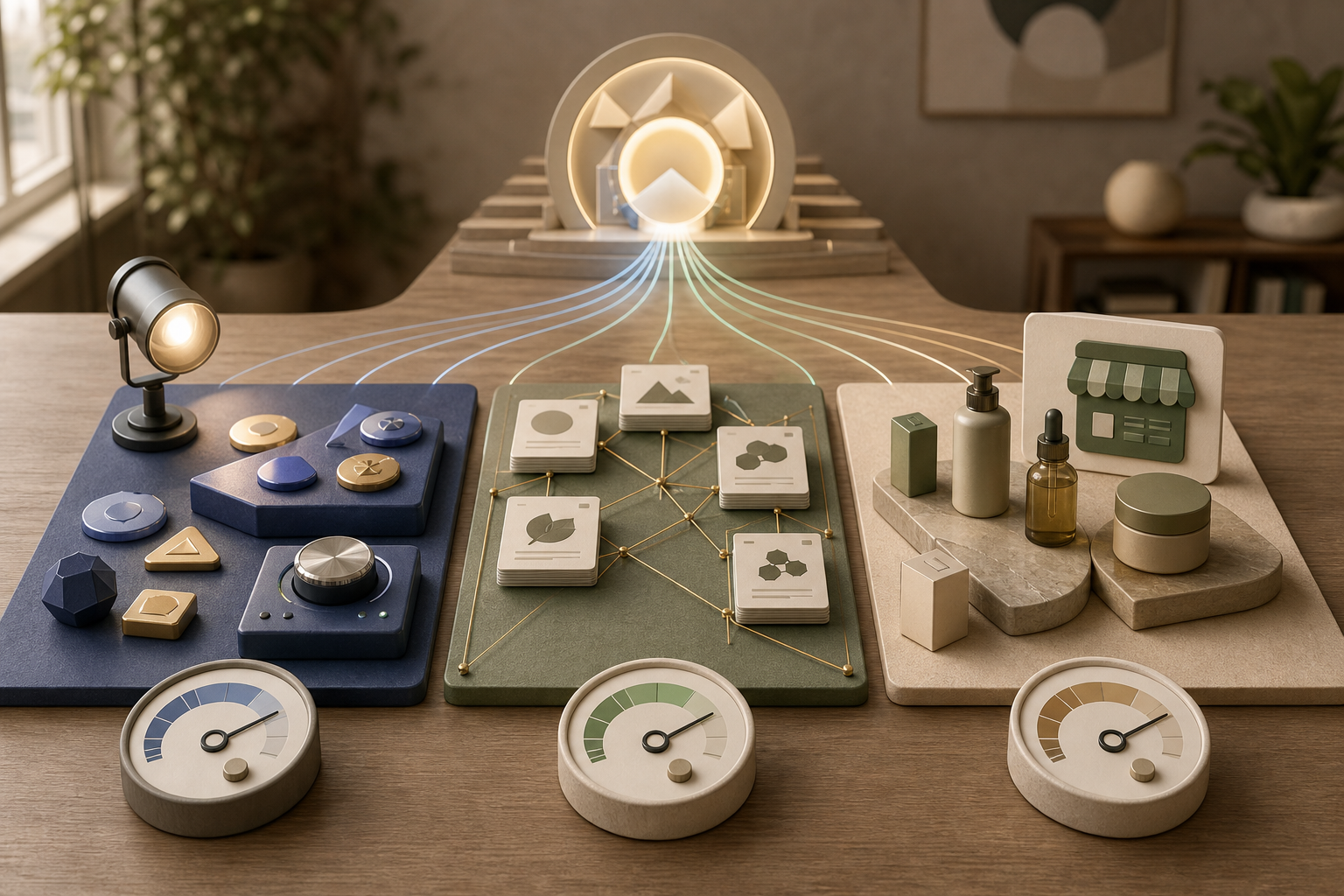
Organizations can respond by assigning each visibility layer a distinct job. Paid-search teams can evaluate AI Mode ads according to query economics, placement availability and conversion performance. SEO and content teams can monitor whether the brand’s pages are cited or ranked, then improve the relevance and usefulness of the pages intended to earn that exposure.
Local and commerce teams need a third workstream for Google-hosted information. Business hours, locations, photos and reviews can become part of the AI Mode experience through Google Business Profiles. Product specifications and compatibility information may surface through Product Knowledge Panels. Because those details can be encountered before the website, maintaining them is part of commercial presentation rather than a secondary listing task.
Reporting should preserve the same separation. A combined visibility score can conceal whether progress came from spending more, earning stronger source selection, improving organic rankings or maintaining a more complete Google-hosted profile. Channel-specific reporting makes it possible to connect each outcome to the team and investment responsible for it.
The next useful evidence will be longitudinal: whether ad incidence continues to rise, whether new formats change advertiser competition, and whether Google’s share of citations remains concentrated in its own local and product surfaces. Until those patterns are clearer, the sound approach is to manage AI Mode as a portfolio of paid, earned and platform-hosted visibility rather than as a single search position.
References
- CrushPress.AI – Google AI Mode Ads Now Reach Nearly 30% of Queries
- CrushPress.AI – Why Google Is Now AI Mode’s No. 2 Most-Cited Domain
Leave a Reply