
AI search has expanded far beyond just Google. I discovered that understanding where my brand appears across tools like ChatGPT, Claude, Gemini, and Perplexity is crucial.
Living in the era of generative engine optimization (GEO), tracking my brand’s AI presence has become essential. Without it, I’d be navigating blind.
The AI Search Revolution is Here
The shift is undeniable: 58% of people now use AI tools over traditional searches for product recommendations, and traditional search traffic might fall by 50% by 2028.
Unlike before, where ranking on search pages was key, AI searches like those on ChatGPT or Claude provide direct answers and cite fewer sources. It’s critical for my brand to be one of those sources.

Here’s where a GEO rank tracker proves invaluable. With tools like Geoptie’s free GEO Rank Tracker, I can see where my brand stands on these AI platforms.
What is a GEO Rank Tracker?
A GEO rank tracker evaluates my brand’s citations, recommendations, and mentions on AI search engines. Unlike traditional metrics, it offers insights into brand mention frequency, citation rates, share of voice, and cross-platform visibility.
With these insights, I can now optimize not for a list of results but for AI mentions and perceptions.
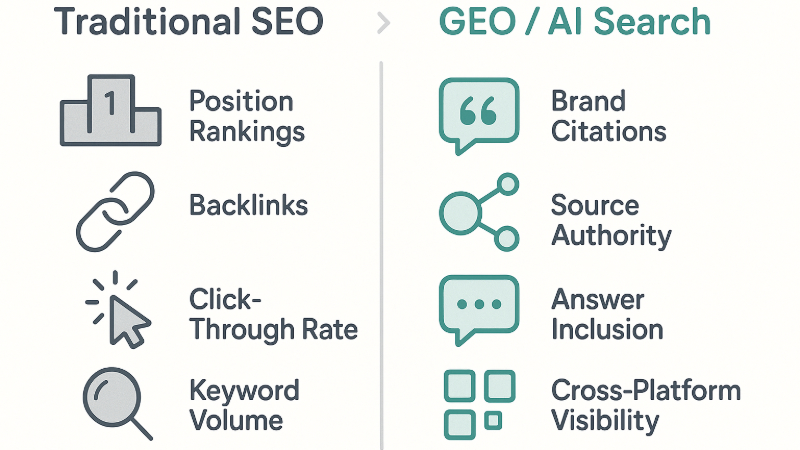
Why Traditional Rank Tracking Falls Short
Traditional tracking misses out on the unique ways AI engines operate, like using retrieval-augmented generation (RAG). It’s not just about being visible—it’s about being mentioned in AI responses.
Through GEO tracking, I realized that monitoring across all platforms ensures my brand isn’t just visible in one, but across many, ensuring wider reach.
Key Metrics Every GEO Rank Tracker Should Measure

When diving into AI search visibility, focusing on citation frequency, brand visibility score, AI share of voice, and sentiment is paramount. These metrics provide a comprehensive view of how my brand stands.
How to Track Your Brand’s AI Search Rankings
Embarking on GEO tracking involves identifying core prompts, monitoring multiple platforms, tracking by location, and benchmarking against competitors. I found starting with resources like Geoptie’s free GEO Rank Tracker simplified this process.
Interpreting Your GEO Rank Tracker Results

By analyzing my brand’s visibility data, I can see where to strengthen content, which platforms need more focus, and how to address any declines or gaps found.
From Tracking to Optimization: Building Your GEO Strategy
Data is just the beginning. By expanding my brand’s semantic footprint, increasing fact density, and building entity authority, I can turn insights into action for greater visibility.
The Cost of Ignoring GEO Tracking

Ignoring AI visibility means missing out on being discovered, falling behind competitors, and misallocating resources. It’s crucial to adapt to this shifting landscape.
Getting Started Today
Starting GEO tracking is easier than it seems. A simple first step is to use tools that provide an initial visibility snapshot and document the findings for strategic improvements.
The Future of AI Search Visibility
As AI search evolves, those who prioritize understanding and optimizing for AI visibility now will be better positioned in the future.
Key Takeaways
- GEO tools, like Geoptie, are essential for AI visibility.
- Understanding core metrics aids in effective optimization.
- AI search varies by platform, necessitating diverse monitoring.
- Insights from GEO metrics drive smarter, more effective strategies.
- Beginning with Geoptie’s free GEO Rank Tracker offers insights into finding and expanding AI visibility.
Inspired by this post on Search Engine Land.

Leave a Reply