If you sell firearm accessories in the United States, Google’s October opening may look like permission to switch on ads for an entire catalog. It isn’t. The opportunity is narrow, temporary, and bounded by both product classification and advertising surface.
Your first job is not writing ads. It is deciding which individual products can enter the pilot, separating them from everything that cannot, and building a campaign whose results will still make sense if Google changes course after six months.
Start with the policy boundary, not the media plan
Beginning in October 2026, Google plans to run a six-month pilot for certain firearm accessories on U.S. Search. Examples include bipods, sights, slings, mounts, and braces. The word “certain” matters: this is not blanket permission for every product sold under one of those labels.
| Dimension | Within the pilot | Outside the opening |
|---|---|---|
| Products | Certain bipods, sights, slings, mounts, braces, and similar eligible accessories | Firearms, ammunition, regulated firearm parts, and accessories requiring a permit or license or regulated under state or federal law |
| Advertising surface | Google Search | Google’s other advertising surfaces |
| Geography | United States | Other countries |
| Timing | A six-month test scheduled to begin in October 2026 | Permanent availability is not promised |
| Safety accessories | Products intended to increase firearm safety remain permitted | The pilot does not redefine their existing status |
Every prospective ad therefore has to pass two gates. The product must fit the limited accessory scope, and it must not fall into a prohibited regulatory category. A familiar retail category name does not settle the second question. The inclusion of braces among Google’s examples, for instance, does not override the separate exclusion for regulated products.
Advertising eligibility and legal permission are also different decisions. An ad approval does not establish that a product may be sold, shipped, or promoted in every jurisdiction you target. If a product’s legal classification is unclear, pause it and obtain advice from a lawyer familiar with the applicable firearm rules. Do not use Google’s review outcome as a substitute for that determination.
Turn the rule into a SKU-level eligibility register
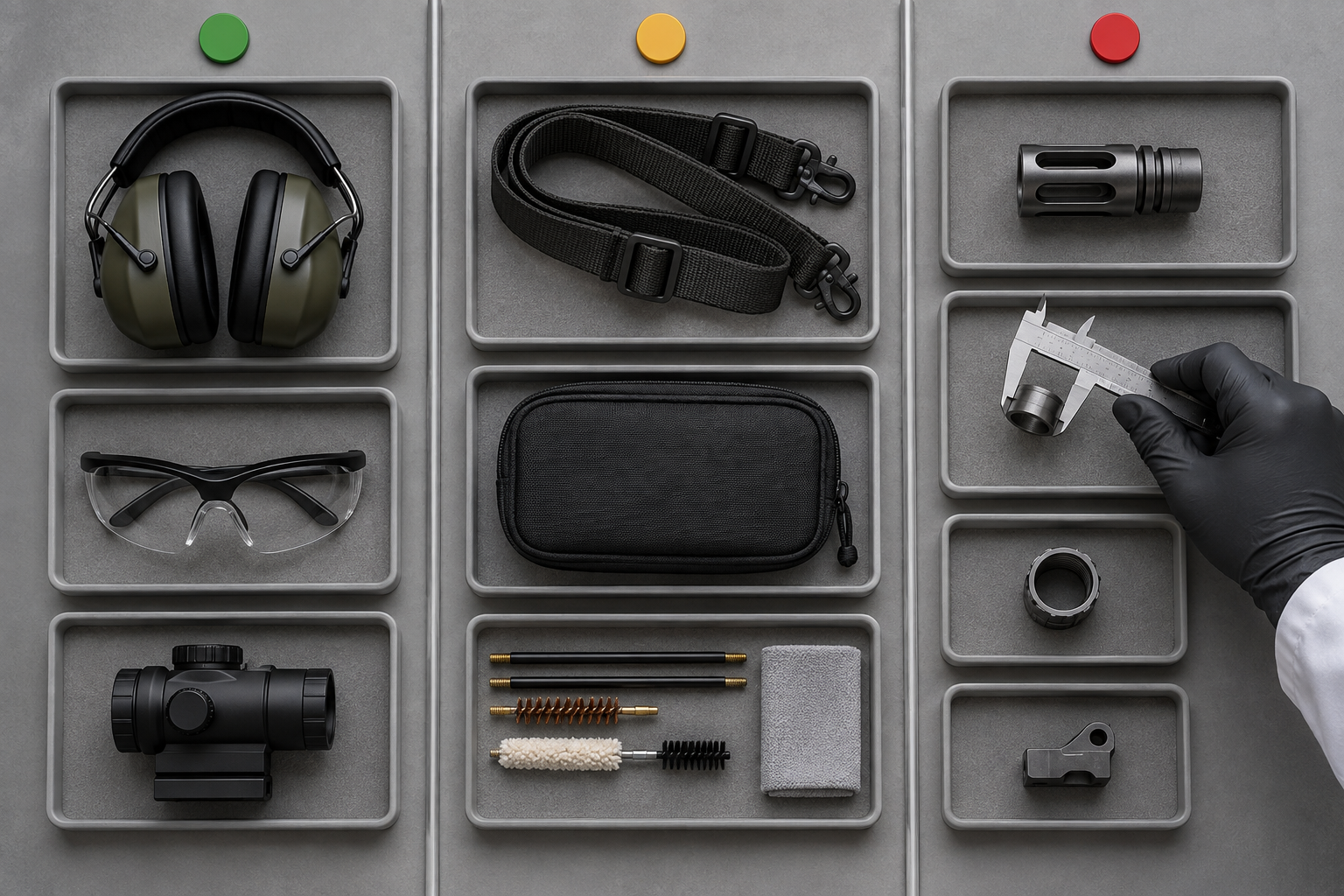
A merchant with a mixed catalog should not approve products by department, brand, or menu category. Build a register at the SKU or variant level. That makes the decision auditable and prevents one ambiguous product from quietly entering a feed, ad group, or landing-page collection intended for clearly eligible accessories.
- Export the candidate inventory. Record each SKU, variant, product title, product URL, accessory type, and the countries or jurisdictions where you intend to advertise it.
- Assign one of four statuses. Use “pilot candidate,” “already permitted safety accessory,” “prohibited,” or “needs review.” Keeping the safety category separate preserves a useful baseline because those products were allowed before the experiment.
- Document the reason. “It is a sight” is not enough. Record why the specific item fits the accessory category and whether a permit, license, or state or federal restriction applies. Attach the internal evidence used to reach that conclusion.
- Review every variant independently. Do not assume that products sharing a parent listing have the same eligibility. If a variant changes the product’s function or regulatory treatment, it needs its own decision.
- Inspect the destination. Send the click to a page where the promoted accessory is unmistakable. A broad category page dominated by firearms, ammunition, or uncertain products makes the scope of the promotion needlessly ambiguous.
- Name an owner and review date. Someone should be accountable for classification changes, disapprovals, and policy updates throughout the pilot. A spreadsheet that nobody maintains will become stale before the test ends.
Do not resolve uncertainty by choosing the most favorable label. Put the SKU in the review queue. The cost of delaying one questionable product is easier to contain than the legal, policy, and account consequences of promoting an ineligible one.
Build a campaign that can answer a six-month question

The useful question is not simply whether firearm accessory ads can generate sales. You need to learn which eligible product families and search intents acquire customers at an acceptable margin, without persistent classification or enforcement problems. Your account structure should make that answer visible.
- Create dedicated pilot campaigns. Do not fold the new products into a mixed campaign that also serves other countries, other advertising surfaces, or historically permitted safety accessories.
- Separate materially different accessory families. Bipods, sights, slings, mounts, and braces should not disappear into one reporting bucket. Different product types can carry different economics, search intent, and classification risk.
- Limit delivery to U.S. Search. The pilot’s permission does not extend to other countries or Google’s other ad inventory. Check the actual campaign configuration instead of assuming an existing campaign is suitably restricted.
- Keep keywords, ads, and destinations aligned. A sight query should lead to the exact sight or a tightly relevant sight collection. Avoid copy that implies the sale of a firearm, ammunition, or another prohibited product.
- Use negative keywords to block prohibited purchase intent. Review the actual queries that trigger ads and exclude terms seeking firearms, ammunition, regulated parts, or products outside your approved inventory.
- Apply an explicit budget ceiling. The program is an experiment, not a permanent channel. A separate budget protects the rest of your acquisition plan and makes the pilot’s incremental cost visible.
Track policy performance beside commercial performance. Your log should include the SKU submitted, decision, decision date, stated reason for any disapproval, changes made, and final status. Your business report should include spend, queries, clicks, conversions, revenue, gross margin, and acquisition cost at the product-family level. A campaign that produces orders but repeatedly exposes ambiguous inventory is not a clean success.
Establish a pre-pilot baseline for products that already receive organic, direct, referral, or permitted paid traffic. Keep previously allowed safety accessories in a separate cohort. Without those distinctions, a general rise in demand can look like pilot-generated growth, while the performance of established safety campaigns can be mistakenly credited to the new policy.
During the test, change one major layer at a time: targeting, ad message, destination, or offer. Record each change. Six months is long enough to learn, but short enough that an account-wide rewrite can erase the comparison you need when Google decides whether to continue the program.
Make the destination easy to classify and easy to buy from
The landing page has two jobs. It must help a buyer decide whether the accessory fits, and it must make the advertised product unambiguous. Clever language works against both goals.
- Name the product type plainly. Put the precise accessory name in the page title, primary heading, product description, and relevant metadata.
- State compatibility and incompatibility. Identify the models, dimensions, interfaces, or configurations the product does and does not support. Do not make the buyer infer fit from photos.
- List what the purchase contains. If a firearm, ammunition, regulated component, tool, or mounting part is not included, say so where a buyer will see it before checkout.
- Keep regulatory and shipping language specific. Do not use an unsupported claim such as “legal everywhere.” If availability varies, route the question through your approved legal and fulfillment process.
- Keep structured data consistent with the visible page. Product name, variant, price, availability, and offer details should agree across the page and its machine-readable markup. Schema can clarify a product; it cannot turn an ineligible product into an eligible one.
- Answer real pre-purchase questions. A short FAQ about fit, included hardware, installation requirements, dimensions, and returns can reduce uncertainty for buyers and make the page easier for search and answer systems to interpret.
Audit consistency across the ad, landing page, product feed if one is involved in your workflow, structured data, cart, and confirmation screen. A product described as a mount in the ad but given a vague tactical label on the page creates avoidable uncertainty. Use the most exact accurate name everywhere.
Do not build an approval-only page that conceals what the customer will encounter after the click. The sustainable version of this campaign is a transparent path from query to accessory to checkout, with the same product represented at each step.
Key takeaways for the pilot window
- The pilot covers certain firearm accessories, not complete accessory departments and not every item bearing an eligible category label.
- Firearms, ammunition, regulated firearm parts, and accessories that require a permit or license or are regulated under state or federal law remain outside the opening.
- Campaigns must be confined to Google Search in the United States; the permission does not extend to other Google advertising surfaces or other countries.
- Safety-focused accessories that were already permitted should be measured separately from products entering through the pilot.
- Eligibility should be decided at the SKU or variant level, with uncertain products held for legal and policy review.
- The program lasts six months, so measure both commercial results and policy friction while retaining a plan for continuation, modification, or shutdown.
This category also carries an audience-sensitivity issue that ordinary accessory reporting will not capture. People who do not want to encounter these ads can adjust their preferences through Google’s My Ad Center. Keep the message literal, product-specific, and proportionate. Attention-grabbing weapon language may attract the wrong query, create brand risk, and make an accessory promotion look broader than it is.
Do not make a permanent revenue forecast from temporary access. Google may expand, modify, or end the program after the six-month trial. Keep campaign assets, budgets, landing pages, and reporting separable enough that you can respond without disrupting the rest of the account.
Start with the eligibility register now. Launch only the SKUs you can defend, isolate the U.S. Search test, and let six months of clean product-level data determine whether this becomes a durable acquisition channel or a controlled experiment you can close without residue.
References

Leave a Reply