Hey there! If you’re anything like me, your backlog is overflowing, your developer is eager to know what to tackle first, and your boss is questioning why months of SEO work haven’t shown results. I’ve been stuck defending my roadmap with gut feelings, and it’s tough.
Without estimating the traffic impact of a fix before it’s live, it’s just a guess—and we both know guesses don’t cut it in budget meetings.
Let me share a framework I use to transform messy data into reliable estimates. It’s not perfect, but it’s solid enough to prioritize with confidence and explain my strategy in any meeting.
Why every recommendation can’t be high priority
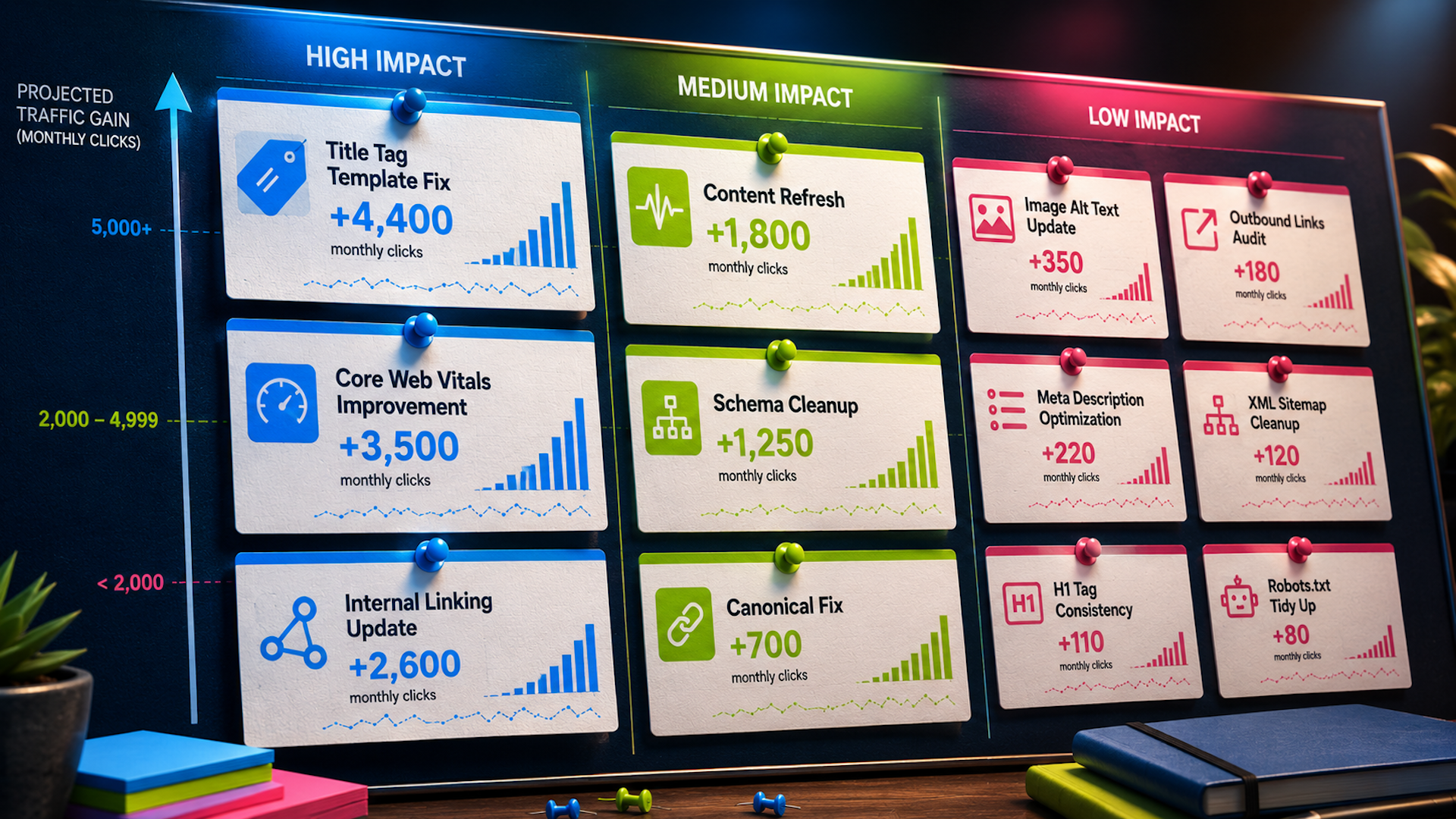
I’ve seen teams spend sprints on minor schema issues, ignoring a bigger problem—like a title tag bug affecting thousands of pages. Both were marked as “high priority,” but the traffic impact of one was negligible compared to the other.
Traffic guides true priority. While we can’t neglect brand visibility or UX, traffic offers a universal measure to compare efforts. Without quantified impact, you’re letting the loudest voice, or the most tempting technical puzzle, dictate your roadmap instead of focusing on what truly drives business value.
Plus, SERP landscapes have changed drastically. According to SparkToro, 68% of U.S. Google searches this year ended without a click, up significantly since just two years ago.
With AI Overviews intercepting traffic, the impact of a ranking improvement can vary wildly by SERP layout. Jumping to position three on a commercial keyword might be gold, but on an informational query dominated by AI? Not necessarily.
Your forecasts should account for these dynamics to avoid overpromising.
Step 1: Define the scope
Before making any estimates, I always define the scope. Is the adjustment sitewide, a template fix, or a single-page optimization? Each scenario changes the math.
Sitewide technical fixes
These encompass site speed, mobile usability, HTTPS migrations, and Core Web Vitals. They influence every page, but not uniformly. Address areas with pages on the borderline of failing tests first.
Template-level changes
Fixes like rewriting title tags can have a major impact, but it’s vital to focus where traffic truly exists. Product templates might garner the majority of clicks, while blogs might trail behind.
Individual page optimizations
Actions like updating meta descriptions can provide quick wins, but their small scale might not significantly impact the business. Focus on these without losing sight of larger opportunities.
Step 2: Calculate your current traffic exposure
To gauge traffic exposure, I turn to Google Search Console to pull essential data.

Organic clicks serve as a baseline. By filtering affected URLs and reviewing trends, I assess urgency and context.
Impressions and near-win rankings pinpoint real potential. Pages ranked 8-15 are ripe for improvements—push them higher for a CTR boost.
SERP features can greatly influence CTR. Using Search Console’s AI Mode data, I check for AI Overview dominance and adjust expectations.
Step 3: Estimate potential lift
Now, it’s time for educated estimation.
Your own history
When I’ve optimized similar pages before, I use those outcomes as future baselines. Keeping track of past projects builds a valuable benchmarking library.
Competitor benchmarks and SERP analysis
Review competitors and pinpoint their advantages, whether it’s content depth, UX, or backlinks. Aiming to close these gaps can justify a ranking gain.
AI-influenced CTR assumptions
Forecasting can falter without updated CTR assumptions. Seer’s research shows drastic CTR changes due to AI integration. Staying aware of these shifts is essential.
Step 4: Build three scenarios, not one number
One definitive forecast can be deceptive. I prefer building three—conservative, expected, and aggressive—to provide a range that reflects real possibilities.
In the conservative model, expect partial implementations and competition improvements. With the expected model, rely on solid historical benchmarks. The aggressive model accounts for perfect execution and fast indexing.
This comprehensive view guides stakeholders through potential outcomes, ensuring transparency and credibility.
Step 5: Use the forecast to build your roadmap
After forecasting, I compare traffic impact predictions to effort levels using frameworks like RICE. This demonstrates which initiatives offer the most value for the effort and helps align priorities with business goals.
A well-organized roadmap doesn’t just appeal to me but speaks clearly to everyone involved, highlighting efficiency and business impact.
Inspired by this post on Search Engine Land.

Leave a Reply