Tag: Traffic

  • Mastering SEO Fixes: Predict Traffic Impact with Confidence

    Mastering SEO Fixes: Predict Traffic Impact with Confidence

    Hey there! If you’re anything like me, your backlog is overflowing, your developer is eager to know what to tackle first, and your boss is questioning why months of SEO work haven’t shown results. I’ve been stuck defending my roadmap with gut feelings, and it’s tough.

    Without estimating the traffic impact of a fix before it’s live, it’s just a guess—and we both know guesses don’t cut it in budget meetings.

    Let me share a framework I use to transform messy data into reliable estimates. It’s not perfect, but it’s solid enough to prioritize with confidence and explain my strategy in any meeting.

    Why every recommendation can’t be high priority

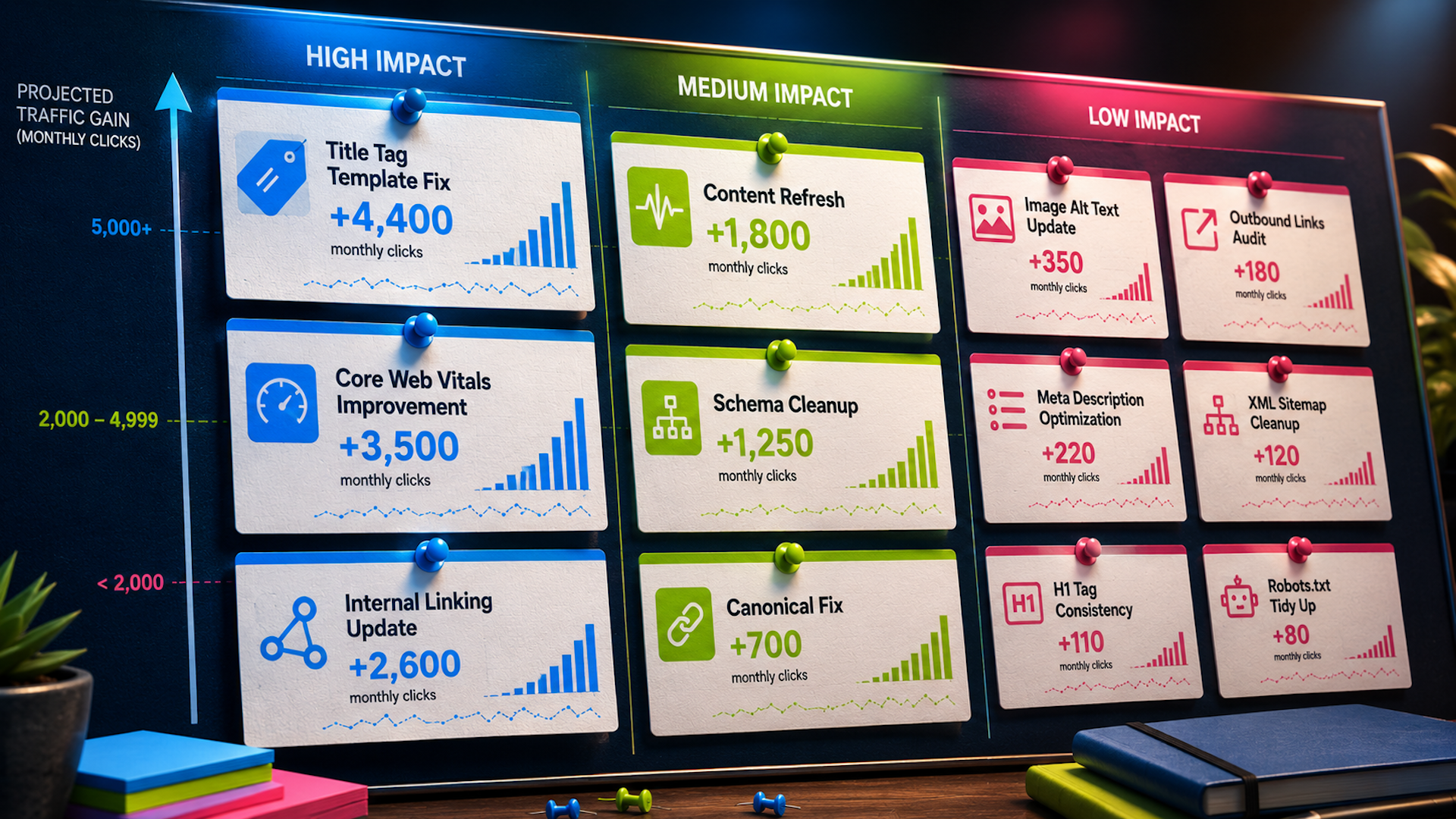
    I’ve seen teams spend sprints on minor schema issues, ignoring a bigger problem—like a title tag bug affecting thousands of pages. Both were marked as “high priority,” but the traffic impact of one was negligible compared to the other.

    Traffic guides true priority. While we can’t neglect brand visibility or UX, traffic offers a universal measure to compare efforts. Without quantified impact, you’re letting the loudest voice, or the most tempting technical puzzle, dictate your roadmap instead of focusing on what truly drives business value.

    Plus, SERP landscapes have changed drastically. According to SparkToro, 68% of U.S. Google searches this year ended without a click, up significantly since just two years ago.

    With AI Overviews intercepting traffic, the impact of a ranking improvement can vary wildly by SERP layout. Jumping to position three on a commercial keyword might be gold, but on an informational query dominated by AI? Not necessarily.

    Your forecasts should account for these dynamics to avoid overpromising.

    Step 1: Define the scope

    Before making any estimates, I always define the scope. Is the adjustment sitewide, a template fix, or a single-page optimization? Each scenario changes the math.

    Sitewide technical fixes

    These encompass site speed, mobile usability, HTTPS migrations, and Core Web Vitals. They influence every page, but not uniformly. Address areas with pages on the borderline of failing tests first.

    Template-level changes

    Fixes like rewriting title tags can have a major impact, but it’s vital to focus where traffic truly exists. Product templates might garner the majority of clicks, while blogs might trail behind.

    Individual page optimizations

    Actions like updating meta descriptions can provide quick wins, but their small scale might not significantly impact the business. Focus on these without losing sight of larger opportunities.

    Step 2: Calculate your current traffic exposure

    To gauge traffic exposure, I turn to Google Search Console to pull essential data.

    ```json
{
  "alt": "The CapmatchOne logo with a gradient circle and bold text.",
  "caption": "Discover innovation with the CapmatchOne logo, featuring sleek typography and a modern gradient circle.",
  "description": "The CapmatchOne logo features bold, modern typography coupled with a gradient circle, symbolizing connection and innovation. The sleek design conveys a sense of progress and creativity. This image can be used for branding or promotional purposes, appealing to audiences interested in innovative solutions and forward-thinking designs."
}
```

    Organic clicks serve as a baseline. By filtering affected URLs and reviewing trends, I assess urgency and context.

    Impressions and near-win rankings pinpoint real potential. Pages ranked 8-15 are ripe for improvements—push them higher for a CTR boost.

    SERP features can greatly influence CTR. Using Search Console’s AI Mode data, I check for AI Overview dominance and adjust expectations.

    Step 3: Estimate potential lift

    Now, it’s time for educated estimation.

    Your own history

    When I’ve optimized similar pages before, I use those outcomes as future baselines. Keeping track of past projects builds a valuable benchmarking library.

    Competitor benchmarks and SERP analysis

    Review competitors and pinpoint their advantages, whether it’s content depth, UX, or backlinks. Aiming to close these gaps can justify a ranking gain.

    AI-influenced CTR assumptions

    Forecasting can falter without updated CTR assumptions. Seer’s research shows drastic CTR changes due to AI integration. Staying aware of these shifts is essential.

    Step 4: Build three scenarios, not one number

    One definitive forecast can be deceptive. I prefer building three—conservative, expected, and aggressive—to provide a range that reflects real possibilities.

    In the conservative model, expect partial implementations and competition improvements. With the expected model, rely on solid historical benchmarks. The aggressive model accounts for perfect execution and fast indexing.

    This comprehensive view guides stakeholders through potential outcomes, ensuring transparency and credibility.

    Step 5: Use the forecast to build your roadmap

    After forecasting, I compare traffic impact predictions to effort levels using frameworks like RICE. This demonstrates which initiatives offer the most value for the effort and helps align priorities with business goals.

    A well-organized roadmap doesn’t just appeal to me but speaks clearly to everyone involved, highlighting efficiency and business impact.


    Inspired by this post on Search Engine Land.


    crushpress.ai community screenshot
  • Unveiling ChatGPT’s Traffic Path: Google’s Surprising Role

    Unveiling ChatGPT’s Traffic Path: Google’s Surprising Role

    I recently came across an intriguing Semrush study that revealed some fascinating insights into ChatGPT’s traffic patterns. Despite a whopping 206% increase in referrals, surprisingly few sites actually see significant traffic. This is largely because many queries are backed by pre-trained knowledge rather than live web searches.

    According to the study, over 30% of outbound clicks go to just 10 domains. Google alone claims more than 20% of these clicks. It’s intriguing to see how much weight the tech giant holds in this landscape.

    ChatGPT is gradually leaning less towards live web searches. It only triggers search functions in 34.5% of queries now, a decline from 46% in late 2024. This shift indicates a change in how the platform’s role is evolving in navigating the web.

    Let me break it down further. Although ChatGPT’s referral traffic saw a significant rise, the traffic mainly flows towards a limited number of sites. In fact, about 21.6% of this traffic heads straight to Google, followed by nine other domains that make up a total of just over 30%.

    Many other websites are left with a small fraction of residual traffic. The number of domains receiving any referrals peaked at around 260,000 in 2025 but has since settled near 170,000.

    Why is this important for us? The visibility on ChatGPT doesn’t always translate directly into traffic. Often, the impact of referrals may seem marginal. Plus, the decline in search-triggered queries makes securing citations and traffic even more challenging.

    While ChatGPT defaults to pre-trained knowledge, it resorts to web searches in certain scenarios, like when users request sources, inquire about current events, or when the model shows uncertainty.

    I’ve noticed a shift in user behavior—most ChatGPT prompts don’t mirror typical search queries. Instead, between 65% and 85% reflect complex, conversational inputs, indicating a transformation in engagement. Interestingly, the number of queries per session jumped 50% in late 2025.

    Looking into the data, Semrush analyzed over a billion lines of U.S. clickstream data between October 2024 and February 2026. This analysis tracked prompts, referral destinations, and patterns in search usage.

    For those interested, more detailed insights can be found in the ChatGPT traffic analysis. The study, titled “ChatGPT traffic analysis: Insights from 17 months of clickstream data,” is an enlightening read.


    Inspired by this post on Search Engine Land.


    crushpress.ai community screenshot
  • Explosive Growth: Automated Traffic Surpassing Human Activity

    Explosive Growth: Automated Traffic Surpassing Human Activity

    I recently came across an intriguing report by HUMAN Security revealing a seismic shift in internet traffic dynamics. Automated traffic is accelerating at a staggering rate, outpacing human traffic growth by eightfold. Machines aren’t just passively scrolling; they’re actively engaging online!

    In 2025, automated traffic surged by 23.5% compared to the previous year, while human traffic increased by a mere 3.1%. This data, outlined in the State of AI Traffic report, paints a compelling picture of our digital evolution.

    AI-driven traffic is spearheading this transformation, with its monthly volume skyrocketing by 187% year over year. Notably, AI agents and agentic browsers, such as OpenAI’s Atlas and Perplexity’s Comet, experienced an astonishing growth of nearly 8,000%!

    As defined in the report, automated traffic encompasses all internet activity generated by software systems rather than humans. This includes classic automation like search engine crawlers and monitoring bots, as well as more sophisticated AI-driven traffic.

    Matthew Prince, Cloudflare’s CEO, foresaw this trend, predicting that bots might overtake human web usage by 2027. A bold forecast, but one that seems increasingly plausible.

    Why we care. The landscape of search is evolving beyond mere human interaction. AI agents now delve into discovery, comparisons, and transactions, dynamically influencing Google’s evolving results and other AI-powered interfaces.

    The details. HUMAN categorizes AI-driven traffic into three main types:

    1. Training crawlers, which still dominate AI traffic at 67.5%, though their lead is waning as scrapers and agents gain traction.

    2. Real-time scrapers, which are essential for AI searches and live answer engines, boosted by nearly 600% in 2025.

    3. Agentic AI systems, which autonomously execute tasks, are smaller in share but growing rapidly and proving to be highly disruptive.

    AI agents behave more like users. These systems are becoming more sophisticated, engaging in navigation, logging in, and conducting transactions. In 2025:

    – 77% of agentic activity was observed on product and search pages.

    – Close to 9% involved account-level interactions.

    – Over 2% reached checkout processes.

    About the data. HUMAN examined over a quadrillion interactions from 2022 to 2025, using aggregated, anonymized data from its customers. The report classified AI-driven traffic into three categories using user-agent strings, infrastructure signals, and activity characteristics. However, self-reported bot identities may not fully capture AI-driven activity.

    Bottom line. The digital world is shifting from being solely human-focused. Discovery is no longer restricted to search engines. Optimizing content now involves deciding which machines can access and act upon it.

    The report. For deeper insights, you can check out the 2026 State of AI Traffic & Cyberthreat Benchmark Report.


    Inspired by this post on Search Engine Land.


    crushpress.ai community screenshot
  • Unlock Insights with Google’s New Branded Queries Filter

    Unlock Insights with Google’s New Branded Queries Filter

    I recently discovered a fantastic update from Google Search Console that’s now available for all eligible sites. This new feature shows exactly how much traffic comes from branded versus non-branded search queries, and I couldn’t wait to explore its potential.

    Google’s branded queries filter, which was announced on November 20, allows us to separate branded and non-branded search traffic in the Performance report. This is a game-changer for anyone who’s struggled with manual regex filters or keyword lists to achieve similar results.

    Why I care. As someone deeply invested in understanding brand demand versus discovery traffic, this new native segmentation in Search Console makes life so much easier. Finally, I can accurately measure and compare these insights.

    What Google announced. Today, Google confirmed through a LinkedIn post that this branded queries filter is accessible to us all. It helps analyze the queries driving traffic by autofiltering between branded and non-branded ones.

    Exploring the details. This filter can be found in the Search results Performance report and allows queries to be segmented into two main groups:

    Branded: These queries include our brand name, its variations, any misspellings, and brand-related products and services.

    Non-branded: This group covers all other types of queries.

    When applying the filter, Search Console restricts metrics like impressions, clicks, CTR, and average position, focusing solely on the selected group. The filter works across all search types including Web, Image, Video, and News.

    Notable insights. Google also enriched the Insights report with a new card that breaks down clicks between branded and non-branded traffic, providing a clearer picture of brand recognition.

    As Google explained, this feature helps us measure the traffic from users already familiar with our brand compared to those discovering it for the first time.

    Understanding Google’s classification. Google employs an AI-driven system to classify queries as branded. This system can adeptly recognize brand names in various languages, handle misspellings or variations, and detect queries that mention unique brand products or services.

    There might be occasional misclassifications due to the contextual nature of brand detection, and Google clarifies that this filter doesn’t impact search rankings.

    Keeping an eye out. With today’s announcement, this feature is supposedly available for all eligible sites. However, some sites might not qualify yet due to specific query and impression volume requirements.


    Inspired by this post on Search Engine Land.


    crushpress.ai community screenshot
  • Why SaaS AI Traffic Declined by 53%: Insights and Lessons

    Why SaaS AI Traffic Declined by 53%: Insights and Lessons

    I recently discovered some fascinating insights into what’s really behind the 53% drop in SaaS AI traffic. It turns out, AI traffic isn’t actually collapsing—it’s just becoming more focused. While Copilot experiences a surge in in-workflow engagement, a significant 41% lands on search pages, all influenced by the ebbs and flows of Q4 budget cycles.

    As the SaaS market navigates a downturn, driven largely by the emergence of autonomous AI agents like Claude Cowork, new data reveals a substantial 53% decline in AI-driven discovery sessions. This phenomenon has been dramatically labeled the “SaaSpocalypse” by Wall Street.

    The overarching question of whether AI agents will eventually replace SaaS products looms larger than what this particular dataset can resolve. However, amidst the panic, the data offers clarity for SEO teams, highlighting key areas they should be monitoring closely.

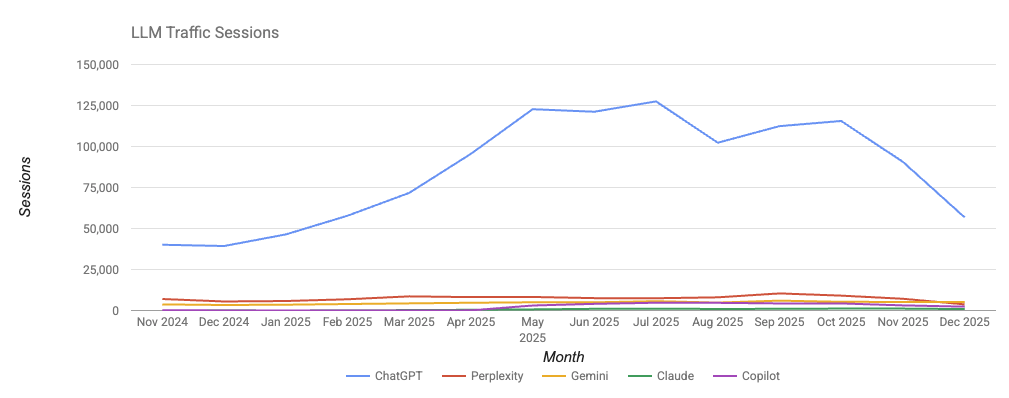
    Between November 2024 and December 2025, the SaaS sector experienced 774,331 sessions driven by large language models (LLM). Interestingly, ChatGPT was responsible for 82.3% of this traffic, yet Copilot’s remarkable growth tells a unique story.

    Copilot started with a modest 148 sessions at the close of 2024, only to expand more than twentyfold by May 2025. From there, it averaged 3,822 sessions monthly from June through December, emerging as the second biggest AI referrer by year-end 2025.

    This data indicates that while investor sentiment wiped out $300 billion from SaaS market caps over concerns about AI replacing enterprise software, the real driver of change is occupancy in the workflow. Copilot is flourishing because it seizes the moment of intent within a given task. By comparison, standalone AI tools suffered a steep 53% traffic drop, while workflow-embedded AI solutions saw an exponential 20x growth.

    ```json
{
  "alt": "Line graph showing LLM traffic sessions from November 2024 to December 2025 for ChatGPT, Perplexity, Gemini, Claude, and Copilot.",
  "caption": "Exploring AI Trends: LLM Traffic Sessions from Nov 2024 to Dec 2025. Observe the rise and fall in ChatGPT usage, the leading model, among others.",
  "description": "This line graph illustrates the traffic sessions of various LLMs, including ChatGPT, Perplexity, Gemini, Claude, and Copilot, from November 2024 to December 2025. ChatGPT shows a significant upward trend, peaking mid-2025 before a decline. The Y-axis represents sessions, and the X-axis covers months from November 2024 to December 2025. Each line color corresponds to a different LLM for easy differentiation, providing insights into the popularity and usage patterns."
}
```

    AI-led SaaS discovery predominantly directs users to internal search pages rather than directly to product or pricing pages. Over 320,615 sessions were directed to search results—surpassing blogs, pricing, and even product pages—reflecting potential LLM shortcomings rather than content superiority. Essentially, when LLMs lack direct answers, they lean on internal search as a fallback.

    This scenario isn’t detrimental but points to a crawlability issue that can be rectified; it underscores the importance of well-structured, indexable search pages. Smart design strategies can ensure that your internal search feature becomes an effective API for AI agents.

    Seasonal work cycles also play a role. SaaS AI traffic hits its zenith in July, attributable to active work cycles and available Q3 budgets, before waning through Q4 due to holiday pauses and budget limitations, following typical B2B purchase patterns.

    For SEO teams out there, it’s crucial to concentrate efforts not merely based on traffic numbers but on penetration rates and landing page relevance. Consider tracking AI traffic by page type, ensuring indexability of search results, and structuring both pricing and blog content to be LLM-friendly by making crucial data visible and accessible.

    In essence, AI discovery is here to stay, but to thrive in this evolving landscape, SaaS companies must enhance their visibility. Those who invest in transparent, crawlable, and comparison-centric content now are setting themselves apart in a competitive space.


    Inspired by this post on Search Engine Land.


    crushpress.ai community screenshot
  • Is Organic Search Truly Declining? An In-Depth Analysis

    Is Organic Search Truly Declining? An In-Depth Analysis

    Organic search traffic down

    I recently came across some fascinating data regarding organic search traffic trends, and I can’t wait to share it with you. Contrary to some alarming reports, organic search traffic has only dipped by 2.5% year over year, far from the drastic declines we often hear about, ranging from 25% to 60%. This significant insight comes from a comprehensive study conducted by Graphite using Similarweb data from a plethora of the largest U.S. websites.

    This revelation certainly questions the exaggerated claims that the rise of AI tools, like ChatGPT, is rapidly taking over traditional search methods and rendering SEO obsolete.

    What’s really happening? Many have suggested through surveys and anecdotes that organic traffic is crumbling, with large language models diverting user searches away from traditional search engines. However, the data collected by Graphite tells a different and more reassuring story.

    In their study, Graphite utilized Similarweb’s visit data to analyze organic search traffic from the top 40,000 U.S. sites over periods from February to December 2024 and January to November 2025. The findings revealed a minor decrease rather than a major disruption.

    Google’s stance aligns with these findings as well. The company stated in August 2025 that organic click volumes were largely stable year over year.

    By the numbers. Traffic patterns differ significantly by the size of the sites. The largest sites, ranking within the top 10, witnessed a 1.6% increase in organic traffic. Mid-sized publishers, particularly those ranked between the top 100 and 10,000, faced more noticeable declines.

    • Organic SEO traffic: -2.5% YoY
    • Search engine traffic overall (2025): +0.4%
    • Google traffic (2025): +0.8%
    • Organic vs. paid clicks: ~90% organic, ~10% ads
    • AI Overview CTR impact: -35% when present
    • AI Overview prevalence: ~30% of SERPs

    AI Overviews: Impact but not devastation. While AI Overviews do affect click-through rates when they occur, their presence isn’t as widespread as often presumed.

    • AI Overviews are featured in roughly 30% of search queries, predominantly informational ones.
    • Commercial and transactional search terms are notably less impacted.

    Google ads aren’t “stealing” organic clicks. There’s a growing belief that Google is redirecting organic traffic towards its paid ads. However, data suggests only a slight shift.

    • The percentage of clicks on ads increased by about two points.
    • Despite this, organic results still garner nearly ten times more clicks than paid ads do.

    Why this matters. SEO remains an immensely valuable channel. While AI is transforming the presentation and user interaction with search results, the demand for search isn’t disappearing. What’s evolving is SEO itself, with more SERP features, AI-driven answers, and heightened competition for fewer clicks, particularly on informational queries. Now more than ever, effective strategy is crucial.

    About the data. This analysis is grounded in Similarweb traffic estimates for over 40,000 of the largest U.S. sites, utilizing a blend of opt-in user panels, ISP and mobile carrier data, public web signals, and direct site measurements. For accuracy, Graphite compared Similarweb’s trends with first-party data from Google Search Console and Google Analytics across various websites, discovering a median correlation of 0.86.

    Curious about the complete analysis? Check out Debunking The Myth That Search Is Dying


    Inspired by this post on Search Engine Land.

    crushpress.ai community screenshot
  • AI Search Boom: Insights from the 2025-2026 Traffic Report

    AI Search Boom: Insights from the 2025-2026 Traffic Report

    I recently came across some exciting data about AI search traffic, and I wanted to share it with you. AI-related searches are booming, with a whopping 900 million weekly users turning to ChatGPT. Meanwhile, Gemini isn’t far behind with 650 million users.

    The explosive growth in AI search usage is not just a trend; it’s a significant transformation in how we interact with technology. To get a clearer picture, you can dive into the complete AI search traffic data breakdown, illuminating the shifts and spikes in user engagement.

    Reflecting on these numbers, I can’t help but wonder about the future of AI and how it will continue to influence our digital landscapes. As we move into 2025 and 2026, AI’s role in search will be more pivotal than ever.


    Inspired by this post on genmark.ai Blog.


    crushpress.ai community screenshot
  • Maximize Affiliate Traffic: Explore Beyond Google Search

    Maximize Affiliate Traffic: Explore Beyond Google Search

    As organic search from Google dwindles, I’ve discovered numerous avenues for driving traffic to affiliate sites by leveraging communities, courses, and partnerships.

    Google’s AI Overviews often display affiliate content without providing traffic or clicks back to publishers. Fortunately, we don’t need to rely solely on Google to drive our success.

    With a new year upon us, I’ve been exploring diverse sources of traffic and identifying new methods to diversify income. It’s crucial to stick to what we do best while expanding our reach.

    The strategies I share here are ones I regularly apply with partners and have seen them succeed time and again.

    This discussion stems from a podcast where I questioned if affiliate marketing was at its end. Fortunately, it’s far from it. Affiliate marketing reaches far beyond Google, continuing to thrive as a vital industry.

    Skool and Educational Platforms

    Platforms like Skool offer possibilities to launch a course or nurture a community with multiple features, including text, video, newsletters, and interactivity.

    These platforms stand out due to their focus on creators and educators, quickly gaining market share. They empower us to monetize creatively and offer the flexibility to cultivate a community and brand.

    Imagine crafting courses on topics ranging from starting a photography business to cooking classes. We dictate if and when courses are free or paid, and tailor the content our students receive.

    What’s especially advantageous is the integration of affiliate links and an email system, both designed to convert free trials or foster ongoing engagement with students.

    Platforms like these support virtually any niche. Whether in credit repair, skill learning, or business startups, they provide us with tools to succeed.

    Data from Semrush as of December 27, 2025, reveals around 110,000 monthly branded searches, with 33,000 directed to the login page. This suggests a robust user base available for those like us eager to grow our courses.

    Dig deeper: How AI answers are disrupting publisher revenue and advertising

    Discord, Reddit, Medium, and Streaming Communities

    With platforms like Reddit gaining popularity, many affiliates are using them to target high-volume queries unreachable through traditional blogs.

    By engaging these communities and driving members to our platforms, we establish brand trust and reach a broader audience.

    Several strategies are powering our growth:

    • We tap into high search-volume queries via affiliate links, ensuring proper advertising disclosure.
    • Funnel community members to email and SMS lists
    • Share solutions and embed affiliate links in the content
    • Run banner ads within forums, as allowed by communities such as Reddit
    • Create a thriving community around our existing blogs or social channels, boosting brand awareness
    • Host AMAs or interviews to boost exposure and cultivate trust with community members

    Dig deeper: A smarter Reddit strategy for organic and AI search visibility

    Going Offline with QR Codes, Coupons, and Email

    I’ve noticed a resurgence in offline advertising within affiliate channels, offering opportunities to engage audiences in unique ways.

    ```json
{
  "alt": "SEO keyword performance table showing positions and volumes for 'skool' and 'skool login'.",
  "caption": "Explore the top-ranking keywords 'skool' and 'skool login' with impressive search volumes, revealing online popularity trends.",
  "description": "A table displaying SEO performance metrics for keywords 'skool' and 'skool login'. Both terms rank in position 1 with search volumes of 110K and 33.1K respectively. Intent labels 'N' for navigational and 'T' for transactional are indicated. This data is crucial for understanding search trends and optimizing digital marketing strategies."
}
```

    Beyond traditional approaches like TV ads, I’ve seen affiliates leverage QR codes in retail environments or on physical flyers—even if I was too rushed to scan them myself!

    Experts and speakers we meet at workshops often integrate affiliate links into their presentations. By placing links on business cards, they earn from recommendations they would make regardless.

    Get the newsletter search marketers rely on.

    MktoForms2.loadForm(“https://app-sj02.marketo.com”, “727-ZQE-044”, 16298, function(form) { // form.onSubmit(function(){ }); // form.onSuccess(function (values, followUpUrl) { }); });

    I’ve thought about the potential of placing QR codes on T-shirts—imagine the possibilities in high-traffic areas! Curious passersby could find themselves exploring products or content they weren’t expecting.

    This tactic could lead to impulse buys, jokes of the day, or even popular travel app promotions. The creative offline opportunities are boundless.

    Dig deeper: The best affiliate networks by need and use case

    Partner Portals

    It’s exciting to see brands returning to the affiliate channel by investing in perks and partner portals.

    By linking with complementary companies via these portals, brands are referring users while collecting commissions.

    Partnership portals help us find valuable co-marketing partners for email campaigns, social media posts, and more.

    • Banks are promoting insurance and web hosting services.
    • Web hosts suggest LLC formations alongside essential legal documents like privacy policies.
    • Food brands are highlighting kitchen tools and accessories.

    Affiliates also coordinate with brands to market software or cashback platforms on post-purchase thank-you pages. When we have access to a shopper within a brand’s cart, it’s golden.

    Dig deeper: How amplifying creator content strengthens trust and lowers media costs

    So, how does this drive traffic? By featuring each other in partner portals, we cross-promote and amplify our collective reach. Collaborate with a partner to create a complementary course or service and be bold in suggesting an inclusion within its portal.

    Acting as niche experts, we add incredible value, particularly when supporting upsells that a brand struggles to convert. This collaboration can convert enthusiastic audiences.

    Through this synergy, brands capitalize on our credibility, ultimately reaping higher-value customers without navigating conversion issues alone.

    When Search Sends Fewer Clicks, Creativity Matters

    There’s ample opportunity within traditional platforms like social media and SEO, yet creativity is king when search engines fail to deliver clicks.

    Challenge yourself to discover where you can generate traffic and route those users to your affiliate links. The only limits are those imposed by your imagination.


    Inspired by this post on Search Engine Land.


    crushpress.ai community screenshot
  • Social Media Overtakes SEO as SMBs’ Leading Traffic Source

    Social Media Overtakes SEO as SMBs’ Leading Traffic Source

    I’ve discovered that social media is now a more significant driver of traffic to small and medium-sized businesses than search engines. This shift has also made us aware of the growing importance of AI in our referral tracking. Many of us, including myself, see our competitors appearing in AI summaries as a potential threat. This insight comes from the latest survey data shared by WordStream by LocaliQ.

    Why this matters to me. As a small business owner, these AI summaries are becoming an essential part of my strategy. They play a crucial role in influencing buyers’ initial decisions, and there’s a clear opportunity to steer them toward my products instead of competitors’. The AI referrals are also trackable, pushing me to optimize for these new channels.

    The decline in Google traffic. About 40% of us SMBs have noticed a loss in traffic due to recent Google updates and AI-driven search adjustments. Larger companies among us have felt this impact most, with almost half admitting to seeing declines. Yet, a significant portion of us (72%) still believe in the effectiveness of our SEO efforts.

    Social media leads the way. An impressive 64% of us list social media as our main traffic driver, surpassing organic search, which stands at 52%.

    • Solo entrepreneurs and small businesses like mine found social media to be the top source of traffic.
    • Interestingly, 35% of businesses without websites find that social channels and marketplaces bring in enough leads to forego having a website.

    AI’s growing influence. Though AI search isn’t yet the top traffic source, it’s certainly on my radar and that of fellow SMBs:

    • Half of us monitor AI referrals and mentions.
    • Among the larger SMBs, this number climbs to 70%.
    • There’s a rising awareness of Generative Engine Optimization (GEO) across businesses of various sizes.

    The greatest frustration for me, and many others, is when competitors appear in AI summaries over our businesses. However, there’s an upside: these AI models pull from sources beyond Google’s typical top search results, presenting a rare chance for visibility.

    Importance of key webpages. For those of us tracking AI-driven traffic, the most important pages are:

    • Homepages (57% of us rely heavily on these)
    • Product or service pages (48% highlight these)
    • Contact pages (34% consider these crucial)

    Our adaptation strategies. In my quest to boost AI visibility, I’ve noticed that the top strategies align with SEO basics:

    • Using clear, descriptive headlines (35% of us are doing this)
    • Improving readability (a focus for 26%)
    • Addressing technical factors like speed and mobile performance (24% are prioritizing this)
    • Larger SMBs focus on building external brand mentions (33%) and adding structured data (30%)

    About this data. This insight comes from a WordStream by LocaliQ survey, conducted with over 300 U.S. small businesses in 24 industries. It includes responses from various business sizes, from sole proprietors to companies with up to 100 employees.

    The full report. You can explore the complete findings in The Big SMB Website Trends Report: SEO, GEO, & the Future of Traffic.


    Inspired by this post on Search Engine Land.


    crushpress.ai community screenshot