
I recently discovered some fascinating insights into what’s really behind the 53% drop in SaaS AI traffic. It turns out, AI traffic isn’t actually collapsing—it’s just becoming more focused. While Copilot experiences a surge in in-workflow engagement, a significant 41% lands on search pages, all influenced by the ebbs and flows of Q4 budget cycles.
As the SaaS market navigates a downturn, driven largely by the emergence of autonomous AI agents like Claude Cowork, new data reveals a substantial 53% decline in AI-driven discovery sessions. This phenomenon has been dramatically labeled the “SaaSpocalypse” by Wall Street.
The overarching question of whether AI agents will eventually replace SaaS products looms larger than what this particular dataset can resolve. However, amidst the panic, the data offers clarity for SEO teams, highlighting key areas they should be monitoring closely.
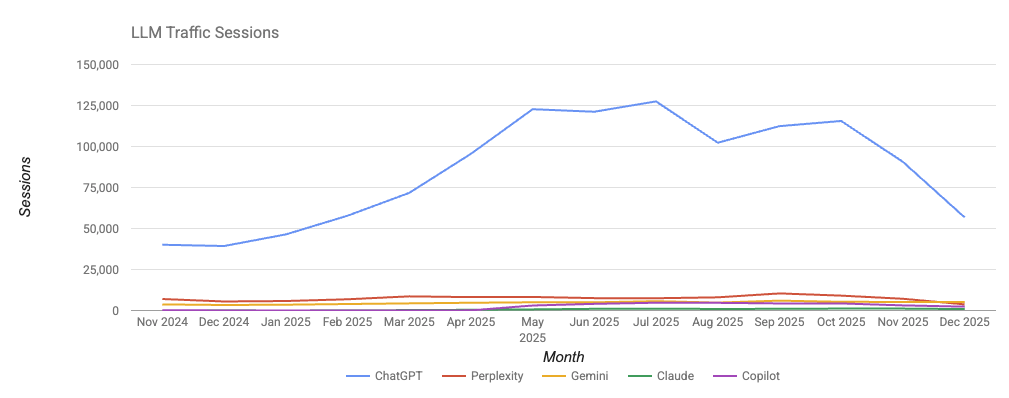
Between November 2024 and December 2025, the SaaS sector experienced 774,331 sessions driven by large language models (LLM). Interestingly, ChatGPT was responsible for 82.3% of this traffic, yet Copilot’s remarkable growth tells a unique story.
Copilot started with a modest 148 sessions at the close of 2024, only to expand more than twentyfold by May 2025. From there, it averaged 3,822 sessions monthly from June through December, emerging as the second biggest AI referrer by year-end 2025.
This data indicates that while investor sentiment wiped out $300 billion from SaaS market caps over concerns about AI replacing enterprise software, the real driver of change is occupancy in the workflow. Copilot is flourishing because it seizes the moment of intent within a given task. By comparison, standalone AI tools suffered a steep 53% traffic drop, while workflow-embedded AI solutions saw an exponential 20x growth.
AI-led SaaS discovery predominantly directs users to internal search pages rather than directly to product or pricing pages. Over 320,615 sessions were directed to search results—surpassing blogs, pricing, and even product pages—reflecting potential LLM shortcomings rather than content superiority. Essentially, when LLMs lack direct answers, they lean on internal search as a fallback.
This scenario isn’t detrimental but points to a crawlability issue that can be rectified; it underscores the importance of well-structured, indexable search pages. Smart design strategies can ensure that your internal search feature becomes an effective API for AI agents.
Seasonal work cycles also play a role. SaaS AI traffic hits its zenith in July, attributable to active work cycles and available Q3 budgets, before waning through Q4 due to holiday pauses and budget limitations, following typical B2B purchase patterns.
For SEO teams out there, it’s crucial to concentrate efforts not merely based on traffic numbers but on penetration rates and landing page relevance. Consider tracking AI traffic by page type, ensuring indexability of search results, and structuring both pricing and blog content to be LLM-friendly by making crucial data visible and accessible.
In essence, AI discovery is here to stay, but to thrive in this evolving landscape, SaaS companies must enhance their visibility. Those who invest in transparent, crawlable, and comparison-centric content now are setting themselves apart in a competitive space.
Inspired by this post on Search Engine Land.

Leave a Reply