
Tag: Copilot

  • Get More From Microsoft Advertising With AI Signals

    Get More From Microsoft Advertising With AI Signals

    How to get more from Microsoft Advertising than a campaign import

    When I see Microsoft Advertising campaigns struggle to scale, the issue is often not the platform itself. It is usually that the account is being treated as a copy of a strategy built somewhere else.

    Importing campaigns can get me live quickly, but it is only the beginning. Real performance comes when I add human judgment, Microsoft-specific structure, clean measurement, business-specific controls, and enough creative assets to help AI understand what I am actually selling.

    The strongest accounts I see have a shared pattern: import is the starting point, visual creative opens more demand, and AI works best when I give it the right structure, signals, measurement, and guardrails.

    Here is how I approach Microsoft Advertising when I want more than a simple campaign import.

    Note: I’m a Microsoft employee, and I have written this as objectively as possible. I have also included community-sourced hidden gems where they help highlight useful features.

    1. I start with import, but I do not stop there

    Import is useful because it removes friction. It can bring over campaign structure, assets, and settings from Google, Meta, or Pinterest so I can launch faster. The mistake is assuming that a successful import means the Microsoft Advertising strategy is finished.

    Imported campaigns often preserve yesterday’s assumptions. I still need to make Microsoft-specific decisions about budget, bidding, audiences, creative, measurement, reporting, and AI-powered opportunities.

    Decide whether sync helps or holds the account back

    One of the first choices I review is whether future changes from the source platform should keep syncing into Microsoft Advertising. If I only want to mirror another platform, automatic sync can reduce maintenance. If I want to build a Microsoft-specific strategy, automatic sync can quietly overwrite the optimizations I make after launch.

    To see the full list of import settings, I go to Manual import > Advanced settings. From there, I review which settings should stay, which should change, and which Microsoft-specific opportunities were never part of the original structure.

    Review budgets, bids, currency, and Microsoft-only options

    Imported budgets may not match the opportunity or efficiency available in Microsoft Advertising, especially when I can consolidate campaigns and use ad-group-level controls instead.

    Imported bids can also carry assumptions from another platform. I want Microsoft Advertising to have room to optimize for its own auction dynamics, audiences, and conversion data.

    Screenshot of a LinkedIn post by Hana Kobzová praising LinkedIn Profile Targeting and Job Seniority for B2B Microsoft Advertising precision.
    A PPC expert highlights LinkedIn Profile Targeting as a Microsoft Advertising hidden gem, especially for B2B campaigns that need to reach senior decision influencers.

    Review Microsoft-specific settings after import

    Import cannot choose Microsoft-specific opportunities for me. After launch, I review the settings that can materially change performance.

    • LinkedIn profile targeting: I can bid up or down, observe performance, and use LinkedIn profile data as a Performance Max audience signal across Company, Industry, Job Function, and Seniority.
    • Ad-group-level scheduling and location targeting: I can override campaign-level schedules and location targets at the ad group level, including whether ads serve in the user’s time zone or the account’s time zone.
    • Impression-based remarketing: I can target, exclude, or adjust bids based on someone seeing my ad. It does not require an existing email list or pixel, and members can remain on the list for up to 30 days after a single impression.
    • Multimedia ads: These visual-heavy ads have their own auction, can appear on the same SERP as my text ad, and may also serve in Copilot.
    • Cross-account portfolio bidding: If I need to launch a new account for the same brand, I can let it benefit from conversion data in an existing account.
    • Microsoft Clarity: I can use this free behavioral analytics tool to understand how people and AI engage with my site, where landing pages create friction, and which grounding queries may connect AI systems to my content.
    • Creative and editorial considerations: Microsoft has stricter advertising policies than many platforms, but it also allows useful capabilities such as exclamation points in headlines and disclaimers of up to 500 characters that do not take up ad space. If I enable disclaimers, my ads will only serve when the disclaimers can appear alongside them.

    2. I build the signal foundation before optimizing

    Account-level settings can look overly technical, but I treat them as the foundation for AI performance. They determine whether automation learns from clean data or from messy, misleading signals. Settings such as business attributes also help me communicate why customers should choose the business.

    Verify conversion tracking and attribution before changing bids

    Even the best bidding strategy cannot make up for incomplete conversion data. Before I blame bids, keywords, audiences, or creative, I verify that conversion and attribution data are flowing correctly.

    • Microsoft Click ID (MSCLID): This helps connect ad clicks to conversion activity.
    • View-through conversions: These help me understand the role visual creative plays before a conversion happens.
    • Simplified conversion setup: This enables intelligent conversion action creation.

    Without verified tracking, it is easy to diagnose the wrong problem. What looks like a bidding issue may actually be incomplete or inconsistent conversion data.

    If the organization relies heavily on UTM parameters, I also validate how auto-tagging and manual tagging interact. My goal is clean reporting, not duplicated parameters or attribution confusion caused by mislabeling.

    Treat creative inputs as signals

    When enabled, Microsoft Advertising can use images from landing pages to create more relevant ad experiences. If the site has strong, brand-safe, well-maintained imagery, this can improve creative coverage without forcing me to manually build every variation for every campaign type.

    AI-optimized creative works best when the site already gives it good material. If the pages include images I would not want in ads, or if the imagery is sparse, text-heavy, or poorly matched to the offer, I upload the assets I want the system to use. Auto-retrieved images reduce friction, but they do not replace creative strategy.

    Use account-level negatives carefully

    Account-level negatives can eliminate unwanted traffic patterns across the account. Microsoft supports phrase and exact match negatives. If I need to remove a root problem, phrase match is often the better option. If I need to block a specific search term, exact match may work better. Neither negative match type accounts for close variants.

    I only use account-level negatives for terms I am confident should not serve anywhere in the account. More nuanced exclusions belong at the campaign or ad group level.

    3. I use structure and controls to help AI perform

    Microsoft Advertising gives me useful controls, but my goal is not to micromanage every lever. I want to give AI cleaner inputs, stronger guardrails, and fewer structural problems to solve.

    Purple Microsoft Advertising graphic stating Search Partner Network low-quality impressions delivered to advertisers fell 20% over the past year.
    Microsoft reports a 20% reduction in low-quality Search Partner Network impressions, crediting earlier invalid activity detection, stronger quality signals, and tougher enforcement.

    Concentrate signals instead of fragmenting them

    Ad-group-level location and ad schedule settings can reduce the need to create duplicate campaigns or split budgets across multiple accounts.

    I have seen advertisers create separate campaigns only to support different geographies or schedules. In many cases, I can manage those settings at the ad group level, simplify the structure, and concentrate conversion volume.

    That matters because automated bidding usually performs better with stronger, more consistent signals. When possible, I aim for at least 30 conversions in 30 days. That level of signal gives automated bidding a better chance to make stable decisions than a fragmented structure with thin conversion volume.

    Use scheduling, location, and disclaimers as guardrails

    I always review location targeting. Microsoft Advertising supports geographic targets, radius targeting, and exclusions, but city-, county-, metro-, or DMA-level strategies may be more practical than forcing ZIP codes.

    If Microsoft does not support a specific location target, it defaults to the next-highest level, such as ZIP code to city or city to DMA. If I need narrow targeting, I look closely at exclusions.

    Avoid unnecessary learning volatility

    Large bid or budget changes can create volatility while the system adjusts. As a general rule, I try to keep bid or budget changes below 15% over a 14-day period when I want to avoid unnecessary learning disruption. Larger changes may still be necessary, but I make them intentionally.

    Seasonality adjustments help when I expect a temporary conversion rate change because of a sale, event, promotion, or other short-term spike. Data exclusions help when conversion tracking breaks or reports misleading data that I do not want automated bidding to learn from. These tools are not bidding hacks. They protect automation from learning the wrong lesson.

    Use conversion value rules whenever possible

    The cleanest way I can communicate value to the bidding algorithm is through conversion value rules grounded in accurate conversion tracking. These rules let me create if/then logic for devices, audiences, and locations, then add a monetary amount or multiply conversion value.

    Microsoft supports bid adjustments across audiences, devices, demographics, locations, and time. Multiple adjustments can compound. If a user qualifies for several categories at once, the bid may become more aggressive than I intended.

    Before I add another layer, I ask whether I truly want to spend more to reach that audience, in that location, on that device, at that time. If I want the algorithm to understand value, meaningful conversion values and conversion value rules are usually stronger signals. If values are not reliable, CPA-oriented bidding with carefully chosen adjustments can still work.

    Microsoft Advertising graphic showing 45% higher indexed conversion rate and 1.5% lower indexed cost per conversion at network level.
    Microsoft Advertising reports network-level gains, with indexed conversion rates up 45% and indexed cost per conversion down 1.5%, tied to cleaner traffic quality.

    4. I use audiences, inventory, and creative to shape demand

    Microsoft’s differentiated audiences, inventory, and creative formats can help me generate and shape new demand instead of only capturing demand that already exists.

    Use LinkedIn profile targeting intentionally

    LinkedIn profile targeting is still one of the most distinctive audience capabilities in Microsoft Advertising. I can apply bid adjustments based on company, industry, job function, and seniority.

    Multiple targets within the same LinkedIn profile category act as “or” statements, while targeting across categories narrows the signal. A company target plus a seniority target is more restrictive than two company targets. That can be powerful when intentional and expensive when accidental because bid adjustments compound.

    For B2B advertisers, this can be especially useful, but it is not limited to enterprise brands. Any business selling to specific professional audiences can use these signals to prioritize valuable traffic.

    For example, if I am trying to reach someone traveling for work with local experiences or travel gear, I might bid up on a “Business development” job function in an industry with a conference happening in the next two to three weeks.

    Build audiences from exposure, not just site visits

    Traditional remarketing depends on someone visiting my website. Impression-based remarketing gives me another option: building audiences from people who have been exposed to my advertising.

    A prospect may not click the first time they see the brand, especially in formats such as Audience ads, Premium Streaming, or Multimedia ads. Impression-based remarketing lets me continue the conversation later instead of treating the first exposure as a failed interaction. An impression can become the starting point for an audience strategy.

    Reevaluate search partners and exclusions

    Many advertisers disable search partners because they assume the inventory behaves like display network expansion on other platforms. I do not start with that assumption. Search partner inventory is still search inventory, and Microsoft provides publisher visibility, so I can evaluate it directly.

    Recent Microsoft studies have shown a 45% improvement in conversion rates and a 20% reduction in low-quality impressions tied specifically to Search Partner inventory, independent of advertiser optimization.

    If specific publishers are not performing, I use the available controls. I can manage unlimited exclusion lists at the MCC account level, and each list can exclude up to 2,500 URLs. If I need to protect a campaign’s ability to target a placement, such as when Performance Max and Audience ads run together, I exclude domains surgically instead of cutting off useful inventory.

    LinkedIn comment from Dii Pooler about separating multimedia ads from branded search campaigns to gain more SERP real estate.
    A PPC strategist highlights a practical Microsoft Advertising tactic: run multimedia ads separately from branded search to expand visibility without self-competition.

    Use Multimedia ads to expand SERP presence

    Multimedia ads participate in their own auction and can appear in prominent visual placements on the search results page. A traditional search ad and a Multimedia ad can both appear for the same brand, increasing my presence on the SERP.

    I can enable Multimedia ads at the campaign level and then use ad-group-level decisions to direct budget toward or away from the format.

    They matter because they can amplify visual presence, serve as ads in Copilot, and qualify for impression-based remarketing. Their value is not limited to direct-click performance. They can connect search visibility, visual storytelling, and remarketing strategy.

    Use Audience ads to expand reach

    I use Audience ads, including display, native, and video, as a controlled way to expand reach, support full-funnel strategy, and build remarketing inputs that inform other parts of the account.

    Audience ads support audience strategies, placement preferences, content category controls, and creative preview before launch. For organizations that require legal, brand, product, or executive approval, preview capability can make review much easier.

    Use creative and editorial details to reduce friction

    Microsoft Advertising has editorial policies I need to understand instead of assuming every platform evaluates ads the same way. Claims such as “best,” “number one,” or other superiority language need clear landing page support.

    Microsoft Advertising also allows some emphasis I might not expect, such as one exclamation point in headlines, but that flexibility does not remove the need for substantiated claims and clean final URLs.

    Editorial issues are often misdiagnosed as platform friction. In many cases, the issue is one specific asset rather than the entire ad. Final URL problems are more fundamental and can prevent an ad from serving at all.

    Extensions and visual assets can help brands communicate more value before users reach the landing page, especially in competitive categories where plain text may not provide enough differentiation.

    5. I treat PMax, AI Max, and Copilot as AI opportunities with guardrails

    I find Microsoft’s approach to AI most useful when I view it as augmentation rather than replacement. Human-centered AI should help me scale thoughtfully while preserving consent, transparency, and trust.

    Screenshot of a LinkedIn post by Ben Luong praising Microsoft Clarity for summarizing mobile usability pain points and odd click behavior.
    A marketer highlights how Microsoft Clarity surfaces real user friction, from mobile testing gaps to visitors tapping images they mistake for links, offering useful context for ad and landing page optimization.

    Know what Performance Max is designed to enable

    Performance Max can be powerful, but it requires a different mindset from traditional campaign structures. Asset groups are not ad groups. There is no asset-group-level equivalent to ad-group negatives, and I cannot force one asset group to take priority over another.

    Performance Max is built for AI-driven allocation. If strict control is the priority, traditional Search, Shopping, and Audience campaigns may provide clearer governance. When I want to influence Performance Max, I focus on the inputs that matter most.

    • Strong audience signals: I include impression-based remarketing and LinkedIn profile targeting, which are unique to Microsoft.
    • Relevant creative: Copilot can pull creative from the landing page and adapt existing creative with tonal shifts, rewrites, or formatting improvements.
    • Thoughtful search themes: I avoid duplicating exact match keywords as search themes because exact match keywords take priority in the auction.
    • Meaningful conversion tracking: I make sure conversion tracking and conversion values are accurate because Performance Max needs conversions to perform effectively.
    • Clear landing pages: The landing page must communicate the offer clearly. If it does not, the algorithm may struggle to match the right queries, and people may struggle to do business with me.

    If I run the same search theme as an exact match keyword, there is a strong chance the exact match keyword will serve instead of the Performance Max campaign. I prefer to use search themes as testing grounds rather than duplicates.

    Performance Max website URL reporting gives me URL-level visibility into spend, clicks, impressions, and conversions. That gives me more to work with than impression-only reporting and can make automated campaign testing easier to justify.

    Separate campaigns when budget separation matters

    If budget separation matters, I create distinct campaigns instead of forcing multiple business objectives into one Performance Max campaign. Microsoft’s capacity of 300 Performance Max campaigns, compared with Google’s 100, can be useful when budget priorities genuinely need separation.

    For example, if I have two equally important products with drastically different tROAS goals, I would not want them to share budgets because I cannot specify which asset group or product should take priority. Separate campaigns with distinct budgets and tROAS goals are usually a cleaner fit.

    My rule is simple: if related assets and audiences can share a budget, I consolidate Performance Max campaigns to strengthen conversion volume. If budget separation matters, I build that control at the campaign level instead of trying to force it through asset groups.

    Evaluate AI Max and Copilot for new opportunities

    AI Max now addresses many of the use cases that once made Dynamic Search ads valuable. If my goal is to let Microsoft AI better match queries, creative, and landing pages, AI Max may be the better place to test.

    That does not mean I abandon existing high-performing campaigns. It means I stay intentional about whether I am investing in legacy dynamic functionality or AI-powered capabilities built on Microsoft’s latest technology.

    Ads can appear in relevant Copilot experiences when Microsoft determines there is clear commercial intent and the ad may help the user. Ads have served in Copilot since 2024. The goal is not to force ads into AI answers. It is to preserve a useful experience for the user.

    Neon Google search bar with microphone icon over a futuristic digital data background, representing search technology and SEO updates.
    A glowing Google search bar cuts through streams of digital data, capturing the fast-moving world of search, shopping visibility, and SEO innovation.

    Copilot is not a separate campaign type I manually opt into. Performance Max, AI Max, exact, phrase, and broad match search campaigns, Multimedia ads, and Shopping ads are all eligible to serve in Copilot. Performance Max and AI Max have the easiest time serving there because they can adapt to AI-driven experiences.

    Use generative AI as a creative workflow and diagnostic tool

    Copilot can help me brainstorm, rewrite, refine, and adapt creative across Performance Max, responsive search ads, Multimedia ads, Audience ads, and other campaign types. It does not replace the marketer. It reduces friction between strategy and iteration.

    Ad Studio can generate new creative assets and make adjustments such as background modifications, seasonal refinements, location-specific tailoring, and additional aspect ratios. I see its best use as accelerating iteration once the creative strategy is already clear.

    AI-generated assets can also help me diagnose how clearly the site communicates. If the outputs accurately represent the business, the site is probably sending clearer signals. If they repeatedly miss the mark, the landing pages, messaging, or content structure may be confusing both AI systems and people. The Performance Max campaign generator can be a useful diagnostic shortcut for the same reason.

    6. I use reporting and Clarity before blaming the auction

    No amount of AI, bidding nuance, or audience strategy can compensate for poor measurement. Microsoft Advertising provides strong reporting visibility, and I use it before making media-only decisions.

    Use transparent reporting to make better decisions

    Microsoft provides visibility into every search term that generates a click as part of its transparency approach. I use that visibility to understand what is really happening behind performance changes.

    • Genuinely wasteful: There may be no business case for targeting that search.
    • An AI-driven match: The query may look questionable until I examine the customer journey with behavioral analytics.
    • A landing page issue disguised as a traffic problem: Before I add a negative keyword, I evaluate post-click behavior to see whether the landing page or conversion tracking is the real issue.

    Use Microsoft Clarity before making campaign changes

    Microsoft Clarity answers one of the most important questions in campaign diagnostics: what happens after the click? It can show whether users engage with the page, get confused, abandon forms, run into technical issues, or complete actions that are not being tracked correctly.

    I want Clarity in the diagnostic process before I make major campaign changes.

    • If people arrive and get stuck, the issue may be the landing page experience.
    • If they complete the desired action but conversions do not appear in Microsoft Advertising, the issue may be tracking.
    • If they arrive and immediately disengage, the issue may be creative alignment, traffic quality, or the offer itself.

    Clarity can also help me understand how AI systems interact with my content, including the grounding queries that led AI systems to cite the domain and recommendations for improving citation opportunities.

    If AI systems cite the domain as relevant, that can validate the content strategy. If they do not, or if the queries reveal mismatches, that may point to gaps in how the content communicates value.

    I apply Microsoft-specific optimizations deliberately

    I can import existing campaign structures and assets while still taking advantage of Microsoft-specific capabilities. AI can play a central role, act as an occasional assist, or be used selectively, but scaling becomes harder without some level of AI adoption.

    Testing Microsoft Advertising does not require a massive investment. It does require getting the fundamentals right: conversion tracking, bid-to-budget ratios, and creative that reflects the channel’s visual nature.

    When I get those fundamentals right, Microsoft Advertising gives me search term transparency, GDPR-compliant impression-based audiences, and opportunities to reach people across the surfaces where they work, live, and play.


    Inspired by this post on Search Engine Land.


    crushpress.ai community screenshot
  • ChatGPT Owns AI Referrals: What 6.77M Sessions Show

    ChatGPT Owns AI Referrals: What 6.77M Sessions Show

    AI traffic search

    A year ago, I watched the industry place its bets on which AI platform would own discovery. Perplexity looked like the search-native challenger. Copilot looked like the enterprise Trojan horse. In the data I’m seeing now, neither bet has really paid off.

    Previsible (disclosure: I’m its CPO and co-founder) just published its third AI Traffic Study, based on 6.77 million LLM-driven sessions. What stands out to me is the level of consolidation. Monthly LLM sessions grew 9.9x, reaching 644,478 in May 2026, and 92.4% of that traffic came from one platform.

    The plateau was a pause

    In mid-2025, it looked like AI traffic might be topping out in some sectors. I don’t think that was the real story.

    Sessions climbed from 65,249 in November 2024 to 396,278 by August 2025. Then they dropped sharply in November 2025 before reaching new highs of 428,203 in February 2026 and 644,478 in May.

    That November dip deserves context.

    Sessions fell 50% in a single month, driven almost entirely by ChatGPT referrals dropping from 448,412 to 213,345. Other platforms were mostly steady. To me, that points to a model-related change. We’ve already seen small product shifts create major swings in referral traffic, including last fall, when many sites lost half their ChatGPT traffic because the model began favoring Wikipedia and Reddit. By December, sessions had recovered to 442,609.

    The lesson I take from this is simple: one vendor’s product decision can cut your AI traffic in half overnight. I would plan for that volatility instead of treating AI referrals as a stable channel.

    Consolidation, not competition

    When we last published in December 2025, ChatGPT held about 84% share. Perplexity followed at 8.9%, Gemini at 4.5%, Copilot at 2.1%, and Claude at 0.6%. Six months later, the field had moved even more decisively toward the leader.

    Across the full dataset, ChatGPT now commands 92.4% of trackable LLM referral traffic. It grew 12.8x over 19 months, with no clear sign of slowing. It is the only LLM sending meaningful referral volume at scale, which means I would not talk about “AI visibility” without putting ChatGPT first.

    There is one important caveat. This study measures standalone LLM referral traffic. AI discovery inside Google’s own results, including AI Overviews, almost certainly drives more AI traffic than all standalone platforms combined. But that operates under a different measurement model, so it is not included here.

    The challengers flipped

    The surprise is not that ChatGPT is on top. What I find more interesting is the movement beneath it.

    Claude

    Claude grew 64x, moving from 133 sessions in November 2024 to 8,528 in May 2026. It overtook Perplexity in March 2026 for the first time, and it stayed ahead.

    Claude was mostly flat through 2025, then accelerated 4x in two months as its agentic tools and enterprise integrations gained adoption. The enterprise advantage many people expected Copilot to win may be materializing for Claude instead.

    If your audience includes technical buyers, developers, or professional services, I would treat Claude visibility as material now. The early positioning window is still open, but it may not stay that way for long.

    Gemini

    Gemini is the quiet number two in this dataset. It delivered 3.2x growth with very little volatility. Because Gemini is tied into Workspace and Android, I suspect referral numbers undercount its real discovery footprint.

    Perplexity & Copilot

    Perplexity peaked at 17,507 monthly sessions in March 2025 and has fallen 61% since. Copilot fell even harder, dropping 96% from its August 2025 peak, from 8,651 sessions to 339.

    I no longer see either platform as a strong traffic-acquisition growth bet. Both are shifting toward experiences that keep users inside their own environments, including browsers, agents, and modes where they do not need to send traffic out at all.

    Where LLMs send users, and why it should change your roadmap

    The most actionable finding in the study is not market share. It is where LLMs send people after they decide a site is worth visiting.

    ChatGPT sends 28.8% of its traffic to internal search results pages. Across industries, roughly 25% of AI-referred traffic lands on internal search.

    Futuristic SEO and AI search illustration showing old tools breaking apart as blue data streams lead to a glowing search platform and digital icons.
    Old search marketing tools give way to a faster, connected future, with data streams, AI icons, and a glowing search hub symbolizing SEO innovation and community growth.

    My read is that the model trusts the domain but cannot always identify the exact right page. So it sends users to the site’s search box and lets them navigate from there. Because this pattern holds across verticals and time periods, I see it as structural to retrieval-augmented generation rather than a temporary quirk.

    That changes the role of internal search. The model already did the hard work of choosing your domain. Now your internal search experience decides whether that high-intent visit converts or bounces.

    For most sites, internal search is still treated like a neglected navigation feature. I think it needs to be treated as an acquisition surface.

    The vertical-level data tells several different stories. SaaS traffic lands on search pages 34.6% of the time. Publisher traffic lands on news pages 54% of the time, but against 120+ million organic sessions, publisher penetration is only 0.11%. Publishers create the content LLMs cite, yet they capture almost none of the resulting traffic.

    Ecommerce traffic tends to land on product pages, often with purchase intent already formed. Education traffic lands directly on course pages 52% of the time, bypassing marketing content. Health traffic lands on About pages 42.1% of the time, suggesting users are evaluating the source before trusting the content. Legal traffic spreads across blog, about, contact, and location pages, which reflects the full evaluation arc.

    The platforms have distinct behaviors, too. ChatGPT and Gemini act more like search-pattern models: they show domain trust but page-level uncertainty. Perplexity and Claude behave more like content-selection models, picking specific pages and over-indexing on long-form content.

    If your strategy depends on editorial content driving qualified traffic, I would give Perplexity and Claude more attention than their raw share suggests.

    What I would do now

    First, I would optimize for ChatGPT before anything else and expand to other platforms only when the volume justifies the work. ChatGPT is where the measurable standalone LLM referral traffic is concentrated.

    Second, I would monitor Claude closely. It overtook Perplexity in March 2026, and early visibility advantages can compound quickly when a platform is still forming its citation and recommendation patterns.

    Third, I would treat product pages as AI entry points. Product pages capture 43% of ecommerce LLM traffic, which makes structured, comparable product data a discoverability requirement rather than a nice-to-have.

    Fourth, I would make pricing machine-readable wherever possible. “Contact us for pricing” gives AI systems very little to summarize, compare, or recommend.

    Fifth, I would prioritize internal search. It is not just a navigation feature anymore. For AI-referred users, it may be the first real conversion point.

    Finally, I would track AI traffic by page type instead of relying only on site-wide averages. Your overall AI traffic number can hide where the real concentration is. A pricing page, for example, might run 3x your site-wide penetration.

    The next question I want answered is conversion rate by LLM platform. Which platforms send users who buy, and which send users who bounce?

    We built this dataset to answer that. If the last 19 months are any guide, I expect the answers to change faster than most teams are prepared for.

    About the data

    This analysis includes 166 GA4 properties from November 2024 through May 2026, spanning SaaS, ecommerce, finance, legal, health, insurance, education, publishing, and ticketing. All 166 properties are present throughout the full 19-month window, so I’m looking at behavioral change rather than sample expansion.

    The report

    You can find the full report at previsible.io.


    Inspired by this post on Search Engine Land.


    crushpress.ai community screenshot
  • Why SaaS AI Traffic Declined by 53%: Insights and Lessons

    Why SaaS AI Traffic Declined by 53%: Insights and Lessons

    I recently discovered some fascinating insights into what’s really behind the 53% drop in SaaS AI traffic. It turns out, AI traffic isn’t actually collapsing—it’s just becoming more focused. While Copilot experiences a surge in in-workflow engagement, a significant 41% lands on search pages, all influenced by the ebbs and flows of Q4 budget cycles.

    As the SaaS market navigates a downturn, driven largely by the emergence of autonomous AI agents like Claude Cowork, new data reveals a substantial 53% decline in AI-driven discovery sessions. This phenomenon has been dramatically labeled the “SaaSpocalypse” by Wall Street.

    The overarching question of whether AI agents will eventually replace SaaS products looms larger than what this particular dataset can resolve. However, amidst the panic, the data offers clarity for SEO teams, highlighting key areas they should be monitoring closely.

    Between November 2024 and December 2025, the SaaS sector experienced 774,331 sessions driven by large language models (LLM). Interestingly, ChatGPT was responsible for 82.3% of this traffic, yet Copilot’s remarkable growth tells a unique story.

    Copilot started with a modest 148 sessions at the close of 2024, only to expand more than twentyfold by May 2025. From there, it averaged 3,822 sessions monthly from June through December, emerging as the second biggest AI referrer by year-end 2025.

    This data indicates that while investor sentiment wiped out $300 billion from SaaS market caps over concerns about AI replacing enterprise software, the real driver of change is occupancy in the workflow. Copilot is flourishing because it seizes the moment of intent within a given task. By comparison, standalone AI tools suffered a steep 53% traffic drop, while workflow-embedded AI solutions saw an exponential 20x growth.

    ```json
{
  "alt": "Line graph showing LLM traffic sessions from November 2024 to December 2025 for ChatGPT, Perplexity, Gemini, Claude, and Copilot.",
  "caption": "Exploring AI Trends: LLM Traffic Sessions from Nov 2024 to Dec 2025. Observe the rise and fall in ChatGPT usage, the leading model, among others.",
  "description": "This line graph illustrates the traffic sessions of various LLMs, including ChatGPT, Perplexity, Gemini, Claude, and Copilot, from November 2024 to December 2025. ChatGPT shows a significant upward trend, peaking mid-2025 before a decline. The Y-axis represents sessions, and the X-axis covers months from November 2024 to December 2025. Each line color corresponds to a different LLM for easy differentiation, providing insights into the popularity and usage patterns."
}
```

    AI-led SaaS discovery predominantly directs users to internal search pages rather than directly to product or pricing pages. Over 320,615 sessions were directed to search results—surpassing blogs, pricing, and even product pages—reflecting potential LLM shortcomings rather than content superiority. Essentially, when LLMs lack direct answers, they lean on internal search as a fallback.

    This scenario isn’t detrimental but points to a crawlability issue that can be rectified; it underscores the importance of well-structured, indexable search pages. Smart design strategies can ensure that your internal search feature becomes an effective API for AI agents.

    Seasonal work cycles also play a role. SaaS AI traffic hits its zenith in July, attributable to active work cycles and available Q3 budgets, before waning through Q4 due to holiday pauses and budget limitations, following typical B2B purchase patterns.

    For SEO teams out there, it’s crucial to concentrate efforts not merely based on traffic numbers but on penetration rates and landing page relevance. Consider tracking AI traffic by page type, ensuring indexability of search results, and structuring both pricing and blog content to be LLM-friendly by making crucial data visible and accessible.

    In essence, AI discovery is here to stay, but to thrive in this evolving landscape, SaaS companies must enhance their visibility. Those who invest in transparent, crawlable, and comparison-centric content now are setting themselves apart in a competitive space.


    Inspired by this post on Search Engine Land.


    crushpress.ai community screenshot
  • 2 Million LLM Sessions: AI Discovery Insights Revealed

    2 Million LLM Sessions: AI Discovery Insights Revealed

    Analyzing nearly two million LLM sessions across nine industries throughout 2025 was a fascinating journey for me. I began with the assumption that ChatGPT would dominate and that AI usage patterns would be relatively uniform with minimal impact.

    The findings, however, were surprising.

    While ChatGPT does indeed control 84.1% of the trackable AI discovery traffic, it’s primarily serving as a broad-market tool. This discovery significantly impacts strategic approaches.

    In today’s landscape, relying solely on a single discovery strategy is not viable. A multi-platform approach that aligns with how and where users find productivity is essential.

    Brands must now discern which platforms are empowering productivity rather than merely supporting initial discovery phases.

    Various LLMs are excelling in different sectors, often with stark differences. The key takeaway for 2026 is more complex than simply focusing on ChatGPT.

    Here’s what I’ve discovered from the data.

    The Growth Rate Divergence: ChatGPT vs. Competitors

    Throughout 2025, major LLM platforms exhibited significant growth discrepancies:

    • ChatGPT: 3x growth
    • Copilot: 25x growth
    • Claude: 13x growth
    • Perplexity: 1x growth
    • Gemini: 1x growth

    Although ChatGPT grew, Copilot and Claude experienced much more rapid growth. Platforms like Perplexity and Gemini remained steady, reinforcing specific workflows.

    These numbers highlight strategic priorities:

    • Satya Nadella celebrated Copilot reaching 100 million monthly users.
    • Dario Amodei revealed that Anthropic’s revenue grew from $100 million to $8–10 billion in under two years.
    • Aravind Srinivas noted significant interest in Perplexity Finance.

    The focus on growth is crucial because it signals true user value:

    • Copilot excels in the Microsoft ecosystem.
    • Claude appeals to developers.
    • Perplexity thrives among finance professionals.

    Different LLMs are thriving in various industries at markedly different rates.

    Pattern 1: Copilot’s Striking Growth

    Copilot’s remarkable 25x growth is indicative of its premier position in B2B environments reliant on Microsoft tools.

    SaaS

    • ChatGPT: 2x growth
    • Copilot: 21x growth
    • The rapid adoption mirrors modern SaaS practices, embedding LLMs directly into workflows.

    Education

    • ChatGPT: 6x growth
    • Copilot: 27x growth
    • Copilot benefits from educational settings fostering knowledge sharing and synthesis.

    Finance

    • ChatGPT: 4.2x growth
    • Copilot: 23x growth
    • Finance aligns with Copilot due to automation needs and context dependency.

    Copilot’s growth is most pronounced in industries where professionals are deeply integrated with Microsoft tools.

    Instruments like Excel transform into data interpretation powerhouses with Copilot, eliminating the need for external searches.
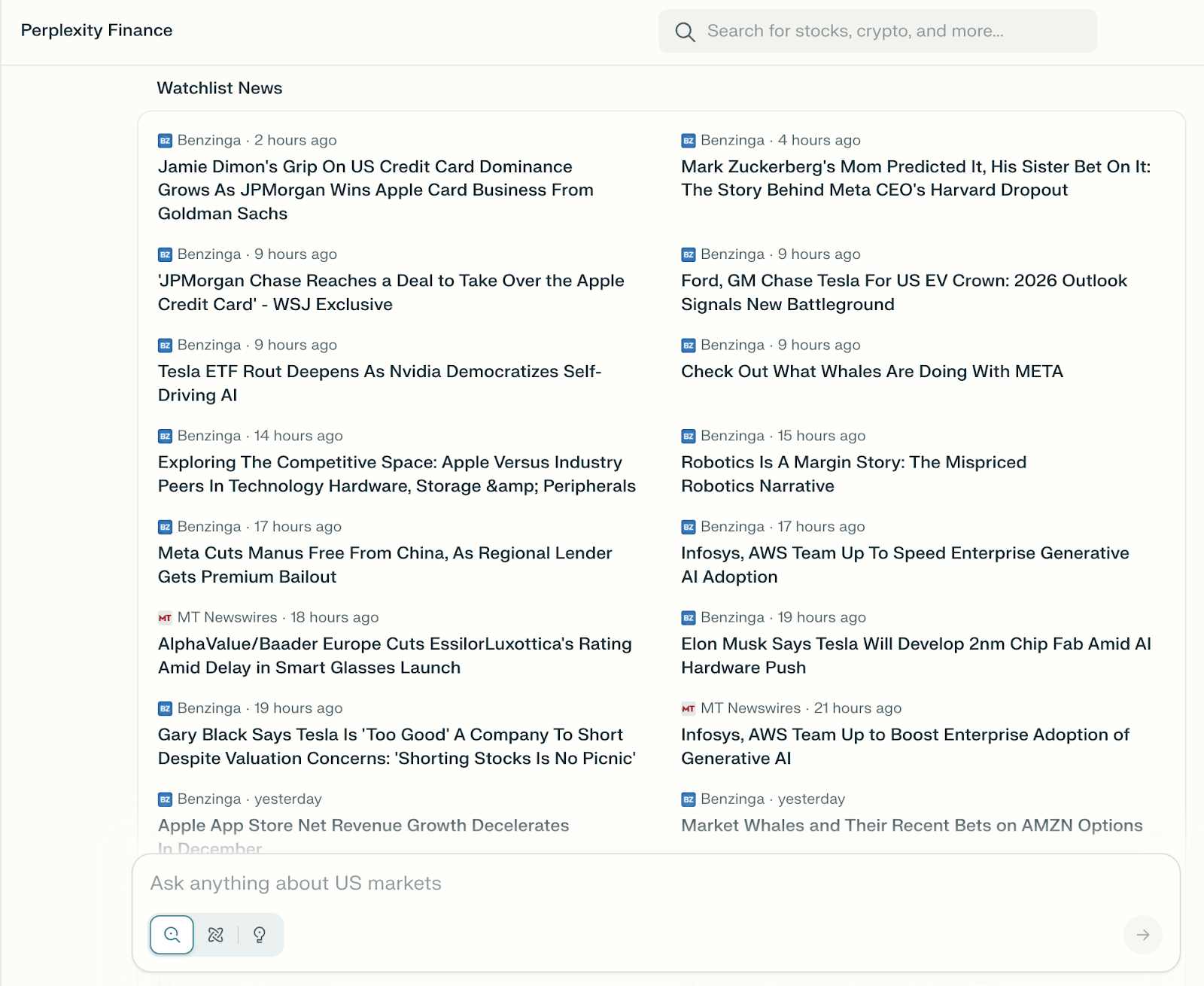
    ```json
{
  "alt": "Screenshot of stock news headlines from Perplexity Finance with a search bar at the top.",
  "caption": "Stay updated with the latest financial headlines on Perplexity Finance. Track market shifts, tech advancements, and industry changes in real-time.",
  "description": "The image displays a screenshot from Perplexity Finance featuring a list of news headlines related to the stock market and financial sectors. The headlines cover topics like JPMorgan's credit card dominance, Apple's competitive challenges, Tesla's AI developments, and more. A search bar at the top allows users to explore stocks, cryptocurrencies, and other financial topics. The layout is clean and organized, catering to users seeking quick updates and insights into financial markets. Keywords: finance, stocks, market news, Perplexity Finance."
}
```

    Implications

    For work-centric audiences like SaaS, finance, and education specialists, AI discovery is shifting into LLMs embedded in workflows.

    Pattern 2: Perplexity Shines in Finance

    While Perplexity has flat growth overall, it stands strong in finance with a 24% market share, unlike in other sectors where it has diminished.

    • SaaS: down to 7.3%
    • E-commerce: down to 3.4%
    • Education: down to 5.2%
    • Publishers: down to 3.6%

    Finance demands accuracy; thus, traceable sources make Perplexity vital in this sector.

    Partnering with Benzinga, FactSet, and others, Perplexity offers in-depth data vital for financial decisions.

    Trust and verifiability are crucial in finance, and that’s where Perplexity excels.

    Implications

    In finance, selection of platforms that integrate with licensed data and credible sources is critical. Success hinges on being part of these authoritative ecosystems.

    Pattern 3: Claude’s Dominance in Analysis

    With just a 0.6% share, Claude might appear to be an underdog, but it thrives in specialist sectors like publishing and finance.

    • Publishers: 49x growth
    • Education: 25x growth
    • Finance: 38x growth
    • SaaS: 10.3x growth

    Claude’s strength lies in standalone, strategic thinking rather than integrated tools like Copilot.

    • Publishing professionals and financial analysts use Claude for its substantial context window, enabling complex and strategic queries.

    Implications

    Target audiences that require in-depth analysis should focus on creating structured and detailed content. Claude’s user base is smaller but highly influential.

    Pattern 4: Challenges in Tracking Gemini

    The data concerning Gemini is puzzling, showing both growth and declines. This could be attributed to issues with attribution rather than an actual decline in users.

    • Education: −67% tracked traffic
    • SaaS: +1.4x growth
    • Finance: +1.3x growth
    • E-commerce: +2.7x growth

    Gemini’s interaction model keeps users within its ecosystem, making measurement challenging.

    The reality is that usage might still be robust, but the tracking systems need to catch up with user behaviors.

    Implications

    As AI-assisted conversions increasingly occur, traditional last-click attribution models need reconsideration.

    Monitor brand search performance and invest in broader visibility strategies.

    Strategizing Your LLM Approach

    AI discovery is diversifying rather than converging. Tailoring strategies based on your audience’s preferences and behaviors is crucial.

    • Enterprise Audiences: Focus on Copilot integration for SaaS and B2B environments.
    • High-Stakes Decisions: Consider Perplexity’s reliability in providing traceable data.
    • Technical Evaluations: Claude’s detailed analysis capabilities require rich, structured content.
    • Emerging Sectors: Initiate with ChatGPT, monitor for evolving platform preferences.
    • Measurement Challenges: Adjust strategies to accommodate for gaps in tracking.

    Success in AI discovery is rooted in understanding your audience’s platform preferences and their specific needs.

    Read the full study: 2025 State of AI Discovery Report: What 1.96 Million LLM Sessions Tell Us About the Future of Search


    Inspired by this post on Search Engine Land.


    crushpress.ai community screenshot