
Recently, I’ve noticed that many AI visibility platforms base their insights on a limited set of prompts. It’s time we explore more suitable metrics for our ever-evolving query landscape.
Traditional share of voice (SOV) has become outdated. But what concerns me even more is how organizations are embracing AI share of voice, an equally flawed metric.
Software vendors are now attempting to quantify brand visibility across platforms like ChatGPT, Gemini, Claude, and Perplexity with a single percentage score. This approach relies on a denominator none of us can see.
Unlike the traditional search with a fixed set of keywords, AI prompts are limitless, making these metrics often unreliable.
Though traditional SOV had its drawbacks, its assumptions were clear. We marketers would define a keyword list, observe our visibility against competitors, and use a stable denominator.
This methodology is no longer valid. With dynamic and personalized search results taking over, it’s vital that AI visibility platforms stop presenting precise percentages that lack auditing or validation.
For this reason, we must redefine how we measure visibility in AI searches to avoid misleading leadership teams with fictional metrics.
Why Traditional SOV Metrics Now Fail
The core principles of SEO and digital brand tracking have been disrupted by two significant trends: the end of static result pages and the rise of personalized interfaces.

Search engines have become dynamic and change constantly based on real-time data.
With AI-generated summaries, localized results, and continuous scrolling, one person’s search experience will never be identical to another’s.
Given this, gauging an accurate ‘share’ of screen space is now mathematically impossible.
In today’s landscape, being ranked first might still mean sitting beneath several higher-priority elements like sponsored listings or AI-generated content.
Search engines now tailor layouts dynamically based on immediate user intent and past interactions, resulting in hourly ranking fluctuations.
Attempting to gauge share of voice on these terms is as inefficient as measuring ocean tides with a ruler.
The Modern AI Share of Voice
As traditional rank tracking became less relevant, vendors provided new metrics like LLM Visibility or AI share of voice, promising polished and reliable percentage scores.
These metrics claim to chart a brand’s footprint across various platforms, yet they obscure key methodological weaknesses that demand attention.
Legacy Tracking vs. LLM visibility: Legacy methods allowed for fixed keyword lists and auditable ranks on SERP, whereas LLM relies on random subsets and subjective denoting.
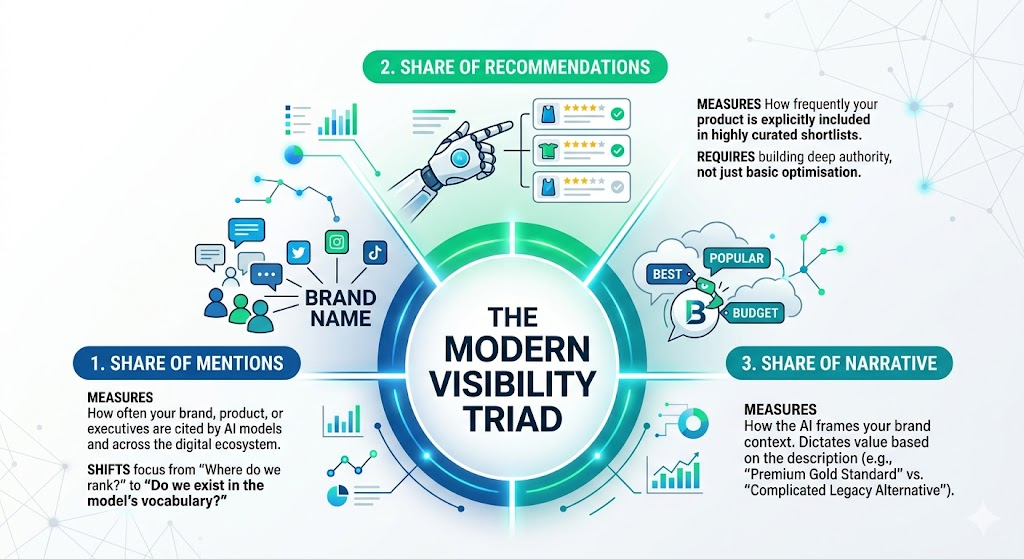
Beyond AI Share of Voice: 3 Key Metrics
The need to transition from pure search volume metrics to evaluating how well a brand is integrated in digital dialogues is evident. Rather than focusing solely on keywords, evaluation should revolve around a brand’s prominence in AI’s conceptual frameworks.
1. Share of Mentions: AI models build connections rather than simply recording pages. Thus, a brand needs to be part of the training dataset or real-time retrieval sources used by AI to ensure visibility.
2. Share of Recommendations: This measures how frequently your product is advised when buyers consult AI engines. A precise and well-documented position in the market is crucial for prominence.
3. Share of Narrative: Monitoring the qualitative nature of mentions is essential, as being depicted negatively despite frequent mentions can be detrimental to the brand.
Inspired by this post on Search Engine Land.

Leave a Reply