
Every SEO professional, including myself, knows that feeling of dread when we open an audit tool and it throws 847 problems our way. We’re talking broken links, crawl errors, pages with duplicate titles, missing alt tags, and Core Web Vitals cautioning us with yellow flags. And then, that whisper surfaces, “Fix it all, or else you’ll never rank.”
But in truth, that whisper is deceiving us.
The ‘fix everything’ strategy is a common pitfall in SEO and quietly sabotages many efforts. I get it—closing tickets and checking items off the list feels productive. Our audit scores might climb, but our traffic and conversions remain stagnant, leaving us puzzled after months of hard work.
The reason? We’ve mistaken activity for impact.
If you’ve ever completed a sprint feeling accomplished, only to see no change in Google Search Console, you’re not alone—this article is made just for you.
The tool isn’t your boss
Audit tools are impressive at pinpointing issues, examining thousands of pages in moments, flagging minor HTML glitches, and measuring Core Web Vitals with precision. While indispensable, they create a misconception that every issue demands utmost attention. A minor H1 tag absence on a low-traffic page holds the same weight as a noindex tag on your homepage. There’s no column for relevance.
John Mueller from Google has clarified that third-party tool scores aren’t used for ranking. While structure is important, tool scores don’t reflect ranking reality.
The challenge isn’t that audit tools detect issues; it’s that they don’t differentiate those affecting your bottom line. Teams often translate this to a flawed belief: more fixes equal more results. But that’s a myth.
Dig deeper: Where to focus technical SEO when you can’t do it all
This is where opportunity cost, the hidden killer of SEO programs, quietly wreaks havoc. Each moment our dev team dedicates to minor legacy fixes detracts from potentially lucrative new projects. When resources are tied up on negligible refinements, we forfeit real growth opportunities.
- New content targeting competitive, high-intent keywords.
- Enhancing top-performing pages already on the first page.
- Strategic internal linking from authoritative content.
- Optimizing conversion paths on revenue-generating pages.
A technically cleaner site with flat traffic is not progress. Busy SEO feels productive, but it isn’t growth.
Not all SEO problems are created equal — context changes everything
Competitive keywords often result in top-ranking sites with imperfect Core Web Vitals and other technical flaws. Yet, they rank because they excel in authority and user satisfaction.
Google values relevance and satisfaction over flawlessness, but distinguishing between critical growth barriers and less relevant issues remains a challenge.
I use this mental model: filter issues through impact, reach, effort, and risk before setting priorities.
- Impact: Potential effect on traffic, revenue, or visibility.
- Reach: Number of high-value pages affected.
- Effort: Resource cost for a fix.
- Risk: Crawlability, compliance, or UX risk if unresolved.
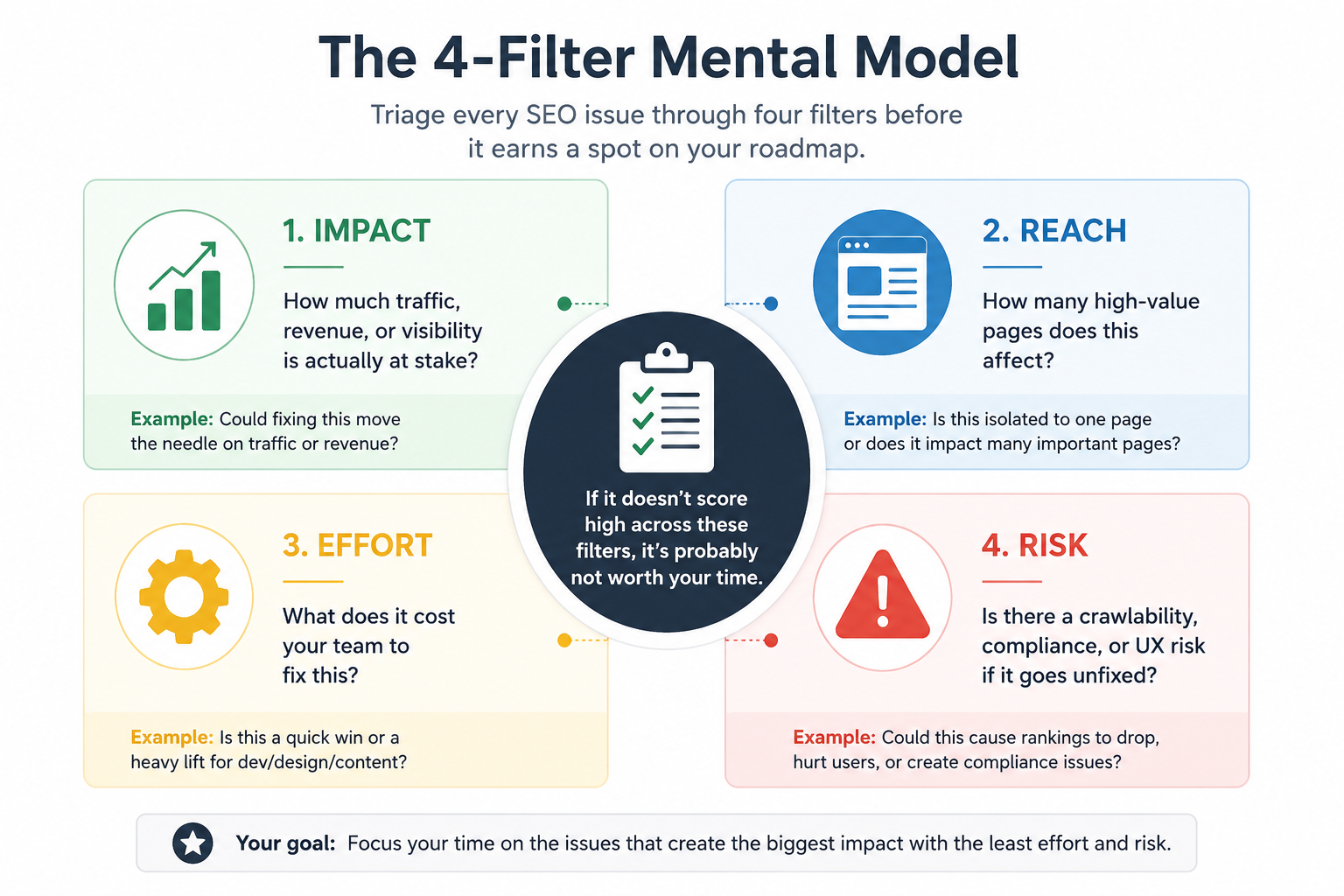
Address roughly 30% of your to-do list that truly matters, streamlining efforts and focusing on what improves the bottom line.
Dig deeper: How to prioritize technical SEO fixes by business impact
Strategic neglect: What’s actually OK to leave alone
While it may seem counterintuitive, strategic neglect is not negligence. It’s about deliberately choosing not to fix certain SEO issues to concentrate on high-leverage tasks. Here’s what I usually deprioritize:
- Non-indexable, low-impact legacy URLs with minor errors.
- Redirect chains that do not significantly impact link equity or UX.
- Minor HTML and non-critical JavaScript errors.
- Micro-optimizations for Core Web Vitals after achieving ‘good’ status.
To prioritize effectively, ask if it serves your audience or business goals. If the answer is “no” or “barely,” let it slide.
However, systemic issues like massive indexation problems, site migrations affecting entire navigations, compliance, or security concerns deserve immediate attention. Address these critical blockers first and set aside the superficial.
What high-performing SEO teams focus on
I’ve noticed that successful SEO teams don’t begin with audits; they start with the business. By determining which pages and queries drive conversions and revenue, we can focus efforts where it really counts.
The Pareto Principle helps us target the 20% of our work responsible for 80% of the results. This usually means concentrating on high-impact initiatives.
- Enhancing page-one performers: These are already hitting targets; enhance them further by refreshing content and optimizing clicks.
- Boosting mid-tier rankings: Pages in positions 11-30 are prime opportunities for significant gains.
- Building comprehensive topic clusters: Demonstrates expertise and relevance in the eyes of Google.
- Resolving true technical blockers: Address crawlability, canonical, indexation, mobile usability, and server issues.
Dig deeper: 4 ways to strengthen buy-in for technical SEO work
A smarter framework: The impact/effort matrix
The impact/effort matrix is my go-to tool for sorting through audit clutter. By evaluating tasks based on potential impact and required effort, I can choose smarter.
- High-impact, low-effort: Prioritize these tasks immediately.
- High-impact, high-effort: Strategize and resource these tasks cautiously.
- Low-impact, low-effort: Address these opportunistically.
- Low-impact, high-effort: Avoid these tasks unless absolutely necessary.
Pairing this matrix with a business-aligned roadmap ensures that SEO efforts reflect true business priorities rather than simply following everything flagged by an audit tool.
Your SEO strategy isn’t about achieving a sky-high audit score. It’s about aligning with the core business goals to drive meaningful growth and results. Remember, effective SEO is proactive and strategic, not just a checklist of technical fixes.
Inspired by this post on Search Engine Land.

Leave a Reply