
Is Google Ads Asset Studio Truly a Game Changer?

```json
{
  "alt": "Person using a laptop displaying Google Ads asset studio interface.",
  "caption": "Harness the power of Google Ads with a personalized touch, as showcased on a sleek laptop screen.",
  "description": "This image shows a person working on a laptop with the Google Ads interface open. The screen displays the Asset Studio, featuring options for creating and editing images using Google AI. The laptop is situated on a wooden desk with office supplies, giving a professional vibe. Keywords: Google Ads, Asset Studio, AI, laptop, office."
}
```

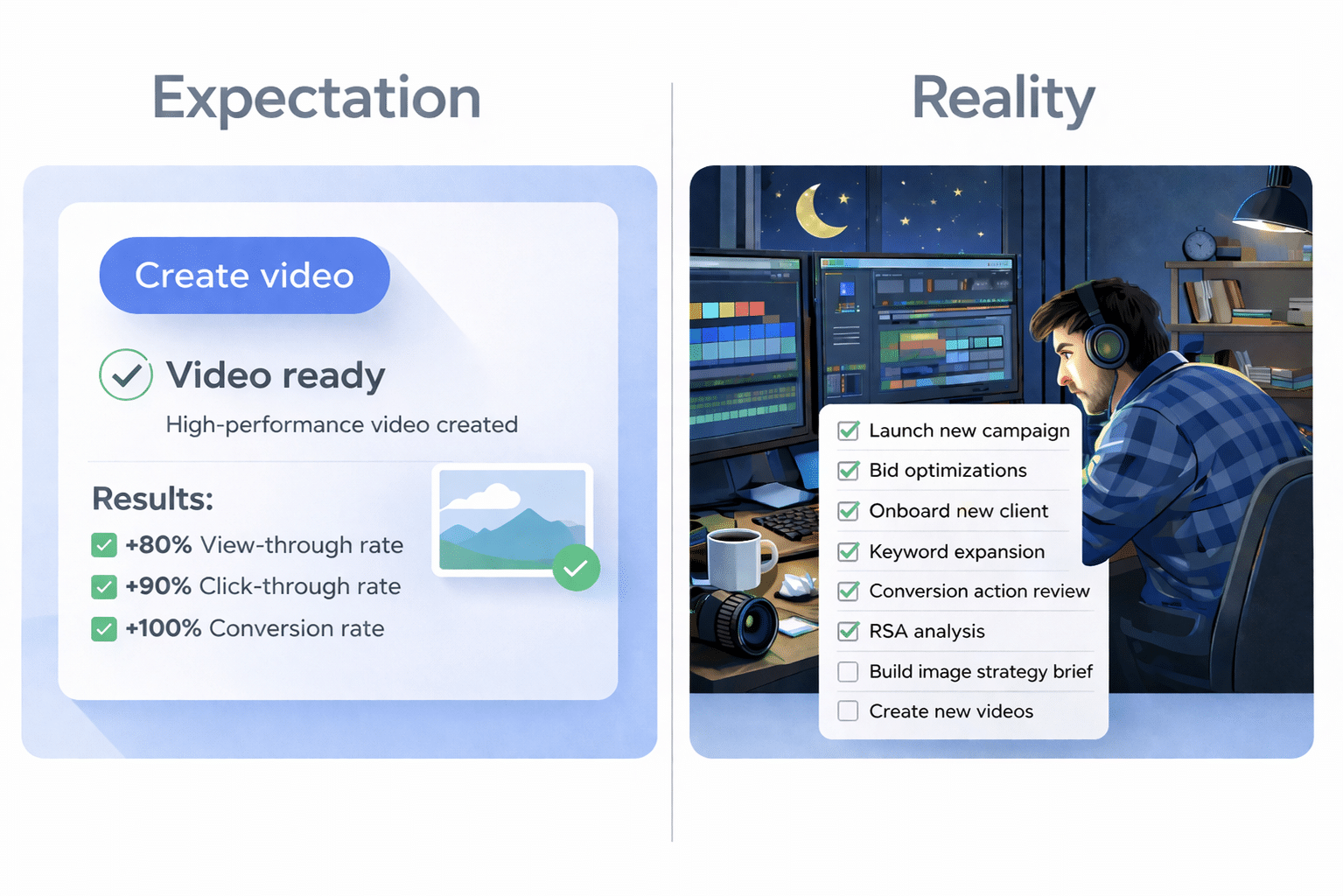
I recently dove into Google Ads Asset Studio to see what all the hype was about. I’ve heard declarations like, “Google just ended all excuses for not running video ads!” and “It’s a total game-changer; no production budget needed!”

The process is supposed to be simple: upload some images and get campaign-ready videos in minutes. Using Google Ads > Tools > Asset Studio, I can manage and scale images and videos effortlessly across various ad formats.

Recent additions like Veo, Google’s AI video model, and Nano Banana Pro suggest we can transform a few product images into engaging video ads almost instantly.
```json
{
  "alt": "Two interfaces of a video editing platform, showing a video generation failure message.",
  "caption": "Exploring the capabilities of Veo and Veo in Asset Studio, where creativity meets technology. A video generation message highlights the intricacies of AI compliance.",
  "description": "This image showcases two user interfaces from a video editing platform, Veo and Veo in Asset Studio. The main focus is on a woman in a red dress standing on an airplane wing against a clear sky. Adjacent, a pop-up message explains video generation failures due to content issues, emphasizing restrictions on AI usage adhering to policies. The elements highlight technological features and compliance requirements within video editing tools."
}
```

But does it really change the advertising game? Let’s explore if it’s truly worth our time.

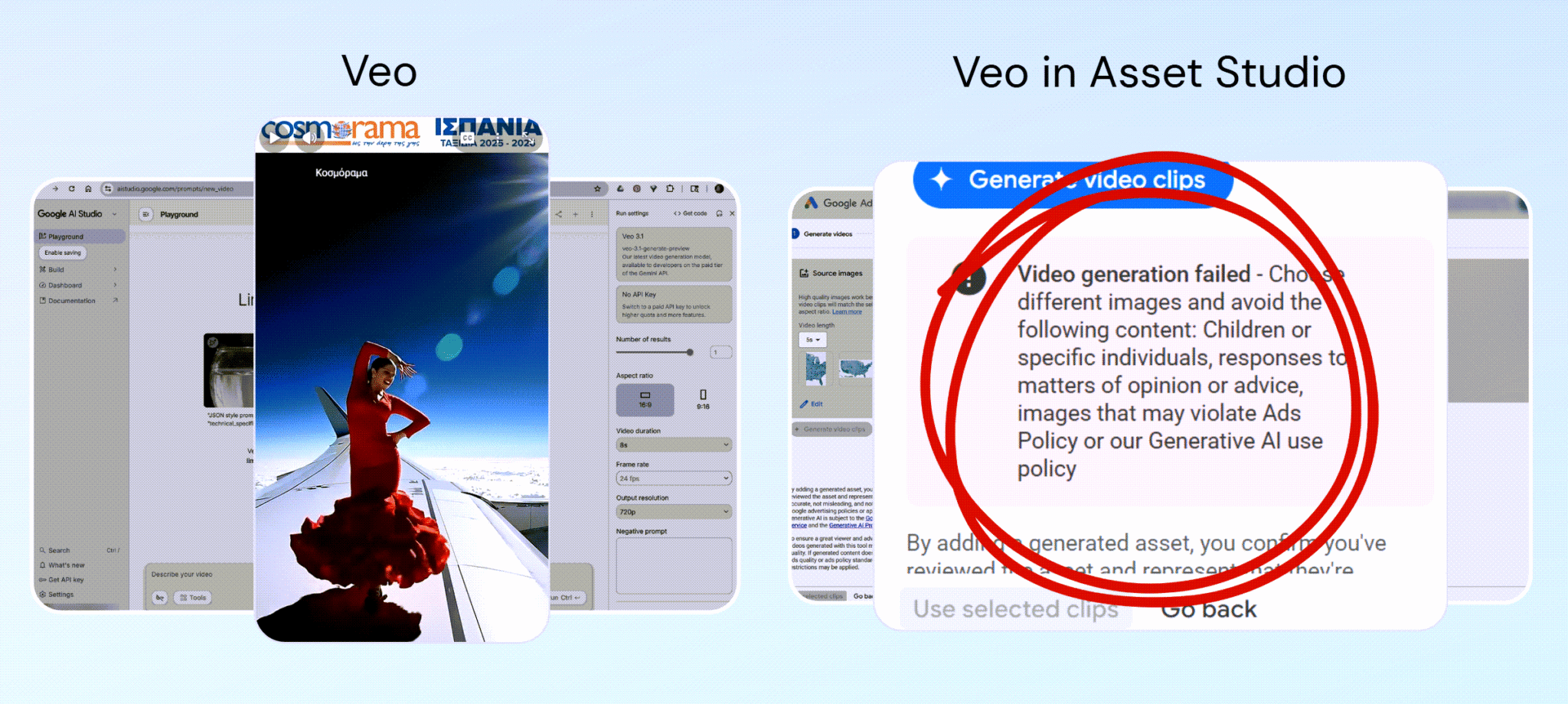
From the Think with Google article about AI-generated ads, such as those for Cosmorama, I tried to reverse-engineer their imaginative approach. Unfortunately, despite using Nano Banana and Veo, I encountered many limitations.

```json
{
  "alt": "The CapmatchOne logo with a gradient circle and bold text.",
  "caption": "Discover innovation with the CapmatchOne logo, featuring sleek typography and a modern gradient circle.",
  "description": "The CapmatchOne logo features bold, modern typography coupled with a gradient circle, symbolizing connection and innovation. The sleek design conveys a sense of progress and creativity. This image can be used for branding or promotional purposes, appealing to audiences interested in innovative solutions and forward-thinking designs."
}
```

For instance, I found the lack of scene-level control problematic. No prompting for video scenes meant I couldn’t guide the animation’s motion or pacing.

When generating videos, anything that resembled a human face—AI-generated or not—caused errors. This restriction limited my asset options significantly.
```json
{
  "alt": "Comparison image showing 'Expectation' and 'Reality' of video creation, with a checklist and a person working at multiple screens.",
  "caption": "Expectation vs Reality: Simplified video success vs. the reality of multitasking through the night.",
  "description": "This image illustrates the contrast between the 'Expectation' and 'Reality' in video production. On the left, 'Expectation' displays a straightforward checklist for creating a high-performance video, highlighting impressive results like +80% view-through rate and +100% conversion rate. On the right, 'Reality' depicts a person working late at a cluttered desk with multiple computer screens, highlighting tasks like launching new campaigns and bid optimizations. The image effectively uses color and design to convey the complexity of real-world video production."
}
```

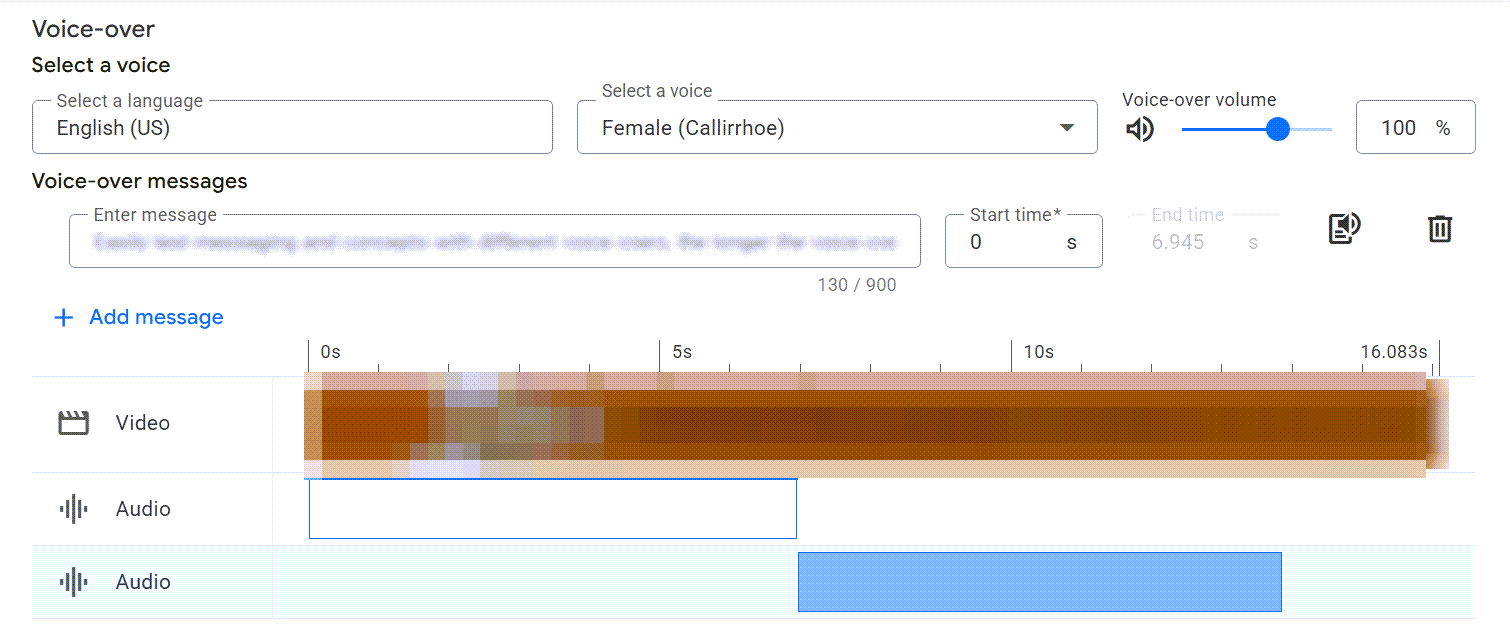
The audio options were also very limited. Unlike Cosmorama’s videos with cinematic scores, I was stuck with a small set of preloaded audio without the ability to upload custom tracks.

Overall, while Veo 3 introduced significant restrictions within Asset Studio, requiring a shift from expectations of advanced creative freedom.
```json
{
  "alt": "Golden retriever jumping to catch a red frisbee by a beach, with AI-generated content analysis overlay.",
  "caption": "A golden retriever leaps joyfully for a red frisbee at the beach, while AI analysis reveals the use of Google AI in image creation.",
  "description": "A playful golden retriever is captured mid-air as it jumps to catch a bright red frisbee at a beach, with a sunny blue sky in the background. The image is part of a visual demonstrating AI capabilities, shown by overlayed analysis indicating the content was generated with Google AI via a SynthID watermark. This inventive combination highlights technology's role in modern imagery."
}
```

While simplifying production could be beneficial, if you were expecting full creative control, you might be disappointed.

Thinking about whether Asset Studio truly saves time and effort, my experience suggests it’s a mixed bag. For brands previously in need of full production teams, Asset Studio might offer a faster and more cost-effective solution. However, for agencies or individuals incorporating this into existing workloads, it turns creative constraints into a newfound responsibility.
```json
{
  "alt": "Person wearing headphones with promotional feature for product images using AI.",
  "caption": "Immerse yourself in the sound! Use AI to feature your products in stunning lifestyle scenes effortlessly.",
  "description": "The image showcases a person wearing headphones, illustrating the promotion of an AI tool for creating product images in lifestyle settings. It suggests adding images of a single product and leveraging Google AI to place them realistically. The interface includes options to add images and describe the type of image desired. Keywords: AI, product images, lifestyle, headphones."
}
```

Regarding AI ad compliance, it’s worth noting there are no current U.S. federal laws against using AI in ads. However, places like New York are setting new precedents with upcoming laws requiring disclosure of AI use.

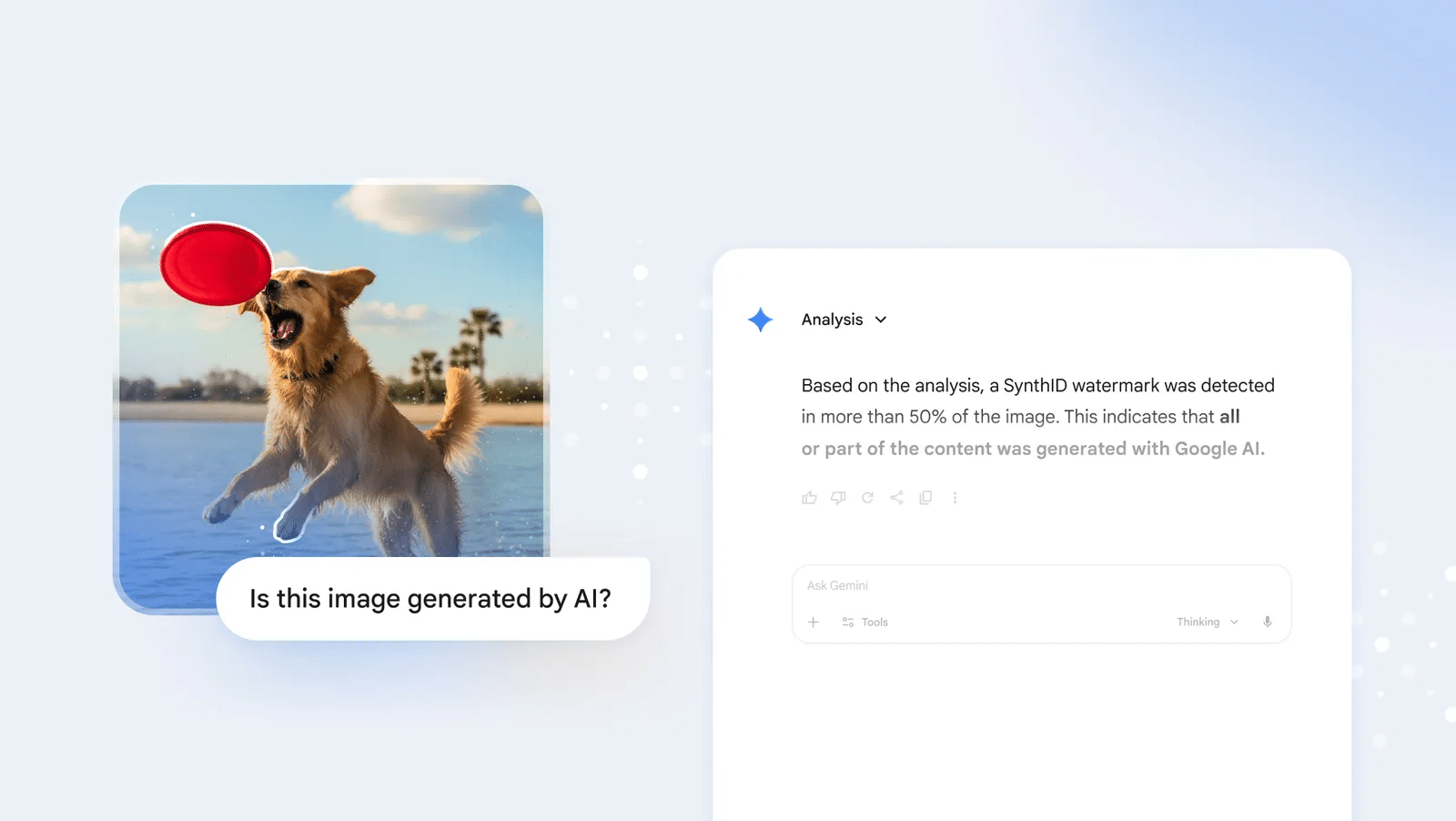
On the brighter side, if you use Asset Studio with ethical transparency in mind, although there’s no watermark or disclosure methods built-in, Google’s SynthID supports invisible AI tagging.
```json
{
  "alt": "Screenshot of voice-over editing interface with timeline and audio settings.",
  "caption": "Dive into the world of voice-over editing with this user interface, showcasing options to select language, voice type, and adjust volume, alongside a detailed timeline.",
  "description": "This image displays a screenshot of a voice-over editing interface. It includes drop-down menus for selecting language and voice for the voice-over, such as 'English (US)' and 'Female (Callirrhoe)'. The interface also features a volume adjustment slider set at 100%. Below, a timeline is visible, showing video and audio tracks with time markers. Users can enter messages and set start and end times for audio. This tool is ideal for video creators needing precise audio customization. Keywords: voice-over, editing, audio, video, interface, timeline."
}
```

Could this tool live up to its potential without succumbing to ‘AI slop’? Josh Spanier from Google suggests not to worry, yet it’s essential to maintain control to avoid low-quality AI-generated ads from being published unwittingly.

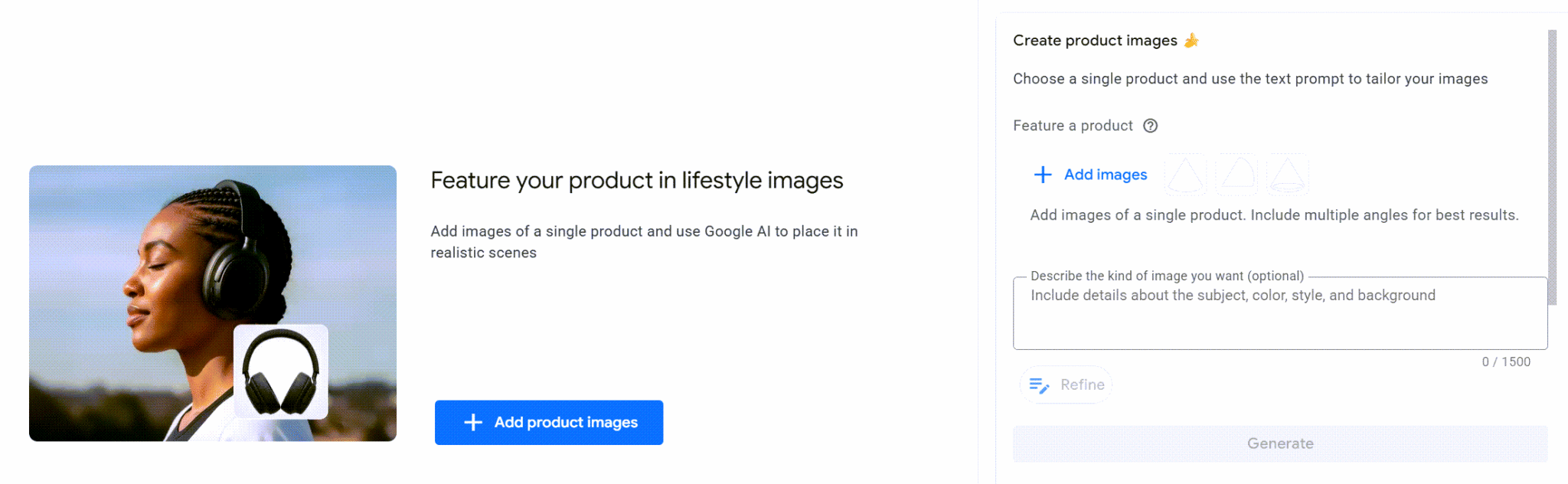
Asset Studio indeed offers a streamlined way to bring product images to life, optimized for product integrity through tools like Nano Banana 2.

Features like quick trimming and leveraging simple templates show promise in turning around high-performing, concise ad creatives, even doubling CTR compared to previous client efforts.

In conclusion, while Asset Studio isn’t a complete game-changer, it provides tools that democratize creative access for those lacking a full production budget. However, it’s vital to measure the outcomes in terms of conversions and sales.

I’m running tests to see what truly holds up. Stay tuned.


Inspired by this post on Search Engine Land.


crushpress.ai community screenshot

FAQs

Is Google Ads Asset Studio Truly a Game Changer?

The post argues it isn’t a complete game-changer. It can streamline turning product images into video ads, but it imposes constraints like no scene-level prompting and limitations with AI-generated faces.

What are the main limitations of Asset Studio mentioned in the post?

There is no prompting for video scenes, so you can’t guide animation pacing. AI faces cause errors, and the audio options are limited.

Who could benefit from Asset Studio, according to the post?

The post notes Asset Studio can be faster and more cost-effective for brands without a full production team, but agencies or teams integrating it into existing workflows may face tighter creative constraints.

What does the post say about AI compliance and legal considerations?

There are no current US federal laws against using AI in ads, but New York is considering new laws requiring AI disclosure; SynthID supports invisible tagging, and the post advises ethical transparency.

What positive outcomes does Asset Studio potentially offer?

The post notes it can democratize creative access and turn around high-performing, concise ad creatives, even potentially doubling CTR in some cases. It may also accelerate turnaround compared with traditional production.

Comments

Leave a Reply

Your email address will not be published. Required fields are marked *