Tag: Creative Strategies

  • Discover Why ‘Ugly’ Ads Could Boost Your Marketing Success

    Discover Why ‘Ugly’ Ads Could Boost Your Marketing Success

    For years, I’ve been told to stick to a set of guidelines: always use top-notch creatives, maintain a polished brand, follow scripts, and adhere to platform-recommended formats.

    Lately, while navigating ad accounts or simply scrolling through feeds, I’ve noticed something intriguing. The ads that grab my attention often defy these rules. They’re less polished, scrappier, and sometimes referred to as ‘ugly ads.’ What’s fascinating is that they’re outperforming the traditional, polished ones.

    More brands are deliberately breaking so-called best practices to stand out. It’s important to remember that these practices represent an average of what worked for others in the past. By the time a strategy becomes a platform-recommended rule, it might have already lost its edge.

    This is why defying best practices can lead to success — but only if you understand the reasons behind them.

    Why Breaking Best Practices Enhances Ad Performance

    Before diving into what to change, it’s crucial to understand the rationale behind existing rules. Platforms like Meta and TikTok have dual objectives:

    • They aim for you to spend money on ads.
    • They want to keep users engaged on their platforms.

    The best practices they promote are designed to ensure a seamless experience, encouraging ads to resemble others. The issue is that familiarity eventually breeds invisibility. When I adhere too closely to the rules, my ads risk blending into the background noise, overlooked by users.
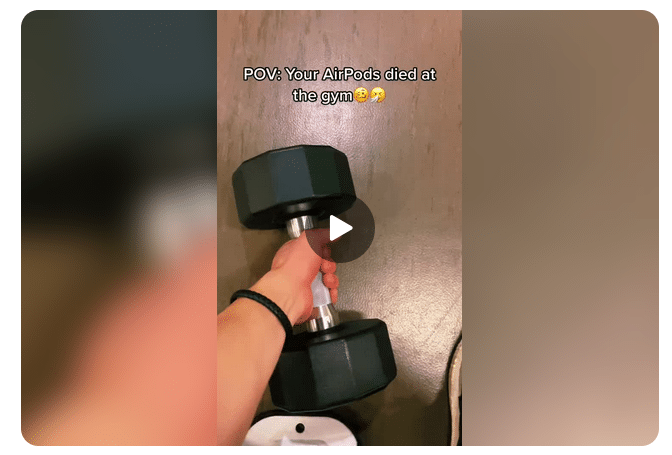
    ```json
{
  "alt": "Person holding a dumbbell at the gym, with text saying 'Your AirPods died at the gym' and emoji expressions.",
  "caption": "When your motivation gets heavy! A classic gym moment – your AirPods gave up, but you didn’t. Feel the silence and lift on!",
  "description": "Image shows a close-up of a person’s hand gripping a black dumbbell at the gym. The text overlay humorously reads 'POV: Your AirPods died at the gym' with laughing emojis, depicting the common scenario of exercising without music due to AirPods losing charge. This relatable gym scene captures the blend of determination and humor. Keywords: gym, dumbbell, AirPods, workout, humor."
}
```

    Highly-produced ads often scream ‘this is an ad,’ prompting users to skip them before my message hits home. In contrast, when my ad resembles something a friend might share, users’ defenses remain down longer, potentially transforming a scroll into a conversion.

    This is why many top-performing ads today don’t appear traditionally polished or on-brand. They break patterns instead. Consider:

    • Grainy phone footage.
    • Notes app screenshots.
    • Green-screened reactions or commentary videos.
    • Other lo-fi formats that outperform studio-quality creatives.
    A screenshot of a TikTok video ad featuring POV overlay text, a hand grabbing a dumbbell, and AirPods
    Source: TikTok Ads Manager

    To implement this, I started intentionally reducing my production value and experimented with formats like point-of-view (POV) shots tailored to various personas.

    Dig deeper: TikTok ad creative has a shorter shelf life. Here’s how to keep up

    Founder-Led Ads: Reviving the Human Touch

    Many brands have adopted guidelines that make them seem faceless and untouchable. They refrain from showing a messy office, an unpolished founder, or anything that challenges their corporate script. However, others are discarding that playbook, embracing founder-led ads that deviate from the polished executive version.

    ```json
{
  "alt": "The CapmatchOne logo with a gradient circle and bold text.",
  "caption": "Discover innovation with the CapmatchOne logo, featuring sleek typography and a modern gradient circle.",
  "description": "The CapmatchOne logo features bold, modern typography coupled with a gradient circle, symbolizing connection and innovation. The sleek design conveys a sense of progress and creativity. This image can be used for branding or promotional purposes, appealing to audiences interested in innovative solutions and forward-thinking designs."
}
```

    There’s a catch.

    Breaking the rules works only when it’s genuine. I’ve learned that faking authenticity is easy to spot and can backfire. This was evident in a viral series of videos where McDonald’s CEO appeared to present a new burger, but his execution was criticized for being stiff and unconvincing.

    As shown in a Dineline video, his performance appeared staged. Contrarily, Burger King’s president presented their burger with no hesitation, offering a genuine and relatable moment.

    The distinction was evident: One was a product pitch, and the other felt authentic.

    If my leadership doesn’t genuinely believe in the product, neither will my customers. Rule-breaking should allow us to be real, rather than simply appear unpolished.

    ```json
{
  "alt": "A man in a light sweater speaks in a video with McDonald's fries and drink in front of him.",
  "caption": "A promotional video featuring a man discussing while enjoying McDonald's fries and a drink, set against a vibrant yellow background.",
  "description": "The image shows a man seated in an office setting, wearing a light sweater, speaking in a promotional video. In front of him is a McDonald's meal, including a box of fries and a cup with a plastic straw. The background is bright yellow, adding vibrancy to the scene. This promotional video appears designed to emphasize McDonald's offerings in a casual yet professional manner. Keywords: McDonald's, promotional video, fast food, marketing."
}
```
    A screenshot of a YouTube video of theMcDonald’s CEO with their new burger
    Source: Dineline on YouTube

    The Comment Hook Hijack

    You’ve probably encountered video hook best practices like ‘show the product in the first two seconds and state the value prop clearly.’ Sound familiar?

    Imagine my ad starting with a screenshot of a negative comment, like one for a skincare product stating, ‘This probably smells like old socks, and does it even work?’ My ad would then show the founder confidently disproving this in an unscripted manner, applying the product.

    Though this breaks the positive-association rule, it leverages viewers’ curiosity about digital conflicts. By the time they realize it’s an ad, they might already be engaged.

    A screenshot of a TikTok video ad with a comment bubble that a person is addressing
    Source: TikTok Creative Center

    The Rebel’s Safety Net

    I learned not to abandon all polished assets just yet.

    Rule-breaking is strategic, and often misunderstood when the ’80/20 rule’ is ignored.
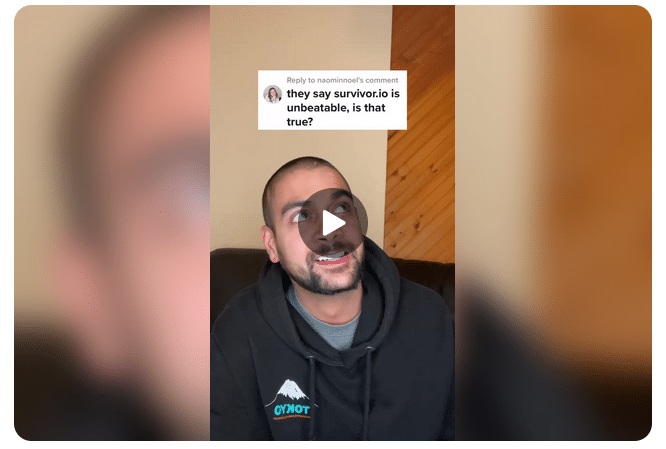
    ```json
{
  "alt": "Man in a black hoodie answers a question about the game Survivor.io",
  "caption": "Exploring the unbeatable myth of Survivor.io, this video provides insights and tips.",
  "description": "A man in a black hoodie, marked with a logo, responds to a comment asking if Survivor.io is unbeatable. The background shows a two-toned wall with wood paneling. The video aims to address a common inquiry among players, sharing personal experiences and strategies related to the game. Keywords: Survivor.io, unbeatable, gaming tips, strategy."
}
```

    Switching completely to shaky phone footage isn’t wise. Keeping 80% of the budget in traditional ads while using 20% for testing unconventional ones can be effective.

    Next testing campaign, I plan to try:

    • The silent test: Running a silent ad with bold captions to stand out in a noisy feed.
    • The UI ghost: Using static images resembling platform notifications to pause scrolling.
    • The algorithmic trust fall: Disabling auto-optimizations in a campaign to test creative performance without constraints.

    Don’t Follow the Rules; Understand Them

    Best practices are a guide, not a strategy. To move beyond them, I do it systematically.

    I start by questioning the rule’s existence, evaluating its current relevance, and testing its opposite in a structured manner. Comparing traditional and lo-fi approaches helps me understand user engagement better.

    In an environment where brands play it safe, those who understand and strategically break the rules will capture attention and conversions. My goal is to learn faster than the competition, skipping guesswork.


    Inspired by this post on Search Engine Land.


    crushpress.ai community screenshot
  • Is Google Ads Asset Studio Truly a Game Changer?

    Is Google Ads Asset Studio Truly a Game Changer?

    I recently dove into Google Ads Asset Studio to see what all the hype was about. I’ve heard declarations like, “Google just ended all excuses for not running video ads!” and “It’s a total game-changer; no production budget needed!”

    The process is supposed to be simple: upload some images and get campaign-ready videos in minutes. Using Google Ads > Tools > Asset Studio, I can manage and scale images and videos effortlessly across various ad formats.

    Recent additions like Veo, Google’s AI video model, and Nano Banana Pro suggest we can transform a few product images into engaging video ads almost instantly.

    ```json
{
  "alt": "Two interfaces of a video editing platform, showing a video generation failure message.",
  "caption": "Exploring the capabilities of Veo and Veo in Asset Studio, where creativity meets technology. A video generation message highlights the intricacies of AI compliance.",
  "description": "This image showcases two user interfaces from a video editing platform, Veo and Veo in Asset Studio. The main focus is on a woman in a red dress standing on an airplane wing against a clear sky. Adjacent, a pop-up message explains video generation failures due to content issues, emphasizing restrictions on AI usage adhering to policies. The elements highlight technological features and compliance requirements within video editing tools."
}
```

    But does it really change the advertising game? Let’s explore if it’s truly worth our time.

    From the Think with Google article about AI-generated ads, such as those for Cosmorama, I tried to reverse-engineer their imaginative approach. Unfortunately, despite using Nano Banana and Veo, I encountered many limitations.

    ```json
{
  "alt": "The CapmatchOne logo with a gradient circle and bold text.",
  "caption": "Discover innovation with the CapmatchOne logo, featuring sleek typography and a modern gradient circle.",
  "description": "The CapmatchOne logo features bold, modern typography coupled with a gradient circle, symbolizing connection and innovation. The sleek design conveys a sense of progress and creativity. This image can be used for branding or promotional purposes, appealing to audiences interested in innovative solutions and forward-thinking designs."
}
```

    For instance, I found the lack of scene-level control problematic. No prompting for video scenes meant I couldn’t guide the animation’s motion or pacing.

    When generating videos, anything that resembled a human face—AI-generated or not—caused errors. This restriction limited my asset options significantly.

    ```json
{
  "alt": "Comparison image showing 'Expectation' and 'Reality' of video creation, with a checklist and a person working at multiple screens.",
  "caption": "Expectation vs Reality: Simplified video success vs. the reality of multitasking through the night.",
  "description": "This image illustrates the contrast between the 'Expectation' and 'Reality' in video production. On the left, 'Expectation' displays a straightforward checklist for creating a high-performance video, highlighting impressive results like +80% view-through rate and +100% conversion rate. On the right, 'Reality' depicts a person working late at a cluttered desk with multiple computer screens, highlighting tasks like launching new campaigns and bid optimizations. The image effectively uses color and design to convey the complexity of real-world video production."
}
```

    The audio options were also very limited. Unlike Cosmorama’s videos with cinematic scores, I was stuck with a small set of preloaded audio without the ability to upload custom tracks.

    Overall, while Veo 3 introduced significant restrictions within Asset Studio, requiring a shift from expectations of advanced creative freedom.

    ```json
{
  "alt": "Golden retriever jumping to catch a red frisbee by a beach, with AI-generated content analysis overlay.",
  "caption": "A golden retriever leaps joyfully for a red frisbee at the beach, while AI analysis reveals the use of Google AI in image creation.",
  "description": "A playful golden retriever is captured mid-air as it jumps to catch a bright red frisbee at a beach, with a sunny blue sky in the background. The image is part of a visual demonstrating AI capabilities, shown by overlayed analysis indicating the content was generated with Google AI via a SynthID watermark. This inventive combination highlights technology's role in modern imagery."
}
```

    While simplifying production could be beneficial, if you were expecting full creative control, you might be disappointed.

    Thinking about whether Asset Studio truly saves time and effort, my experience suggests it’s a mixed bag. For brands previously in need of full production teams, Asset Studio might offer a faster and more cost-effective solution. However, for agencies or individuals incorporating this into existing workloads, it turns creative constraints into a newfound responsibility.

    ```json
{
  "alt": "Person wearing headphones with promotional feature for product images using AI.",
  "caption": "Immerse yourself in the sound! Use AI to feature your products in stunning lifestyle scenes effortlessly.",
  "description": "The image showcases a person wearing headphones, illustrating the promotion of an AI tool for creating product images in lifestyle settings. It suggests adding images of a single product and leveraging Google AI to place them realistically. The interface includes options to add images and describe the type of image desired. Keywords: AI, product images, lifestyle, headphones."
}
```

    Regarding AI ad compliance, it’s worth noting there are no current U.S. federal laws against using AI in ads. However, places like New York are setting new precedents with upcoming laws requiring disclosure of AI use.

    On the brighter side, if you use Asset Studio with ethical transparency in mind, although there’s no watermark or disclosure methods built-in, Google’s SynthID supports invisible AI tagging.

    ```json
{
  "alt": "Screenshot of voice-over editing interface with timeline and audio settings.",
  "caption": "Dive into the world of voice-over editing with this user interface, showcasing options to select language, voice type, and adjust volume, alongside a detailed timeline.",
  "description": "This image displays a screenshot of a voice-over editing interface. It includes drop-down menus for selecting language and voice for the voice-over, such as 'English (US)' and 'Female (Callirrhoe)'. The interface also features a volume adjustment slider set at 100%. Below, a timeline is visible, showing video and audio tracks with time markers. Users can enter messages and set start and end times for audio. This tool is ideal for video creators needing precise audio customization. Keywords: voice-over, editing, audio, video, interface, timeline."
}
```

    Could this tool live up to its potential without succumbing to ‘AI slop’? Josh Spanier from Google suggests not to worry, yet it’s essential to maintain control to avoid low-quality AI-generated ads from being published unwittingly.

    Asset Studio indeed offers a streamlined way to bring product images to life, optimized for product integrity through tools like Nano Banana 2.

    Features like quick trimming and leveraging simple templates show promise in turning around high-performing, concise ad creatives, even doubling CTR compared to previous client efforts.

    In conclusion, while Asset Studio isn’t a complete game-changer, it provides tools that democratize creative access for those lacking a full production budget. However, it’s vital to measure the outcomes in terms of conversions and sales.

    I’m running tests to see what truly holds up. Stay tuned.


    Inspired by this post on Search Engine Land.


    crushpress.ai community screenshot
  • Boost PPC Success: Why Creative Wins Over Bidding

    Boost PPC Success: Why Creative Wins Over Bidding

    For years, I’d been accustomed to centering my PPC strategy around bidding. The debates seemed endless: should I go with manual or automated, focus on Target CPA or aim for Maximize Conversions? Plus, the ongoing discussions around incrementality, budget pacing, and efficiency thresholds were never far behind.

    But as we move into 2026, I’ve realized that this focus might not be serving us as well as it once did. With automation taking over bidding on platforms like Google Ads and Meta Ads, the real bottleneck holding back performance is the creative side of things. If anything, Meta’s recent Andromeda system update makes this shift glaringly obvious.

    Smart bidding frameworks now largely mirror each other. On Google, Smart Bidding considers real-time signals such as device, location, behavior, and intent—parameters that would overwhelm any human doing this manually. Meta’s system also optimizes ad delivery by predicting outcomes rather than sticking to static audience definitions.

    With such similar optimization engines in play, bidding has become more of a commodity. It’s no longer the edge it once was; rather, it’s the creative inputs we feed into these systems that truly differentiate performance. And it’s about time we acknowledged this.

    The new Andromeda update from Meta is a testament to how critical creative has become. It’s not just a performance enhancer anymore; it’s an essential aspect of delivery. Meta even published a technical dive into Andromeda, explaining how it prioritizes and ranks ads based heavily on creative signals, boosting ad quality and increasing efficiency.

    What this means for us is simple yet crucial: ads that don’t cut it creatively might not even reach meaningful auction phases, despite how well we target or how much budget we allocate. Poor creative not only costs more but can limit our reach entirely.

    Meta’s clear stance positions creative quality as a pivotal factor in ad auctions. Studies have shown that campaigns with more creative variants achieve better cost-efficiency, and Andromeda compounds this by learning faster and being more selective. Many advertisers, including myself, have noticed a plateau in performance, even with consistent bidding and budgets. The reason? Creative inputs aren’t meeting the system’s learning needs.

    ```json
{
  "alt": "The CapmatchOne logo with a gradient circle and bold text.",
  "caption": "Discover innovation with the CapmatchOne logo, featuring sleek typography and a modern gradient circle.",
  "description": "The CapmatchOne logo features bold, modern typography coupled with a gradient circle, symbolizing connection and innovation. The sleek design conveys a sense of progress and creativity. This image can be used for branding or promotional purposes, appealing to audiences interested in innovative solutions and forward-thinking designs."
}
```

    I’ve also seen that Google Ads is quietly evolving in the same way, emphasizing the importance of creative assets in Performance Max, Demand Gen, and others. These changes demand that we prioritize creative assets as a major part of our strategy.

    Many agencies, including those I’m part of, hit performance plateaus where the instinct is to re-evaluate bids. But often, it’s the creative that needs refreshing. Audiences get tired of repetitive visuals and messages, making engagement drop and costs rise.

    I’ve realized that our current setup emphasizes optimizing bids faster than generating new creative. Creating engaging ads takes time—it involves strategic planning, design, approvals, and sometimes iterative refinement. However, retaining the same ads over prolonged periods stunts performance growth.

    I’ve learned that effective creative testing is an ongoing process, much like a product development cycle. Successful campaigns focus on continually introducing new creative elements—each honing a specific aspect, whether it’s the opening line, visual style, or call to action.

    If creative is identified as the bottleneck, agency operations must adapt. Planning for creative content should go hand-in-hand with media planning. It should be seen as fundamental, not supplementary, allowing teams to maintain a fresh and diverse creative library.

    By acknowledging that creative drives performance, we can move beyond just optimization skills and into a realm of consistent growth, fueled by innovative and diverse creative inputs.


    Inspired by this post on Search Engine Land.


    crushpress.ai community screenshot
  • Unlock Creative Success with Performance Max A/B Testing

    Unlock Creative Success with Performance Max A/B Testing

    I recently discovered that Performance Max now includes built-in A/B testing for creative assets. This feature offers advertisers a straightforward way to measure and enhance their advertising strategies.

    Google is introducing a beta feature that allows me and other advertisers to conduct structured A/B tests on creative assets within a single Performance Max asset group. This setup enables me to split traffic between two sets of assets and evaluate performance through a controlled experiment.

    Why it matters to me. In the past, creative testing within Performance Max was often guesswork. With Google’s new native A/B asset experiments, I can now perform controlled tests directly within PMax without needing to launch separate campaigns.

    How it works for me. I select one Performance Max campaign and asset group, then define a control asset set using my existing creatives and a treatment set with new alternatives. Shared assets can be utilized across both versions. After setting a desired traffic split, like 50/50, the experiment runs for several weeks, allowing me to apply the winning assets based on actual performance data.

    Why this is beneficial for me. Conducting tests within the same asset group isolates the impact of the creatives I’ve designed, minimizing interference from changes in campaign structure. This controlled split allows me to obtain clearer reporting, helping my team make data-driven decisions based on solid performance metrics rather than assumptions.

    ```json
{
  "alt": "Google Ads interface showing options to choose experiment type and test variables.",
  "caption": "Exploring Google Ads: A look at the platform's options for testing and optimizing ad campaigns, featuring performance and asset management tools.",
  "description": "The image showcases the Google Ads interface where users can select an experiment type to test different assets, goals, and campaign types. Highlighted sections include options to test campaign features such as assets, campaign types, and custom variables. The interface also allows selection between different campaign types like App, Demand Gen, and Performance Max. Notable is the emphasis on creating and testing creative assets like text, images, and videos to optimize ad performance. Keywords: Google Ads, experiment type, campaign testing, asset management."
}
```

    What I’ve learned so far. Early testing indicates that shorter experiments—especially those under three weeks—can yield unstable results, particularly in accounts with lower volume. I’ve found that extending the test duration and avoiding simultaneous campaign changes significantly enhances reliability.

    My takeaway. Performance Max is evolving into a more testable platform. I now have the ability to validate creative decisions using built-in experiments, reducing reliance on trial and error approaches.

    Source of insight. A Google Ads expert noticed the update and shared insights on LinkedIn.


    Inspired by this post on Search Engine Land.

    crushpress.ai community screenshot
  • 4 Timeless Facebook Ad Templates That Will Boost Your Success

    4 Timeless Facebook Ad Templates That Will Boost Your Success

    Have you ever scrolled through your Facebook feed, searching for ad inspiration?

    If so, you might have noticed that most ads don’t really grab your attention. Let’s be honest, scrolling through Facebook can feel oddly exhausting these days.

    Here’s the reality: the top-performing ads in 2026 aren’t winning because they’re exceptionally original or going viral (does that term still hold?).

    They stand out by adhering to reliable templates that savvy marketers have relied on for years.

    Even today, with AI and creative strategies, these frameworks remain as relevant as ever.

    In this article, I aim to bypass the conceptual buzz and focus on proven strategies.

    Below, I share four Facebook ad templates to boost your results, each with real examples showcasing top brands’ creative strategies.

    1. Problem? Meet solution

    Pain point → Relief → Simple next step

    This classic approach has stood the test of time, unchanged from 1926 to 2026.

    Customers are more focused on their own problems than on your business.

    They ponder their challenges:

    • “I’ve spent too much money.”
    • “I lack time.”
    • “I’m feeling stuck.”
    • “I’m overwhelmed.”
    • “I can’t seem to stay consistent.”

    You need to meet them where they are emotionally.

    Customers won’t buy if they don’t see their situation as solvable.

    Even as the best solution, recognition of the problem is crucial for them to seek answers.

    Example: ClickUp

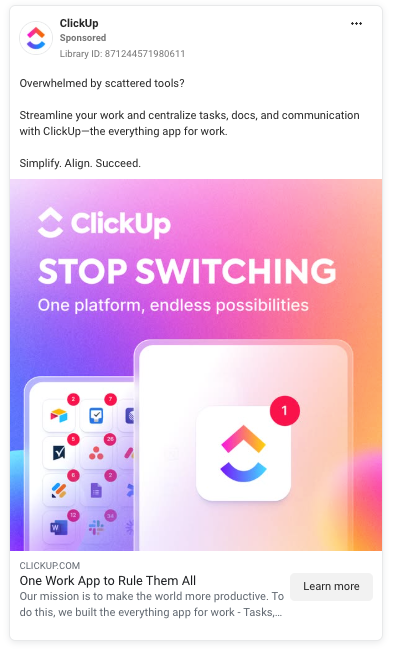
    Facebook Ads - ClickUp

    ClickUp converts a common tech frustration into an actionable solution:

    ```json
{
  "alt": "Promotional ad for ClickUp, highlighting its capabilities to centralize tasks and communication with vibrant colors.",
  "caption": "Tired of juggling multiple tools? Discover ClickUp, your one-stop app for streamlining work tasks and communication with ease.",
  "description": "This promotional image showcases ClickUp, an app designed to centralize tasks, docs, and communication. It features a vibrant gradient background with bold text encouraging users to 'Stop Switching'. The interface preview highlights its comprehensive capabilities. Ideal for productivity enthusiasts seeking a unified work platform."
}
```

    Fed up with juggling numerous tools? Opt for an all-in-one platform to streamline everything.

    The ad transcends “project management” by offering:

    • Mental peace.
    • A unified source of truth.
    • Reduced transition time, increased productivity.
    • Team cohesion.
    • An alluring promise of control.

    Plug-and-play copy starter

    Still dealing with [problem]?

    You’re not alone – and you don’t have to stay stuck.

    [Product/service] helps you [benefit] without [common objection].

    Get started → [CTA]

    Dig deeper: Meta Ads for lead gen: What you need to know

    2. Can your competitors do this?

    Unique selling point → Instant comparison → ‘Oh, hey’ moment

    If you’re in a saturated market, the standout brands help customers easily answer one crucial query:

    • Why should I choose you?

    You don’t need groundbreaking innovation; sometimes it’s about your execution, priorities, or target audience.

    Understanding your differentiator quickly is key.

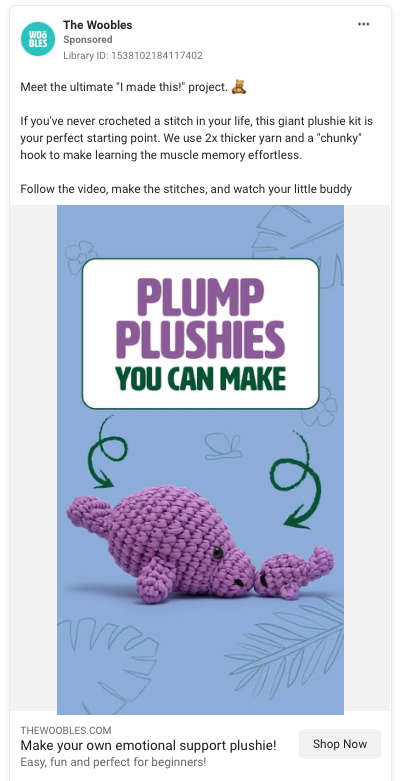
    Example: The Woobles

    Facebook Ads - The Woobles

    Crocheting’s been around forever, yet The Woobles claimed significant market share in this timeless craft.

    ```json
{
  "alt": "Purple crochet plushie with text 'Plump Plushies You Can Make' from The Woobles ad.",
  "caption": "Dive into crochet with this beginner-friendly plushie kit from The Woobles. Craft your own adorable creation, perfect for gaining confidence in crocheting!",
  "description": "This image is an advertisement from The Woobles showing a purple crochet plushie on a blue background. The text 'Plump Plushies You Can Make' highlights the DIY nature of the kit, which is designed for beginners. The kit includes thicker yarn and a chunky hook to simplify the learning process and create a cuddly, handmade plushie."
}
```

    This ad reveals their method.

    They distinguish themselves by illustrating why their kits are irresistible:

    • Contemporary projects that people cherish.
    • Designed for true novices.
    • Thicker yarn and a chunky hook.
    • Step-by-step video guides.

    Great USP ads do more than state uniqueness; they communicate why they’re simpler, better, and swifter.

    Plug-and-play copy starter

    Most [category] products do [expected thing].

    Ours does [unexpected/uncommon benefit].

    Here’s what makes it different:

    • [Differentiator 1]
    • [Differentiator 2]

    Try it for yourself → [CTA]

    Dig deeper: Rethinking Meta Ads AI: Best practices for better results

    3. Say more with less

    Testimonial/UGC → Minimal brand talk → Trust does the selling

    Not all ads have to scream “advertisement.” In 2026, some of the best Facebook ads take a moment to even register as sponsored.

    This “let the customer speak” template thrives on platforms like Instagram and TikTok.

    Think user-generated content (UGC), testimonials, and authentic reviews that seem raw and sincere.

    The minimal polish adds a touch of honesty, avoiding the usual sales pitch impression.

    ```json
{
  "alt": "Allbirds Tree Dasher 2 advertisement with a focus on a blue athletic shoe.",
  "caption": "Discover unparalleled comfort with the Allbirds Tree Dasher 2, designed for breathability and everyday movement. Perfect for those who value style and function.",
  "description": "This image showcases an advertisement for the Allbirds Tree Dasher 2. The main focus is a blue athletic shoe designed for breathability and daily use. Below this central image, there are three smaller images depicting the shoe in various lifestyle settings and in different colors. The text highlights the shoe's comfort and suitability for extended wear, appealing to both fashion-conscious and active individuals. Keywords: Allbirds, Tree Dasher 2, athletic shoe, comfort, breathability."
}
```

    Example: Allbirds

    Facebook Ads - Allbirds

    Allbirds features a simple, product-centric ad for the Tree Dasher 2, coupling a customer quote with the shoe’s image.

    • “Wore these @allbirds for 13 hours and could’ve gone another 13. I never want to take them off.”

    That line does all the talking.

    It implies:

    • Day-long comfort.
    • No need for a break-in phase.
    • Fit for real-world use.

    The ad’s simplicity mirrors its honesty, making it both unpretentious and credible.

    Plug-and-play copy starter

    “I didn’t think anything would help, but this actually worked.”

    [Show the proof]

    If you’re dealing with [problem], try [product] → [CTA]

    Dig deeper: How to test UGC and EGC ads in Meta campaigns

    4. The ‘quick win’ checklist

    3-5 bullets → Easy decision → Low-friction CTA

    Sometimes simplicity is what people crave over complex stories.

    This template is ideal for the fast-paced, easily distracted Facebook scroller who wants a quick fix.

    Rather than lengthy paragraphs, provide a few key benefits captured in moments.

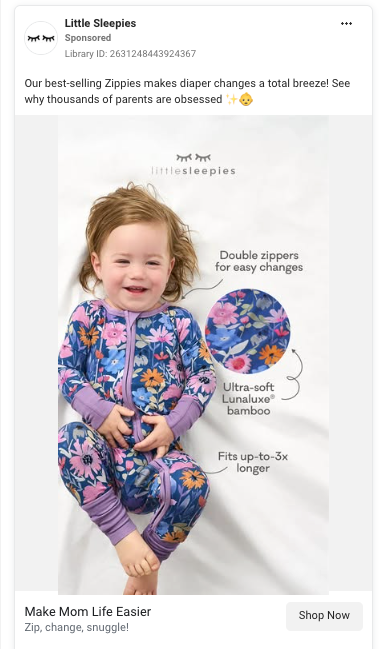
    ```json
{
  "alt": "Smiling baby in a floral sleeper with double zippers, promoting Little Sleepies' LunaluXe bamboo fabric.",
  "caption": "Discover the joy of easy diaper changes with Little Sleepies' adorable Zippies. Featuring double zippers and ultra-soft bamboo fabric, it's a parent favorite!",
  "description": "This image shows a baby happily wearing a Little Sleepies floral sleeper designed with double zippers for convenient diaper changes. The outfit is made from ultra-soft LunaluXe bamboo fabric, noted for its comfort and ability to fit up to three times longer. The promotional text highlights why thousands of parents love these Zippies, featuring the tagline 'Make Mom Life Easier.' Perfect for keyword searches related to baby clothes, convenient diaper changes, and soft bamboo fabric."
}
```

    The ‘quick win’ Checklist format:

    • Minimizes decision fatigue.
    • Makes value quickly understandable.
    • Emphasizes benefits without detailed explanations.
    • Appeals to fresh audiences unfamiliar with your brand.

    Example: Little Sleepies

    Facebook Ads - Little Sleepies

    Little Sleepies uses simple visuals and benefit callouts to tap into parenting needs:

    • “Is this actually going to make my life easier?”

    Without cleverness, the ad shares practical wins:

    • Double zippers for quicker diaper changes.
    • Ultra-soft bamboo for added comfort.
    • Fits longer (up to 3x) for better value.

    It’s a testament to how the winning ads in 2026 make purchases feel effortless.

    Plug-and-play copy starter

    Everything you need to [achieve outcome]:

    • [Benefit 1]
    • [Benefit 2]
    • [Benefit 3]

    Get it today → [CTA]

    Dig deeper: How to get better results from Meta ads with vertical video formats

    Templates beat inspiration every time

    In 2026, the Facebook champions aren’t those reinventing the ad wheel or investing in glossy campaigns.

    They are those who:

    • Embrace tried-and-tested frameworks.
    • Communicate clearly.
    • Speedily trial variations.
    • Allow their results to lead the way.

    Inspiration is optional; a dependable structure is invaluable when crafting Facebook ads.

    Select a template, test two versions, analyze outcomes, and iterate.


    Inspired by this post on Search Engine Land.


    crushpress.ai community screenshot
  • Mastering AI Video Ads: Top Strategies for PPC Success

    Mastering AI Video Ads: Top Strategies for PPC Success

    AI for video advertising- 5 best practices for PPC campaigns

    As I delve into the world of digital advertising, I realize that AI is more than just a buzzword; it’s a fundamental component of our strategies in 2026. Especially with video ads, where visuals speak louder and clearer than text, leveraging AI has become crucial not just for creating content but for innovating how we connect with audiences.

    The power of video in advertising is undeniable as it allows consumers to process information rapidly. With the drop in creative costs, using video is more viable and impactful than ever. The real question I find myself asking is not if PPC teams should use AI, but how to optimize its usage to maximize results and ensure our content remains compelling and governed well, safeguarding against pitfalls like hallucinations that might disrupt performance.

    Why has AI adoption in PPC alone become insufficient to enhance performance? Nearly 90% of marketers now integrate AI for creating or modifying video ads—a testament to its widespread use, though it does not guarantee success. Being successful in this domain now hinges more on our ability to feed AI the right creative inputs, data signals, and monitoring practices instead of relying on outdated manual bidding strategies.

    Here are five AI-backed strategies that I believe are key to enhancing video PPC campaigns effectively:

    1. Embrace Modular Asset Libraries Over Perfection

    Historically, we have approached video production with a mindset tailored for TV-style advertising. However, in this new age of Performance Max, providing a rich library of modular assets allows AI to dynamically craft video experiences, tailored to user behavior, device, and intent. Flexibility in creative elements does not hinder, but rather enhances, performance by offering multiple hooks, bodies, and CTAs that AI can creatively assemble.

    2. Move Beyond Keywords to Intent Orchestration

    In today’s AI-driven ad environment, keywords are more about nuances rather than triggers, aimed at helping systems understand audience themes. Rather than allowing AI to optimize within broad, unguided targets that may reduce quality, it’s imperative to guide it toward understanding and targeting true intent, using negative keywords and first-party data to inform its decisions.

    3. Optimize With Value-Centric Data

    One common pitfall we face is feeding generic or low-value conversion signals to AI systems, which misdirects efforts toward less fruitful outcomes. By aligning AI optimization strategies with value-based conversions through enhanced and offline data imports, we can refine how AI perceives and prioritizes user actions, ensuring a focus on quality over mere quantity.

    4. Opt for Lift Measurement Over Last-Click Attribution

    In assessing the impact of AI-driven video formats like YouTube Shorts, adopting advanced attribution models becomes crucial since traditional models fall short. By employing media mix modeling or simple tests that monitor consistency in spend and revenue growth, we can better understand and demonstrate the true value ads deliver across channels.

    5. Cater to Silent Viewers

    Many viewers start by watching videos on mute, especially during initial discovery phases. Therefore, ensuring that visual elements of a video are clear and engaging without the necessity of sound can effectively maintain audience interest and ensure message retention from the first visual frame onward.

    Shaping the Future of PPC

    The role of the PPC manager resembles that of an architect, structuring the framework in which AI operates. The emphasis has shifted from direct control to strategic input planning and data management, allowing for scalable and efficient AI-guided campaigns that propel brands toward success.


    Inspired by this post on Search Engine Land.

    crushpress.ai community screenshot
  • PPC Strategies: Debunking 3 Myths for 2026 Success

    PPC Strategies: Debunking 3 Myths for 2026 Success

    Entering into the world of PPC advertising for 2026, I realize how easily we can be misled by trends. AI, creative scaling, and marketing models promised us efficiency, but often ended up costing more than delivering. So how can we reset our PPC priorities as we step into the new year?

    In 2025, PPC advice revolved heavily around AI and glittering new tools, sounding both promising and expensive. We found ourselves succumbing to platform narratives rather than aligning with business needs, causing budgets to balloon without corresponding efficiency gains.

    As 2026 dawns, it’s high time to break free from these outdated beliefs. This article highlights three PPC myths that looked appealing in theory and quickly spread in 2025 but often led to poor decisions.

    My objective is straightforward: rethink priorities and avoid repeating costly mistakes.

    Myth 1: AI Outshines Manual Targeting

    We’ve been told countless times to trust AI for targeting while manual structures are deemed obsolete. But is that truly the case?

    The truth depends on conditions. AI thrives on volume and quality signals. Without these, the AI delivers no meaningful results, just automated processes that mask poor performance.

    For instance, ecommerce brands often find value in feeding purchase data back into Google Ads, assuming they generate enough conversions. Only then does outsourcing targeting to AI hold potential.

    If your campaigns struggle with low conversions or rely primarily on lead optimization, manual intervention may still be necessary.

    How to Reset Priorities

    Before turning everything over to AI, there are critical questions to ask:

    • Are campaigns optimized against a business-level KPI like CAC or ROAS?
    • Do the ad platforms receive sufficient conversion data?
    • Are conversions reported promptly, with minimal delay?

    If any answer is no, consider revisiting PPC fundamentals for 2026. Do not hesitate to apply traditional methods when needed. In 2025, I turned around a client’s fortunes by using match-type mirroring structures, even though it contradicted the common best practices.

    The success was based on historical performance data:

    Match TypeCost per LeadCustomer Acquisition CostSearch Impression Share
    Exact€35€45024%
    Phrase€34€1,48517%
    Broad€33€2,11618%

    Here, Google Ads did exactly what it was told—focus on lower cost per lead, disregarding business impact like KPIs.

    I regained control by focusing on high-performing audiences with unsaturated potential, via exact match keywords. If you’re unfamiliar with traditional structures, advanced semantic techniques can offer an excellent starting point without over-reliance on automation.

    Myth 2: More Ads Lead to Better Results

    This myth frustrates me as it sounds logical but rarely pans out. The argument is simple: more creative variation equates to better ad auction performance. But more often, it increases creative costs without the promised results, helping agencies more than advertisers.

    Creative volume adds value only when backed by high-quality conversions. Without them, extra ads only mean more materials rotating meaninglessly.

    How to Correct Course

    True value still lies in creative diversification that matches messages to audiences and contexts. This isn’t a novel concept. The same principles apply:

    • Have a strategic approach to creative testing; testing without intent is wasteful.
    • Plan measurement in advance to avoid setting yourself up for failure.
    • Ensure business-level KPIs are present in enough volume to make a difference.

    When resources are tight, rotating ads without direction is common. Focus on Conversion Rate Optimization (CRO) instead:

    • Enhance tracking for better performance.
    • Refine customer journeys to boost conversion rates and signal volume.
    • Align higher-margin products with more efficient spending.
    • Explore new networks or channels with saved creative budget.

    Myth 3: MMM Will Offer Clear Clarity

    Finding 10 marketers who believe GA4 is effective is challenging, indicating Google’s missteps. The misalignment with ad platform data breeds mistrust, leading to the belief that advanced solutions are needed. Yet, this often results in higher costs with average outcomes.

    Most brands don’t have the scale required for Marketing Mix Modeling (MMM) to yield insightful results. Instead, it’s best to master existing tools.

    The usual brand setup looks like this:

    • Concentrated media spend across a handful of channels, mainly Google and Meta, with YouTube, LinkedIn, or TikTok as extras.
    • Reliance on a narrow but consistent customer base, risking long-term stability.
    • Marginal marketing impact beyond the core audience.

    In such settings, MMM adds abstraction, not clarity. Staying grounded in fundamentals remains vital, not modeling complexities.

    Strategies to Add Value Instead

    Before considering advanced tools, ensure you’re getting the basics right:

    • Stand out clearly from competitors.
    • Boost margins, even with simple budget plans.
    • Build a strong data foundation, emphasizing tracking, CRO, and conversion paths.
    • Expand your channel or network options.
    • Align creative execution with genuine customer pain points.
    • Smooth out any marketing execution kinks.

    While advanced tools gain importance with complexity, deploying them too soon obscures accountability rather than offering real insights.

    The True Issue Lies in Misuse

    The thread linking these PPC myths isn’t the capabilities like AI, creativity, or analytics—it’s how they’re misused. Platforms fulfill the roles they are set for, optimizing within the provided signals and limitations.

    Business fundamentals are what break in these scenarios, rather than AI fixing our problems.

    Instead of pursuing the next shiny distraction, 2026 should be about focusing on core business strategies and executing with precision for profitable scaling.


    Inspired by this post on Search Engine Land.


    crushpress.ai community screenshot