Unlock Local SEO: Master Google’s Entity Recognition

```json
{
  "alt": "Futuristic digital art showing AI interpreting business types with a blue glowing human figure and robotic elements.",
  "caption": "Discover the future as AI interprets the 'soul' of your business. Engage with the digital revolution featuring a glowing human figure and advanced robotics.",
  "description": "This futuristic digital art piece illustrates AI's role in business interpretation. A blue, glowing human figure symbolizes the 'soul' of a business, surrounded by digital and robotic elements. The image features an artificial intelligence eye with the Google logo, a robotic hand pointing at business types like 'Pizza Restaurant,' 'Sushi Bar,' and 'General Business.' The composition is rich with vibrant blues and oranges, highlighting technology's transformative impact."
}
```

The local SEO gatekeeper- How Google defines your entity

Have you ever wondered why some businesses never make it to the top of the local pack rankings on Google? It’s not just about lacking reviews, links, or even proximity. The real challenge starts before any of these factors. Allow me to walk you through how Google determines if your business is eligible in the first place.

Think of it this way: Google first confirms the identity of your business before considering its relevance. It’s a critical step that many overlook.

From Exact Matches to Broad Intent: How Eligibility Shifts

```json
{
  "alt": "Screenshot of a Google API documentation discussing business type categorization.",
  "caption": "Explore the Google API documentation on business type categorization, detailing the use of business names and categories for location-based elements.",
  "description": "This image is a screenshot from the Google API documentation. It discusses the high-level categorization of business types, specifically using the parameters BUSINESS_NAME and BUSINESS_CATEGORY. The text explains how business types align with QRef collections and outlines examples such as hotels and restaurants. It also includes a note on grammar categorization and business type matching. Essential for developers working with location-based data."
}
```

For niche queries, Google searches for a precise 1:1 match, ensuring there’s no room for misunderstanding. But when the query broadens, as in searching for “restaurants,” the landscape changes dramatically, opening up more possibilities based on various categories.

This highlights hidden ranking elements like clicks, reviews, and even real-time data like whether a business is open.

Your business name and category must create a cohesive signal, defining what I like to call your “entity boundary.” For many businesses, a name that’s too specific can become an anchor, limiting your visibility in broader searches. If you’re aiming to conquer a niche, aligning your name and category perfectly can be your secret weapon.

```json
{
  "alt": "Search results for child dance lessons in Palm Beach showing dance schools with ratings and contact details.",
  "caption": "Explore top-rated dance schools in Palm Beach for your child's dance lessons. Find essential details and contact information to start your child's dance journey.",
  "description": "This image displays search results for child dance lessons in Palm Beach. It includes listings of various dance schools with ratings, years in business, and contact information. Highlights include Tippi Toes Palm Beach Gardens and KemKids Dance Studio, both marked with red arrows for emphasis. The displayed options provide detailed information like customer reviews, office hours, and website links, offering a guide to parents seeking dance lessons for their children."
}
```

The Eligibility Gatekeeper: Interpretation First, Rankings Second

Competing isn’t just about outperforming other businesses; it’s also about meeting Google’s stringent need for certainty. Thanks to the Google Content Warehouse API Leak, we now understand the engine that decides which businesses are eligible before considering traditional ranking factors like reviews or links.

This mechanism pre-qualifies businesses using a machine-learning classifier to filter out those unlikely to fulfill a query, ensuring only the most confident matches appear.
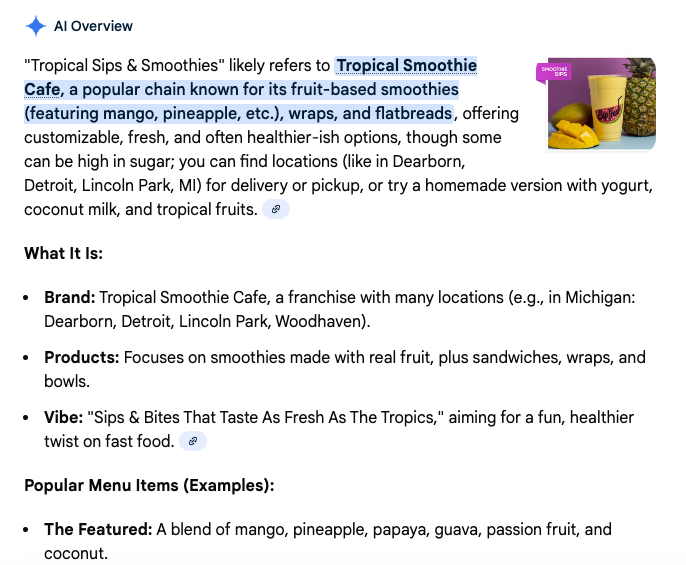
```json
{
  "alt": "Text about Tropical Smoothie Cafe, highlighting their fruit-based smoothies, wraps, and flatbreads with an image of smoothies and fruit.",
  "caption": "Discover the tropical flavors of Tropical Smoothie Cafe, known for their vibrant fruit smoothies and tasty wraps. Perfect for a refreshing treat!",
  "description": "This image features descriptive text about Tropical Smoothie Cafe, a franchise renowned for its fruit-based smoothies, wraps, and flatbreads. Located in various cities, the cafe focuses on real fruit smoothies and offers a fun, fresh take on fast food with items like the mango-pineapple blend. A small image shows smoothies and fresh fruit, reinforcing the tropical theme and fresh offerings of the cafe."
}
```

Your business name and primary category aren’t just descriptors; they set boundaries that determine your eligibility for specific queries.

Understanding the intricacies of these “entity boundaries” can help you determine how Google perceives the essence of what your business offers. I’ve seen this factor repeatedly transform ranking outcomes.

Business name + category: A unified signal

```json
{
  "alt": "Local smoothie store search results displaying ratings, prices, and locations.",
  "caption": "Finding your perfect smoothie spot made simple with detailed local store listings, featuring ratings, price ranges, and customer reviews.",
  "description": "This image captures a search result for 'smoothie store near me', showcasing several options with ratings and reviews. The list includes Beyond Juicery + Eatery, Smokey’s Smoke & Smoothie, and Vara Juice, each with customer ratings, price estimates, and brief testimonials. Perfect for users seeking nearby smoothie shops with top customer feedback."
}
```

Google evaluates your business name and category as one unit. They process parallel through semantic models, each playing a distinct role: while your business name acts as a self-identification signal, the category offers authoritative structure.

Understanding how these two elements interact can be pivotal in leveraging your business’s online visibility and eligibility to show up for desired queries.


Inspired by this post on Search Engine Land.


crushpress.ai community screenshot

Comments

Leave a Reply

Your email address will not be published. Required fields are marked *