

New data has revealed that many people, like myself, use ChatGPT to search for local healthcare and aesthetic services using short prompts and specific keywords.
In the SEO world, there’s been this idea that people have changed how they search for local services, preferring longer, conversational prompts over simple keyword searches.
With tools like ChatGPT becoming more prevalent, I wanted to see how true this is. I observed how everyday users, including myself, used ChatGPT for locating local service providers like healthcare and aesthetic practices.
We all began our search with ChatGPT, mimicking our usual behavior—be it visiting websites, checking social media profiles, or reading reviews.
Some key questions guided our observations:
- Are we using ChatGPT the way industry experts assume, especially when it comes to searching for local services?
- Is the trend moving away from keyword searches, rendering traditional keyword strategies obsolete?
- Do people truly engage in extended dialogues with ChatGPT for transactional purposes?
The results were intriguing, as they debunked many widespread beliefs being touted in SEO circles.
75% of Sessions Included Keyword Searches
Despite assumptions to the contrary, it turns out I’m not alone in still relying heavily on keyword searches when using AI platforms.
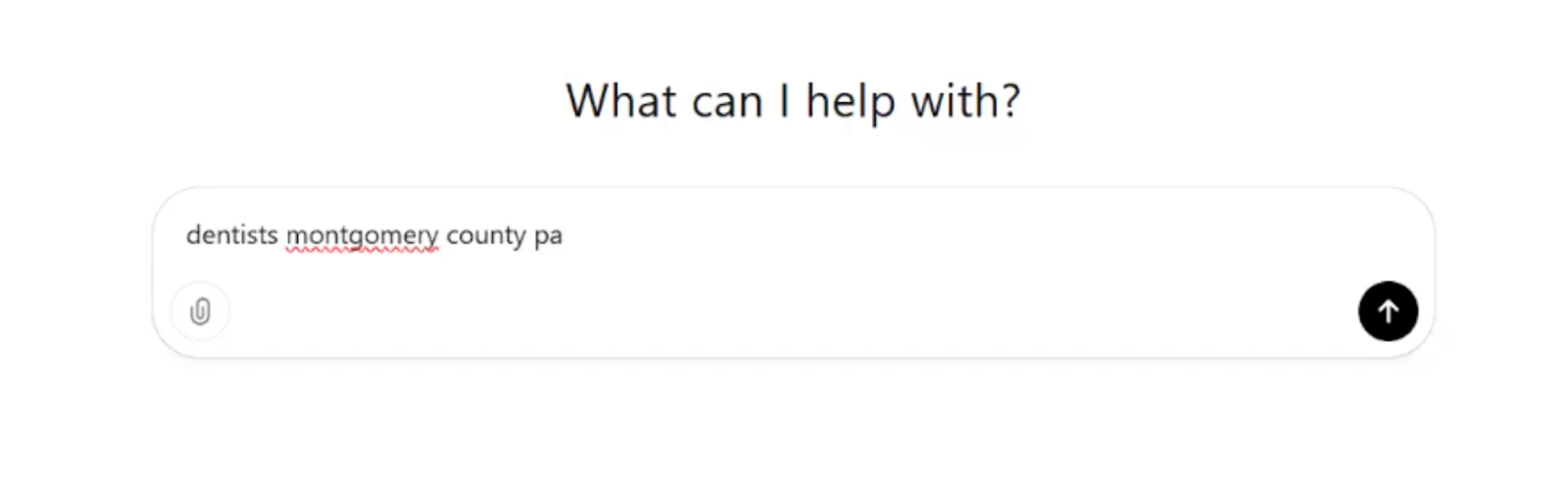
Initially, we didn’t focus on keywords, influenced by the misconception that they were becoming obsolete in AI contexts. However, observing user behavior revealed a pattern very familiar from traditional search engines.
To my surprise, 75% of the sessions I observed included at least one keyword-based prompt, reaffirming the continued relevance of keyword-based search behavior.
Here are a few screenshots showcasing this behavior:


Honestly, this should not come as a surprise.
It’s much easier to type a short phrase like “dentist 11214” than to input a long sentence explaining every detail.
This behavior aligns with how users have traditionally interacted with search engines—a habit that’s hard to break.
These observations raise questions about the relevance of keyword tracking in the evolving landscape of Generative Engine Optimization (GEO).

Some propose that GEO should transform transactional keywords into elaborate sentences, yet for local services, this seems unnecessary.
Despite varied responses from AI learning models, keywords still often appear when users seek services, affirming their utility in GEO strategies.
Dig deeper: Why local SEO is thriving in the AI-first search era
Local Searches Aren’t Conversational: 45% Use One-shot Prompts
When I’m searching for local services, I’ve found that engaging in a lengthy dialogue with ChatGPT is quite rare.
In fact, nearly half of the sessions—45%—were resolved with a single prompt, without any additional questions.
Additionally, when follow-up prompts were used, 34% simply requested more results.
At an average, I would say most users employed around 2.1 prompts during their searches for local services.
| Task | Average number of prompts |
| Find a new dentist | 2.41 |
| Find a place to get botox | 1.96 |
| Find a dermatologist to check a mole | 1.71 |
| Hair transplant | 1.33 |
| Find a chiropractor | 2.33 |
| Decided to get a facelift | 2.00 |

This doesn’t mean conversations aren’t happening; instead, the notion of conversational searches for local services appears overestimated.
Dig deeper: GEO x local SEO: Future of Discovery
Prompting Varies by Intent & Could Evolve
It seems people engage in conversations with ChatGPT mostly for informational needs, differing from what my findings might suggest.
However, documenting this behavior proved challenging due to its support largely from anecdotal evidence.
When it comes to services, we’re still more inclined to prompt ChatGPT as if we were using Google or another search engine.
This could change as users become more familiar with upgraded, paid versions of ChatGPT.
Yet, the simplicity of keyword searches may always hold appeal, especially if AI models efficiently deliver desired results with minimal input.
Explore the complete study and data for more insights. (Disclosure: I’m the founder of Sagapixel.)
Dig deeper: Boost Local SEO: 4 AI-Driven Tactics
Inspired by this post on Search Engine Land.

Leave a Reply