
I’m always fascinated by how technology evolves, especially when it comes to AI models. Recently, I stumbled upon some compelling data showing how these AI systems are reshaping brand hierarchies and influencing buyer decisions at an unprecedented speed.
AI models like ChatGPT, Gemini, and Claude have become a part of our daily interactions, from search to content creation and product recommendations.
According to a survey conducted by Responsive, a significant 80% of tech buyers now use generative AI to research vendors just as often as they use traditional search methods. This shift in how buyers build trust with AI-driven discovery tools quietly determines which brands stay top-of-mind and which fade into oblivion.
At Previsible, we’ve been analyzing this intriguing phenomenon through what we call LLM perception drift. It’s a new metric revealing how AI models are dynamically organizing brands within specific categories over time. (Disclosure: I am the CEO and co-founder of Previsible.)
Our case study on project management software, comparing data from September to October 2025, highlights just how quickly AI brand perception can change. This volatility is set to become the next major metric for SEO strategies.
Key insights
- The concept of LLM perception drift is emerging as a crucial visibility metric in SEO and B2B marketing.
- Brands like Atlassian gained prominence, while others like Trello and Slack saw declines, indicating the dynamic nature of AI perception.
- Understanding AI brand perception is pivotal for marketers aiming to grasp authority and relevance in language models.
- By 2026, maintaining digital visibility will hinge on AI brand signal stability as LLMs rapidly evolve.
A subtle shake-up inside the AI mind
Evertune’s AI brand score provides insights into how likely a model is to recommend a brand without specific prompting. It measures both visibility and ranking within AI responses.
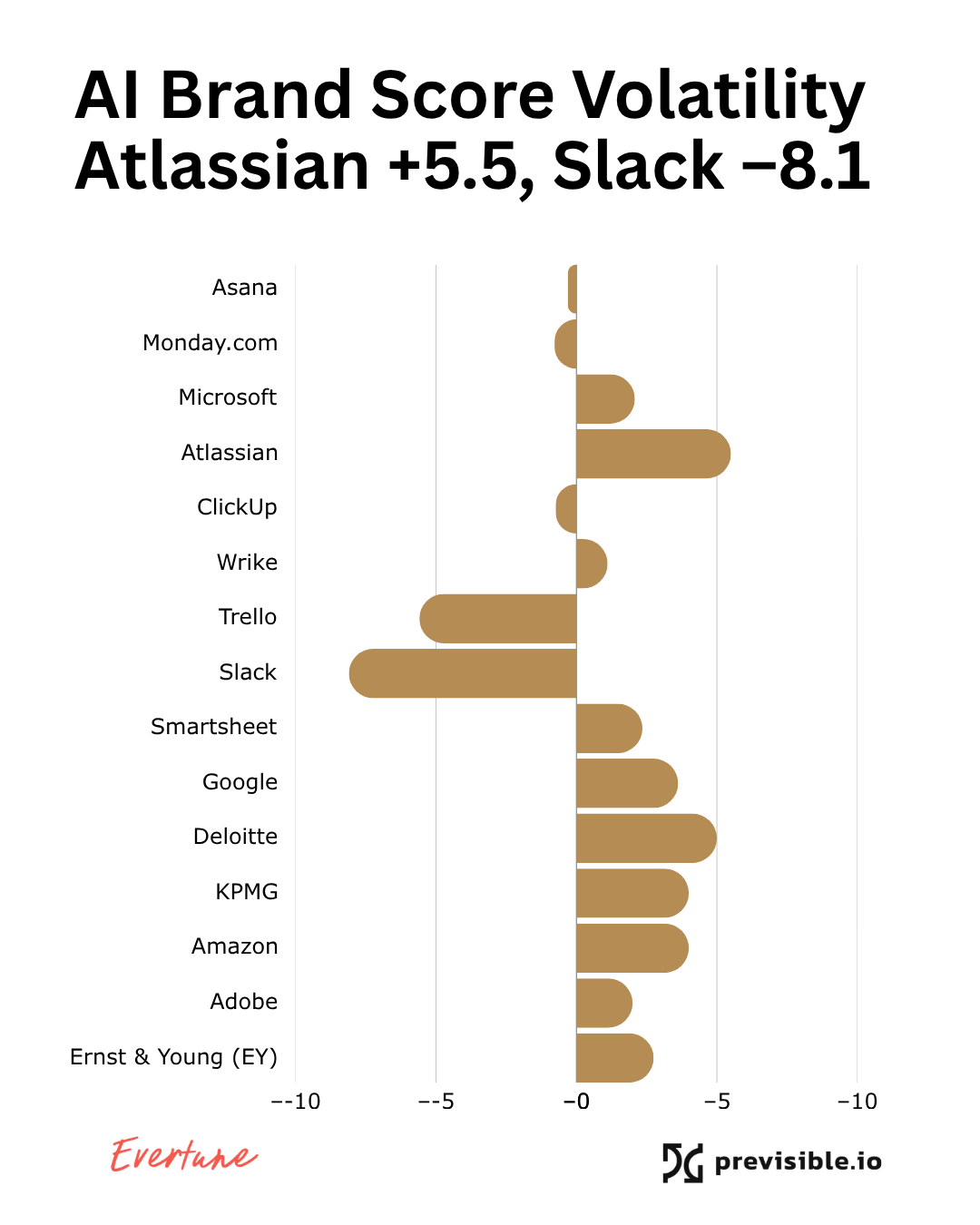
September to October shifts highlight considerable changes in the internal brand landscape of AI models. Notably, Slack saw a significant decline, while Atlassian experienced a boost.
This seemingly simple reshuffle reveals a deeper transformation in AI’s nonspecific brand awareness, altering how the model discerns and prioritizes brands despite market stability.
The meaning behind the drift
We’re seeing two main forces driving these shifts:
Category entanglement
Rather than declining, categories are blurring — project management tools are being integrated into broader conceptual frameworks.
- Operations
- Digital transformation
- Workflow orchestration
- Enterprise productivity
- IT consulting
Names like Deloitte and KPMG rise alongside Smartsheet and Atlassian.
Ecosystem advantage
Brands with multi-product ecosystems are getting noticed more. Atlassian’s lift, for example, stems from its robust documentation and integration abilities. Brands like Microsoft, Google, and Amazon are also seeing positive movement.
Models increasingly prefer brands that span multiple ecosystems, echoing entity-based SEO patterns but at a faster, more volatile pace.
Dig deeper: Alignment for LLM visibility is incredibly complex, but doable
New entrants, new patterns
We observe emerging trends in newer brands like Celoxis and Workfront, showcasing how fine-tuned LLMs draw from diverse datasets.
- SaaS directories
- GitHub repositories
- Technical documentation
- Reviews
- Community content
For smaller B2B brands, this represents a gateway to visibility without needing to dominate traditional SEO metrics.
Why this shift matters for B2B discovery – and why it’s speeding up
Traditional SEO focuses on visible search results, whereas LLMs synthesize knowledge based on associations and contextual richness.
This means that brand recall in AI systems relies on deeper semantic connections, and these can fluctuate significantly over short periods.
Understanding and leveraging this LLM perception drift is crucial — being consistently recognized in AI outputs is now as vital as traditional search rank.
Dig deeper: Why AI availability is the new battleground for brands
A new AI optimization KPI: AI brand signal stability
In working with B2B clients, we’re focusing on AI brand signal stability as an emerging metric — tracking how consistently a brand’s presence is maintained in AI outputs.
Fluctuations suggest fragile brand perception, influenced by data changes and model retraining, while stable scores indicate strong semantic grounding.
In coming years, AI brand signal stability will be essential alongside share of voice and traditional SEO metrics.
From project management to every B2B vertical
This transformation isn’t limited to project management — it’s happening across all B2B sectors.
The recalibration of category contexts by AI models alters the buying journey, influencing brand appearance in AI-generated content.
The rise or fall of brand attention affects which brands occupy summative or comparative outputs, making AI memory a new realm of marketing focus.
Dig deeper: LLM perception match: The hurdle before fanout and why it matters
The next frontier of optimization
This shift marks SEO’s evolution — from focusing on search indices to emphasizing model memory optimization. Our goals now include measuring how AI interprets and recalls brand identity.
It’s about ensuring that AI systems correctly interpret and represent brands across their expansive digital landscapes.
This demands new strategies and tools tailored to how dynamic perception systems function, rather than treating them as static outcomes.
Evertune’s dataset highlights more than monthly position changes — it showcases a quick shift in AI’s category perception, which marketing teams must monitor to stay competitive.
By 2026, brand appearance in AI-generated summaries will play a bigger role in decision-making than traditional metrics like pageviews or clicks. Brands that effectively manage their model-driven visibility will set themselves apart as AI becomes a mainstay in digital research.
Inspired by this post on Search Engine Land.

Leave a Reply