Category: Opinion

  • Embrace Positionless Marketing: Think Beyond Traditional Limits

    Embrace Positionless Marketing: Think Beyond Traditional Limits

    In 1997, Apple launched a groundbreaking campaign that I often think about: “Think Different”. It celebrated those who dared to break the mold, challenging norms to change the world. Apple grasped a vital truth: the constraints stifling creativity weren’t real; they were assumed, passed down through tradition.

    Fast forward to today, and I see that marketing finds itself in a similar “Think Different” moment. The barriers that once constrained our industry have vanished. Thanks to technology, AI generates countless variations, data platforms provide up-to-the-minute insights, and orchestration tools bridge every channel instantaneously.

    Yet, I notice many marketers are still functioning within an outdated paradigm. They wait for others—the data teams, creative teams, or engineers—to move projects along, not realizing technology has already unlocked those doors.

    We no longer need to follow a linear, assembly-line process that passes tasks from one department to the next. The box has disappeared, but old habits die hard.

    Here’s to the marketers who refuse to wait for approval

    I find inspiration in those who see a customer need at 3 p.m. and launch a personalized campaign by 4 p.m., driven by urgency rather than seeking permission.

    These are the marketers who don’t send multiple briefs to multiple teams—they pull the data, create content, and execute campaigns independently. Not to sideline experts, but to seize on moments that matter now.

    Their constant experimentation, running multiple tests and iterations, proves essential in crafting insights. They know, as I do, that perfection comes from trial and error, not waiting around for analysis.

    Here’s to the ones who see campaigns where others see dependencies

    For them, it’s not about passing data to an analytics team; it’s about directly accessing and utilizing customer insights instantly.

    They bypass traditional creative approvals with AI tools that produce tailored assets swiftly, enabling personalization on a grand scale.

    They aren’t beholden to engineering delays but leverage orchestration platforms to automate journeys smoothly, sans tickets.

    They’re not reckless nor cowboys

    Instead, they work at the speed technology allows, guided by strategic thinking and judgment rather than rigid processes.

    This ethos is at the heart of Positionless Marketing: using Data, Creativity, and Optimization powerfully and in tandem, not due to a lack of specialists, but because technology removed those earlier dependencies.

    This isn’t just about speed; it’s about potential

    In times when marketers managed long processes, their role was merely about coordination. Today, I see it as enabling potential, pushing everyone, including you and me, to do what we’re capable of with unchained boundaries. I no longer see the brief as a roadblock, but a stepping stone to instant creativity and autonomous coordination.

    Teach people to think outside the box by showing them there is no longer a box

    Now, I can see how the data analyst can transcend report creation to build real-time predictive models. The campaign manager can independently design, test, and optimize entire journeys. The creative strategist can not only craft briefs but execute ideas across platforms.

    This is the real impact of technology; not just getting the work done, but dismantling barriers that once held us back, releasing the talents we’ve always possessed.

    The Positionless Marketers of today are doing the same thing

    They refuse to delay action when immediate responses are needed. They reject the notion that insights take forever when available in seconds. They aren’t bound by bygone constraints.

    By thinking differently, not for defiance’s sake, but because the past ways no longer align with the new potential.

    Apple once said, “The people who are crazy enough to think they can change the world are the ones who do.” In our era, those who believe they can seamlessly deliver customized experiences and instigate rapid-fire campaigns without relying on dependencies will lead the charge.

    The constraints are gone. The assembly-line marketing box can no longer exist.


    Inspired by this post on Search Engine Land.


    crushpress.ai community screenshot
  • Best AI Tools for PPC and Social Campaigns You Need Now

    Best AI Tools for PPC and Social Campaigns You Need Now

    As a performance marketer, I’ve realized that leveraging AI is crucial for growth and efficiency, especially as we advance into 2026 and beyond.

    Anyone not exploring new AI tools to enhance or streamline their PPC efforts is missing out on a significant opportunity for their brand or clients.

    The rapid pace at which these tools evolve can make it feel like a full-time job to keep up, which is why my agency prioritizes AI in our knowledge-sharing sessions.

    As a team, we’ve distilled our top picks for creative, campaign management, and AI search measurement tools.

    This article will guide you through essential tools in each category, providing quick reviews and highlighting my current favorite.

    One key piece of advice before diving in: Be cautious about long-term contracts with AI tools, as today’s sensation might be tomorrow’s obsolete tool.

    AI Creative Tools for Paid Social Campaigns

    With numerous tools available for generating creative assets, each offers unique benefits but also carries the risk of creating subpar AI content.

    Whatever tool you choose, ensure it undergoes rigorous testing and is backed by a robust human-in-the-loop process to maintain quality, accuracy, and brand alignment.

    Here’s a summary of tools we’ve evaluated:

    • AdCreative.ai: Generates images, video creatives, ad copy, and headlines efficiently, with data-backed scoring.
    • Creatify: Excels in video ads and supports diverse formats.
    • WASK: Merges AI creative generation with campaign optimization and competitor analysis.
    • Revid AI: Suited for story format creation.
    • ChatGPT: A familiar, free tool that gives marketers an edge in crafting effective prompts.

    Currently, I favor AdCreative.ai. It simplifies brainstorming creative concepts and testing variations quickly.

    It offers significant advantages like:

    • Creating multiple variants swiftly to keep creative fresh and combat ad fatigue.
    • Reducing dependence on external designers for repetitive or template-based content.
    • Experimenting with various creative elements rapidly to determine winning combinations.
    • Providing data-driven insights such as creative performance predictions.

    However, always ensure you establish:

    • Guardrails to prevent off-brand outputs with clear voice guides and style rules.
    • Verification processes to catch errors in technical claims or data.
    Dig deeper: How to get smarter with AI in PPC

    AI Campaign Management and Workflow Tools for Performance Campaigns

    In the realm of workflow automation tools like Zapier, Workato, and Microsoft Power Automate, our agency prefers n8n for its flexibility in creating agentic workflows and integrations.

    ```json
{
  "alt": "SEMRUSH ad promoting AI optimization with brand share of voice chart at 70%.",
  "caption": "Explore the future of search with SEMRUSH's AI Optimization. Discover if your brand will be seen in the changing digital landscape.",
  "description": "This SEMRUSH advertisement highlights the importance of AI optimization in modern search strategies. The image features a brand share of voice chart indicating 70%, along with a list of AI tools like Perplexity, Gemini, ChatGPT, and Claude. A call-to-action button invites users to get a demo. The vibrant purple design emphasizes innovation and technology. Keywords: AI optimization, SEMRUSH, brand visibility, search tools, digital marketing."
}
```

    Our primary n8n use cases include:

    • Lead management: Enhance and route leads automatically with the integration of Clearbit and CRMs.
    • UTM cleanup: Normalize UTM parameters automatically for accurate CRM entry.
    • Data reporting: Fetch metrics, structure data, and use AI to summarize insights, sharing them via Slack or collaborative tools.

    Be aware of potential challenges with n8n:

    • Requires technical knowledge of APIs, JSON, and authentication methods.
    • Security setups are necessary to protect data; misconfigured systems can pose risks.
    • Lacks some ad platform integrations which require more manual work.
    Dig deeper: Top AI tools and tactics you should be using in PPC

    AI Search Visibility Measurement Tools

    Most SEOs rely on platforms like Semrush, Moz, and SE Ranking, yet tracking AI search visibility requires specialized tools like Profound.

    Profound provides valuable persona-level and competitor-level insights, linking them to strategic levers for actionable insights.

    It offers quick access to insights like:

    • Benchmarks against competitors showing AI visibility strengths and gaps.
    • Messaging intel from AI about brand solutions to refine content and messaging.
    • Signals improving brand consistency and favorability in AI results.
    • Trends in AI’s influence on search results and user behavior.
    • Insights revealing AI model-generated brand narratives.
    • Opportunities to influence brand perception in AI answers.

    Choosing a tool quickly is crucial to gather data on shifting AI search trends and adjust strategies effectively.

    Dig deeper: Scaling PPC with AI automation: Scripts, data, and custom tools

    What Remains True as the AI Toolset Evolves

    While I strive for my content to remain relevant over time, I’m aware that this piece may become more of a historical reference.

    Nonetheless, the need to:

    • Stay updated on AI developments.
    • Vigorously test new capabilities and features.
    • Foster strong knowledge-sharing within the team remains essential.

    Though AI in performance marketing has grown rapidly, there’s still room for teams that adapt quickly, conduct strategic testing, and pivot effectively to differentiate themselves.

    Dig deeper: AI agents in PPC: What to know and build today


    Inspired by this post on Search Engine Land.

    crushpress.ai community screenshot
  • Mastering SEO Tool Evaluation in 2026: Avoid Budget Pitfalls

    Mastering SEO Tool Evaluation in 2026: Avoid Budget Pitfalls

    As I navigate the ever-evolving world of SEO, evaluating tools in 2026 has become a complex task. Rising costs and the AI frenzy often make it difficult to justify the investment in new platforms.

    The challenge lies in demonstrating the business value of these tools to leadership, who are more interested in results than in the number of keywords we can track or the speed of content optimization.

    Most tools fail to meet the demand to connect SEO work directly to business outcomes. The offerings often come bundled in convoluted packages, further complicating the decision-making process.

    This article offers a framework to approach SEO tool evaluation in 2026, focusing on must-have features, efficient tool comparison methods, and effective vendor conversations.

    Understanding the forces reshaping SEO tools can help. Many platforms lag in connecting SEO to measurable business value, complicating budget approvals.

    AI advancements are setting new expectations. Whether to train a custom AI agent or invest in a ready-made tool is a key question every team faces.

    Small teams need automation that truly saves time. Without context, many tools only generate noise, failing to deliver tailored insights for specific markets or businesses.

    Technical SEO tools remain relatively stable, yet the assumption that AI can solve all problems presents a budgeting challenge.

    Real impact in tool evaluation lies in focus areas like advanced data analysis, SERP intelligence, meaningful automation, robust multilingual support, and transparent pricing.

    To avoid wasting time comparing tools, start with clear pricing, align tests with typical weekly tasks, and ensure you always secure a free trial.

    When it comes to vendor interactions, concise goals and informed questions can streamline discussions and facilitate more productive evaluations.

    Business considerations should include presenting a range of options, avoiding overpromising, and ensuring that proposed tools align with strategic business objectives.

    As we look to the future of SEO tools, connecting searches to tangible business outcomes will define premium offerings, though such solutions remain rare.


    Inspired by this post on Search Engine Land.

    crushpress.ai community screenshot
  • How AI Perception Drift Will Redefine SEO Strategies by 2026

    How AI Perception Drift Will Redefine SEO Strategies by 2026

    I’m always fascinated by how technology evolves, especially when it comes to AI models. Recently, I stumbled upon some compelling data showing how these AI systems are reshaping brand hierarchies and influencing buyer decisions at an unprecedented speed.

    AI models like ChatGPT, Gemini, and Claude have become a part of our daily interactions, from search to content creation and product recommendations.

    According to a survey conducted by Responsive, a significant 80% of tech buyers now use generative AI to research vendors just as often as they use traditional search methods. This shift in how buyers build trust with AI-driven discovery tools quietly determines which brands stay top-of-mind and which fade into oblivion.

    At Previsible, we’ve been analyzing this intriguing phenomenon through what we call LLM perception drift. It’s a new metric revealing how AI models are dynamically organizing brands within specific categories over time. (Disclosure: I am the CEO and co-founder of Previsible.)

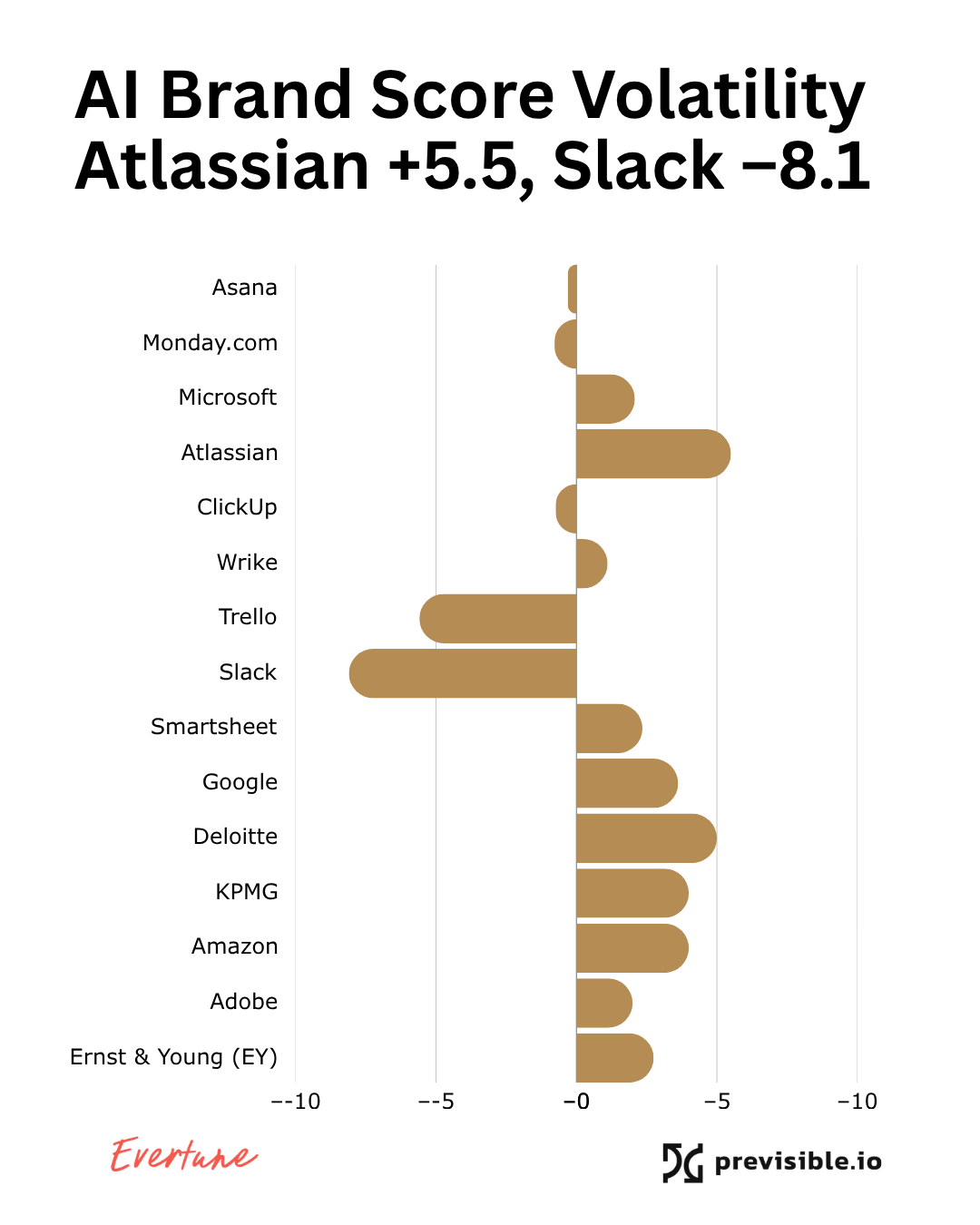
    Our case study on project management software, comparing data from September to October 2025, highlights just how quickly AI brand perception can change. This volatility is set to become the next major metric for SEO strategies.

    Key insights

    • The concept of LLM perception drift is emerging as a crucial visibility metric in SEO and B2B marketing.
    • Brands like Atlassian gained prominence, while others like Trello and Slack saw declines, indicating the dynamic nature of AI perception.
    • Understanding AI brand perception is pivotal for marketers aiming to grasp authority and relevance in language models.
    • By 2026, maintaining digital visibility will hinge on AI brand signal stability as LLMs rapidly evolve.

    A subtle shake-up inside the AI mind

    Evertune’s AI brand score provides insights into how likely a model is to recommend a brand without specific prompting. It measures both visibility and ranking within AI responses.

    September to October shifts highlight considerable changes in the internal brand landscape of AI models. Notably, Slack saw a significant decline, while Atlassian experienced a boost.

    This seemingly simple reshuffle reveals a deeper transformation in AI’s nonspecific brand awareness, altering how the model discerns and prioritizes brands despite market stability.

    The meaning behind the drift

    We’re seeing two main forces driving these shifts:

    Category entanglement

    Rather than declining, categories are blurring — project management tools are being integrated into broader conceptual frameworks.

    • Operations
    • Digital transformation
    • Workflow orchestration
    • Enterprise productivity
    • IT consulting

    Names like Deloitte and KPMG rise alongside Smartsheet and Atlassian.

    Ecosystem advantage

    Brands with multi-product ecosystems are getting noticed more. Atlassian’s lift, for example, stems from its robust documentation and integration abilities. Brands like Microsoft, Google, and Amazon are also seeing positive movement.

    Models increasingly prefer brands that span multiple ecosystems, echoing entity-based SEO patterns but at a faster, more volatile pace.

    Dig deeper: Alignment for LLM visibility is incredibly complex, but doable


    New entrants, new patterns

    We observe emerging trends in newer brands like Celoxis and Workfront, showcasing how fine-tuned LLMs draw from diverse datasets.

    • SaaS directories
    • GitHub repositories
    • Technical documentation
    • Reviews
    • Community content

    For smaller B2B brands, this represents a gateway to visibility without needing to dominate traditional SEO metrics.

    Why this shift matters for B2B discovery – and why it’s speeding up

    Traditional SEO focuses on visible search results, whereas LLMs synthesize knowledge based on associations and contextual richness.

    ```json
{
  "alt": "Bar chart showing AI brand score volatility for companies like Atlassian, Slack, Microsoft.",
  "caption": "AI Brand Score Volatility: Atlassian excels with a +5.5 score, contrasting Slack's dip to -8.1. Discover how leading companies fluctuate in AI perception.",
  "description": "The image is a bar chart depicting the volatility of AI brand scores among various tech companies. Atlassian shows a significant positive change of +5.5, while Slack experiences a decline to -8.1. Other companies included in the chart are Asana, Monday.com, Microsoft, ClickUp, Wrike, Trello, Smartsheet, Google, Deloitte, KPMG, Amazon, Adobe, and Ernst & Young (EY). The bars, displayed horizontally, represent scores ranging from -10 to +10. The chart provides insights into the fluctuation of AI perceptions for these brands, useful for market analysis and strategic planning."
}
```

    This means that brand recall in AI systems relies on deeper semantic connections, and these can fluctuate significantly over short periods.

    Understanding and leveraging this LLM perception drift is crucial — being consistently recognized in AI outputs is now as vital as traditional search rank.

    Dig deeper: Why AI availability is the new battleground for brands

    A new AI optimization KPI: AI brand signal stability

    In working with B2B clients, we’re focusing on AI brand signal stability as an emerging metric — tracking how consistently a brand’s presence is maintained in AI outputs.

    Fluctuations suggest fragile brand perception, influenced by data changes and model retraining, while stable scores indicate strong semantic grounding.

    In coming years, AI brand signal stability will be essential alongside share of voice and traditional SEO metrics.

    From project management to every B2B vertical

    This transformation isn’t limited to project management — it’s happening across all B2B sectors.

    The recalibration of category contexts by AI models alters the buying journey, influencing brand appearance in AI-generated content.

    The rise or fall of brand attention affects which brands occupy summative or comparative outputs, making AI memory a new realm of marketing focus.

    Dig deeper: LLM perception match: The hurdle before fanout and why it matters

    The next frontier of optimization

    This shift marks SEO’s evolution — from focusing on search indices to emphasizing model memory optimization. Our goals now include measuring how AI interprets and recalls brand identity.

    It’s about ensuring that AI systems correctly interpret and represent brands across their expansive digital landscapes.

    This demands new strategies and tools tailored to how dynamic perception systems function, rather than treating them as static outcomes.

    Evertune’s dataset highlights more than monthly position changes — it showcases a quick shift in AI’s category perception, which marketing teams must monitor to stay competitive.

    By 2026, brand appearance in AI-generated summaries will play a bigger role in decision-making than traditional metrics like pageviews or clicks. Brands that effectively manage their model-driven visibility will set themselves apart as AI becomes a mainstay in digital research.


    Inspired by this post on Search Engine Land.


    crushpress.ai community screenshot
  • Accelerate B2B Optimization with Proxy Metrics

    Accelerate B2B Optimization with Proxy Metrics

    Embarking on the complex B2B journey can feel like navigating a labyrinth. I know this from firsthand experience, especially when it comes to optimizing campaigns amidst long sales cycles and low conversion volumes.

    In the realm of selling high-value items, waiting for months to see tangible results can be frustrating. That’s where I discovered the power of proxy metrics, or micro-conversions, to drive faster optimization.

    Let’s dive into the specifics of proxy metrics and their transformative impact on B2B campaigns.

    Understanding Proxy Metrics

    From my perspective, proxy metrics are like the early indicators of success that help predict final outcomes. Think of them as a weather vane pointing towards future achievements.

    Engagement rates hint at potential conversions, while add-to-cart events often precede sales. Watching these early signs allows me to course-correct campaigns sooner and optimize budget allocations.

    Proxy metrics also prove invaluable when navigating Google’s 90-day latency window. I’ve learned to identify key predictors within this time frame to maintain tracking efficiency.

    Dig deeper: How to use GA4 predictive metrics for smarter PPC targeting

    Enhancing Algorithmic Bidding with Proxy Metrics

    In my work with digital ad platforms like Google and Meta, I’ve seen the crucial role of machine learning in campaign optimization. Feeding these systems with early signals like micro-conversions enhances their ability to target quality users effectively.

    ```json
{
  "alt": "Digital illustration of a correlation funnel showing predictors like engaged sessions, newsletter signups, and add to cart leading to sales.",
  "caption": "Unlocking Sales Success: A visual guide to the correlation funnel, showcasing how online activities like engagement and signups drive sales.",
  "description": "This image illustrates a correlation funnel concept, displaying predictors such as engaged sessions, newsletter signups, and cart additions funneling into sales. The diagram highlights the importance of each component in the digital sales process. Keywords: correlation funnel, predictors, sales strategy, digital marketing."
}
```

    With metrics like time on site and scroll depth, I can refine targeting even when conversion data appears sparse, creating training signals that define algorithms’ paths.

    Building Audiences and Gaining Insights with Proxy Metrics

    Segmentation through proxy metrics opens up smarter audience building. By identifying engaged users, I craft lookalike audiences that mirror high-value customers, shifting focus from mere click-through metrics.

    I’m also able to expedite testing cycles by employing leading indicators instead of waiting for long-term data, thereby speeding up hypothesis validations and subsequent decisions.

    Proxy metrics frequently offer more robust statistical significance in models than distant revenue markers, enabling reliable market assessments.

    Evaluating the Trustworthiness of Proxy Metrics

    I’ve learned that not all proxy metrics pack the same punch. Some signal genuine interest more effectively than others. Newsletter signups, for example, often predict engagement, whereas add-to-cart events can be misleading due to frequent abandonment.

    To choose the right proxies, I measure correlation strength, timeliness, actionability, and stability to ensure they provide reliable guidance for strategic decisions.

    By focusing on these factors, I navigate the intricate path of B2B optimization with confidence, leveraging insights to drive impactful outcomes.


    Inspired by this post on Search Engine Land.


    crushpress.ai community screenshot
  • Submit Your Cutting-Edge Session for SMX Advanced 2026

    Submit Your Cutting-Edge Session for SMX Advanced 2026

    I’m excited to share with you that SMX Advanced is gearing up to make its mark in Boston from June 3rd to 5th, 2026, hosted at the Westin Boston Seaport. This is the premier event for those of us committed to mastering search marketing.

    We’re really keen on highlighting the advanced strategies in SEO, PPC, and AI, and we can’t do it without your expertise.

    The world of search is evolving incredibly fast.

    As SEOs, we find ourselves adapting to AI SEO trends, making sense of AI Overviews dominating SERPs, and navigating Google’s ever-changing landscape and algorithm updates.

    For those in PPC, there’s the challenge of making informed, data-driven decisions while seamlessly integrating new AI tools and maintaining that essential human touch.

    We’re looking for speakers at SMX Advanced who can provide real solutions to these complex issues.

    Do you have proven, high-level strategies for today’s marketing landscape? Now is the perfect time to share your session idea with us. Even if you haven’t spoken at SMX before, in person or virtually, we encourage diverse voices and perspectives to come forward.

    The deadline for submitting your SMX Advanced session pitch is January 30th. Don’t delay—spots are limited and fill up quickly.

    Consider these tips for crafting a compelling session proposal:

    Ensure that your topic is truly advanced and tailored for intermediate to advanced professionals in search marketing.

    Introduce an original idea or a unique session format.

    Include a case study or specific examples to illustrate your points.

    Be mindful of what can realistically be covered in a 20-minute timeframe.

    Provide clear, actionable takeaways for participants to implement.

    Clarify what skills or insights attendees will gain from your session.

    Don’t forget to check out our guide to speaking at SMX for more details on the submission process. When you’re ready, create your profile and send us your pitch!

    If you have any questions, drop me an email at kathy.bushman@semrush.com. I can’t wait to see what you come up with!


    Inspired by this post on Search Engine Land.

    crushpress.ai community screenshot
  • Master Off-Page SEO: Build Authority and Visibility

    Master Off-Page SEO: Build Authority and Visibility

    I’ve learned that off-page SEO has come a long way from just building links. It’s now about crafting strategies that enhance authority, reputation, and visibility across various platforms.

    In today’s fast-evolving digital landscape, search has moved well beyond simple blue links. Now, people find information not just on Google but also on platforms like TikTok, Pinterest, Amazon, and YouTube, as well as AI systems that provide synthesized answers from trusted sources.

    As search engine results pages (SERPs) shift towards rich results and AI summaries, users can get what they need without even clicking. This change means brand authority extends beyond your website’s domain; it crosses platforms and content formats, influencing how AI systems learn from and use your content.

    Modern off-page SEO demands strategies that cater to both search engines and AI models that recognize and highlight your expertise. This guide delves into what off-page SEO tactics work today and offers best practices for 2026.

    What is off-page SEO today?

    Off-page SEO encompasses all efforts made beyond your website to elevate its ranking and visibility in search engines. It includes strategies to secure inbound links, citations, and brand mentions, each contributing to your site’s authority and search engines’ trust.

    Over time, search algorithms have advanced. While earlier algorithms focused heavily on backlinks to assess domain authority, search engines like Google now use a diverse array of factors, including expertise, authoritativeness, trustworthiness, and experience, commonly referred to as E-E-A-T.

    Enhancing E-E-A-T involves:

    • Producing content with actual subject-matter experts.
    • Being transparent about your information sources and company details.
    • Gaining citations and mentions from authoritative sites relevant to your industry.
    ```json
{
  "alt": "Venn diagram illustrating Off-Page, On-Page, and Technical SEO elements.",
  "caption": "Explore the vital components of SEO: Off-Page, On-Page, and Technical. This Venn diagram illustrates the synergy needed for effective search optimization.",
  "description": "This image is a Venn diagram detailing three core SEO components: Off-Page SEO, On-Page SEO, and Technical SEO. Off-Page SEO focuses on generating inbound links and brand mentions from third-party websites. On-Page SEO is about optimizing website content for specific keywords and user experience. Technical SEO involves optimizing the crawlability and indexation of a website. This comprehensive view helps in understanding the different aspects of search engine optimization."
}
```

    Throughout this discussion, I prefer using the term “inbound links” instead of “backlinks,” as it carries fewer negative connotations associated with outdated, manipulative practices. The focus is on earning connections that are authoritative and relevant, offering genuine value to users.

    This approach reflects a broader strategy—link building as a content-driven initiative, not a manipulative shortcut.

    How important is off-page in your overall SEO strategy?

    Off-page SEO is critical to building your site’s credibility. Each link or mention serves as an endorsement of your brand, akin to word-of-mouth recommendations, thus influencing your online reputation positively.

    The more high-quality, relevant endorsements from credible sources you receive, the more authoritative your website appears to search engines.

    Off-page and the rise of answer optimization

    In today’s AI-driven search landscape, off-page SEO’s importance is magnified. AI systems not only index content but also interpret, summarize, and generate answers based on reliable sources.

    This means that off-page signals like brand mentions, links, and social sentiment shape not only Google rankings but also how AI models perceive your brand’s authority.

    Structured data, a consistent brand identity, and third-party mentions are crucial for AI to connect your content with relevant topics, ensuring visibility and authority in AI-generated answers.


    Inspired by this post on Search Engine Land.


    crushpress.ai community screenshot
  • How New AI Models Are Disrupting My SEO Strategies

    How New AI Models Are Disrupting My SEO Strategies

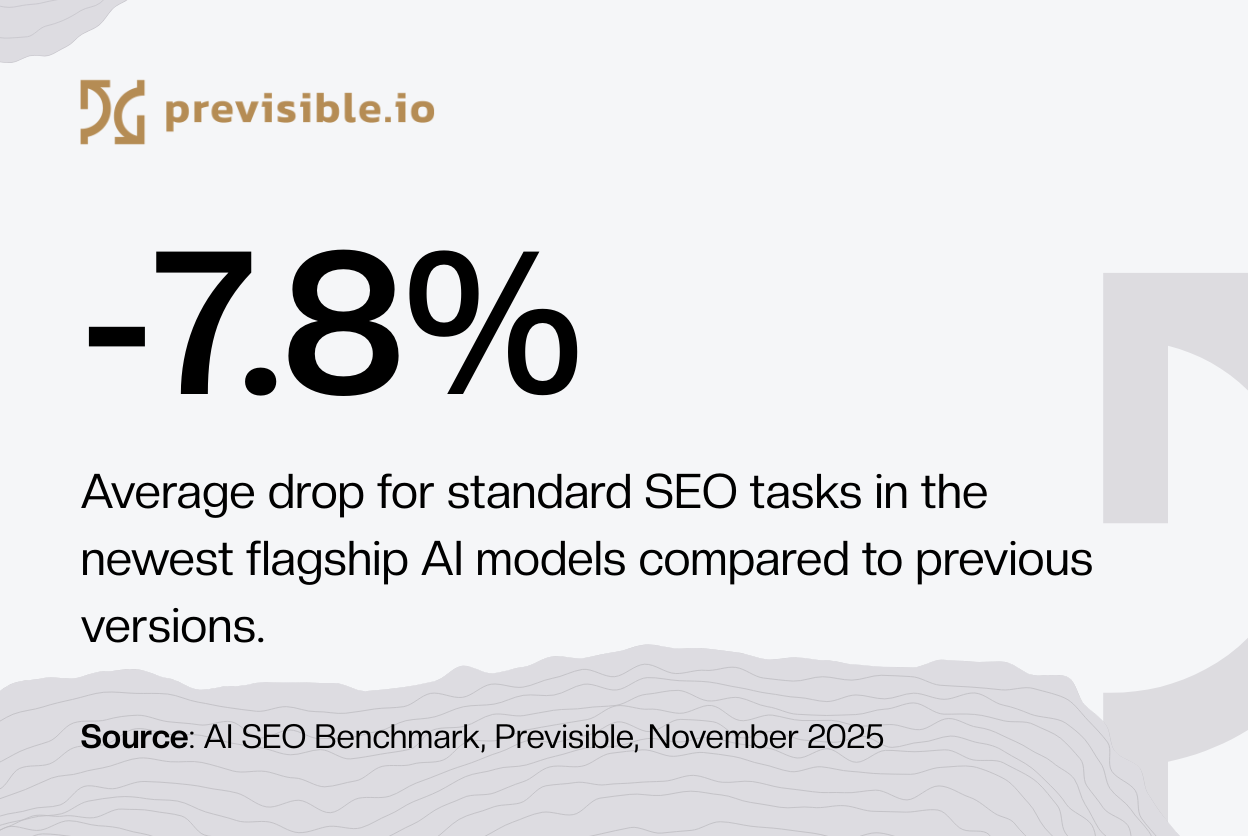
    I’ve noticed a startling trend with the latest AI models: they’re wreaking havoc on my SEO workflows. The recent benchmark results show that there’s a significant 9% drop in SEO accuracy with newer models like Claude, Gemini, and GPT.

    It turns out, these AI models aren’t just glitching—it’s all part of how they’re optimized now for deeper reasoning rather than giving quick, straightforward answers.

    Last year, it was easy to think that newer meant better. But the results from our AI SEO benchmark with Claude Opus 4.5, Gemini 3 Pro, and ChatGPT-5.1 Thinking make it clear: newer models aren’t just failing to improve, they’re actually less effective.

    ```json
{
  "alt": "Previsible.io reports a 7.8% decrease in SEO task performance for new AI models, November 2025.",
  "caption": "New benchmark by Previsible.io reveals a 7.8% drop in SEO efficiency of the newest AI models, challenging industry standards.",
  "description": "An infographic by Previsible.io highlights a 7.8% decrease in standard SEO task performance of the latest flagship AI models compared to previous versions, as per the AI SEO Benchmark report in November 2025. This suggests a potential concern for businesses relying on these technologies for SEO purposes. The report's findings are presented with a clean, modern design featuring a wavy pattern at the bottom, enhancing its visual appeal."
}
```

    I can no longer rely on models out of the box. If I want to get back to, or surpass, the accuracy benchmarks, I need to focus on structuring my workflow differently. Just using raw prompts isn’t going to cut it anymore.

    One of the biggest shifts I need to make is moving away from the chat interface and towards more structured workflows. This means considering tools like OpenAI’s Custom GPTs or Google’s Gemini Gems.

    ```json
{
  "alt": "Table comparing language models with scores, percentage difference, and release dates.",
  "caption": "Explore the latest performance stats of leading language models, along with their scores and release dates. Which model stands out for you?",
  "description": "This image features a comparison table of three language models: Claude Opus 4.5, Gemini 3 Pro, and Chat GPT-5.1 Thinking. Each model is evaluated with a score out of 100, with Claude Opus 4.5 scoring 76%, Gemini 3 Pro at 73%, and Chat GPT-5.1 Thinking leading with 77%. The table highlights the negative percentage differences compared to previous versions, denoted in red: -8%, -9%, and -6%, respectively. Additionally, the release dates are listed as November 24, 2025, November 18, 2025, and November 12, 2025."
}
```

    I’ve realized that hard-coding context is crucial. Without strict guidelines, these models stray, giving generic instead of tailored advice.

    The key takeaways for me are clear: I shouldn’t rush to upgrade to the newest models simply because they’re the latest. I shouldn’t be stuck on single prompts without robust contextual backgrounds either.

    In this new age of AI agents, my role isn’t becoming obsolete. Instead, it’s evolving, requiring me to architect AI systems and apply my judgment to refine and steer outputs effectively.


    Inspired by this post on Search Engine Land.


    crushpress.ai community screenshot
  • Inside Google’s Overambitious Daily Hub Revolutionizing Search

    Inside Google’s Overambitious Daily Hub Revolutionizing Search

    I recently delved into the enigmatic world of Google’s Daily Hub, a complex system aiming to redefine how we interact with search. At its core, Daily Hub sought to seamlessly integrate embeddings, entities, and real-time context. Unfortunately, the system crumbled under the weight of its own complexity.

    The Daily Hub is far more intricate than many of us originally thought. It represents a broader trend toward hyperpersonalization we’ve seen lately. Elements like Preferred Sources and followable profile pages in Discover are steadily headed toward predicting what I need even before I type my queries.

    Tracing its roots, Daily Hub extends from the “News Digest and Daily Brief” agent, which surfaced during my exploration into Google’s vast, ongoing AI initiatives. This system launched with much fanfare on the Pixel 10, yet was swiftly paused due to its intricate technical web.

    The Daily Hub’s Three-Tier Architecture

    Imagine Google’s system as a grand conductor, coordinating a diverse ensemble in real-time harmony. This is precisely the vision for Daily Hub.

    First Tier: The ‘Memory and Embeddings’ Layer

    Daily Hub’s foundation is built on two key document types, forming its memory.

    The MemoryDocument encapsulates full content units, complete with structured text, entity identifiers from the Knowledge Graph, comprehensive embeddings, and essential technical metadata.

    There’s also the MemoryEntityDocument, a leaner form that embodies each specific entity highlighted in the content.

    In practice, if Daily Hub processes an article about “Lionel Messi joining Inter Miami,” it constructs a MemoryDocument for the article and various entity documents for involved topics like “Lionel Messi” and “Inter Miami CF.”

    Second Tier: The Personalization Triumvirate

    Various systems power the personalization aspect of Daily Hub, ensuring its response to personalized searches and updates is both swift and attuned to individual preferences.

    Nephesh, known for refining user interests, AIP_TOP_ENTITIES, and TAPAS_USER_PROFILE each contribute to crafting a unique user interaction experience by leveraging behavior and contextual data.

    ```json
{
  "alt": "Flowchart depicting data processing from inputs to outputs involving various stages like signal processing, entity ranking, and behavior analysis.",
  "caption": "This flowchart visualizes a data processing pipeline, showcasing steps from capturing user signals to creating personalized content cards using AI models.",
  "description": "The image is a flowchart illustrating a complex data processing pipeline. It starts with inputs such as user signals, knowledge graph data, behavioral profiles, and memory layers. These inputs are processed through stages like NEPHESH for signal processing, AIP Top Entities for entity ranking, and TAPAS User Profile for behavioral analysis. Outputs such as AMBIENTRANKING algorithms yield personalized content cards. The system integrates AI models like GEMINI 2.5 FLASH LITE, showing a sophisticated process for generating data-driven results."
}
```

    Third Tier: ‘Ambient’ Orchestration

    In this realm, the AmbientRanking system oversees card presentations, using metadata to refine user experiences based on relevance and timeliness.

    For example, sports scores and calendar events are prominently displayed when their relevance is at its peak, ensuring my engagement with timely content.

    Understanding Gemini Prompts

    Andell’s documentation of Gemini’s prompts offers unparalleled insights into the system’s strategic thinking.

    Prompt ‘News Topics’: News over 7 Days

    With precise formatting and numerous constraints, this prompt identifies and summarizes pertinent news while meticulously adhering to laid down thematic boundaries.

    The prompt logic considers only the top interests and excludes unnecessary themes, maintaining focus solely on pertinent areas.

    A System with Potential: The Journey Ahead

    Despite its hiccups, Daily Hub is a prototype that embodies Google’s goal to create an assistant capable of forecasting our needs through sophisticated data integration and hyper-personalized content delivery.

    As these technical hurdles are addressed, I anticipate a transformation in how I interact digitally, setting a new standard for search interfaces.

    From today’s suspended project to tomorrow’s blueprint for digital interaction, Google’s vision pivots on delivering a groundbreaking consumer experience.


    Inspired by this post on Search Engine Land.


    crushpress.ai community screenshot
  • How AI Revolutionizes Ad Rankings: Winning the Top Spot

    How AI Revolutionizes Ad Rankings: Winning the Top Spot

    The position of ads is more crucial than ever. I’ve recently come across new data that underscores how Google AI Overviews are reshaping paid search visibility and click-through rates (CTR).

    In my experience, Google’s AI Overviews have dramatically altered the search landscape almost overnight. As someone deeply invested in paid search, I’ve noticed the battle for visibility isn’t just about ad rank anymore—it’s about appearing above the AI results.

    This change is part of a rapid surge in AI Overviews, which I discovered in Adthena’s earlier study. My analysis found that AI Overviews are now trespassing into short, high-volume commercial searches.

    The underlying mechanism causing this is pretty clear to me: AI Overviews intercept user attention, slash CTRs, and push both organic and paid listings lower down the page. As a result, clicks and revenue take a hit.

    From what I’ve seen in Adthena’s latest research, it accurately identifies how often advertisers secure top ad positions above AI Overviews across seven major industries, device types, and query categories. The research highlights clear leaders and provides actionable strategies for the rest of us in paid search.

    The topline reality: Ad position visibility is lost 25% of the time

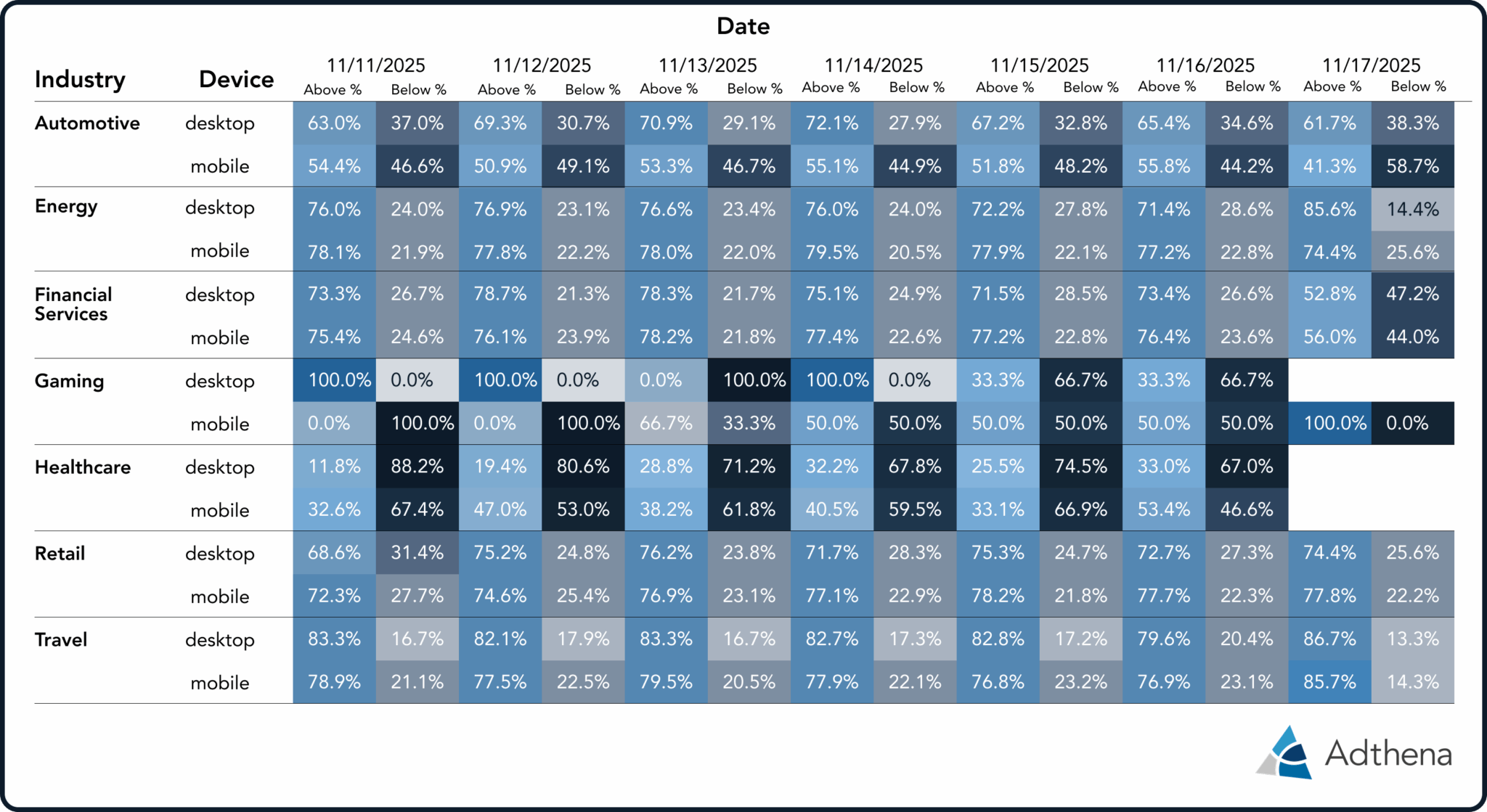
    The industry benchmark table below reveals how fierce the fight is for the top spot. It shows us the percentage of ads that appear either above or below AI Overviews across seven industries.

    ```json
{
  "alt": "Industry performance chart showing percentage above and below average for Automotive, Energy, Financial Services, Gaming, Healthcare, Retail, and Travel sectors.",
  "caption": "Discover how different industries stack up in performance, with percentages showing which sectors lead and lag relative to the average.",
  "description": "This image is a chart detailing the performance of various industries, measuring percentages above and below average. It covers sectors such as Automotive, Energy, Financial Services, Gaming, Healthcare, Retail, and Travel. Automotive (62.3% above), Energy (76.9% above), and others are analyzed, with variables like Healthcare showing 35.4% above and 64.6% below. The chart is branded by Adthena for marketing and analysis insights."
}
```

    Strategic implications from the topline data

    • The leaders: Industries like Travel, Energy, Financial Services, and Retail consistently land above the AI Overviews in more than 75% of cases. However, I’ve noticed that even in these sectors, 1 in 4 paid ads are still affected. When keywords drive major revenue, that 20% to 30% exposure is a direct threat to ROI.
    • The runners-up (the risk of being hidden): Healthcare is a major outlier. Ads in this field often appear below AI Overviews 64.6% of the time, given the high-stakes nature and research-heavy aspect of healthcare searches. Google’s AI prioritizes “expert” information first, meaning healthcare ads see significantly less visibility.
    • The volatility: The gaming sector shows a clear 50/50 split. Visibility feels like flipping a coin, demonstrating to me the need for agile bidding strategies.

    The device divide: Why mobile is your biggest threat

    From what I’ve gathered, device-specific data indicates that ads are more likely to be displaced by AI Overviews in a mobile setting due to limited screen space.

    Strategic implications on device differences

    • Automotive’s Mobile Problem: Although Automotive shows strong “Above %” placement overall, daily trends are worrying. On mobile, ads are frequently buried by AI Overviews, making them invisible without extensive scrolling. This leads to diminishing visibility and CTR for us marketers.
    • The “double whammy”: In healthcare, desktop ads generally appear below AI Overviews, although mobile sometimes performs slightly better. It seems the AI Overviews box might be designed for mobile screens, occasionally allowing one or two ad slots to remain visible. However, desktop visibility still suffers greatly.
    • Actionable insight: Mobile is where AI Overviews present the greatest challenge. For industries like healthcare and gaming, where this is a significant problem, securing top ad positions is vital for survival.

    The query intent test: Where does AI Overviews win and lose?

    Generally, I’ve observed that long queries tend to be more informational and thus more likely to activate AI Overviews, while shorter ones are typically transactional. The table below unfolds a surprising industry pattern related to this.

    This table reveals the connection between query complexity (or user intent) and AI Overviews’ dominance, spread over query lengths from one to ten words.

    ```json
{
  "alt": "Heatmap showing percent above and below benchmarks for various industries and devices from 11/11/2025 to 11/17/2025.",
  "caption": "Explore industry trends with this heatmap displaying percentage data across devices from November 11 to 17, 2025, illustrating performance benchmarks.",
  "description": "This heatmap visualizes percentage data for industries like Automotive, Energy, and Gaming across desktop and mobile devices. It spans from November 11 to 17, 2025, showing percentages above and below benchmarks. Each cell is color-coded to reflect performance, providing a clear view of industry trends. Created by Adthena, this chart is useful for analyzing market variations and device-specific engagement with specific focus on sectors such as Financial Services, Healthcare, Retail, and Travel."
}
```

    Strategic implications on query intent

    1. AI Overviews dominance on the fringes:
      • Healthcare shows that as queries get longer (up to 10 words), ad positions above AI Overviews drop to 0%. Google clearly prioritizes complex health questions, relegating commercial interests lower.
      • Gaming reveals the opposite: short terms (1-2 words) have 0% visibility above AI, suggesting organic results or features claim the top spot. However, for longer terms (7-9 words), ads dominate above AI Overviews, a golden opportunity to engage users deeply researching.
    2. The unexpected paid search opportunity (Automotive & Travel):
      • Automotive and Travel ads excel with longer informational queries rather than short, high-volume ones. For example, Automotive’s “Ad Above AI Overviews” rate leaps from 21.9% (one word) to over 74% (four words).
      • Strategic implication: This upends conventional PPC strategy, suggesting we should be bidding eagerly on mid-to-upper-funnel terms where AI Overviews are present, intercepting the user’s journey before their final decisions.

    Next steps for paid search marketers

    Adthena’s research highlights that the threat of Google AI Overviews is fragmentary. Precision is key: know when and where your ads can outrank AI Overviews, adjust your bids and content accordingly.

    From my ongoing observations, as the frequency of AI Overviews rises, these ad position percentages might swing. I advise regularly auditing profitable keywords to effectively handle changes in the AI-driven search landscape.

    Here are three game-changing steps we can take:

    1. Have you explored testing a device-specific strategy?

    I’ve realized that mobile often amplifies visibility loss from AI Overviews, notably in sectors like automotive.

    I recommend considering a device-specific strategy, especially for campaigns severely impacted by AI Overviews.

    2. Have you identified quick wins in keyword coverage?

    Data on word counts reveals unexpected possibilities. Industries like Gaming and Automotive often see robust ad placements with long-tail queries (four words or more) above AI Overviews.

    ```json
{
  "alt": "Heatmap table showing word count in search queries across industries like Automotive, Energy, and Retail.",
  "caption": "Explore the trends in search query word counts across industries such as Automotive and Healthcare. This heatmap reveals insights into percentage distributions above and below average.",
  "description": "This image is a heatmap table illustrating the word count distribution in search queries for various industries, including Automotive, Energy, Financial Services, Gaming, Healthcare, Retail, and Travel. Each industry's search query percentages are categorized as above or below the average, with varying word counts from 1 to 10. Darker shades indicate higher percentages. This data is presented by Adthena and provides insights into how different industries perform in search result metrics."
}
```

    This signals high-visibility traffic in mid- to upper-funnel searches that our competitors may be ignoring.

    3. Have you reviewed your ad copy against the AI answer?

    AI Overviews can miss out on brand nuances and emotional resonance.

    To captivate users, ads must deliver what AI can’t: a strong, compelling reason to choose you over Google’s summary. Using messaging that includes trust, guarantees, or urgency can clearly differentiate from AI’s generic style.

    Convey transactional incentives like deals, free shipping, or scarcity (“Limited stock, grab yours!”), and use emotional elements like customer testimonials to build trust and convey your unique brand narrative.

    The search landscape has evolved. Adthena’s data suggests that marketers who rapidly analyze and adjust their ad strategies in response to AI Overviews will thrive.

    Ready to see where your ads sit today?

    Adthena gives you the precise data on ad appearances in relation to AI Overviews, helping you adapt to changes in AI search performance. Book a demo to see where your ads rank today.


    Inspired by this post on Search Engine Land.


    crushpress.ai community screenshot