Over the past six months, I’ve been on a journey to discover how custom visual assets can enhance SEO performance. I decided to test different design elements across 47 articles on a high-traffic accounting education website.
The experiment involved featured images, infographics, and videos used in both new and existing content. Interestingly, some visuals significantly boosted organic traffic, while others didn’t justify the investment.
Instead of showing that any image can help, my goal was to uncover the ROI of bespoke design elements that could consistently improve organic traffic.
Infographics emerged as the clear winner, with an astounding 110% average increase in organic traffic on the articles that used them.
This taught me a crucial lesson: Custom visuals supercharge already popular pages. They enhance strong content but can’t breathe new life into struggling articles.
Struggling with maintaining brand consistency? I’ve learned that it’s not about having more tools, but rather having the right tools, perfectly aligned with your brand’s goals.
I’ve seen marketing teams overwhelmed with tools. The average B2B company might use up to 20 different martech solutions. Despite this, keeping brand consistency at scale can be tough. Fewer than 10% of brands manage to maintain strong cohesiveness across all products and channels. The core issue? Tools rarely work in harmony to support a unified brand experience.
Managing a brand across various channels, whether through campaigns or social media, can lead to brand elements drifting. It’s those small inconsistencies—a slightly off-color logo here, outdated messaging there—that can gradually erode the hard-earned brand equity.
The solution isn’t about increasing the number of tools. It’s about selecting the right ones and arranging them with deliberate intention.
Start with strategy, then stack
Before diving into an audit of your current software or seeking out new options, it’s crucial to develop a framework for what brand equity means to your organization. David Aaker’s brand equity model—which focuses on loyalty, awareness, perceived quality, and brand associations—is a sound approach. It transforms brand management into a sustainable growth strategy. In terms of a martech stack, this means utilizing tools that both build and protect your brand.
On the strategy side, platforms like Notion, Miro, and Lucidchart are invaluable. They help document positioning, define messaging, and map out customer journeys. These may not be glamorous, but they provide the solid foundation for successful execution. Without such a framework, design and content teams are left guessing.
The core of the stack: Digital asset management
If there’s one tool that differentiates a cohesive brand management stack from fragmented apps, it’s digital asset management (DAM). Unlike typical cloud storage services such as Google Drive or Dropbox, a DAM solution organizes and governs brand assets comprehensively, offering features like approval workflows and version management that cloud storage lacks.
Consistent branding can increase revenue by 10–20%, and a DAM provides the structure needed to maintain this consistency at scale. By ensuring all team members and partners access the same approved asset library, you eliminate brand drift.
Modern DAMs further simplify brand management by integrating AI to speed up content discovery and automated metadata tagging, reducing creative bottlenecks and accelerating go-to-market timelines.
Execution tools that reinforce brand standards
Apart from DAM, execution tools are essential for converting brand strategy into consistent published content. Depending on your team, Adobe Creative Cloud, Figma, or Canva can be used. They offer varying degrees of design flexibility and guardrails to maintain brand standards.
Balancing creativity with adherence to brand guidelines is key. Tools with brand templating features allow teams autonomy while ensuring brand consistency. Alternatively, using brand templates within your DAM offers greater control and tracking capabilities.
For social media and content distribution, platforms like Hootsuite and HubSpot ensure cohesive publishing across channels. It’s crucial these tools connect to your DAM to guarantee only brand-approved content is shared widely.
SEO tools like SEMrush and Ahrefs help reinforce your brand’s voice and authority online. In today’s market, where SEO extends to geo-targeting, it’s vital to ensure your brand is accurately represented from the start of customer interaction.
Governance closes the loop
A martech stack without governance is simply a mix of tools. Governance—including approval workflows and brand monitoring—is what makes your stack effective and protective.
Incorporating workflow tools into project management or your DAM ensures faster and accountable proofing cycles. Tools like Mention help track external brand perception, highlighting areas of potential drift before they escalate.
The takeaway
The aim of a streamlined brand management martech stack is not complexity but efficiency. It should empower any team member or partner to access and create on-brand content swiftly, independently, and without needing constant design team input.
This requires a strategic approach, a robust DAM as the central hub, integration with execution tools, and governance practices that uphold standards. When these elements work together, your brand transforms from a reactive endeavor to a proactive tool for long-term success.
When I ran a crawl on my website, the report flagged hundreds of technical issues, all marked as high priority by my chosen tool. Sketching out a plan based on best practices, I felt the dread of impending communication with my developers.
But here’s the twist: Not all those ‘critical errors’ are really significant. I could spend weeks fixing high-priority technical issues and still not see a meaningful rise in traffic or conversions.
Some fixes seem urgent yet irrelevant, like a 404 error buried deep in the site architecture. It probably doesn’t deserve all the fuss.
Conversely, a minor issue in internal linking on high-value category pages might be holding millions of potential revenue back.
The real challenge in technical SEO isn’t in the fixes themselves but in understanding that not all issues hold the same weight. The myth that every fix is equally important persists. They simply aren’t.
Understanding the shift from issue-based to impact-based SEO is crucial for growth. Fixing everything isn’t the goal; fixing what truly moves the needle is.
Technical SEO tools are invaluable yet often create unnecessary anxiety. Crawl reports and health dashboards with flashing red flags often give the impression that every issue must be addressed immediately.
Yet, labeling something as a ‘critical issue’ due to a best practice violation doesn’t necessarily mean it impacts organic performance.
Time is often lost confusing technical correctness with search impact.
A site doesn’t need to be technically perfect to perform well in search engines. Equally, having an excellent CWV score doesn’t guarantee success if the wrong problems are prioritized. Some issues are cosmetic, some matter only at scale, and some relate to outdated best practices.
For me, successful technical SEO should focus on outcomes, not scores from various tools.
I often ask myself: Do this issue impact crawlability or indexing? Does it affect key sections of my site, like top-performing pages? Is there tangible evidence that it’s suppressing traffic or rankings? These questions help me prioritize effectively.
Equipped with the answers, I use a prioritization matrix to strategize effectively.
Some high-effort, low-impact fixes often drain my time without real benefits, such as fixing 404 errors that don’t affect user journeys or chasing minor Core Web Vitals changes that don’t benefit key pages.
By focusing on strategic internal linking or fixing canonical issues, I achieve low-effort, high-impact wins that significantly enhance discoverability and performance.
I’ve realized that the context of every site differs. Factors like business models and site architecture change the impact of specific SEO practices.
There’s no universal checklist for SEO priorities. What matters is understanding the impact of a fix on my site’s unique structure and content, and how it generates value from search.
A crawl report might show thousands of errors, but not all spell opportunity. At times, a single fix like a canonical correction or rendering issue overshadows everything else.
The essence of real SEO expertise is distinguishing between insignificant noise and impactful changes.
When I receive emails like, “Hi Frank, I had ChatGPT look at our SEO and it has a bunch of recommendations. Can you take care of this for us?” I know I’m not alone. Many of us are facing similar queries from clients and managers.
The challenge lies in responding effectively without appearing defensive. We need to guide through what’s pertinent, what’s generic, and what’s simply off the mark.
Mastering SEO is one thing; communicating about AI-generated insights is another. Here’s how I’ve learned to handle AI suggestions tactfully.
Resist the Urge to Simply State, ‘ChatGPT is Wrong’
Although it might be tempting to outright dismiss the AI output, doing so can often backfire, leading to perceptions of being territorial instead of collaborative.
Rather than debating the AI, I focus on demonstrating my ability to assess AI output objectively and effectively.
My first step always involves acknowledging the effort behind the suggestions before diving into their evaluation.
Validate the Effort
I start with gratitude: thanking them for their input. It’s crucial to remember that these suggestions are usually a genuine attempt to contribute.
Rushing to critique AI recommendations can make them feel their effort is undervalued.
For instance, recently, my response was:
“Hi Dr. _______, thanks for sending this over. There are a few ideas worth considering. I also have thoughts on enhancing the model’s context with additional data. I’ll dive into it and update you.”
This approach shows appreciation, signifying my willingness to consider their suggestions earnestly.
Follow Up with What’s Worth Exploring
Begin by identifying the suggestions that hold potential value. This demonstrates a balanced view rather than outright rejection.
I often find value in AI suggestions, which can serve as a starting point for deeper analysis and refinement.
For example, if I receive AI feedback on page content, I review it to identify enhancements while ensuring alignment with our goals.
Let Them Realize When ChatGPT is Off
After exploring valuable insights, I walk clients through weaker points, encouraging them to understand the discrepancies independently.
We once had a client misled by AI into thinking competitors focused solely on one procedure. Through analysis, we revealed they covered diverse topics, allowing the client to recognize AI’s oversights.
Improve the Analysis, Don’t Debate Output
I explain that AI outputs reflect the input quality. When context or guidance is lacking, AI’s conclusions can be skewed.
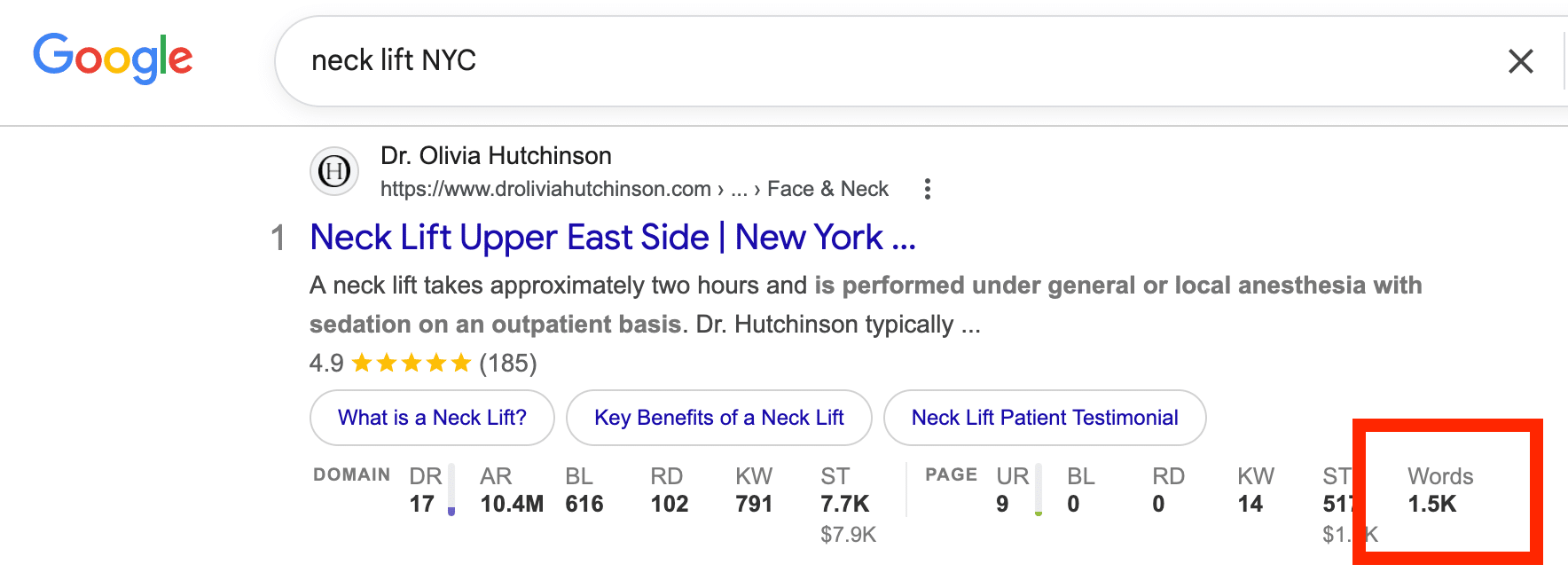
For example, AI suggested 3,000+ word procedure pages. However, top-ranking pages were shorter, affirming my experience that word count alone doesn’t influence rankings.
Thus, refining prompts, not necessarily dismissing AI, is where the focus should be.
Embrace and Master AI-Related Emails
Such emails are inevitable, and learning to address them efficiently strengthens our role as marketing leaders.
Mastering this skill means keeping clients engaged, bolstering our expertise, and managing time efficiently.
The next time you’re on the receiving end, remember to blend professionalism with collaboration and expertise.
I believe the launch of TurboQuant will revolutionize AI and SEO as we know it. This cutting-edge algorithm from Google drastically reduces the computing power and energy needs by allowing the massive compression of LLMs and vector search engines.
Imagine using six times less memory and achieving eight times the speed without compromising accuracy. That’s how TurboQuant dramatically lowers the cost of running AI tasks.
As search engines evolve from simply listing links on a SERP to providing immediate AI-generated overviews, it’s crucial for us in the SEO industry to adapt. We need to focus on creating meaningful, trustworthy content and understand its impact on searches.
Before AI became prevalent, SEO was grounded in basic keywords and topics, which inefficiently represented user intent. High costs and energy consumption hindered mapping true meaning across the web, but now TurboQuant uses an advanced compression method, PolarQuant, to transform data into manageable coordinates. This breakthrough allows Google to process complex ideas far more efficiently.
TurboQuant can match exact search meanings in real time, thanks to its ability to understand user intent using past searches and real-world contexts.
The near-zero indexing lead time of TurboQuant eradicates delays between publication and ranking. Trusted publishers will gain instant recognition for their expertise, while the system also blocks manipulation and spam from appearing.
We must prepare for the fast-approaching era where AI summaries become the norm in responding to most queries. Thin content, which adds no original value, will vanish because AI can now summarize the web almost instantly, making unique viewpoints and genuine data irreplaceable.
Developing trust and authority with original thoughts, data, and experiences will prove essential, as AI-generated summaries merely consolidate existing information.
The focus of our SEO strategies should be to become a source AI recommends reliably, not just rankings based on keywords. TurboQuant maintains a more reliable index of facts by validating them against its real-time knowledge base.
This new system tracks a brand’s strength across various platforms, reinforcing the necessity of improving our knowledge graph as a trusted source.
With TurboQuant handling vast information without delays, hyper-personalization is set to explode in ways we’ve previously not imagined. AI agents could remember extensive user interactions to provide extensive personalization.
TurboQuant’s capability to integrate various signals into a cohesive perception of a brand’s value demands a strategic shift toward consistent, omnichannel representation.
We’ve prioritized quantity over quality for far too long in this industry. TurboQuant signals the end of this era, as it necessitates creating high-quality, meaningful content that establishes us as trusted entities.
Delivering a reliable message with a clear voice will guide how our messages are distributed and our brand credibility.
Over the past few years, I’ve been inundated with advice on generative engine optimization (GEO) – everything from AI citation checklists to technical guides for structuring content for large language models.
Most GEO guidance revolves around a key premise: To be visible in AI-generated answers, your content must be structured, authoritative, and easy to extract.
In my view, this advice, while valuable, falls short if your brand isn’t yet eligible for consideration in AI-generated results.
The underlying assumption is that ticking those boxes makes your brand eligible for AI-generated answers. However, many brands overlook the fact that they aren’t even being considered.
To get past this hurdle, we need to address an underappreciated factor that many GEO enthusiasts miss.
Traditional SEO has taught us to seek visibility through rankings, believing that higher rankings translate into more clicks and better outcomes. Many have now adapted this mindset to AI, aiming for citations or inclusions in AI-generated answers.
However, AI systems don’t just rank; they filter and select entities based on signals, determining eligibility before weighing options.
Without eligibility, many brands risk being excluded from the AI recommendation set right from the start.
Brands often misprioritize, focusing on extractability before establishing clarity, which results in missed opportunities.
It’s critical to understand the difference between qualification (being eligible to join the candidate set) and selection (being chosen from that set).
AI-driven search changes the game. While traditional SEO ranks pages, AI selects entities, such as branded products and concepts, interconnected in a web of knowledge.
This shift means we must prioritize entities over pages. An entity might excel in traditional search yet remain ambiguous in AI-generated answers.
Common issues lie in clarity and relevance. AI systems ask: Can I identify and associate this entity accurately?
If definitions are inconsistent across platforms or names vary, brands struggle to pass this threshold.
Clarity is the cornerstone. When AI or search engines see your brand, clarity allows them to understand exactly who you are.
For example, when I noticed my common name, Mariana Franco, was causing confusion, I changed it to “Maryanna.” This helped ensure that my identity was distinct and recognizable to AI systems.
By consistently using this unique name variant across all my online assets, I reduced ambiguity within a week, making it easier for systems to recognize me as an entity.
Relevance is another crucial factor. Does the web associate your brand with relevant topics consistently and strongly?
This involves appearing alongside related entities, demonstrating expertise through in-depth content, and being referenced by well-known entities in your field.
Once qualified, a brand becomes part of the candidate pool, applying GEO strategies to increase the chance of selection.
Credibility becomes vital at this stage. You need corroboration from reputable sources to enhance your credibility.
Multiple credible mentions and appearances in media, reports, and podcasts bolster your visibility and reliability.
Extractability, or how easily an AI can generate answers from your content, is crucial once in the candidate set.
To ensure extractability, organize your content clearly, prioritizing concise, context-independent answers.
Testing your brand’s appearance in AI tools can reveal whether you’re recognized or recommended. A search using ‘best [your category]’ illuminates inclusion gaps.
If AI recognizes your brand but doesn’t recommend it, focus on building selection signals — credibility and extractability.
For comprehensive visibility, prioritize clarity and relevance to ensure eligibility, then focus on credibility and extractability to strengthen your standing.
Start by ensuring name consistency and clarity — the foundation of being recognized as a distinct entity.
Your About page should explicitly define your brand, utilizing schema to integrate into AI systems.
In AI’s expanding landscape, qualified entities will thrive, making consistent clarity and corroboration more critical than ever.
When my website’s traffic suddenly vanished, it felt like my online presence had evaporated overnight. Google had stopped indexing my pages, and I was desperate to reverse the decline caused by a botched migration.
This is my journey through a challenging case study of a multinational media organization that lost 90% of its traffic after a domain migration. By addressing the underestimated issue of soft 404 errors, we managed to liberate traffic potential across 13 country-specific domains.
While the events unfolded between 2021 and 2023, the lessons I’ve learned are timeless, and they apply to anyone facing indexing hurdles today.
The Sudden Traffic Plunge
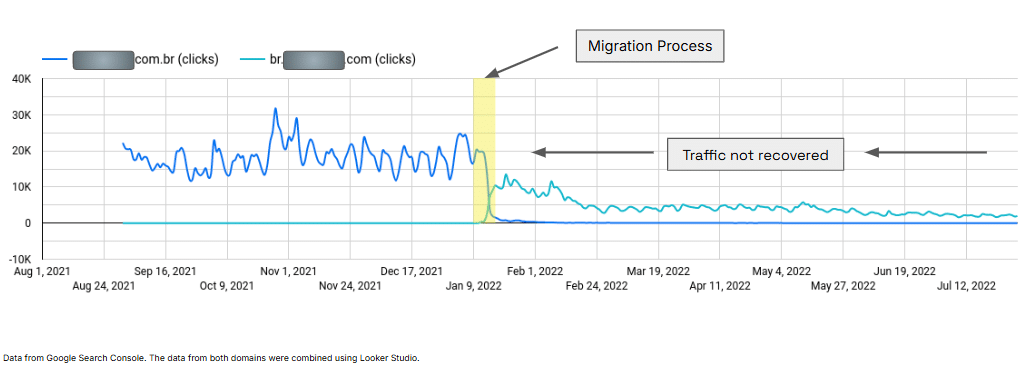
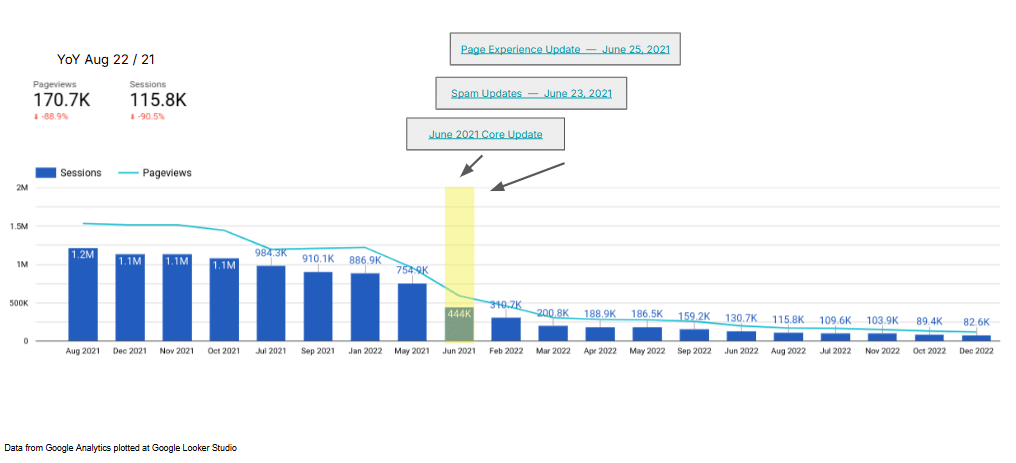
In January 2022, the Brazilian version of a cryptocurrency news website completed a domain migration. Shockingly, instead of a minor drop, traffic plummeted drastically. A comparison between December 2021 and December 2022 showed a decline of approximately 90% year-over-year in both sessions and pageviews.
Before the migration, our old domain (xx.com.br) enjoyed between 15,000 to 25,000 clicks per day. After shifting to a new subdomain structure (br.xx.com), traffic fell to a sustained rate of just 2,000 to 4,000 clicks daily, and it stayed that way for over a year.
The migration occurred alongside three major Google algorithm updates in June 2021: a core update, a spam update, and a page experience update. The Brazilian site, however, showed no recovery even after facing temporary volatility due to these updates.
More Than Just Redirects: The Migration Dilemma
Generally, traffic recovery following domain migrations occurs within weeks or months as Google recrawls the site. Here, we observed no such recovery.
The crux of the issue was that Google continued crawling the old domain long after the migration. This split Google’s crawl budget, not consolidating on the new domain as expected, severely hindering our SEO efforts.
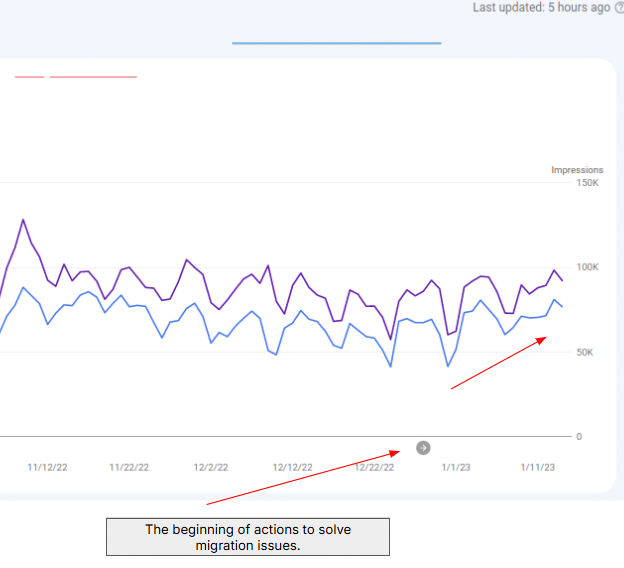
In mid-August 2022, after fixing the migration problems with the help of my SEO and IT teams, I noticed a slight positive change—a peak of 12 clicks and 37 impressions on August 29. This gave me a sign that Google was beginning to recognize the new domain appropriately.
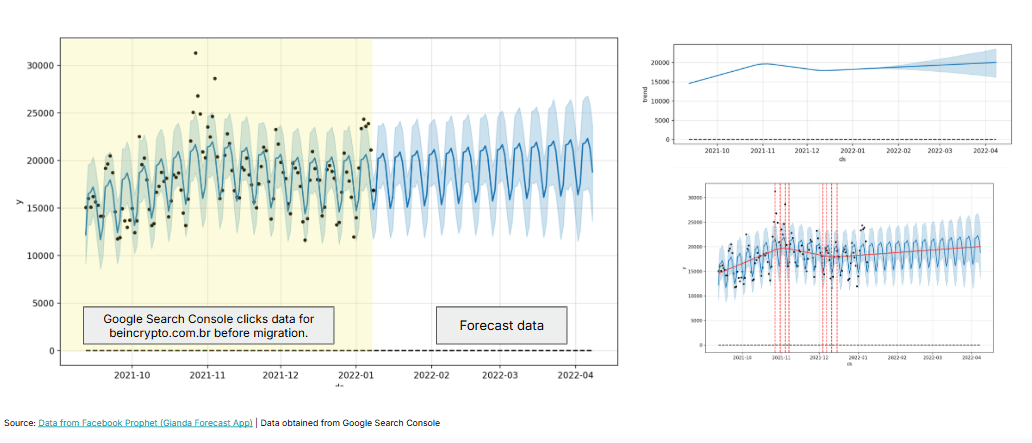
Utilizing Facebook Prophet forecasting on our pre-migration data, we estimated that without migration issues, the Brazilian site could have exceeded 2 million monthly clicks by early 2022. Instead, the numbers were far less impactful.
Deciphering the Indexing Bottleneck
Resolving the migration unveiled a deeper issue affecting all 13 country domains: a massive backlog in indexing.
Google processes pages through four stages: Crawl, Render, Index, and Rank. For the Brazilian site, while crawling new articles took just about 2 minutes—acceptable for news—indexing took 24 hours. This delay was disastrous for timely cryptocurrency news.
The Magnitude of Migration Chaos: 513,000 Unindexed Pages
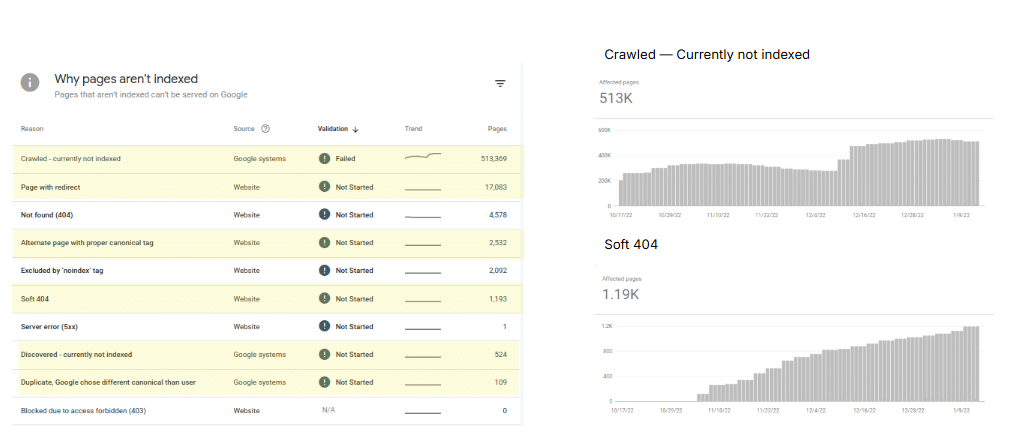
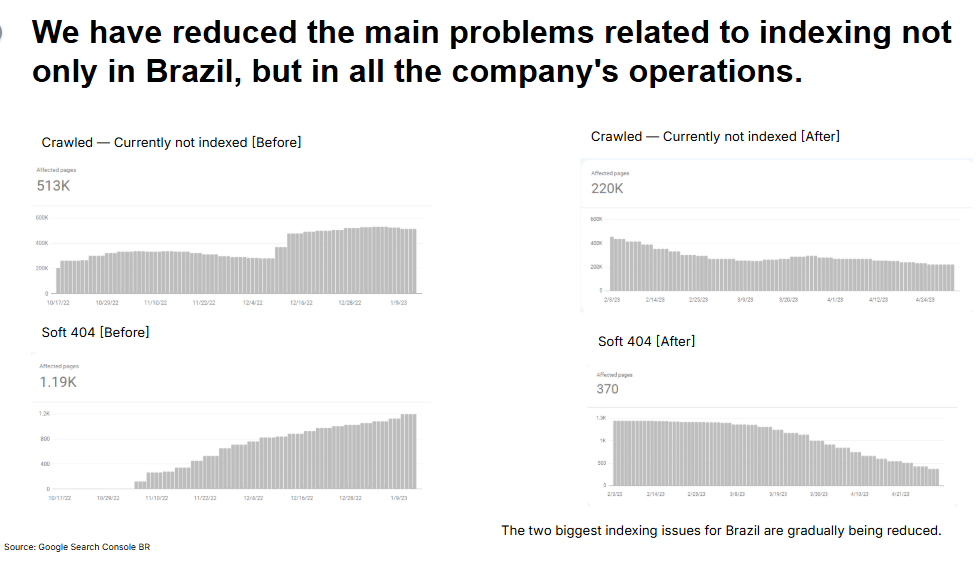
Google Search Console data in January 2023 highlighted severe indexing challenges across all domains, with Brazil alone having 513,369 pages categorized as ‘Crawled – currently not indexed’.
The ‘Crawled – currently not indexed’ status was troubling. These pages weren’t indexed because Google deemed them low quality or duplicate—yet potentially valuable content was left out of the index.
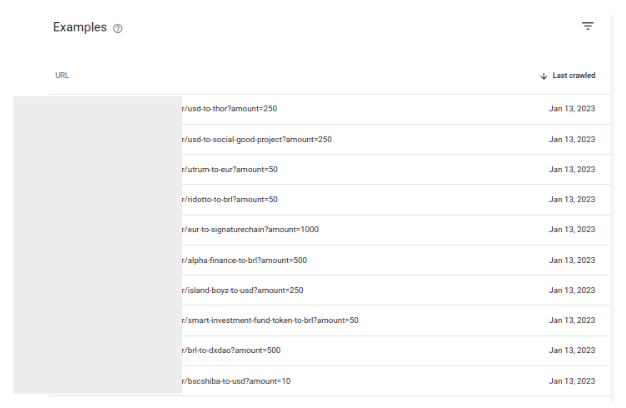
Upon investigation, I discovered that automatically generated thin-content pages, like currency converter URLs (e.g., “usd-to-thor”), were eating up the crawl budget, deprioritizing the domain.
Dealing With Soft 404 Explosions
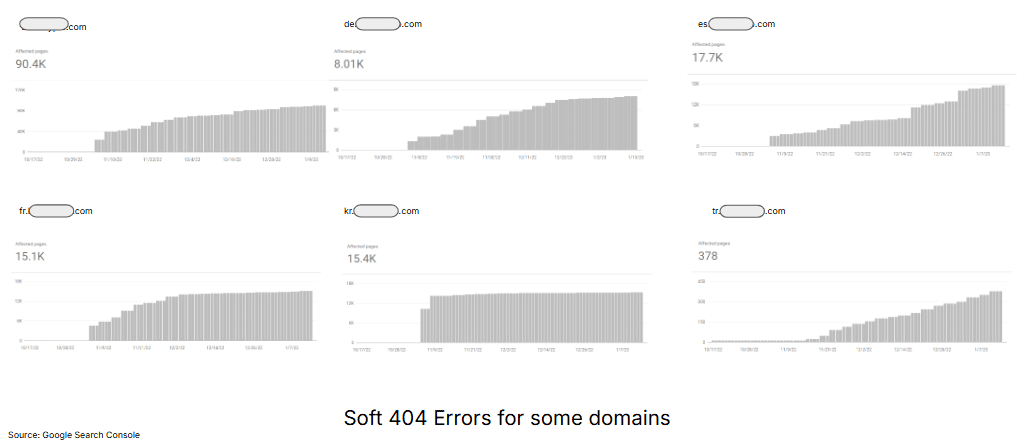
Addressing the migration alone wasn’t enough, as a surge of soft 404 errors also demanded attention. These errors occur when pages return a success status (200), but lack meaningful content, mystifying search engines and squandering crawl budgets.
Soft 404s were proliferating across domains, including the main site and several international versions, complicating our SEO efforts further.
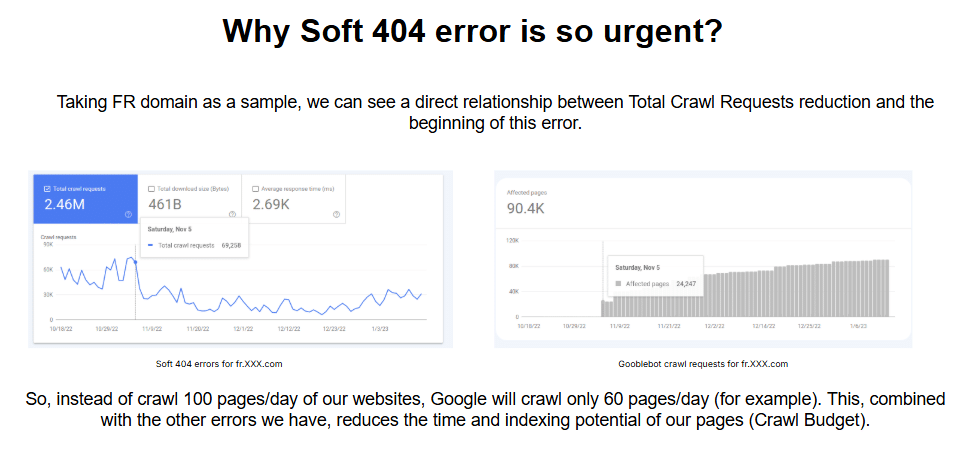
In France, this accumulation of soft 404 errors caused Google’s crawl requests to drop drastically, illustrating the pressing need to fix these issues.
Tackling the Crawl Budget Crisis
Understanding crawl budget is crucial. Excessively crawling ineffective pages depletes Google’s ability to find and index valuable content, particularly harmful for news sites needing prompt indexing.
By early 2023, our technical SEO was draining crawl resources, leading to slower indexing of fresh content and lost online visibility.
Implementing a Systematic SEO Fix
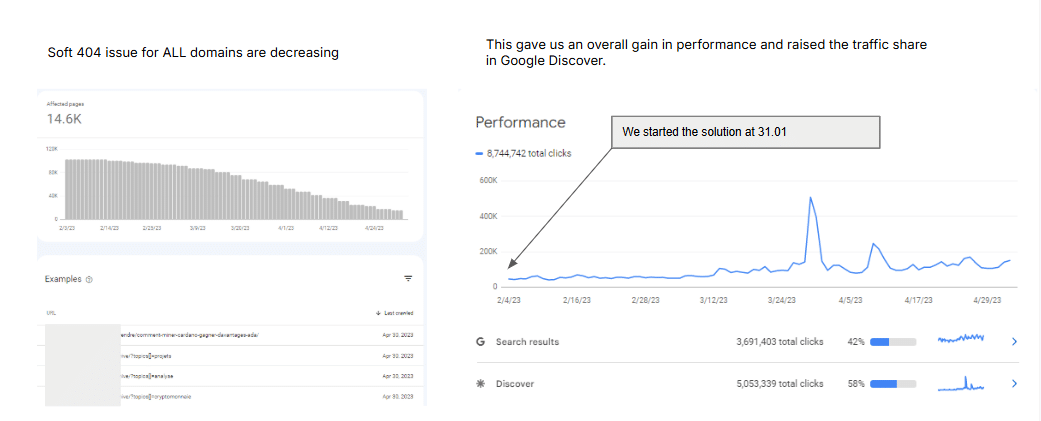
On January 31, 2023, I initiated an all-encompassing SEO strategy to target three priorities at once: Resolving soft 404s, optimizing the crawl budget, and refining Core Web Vitals, though the latter took a backseat to immediate indexing concerns.
Key actions included proper HTTP status code implementations for non-existing pages, optimizing URL structures, and improving canonicalization.
After the Fixes: Impressive Traffic Rebounds
The results were measurable just weeks later. In Brazil, ‘Crawled – currently not indexed’ pages fell by 57%, soft 404 errors reduced by 69%, and traffic began trending upward in early 2023.
International Recovery Highlights
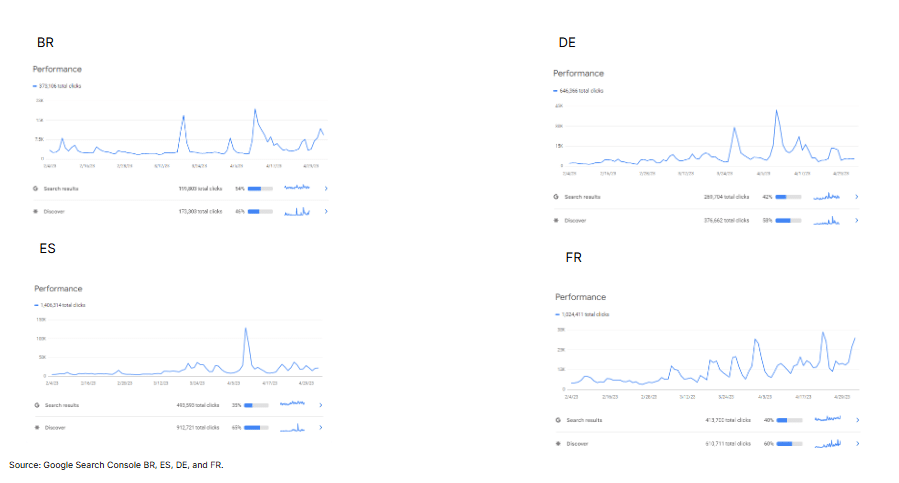
In Germany, indexed pages surged, driving total daily clicks notably higher. Similarly potent results emerged across Poland and Spain.
Key Insights from My SEO Journey
I learned that handling indexing issues trumps almost every other SEO concern. No matter the quality of your content and backlinks, if your pages aren’t being indexed, your visibility won’t improve.
Moreover, ignoring soft 404s can quietly erode your site’s crawl budget, which silently undermines your SEO efforts until it becomes glaringly apparent in lost traffic.
Finally, detailed verification during domain migrations and focusing SEO strategies on regional requirements can make all the difference between an underperforming and a thriving website.
I’ve discovered that the biggest SEO gains now come from interactive experiences that immediately address user intent and remove friction.
SEO was once heavily reliant on external factors, especially developer support and waiting on roadmaps that promised features “maybe next quarter.”
If I needed a new page template, a calculator, or even an interactive component, I had to wait. But that’s no longer the case.
Nowadays, if you’re involved in SEO or GEO and haven’t explored vibe coding, you might be hindering your potential impact.
Vibe Coding: Shifting SEO Power Dynamics
Not long ago, creating tools like calculators or widgets involved lengthy processes, but now I’ve used AI to build dozens of apps without needing a developer.
Some tools are basic and others not visually appealing, but they’re effective and drive thousands of organic visits monthly.
Pages centered around these tools are outperforming traditional content competitors.
What’s truly transformative is that my SEO team is now adept at building tools independently, which empowers us to achieve our goals faster.
We can test ideas instantly and utilize developer skills for more complex tasks like scaling and infrastructure.
There’s a significant sense of accomplishment when creating and releasing a tool that consistently attracts traffic.
It’s not about sophistication; it’s about building effective tools.
Engage Directly: From User Personas to Conversations
The traditional approach says to identify and cater to user personas. But few explain how to present that effectively.
Recognize user personas.
Pinpoint their challenges.
Create content to address those challenges.
Previously, SEO relied heavily on text targeting personas, which is now outdated.
Instead, we should let users self-identify to show the most relevant content.
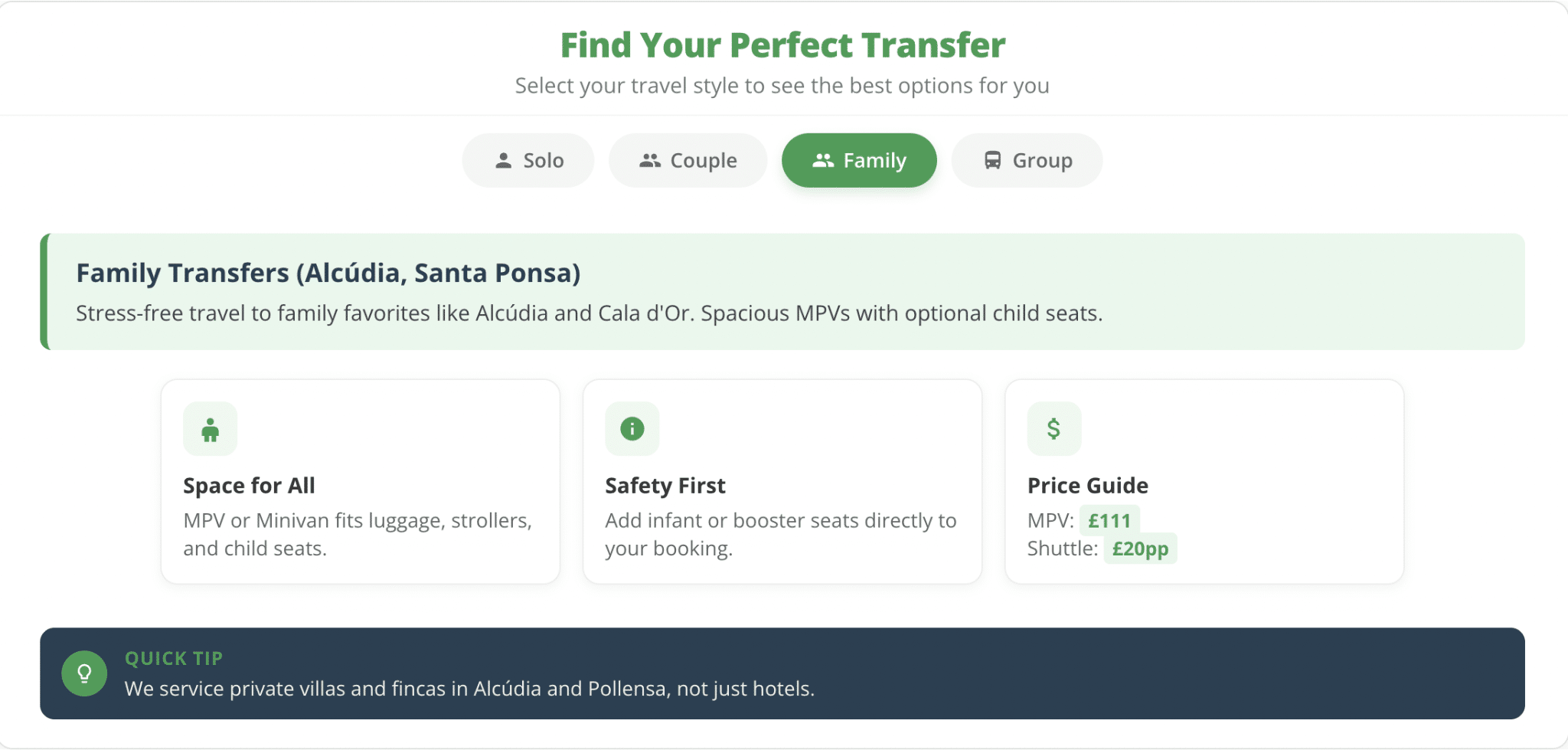
A vibe-coded component with tabs for different personas.
Each tab reveals content tailored to that persona.
For instance, Majorca airport transfers differ greatly between family travelers and solo adventurers.
Families care about safety and child-friendly options, visible only when their tab is selected.
SEO strategies now harness data from sources like Google Search Console to directly address these needs.
The component was strategically coded to enhance immediate intent satisfaction.
This mirrors AI platforms’ approach: segmented, persona-aware, and intent-driven.
Harnessing Traffic through Tool-Only Categories
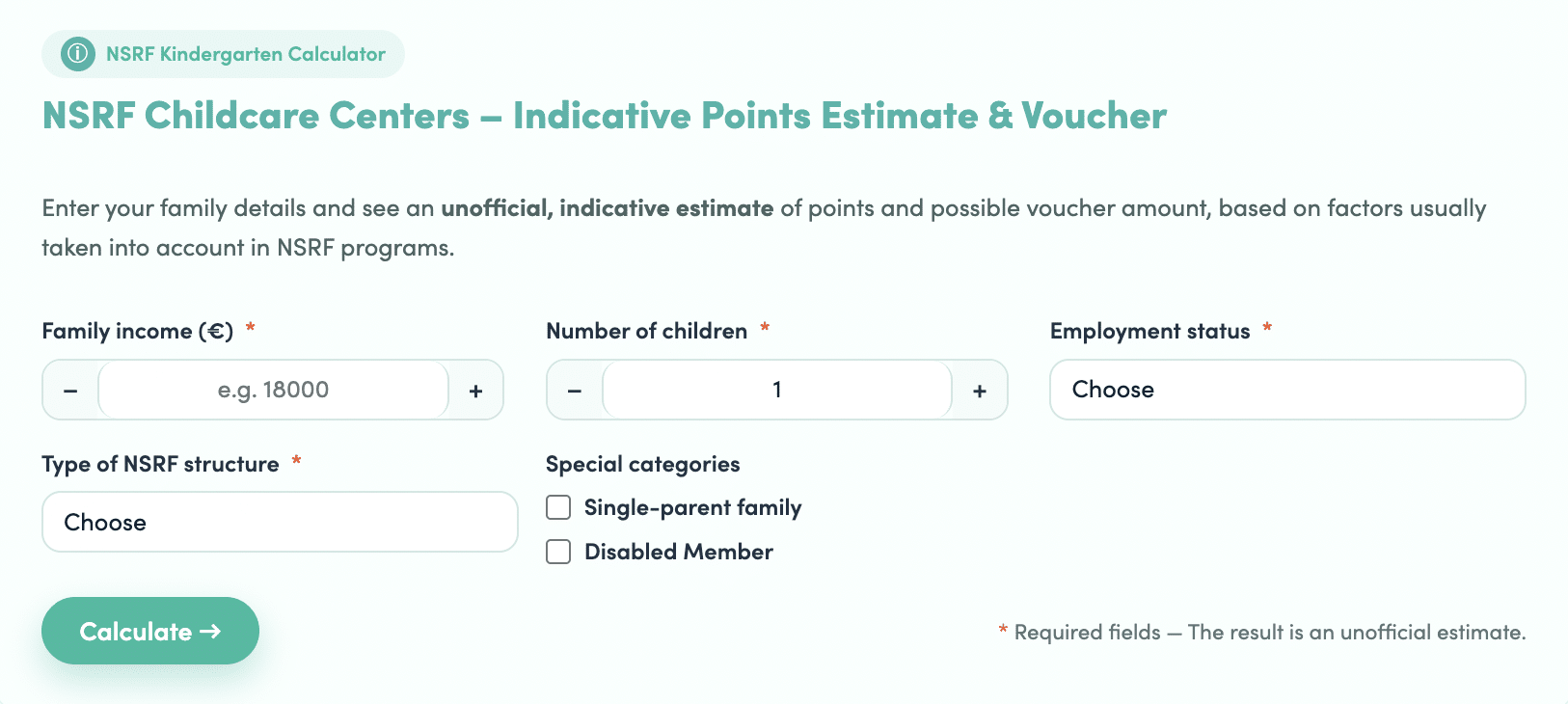
In a personal project, I launched a Tools category with ten pages of simple, effective tools like calculators and count-down timers.
Calculators.
Checklists.
Calendars.
Countdown timers.
AI generators.
Each page’s centerpiece is its tool, supported by components addressing additional queries.
The impact? Over 5,000 clicks in two months, even with seasonal variations.
UI: A Powerful Ranking Factor
SEO capabilities have expanded, but creativity remains essential.
Visual presentation is a highly underrated SEO asset today.
Merely producing text is insufficient. Instantly fulfilling intent through UI is key.
Two calculator pages have added significant monthly sessions.
A tool ranked in the top three within days for a government query.
Pages rank off-season thanks to superior UI.
Where others list information, I offer interactive user engagement.
Eligibility calculators.
Countdown timers.
Dynamic tables.
Visual comparisons.
Text backs up the tool rather than being the main attraction.
SEO Done Right, Quickly
I published a page targeting a Greek government program, outshining heavy-text competitors.
We introduced:
An eligibility tool.
A transparent algorithm explanation.
Tips to avoid application errors.
Historical program updates.
An application walkthrough.
The page was promptly tagged and marked up, achieving a first-page ranking within three days and generating substantial clicks.
Solving problems better than anyone else shortens the typical SEO timeline.
Maximize SEO and PR with Tools
Tools can drive traffic or act as valuable digital PR assets.
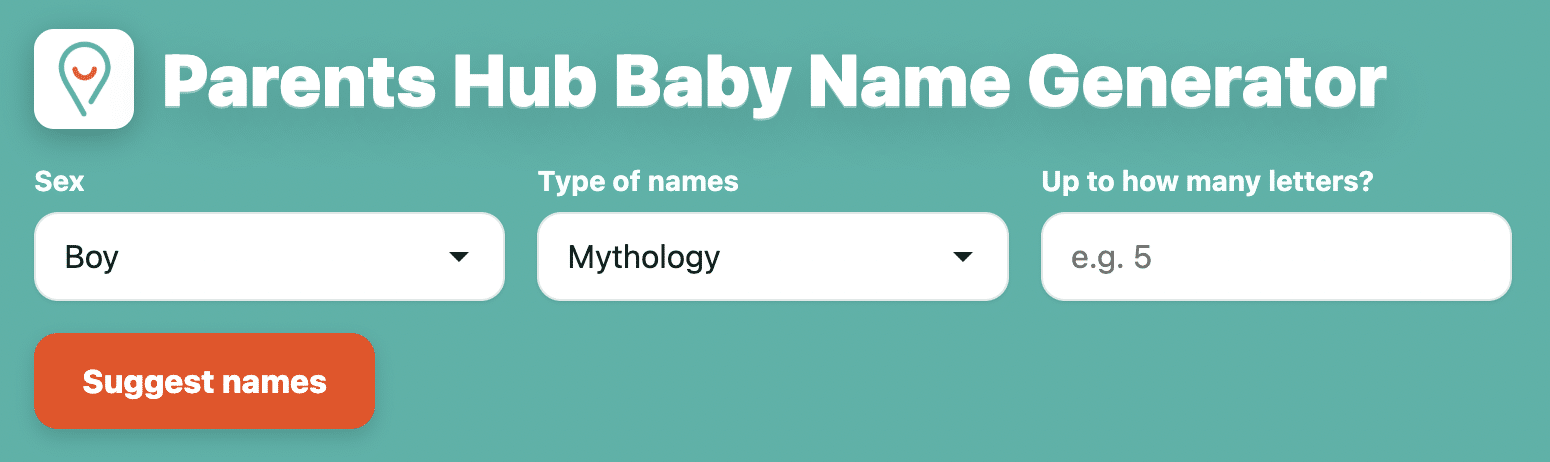
A due date calculator or baby name generator could turn into a major PR opportunity.
A modern tool addressing real needs, outshining SERP features, can become the interface where SEO and PR beacons meet.
Uncovering Tool Page Opportunities with Ease
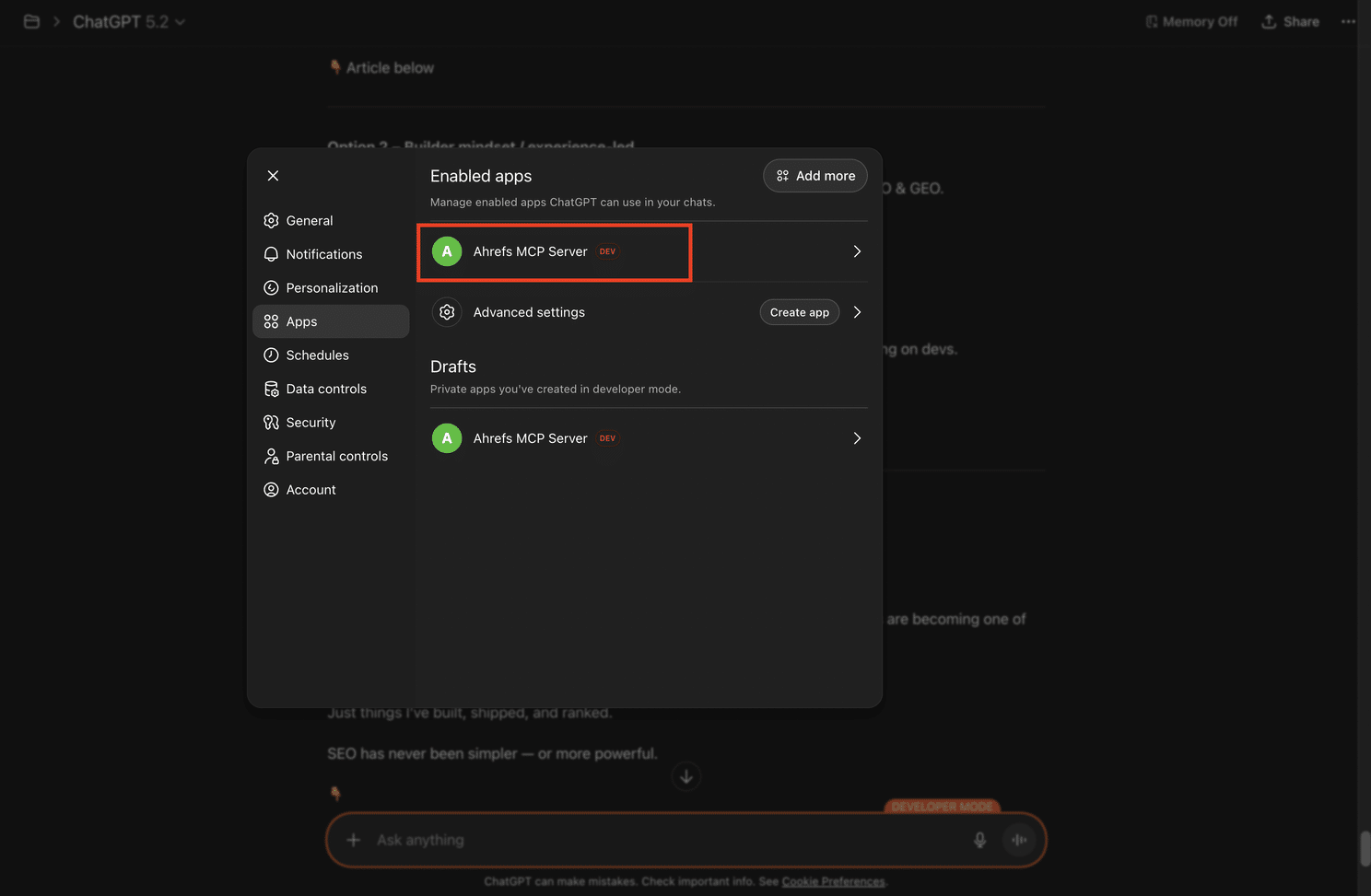
SEO tools’ MCP servers now make discovering tool ideas from search demand a breeze, letting me validate and launch swiftly.
This method has significantly sped up my tool page creation process compared to traditional methods.
We’re moving into an era where ideation, validation, and action can occur in days, reducing project duration considerably.
The Paradigm Shift in SEO
SEO has evolved beyond long-form content, demanding fast intent fulfillment and seamless user experiences.
Embracing vibe coding can accelerate development and provide a competitive edge. Building interactive elements, not just content, is crucial for modern SEO success.
Planning PPC budgets was never straightforward for me, especially when facing differing data from Google Ads, Meta Ads, GA4, and my CRM/CMS. I often ask myself, what numbers should I actually report, and how can I ensure I’m optimizing for a genuine impact?
Like many, I believed better tracking, cleaner UTMs, or a refined analytics setup might solve the problem. But often, it’s something else entirely—the attribution trap.
We’ve been taught to rely on data-driven marketing. Ideally, analytics tools clarify what’s effective if configured right. But is it enough to just follow the data?
Attribution can be misleading. Without a solid framework, I find myself making budget decisions based on incomplete insights, potentially damaging the business.
Let’s consider: Attribution assigns conversion credit to channels, which is useful, but it doesn’t reveal which channels actually drove those conversions.
This may sound academic, but understanding it is crucial for solving the measurement puzzle. I’ll explore why attribution fails, how to use existing data effectively, and if incrementality testing is necessary.
Why ads, analytics, and CRM numbers never match
Aligning ad networks, GA4, and CRM data seems impossible. These systems serve different purposes, follow different methodologies, and measure distinct moments in the customer journey.
Your customer journey as a framework
Picture someone clicks on a Meta ad, sees retargeting on YouTube, then Googles the brand before buying—all in a week.
With standard attribution windows, both Meta and Google Ads report one conversion. GA4 and my CRM also show one, likely crediting Google Ads paid search.
Did Meta create a “duplicate” conversion? No. Meta can’t see Google Ads interactions, so it can’t detect duplicates.
GA4 and CRM probably ignore Meta Ads. Should I move Meta Ads budget to Google Ads branded search based on that? Probably not.
Structural differences as diagnosis enhancers
It doesn’t end there:
Attribution date: Ad platforms credit conversions on the click day, whereas GA4 and CRMs report based on conversion day, leading to discrepancies with long customer journeys.
Cross-device behavior: Different devices for interactions lead to CRM discrepancies if users aren’t merged correctly.
Privacy restrictions: Ad blockers and cookie consents prevent some conversion tracking, and ad networks use modeled conversions to fill these gaps, unlike CRMs.
Some issues are fixable with better configuration, such as server-side tagging, offline conversion imports, and consistent UTMs. However, structural differences mean expecting full correlation is unrealistic.
Once I accepted the number disparities, my next temptation was choosing a single source of truth, often GA4 or CRM, and relying on it. That’s where the attribution trap snaps shut.
Every tool uses an attribution model. Regardless of model—be it first-click, last-click, linear, time decay, or data-driven—they all have limitations.
Every attribution model has blind spots
Last-click. Although easy to understand, it’s easy to exploit by rewarding the final touchpoint and undervaluing demand generation.
First-click. It rewards discovery but ignores what convinces a customer to convert.
Linear and time-decay. While they seem balanced, they’re quite arbitrary, as customer journeys don’t follow strict rules.
Data-driven. Despite its sophistication, its mechanisms remain opaque, perpetuating a “black box” issue.
What happens depending on your source of truth
Hopefully, you now grasp the deeper issue: attribution addresses which touchpoints deserve credit once a conversion occurs. Relying solely on one tool means you can’t escape the attribution model’s blind spots.
If I depend solely on my CRM, I fall into the last-click attribution pit, often focusing on branded search. Over time, I might see demand decline despite strong results from my chosen source of truth.
Conversely, depending only on ad platform data means inflated results reporting, showing 2x to 4x more revenue than finance actually sees, resulting in increased marketing budgets while finance calls for cuts.
GA4 seems mature, but it only captures on-site customer journeys, missing awareness campaigns that might not result in website visits.
Realizing each tool’s fundamental flaws will lead someone to suggest incrementality testing — Did this campaign drive otherwise impossible conversions?
Incrementality tests: The perfect solution?
Incrementality measures results from your campaign — conversions that wouldn’t have existed without it.
Think of two worlds: one where the ad ran, the other where it didn’t. The difference between these worlds is your incremental impact. Everything else is baseline activity.
Attribution vs. incrementality
This distinction is crucial. Many reported conversions, especially from retargeting and branded search, are from individuals who would have converted anyway.
An ad followed by a conversion doesn’t guarantee the ad caused it. Incrementality testing measures the real credit.
For budgeting, distinguishing between true conversion drivers and illusions is vital.
A retargeting campaign showing strong ROAS might deliver little incremental value. If I cut it, conversions barely change; keeping it means paying for illusory performance.
How to test for incrementality
Testing incrementality involves experiments with two groups: one exposed to the ad and one that isn’t. Here are some typical methods:
Geo holdout. Compare regions where campaigns run versus those where they don’t and observe conversion differences.
Audience holdout. Platforms like Google and Meta allow excluding portions of the target audience from ad exposure, then measuring outcome differences.
Time-based testing. Temporarily halt campaigns to assess changes in conversion volumes, though this method carries risks like seasonal effects blurring results.
Is incrementality right for you?
For those managing large budgets — say €1 million per month — you’re likely familiar with these tests. But what if you’re running a smaller operation?
At this scale, incrementality can be impractical as reliable tests demand meaningful test and control group distinctions, necessitating significant data and spend.
Nonetheless, I can use shortcuts, particularly around branded search, to spot potential problem areas.
Triangulation: The actionable decision-making process
Considering attribution limitations and incrementality tests for big advertisers only, I rely on triangulation.
Utilize existing tools, acknowledging their imperfections, and educate clients or leaders on not sticking to a “single source of truth.”
Start with your CRM/CMS
These systems track genuine deals and revenue. Treat all other figures as explanatory attempts.
If the ad platforms together show $50K revenue while Shopify reports $35K, trust Shopify as it reflects reality.
It can even differentiate conversions from new versus returning customers, crucial for measuring nCAC.
Overlay my customer journey onto ad platform results to understand campaign impacts along the journey, using available incrementality tests to decide budget allocation better.
Improve on triangulation
Attribution windows: Long customer journeys challenge interpretation. Segment campaigns by customer journey stages, and shrink attribution windows to improve outcomes.
Track ratios: Keep the gap between ad platform conversions and CRM data consistent. Sudden changes might reveal an incrementality insight.
Triangulation won’t provide clean numbers. But it will deliver a consistent decision-making framework, far superior to false precision.
I recently discovered how AI is revolutionizing the way customers find local businesses. Tools like Google AI Overviews, Gemini, and Ask Maps are paving the way for more detailed, conversational searches.
It’s clear to me that traditional search rankings are no longer the sole factor in gaining visibility. Ensuring your business details are complete and accurate—like your Google Business Profile, reviews, and local content—can make a big difference.
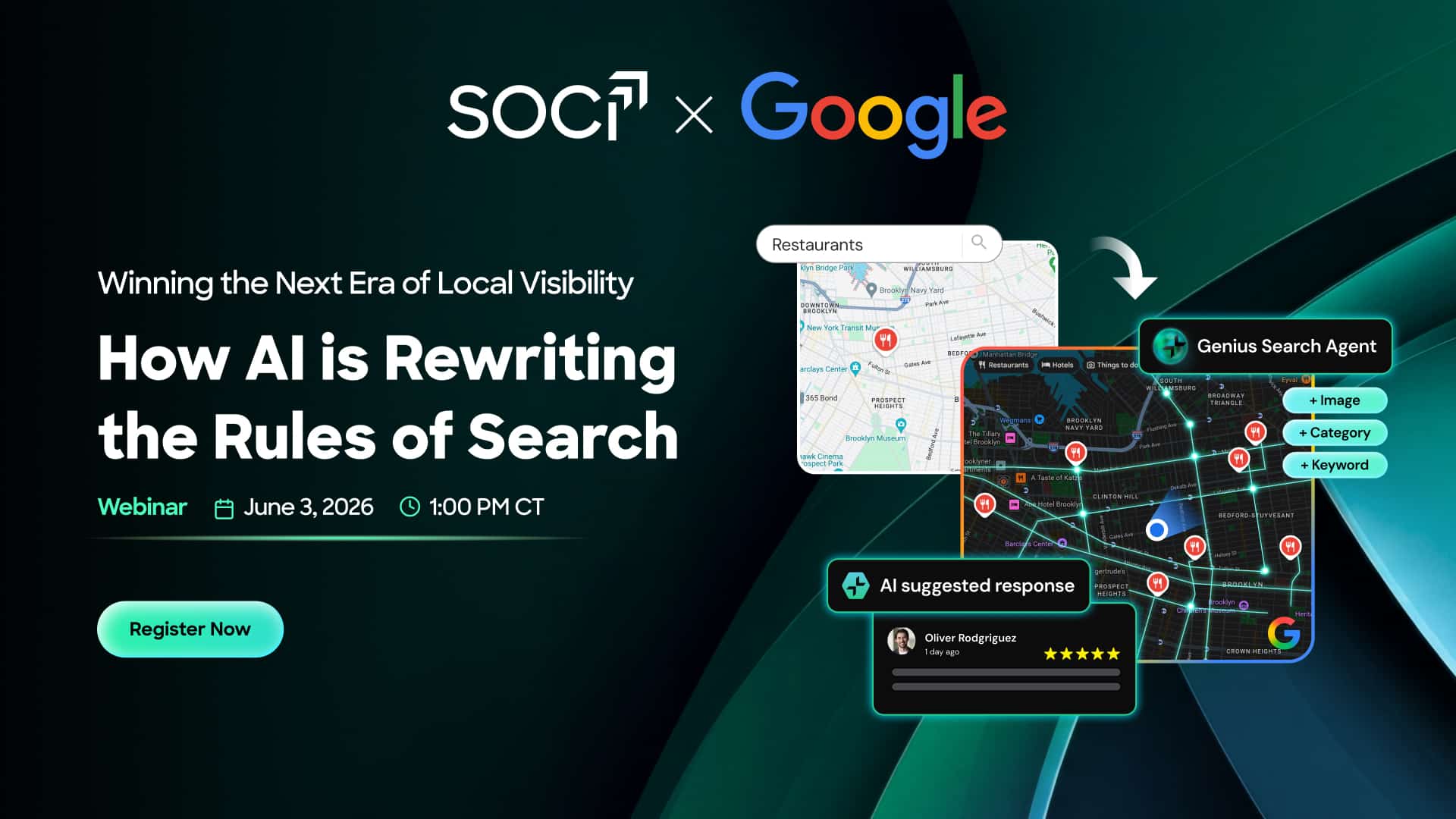
I’m excited to join SOCi and Google for an exclusive webinar, Winning the Next Era of Local Visibility, on June 3. It’s a golden opportunity for anyone looking to stay ahead of the curve.
During this webinar, I look forward to learning:
How AI is transforming local search dynamics.
The types of signals that AI considers for recommendations.
Strategies to boost visibility on Search, Maps, and Gemini.
The implications of Ask Maps for your brand.
I’m convinced that AI is already shaping customer discovery, so it’s crucial to ensure your business isn’t left behind.