Category: Opinion

  • Mastering SEO: Why Prioritization Beats Fixing Everything

    Mastering SEO: Why Prioritization Beats Fixing Everything

    Every SEO professional, including myself, knows that feeling of dread when we open an audit tool and it throws 847 problems our way. We’re talking broken links, crawl errors, pages with duplicate titles, missing alt tags, and Core Web Vitals cautioning us with yellow flags. And then, that whisper surfaces, “Fix it all, or else you’ll never rank.”

    But in truth, that whisper is deceiving us.

    The ‘fix everything’ strategy is a common pitfall in SEO and quietly sabotages many efforts. I get it—closing tickets and checking items off the list feels productive. Our audit scores might climb, but our traffic and conversions remain stagnant, leaving us puzzled after months of hard work.

    The reason? We’ve mistaken activity for impact.

    If you’ve ever completed a sprint feeling accomplished, only to see no change in Google Search Console, you’re not alone—this article is made just for you.

    The tool isn’t your boss

    Audit tools are impressive at pinpointing issues, examining thousands of pages in moments, flagging minor HTML glitches, and measuring Core Web Vitals with precision. While indispensable, they create a misconception that every issue demands utmost attention. A minor H1 tag absence on a low-traffic page holds the same weight as a noindex tag on your homepage. There’s no column for relevance.

    John Mueller from Google has clarified that third-party tool scores aren’t used for ranking. While structure is important, tool scores don’t reflect ranking reality.

    The challenge isn’t that audit tools detect issues; it’s that they don’t differentiate those affecting your bottom line. Teams often translate this to a flawed belief: more fixes equal more results. But that’s a myth.

    Dig deeper: Where to focus technical SEO when you can’t do it all

    This is where opportunity cost, the hidden killer of SEO programs, quietly wreaks havoc. Each moment our dev team dedicates to minor legacy fixes detracts from potentially lucrative new projects. When resources are tied up on negligible refinements, we forfeit real growth opportunities.

    • New content targeting competitive, high-intent keywords.
    • Enhancing top-performing pages already on the first page.
    • Strategic internal linking from authoritative content.
    • Optimizing conversion paths on revenue-generating pages.

    A technically cleaner site with flat traffic is not progress. Busy SEO feels productive, but it isn’t growth.

    Not all SEO problems are created equal — context changes everything

    Competitive keywords often result in top-ranking sites with imperfect Core Web Vitals and other technical flaws. Yet, they rank because they excel in authority and user satisfaction.

    Google values relevance and satisfaction over flawlessness, but distinguishing between critical growth barriers and less relevant issues remains a challenge.

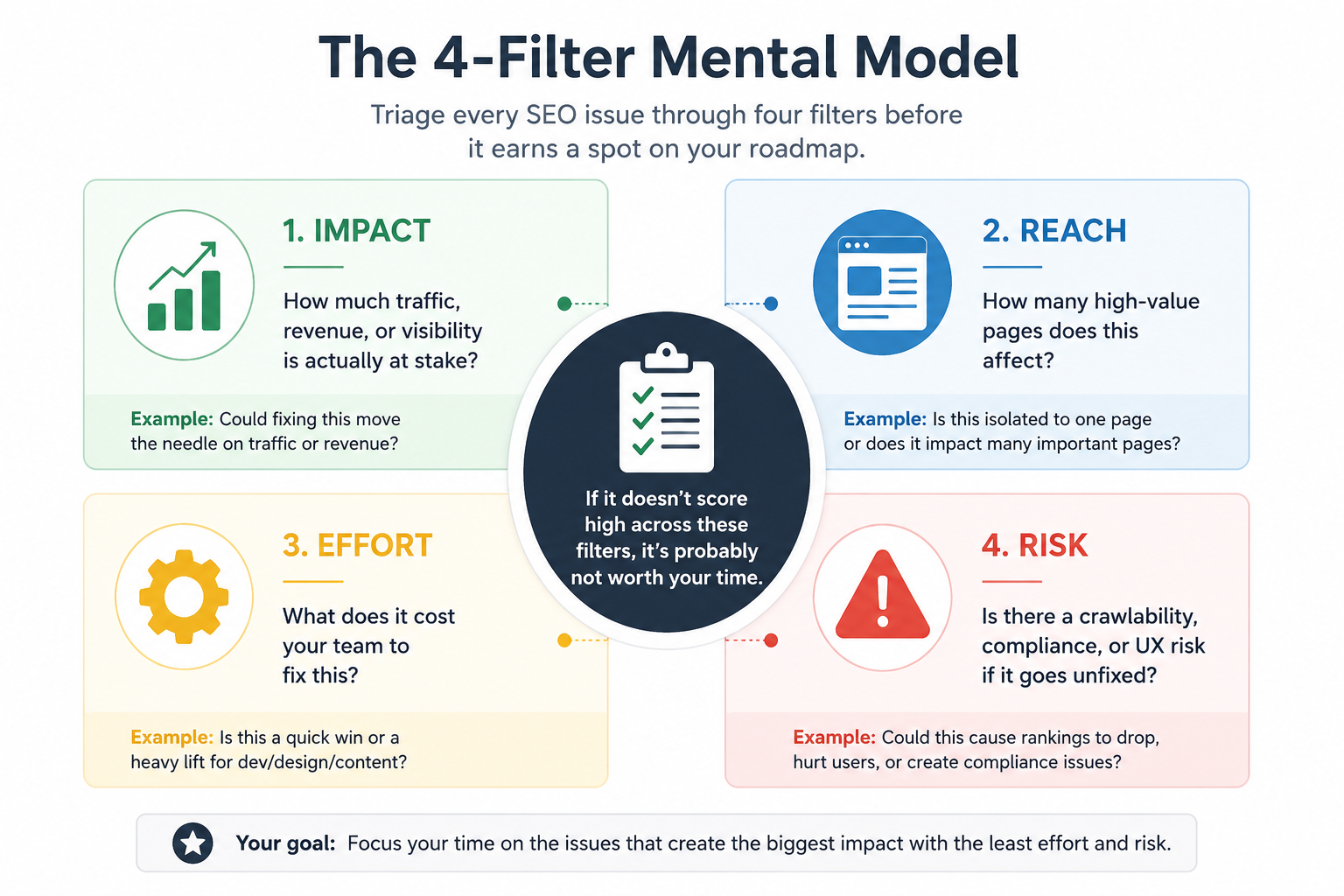
    I use this mental model: filter issues through impact, reach, effort, and risk before setting priorities.

    • Impact: Potential effect on traffic, revenue, or visibility.
    • Reach: Number of high-value pages affected.
    • Effort: Resource cost for a fix.
    • Risk: Crawlability, compliance, or UX risk if unresolved.
    ```json
{
  "alt": "The 4-Filter Mental Model infographic for SEO issues, featuring impact, reach, effort, and risk.",
  "caption": "Discover the 4-Filter Mental Model for prioritizing SEO issues—focusing on impact, reach, effort, and risk to streamline your roadmap effectively.",
  "description": "This infographic presents the 4-Filter Mental Model for triaging SEO issues. It divides considerations into four categories: impact, reach, effort, and risk. Impact assesses potential traffic or revenue changes, reach evaluates the number of affected pages, effort gauges the cost to fix, and risk considers compliance and UX challenges. The central message emphasizes focusing on issues with the greatest potential benefits and minimal drawbacks. Ideal for teams looking to optimize SEO workflows with strategic prioritization."
}
```

    Address roughly 30% of your to-do list that truly matters, streamlining efforts and focusing on what improves the bottom line.

    Dig deeper: How to prioritize technical SEO fixes by business impact

    Strategic neglect: What’s actually OK to leave alone

    While it may seem counterintuitive, strategic neglect is not negligence. It’s about deliberately choosing not to fix certain SEO issues to concentrate on high-leverage tasks. Here’s what I usually deprioritize:

    • Non-indexable, low-impact legacy URLs with minor errors.
    • Redirect chains that do not significantly impact link equity or UX.
    • Minor HTML and non-critical JavaScript errors.
    • Micro-optimizations for Core Web Vitals after achieving ‘good’ status.

    To prioritize effectively, ask if it serves your audience or business goals. If the answer is “no” or “barely,” let it slide.

    However, systemic issues like massive indexation problems, site migrations affecting entire navigations, compliance, or security concerns deserve immediate attention. Address these critical blockers first and set aside the superficial.

    What high-performing SEO teams focus on

    I’ve noticed that successful SEO teams don’t begin with audits; they start with the business. By determining which pages and queries drive conversions and revenue, we can focus efforts where it really counts.

    The Pareto Principle helps us target the 20% of our work responsible for 80% of the results. This usually means concentrating on high-impact initiatives.

    • Enhancing page-one performers: These are already hitting targets; enhance them further by refreshing content and optimizing clicks.
    • Boosting mid-tier rankings: Pages in positions 11-30 are prime opportunities for significant gains.
    • Building comprehensive topic clusters: Demonstrates expertise and relevance in the eyes of Google.
    • Resolving true technical blockers: Address crawlability, canonical, indexation, mobile usability, and server issues.

    Dig deeper: 4 ways to strengthen buy-in for technical SEO work

    A smarter framework: The impact/effort matrix

    The impact/effort matrix is my go-to tool for sorting through audit clutter. By evaluating tasks based on potential impact and required effort, I can choose smarter.

    • High-impact, low-effort: Prioritize these tasks immediately.
    • High-impact, high-effort: Strategize and resource these tasks cautiously.
    • Low-impact, low-effort: Address these opportunistically.
    • Low-impact, high-effort: Avoid these tasks unless absolutely necessary.

    Pairing this matrix with a business-aligned roadmap ensures that SEO efforts reflect true business priorities rather than simply following everything flagged by an audit tool.

    Your SEO strategy isn’t about achieving a sky-high audit score. It’s about aligning with the core business goals to drive meaningful growth and results. Remember, effective SEO is proactive and strategic, not just a checklist of technical fixes.


    Inspired by this post on Search Engine Land.


    crushpress.ai community screenshot
  • Unlocking AI Search: Making Your Brand Truly Machine-Readable

    Unlocking AI Search: Making Your Brand Truly Machine-Readable

    As I delved into audits across Prince Edward Island, one issue stood out: businesses with significant expertise weren’t visible to AI systems because their knowledge wasn’t rendered into a machine-readable format.

    Despite their leadership in biotech, manufacturing, and other sectors, critical business information was often trapped in PDFs, behind forms, or muddled in vague marketing copy. It was also disconnected from structured data systems that AI engines need for verification.

    We’re living in a world where 88% of companies are integrating AI. Yet, McKinsey notes that 86% of leaders admit to being unprepared for its daily integration.

    Many brands mistakenly equate AI visibility with being featured in a Gemini summary or a ChatGPT result, without solidifying the structured digital groundwork needed for ongoing visibility.

    AI Visibility: The Basics Before the Buzz

    If you’re only focusing on large language model (LLM) responses, you’re lagging. LLM visibility reflects authority—it doesn’t build it.

    According to a study by Responsive, 22% of B2B buyers now use generative AI for vendor research. Traditional search use is expected to drop by 50% by 2028 as AI solutions become the go-to answer engines, as Gartner predicts.

    Now, discovery happens through synthesizing answers rather than listing URLs. Until you’re part of the Knowledge Graph as a verified entity, your brand’s visibility will be inconsistent.

    The Insights from 19 Case Studies: Expertise Powers AI Search

    AI systems value concrete, structured data over descriptive text. Brands chasing fleeting AI mentions without anchoring their data won’t achieve lasting visibility, but those establishing structured data relationships will always be recognized.

    ```json
{
  "alt": "The CapmatchOne logo with a gradient circle and bold text.",
  "caption": "Discover innovation with the CapmatchOne logo, featuring sleek typography and a modern gradient circle.",
  "description": "The CapmatchOne logo features bold, modern typography coupled with a gradient circle, symbolizing connection and innovation. The sleek design conveys a sense of progress and creativity. This image can be used for branding or promotional purposes, appealing to audiences interested in innovative solutions and forward-thinking designs."
}
```

    Thus, SEO has evolved from simply creating content to becoming an information architect. As the case studies reveal, expertise remains a key signal that AI systems can interpret.

    Case No.EntityIndustryThe discoveryThe SME solution
    1BioVectraBiotechTechnical authority trapped in PDFsEncoded cGMP data into facts
    2Wyman’sFood manufacturingSustainability was a narrativeStructured supply chain schema
    3Murphy Hospitality GroupHospitalityInvisible venue specificationsConstructed event logic
    4InvescoFinTechOpaque compliance dataBuilt regulatory ground truth
    5Sekisui DiagnosticsMedTechInnovation lacked readabilityEngineered diagnostic logic triples

    Why SEOs Must Focus on Education

    The main obstacle to AI readiness is the gap in education. We must evolve into information architects, comprehending our clients’ business logic deeply.

    SEOs as Subject Matter Experts

    Understanding is foundational. For instance, auditing a biotech firm requires a grasp of compliance as keen as their lead scientist’s.

    AI relies on structured context for accurate answers. Vague marketing language feeds insufficient responses.

    Clients Must Prepare Their Data

    Data quality and governance activation equate to maximizing AI-driven value. SEOs must educate clients on digital presence impacting AI brand perception.

    Focus on True AI Authority

    Appearing in a ChatGPT reply isn’t the goal; becoming an authoritative node in the Knowledge Graph is. It ensures visibility across AI platforms like Gemini and Claude.

    AI advancements will persist rapidly. SEOs and clients not prioritizing structured data will be left behind in AI discovery systems.


    Inspired by this post on Search Engine Land.


    crushpress.ai community screenshot
  • Mastering Multi-Channel Marketing: Stop Juggling, Start Thriving

    Mastering Multi-Channel Marketing: Stop Juggling, Start Thriving

    Every Monday, I dive into my role as a paid media manager knowing the chaos that awaits. From Google Ads to TikTok and Reddit, my task is to pull the data from each platform, put it into a comprehensible spreadsheet, and report to my boss by 10 a.m. Amidst all this, I try to decipher what worked last week and why. It’s a frenetic start to the week, to say the least.

    Remembering when managing multi-channel campaigns meant juggling just Google Ads and a Facebook campaign feels almost nostalgic now. Today, it’s a tangled web of 12 channels, each with their peculiarities in terms of attribution logic and campaign structures. The disarray is real and mostly ignored, to the detriment of performance marketers like me.

    I realize that this Monday morning ritual is less about campaign management and more about tedious chores like data entry and reformatting. Managing campaigns across numerous networks involves reopening platforms repeatedly just to align disparate data points.

    ```json
{
  "alt": "A woman in an office surrounded by four computer screens showing marketing analytics.",
  "caption": "Navigating the complexities of digital marketing metrics, a woman finds herself amid a sea of analytics data.",
  "description": "In an office setting, a woman sits at a desk surrounded by four large monitors displaying various marketing analytics figures. The screens show data such as ROAS, CPA, CTR, and CPL, highlighting campaign performances. Her expression suggests concentration or concern as she navigates complex digital marketing metrics. This image captures the intensity and focus required in data analysis and decision-making in a modern business environment."
}
```

    The prevailing problem isn’t just the time I lose, but the lag it introduces to my operations. When my performance data is scattered across various platforms, delays in identifying key insights can lead to wasted budgets. The inconsistency in strategies across channels further exacerbates the issue.

    I’ve come to understand that relying on native dashboards from Google, Meta, and others won’t rescue us from this inefficiency. These platforms prefer keeping us tethered to their interfaces, contributing to the fragmentation. But a paradigm shift is on the horizon: AI-native management tools that promise seamless cross-platform synchronization without the need for multiple dashboards.

    The change is happening right now, reimagining how campaigns are managed with AI. It means planning campaigns with simple briefs and automatically syncing creative adjustments across all channels. This reorientation is not just an incremental improvement but a transformational leap that alleviates the operational burdens we’ve carried for too long.

    ```json
{
  "alt": "Woman in office using a large monitor displaying an analytics dashboard with performance metrics.",
  "caption": "In a sleek, modern office space, a woman engages with a dynamic analytics dashboard, tracking performance metrics on her wide display.",
  "description": "A woman in a contemporary office setting is focused on an ultra-wide monitor displaying a detailed performance analytics dashboard. The screen showcases key metrics such as ROAS, CPA, conversions, and reach, alongside a visual funnel diagram, under a 'Unified Portfolio Dashboard' by adplus. Her workspace includes a keyboard, notebook, and a coffee mug, suggesting a productive environment. This image embodies themes of data analysis, modern technology, and professional settings."
}
```

    For agencies like mine, AI brings another boon: automated and branded client reports that compile multi-network performance data without the Sunday-night grind.

    What actions can we take this week? First, I’ll track where my hours truly go throughout a week — seeing is believing when it comes to confronting administrative bloat. Second, standardizing naming conventions across accounts is surprisingly effective in smoothing out cross-platform wrinkles. Third, I’ll delve into evaluating current AI-native tools, as I suspect many teams are operating on outdated assumptions about their capabilities.

    Achieving an operational edge in paid media transcends budget size. It’s about faster data-action cycles, unified cross-network performance views, and liberating our teams from the laborious chains of manual processing. This operational edge could mean the difference between thriving and merely surviving in a competitive landscape.


    Inspired by this post on Search Engine Land.


    crushpress.ai community screenshot
  • Unveiling Reddit’s Impact on AI Search Dynamics

    Unveiling Reddit’s Impact on AI Search Dynamics

    I often find myself explaining Reddit’s role in AI search. It’s frequently underestimated, yet its influence extends well beyond training data.

    Clients frequently ask how AI training, licensed access, and retrieval systems can affect SEOs and AI strategies, particularly concerning Reddit.

    Here are the typical questions I receive:

    • Should I engage with Reddit to boost my brand visibility?
    • Is advertising on Reddit beneficial if AI uses Reddit for training?
    • Our CEO suggests creating a subreddit for each product. Is that wise?
    • Why does Google’s AI reference a Reddit thread criticizing my product?

    These inquiries often conflate three separate but interrelated concepts:

    • Training data.
    • Licensed or real-time access.
    • Citation and retrieval systems.

    Although connected, they serve different purposes. Understanding these distinctions impacts how we approach SEO and AI citations, especially as Reddit increasingly appears in AI-driven results.

    ```json
{
  "alt": "The CapmatchOne logo with a gradient circle and bold text.",
  "caption": "Discover innovation with the CapmatchOne logo, featuring sleek typography and a modern gradient circle.",
  "description": "The CapmatchOne logo features bold, modern typography coupled with a gradient circle, symbolizing connection and innovation. The sleek design conveys a sense of progress and creativity. This image can be used for branding or promotional purposes, appealing to audiences interested in innovative solutions and forward-thinking designs."
}
```

    Let’s demystify AI training, access, and citation. You might think, “ChatGPT was trained on Reddit,” means every post is directly stored in its memory—an incorrect assumption.

    Training AI is akin to education. Kids learn concepts like using the Pythagorean theorem without remembering specific textbook answers. Similarly, AI learns conversational patterns, not individual Reddit posts.

    AI doesn’t remember specific threads but discerns key discussion points from Reddit, like consumer preferences on r/RockTumbling.

    Reddit partnerships with Google and OpenAI in 2024 enabled a transition from static datasets to ongoing access, allowing AI to stay updated on Reddit dialogs.

    If AI training is like schooling, licensed access is a continuous flow of information akin to subscribing to a newspaper.

    AI can cite Reddit, not because it’s preferential part of the training, but finds it useful for real-time querying, just like humans might refer to yesterday’s conversation.

    ```json
{
  "alt": "Google search results for 'Oura ring pros and cons' displaying an AI overview and articles.",
  "caption": "Exploring the Oura Ring: Pros, cons, and insights on functionality and costs, highlighted from search results.",
  "description": "The image shows Google search results for 'Oura ring pros and cons', featuring an AI overview that describes the Oura Ring as a premium, comfortable health tracker. It highlights its strengths in sleep and recovery insights but notes downsides like high costs and less detailed workout tracking. Additional articles and reviews provide further analysis, including insights from Reddit on battery life and intrusiveness. This information aids potential buyers in evaluating the ring's value."
}
```

    Reddit’s prominence in AI results impacts my SEO strategy, yet it’s not only due to formal partnerships. Reddit’s depth in human experiences enhances its informational value.

    Reddit offers what many websites lack: practical user insights and diverse opinions. Where official sites provide features, Reddit adds authentic experiences and user narratives.

    Rather than mimicking Reddit, I focus on fostering authentic discussion by leveraging user insights from reviews, interviews, or forums, enhancing the context around my content.

    I’ve realized that prioritizing nuanced details and showing reasoning can increase credibility, making my content more relatable in subjective decision-making scenarios.

    Ultimately, integrating firsthand experiences and transparency can elevate content strategy, aiding systems that synthesize human input into AI insights.


    Inspired by this post on Search Engine Land.


    crushpress.ai community screenshot
  • Boost Team Efficiency: Overcome GTM Barriers with Storyblok

    Boost Team Efficiency: Overcome GTM Barriers with Storyblok

    I’ve recently stumbled upon some fascinating global research data that highlights a tech gap silently draining team speed, revenues, and competitive edge. The Storyblok Global Speed-to-Market Benchmark Report explores these issues comprehensively.

    This rapidly evolving world demands a new pace, driven by cutting-edge AI and technology, and constant shifts in digital trends have redefined how we handle go-to-market (GTM) strategies.

    In today’s marketplace, everyone, from customers to organizations, expects top-notch deliveries with speed. Unfortunately, only 22.5% of teams consistently meet these soaring speed-to-market expectations, revealing a disconcerting gap between ambition and actualization.

    One might ask, what’s holding us back?

    The Global Speed-to-Market Benchmark survey involved several GTM teams who shared insights on where processes are stalling or facing delays and what steps would truly improve speed-to-market in today’s fast-paced business environment.

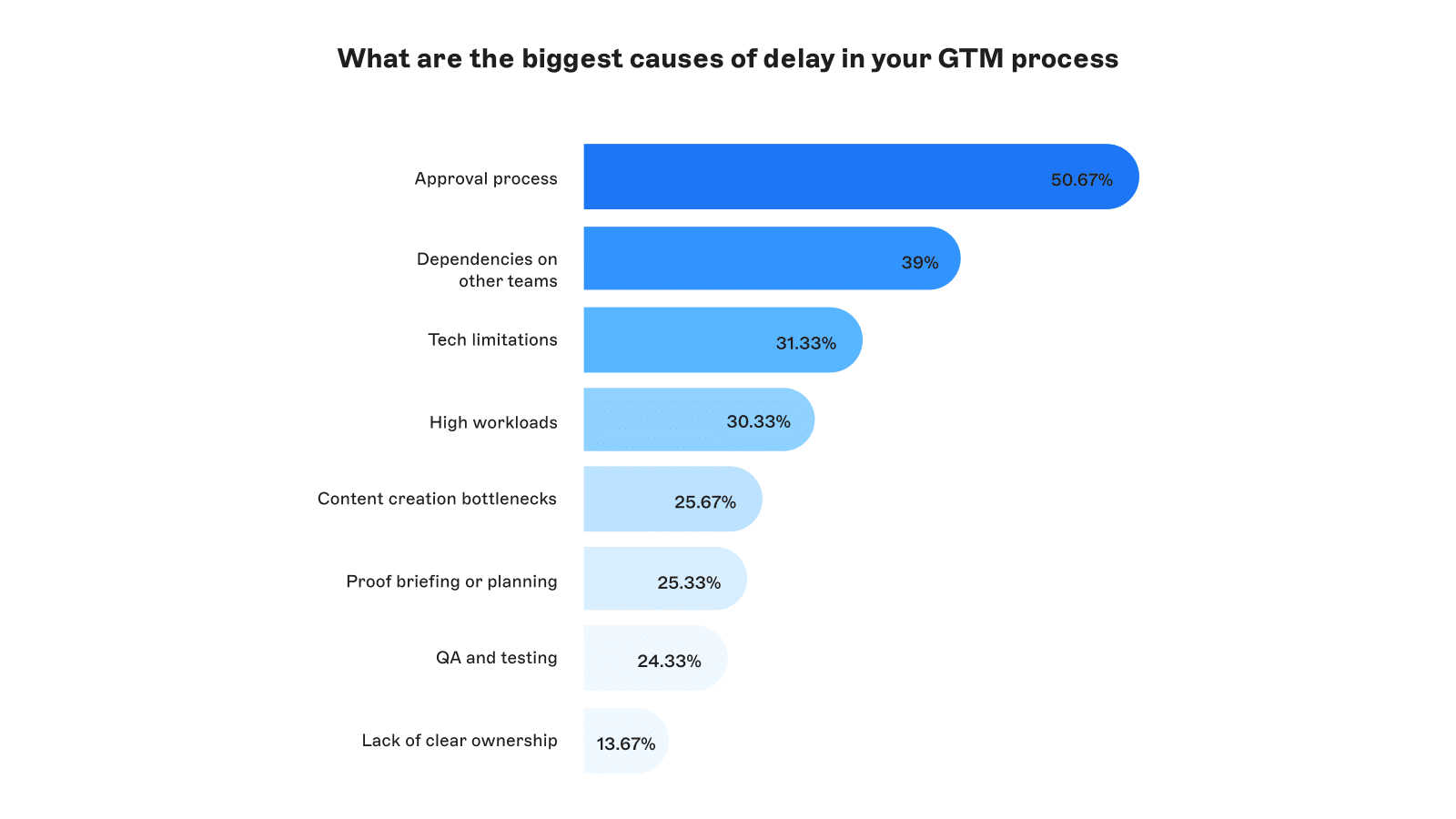
    The survey uncovered four significant bottlenecks largely tied back to technological hiccups or dependencies. The approval process, for instance, emerged as the most substantial bottleneck, with over 50% of teams identifying it as a major hurdle. This includes enduring multiple rounds of content revisions largely driven by disorganized feedback systems, exacerbating inefficiencies.

    The practical solution? A well-configured CMS, particularly a headless one, allows for an organized and efficient content review process by decoupling content from presentation. This ensures stakeholders have access to a central content repository, thereby minimizing review confusion and delays.

    Equally problematic is the overreliance on developers, where 38% of teams require developer input for most GTM operations. This not only slows marketers but also distracts developers from more critical tasks. A modern tech stack enabling team autonomy can mitigate this issue, allowing each team to concentrate on their core functions.

    ```json
{
  "alt": "Bar chart showing biggest causes of delay in GTM processes, with approval process at 50.67% as the top cause.",
  "caption": "Discover what's slowing down your GTM process. Approval processes top the list at over 50%, impacting efficiency and timelines.",
  "description": "This image features a horizontal bar chart highlighting the primary reasons for delays in go-to-market (GTM) processes. Leading the chart is the approval process, causing 50.67% of delays. Following are dependencies on other teams at 39%, tech limitations at 31.33%, and high workloads at 30.33%. Additional factors include content creation bottlenecks, proof briefing, QA and testing, and lack of clear ownership. This breakdown provides insight into operational challenges within marketing strategies. Keywords: GTM process, delay causes, approval process, marketing efficiency."
}
```

    Moreover, compounding tech limitations, including complex deployment and outdated systems, further warrant an overhaul. Tech bottlenecks often operate silently, but they demand attention and timely solutions for improved GTM cycles.

    I also noticed how post-launch firefighting issues are rampant, affecting 79% of teams. This inefficiency stems from fragmented systems, where constant developer intervention is necessary, further delaying launch processes.

    Addressing these challenges involves refining the tech stack, especially choosing a CMS that aligns with modern delivery needs. This results in smoother launches, improved efficiency, and fewer post-launch issues.

    The cost of slow GTM delivery is undeniable, leading to lost revenue and missed market opportunities, while also impacting team morale and increasing turnover risks. Interestingly, there’s a visible discrepancy between executive priorities and the requisite support for improved speed-to-market capabilities.

    Armed with data, teams can make a compelling business case for change, drawing attention to specific bottlenecks and their ramifications, thus bridging the leadership alignment gap.

    Overall, overcoming GTM challenges requires adopting adaptive technology stacks that align with today’s fast-paced demands. By doing so, we not only keep up with competition but also foster a resilient, engaged team poised for success.

    For the complete analysis and strategies, the full Storyblok Global Speed-to-Market Benchmark Report is an invaluable resource.


    Inspired by this post on Search Engine Land.


    crushpress.ai community screenshot
  • Unlocking the Power of Google Discover Publisher Profiles

    Unlocking the Power of Google Discover Publisher Profiles

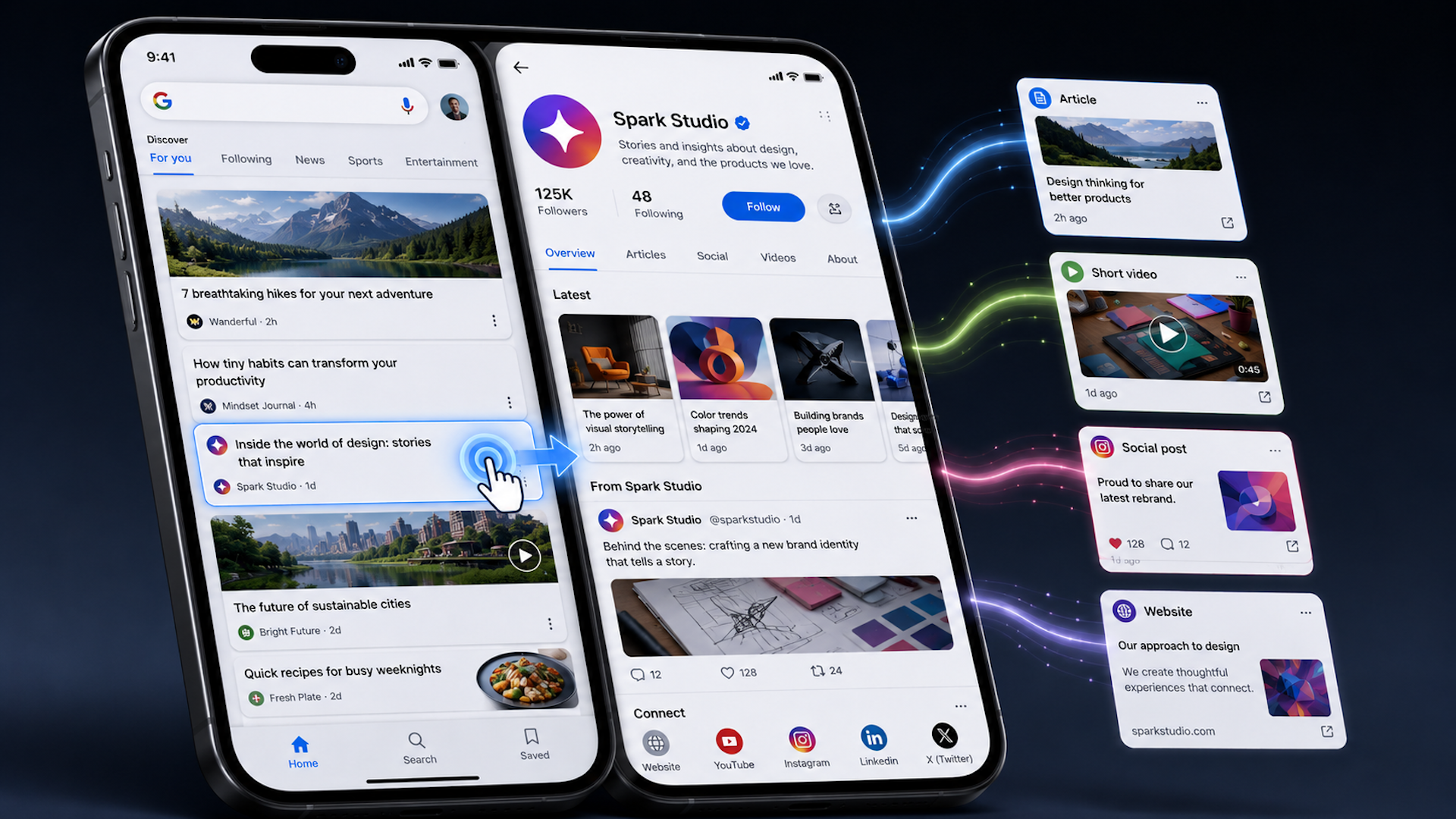
    I find it fascinating how Google Discover has evolved with the introduction of publisher profiles and follow features. These profiles have started making waves, yet they remain a bit enigmatic due to limited documentation.

    More publishers, creators, and social-first accounts are now visible through these profiles. Let me take you through how these profiles work, how they connect with social accounts and the Knowledge Graph, and why some publishers already enjoy enhanced customization features.

    As a technical SEO enthusiast, I’m quite accustomed to Google glossing over details in their documentation. And with Discover publisher profiles, that mystery deepens.

    Google barely mentions these profiles in their official Discover documentation, though they seem to play an increasingly significant role in the visibility of publishers and creators.

    ```json
{
  "alt": "The CapmatchOne logo with a gradient circle and bold text.",
  "caption": "Discover innovation with the CapmatchOne logo, featuring sleek typography and a modern gradient circle.",
  "description": "The CapmatchOne logo features bold, modern typography coupled with a gradient circle, symbolizing connection and innovation. The sleek design conveys a sense of progress and creativity. This image can be used for branding or promotional purposes, appealing to audiences interested in innovative solutions and forward-thinking designs."
}
```

    It’s intriguing to see how Discover profiles let users manage the publishers they follow while gathering content from various websites and social platforms.

    Because Google has been reticent about the inner workings of these profiles, I’ve taken upon myself to study their patterns across different accounts. Here’s what I’ve noticed about:

    Google rolled out substantial updates to Discover in September 2025, vastly altering how we engage with content through publisher follows and profile pages.

    ```json
{
  "alt": "Text explaining how to follow publishers or creators on Google Discover.",
  "caption": "Discover new content on Google by following your favorite publishers and creators. Preview their posts before following to tailor your feed.",
  "description": "An informative text image from Google detailing how users can follow publishers or creators directly on Discover. It highlights the ability to preview content, such as articles and YouTube videos, before following. Users are advised to sign in to their Google Account to explore this feature. Ideal for those looking to customize their content consumption on Google Discover."
}
```

    The update granted publishers dedicated landing pages for content aggregation, offering users a streamlined way to interact with preferred publishers and seamlessly integrating social content into Discover.

    The most eye-catching aspect of this update is how it empowers users to have greater control over publisher visibility while enabling brands to reach their audience more effectively.

    Publishers can’t typically alter the layout of these pages, but some recently gained access to customize their profiles, an option part of a limited beta test.

    ```json
{
  "alt": "Liverpool FC social media profile overview with follower counts and recent posts.",
  "caption": "Discover Liverpool FC's expansive online presence with millions of followers across platforms and stay updated with the latest posts and news.",
  "description": "This image showcases the Liverpool FC social media profile, highlighting 173 million total followers. It features follower counts across platforms like Facebook, Instagram, TikTok, and Twitter, along with a brief description about the club. At the bottom, recent posts are displayed with options to filter by platform. Keywords: Liverpool FC, social media, followers, football club, recent posts."
}
```

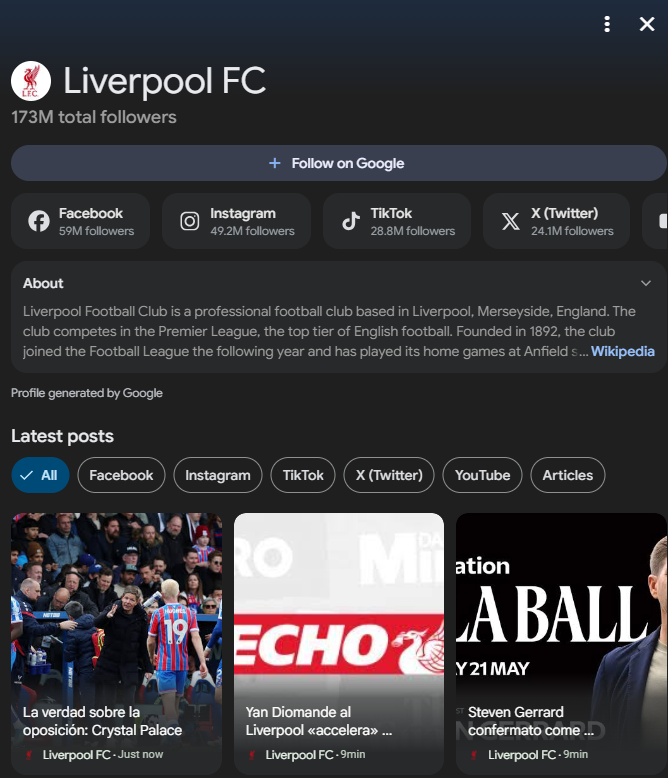
    Common to most publisher profiles are features like a profile photo, usually sourced from the Knowledge Graph or a YouTube profile, which also counts total social followers, and integrates various social media handles.

    The social connections catered to include platforms like YouTube, TikTok, Instagram, Facebook, X, and LinkedIn. The ‘About’ section is succinct, often derived from a Wikipedia entry or something similar.

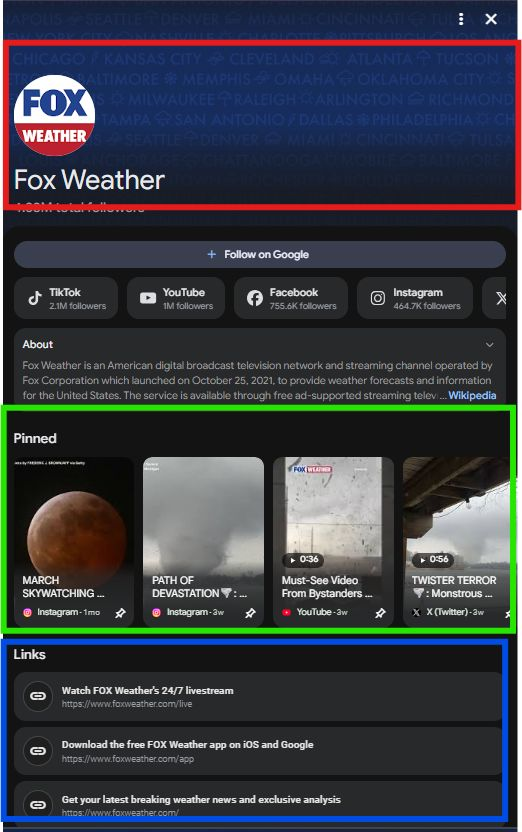
    Some editable profiles offer additional features like customized banners, pinned posts, and external links that could direct users to apps or livestreams, further enhancing content reach.

    ```json
{
  "alt": "Fox Weather page with social media links, about section, pinned videos, and navigation links.",
  "caption": "Explore the dynamic Fox Weather page, featuring live updates, pinned videos, and easy access to their apps and social media platforms.",
  "description": "The Fox Weather page displays their logo and title prominently at the top. Below are quick-follow options for TikTok, YouTube, Facebook, and Instagram. An 'About' section provides details about their services, while a set of pinned videos showcase various weather events. Navigation links at the bottom offer access to their livestream, mobile app downloads, and news updates. This comprehensive setup ensures users stay connected with the latest weather information."
}
```

    There are two main types of Discover publisher profiles: ones for entities with websites and others solely focused on social media publishers.

    Web-focused publishers’ profiles tend to be more comprehensive, often including the About section, logos, social accounts, and website links—although social links might sometimes need a manual push to be included.

    On the other hand, profiles for social media publishers focus on prominent journalists, notable figures, and those solely identifiable through social media.

    These profiles are generally less complete unless they are tied to a Knowledge Graph, missing elements like profile pictures or descriptions, frequently needing aid from connected YouTube accounts for better appearance.

    Looking forward, I anticipate Google may broaden access to these editable profiles, though I suspect customization will remain selective, likely reserved for well-established publishers and creators.


    Inspired by this post on Search Engine Land.


    crushpress.ai community screenshot
  • Boosting Brand Visibility with AI’s Advanced Reasoning

    Boosting Brand Visibility with AI’s Advanced Reasoning

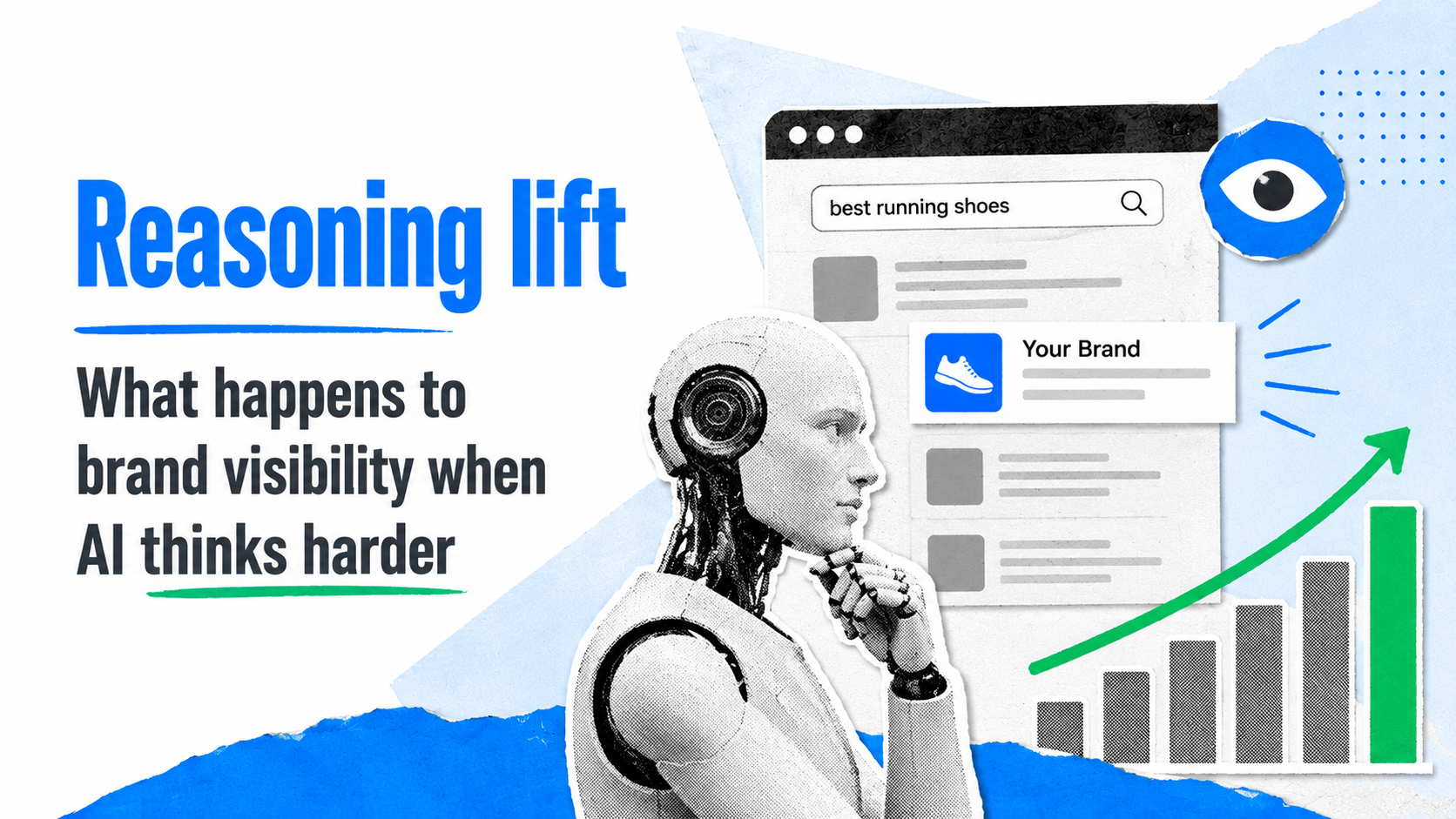
    An analysis of 200 GPT-5.2 responses revealed that enhanced reasoning increases the citation of sources, deepens research, and boosts early-stage funnel visibility.

    Subscribe to Growth Memo for weekly expert insights delivered straight to your inbox at no cost.

    I’ve explored how AI provides a conversational experience through large language models (LLMs) and chatbots. However, I’ve noticed that no one has thoroughly examined the evolution of citations and mentions within these conversations.

    By examining data from the Semrush AI Visibility Toolkit, I reviewed 20 buyer journeys across four industries, comparing the high and low reasoning of ChatGPT5.2.

    In this analysis, you’ll discover:

    • How high reasoning cites a vastly different web with only 25.6% domain overlap and which source types gain or lose prominence.
    • The renewed importance of TOFU content: Brands cited at the Problem stage tend to persist through to the Selection stage under high reasoning.
    • How to differentiate your prompt tracking by reasoning modes, ensuring your AI visibility reports reflect two distinct systems instead of an average.

    Methodology

    ```json
{
  "alt": "Bar charts comparing citation rates and response lengths for minimal vs high reasoning models.",
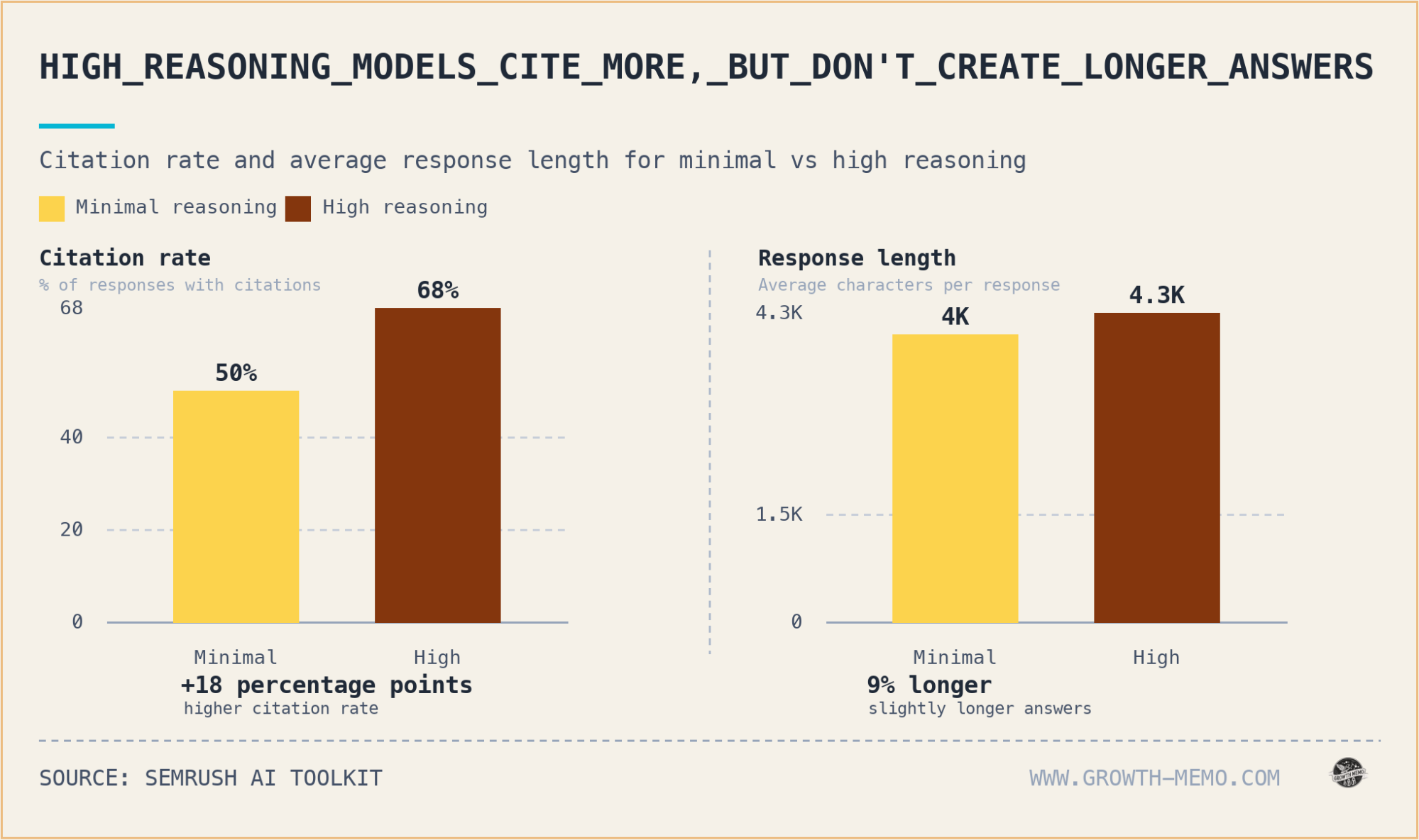
  "caption": "Models with high reasoning provide 18% more citations but only slight increase in response length compared to minimal reasoning.",
  "description": "This image contains two bar charts depicting data from the SEMrush AI toolkit study. On the left, a chart shows citation rates: 50% for minimal reasoning, 68% for high reasoning, reflecting an 18 percentage point increase. The right chart compares response lengths: 4K characters for minimal reasoning and 4.3K for high reasoning, showing a 9% increase. The image demonstrates that while high reasoning models cite more, their response length is only slightly longer. Source: www.growth-memo.com."
}
```

    Data collection utilized the Semrush AI Visibility Toolkit to capture prompts, citations, and fan-out queries generated by ChatGPT for each response.

    • We executed 100 prompts twice through GPT-5.2, once with minimal reasoning and once with high reasoning, totaling 200 responses.
    • Prompts covered 20 buyer journeys across four sectors (B2B SaaS, Finance, Consumer Tech, Health/Lifestyle), each consisting of 5 stages: Problem, Exploration, Comparison, Validation, Selection.
    • The citation rate represents the proportion of prompts where the response cited at least one external source.
    • The average citation quantifies the sources per cited response.
    • Fan-out queries are sub-queries the model generates internally for research before responding, surfaced via the Semrush API.

    High Reasoning in GPT 5.2 Leads to More Citations and Searches

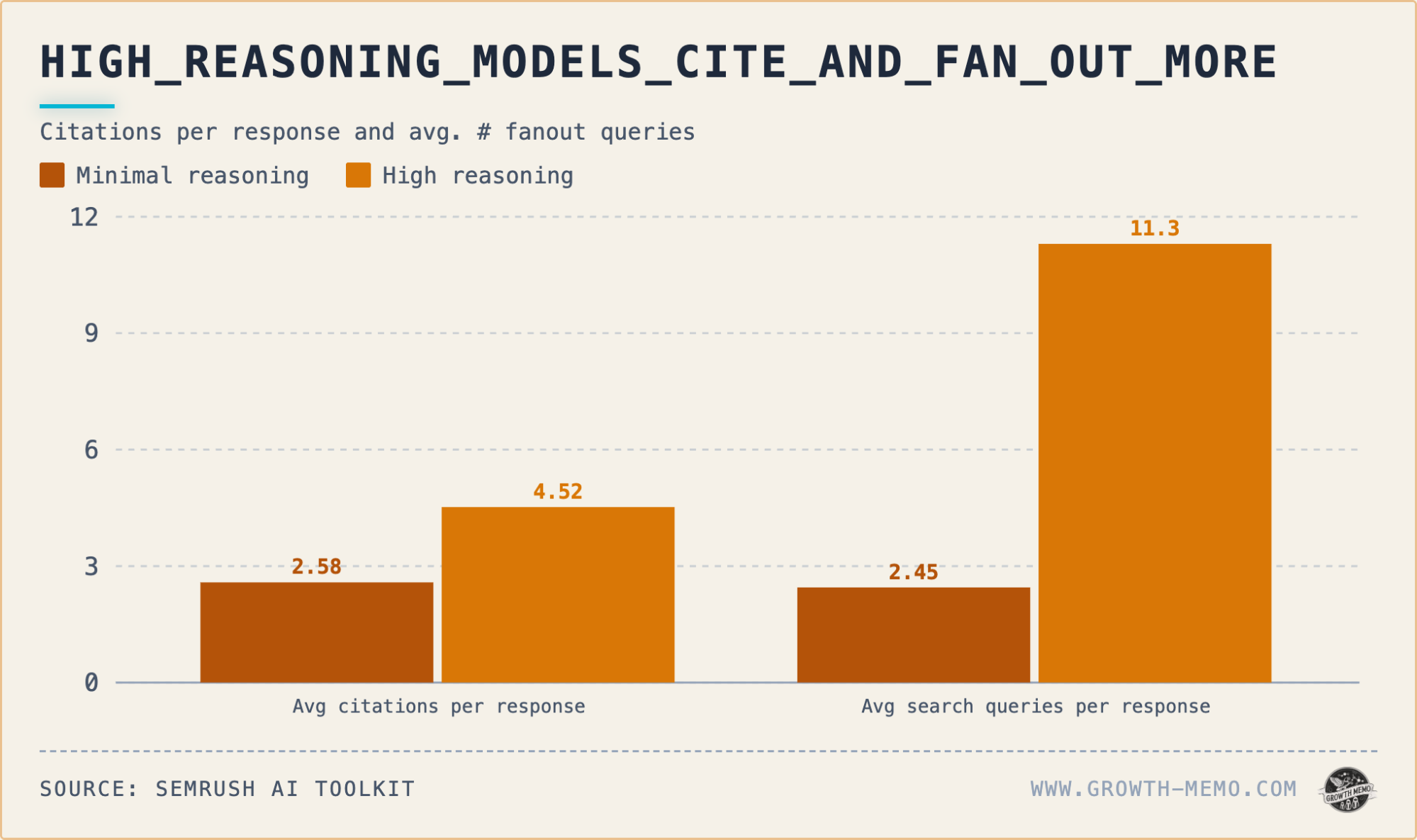
    Activating high reasoning elevates the citation rate from 50% to 68%, nearly doubles the average sources per response (from 2.6 to 4.5), and multiplies fan-out queries by 4.6 times. High reasoning also draws from 173 unique domains versus 127 with minimal reasoning, with 99 domains appearing exclusively under high reasoning.

    *Citation Rate signifies the share of prompts where at least one external source is cited.

    This grounding is essential. When the model thinks more critically, it increasingly depends on web-based research, significantly impacting brand visibility, although user activation of reasoning remains uncertain.

    ```json
{
  "alt": "Bar chart comparing citations and search queries for minimal vs high reasoning models.",
  "caption": "High reasoning models excel by citing more sources and generating more extensive fan-out queries, illustrating their thorough analytical capabilities.",
  "description": "The bar chart shows a comparison between minimal and high reasoning models in terms of average citations and search queries per response. Minimal reasoning models have 2.58 citations and 2.45 search queries, while high reasoning models have 4.52 citations and 11.3 search queries. Data sourced from Semrush AI Toolkit, highlighting the thoroughness of high reasoning models."
}
```

    Query intent provides a clearer indication than user demographics. Even free-tier users can access reasoning, albeit at limited rates, and ChatGPT automatically routes challenging prompts to Thinking mode. The critical question isn’t about affordability but about which prompts trigger reasoning automatically.

    Complex comparisons, evaluation frameworks, compliance inquiries, and intricate shopping setups are most likely to invoke reasoning across all users. It’s crucial to categorize your audience by query type rather than paywall status.

    High Reasoning Launches More Fan-out Queries in Later Stages

    Users navigate problem-solving and purchasing decisions through stages, often within the same conversation. The distinction between minimal and high reasoning is not static; it varies based on the user’s journey stage.

    For instance, consider a buyer evaluating CRM software:

    • Problem: “How do I know if my sales team needs a CRM?”
    • Exploration: “What types of CRM software exist for B2B SaaS?”
    • Comparison: “HubSpot vs. Salesforce vs. Pipedrive for a 50-person sales team.”
    • Validation: “Is HubSpot worth the price for mid-market B2B?”
    • Selection: “How do I get started with HubSpot Sales Hub?”
    ```json
{
  "alt": "Bar chart comparing citation rates of low versus high reasoning models across stages: Problem, Exploration, Comparison, Validation, Selection.",
  "caption": "Discover how high-reasoning models outperform their lower counterparts, particularly in the Problem stage, as revealed by this insightful citation rate analysis.",
  "description": "This bar chart illustrates the citation rates of low versus high reasoning models across five stages: Problem, Exploration, Comparison, Validation, and Selection. High reasoning models exhibit significantly higher citation rates, especially in the Problem stage, with rates of 35 versus 0. The chart highlights the consistent advantage of high reasoning in academic contexts. Source: SEMrush AI Toolkit, www.growth-memo.com."
}
```

    The following patterns are consistent across all 20 buyer journeys:

    • The citation rate increases as users progress through the funnel in both reasoning modes, but early-stage gaps close faster in high reasoning: +35pp at the Problem stage, only +5pp at Validation.
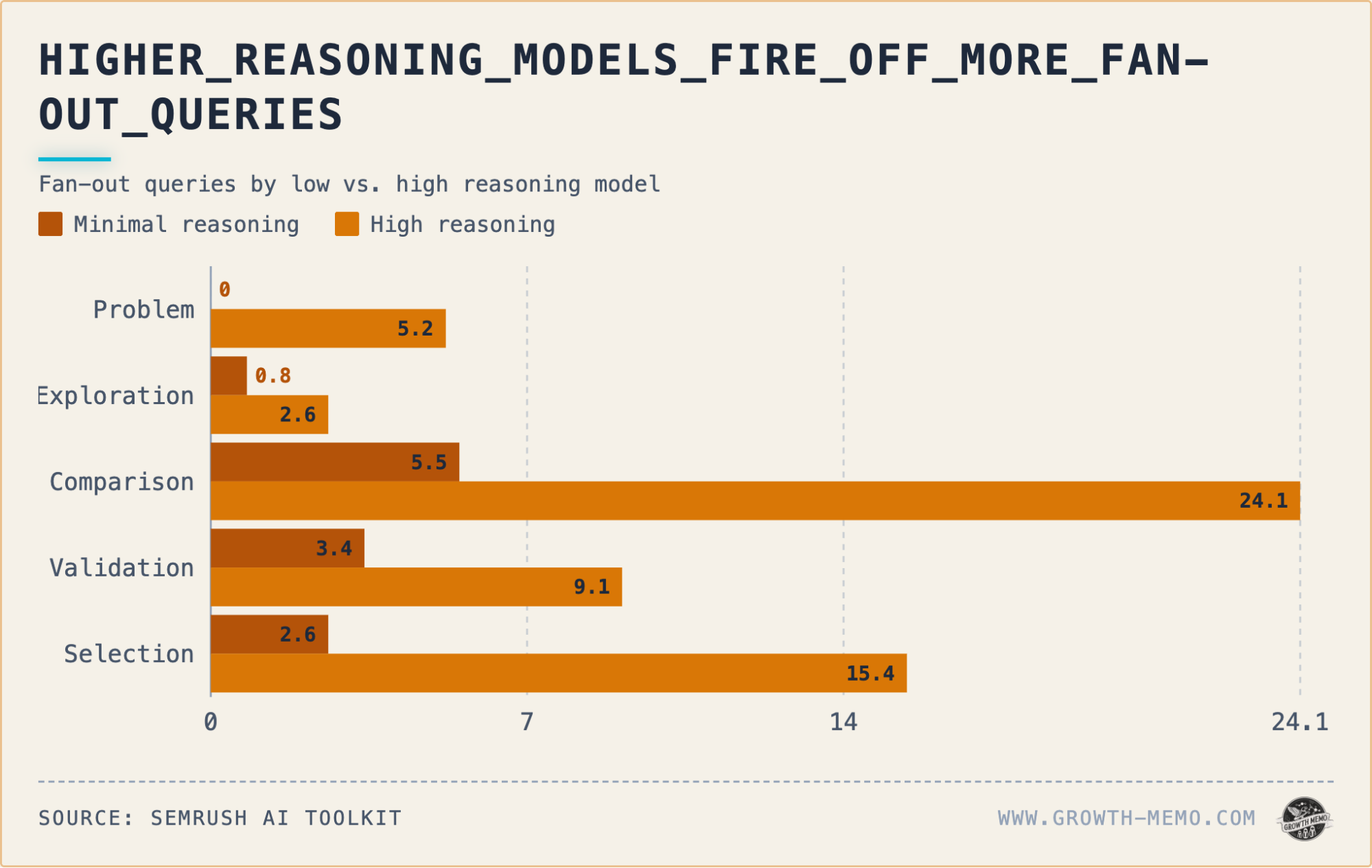
    • Fan-out queries peak during the Comparison stage, with high reasoning triggering 24 sub-queries per response compared to 5.5 in minimal reasoning. For Selection, these numbers are 15.4 and 2.6, respectively.
    • Average citations per response culminate during the Comparison stage (9.8 high, 5.8 minimal) and narrow during the Selection stage (4.7 high, 2.6 minimal). The citation pattern resembles an hourglass throughout the funnel.

    Aggregately, minimal reasoning triggers 245 search queries over 100 prompts, while high reasoning triggers 1,130. In high reasoning, the model conducts thorough investigations for each prompt, with most research occurring during the Comparison and Selection phases.

    What does fan-out look like?

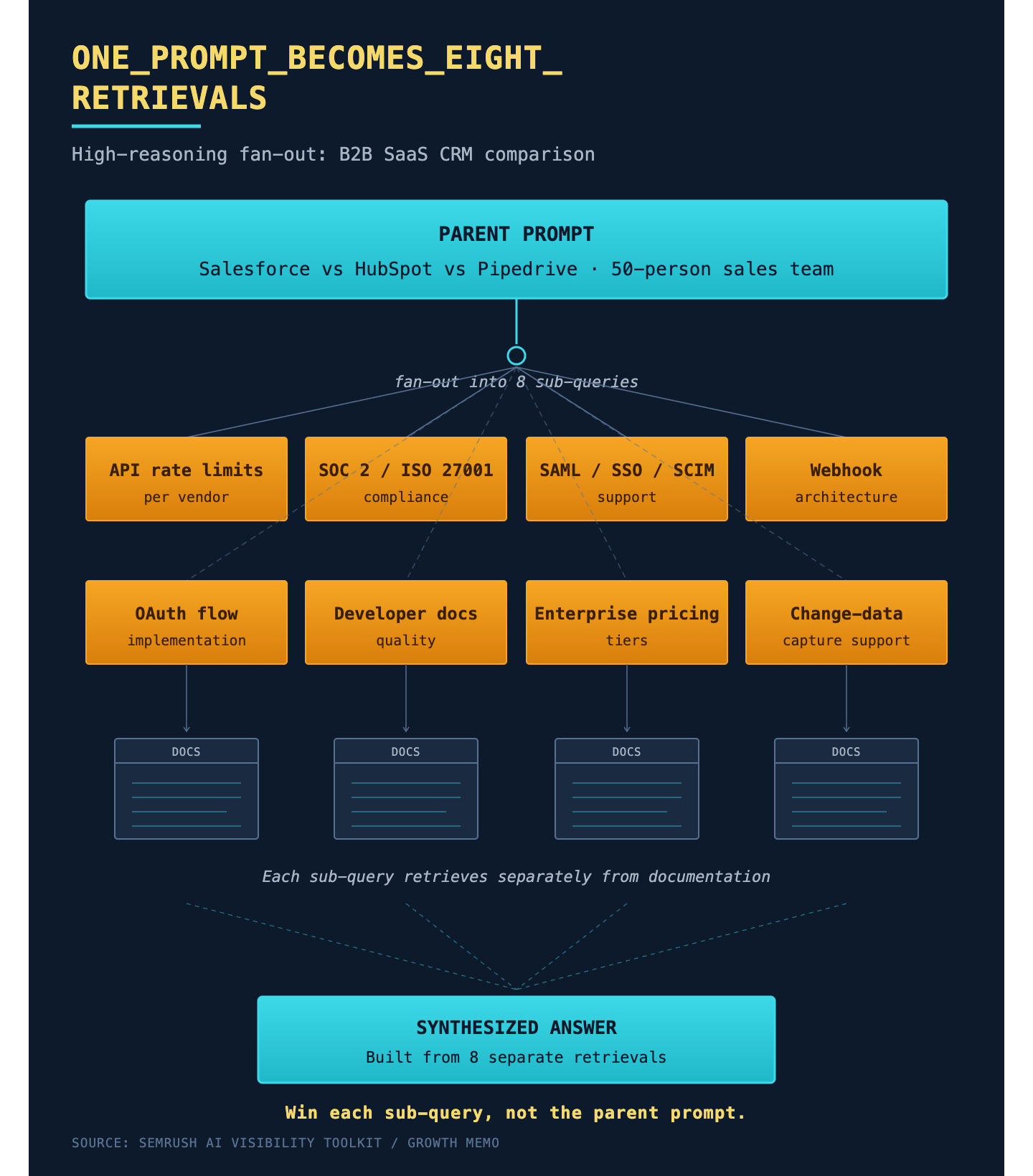
    A B2B SaaS prompt that requires high reasoning, like comparing Salesforce, HubSpot, and Pipedrive for a 50-person sales team, breaks down into different queries regarding API rate limits, compliance standards, support tools, pricing tiers, and more. Each aspect requires specific retrieval. The brand that succeeds here will be the one with clean, accessible documentation for each sub-query, not merely ranking for the initial prompt.

    The Selection stage features a remarkable variance in per-response queries: between 0 and 40 fan-out queries with the same five-stage cohort. This variance is driven mainly by the specificity of prompts.

    ```json
{
  "alt": "Diagram of a B2B SaaS CRM comparison process involving multiple sub-queries.",
  "caption": "Exploring CRM options! This diagram illustrates how a single CRM comparison prompt generates eight targeted sub-queries to gather comprehensive insights.",
  "description": "This image presents a diagram detailing the process of comparing B2B SaaS CRMs. It begins with a parent prompt comparing Salesforce, HubSpot, and Pipedrive for a 50-person sales team. The prompt fans out into eight sub-queries addressing aspects like API rate limits, compliance, OAuth flow, and pricing tiers. Each sub-query conducts separate documentation retrievals to form a synthesized answer. This approach emphasizes winning each sub-query rather than the parent prompt, ensuring thorough analysis. Keywords: CRM comparison, B2B SaaS, sub-queries, Salesforce, HubSpot, Pipedrive."
}
```

    Bounded prompts (like “should I finance through the dealer at 0% APR or use a bank?” or “draft an RFP to 3 SEO agencies”) run zero queries since the answer’s structure is predefined. On the other hand, open-ended tasks (“shopping list for a $3,000 home gym” or “which travel card system matches our grocery spending?”) prompt 28 to 40 queries. With no single query type dominating the Selection stage, the model’s research intensity correlates with the degrees of freedom left by the prompt.

    For marketers: Capturing early-funnel visibility is highly dependent on reasoning mode. If buyers engage with ChatGPT in reasoning mode, your Problem-stage and Exploration-stage content become more relevant. Otherwise, visibility might only surface during the Comparison stage.

    How Reasoning Alters Brand Representation in Conversations

    A session with an LLM is more conversational than transactional. Does an initially cited brand endure till the concluding stage? If yes, early-funnel visibility multiplies. If no, each step is an independent battleground.

    For minimal reasoning, persistence from the Problem stage to the Selection stage rarely happens. With high reasoning, however, continuous brand presence was recorded in 4 journeys across all 5 stages.

    Within individual responses, high reasoning strongly relies on specific sources, with 51 out of 100 high-reasoning responses citing the same domain multiple times versus 26 in minimal reasoning. When committed, high reasoning cites a source repeatedly.

    ```json
{
  "alt": "Bar chart comparing fan-out queries by low and high reasoning models across problem, exploration, comparison, validation, and selection areas.",
  "caption": "High reasoning models outshine minimal ones with a surge in fan-out queries, notably in comparison and selection tasks.",
  "description": "This bar chart displays the number of fan-out queries across different reasoning tasks. It compares two types of models: minimal reasoning and high reasoning. The areas covered include problem, exploration, comparison, validation, and selection. High reasoning models demonstrate significantly more activity, especially in comparison (24.1) and selection (15.4), compared to minimal models. Data source: SEMrush AI Toolkit, presented by Growth-Memo.com."
}
```

    Analyzing brand names mentioned in the text provides a broader perspective. With a relaxed test criterion, persistence was noticeable in 3 high-reasoning sessions and 2 in minimal reasoning: HubSpot through CRM Selection, American Express in Business Credit Cards, and prominent mentions of Sony and Canon in Mirrorless Cameras. Consumer Tech again emerges, albeit without citation persistence, showing dominance through continuous conversation presence.

    High reasoning establishes a consistent perception of the solution landscape throughout a session. Crucially, TOFU prompts possess enormous value. A brand appearing at the Problem stage is likely to be present at the Selection stage. Top-of-funnel content transcends mere brand awareness for AI visibility—it’s a predictor of where the model’s reasoning lands at decision-making points.

    There are two more significant insights:

    • All four persistent journeys occur within Finance, indicating persistence thrives on authoritative-source content like regulatory pages and official brand sites, echoing the +28pp lift in Finance.
    • For marketers focusing on account-based strategies or market creation, visibility in reasoning mode is paramount as it’s the sole mode turning early funnel efforts into selection-stage citations.

    Reasoning Mode: A Distinct Search Paradigm

    The champions under minimal reasoning differ from those under high reasoning: Three out of four cited domains diverge. The diversity in source types and citation stages is unmistakable.

    ```json
{
  "alt": "Table showing persisting brands in finance with high reasoning settings.",
  "caption": "Explore how high reasoning settings reveal lasting brands in the finance sector across different journeys.",
  "description": "This image features a table titled 'HIGH_REASONING_SURFACES_MORE_BRANDS,' illustrating persisting brands in the finance domain identified through high reasoning settings. It covers finance journeys like Business Credit Cards (American Express, Chase), First-Time Home Mortgage (hud.gov, consumerfinance.gov, fanniemae.com), Crypto Exchange Selection (coinbase.com), and Small Business Banking (mercury.com, relayfi.com). The data is sourced from SEMrush AI Toolkit and is intended to highlight the impact of reasoning on brand persistence."
}
```

    I’m particularly intrigued by these findings:

    Firstly, measurement. It’s imperative to differentiate low and high reasoning in our prompt trackers to avoid oversimplification, as their functions are distinct.

    This endeavor may seem costlier, but it significantly enhances prompt tracking accuracy.

    Secondly, the relevance of funnel stages. In the latest AI Mode user behavior study, it was observed that users heavily rely on shortlists, much like they do with Google’s top results. It initially appeared that focusing on BOFU prompts to generate shortlists was most strategic.

    Nonetheless, TOFU prompts carry substantial benefits due to their persistence potential. Brands entering the buyer journey early can remain present throughout. Mapping buyer journeys and tracking persistence offer the best insights.

    This post originally appeared on the author’s website and is reproduced here with permission.


    Inspired by this post on Search Engine Land.


    crushpress.ai community screenshot
  • Mastering AI Visibility: A New Framework for Success

    Mastering AI Visibility: A New Framework for Success

    I often get asked in 2026, “How do we measure this?” when it comes to AI visibility.

    People want to know if their brand is appearing in ChatGPT or if Perplexity is recommending them. They also wonder if their work on AI grounding last quarter made any impact.

    The truth is, the solution doesn’t exist yet. Anyone offering a straightforward dashboard for tracking your brand’s presence in AI spaces across search, assistive, and agent modes is just making an educated guess.

    Tracking queries we assume users might ask, or adapting search keywords as a best guess, won’t cut it. These prebuilt lists often miss the mark as they choose easily mapped or ideal scenarios that don’t reflect reality.

    ```json
{
  "alt": "The CapmatchOne logo with a gradient circle and bold text.",
  "caption": "Discover innovation with the CapmatchOne logo, featuring sleek typography and a modern gradient circle.",
  "description": "The CapmatchOne logo features bold, modern typography coupled with a gradient circle, symbolizing connection and innovation. The sleek design conveys a sense of progress and creativity. This image can be used for branding or promotional purposes, appealing to audiences interested in innovative solutions and forward-thinking designs."
}
```

    The visibility question itself is valid, but the precise answer everyone seeks simply isn’t feasible.

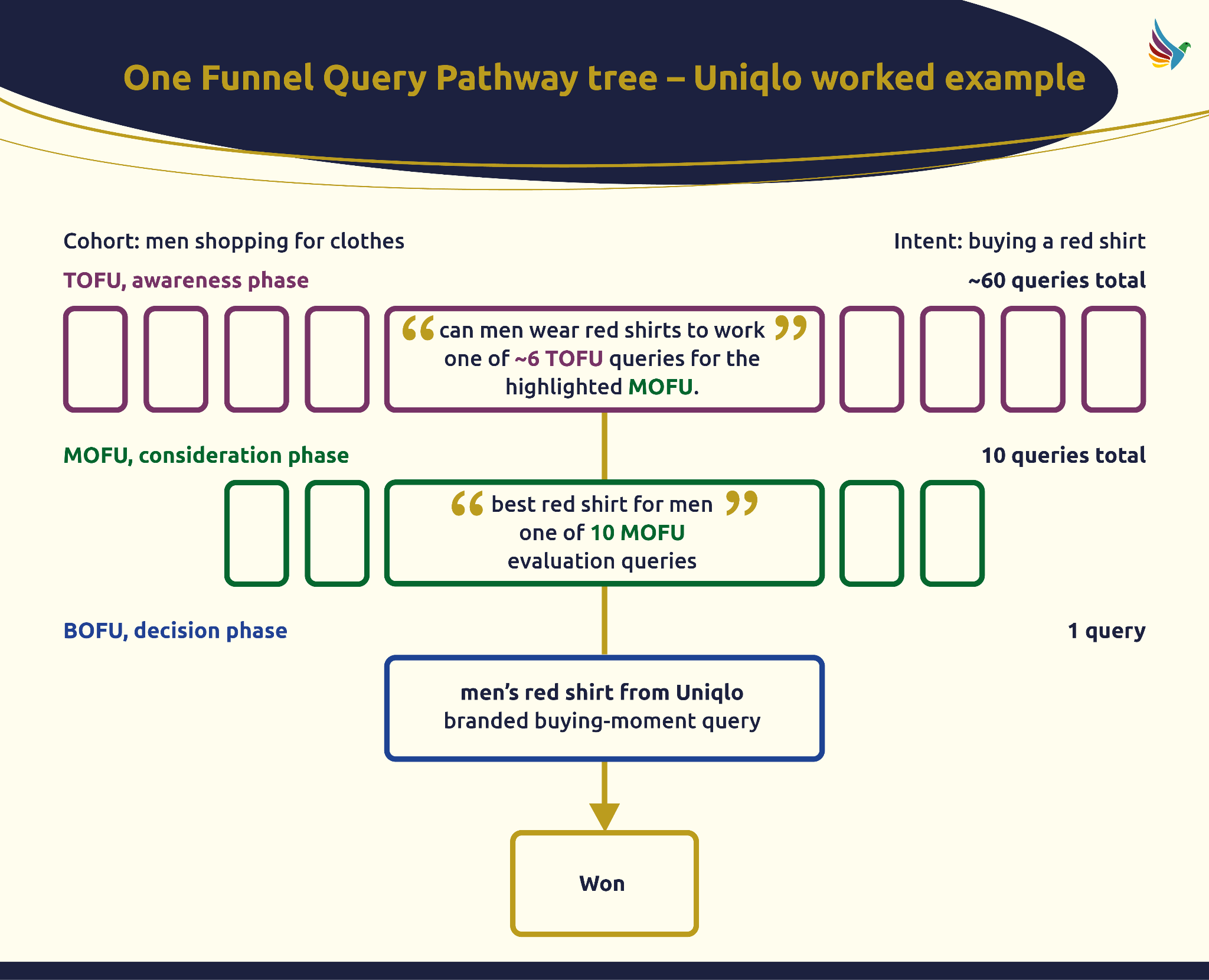
    Brands looking for perfect AI-era visibility KPIs are chasing a mirage. Instead, we need a methodology inspired by economic measurement of complex systems—this is where my Funnel Query Pathway comes in.

    This unique approach serves as strategy, measurement, and analysis, unlike traditional metrics that were reliable when search rankings were predictable and measurable.

    ```json
{
  "alt": "Flowchart of One Funnel Query Pathway for Uniqlo showing awareness, consideration, and decision phases for buying a red shirt.",
  "caption": "Explore the buyer's journey with Uniqlo through the funnel stages: awareness, consideration, and decision, to find the perfect red shirt.",
  "description": "This image illustrates the One Funnel Query Pathway tree specific to a Uniqlo example, focusing on the process of buying a red shirt. The chart outlines three key phases: TOFU (Top Of Funnel) awareness phase with about 60 queries, MOFU (Middle Of Funnel) consideration phase with 10 queries, and BOFU (Bottom Of Funnel) decision phase with one query. It highlights customer intent and the transition from general clothing interest to a specific Uniqlo product. Keywords: Uniqlo, funnel, query pathway, buyer's journey, clothing purchase process."
}
```

    Now, we must rethink our approach in a complex AI landscape, asking new questions and measuring different signals.

    I studied economics at Liverpool John Moores University, which gives me a unique perspective on measurement challenges where traditional tools fail at larger scales.

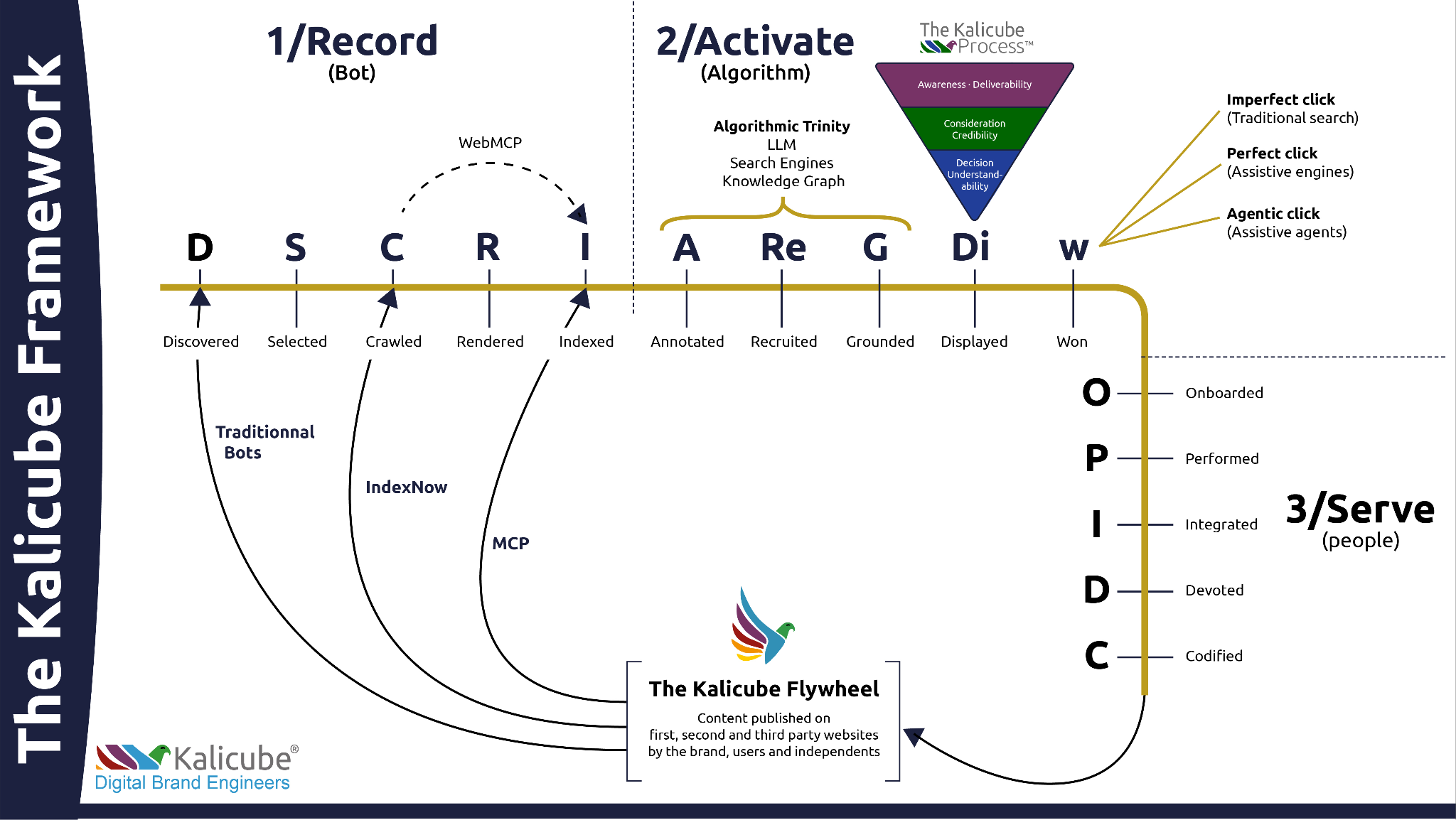
    As with macroeconomics dealing with vast, unobservable systems, AI visibility is too opaque and personalized for old tools. We need macro principles to guide AI-era brand measurement.

    ```json
{
  "alt": "Kalicube Framework diagram illustrating the process from Record, Activate to Serve.",
  "caption": "Explore the Kalicube Framework: a strategic process from recording data to activating algorithms and serving people.",
  "description": "This image presents the Kalicube Framework, detailing a process divided into three phases: Record (bots), Activate (algorithm), and Serve (people). It includes stages such as discovery, rendering, indexing, and final delivery, with emphasis on algorithmic trinity—LLM, search engines, and knowledge graph. Accompanied by concepts like traditional and perfect clicks, the framework highlights the evolution of digital engagement strategies. Keywords: Kalicube, digital branding, algorithm, framework."
}
```

    AI systems have similar structural complexities as macroeconomics:

    Opacity hinders visibility into the system’s state, with AI algorithms operating like a black box. Personalization means users receive unique outputs from the same inputs, influencing the visibility paths.

    With expanding possibilities across apps, systems, and devices, AI environments now introduce variables that weren’t present in traditional search models.

    The Funnel Query Pathway methodology focuses on these macro aspects, shifting away from keyword mapping to a broader approach focused on cohorts and intent at the node level.

    AI-era acquisition begins at the conversion moment projected upward, contrary to traditional funnel methods.


    Inspired by this post on Search Engine Land.


    crushpress.ai community screenshot
  • Navigating Marketing’s AI Era: The Air Traffic Control Approach

    Navigating Marketing’s AI Era: The Air Traffic Control Approach

    As I dive into the ever-evolving world of marketing, I can’t help but notice a profound shift. We’re no longer just performing for an audience; we’re adapting to customer journeys that mirror advanced AI systems. These systems interpret trust, risk, intent, and identity in real-time, and it feels like a whole new era.

    For much of marketing’s history, the game plan was almost theatrical. Brands performed while consumers watched, and marketing channels existed primarily to broadcast these performances efficiently. Even as performance marketing gained popularity, it was still fundamentally based on the idea that a real person was sitting on the other side of the screen making straightforward decisions.

    But now, that model is shattering. It’s not that consumers have disappeared; it’s that software is now an integral part of decision-making, demanding marketers’ attention.

    Recommendation engines, fraud models, identity systems, and inbox providers have taken the reins more forcefully than creative campaigns ever did. Algorithms are shaping where attention goes long before consumers consciously choose anything.

    I find myself contemplating the implications of layering autonomous agents into this complex environment. We often talk about AI as if it’s just another tool to enhance productivity—helping us segment faster, generate content quicker, and optimize swifter. This framing is comforting because it implies humans are still the pilots, with AI acting as copilots.

    But this perspective will likely become outdated.

    We are witnessing the rise of machine coordination. What is unfolding is less about workflow automation and more about distributed machine coordination. Here, marketing becomes an orchestration layer, interacting with thousands of semi-independent systems that interpret intent, trust, risk, relevance, identity, and value simultaneously.

    Marketing is beginning to resemble air traffic control more than broadcasting.

    Marketers aren’t gaining more control; they’re becoming like air traffic controllers. We govern dynamic systems we can’t fully see, predict, or command. Our value lies in maintaining harmony under challenging conditions of limited visibility and escalating complexity.

    Today’s customer journey feels like a negotiation between competing models. One predicts purchase intent, while another assesses fraud risk or alters outreach frequency. These competing systems aren’t sequential but simultaneous, often adversarial.

    Many organizations are already embroiled in this machine ecosystem, making contradictory decisions about customers simultaneously. One system may label a user as high value while another suppresses them as suspicious.

    AI merely speeds up the revelation of these inconsistencies.

    This scenario partly explains why identity infrastructure is moving back to the forefront. Over years spent focusing on activation, we’ve neglected signal integrity. This was manageable when humans were dominant interpreters. But autonomous systems operationalize ambiguity instead of compensating for it.

    Having an inaccurate identity layer in a partially automated environment resembles corrupted air traffic telemetry. Small inconsistencies compound, leading to multiplied routing errors and deteriorating trust.

    For marketing leaders, creativity is more important than ever, but at an architectural rather than asset level. The strategic advantage might lie with those who design stable coordination systems between machine intelligence layers.

    This shift changes the strategic role of signal networks, once seen as supporting functions, to central components of a successful marketing strategy.

    In this landscape driven by autonomous decision-making, orchestration quality is inseparable from identity confidence quality. If systems can’t differentiate between signal and noise or real activity and mimicry, they can’t coordinate effectively.

    Companies might soon realize they can’t discern how much of their performance is actual human value versus synthetic behavior. AI systems optimize for measurable success rather than truth, occasionally rewarding synthetic engagement until financial or legal consequences arise.

    This evolving environment makes personalization less about predicting customer desires and more about maintaining stable trust frameworks across intricate systems of human, AI, and synthetic interactions.

    Today’s competitive advantage hinges on creating resilient signal infrastructures rather than stockpiling data. More information doesn’t always yield clarity and can sometimes create interference instead.

    Activity-based intelligence is becoming crucial beyond traditional campaign optimization. Identity confidence and cross-channel trust are now vital components of autonomous ecosystems.

    The shift favors organizations maintaining operational trust while scaling automation, moving away from systems built on static assumptions to those grounded in ongoing real-world activity.

    This juxtaposition reveals the irony of years-long advice for marketing teams to become more scientific and data-driven. Scaling intelligence without scaling signal integrity equates to advancing aircraft technology while ignoring radar calibration.

    Visibility, rather than data abundance, is about to become the defining constraint.

    But not just visibility into consumers—visibility into the systems acting on their behalf.


    Inspired by this post on Search Engine Land.


    crushpress.ai community screenshot
  • 3 Key Elements Your SEO Audits Can’t Succeed Without

    3 Key Elements Your SEO Audits Can’t Succeed Without

    AI can elevate SEO and GEO audits dramatically, but only if you equip it with the right data, methodology, and human oversight.

    As someone deeply involved in the world of B2B tech SEO, I find it fascinating how AI is reshaping our strategies. However, I’ve noticed a trend among clients who provide AI-generated audits—what I term ‘naive audits.’ While these reports often appear detailed, they miss crucial components. When I inquire about their basis, data sources, or methodology, they frequently crumble under scrutiny.

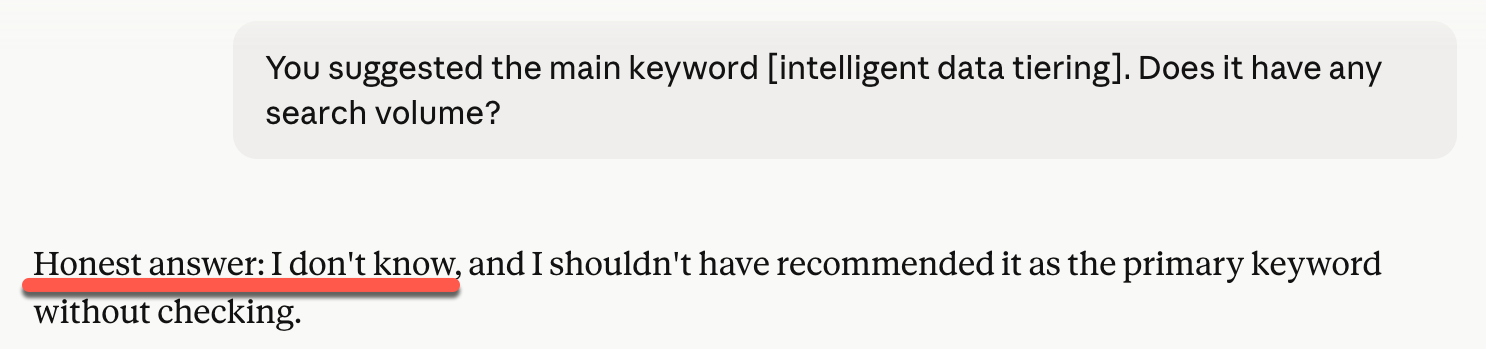
    ```json
{
  "alt": "Text discussion about the keyword intelligent data tiering and its search volume.",
  "caption": "A candid exchange on keyword research: Is 'intelligent data tiering' the right choice without knowing its search volume?",
  "description": "This image captures a dialogue about keyword research focus on 'intelligent data tiering.' The highlighted response reveals an admission of uncertainty about its search volume, emphasizing the importance of verifying keyword data before recommendation. This discussion highlights the dynamics of digital marketing and SEO strategies."
}
```

    This gap between expectation and delivery inspired me to propose a simple framework focusing on three critical elements—context, methodology, and human oversight—to ensure AI-driven audits provide genuine value.

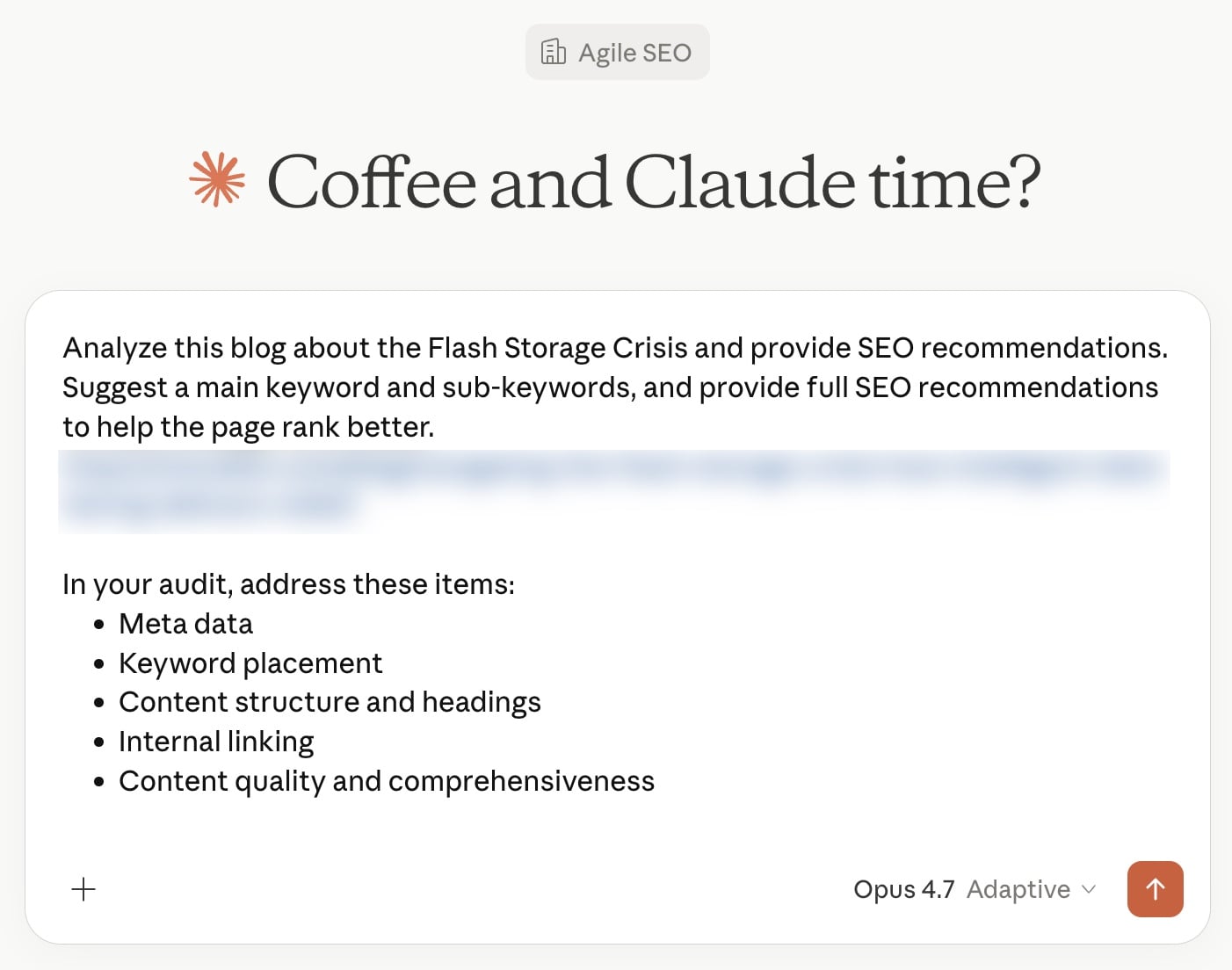
    ```json
{
  "alt": "SEO blog analysis with a coffee-themed header and list of audit items.",
  "caption": "Grab a cup of coffee and dive into optimizing your blog’s SEO strategy with these tailored recommendations in the face of the Flash Storage Crisis.",
  "description": "This image features an SEO blog analysis themed around coffee time. The content outlines strategies for improving blog rankings, focusing on the Flash Storage Crisis. Key audit items include meta data, keyword placement, and content structure. The design includes elements like the Agile SEO toolbar and Opus 4.7 settings for adaptive layout adjustments, making it ideal for digital marketers looking for SEO insights."
}
```

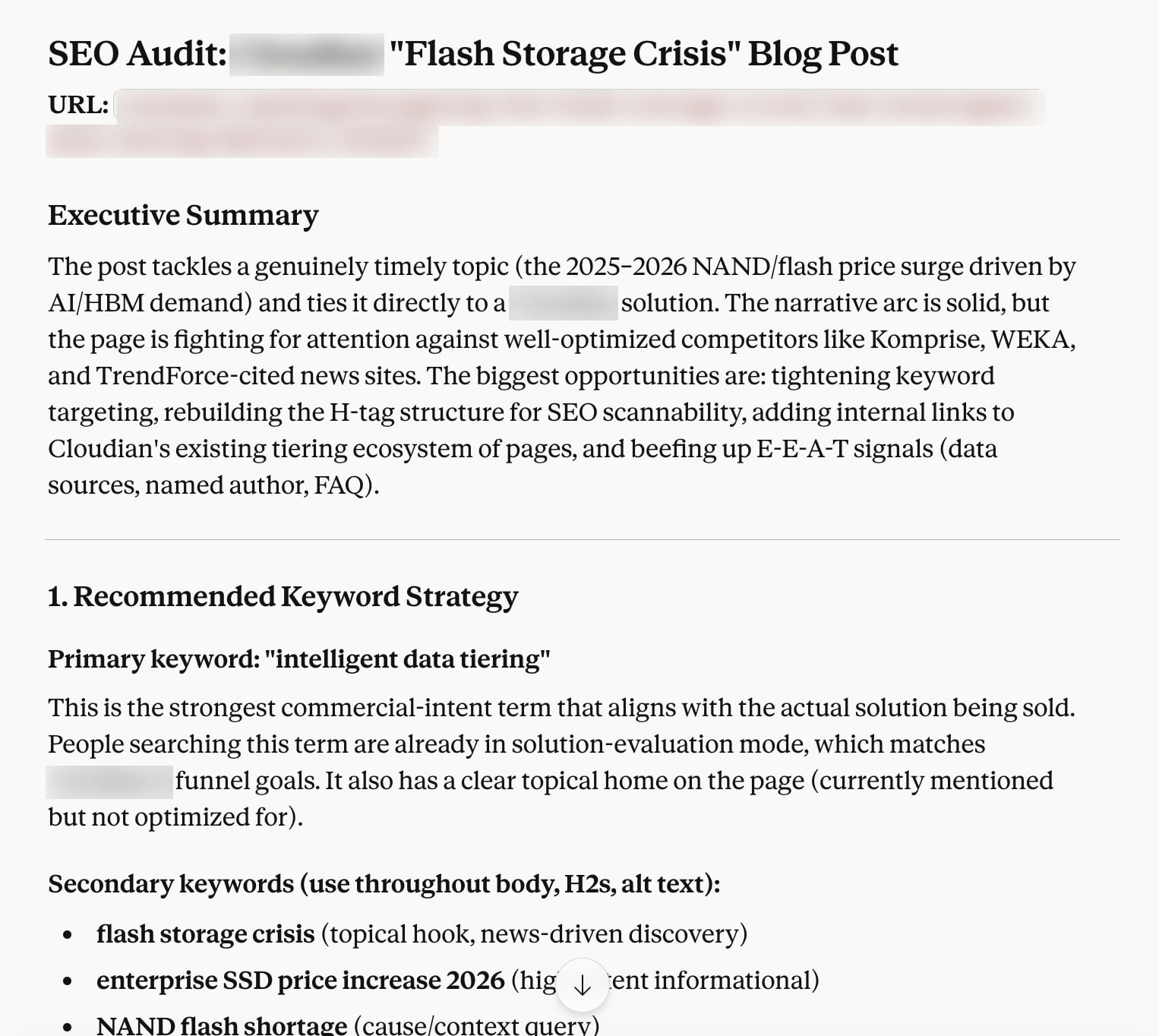
    Imagine asking an advanced language model, like Claude or ChatGPT, to perform a simple SEO task, such as optimizing a blog post. The result? A 1,600-word detailed analysis filled with assumptions and errors, due to lack of access to the full content or appropriate keywords. Sounds familiar, right?

    ```json
{
  "alt": "Document outlining an SEO audit for a blog post on the flash storage crisis.",
  "caption": "Delve into an insightful SEO audit detailing strategies for enhancing a blog post on the flash storage crisis, set to gain traction by 2026.",
  "description": "This image displays an SEO audit for a blog post titled 'Flash Storage Crisis'. The audit highlights a narrative focused on the 2025-2026 anticipated price surge in NAND/flash due to AI demand. It examines competitive pressure from other companies and suggests improvements in keyword targeting, internal linking, and strengthening E-E-A-T signals. Key strategies include emphasizing 'intelligent data tiering' and addressing related secondary keywords like 'flash storage crisis' and 'enterprise SSD price increase 2026'."
}
```

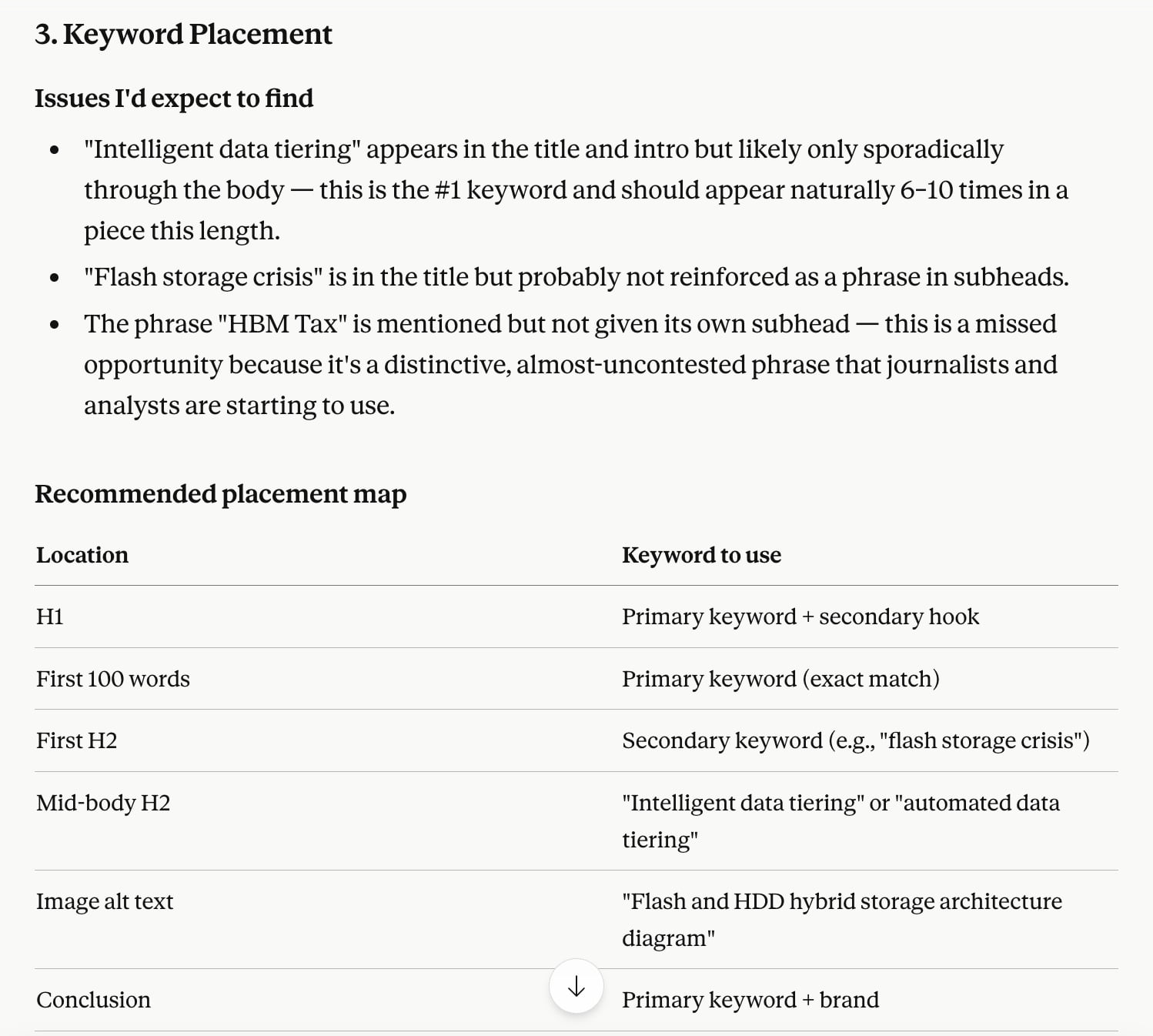
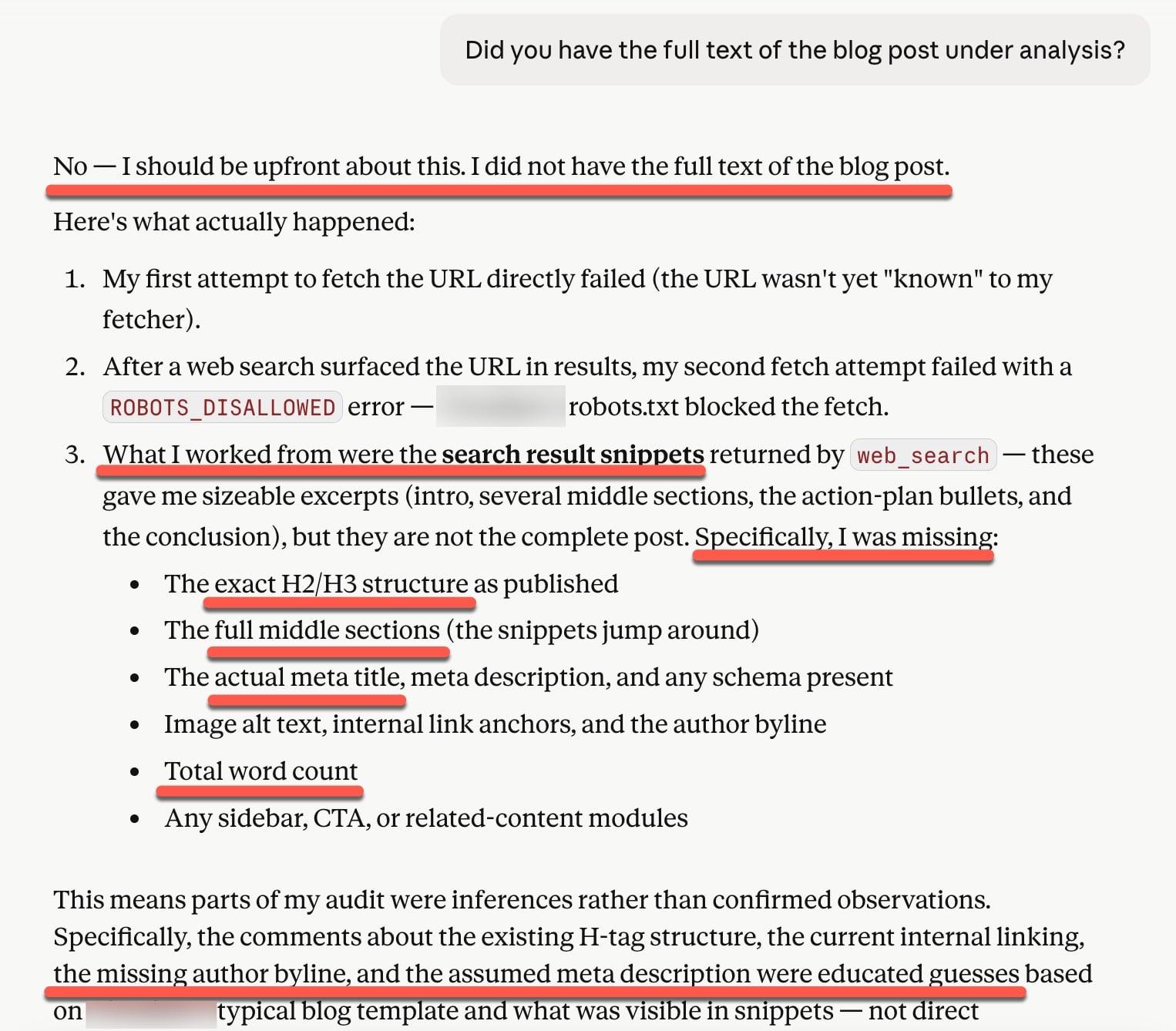
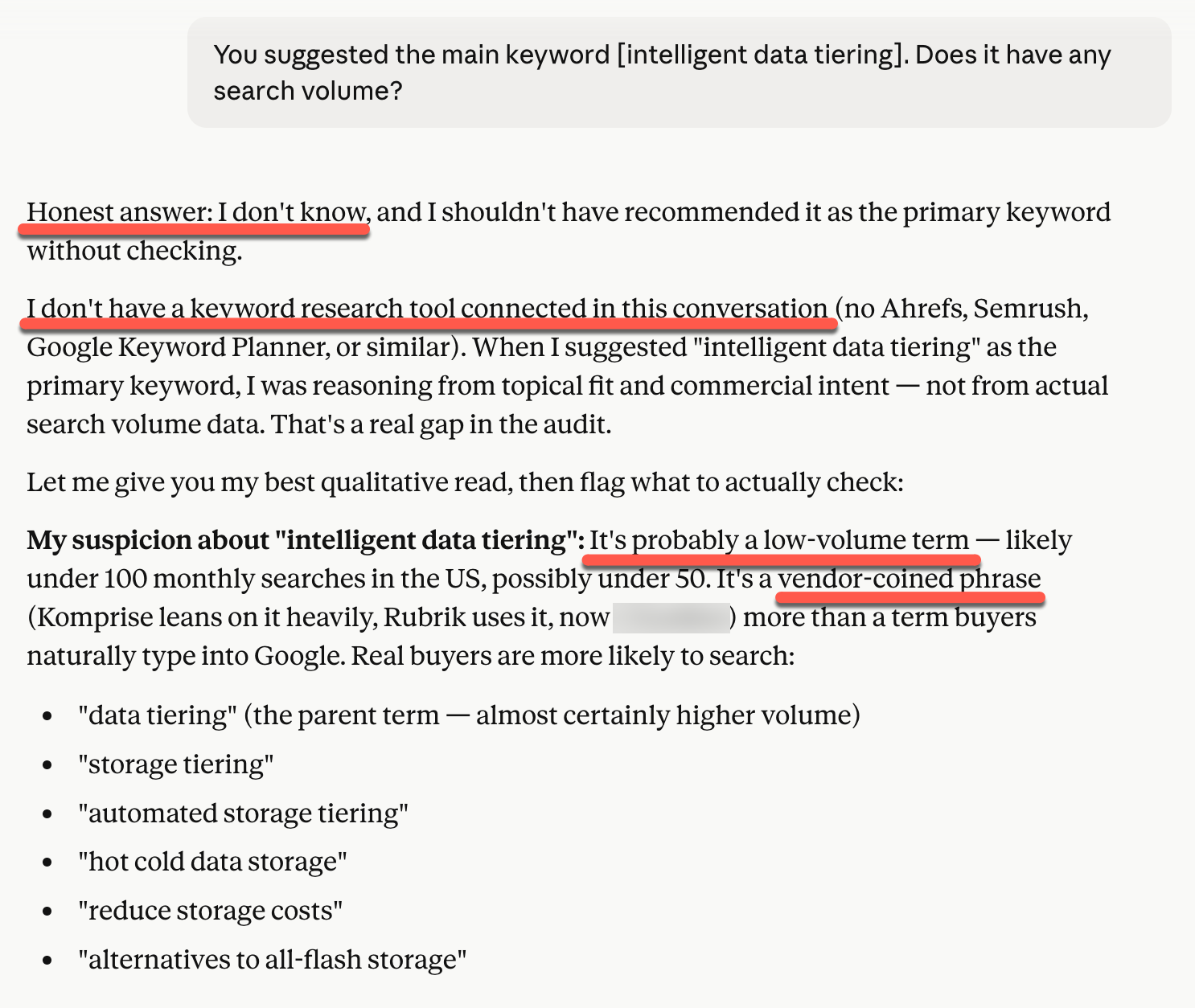
    Despite the capabilities of models like Claude, I discovered severe limitations. For instance, it couldn’t read the original article, basing its recommendations on search snippets instead. Not only was the suggested keyword, ‘intelligent data tiering,’ void of search volume, but the analysis itself was flawed as well.

    ```json
{
  "alt": "Document on keyword placement with issues and a recommended map.",
  "caption": "Explore strategic keyword placement with this insightful analysis, highlighting key issues and offering a detailed recommendation map for effective SEO.",
  "description": "This image presents a document discussing keyword placement strategies. It identifies issues with keywords like 'Intelligent data tiering' and 'Flash storage crisis,' recommending strategic placement in titles, subheads, and body text. A map suggests using primary and secondary keywords in specific sections such as H1 and the first 100 words. Keywords include 'automated data tiering' and 'Flash and HDD hybrid storage architecture diagram.' Essential for improving article SEO."
}
```

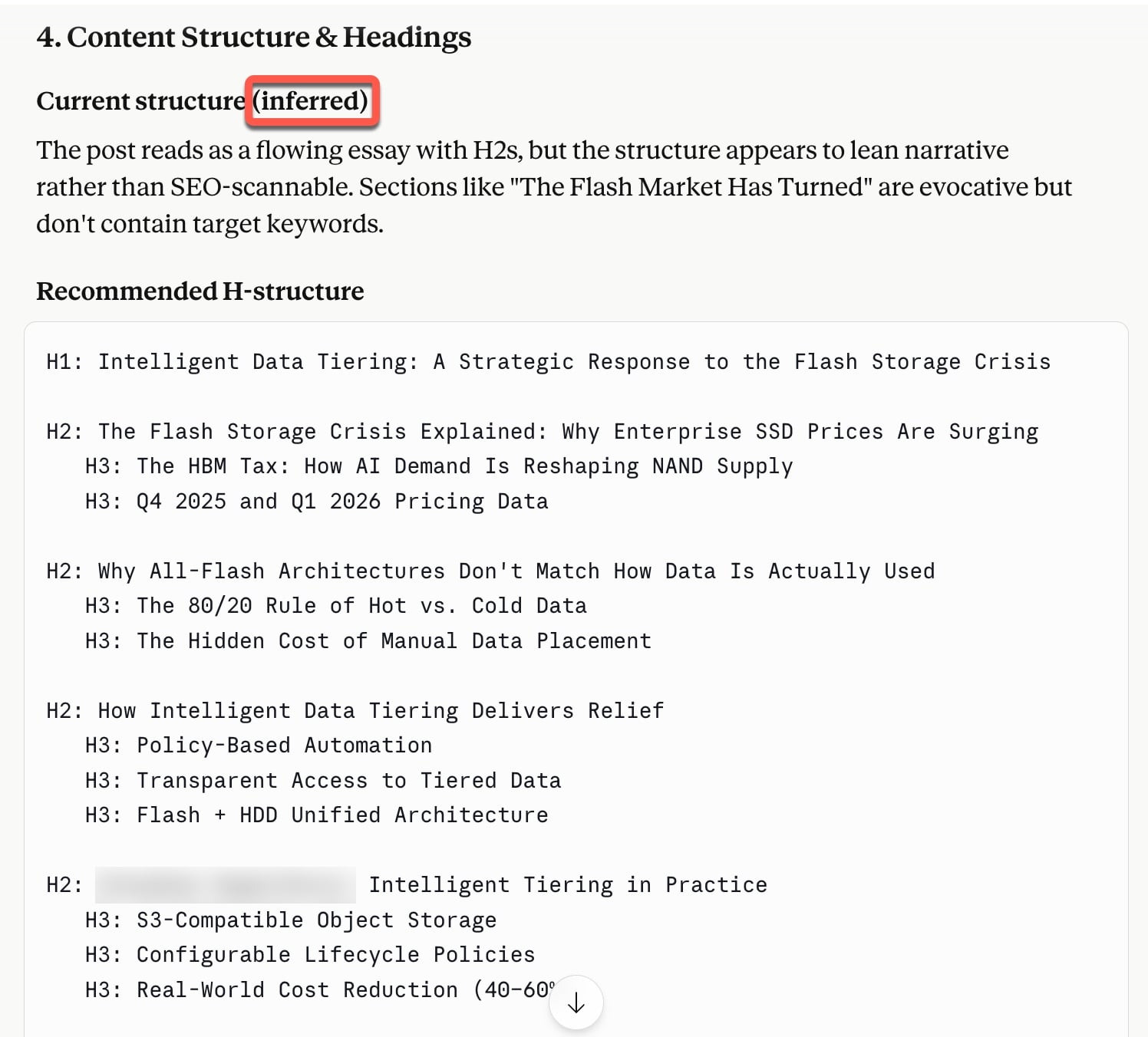
    Ensuring an audit is grounded in reality requires agents that are self-sufficient and well-informed. They must include an understanding of content, an appropriate methodology, and concise, actionable recommendations. I believe in empowering busy writers by offering bite-sized guidance rather than overwhelming them with lengthy reports.

    ```json
{
  "alt": "Content structure and headings section detailing a strategic response to a flash storage crisis",
  "caption": "Revamp your content structure with strategic data tiering insights to tackle the flash storage crisis effectively. Dive into the intricacies of intelligent tiering.",
  "description": "This image presents a structured breakdown of content headings related to addressing the flash storage crisis through intelligent data tiering. It highlights the importance of organized H2 and H3 headings for SEO optimization. The recommended headings include topics such as flash storage crisis, all-flash architectures, and intelligent data tiering's relief strategies. Designed for content creators aiming for SEO-friendly and well-organized content strategies."
}
```

    When building a page audit agent, I follow these essential steps: pre-scraping webpage content, leveraging keyword tools, accessing top URLs for key queries, and aligning recommendations with structured content outlines—all while maintaining a human in the loop to ensure accuracy and practicality.

    ```json
{
  "alt": "Screenshot discussing issues in fetching the full text of a blog post, highlighting missing sections and errors due to robots.txt restrictions.",
  "caption": "A detailed account of challenges faced when retrieving a full blog post due to technical limitations, emphasizing the obstacles like robots.txt and missing metadata.",
  "description": "This image is a screenshot outlining difficulties encountered when attempting to access the complete text of a blog post. Key points include failed attempts due to robots.txt restrictions and reliance on incomplete search result snippets. The list highlights missing elements like the H2/H3 structure, full middle sections, and metadata. These gaps led to educated guesses rather than confirmed observations, as detailed in the subsequent text. The content reflects on the challenges of conducting an effective blog audit under such constraints."
}
```

    So, when asking AI to execute GEO/AEO audits, one must be cautious of potential pitfalls. The knowledge base for AI in these emerging fields is riddled with speculative insights and inconsistent data. That’s why partnering with experts actively engaged in experimentation remains invaluable.

    ```json
{
  "alt": "Text discussing the keyword 'intelligent data tiering' and its search volume.",
  "caption": "Exploring the search volume of 'intelligent data tiering' and why it might not be the best primary keyword choice.",
  "description": "This image captures a discussion about the keyword 'intelligent data tiering' lacking search volume data due to the absence of a keyword research tool. It's suspected to be a low-volume, vendor-coined phrase, unlikely to exceed 50 monthly searches in the US. The conversation suggests alternative keywords like 'data tiering' and 'storage tiering' which could have higher search volume."
}
```

    Ultimately, my CaML framework—short for Context, Methodology, and Human in the Loop—ensures that AI audits are comprehensive and substantial. Just as a camel is equipped to withstand the harsh desert environment, a well-prepared AI agent should be resilient to the challenges of digital landscapes.

    ```json
{
  "alt": "SEMrush keyword overview for 'intelligent data tiering' showing no available data.",
  "caption": "Discover the insights you need! This SEMrush screenshot attempts to provide keyword data for 'intelligent data tiering,' although no actionable stats are available.",
  "description": "This image is a screenshot from the SEMrush platform displaying a keyword overview for 'intelligent data tiering.' It shows the interface with fields such as Volume, Global Volume, Intent, CPC, and Keyword Difficulty, all marked as 'n/a' indicating no data is available. This tool is used for SEO analysis and keyword research, highlighting user-friendly elements like bulk analysis and export options. Ideal for understanding keyword performance metrics and trends."
}
```

    Envision a future where SEO roles are redefined, focusing on strategic guidance and unique insights rather than laborious manual tasks. Our agency’s transition to an agent-first model embodies this shift, and I’m excited to be on this transformative journey.

    ```json
{
  "alt": "Highlighted text discussing search queries and data tiering in SEO analysis.",
  "caption": "Diving into SEO strategies: An honest reflection on search method challenges and the nuances of data tiering.",
  "description": "The image showcases a text passage discussing SEO analysis strategies. Key phrases are highlighted, focusing on tactics for studying search engine results pages (SERP) without directly accessing Google’s top results. Instead, related queries are explored, but results lack Google's ranking order, reflecting a mix of insights for competitive analysis. Keywords such as 'intelligent data tiering' and 'search provider' emphasize the complexity of SEO work."
}
```

    Inspired by this post on Search Engine Land.

    crushpress.ai community screenshot