
AI search is reshaping the marketing landscape faster than anything I’ve seen before.
During my time at Zero Click NY, I witnessed how significantly AI search has evolved over the last six months and identified emerging features that might define its future.
Among all the discussions, these seven trends were the most compelling.
From the emergence of marketing engineers, to the way Claude and ChatGPT differ in results, and Claude’s rapid ascent in the business world over the past year, here are the key insights I gathered.
1. Every AI relies on different content
According to Profound data, only 8% of citations are shared between ChatGPT and Claude. This means 92% of the sources that ChatGPT refers to would not be recognized by Claude for the same inquiry. Essentially, a brand may have high visibility in one AI and not exist in another.
Moreover, each AI favors different types of content.
- ChatGPT frequently indexes community content: Reddit, Quora, and forums make up around 16% of its citations.
- In contrast, Claude cites listicles 36% and opinion content 13.2% of the time, compared to ChatGPT’s ~20% and 7.2%, respectively.
The disparity also applies to traditional search. A significant 64% of websites Claude cites appear in Google’s top 50 for equivalent queries, whereas it’s only 37% with ChatGPT.
Takeaway: It’s vital to inform stakeholders that AI visibility differs between LLMs, and strategic prioritization is necessary to reach your audience.
Track your visibility by engine because effective strategies in one platform may not translate to another. UGC helps drive ChatGPT while listicles boost presence on Claude.
2. Claude is quietly winning B2B — so sequence your optimization by audience
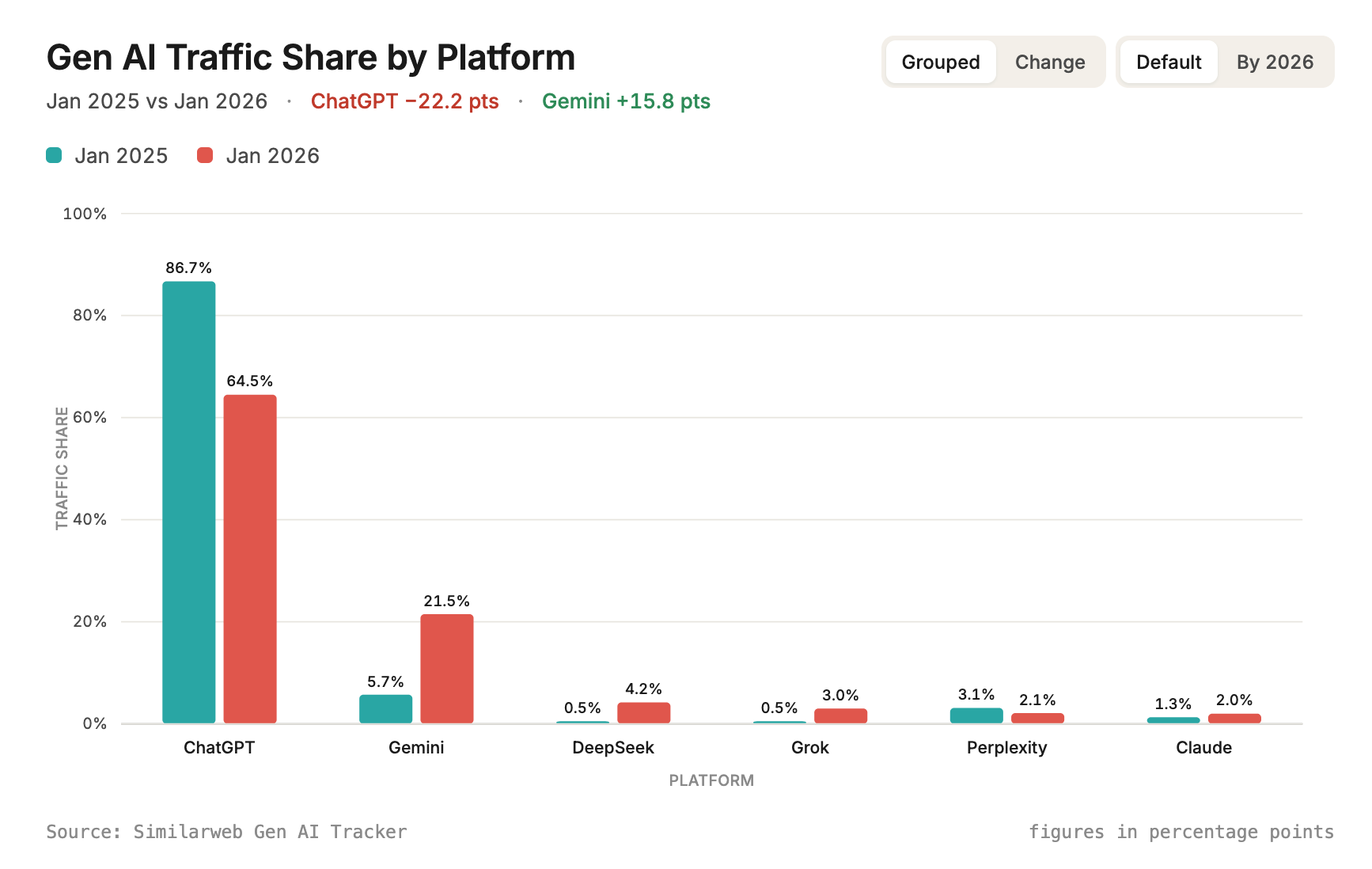
Claude may appear insubstantial in AI traffic-share charts, but it’s a different story when it comes to enterprise usage.

Web traffic doesn’t tell the whole tale. Anthropic derives about 85% of its revenue from enterprise and API usage, not visible in consumer data.

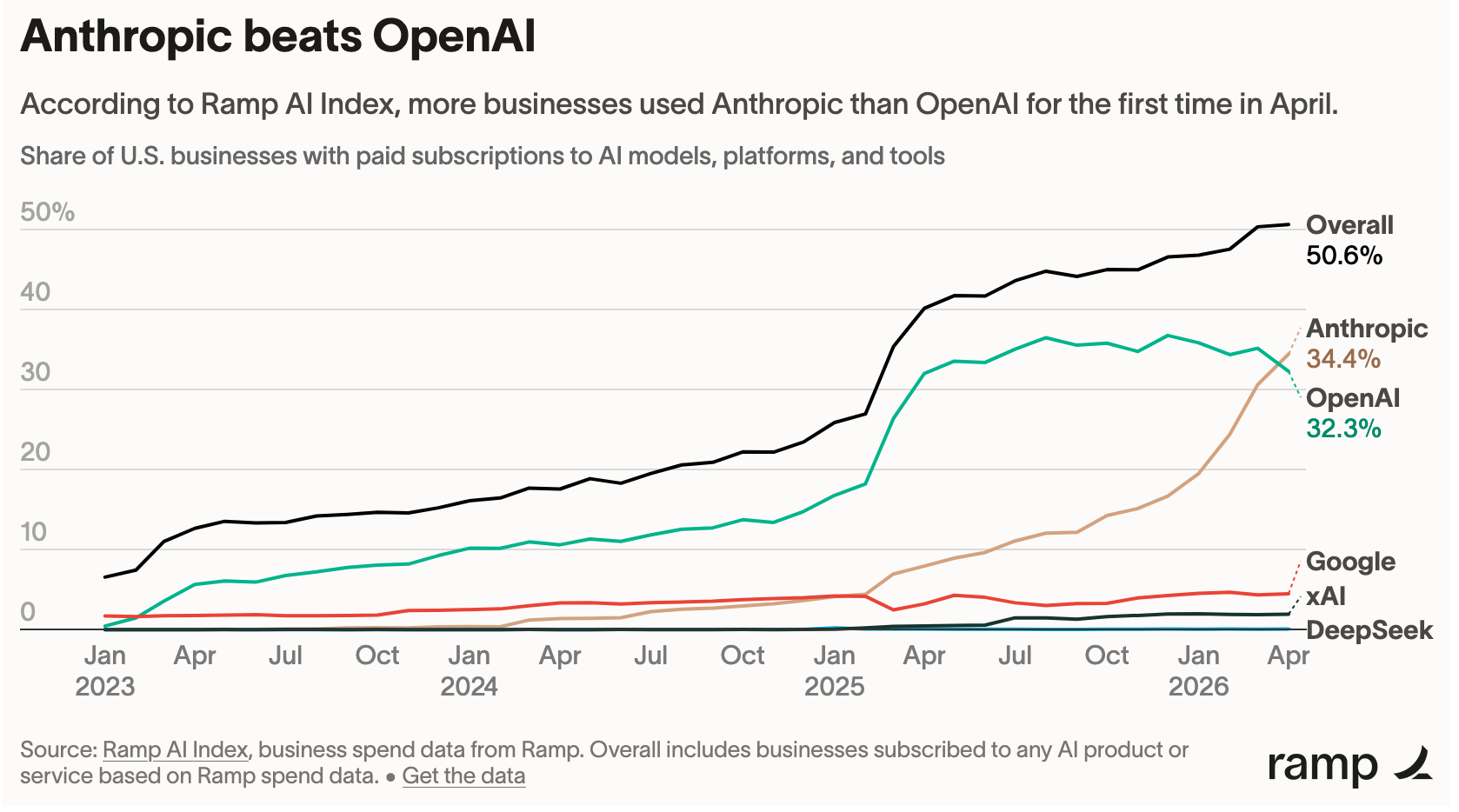
A critical chart from Ramp’s AI Index reveals the true penetration of Anthropic in the business sector. A year ago, only a small number of businesses used Anthropic. Now, it’s at 34.4%, surpassing OpenAI at 32.3%.
This insight led me to reconsider: if more business users are engaging with Claude and consumers are on ChatGPT, shouldn’t our optimization priorities reflect audience preferences?
Should B2B entities focus on Claude first, while B2C aim for ChatGPT visibility?
Currently, few distinguish between ChatGPT, Gemini, or Claude usage. This distinction is bound to grow.
3. ChatGPT ads are here, and this is what we’re seeing
The game has changed: competitors are securing visibility through ChatGPT ads. These ads are now live and available for self-serve directly within the chat interface.
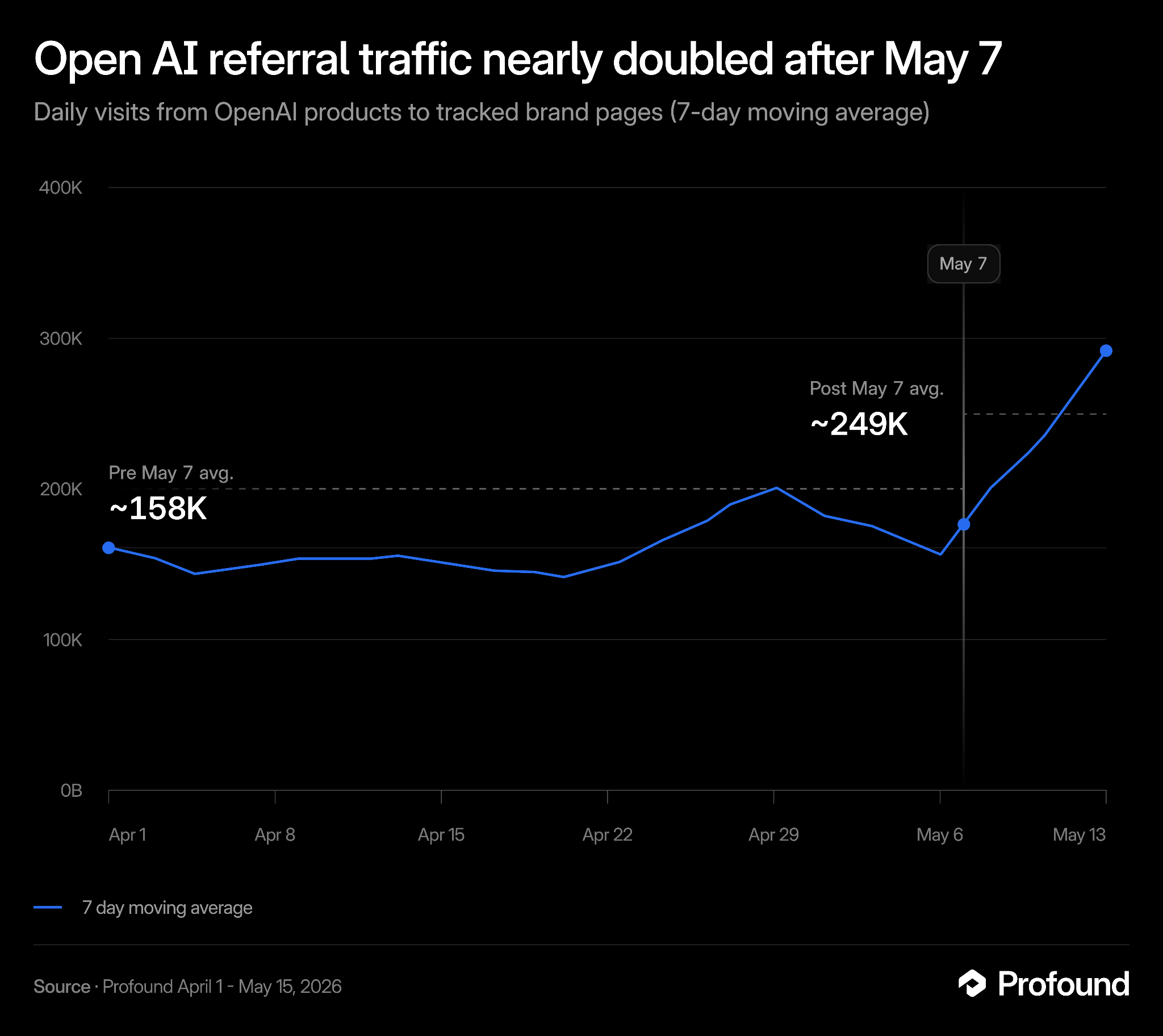
Recent weeks also saw the debut of GPT 5.5, citation chips morphing into clickable links (leading to a 60% spike in referral traffic overnight), and Google integrating AI Mode into its main search functionality.

This wasn’t incidental. The hyperlinks are crucial for an ads business. Analyzing over 100,000 ad placements highlighted three essential revelations.
ChatGPT Ads match on topic
Ads align with topic similarity, not intent. Only 14% of real user prompts express commercial intent, yet 20% show ads, even if the prompt involves a math problem.
Embedding analysis indicates that ad titles and descriptions significantly influence which conversations you appear in, transforming them into tactical targeting tools.
Paying for ads
We have entered a “pay-to-play” era. Approximately one-fifth of ad placements appear when a direct competitor is mentioned, but only 8% of organic references belong to the associated brand.
Competitors are twice as likely to advertise around your brand’s organic mentions than you are.
For instance, Startup CRM Adia is targeting prompts mentioning Salesforce, with Salesforce responding by showing paid ads 40% of the time, defending their position even when organically mentioned.
Ad inventory is scarce and expensive
Currently, ChatGPT presents about one ad per conversation, with the median exchange spanning three turns. Only 30% of eligible users ever see ads, and CPMs/CPCs are about four times Meta’s rates.
Expect future changes: additional ad slots per reply, ads woven deeper into conversations, and engineered suggestions to prolong interactions, ultimately increasing inventory.
The insight: Understanding both organic AEO and paid defense strategies is essential. Monitoring your brand’s organic citations without tracking who advertises against them offers a partial view.
4. Claude is the most directly optimizable AI right now
Claude sources web content directly from Brave searches, not merely influenced by it, as discussed in the presentation I attended.
In recent testing by Profound, 79.2% of Claude’s citations were directly aligned with Brave’s top 10 search results for equivalent queries.
Reshuffling is minimal; no other AI model trusts its search provider so extensively.
This transparency makes Claude the most straightforward AI to optimize for: a visible index, checkable rankings, and, as we’ll explore next, predictable retrieval.
If I’ve convinced you of the importance of Claude for B2B, here’s your approach: identify where you stand on Brave for key prompts and use that as your roadmap for Claude visibility.
This level of transparency won’t last forever. Take advantage now while it’s possible.
Dive deeper: New insights suggest Claude’s visibility significantly depends on Brave Search rankings
5. Claude only performs web searches a third of the time
There’s a significant caveat: ChatGPT initiates web searches for nearly 95% of prompts, but Claude does so only a third of the time, likely due to cost ($5 per thousand searches via Brave’s API).
You can optimize Claude effectively only when it conducts a search.
The encouraging part is its predictable search habits. Prompts framed around recent events (“best X in 2026”) initiate searches about 81% of the time.
Ranking-related prompts lead to 67% search initiation, location-specific prompts 55%, and comparisons 51%.
Prompts concerning definitions and procedures rarely trigger searches, making them poor targets for Claude optimization.
The lesson: Before investing to enhance Claude visibility for a prompt category, determine if Claude actually conducts searches for it.
Focus on recent events, rankings, locations, and comparisons for effective Claude optimization using Brave rankings as a guide.
Other areas rely on internal memory beyond our reach.
6. Query fan-out: A raffle on one platform, near-deterministic on another
Two speakers offered perspectives on query fan-out, presenting a contrast worth exploring.
Query fan-out entails background synthetic queries to collect content prior to providing an AI-generated response.
Mike King of iPullRank viewed it as a raffle: The task is to gain more tickets through a wider content range across owned, earned, and shared channels, and the right content formats make all the difference.
Even if you rank for a fanned-out query, the wrong format renders you ineligible.
According to his research, content-to-query cosine similarity and information gain strongly correlate with success in AI search.
Conversely, Josh Blyskal from Profound notes that Claude’s fan-outs are highly predictable; the same prompt results in consistent fan-out strings 65% of the time. Interestingly, 94% of Claude’s fan-outs are current-year stamped, unlike ChatGPT’s 17%
Where ChatGPT’s fan-outs constantly evolve, Claude’s remain relatively stable. Thus, both perspectives may hold true for different engines.
With stable fan-outs like in Claude, content creation can directly focus on them. The year-stamping trend suggests using the current year in titles.
For volatile fan-outs as in ChatGPT, King’s approach applies: maximize exposure through format variety.
One mechanism demands two strategies, tailored by engine, potentially requiring prioritization between them.
7. The marketing engineer is here, and agents are the new workforce
The role of a “marketing engineer” might sound like a buzzword, but the hiring trends prove otherwise.
Google’s recently hired its first marketing engineer, Figma has an opening at a $295,000 salary, and both RBC and Autodesk have placed hires.
It’s a rapidly growing search term, and Google’s AI marketing lead dubbed it “the hire for 2026.”
What makes someone ideal for this role? Is the priority given to an engineer learning marketing or vice-versa?
The emerging profile emphasizes marketing experiences such as someone with channel expertise who builds and runs AI systems, reports to the marketing head, and supports the team by removing obstacles. They are marketers advancing the state-of-the-art.
The underlying concept is that marketing functions decompose into pipelines: data extraction, transformations, and loading into useful formats. Agents can now automate these pipelines.
- Monitoring competitor pricing and auto-generating sales content.
- Scheduling and assessing AEO presence and landing page efficiency.
- Analyzing sales call objections and drafting relevant content solutions.
What previously were backlogged tasks now become brief agent-building exercises. Creativity replaces headcount as the limiting factor.
If marketing engineering isn’t a role in your team yet, it’s likely only a matter of time before it is.
The job now: Figuring out how this all works
There remains no definitive roadmap for AI search. When a guidebook emerges, the key step will be prioritizing one LLM contingent upon who you wish to reach.
In many instances, that “who” will now be agents, simultaneously assisting us in our endeavors and highlighting the rising need for professionals adept at engineering such systems.
Inspired by this post on Search Engine Land.

Leave a Reply