I’m witnessing a fascinating shift in the search industry, something I hadn’t anticipated witnessing in my career.
The supply of search expertise now outweighs the demand.
We can point fingers at artificial intelligence, the economy, or the increasing commonality of checkbox SEO.
Whatever the cause, the outcome remains unchanged.
SEO job cuts are rising. Openings are dwindling. I’ve never seen the market as competitive in my 15+ years.
The hard truth is many SEO skills that were once invaluable are becoming easier to automate or outsource.
Grab a seat.
I’d love to explore why this is occurring, which skills are now expected, and what SEO talent employers should really be seeking as we move towards 2026.
The notion that AI is directly targeting SEO jobs is widespread, but I disagree.
Instead, AI is reshaping which SEO skills are most valued.
Traditionally, SEO involved collecting data and crafting strategies — technical audits, content briefs, keywords, and more.
These tasks still have importance today.
However, they’re becoming much simpler to execute.
With AI, crafting an audit or optimization suggestion can now take just moments.
This doesn’t devalue the output, but it changes the landscape of value.
For years, companies viewed recommendations as final products. The report was the result.
But recommendations aren’t goals on their own.
They add value only if they lead to prioritized actions and deliver business results.
AI solves the idea generation problem quite proficiently.
However, it falls short in implementation.
That’s why I foresee the first SEO roles AI might impact are those focused on crafting suggestions rather than driving outcomes.
As producing recommendations becomes nearly costless, employers favor those who discern valuable suggestions and execute them.
In essence, AI is streamlining SEO execution tasks.
Yet, it isn’t undermining judgment.
As AI enhances in recommendations, SEO talent shifts towards skills like prioritization, testing, and influence.
These skills have always been crucial.
Now, they’re rapidly becoming key differentiators.
Most companies don’t lack ideas. They struggle with alignment and decision-making.
Ultimately, judgment is essential.
Recently, I disagreed with Gemini on a well-known topic. While the answer was polished, it was incorrect.
As AI grows, recognizing when it’s confidently incorrect is a skill itself.
The future SEO isn’t about generating numerous recommendations, but identifying which are truly impactful.

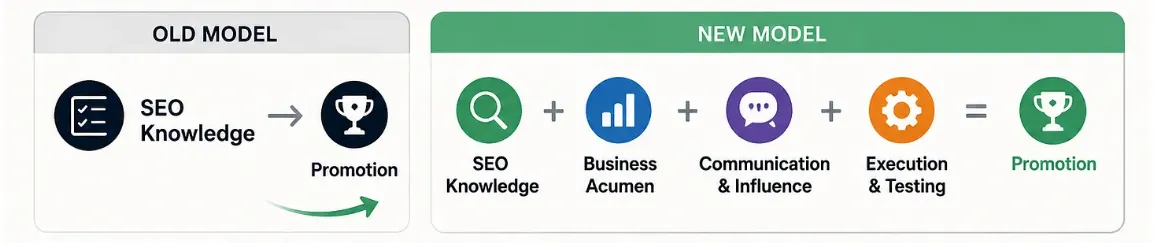
In the past, SEO career growth was straightforward: gain knowledge, get promoted.
Yet now, as AI diminishes pure knowledge value, the layered skills atop expertise matter significantly more.
Today’s most valuable SEOs understand search, AI, and business operations. They align people and resources towards common goals.
Higher organizational roles rely less on identifying problems and more on solving them.
While AI scales execution, people scale vision.
If I were hiring an SEO in 2026, I would focus less on technical details and more on how candidates handle complex situations.
I’d ask for a disagreement experience.
For example, I suspected H1 tags didn’t significantly impact rankings. Initially, people laughed, and opinions varied until further confirmed by experts.
I care more about their resolve than their correctness.
I’d ask about a failed test.
Experienced SEOs know projects often stall. The key is their follow-through post-failure.
I’d inquire about AI mishaps.
I aim to find candidates who turn knowledge into tangible outcomes.
The hard part has always been delivering results, not knowing what to do.
AI won’t substitute SEOs, but those unwilling to adapt may face challenges.
This article initially appeared on my personal site, shared here with permission.
Inspired by this post on Search Engine Land.

Leave a Reply