Boost Your ROAS Like a Pro with Insights from La Maison Simons

```json
{
  "alt": "Channable branding with a chart and upward arrow illustrating a guide to boosting ROAS like La Maison Simons.",
  "caption": "Boost your ROAS effortlessly! Discover a 6-step guide inspired by La Maison Simons to enhance your eCommerce PPC strategies.",
  "description": "This image features Channable branding alongside a colorful bar chart with an upward-pointing arrow, symbolizing growth. The text promotes a 6-step guide on boosting ROAS in eCommerce, inspired by the Canadian fashion leader, La Maison Simons. It serves as a visual aid for a marketing strategy aimed at improving PPC campaigns efficiently."
}
```

Have you ever felt uneasy managing large catalogs in Google Performance Max, almost like you’re handing over your wallet to an algorithm? I sure have.

La Maison Simons faced a similar struggle. With too many products and not enough control, they decided to rebuild their segmentation using Channable Insights. This change turned their perplexing campaign into a revenue powerhouse.

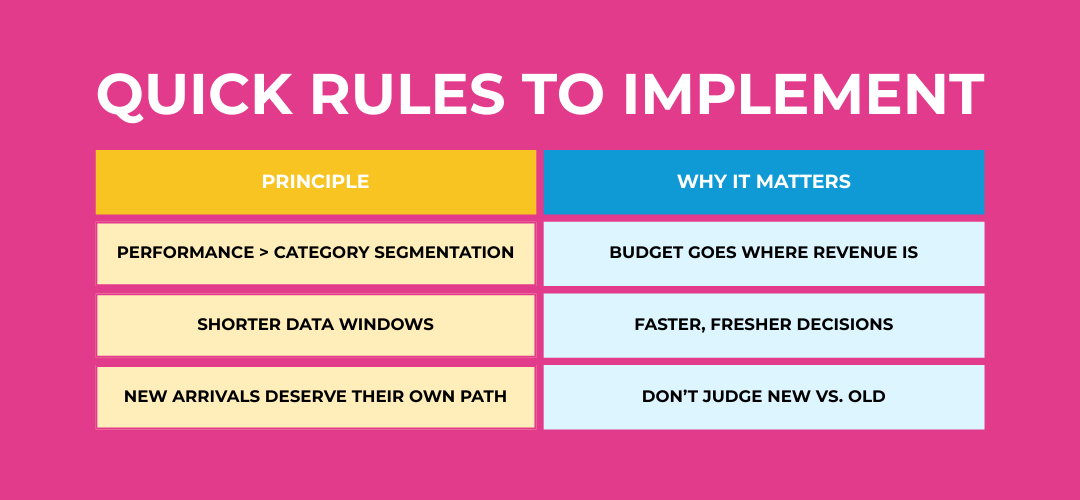
Step 1: Stop segmenting by category

Initially, Simons divided campaigns by product category. It seemed like a good idea until their popular sweater consumed the entire budget, leaving less visible or new products unnoticed.

Static segmentation brought limited visibility and sluggish decision-making. Marketers were trapped with manual tweaks, while Google auto-focused on what’s already succeeding.

Step 2: Segment by performance

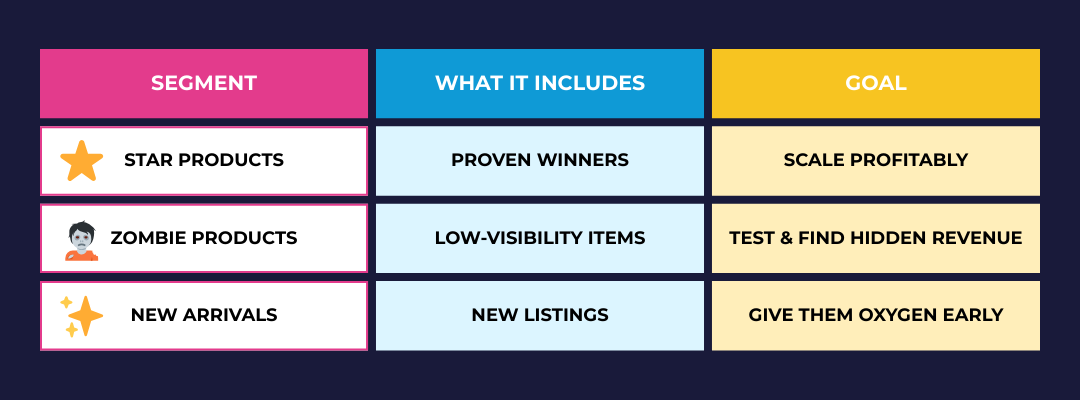
With Channable Insights, product-level data like ROAS and clicks now fuel dynamic grouping:
```json
{
  "alt": "Product segmentation chart showing Star Products, Zombie Products, and New Arrivals with goals.",
  "caption": "Discover the three pillars of product segmentation: Star products to scale profitably, Zombie products to test and find hidden revenue, and New arrivals to nurture early.",
  "description": "This image illustrates a product segmentation chart divided into three categories: Star Products, Zombie Products, and New Arrivals. Each segment has a corresponding goal and includes items like proven winners or new listings. The chart uses bold colors: pink for segments, blue for inclusions, and yellow for goals, optimizing clarity and visibility. Keywords: product segmentation, Star Products, Zombie Products, New Arrivals, business strategy."
}
```

Products automatically transition between segments based on performance. As Etienne Jacques, Digital Campaign Manager at Simons, expressed:

“One super popular item no longer takes all the money.”

Step 3: Shorten your analysis window

Instead of the usual 30-day signals, Simons decided to use a rolling 14-day window. This means quicker reactions, more accurate decisions, and less wasted spend in a fast-paced catalog.

Step 4: Push the strategy across channels

Why limit the strategy to Google? Simons applied the same segmentation across:
```json
{
  "alt": "Image displaying a table with 'Quick Rules to Implement'. Includes principles and their importance.",
  "caption": "Unlock success with quick rules: Prioritize performance over segmentation, embrace shorter data windows, and give new arrivals a unique path.",
  "description": "The image outlines 'Quick Rules to Implement', featuring a table with two columns: 'Principle' and 'Why It Matters'. Principles include prioritizing performance over category segmentation, using shorter data windows, and ensuring new arrivals have unique paths. The reasons include aligning budgets with revenue, making faster decisions, and treating new items without bias. The visual uses a bright pink background with contrasting colors for text, aiding clarity and engagement."
}
```
  • Meta
  • Pinterest
  • TikTok
  • Criteo

This cross-channel consistency amplifies optimization.

Step 5: Watch the metrics climb

Simons unlocked impressive results without increasing ad spend:

  • ROAS growth: from ~800% to ~1500%
  • CPC decrease: $0.37 to $0.30
  • CTR lift: 1.45% to 1.86%
  • 14% increase in average order value
  • 1300% ROAS for New Arrivals campaigns
  • Faster workflows and fewer manual tweaks

Even previously invisible products turned into unexpected profit drivers with a spot in the limelight.

Step 6: Treat automation as control, not chaos

Automation has restored marketing control rather than taking it away. Now, teams can learn from data and actively influence product growth instead of leaving everything to PMax autopilot.

Your action plan

  • Classify products as Stars, Zombies, and New Arrivals.
  • Automate campaign reassignment based on real-time data.
  • Refresh product insights every 14 days.
  • Roll out segmentation logic to every paid channel.
  • Scale what wins – test what’s yet to succeed.

Aiming for Simons-style ROAS gains without raising ad spend? Start with a free feed and segmentation audit to enhance your product data quality.


Inspired by this post on Search Engine Land.


crushpress.ai community screenshot

FAQs

What ROAS strategy did La Maison Simons use in this guide?

The guide says La Maison Simons rebuilt its campaign structure around product performance instead of static product categories. Using Channable Insights, products could move between segments based on data such as ROAS and clicks.

Why stop segmenting ecommerce PPC campaigns by product category?

The post explains that category-based segmentation can let one popular item consume too much budget while newer or less visible products are overlooked. Static segmentation also slows decision-making and keeps marketers tied to manual tweaks.

How should products be grouped for better ROAS?

The article recommends classifying products as Stars, Zombies, and New Arrivals. These groups should update dynamically based on performance data so budget can follow revenue signals and uncover hidden opportunities.

Why did Simons use a 14-day analysis window?

Simons used a rolling 14-day window instead of relying on the usual 30-day signals. The shorter window helped the team react faster, make more accurate decisions, and reduce wasted spend in a fast-moving catalog.

Which paid channels can use this segmentation strategy?

The post says Simons extended the same segmentation logic beyond Google to Meta, Pinterest, TikTok, and Criteo. Applying the approach across channels creates more consistent optimization.

What performance improvements are mentioned in the article?

The article reports ROAS growth from about 800% to about 1500%, CPC decreasing from $0.37 to $0.30, CTR rising from 1.45% to 1.86%, and a 14% increase in average order value. It also mentions 1300% ROAS for New Arrivals campaigns and fewer manual tweaks.

What action plan does the post recommend for marketers?

The action plan is to classify products as Stars, Zombies, and New Arrivals, automate reassignment using real-time data, refresh insights every 14 days, and roll out segmentation logic to paid channels. It also recommends scaling winning products while continuing to test products that have not yet succeeded.

Comments

Leave a Reply

Your email address will not be published. Required fields are marked *